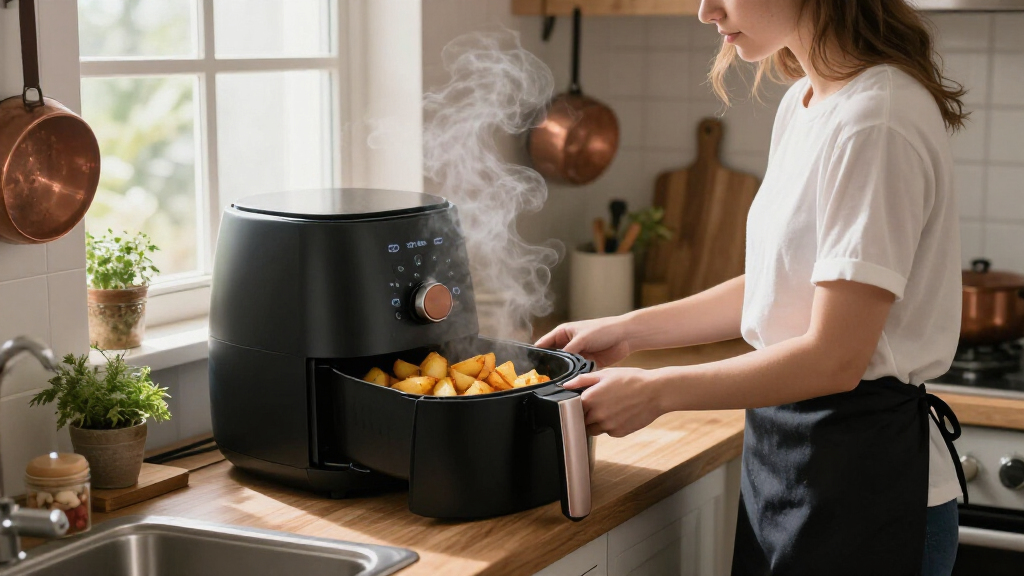

TL;DR

Get kitchen gear delivered free with Prime
- Fast, free delivery on millions of items
- Prime Video, Amazon Music and more included
- Member-only deals all year
A 2- to 4-quart air fryer fits most small kitchens and serves 1–2 people, with a footprint of roughly 10 x 10 inches — about the size of a coffee maker. Drawer-style compact models beat bulkier oven-style units for tight counters, and models under 1,400 watts work on standard apartment circuits without tripping breakers.
Your kitchen counter is maybe three feet of usable space, and an air fryer wants a permanent seat at the table. The good news: the right compact model takes up about as much room as a coffee maker and replaces your oven for 80% of weeknight cooking.
The bad news: buy the wrong one and you’ll either burn your knuckles reaching past it or cook exactly one chicken wing at a time. Size, wattage, and shape matter more in a small kitchen than anywhere else.
In the next few minutes you’ll learn exactly how many quarts you need, which shapes fit tight counters, and how to pick a model that won’t trip your apartment’s breaker at 6 p.m. on a Tuesday.
A 2–4 quart drawer-style air fryer fits 1–2 people in roughly 10 x 10 inches of counter space — the footprint of a coffee maker.
Square baskets hold 20–25% more food than round ones at the same quart rating; always choose square for a small kitchen.
Stay at or under 1,400 watts on standard apartment circuits, plug directly into the wall, and never run the air fryer alongside a kettle on the same circuit.
Leave at least 5 inches of clearance above the vent — trapping steam against a cabinet is the most common way compact air fryers fail early.
Let the air fryer replace an appliance (toaster oven, deep fryer) rather than adding to the pile — that’s how small kitchens stay functional.
What Size Air Fryer Actually Fits a Small Kitchen? (Simple Math)
A 2- to 4-quart air fryer is the sweet spot for small kitchens serving one or two people, with a footprint of roughly 10 x 10 inches — smaller than a standard sheet of parchment paper laid diagonally. That’s big enough for two chicken breasts, a handful of fries, or four salmon fillets, and small enough to slide under a cabinet with 4 inches of clearance to spare.
Here’s the math most people skip. A “quart” in air fryer marketing is basket capacity, not food capacity — you can realistically fill a basket halfway and still get crispy results, because hot air needs room to circulate. So a 3-quart basket cooks about 1.5 quarts of actual food: two servings of most things, one serving if you’re a hearty eater.
My rule of thumb after testing in a 6-foot galley kitchen: measure your counter depth first. Standard counters are 24 inches deep, but if your upper cabinets hang low, you may only have 12–14 usable inches before clearance becomes a fire risk.
Air fryers need at least 5 inches of open space above the vent or you’re recycling hot steam back into the electronics — the #1 way compact models die young.
For a family of three or four in a small kitchen, jump to a 5- or 6-quart model instead. The footprint only grows about 2 inches in each direction, but the cooking capacity nearly doubles. That trade is usually worth it.
Products Worth Considering

Ninja Foodi Air Fryer 8 Qt DualZone 6-in-1 Grey DZ201

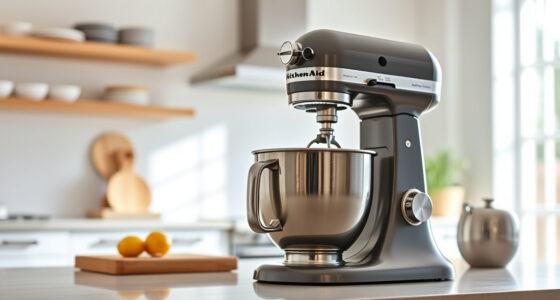
KitchenAid Artisan Mini 3.5-Qt Tilt-Head Stand Mixer, Candy Apple Red

Cuisinart TOA-70NAS Air Fryer Toaster Oven, 1800W, 8-in-1, Stainless Steel
As an affiliate, we earn on qualifying purchases.
Drawer vs. Oven Style: Which Shape Wins on a Tiny Counter?
Drawer-style (basket) air fryers win in small kitchens almost every time, because they pull straight out toward you instead of swinging a door into your limited counter depth. A basket model needs its own footprint plus about 10 inches of pull-out space in front; an oven-style door needs 12+ inches of clearance and blocks access while it’s open.
The exception: if your kitchen has a dead corner or a shelf, a compact oven-style air fryer (like a 4-quart toaster-oven hybrid) can do double duty as your actual toaster, replacing two appliances with one. In a studio apartment where every outlet counts, consolidation beats elegance.
| Feature | Drawer (Basket) | Compact Oven Style |
|---|---|---|
| Typical footprint | 10–12 in. deep | 13–16 in. deep |
| Door clearance needed | ~10 in. in front (only while loading) | 12+ in. always |
| Best for | 1–2 people, fast meals | Replacing a toaster oven |
| Crispiest results | Yes — concentrated air flow | Good, but slightly less crisp |
| Storage under cabinet | Usually yes | Rarely |
Real-world example: in a 500-square-foot studio I used for a year, a 3.5-quart drawer model lived under the cabinet and got used nightly. The oven-style unit I tried first got banished to a closet after two weeks of door-vs-coffee-maker collisions.
Don’t Trip the Breaker: Wattage Rules for Apartments
Compact air fryers in the 2–4 quart range typically draw 1,000–1,400 watts, which runs safely on a standard 15-amp apartment circuit — as long as it doesn’t share that circuit with another heavy hitter. According to electrical safety guidance from outlets like Underwriters Laboratories, high-wattage appliances should always plug directly into a wall outlet, never into a power strip or extension cord.
Here’s the scenario that ruins dinner: your air fryer and electric kettle both plugged into the same kitchen outlet. Kettle pulls ~1,500 watts, air fryer pulls 1,200 — together that’s 2,700 watts on a circuit rated for about 1,800 continuous. Pop. Breaker trips, dinner stops, and your upstairs neighbor’s lights go out too.
- Stay under 1,400 watts if your kitchen wiring is old (pre-1990 buildings especially)
- Never use extension cords or power strips — fire risk, and most manufacturers void the warranty
- Run one high-wattage appliance at a time on the same circuit
- Check the plug and outlet warmth after your first few cooks — a warm plug means call an electrician
If you’re in an older building and your breaker panel is confusing or unlabeled, a licensed electrician can map your circuits in under an hour — cheaper than a fire, and cheaper than replacing a fried air fryer.
Ironically, lower wattage in a small basket is barely a compromise. A 1,000-watt 2-quart model preheats in about 2 minutes because there’s simply less air to heat. Small can be fast.
5 Features That Earn Their Counter Space (and 3 That Don’t)
The five features that matter in a compact air fryer are dishwasher-safe baskets, a visible timer, square vs. round baskets, presets, and auto-shutoff — everything else is marketing. In a small kitchen, each feature either saves you daily friction or isn’t worth the footprint.
- Square basket — fits 20–25% more food than a round one at the same stated quart size
- Dishwasher-safe nonstick basket — tiny kitchens rarely have room to hand-wash and dry a bulky basket
- Auto-shutoff — non-negotiable when the appliance sits inches from cabinets
- Physical dial controls or a simple display — touchscreen models with tiny icons get frustrating daily; dials work with wet hands
- Matte or dark exterior — glossy white models show grease splatter within a week in a compact space
What to skip: app connectivity (you’re standing three feet away), dehydrate functions on 2-quart models (the capacity is useless for it), and “max crisp” turbo modes that just run the fan harder and shorten the motor’s life.
Concrete example: a square 3.7-quart basket fits a full bag of frozen fries in one batch. The same-size round basket? You’re doing two batches, and the second batch is soggy by the time you eat. Shape quietly determines your Tuesday nights.
How to Free Up Counter Space Once It Arrives
You free up air fryer counter space by choosing a permanent home with ventilation, using vertical storage, and treating the appliance as your oven replacement rather than an addition. The goal isn’t fitting the air fryer next to everything else — it’s letting it replace things.
- Pick a home with 5+ inches of overhead clearance — never directly under a cabinet while running, and never against a wall on all sides
- Retire or store one appliance — if the air fryer arrives, the toaster oven or deep fryer usually leaves
- Keep a cutting board as a “landing pad” — slide it over the sink when loading hot baskets; costs zero counter inches
- Store the basket inside the unit — seems obvious, but many people separate them and double the storage footprint
- Unplug between uses — safety habit, and it frees the outlet for your kettle or blender rotation
In an RV or boat kitchen, the pull-out drawer style shines again: you can operate it on a pull-out shelf in a cabinet cavity, sliding it out only while cooking. Just confirm the inverter or shore power can handle the wattage — many RV circuits cap at 1,500 watts total.
Frequently Asked Questions
What is the smallest air fryer that’s still useful?
The smallest genuinely useful air fryers are around 1.6 to 2 quarts. They fit a single chicken breast, two servings of fries, or a few falafel — fine for one person in a dorm or office. Below that size, air circulation gets poor and results turn out uneven. For most solo cooks, a 2–3 quart model is the better minimum.
Can an air fryer sit under a kitchen cabinet?
Stored there, yes. Running there, no. Air fryers exhaust hot steam through a back or top vent, and trapping that heat under a cabinet risks damaging both the cabinet and the appliance over time. Keep at least 5 inches of clearance above and behind the unit while it’s cooking, and pull it forward on a cutting board if needed.
Do small air fryers use a lot of electricity?
A 1,200-watt compact air fryer running for 15 minutes uses about 0.3 kWh — roughly 5 cents at average U.S. rates. That’s a fraction of what preheating a full-size oven costs, which is exactly why air fryers are popular in small apartments: less heat dumped into a small space, lower energy bills, and faster cooking.
Are cheap compact air fryers safe?
Reputable budget models (from brands with UL or ETL certification) are safe when used correctly. The real safety factors are how you use it: direct wall outlet only, no extension cords, one high-wattage appliance per circuit, and a clear ventilation zone. If a plug or outlet ever feels warm during use, stop using it and have a licensed electrician check the circuit.
Can I use an air fryer in an RV or dorm room?
Yes, with two checks. First, verify the power source: an RV inverter or campground pedestal must handle the wattage, and dorm rooms often have limits on appliances over 1,000 watts — check your housing rules. Second, confirm the circuit isn’t shared with a microwave or hair dryer. A sub-1,200-watt compact model is the usual sweet spot for both settings.
Conclusion
Buy the air fryer sized to how you actually cook, not the one with the biggest number on the box. A square 3–4 quart drawer model under 1,400 watts is the right answer for the vast majority of small kitchens, and letting it replace your toaster oven makes it a net zero on counter space.
Measure your counter tonight, check which circuit your kitchen outlet is on, and then shop with confidence. The best small-kitchen appliance isn’t the smallest one — it’s the one you stop noticing because it simply fits.