

For most campers who need fuel-powered backup, I’d start with the WEN 2350-Watt Portable Inverter Generator: its modest output suits basic campsite needs without stepping up to a larger, louder class of machine. The Jackery Explorer 1000 v2 is a standout for campers who want quiet, exhaust-free power, while the WEN DF360iX offers a dual-fuel option for longer stays and fuel flexibility. The main choice is between a nearly silent battery station with limited stored energy and a gas generator that can run longer but produces noise and exhaust. Output, runtime, weight, and campsite rules all affect which tradeoff makes sense. Read on for how the full lineup compares and which option fits your kind of trip.

Get kitchen gear delivered free with Prime
- Fast, free delivery on millions of items
- Prime Video, Amazon Music and more included
- Member-only deals all year
Complete the kit


Key Takeaways
- Battery power stations are the quietest choices: the Jackery Explorer 1000 v2, 2000 v2, and 300 suit noise-sensitive campsites, but their stored energy runs down until recharged.
- Small inverter generators fit basic camping loads better than oversized units: the WEN 2350i and AIVOLT 1600W are more aligned with lights, device charging, and modest appliances than the 4000-watt class.
- More output usually means more generator to carry and manage: 4000-watt and larger models make more sense for RV appliances or several simultaneous loads than for minimalist tent camping.
- Dual-fuel capability is a flexibility feature, not a shortcut to silence: the WEN DF360iX can run on two fuel types, but it still has an engine and campsite noise to manage.
- RV-ready and app features solve specific problems: RV-ready outlets help with compatible hookups, while app monitoring can simplify oversight, but neither replaces checking sound, weight, runtime, and load needs.
| Oxseryn 2800-Watt Portable Inverter Generator |  | Best for Quiet, Lightweight Gas Power | Peak output: 2,800 watts | Running output: 2,000 watts | Engine: 79.8 cc four-stroke OHV | VIEW ON AMAZON | See Our Full Breakdown |
| ERAYAK 4500W Portable Inverter Generator |  | Best for Higher-Power Camping | Starting output: 4,500 watts | Running output: 3,500 watts | Engine: 208 cc four-stroke | VIEW ON AMAZON | See Our Full Breakdown |
| Jackery Explorer 1000 v2 Portable Power Station |  | Best Quiet Pick for No-Exhaust Camping | Battery capacity: 1,070Wh | Battery type: LFP | AC output: 1,500W | VIEW ON AMAZON | See Our Full Breakdown |
| Pulsar PGD40ISCO 4000W Portable Gas Inverter Generator |  | Best for RV Loads in a Compact Gas Unit | Peak output: 4,000 watts | Running output: 3,200 watts | Engine: 145 cc four-stroke | VIEW ON AMAZON | See Our Full Breakdown |
| WEN 3600-Watt Portable Inverter Generator (56360i) |  | Best for RV Outlet Convenience | Surge output: 3,600 watts | Engine: 149 cc | Fuel tank: 1.6 gallons | VIEW ON AMAZON | See Our Full Breakdown |
| PowerSmart 4000W Portable Inverter Generator |  | Best for Quiet, Higher-Wattage Campsites | Starting wattage: 4,000 watts | Running wattage: 3,200 watts | Noise level: 59 dBA at 23 feet | VIEW ON AMAZON | See Our Full Breakdown |
| AIVOLT 1600W Portable Inverter Generator |  | Best Lightweight Gas Pick | Starting wattage: 1,600 watts | Running wattage: 1,260 watts | Noise level: 57 dBA at 23 feet | VIEW ON AMAZON | See Our Full Breakdown |
| WEN 4800-Watt RV-Ready Portable Inverter Generator with Fuel Shutoff (56477i) |  | Best for RV Camping | Surge wattage: 4,800 watts | Noise level: 62 dB at quarter load | Engine displacement: 224 cc | VIEW ON AMAZON | See Our Full Breakdown |
| WEN 2350-Watt Portable Inverter Generator (56235i) |  | Quietest Listed Gas Generator | Surge wattage: 2,350 watts | Noise level: 51 dB at quarter load | Engine: 79 cc, 4-stroke OHV | VIEW ON AMAZON | See Our Full Breakdown |
| Jackery Explorer 2000 v2 Portable Power Station, 2042Wh, 2200W |  | Best Silent Campsite Option | Battery capacity: 2,042 Wh | Output wattage: 2,200 watts | Battery type: LiFePO4 | VIEW ON AMAZON | See Our Full Breakdown |
| Jackery Explorer 300 Portable Power Station (292Wh) |  | Best for Quiet, Short Camping Trips | Capacity: 292Wh | Maximum output: 300 watts | Weight: 7.1 pounds | VIEW ON AMAZON | See Our Full Breakdown |
| POXURIO 2450-Watt Portable Inverter Generator |  | Best for Longer Runtime on a Compact Fuel Generator | Listed wattage: 2450 watts; maximum engine power listed as 3000 watts | Fuel: Gasoline | Noise level: 59 dB | VIEW ON AMAZON | See Our Full Breakdown |
| maXpeedingrods MXR4000 4000-Watt Inverter Generator with App Monitoring |  | Best for App-Based Generator Monitoring | Peak output: 4000 watts | Running output: 3200 watts | Fuel: Gas | VIEW ON AMAZON | See Our Full Breakdown |
| Oxseryn Power Equipment 4400 Watts Inverter Generator Gas Powered, Portable Open Frame Generator, Low Noise with ECO Mode, RV Ready, Emergency Home Backup |  | Best for High Output and Long Light-Load Runs | Starting wattage: 4400 watts | Running wattage: 3400 watts | Fuel: Gasoline | VIEW ON AMAZON | See Our Full Breakdown |
| WEN DF360iX Dual-Fuel Portable Inverter Generator |  | Best for Quieter Dual-Fuel RV Camping | Gasoline output: 3600 surge watts; 2900 rated watts | Propane output: 3500 surge watts; 2600 rated watts | Fuel types: Gasoline and propane | VIEW ON AMAZON | See Our Full Breakdown |
| quiet generator for camping | Weight | Noise level | Engine | Runtime |
|---|---|---|---|---|
| Oxseryn 2800-Watt Portable Inv | 40 lbs | Under 58 dBA at 23 feet | 79.8 cc four-stroke OHV | Up to 9 hours at 25% load |
| ERAYAK 4500W Portable Inverter | 55.12 lbs | 60.5 dB(A) | 208 cc four-stroke | Up to 16 hours |
| Jackery Explorer 1000 v2 Porta | 23.8 lbs | — | — | — |
| Pulsar PGD40ISCO 4000W Portabl | 47.3 lbs | 59 dB | 145 cc four-stroke | Up to 4 hours at half load |
| WEN 3600-Watt Portable Inverte | 46 lbs | 65 dB at quarter load | 149 cc | Up to 5 hours at half load |
| PowerSmart 4000W Portable Inve | 50.7 pounds | 59 dBA at 23 feet | 149 cc, 4-stroke | — |
| AIVOLT 1600W Portable Inverter | 28 pounds | 57 dBA at 23 feet | 60 cc, 4-stroke OHV | Up to 8 hours at 25% load; approximately 2 hours at full load |
| WEN 4800-Watt RV-Ready Portabl | 72.7 pounds | 62 dB at quarter load | — | Up to 7 hours at half load |
| WEN 2350-Watt Portable Inverte | 39 pounds | 51 dB at quarter load | 79 cc, 4-stroke OHV | Over 5.7 hours at half load |
| Jackery Explorer 2000 v2 Porta | 39.5 pounds | — | — | — |
| Jackery Explorer 300 Portable | 7.1 pounds | — | — | — |
| POXURIO 2450-Watt Portable Inv | 43 pounds | 59 dB | 4-stroke | — |
| maXpeedingrods MXR4000 4000-Wa | 48.5 pounds | — | — | — |
| Oxseryn Power Equipment 4400 W | 56 pounds | — | — | Up to 14 hours at 25% load |
| WEN DF360iX Dual-Fuel Portable | 49 pounds | 65 dB at quarter load | 149 cc, 4-stroke | — |
More Details on Our Top Picks
Oxseryn 2800-Watt Portable Inverter Generator
The Oxseryn is a strong fit for campers who want a gasoline generator that is easier to carry and quieter on paper than the higher-output choices here. Its 40-pound weight and reported noise below 58 dBA at 23 feet make it more campsite-friendly than the heavier ERAYAK 4500W, while 2,000 running watts can cover common small-appliance and device needs. ECO mode and up to nine hours of runtime at 25% load reduce interruptions during lighter use. The tradeoff is limited headroom: the Pulsar PGD40ISCO offers 3,200 running watts for larger loads, though its stated half-load runtime is only four hours. The Oxseryn also needs altitude-related adjustment above 4,000 feet, and its kit is not included.
Pros:- 40-pound weight and built-in handle make transport more manageable
- Reported noise below 58 dBA at 23 feet suits quieter campsite use
- Up to nine hours at 25% load supports extended low-demand use
- USB, Type-C, AC, and DC ports cover a range of charging needs
Cons:- 2,000 running watts provide less load capacity than the ERAYAK 4500W and Pulsar PGD40ISCO
- High-altitude kit is not included and adjustment is recommended above 4,000 feet
- Nine-hour runtime applies at only 25% load
Best for: Campers who prioritize a lighter gas generator for lights, charging, and modest appliances, especially at lower elevations
Not ideal for: Campers running an RV air conditioner or several high-draw appliances, or those camping regularly above 4,000 feet who want an included high-altitude kit
- Peak output:2,800 watts
- Running output:2,000 watts
- Engine:79.8 cc four-stroke OHV
- Fuel tank:1.1 gallons
- Runtime:Up to 9 hours at 25% load
- Noise level:Under 58 dBA at 23 feet
- Weight:40 lbs
- Power quality:Less than 3% THD
Our verdict“Choose the Oxseryn if portability and a low reported noise level matter more than the extra running watts offered by the ERAYAK or Pulsar.”
ERAYAK 4500W Portable Inverter Generator
For campers who need more than basic device charging, the ERAYAK pairs 3,500 running watts with up to 16 hours of runtime, making it the most capable gas option in this set for sustained, mixed loads. Its 60.5 dB(A) rating is quieter than the WEN 56360i’s stated 65 dB at quarter load, but it is not the quietest pick: the Oxseryn reports under 58 dBA at 23 feet and weighs less. The ERAYAK’s 0.2%–1.2% THD also makes clean inverter power a useful match for sensitive electronics. Its 55.12-pound weight and larger output are a tradeoff for car campers with limited lifting capacity, and the 16-hour figure depends on load. Oil must be added before first use; parallel and mobility accessories are separate.
Pros:- 3,500 running watts provide more capacity than the Oxseryn and WEN 56360i
- Up to 16 hours of runtime can reduce refueling during lighter-load use
- Low stated THD supports sensitive electronics
- Includes RV, USB-A, and USB-C outlets
Cons:- At 55.12 pounds, it is heavier than the Oxseryn, Pulsar, and WEN 56360i
- Its 60.5 dB(A) rating is higher than the Oxseryn’s reported level
- Requires engine oil before first use; parallel kit and mobility accessories are sold separately
Best for: Car campers and RV users who need to power several devices or higher-demand equipment and can manage a 55-pound generator
Not ideal for: Minimalist campers who prioritize the lightest carry or lowest reported noise over higher output, or buyers expecting included parallel and mobility accessories
- Starting output:4,500 watts
- Running output:3,500 watts
- Engine:208 cc four-stroke
- Fuel tank:2.25 gallons
- Runtime:Up to 16 hours
- Noise level:60.5 dB(A)
- Weight:55.12 lbs
- THD:0.2%–1.2%
Our verdict“Pick the ERAYAK when camping loads call for more running power and runtime than the lighter Oxseryn or WEN can provide.”
Jackery Explorer 1000 v2 Portable Power Station
The Jackery Explorer 1000 v2 is the clearest choice here when quiet means avoiding engine noise altogether. Unlike the gasoline-powered Oxseryn 2800, it has no fuel engine or exhaust during use, which suits campsites where generator sound would be disruptive. Its 1,070Wh LFP battery and 1,500W AC output can run or charge a range of camping gear, but the finite stored energy sets a different limit than a gas generator: extended high-draw use requires recharging. At 23.8 pounds, it is easier to carry than every gas model in this batch. Fast one-hour charging requires emergency charging to be enabled in the app, and solar panels are not included; solar charging is limited to Jackery panels. Choose it for silence and portability, not continuous high-output power.
Pros:- Battery operation avoids generator engine noise and exhaust at camp
- 23.8-pound weight is substantially lighter than the gasoline models listed
- 1,070Wh capacity and 1,500W AC output support a useful range of gear
- LFP battery is rated to retain over 70% capacity after 4,000 charge cycles
Cons:- Stored battery capacity is finite, unlike refueling a gas generator
- One-hour charging requires emergency mode in the app
- Solar panel is not included and solar compatibility is limited to Jackery panels
Best for: Campers who want silent, fume-free power for phones, laptops, lights, and moderate appliances, with access to charging between outings
Not ideal for: Campers who need continuous high-wattage power for long periods or want to recharge with any brand of solar panel
- Battery capacity:1,070Wh
- Battery type:LFP
- AC output:1,500W
- Surge peak:3,000W
- Weight:23.8 lbs
- Ports:3 AC, 2 USB-C, 1 USB-A, 1 DC car port
- Charging time:1 hour with emergency charging enabled; 1.7 hours by default
- Solar compatibility:Jackery solar panels only; panel not included
Our verdict“Choose the Jackery over the gas generators if silence and no exhaust matter more than long-duration, refuelable power.”
Pulsar PGD40ISCO 4000W Portable Gas Inverter Generator
The Pulsar PGD40ISCO favors higher output in a 47.3-pound package: its 3,200 running watts and stated support for air conditioners up to 13,500 BTU make it more suitable for RV power demands than the Oxseryn 2800. Its 59 dB rating is close to the Oxseryn’s under-58 dBA claim, though the figures may use different measurement conditions, so they are not a direct sound test comparison. The main camping compromise is fuel endurance. The one-gallon tank is rated for up to four hours at half load, well short of the ERAYAK 4500W’s stated maximum of 16 hours. Parallel readiness offers a path to more capacity, but the short single-tank runtime makes this a better fit for planned RV use than carefree all-night operation.
Pros:- 3,200 running watts offer more capacity than the Oxseryn 2800
- Designed to support air conditioners up to 13,500 BTU
- 47.3-pound weight is manageable relative to its output
- Parallel-ready for combining output with a compatible second unit
Cons:- One-gallon tank provides only up to four hours at half load
- At 59 dB, its noise rating is higher than the Oxseryn’s reported under-58 dBA
- Only three outlets are specified
Best for: RV campers needing substantial output for compatible air-conditioning and other loads, while keeping generator weight below 50 pounds
Not ideal for: Campers seeking long stretches between refueling or those whose first priority is the lowest possible reported noise
- Peak output:4,000 watts
- Running output:3,200 watts
- Engine:145 cc four-stroke
- Fuel tank:1 gallon
- Runtime:Up to 4 hours at half load
- Noise level:59 dB
- Weight:47.3 lbs
- Warranty:3-year limited
Our verdict“Choose the Pulsar for RV air-conditioning needs and higher output, but favor the ERAYAK if longer stated runtime matters more.”
WEN 3600-Watt Portable Inverter Generator (56360i)
The WEN 56360i sits between the Oxseryn and the larger-output ERAYAK: its 2,900 rated watts offer more running capacity than the Oxseryn’s 2,000 watts, without the ERAYAK’s 55-pound carry weight. At 46 pounds, though, it is not as easy to lift as the Oxseryn or the battery-powered Jackery. The included TT-30R RV receptacle is a practical advantage for campers who want a direct RV connection, and clean inverter power suits sensitive electronics. Its stated 65 dB at quarter load is louder than the Oxseryn’s reported under-58 dBA, making it a weaker fit for sound-sensitive campsites. Runtime reaches up to five hours at half load, so it needs more frequent refueling than the ERAYAK’s stated maximum. Eco mode and fuel shutoff add useful operating and storage controls.
Pros:- 2,900 rated watts exceed the Oxseryn’s 2,000 running watts
- TT-30R RV receptacle simplifies connection for compatible RVs
- Clean inverter power is suited to sensitive electronics
- Eco mode and fuel shutoff support fuel management and storage
Cons:- 65 dB at quarter load is higher than the Oxseryn’s reported noise level
- Up to five hours at half load falls short of the ERAYAK’s stated maximum runtime
- Parallel connection kit is sold separately
Best for: RV campers who want a dedicated TT-30R connection and moderate-to-high output in a midweight gas inverter
Not ideal for: Campers especially sensitive to generator noise or those needing long operation between refueling
- Surge output:3,600 watts
- Engine:149 cc
- Fuel tank:1.6 gallons
- Runtime:Up to 5 hours at half load
- Noise level:65 dB at quarter load
- Weight:46 lbs
- Outlets:Two 120V receptacles, one 120V TT-30R RV receptacle, one 12V DC receptacle, two 5V USB ports
Our verdict“Pick the WEN if an included RV receptacle and more output than the Oxseryn matter more than quiet operation or long runtimes.”
PowerSmart 4000W Portable Inverter Generator
I’d choose the PowerSmart 4000W when camping calls for more output than compact inverter models can provide, but quieter operation still matters. Its 59 dBA rating at 23 feet and under-3% THD suit campsites where you need to power electronics alongside larger loads. Compared with the WEN 4800-Watt, it’s lighter at 50.7 pounds and quieter by its stated noise rating, though the WEN adds wheels and a telescoping handle for moving its heavier frame. The PowerSmart’s 1.3-gallon tank is a meaningful limitation for long stretches away from fuel, and the parallel kit is sold separately. I’d rank it ahead of smaller generators for output, but not for ultralight trips or extended unattended power.
Pros:- 59 dBA noise rating at 23 feet is suited to quieter campsite use.
- 3,200 running watts provide more capacity than compact models such as the AIVOLT 1600W.
- Under-3% THD is suitable for sensitive electronics.
- Eco Mode, six outlets, and parallel capability add flexibility.
Cons:- The 1.3-gallon tank limits time between refueling.
- Parallel connection kit is sold separately.
- Recoil start requires manual starting.
Best for: Campers who need substantial 120V output for several devices and can manage regular refueling.
Not ideal for: Backpack-style campers or anyone seeking long runtimes between fuel stops; its 50.7-pound weight and 1.3-gallon tank work against those needs.
- Starting wattage:4,000 watts
- Running wattage:3,200 watts
- Noise level:59 dBA at 23 feet
- Fuel and tank:Gasoline; 1.3 gallons
- Engine:149 cc, 4-stroke
- Power quality:Under 3% THD
- Weight:50.7 pounds
- Outlets:6
- Warranty:2 years
Our verdict“Choose the PowerSmart if you need higher output at camp without stepping up to the heavier, wheel-equipped WEN 4800-Watt.”
AIVOLT 1600W Portable Inverter Generator
For a small camping setup, the AIVOLT 1600W keeps carry weight and noise lower than the high-output PowerSmart and WEN options. At 28 pounds and 57 dBA at 23 feet, it’s easier to load into a vehicle and less imposing at a campsite. Its 1,260 running watts are better suited to charging devices and running modest loads than powering several demanding appliances, so I wouldn’t pick it as a miniature replacement for the WEN 4800-Watt. The stated runtime reaches eight hours at 25% load, but drops to about two hours at full load; that gap matters if you plan to draw heavily. CO auto-shutoff and clean power add reassurance, while the separate parallel kit and California-use restriction narrow its appeal.
Pros:- 28-pound weight is easier to transport than the larger WEN and PowerSmart models.
- 57 dBA noise rating at 23 feet is relatively quiet for a gasoline generator.
- Under-3% THD supports sensitive electronics.
- CO auto-shutoff, low-oil shutdown, and overload protection are included.
Cons:- 1,260 running watts limit the appliances it can support.
- Runtime falls to about two hours at full load.
- Parallel kit is sold separately, and the product is not legal for use in California.
Best for: Solo campers and couples who want a light gasoline generator for electronics and modest 120V loads.
Not ideal for: Campers in California or anyone who needs to run high-draw appliances for long periods.
- Starting wattage:1,600 watts
- Running wattage:1,260 watts
- Noise level:57 dBA at 23 feet
- Engine:60 cc, 4-stroke OHV
- Runtime:Up to 8 hours at 25% load; approximately 2 hours at full load
- Weight:28 pounds
- Outlets:Two 120V outlets, one USB-A, and one USB-C
- Power quality:Under 3% THD
- Safety features:CO auto-shutoff, low-oil shutdown, and overload protection
Our verdict“Pick the AIVOLT for a light, lower-draw camping setup, but choose the PowerSmart or WEN 4800-Watt for substantially more running capacity.”
WEN 4800-Watt RV-Ready Portable Inverter Generator with Fuel Shutoff (56477i)
The WEN 4800-Watt is the practical choice when an RV connection and broad outlet selection matter more than carrying a light generator. Its TT-30R receptacle serves RV setups directly, while wheels and a telescoping handle make the 72.7-pound unit easier to roll around camp than its weight suggests. The tradeoff is noise: its rating is 62 dB at quarter load, louder than the PowerSmart’s stated 59 dBA at 23 feet and the WEN 2350’s 51 dB at quarter load. Load conditions differ, so those figures aren’t a direct test comparison. This model offers more output and mobility than the smaller WEN 2350, but its half-load runtime figure and 1.9-gallon tank call for fuel planning. I’d favor it for RV-oriented trips, not minimalist campsites.
Pros:- TT-30R RV outlet avoids relying on a standard household receptacle for RV connection.
- Wheels and telescoping handle help manage its 72.7-pound weight.
- CO, low-oil, and low-fuel shutdown features add operating protection.
- Fuel shutoff helps limit carburetor buildup during storage.
Cons:- Its 62 dB rating at quarter load is higher than the listed ratings of several smaller picks.
- At 72.7 pounds, it is a heavy choice to lift into a vehicle.
- Runtime is specified at half load, so lighter-load performance is not stated here.
Best for: RV campers who need a TT-30R connection, multiple outlet types, and wheels for moving a higher-output generator.
Not ideal for: Quiet-seeking campers at noise-sensitive sites or travelers who need a generator light enough to lift easily.
- Surge wattage:4,800 watts
- Noise level:62 dB at quarter load
- Engine displacement:224 cc
- Fuel and tank:Gasoline; 1.9 gallons
- Runtime:Up to 7 hours at half load
- Weight:72.7 pounds
- Outlets:Four 120V receptacles, one TT-30R RV receptacle, one 12V DC receptacle, and two USB ports
- Dimensions:23.8 x 12.6 x 22 inches
- Warranty:3-year limited warranty
Our verdict“Choose the WEN 4800-Watt when RV-ready power and rolling mobility outweigh noise and lifting concerns.”
WEN 2350-Watt Portable Inverter Generator (56235i)
The WEN 2350 earns its place for campers who prioritize a quieter listed noise figure over the higher output of the PowerSmart or WEN 4800-Watt. It runs at 51 decibels at quarter load, and its 39-pound weight is manageable for many car-camping setups. With 1,900 rated watts, it can handle more than the AIVOLT 1600W’s 1,260 running watts, though it still falls short of the larger generators for demanding equipment. The one-gallon tank provides over 5.7 hours at half load, making fuel stops part of the plan on longer trips. AC, DC, and USB outlets cover common campsite charging needs; eco mode and fuel shutoff help with operation and storage. I’d skip it if RV-level output is the priority.
Pros:- 51 dB at quarter load is the lowest stated noise rating among the gasoline generators in this batch.
- 39-pound weight is easier to handle than the PowerSmart and WEN 4800-Watt.
- 1,900 rated watts exceed the AIVOLT 1600W’s running output.
- Eco mode, fuel shutoff, and AC, DC, and USB outlets support practical campsite use.
Cons:- The one-gallon tank limits fuel capacity for extended use.
- Its output is far below the 3,200 running watts of the PowerSmart.
- Parallel connection kit is sold separately.
Best for: Car campers who want a comparatively quiet gasoline generator for device charging and moderate loads.
Not ideal for: RV owners or campers running several high-draw appliances who need more output or a larger fuel reserve.
- Surge wattage:2,350 watts
- Noise level:51 dB at quarter load
- Engine:79 cc, 4-stroke OHV
- Fuel tank:1 gallon
- Runtime:Over 5.7 hours at half load
- Weight:39 pounds
- Outlets:Two 120V AC, one 12V DC, and two USB ports
- Warranty:2 years
Our verdict“Choose the WEN 2350 for a quieter, moderate-output campsite setup, but step up to the PowerSmart if your appliances need more power.”
Jackery Explorer 2000 v2 Portable Power Station, 2042Wh, 2200W
For campers who want to avoid engine noise, the Jackery Explorer 2000 v2 is the clear alternative to every gasoline generator here: it’s a battery power station, not a fuel-burning generator. Its 2,042Wh LiFePO4 battery and 2,200W output can run compatible devices without campsite engine noise, while silent charging stays below 30 dB. That makes it better suited to quiet hours than the WEN 2350, even though the WEN provides a stated 51 dB operating rating and can keep producing power with fuel available. Jackery’s AC and solar charging offer flexibility, but solar panels are optional, and its 39.5-pound weight is still a real carrying load. A 20ms UPS switch is useful for backup use, though camping buyers should focus on battery capacity and charging plans.
Pros:- Battery operation avoids the running-engine noise of the PowerSmart and WEN generators.
- 2,042Wh LiFePO4 capacity and 2,200W output support a broad range of compatible devices.
- AC and optional solar charging provide more than one way to recharge.
- 20ms UPS switching supports backup power use.
Cons:- Solar panels are optional, adding a separate component for off-grid recharging.
- At 39.5 pounds, it is still a substantial item to carry.
- Available power is limited by the stored battery charge rather than an onboard fuel supply.
Best for: Campers at noise-sensitive sites who can plan their power use around battery capacity and recharge opportunities.
Not ideal for: Extended trips without access to AC or solar charging, or buyers who need fuel-powered generation that can continue after the battery is depleted.
- Battery capacity:2,042 Wh
- Output wattage:2,200 watts
- Battery type:LiFePO4
- AC ports:3
- USB-C PD output:100 watts
- Weight:39.5 pounds
- AC fast charging:0–80% in 66 minutes
- Solar charging:As little as 6 hours with 400W panels
- Silent charging noise:Less than 30 dB
Our verdict“Pick the Jackery when silence matters more than continuous fuel-powered output and you can plan around recharging.”
Jackery Explorer 300 Portable Power Station (292Wh)
For campsites where generator noise is unwelcome, the Jackery Explorer 300 is the quietest choice here: as a battery power station, it runs without a fuel engine. At 7.1 pounds, it is also far easier to carry than the gas-powered POXURIO or WEN DF360iX. Its 292Wh capacity and 300-watt output suit phones, lights, cameras, and other modest loads, while the mix of USB and AC connections helps keep several small devices charged. The tradeoff is limited endurance and appliance support: it is not a stand-in for the higher-output Oxseryn or maXpeedingrods generators, and its solar panel is not included. I’d pick it for a low-noise weekend setup, not for running a heater or other demanding equipment.
Pros:- Battery-powered operation avoids engine noise at the campsite
- Light 7.1-pound build is easy to carry
- USB-A, USB-C, AC, and car-port connections support varied small devices
- LiFePO4 chemistry is specified for over 4,000 charge cycles
Cons:- 300-watt output rules out many high-power appliances
- 292Wh capacity limits how long it can supply power between charges
- Solar panel is not included
Best for: Campers prioritizing silent operation and light weight while charging phones, cameras, lights, and other small devices
Not ideal for: RV campers or groups needing sustained power for high-wattage appliances, since its 300-watt output and 292Wh capacity are limited
- Capacity:292Wh
- Maximum output:300 watts
- Weight:7.1 pounds
- Battery chemistry:LiFePO4
- AC output voltage:110 volts AC
- Connectors:DC car port, USB-A, USB-C
- Charge time:4 hours
Our verdict“Choose the Explorer 300 for quiet, lightweight charging of small essentials, but choose a gas inverter generator when you need more output or longer appliance runtime.”
POXURIO 2450-Watt Portable Inverter Generator
The POXURIO DK2450iSA stands out for a reported 59 dB noise level and up to 10 hours of runtime at 25% load, making it a more campsite-minded fuel option than the louder-sounding open-frame Oxseryn, whose listing gives a figure under 72 dBA. Its 43-pound weight is manageable for a portable gas generator, and inverter technology is intended to provide stable power for electronics. Still, I’d treat its output claims cautiously: the listing gives 2450 watts in one place and maximum engine power of 3000 watts in another, while runtime and tank details are also inconsistent. Unlike the battery-powered Jackery Explorer 300, it needs gasoline and produces engine noise. It makes sense when battery capacity is too small, but buyers should verify the exact output and operating details before relying on it.
Pros:- Reported 59 dB noise level is lower than the Oxseryn’s listed under-72-dBA figure
- Inverter technology is intended to provide clean, stable power
- Reported runtime is up to 10 hours at 25% load
- 43-pound weight is portable for a fuel-powered generator
Cons:- Listing gives conflicting wattage figures of 2450 and 3000 watts
- Runtime and fuel tank details are reported inconsistently
- Gasoline engine still creates noise and requires fuel
Best for: Campers who need a gasoline inverter generator with a reported low noise figure and extended light-load runtime, and who can confirm the output specifications before purchase
Not ideal for: Quiet-site campers who want no engine noise, or buyers who need fully consistent, clearly documented wattage and fuel details
- Listed wattage:2450 watts; maximum engine power listed as 3000 watts
- Fuel:Gasoline
- Noise level:59 dB
- Reported runtime:Up to 10 hours at 25% load
- Fuel tank capacity:6 L
- Weight:43 pounds
- Engine:4-stroke
- Outlets:2
Our verdict“Consider the POXURIO if you want a portable fuel generator with a promising noise claim, but verify its output and fuel specifications before choosing it over better-documented alternatives.”
maXpeedingrods MXR4000 4000-Watt Inverter Generator with App Monitoring
The MXR4000 is the high-output, data-focused pick: its app can show fuel level, voltage, output, and runtime, and can control ECO mode. That gives RV users more operating information than the simpler POXURIO, which lists only two outlets and no app features. With 3200 running watts and an included RV outlet adapter, it can handle a broader load than the battery-powered Jackery Explorer 300. The cost of that capacity is a 48.5-pound gasoline unit, so it is not a silent alternative for noise-sensitive campgrounds. Its main quiet-camping drawback is also a specification gap: the listing gives no decibel figure, so I can’t compare its sound directly with the WEN DF360iX’s stated 65 dB at quarter load. Choose it for output and monitoring, not for proven low-noise performance.
Pros:- App monitors key operating data and controls ECO mode
- 3200 running watts provide much more output than the Jackery Explorer 300
- Includes an RV outlet adapter
- Two-year warranty and lifetime technical assistance are listed
Cons:- No noise-level figure is provided, making campsite sound comparisons difficult
- Gas-powered operation requires fuel and produces engine noise
- 48.5-pound weight is heavier than the POXURIO and battery-powered Jackery
Best for: RV campers who need substantial inverter output and want app access to fuel, load, voltage, runtime, and ECO mode
Not ideal for: Campers at noise-restricted sites who need a documented decibel level or a generator-free power source
- Peak output:4000 watts
- Running output:3200 watts
- Fuel:Gas
- Fuel tank volume:4 liters
- Engine displacement:145 cc
- Weight:48.5 pounds
- Starting system:Recoil
- Warranty:2 years; lifetime technical assistance
Our verdict“Choose the MXR4000 for RV-level power and app monitoring, not when a verified low noise level is your main camping requirement.”
Oxseryn Power Equipment 4400 Watts Inverter Generator Gas Powered, Portable Open Frame Generator, Low Noise with ECO Mode, RV Ready, Emergency Home Backup
For campers who need to power an RV or several larger loads, the Oxseryn 4400 offers the lineup’s strongest stated running output at 3400 watts, edging past the maXpeedingrods MXR4000’s 3200 watts. Its claimed runtime of up to 14 hours at 25% load can reduce refueling stops during light use, and ECO mode is intended to help match engine operation to demand. But “quiet” needs context here: the listing says under 72 dBA, while the WEN DF360iX specifies 65 dB at quarter load, so the WEN has the clearer sound comparison. The Oxseryn’s open-frame construction also leaves the engine exposed to weather, and its 56-pound weight is the heaviest in this set. I’d favor it for power and runtime over compactness or campsite quiet.
Pros:- 3400 running watts exceed the maXpeedingrods MXR4000’s 3200 watts
- Listed runtime reaches up to 14 hours at 25% load
- ECO mode and fuel gauge support monitoring and fuel management
- Four power outlets are listed
Cons:- Open-frame design leaves engine components exposed to weather
- 56-pound weight makes it less convenient to transport than the POXURIO or WEN DF360iX
- Under-72-dBA claim is less reassuring for quiet camping than the WEN DF360iX’s stated 65 dB at quarter load
Best for: RV campers who need high running wattage and long light-load operation, and who can place an open-frame generator well away from tents
Not ideal for: Campers seeking the quietest or most weather-protected option, or anyone who needs to carry a generator over long distances
- Starting wattage:4400 watts
- Running wattage:3400 watts
- Fuel:Gasoline
- Noise claim:Under 72 dBA
- Runtime:Up to 14 hours at 25% load
- Tank volume:2 gallons
- Weight:56 pounds
- Outlets:4
Our verdict“Pick the Oxseryn when higher output and long light-load runtime matter more than a compact, weather-protected, clearly quieter setup.”
WEN DF360iX Dual-Fuel Portable Inverter Generator
The WEN DF360iX makes the strongest case among these fuel generators for campers balancing measured noise information with flexibility: it runs on gasoline or propane and lists 65 dB at quarter load. That gives buyers a more useful sound reference than the maXpeedingrods MXR4000, which supplies no noise figure, while propane offers an alternative to carrying gasoline. It also includes an RV receptacle, USB ports, and a carbon monoxide shutdown sensor. The tradeoff is that its gasoline runtime is listed at only five hours at half load; the Oxseryn claims up to 14 hours at a much lighter 25% load, so those figures are not directly comparable but highlight different use cases. At 49 pounds, it is portable for its output, though still far heavier and noisier than the battery-powered Jackery Explorer 300.
Pros:- Runs on gasoline or propane for fuel-choice flexibility
- Listed noise level is 65 dB at quarter load
- Carbon monoxide shutdown sensor adds a safety feature
- RV outlet and USB ports support varied campsite connections
Cons:- Gasoline runtime is listed as up to 5 hours at half load
- At 49 pounds, it is much heavier than a battery power station such as the Jackery Explorer 300
- Parallel connection kit is sold separately
Best for: RV campers who want gasoline-or-propane flexibility, a stated quarter-load noise figure, and built-in CO protection
Not ideal for: Campers who need silent operation or long gasoline runtime at half load without refueling
- Gasoline output:3600 surge watts; 2900 rated watts
- Propane output:3500 surge watts; 2600 rated watts
- Fuel types:Gasoline and propane
- Noise level:65 dB at quarter load
- Gasoline runtime:Up to 5 hours at half load
- Weight:49 pounds
- Engine:149 cc, 4-stroke
- Outlets:Two 120V NEMA 5-20R, one 120V TT-30R RV, one 12V DC, and two 5V USB
Our verdict“Choose the DF360iX for a fuel-powered RV setup with dual-fuel flexibility and a stated noise level, but choose a battery station for genuinely silent camping.”
How We Picked
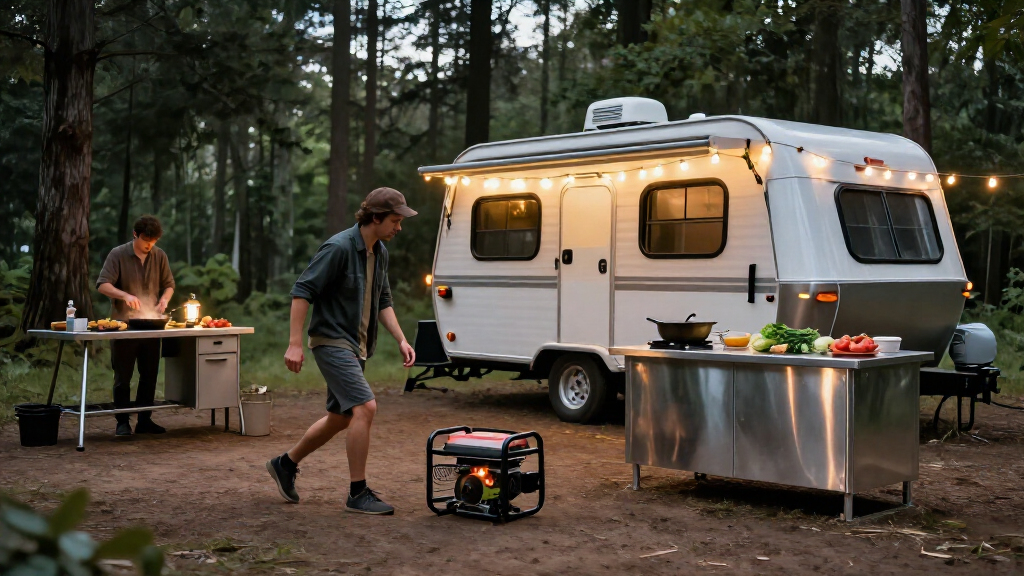
I ranked these options around the specific needs behind quiet generator for camping: how much noise and exhaust they add, whether their power output suits likely campsite loads, and how practical they are to transport and operate away from home. I also weighed fuel flexibility, RV-oriented features, monitoring tools, and the difference between an engine-powered generator and a battery power station. For quieter, low-impact camping, I gave extra weight to products that avoid engine noise altogether, while recognizing that battery capacity and recharging can limit longer trips.
The ranking reflects tradeoffs rather than wattage alone. Compact, lower-output inverter generators rank well for campers who only need essentials; larger models move up for RV users or heavier loads, but their extra capacity does not make them the quieter choice. Battery stations stand out for silent operation but cannot run indefinitely without a charging plan. Because the lineup includes different product types and limited comparable sound and runtime information, I avoid treating advertised wattage as proof of real-world quietness or endurance.
Factors to Consider When Choosing Quiet Generator For Camping
Choosing a camping power source is less about finding the biggest number on a spec sheet and more about matching power, noise, and trip length. I’d work through these factors before deciding whether an engine generator or a battery station belongs in your gear.
Match Running Loads, Not Just Peak Wattage
List what you plan to power at the same time, then separate devices that run continuously from those that cycle on and off. A fridge or appliance with a motor can need more power at startup than its ordinary running draw suggests. Adding up every item’s maximum rating can push you toward a bulky generator you rarely use at full capacity. On the other hand, choosing only for phone charging can leave you short if you later add a cooking appliance or RV equipment. Check both running and surge requirements for your actual devices before comparing generator output. If your campsite needs are modest, a smaller unit can be easier to carry and less cumbersome than excess capacity.
Treat Noise as More Than a Decibel Figure
Noise ratings are useful only when you can compare the measurement conditions, distance, and operating load. A generator may sound different when working hard than when running in an economy mode, so a single figure cannot describe every campsite situation. Battery stations avoid engine noise and exhaust while supplying stored power, making them a different category rather than simply a quieter generator. Campsite quiet hours and local rules may restrict generator use altogether, regardless of how quiet a model is advertised to be. Read the site policy before buying and think about whether you can position the machine safely away from sleeping and neighboring areas. Never place an engine generator inside a tent, vehicle, or enclosed shelter.
Plan for Energy Over the Whole Trip
Generator wattage describes the rate of power delivery; battery capacity describes how much energy is stored. That distinction matters when deciding whether a power station can support several days of use or only a short stretch between charges. Estimate daily energy needs from the devices you will actually use, and account for losses and charging conditions rather than assuming every advertised watt-hour is available to your devices. A fuel generator can be refueled, but it adds fuel storage, engine noise, and maintenance to the plan. A power station needs a way to recharge, such as a compatible vehicle or solar setup, if the trip lasts beyond its reserve. The common mistake is to buy for peak output while ignoring how long the power must last.
Check Weight, Shape, and Camp Setup
Portability depends on more than the word portable: weight, handles, dimensions, and the route from vehicle to campsite all matter. A larger inverter generator may be manageable beside an RV but awkward on a walk-in site. Smaller units are easier to place and store, though their lower output may limit what you can run. Battery stations avoid fuel handling and exhaust but can still be heavy, especially as capacity rises. Think through where the unit will ride, where it will operate, and whether you can move it without help. Do not plan to run a fuel generator close to your tent just because it is compact; exhaust and safe clearance matter.
Pay for Features Only When They Change Your Trip
Dual-fuel capability can help when one fuel type is inconvenient or unavailable, but it does not remove engine noise or the need for safe fuel handling. An RV-ready outlet is useful if your connection and electrical requirements match; it adds little for a tent camper charging small devices. App monitoring can make status checks easier, though it is not a substitute for understanding the generator’s controls and limits. Fuel shutoff and maintenance features may matter more to campers who store equipment between trips than to those who use it constantly. Compare the feature against a real scenario you expect to face rather than treating a longer feature list as a better fit. That approach often favors a simpler, lighter unit over a more capable model.
Consider Campsite Rules and Power Alternatives
Some campgrounds restrict generator hours, prohibit fuel-powered units, or set placement requirements. Check rules before committing to an engine generator, since its power may be unusable during the quiet periods when you need it most. For basic lighting and electronics, a power station or small battery banks may cover the essentials without running an engine. For extended off-grid trips, a fuel generator can offer replenishable power, but only if fuel transport and operation are permitted. Solar charging can extend battery use in suitable conditions, though weather, shade, and panel setup affect how much energy returns. Build your choice around the site and trip rather than assuming one power source works everywhere.
Frequently Asked Questions
Is a battery power station quieter than an inverter generator at a campground?
Yes: a battery power station has no running combustion engine, so it avoids the engine noise and exhaust associated with fuel generators. That makes models such as the Jackery Explorer options worth comparing when campsite noise limits are strict. The tradeoff is finite stored energy; once depleted, the station needs a suitable charging source. For a short trip with modest device use, that can be a cleaner fit than carrying fuel. For repeated high-demand use, estimate energy needs carefully before relying on battery capacity alone.
What size generator do I need for tent camping?
Start with the devices you need rather than choosing a wattage class first. Phone charging, lights, and small electronics usually call for far less capacity than an RV air conditioner, cooking appliance, or other motor-driven equipment. Check each device’s running draw and any startup surge, then decide which items must operate together. A smaller inverter generator such as the WEN 2350i is more aligned with basic camping loads than the 4000-watt options in this roundup. If your needs are limited to electronics, also compare a battery station so you can avoid engine noise.
Can I run a portable generator at any campsite if it is advertised as quiet?
No. Campgrounds can set operating hours, noise limits, placement rules, or bans on fuel generators, and those rules take priority over a product’s marketing. Check the specific campground policy before you pack a generator, especially for quiet hours or walk-in sites. Also leave safe space between an engine generator and tents, vehicles, people, and openings where exhaust could enter. A battery power station may be a better fit where fuel-powered operation is restricted. Do not assume that a low-noise claim grants permission to run an engine.
Does a dual-fuel generator run more quietly than a gas-only model?
Dual-fuel describes the types of fuel a generator can use; it does not by itself promise quieter operation. The WEN DF360iX may appeal if fuel flexibility matters, but you should compare sound information under similar load conditions before treating it as a quieter choice. Noise also depends on how hard the unit is working and where it is placed. If avoiding engine sound is the main goal, compare a battery power station instead. Choose dual fuel for fuel options, not as a substitute for a quiet-power plan.
Should I choose an RV-ready generator for tent camping?
Only if you have a use for its RV connection or need the output for equipment that matches the generator’s specifications. RV-ready models in this lineup, including larger options, can suit campers running compatible onboard appliances, but extra output can add bulk without helping a tent camper who only charges small devices. Check the outlet type and electrical requirements of your RV before buying; the label alone does not confirm every hookup is compatible. For a simple tent setup, a smaller inverter generator or battery station may be easier to manage. Let your actual loads and carrying setup decide.
Conclusion
For the broadest fit among fuel-powered options, I’d choose the WEN 2350-Watt Portable Inverter Generator as the best overall match for modest camping loads; its smaller output is a more sensible starting point than the lineup’s heavier 4000-watt class. For best value in practical capability, compare the WEN 3600-Watt Portable Inverter Generator with your load list, while recognizing it is not the lightest route to basic power. The best premium pick for campers prioritizing quiet and no exhaust is the Jackery Explorer 2000 v2, provided its stored energy and recharging plan match the trip. Beginners who want straightforward power for essentials should look first at the WEN 2350i; those who prefer no engine operation should consider the Jackery Explorer 1000 v2. For RV users or campers with heavier loads, compare the Pulsar PGD40ISCO, WEN 4800i, and WEN DF360iX by outlet needs, fuel plan, and campsite rules. If silence matters more than continuous high output, pick a power station; if replenishable power matters more, choose an inverter generator and plan for its noise, exhaust, and safe placement.
Halloween Picks
halloween
As an affiliate, we earn on qualifying purchases.