For most kitchens, I’d start with the iSpring RCC7AK-UV: it combines reverse osmosis with UV treatment, making it a strong fit for buyers who want a broad filtration setup in one system. The JOREVS 1 GPM is a simpler dedicated under-sink UV option, while the Express Water ROALKUV10D suits households seeking a more elaborate RO system with alkaline filtration. The main tradeoffs are how much filtration you need, installation and maintenance demands, and whether you want a dedicated faucet or a faucet-mounted unit. UV treatment addresses microorganisms; it does not replace filtration for sediment, dissolved contaminants, or chemicals. Read on for how the six options differ and which type of kitchen each suits best.

Get kitchen gear delivered free with Prime
- Fast, free delivery on millions of items
- Prime Video, Amazon Music and more included
- Member-only deals all year
Complete the kit



Key Takeaways
- The iSpring RCC7AK-UV is the strongest all-in-one match for buyers who want UV treatment alongside reverse osmosis and alkaline remineralization, rather than a standalone UV add-on.
- The iSpring UVF11A plays a different role from a complete purifier: it is designed to pair with under-sink or RO filtration, so buyers need to account for the rest of the system.
- RO and ultrafiltration are not interchangeable. The Express Water and iSpring RCC7AK-UV are RO systems, while the LCF uses ultrafiltration; their treatment scope and water-waste considerations differ.
- The JOREVS and Eurolife emphasize simpler UV-focused setups, but faucet-mount convenience and under-sink integration suit different kitchens and installation preferences.
- Matching the system to a tested water concern matters more than maximizing stages. More treatment components can bring added space, upkeep, and filter replacements without addressing a need your household actually has.
| iSpring UVF11A UV Water Filter for Under-Sink and RO Systems |  | Best UV Add-On for Existing RO Systems | Lamp power: 11 W | Power source: 110 V | Maximum flow rate: 1 GPM | VIEW ON AMAZON | See Our Full Breakdown |
| Express Water ROALKUV10D 11-Stage Reverse Osmosis Water Filter System with Alkaline Filtration and UV Sterilization | 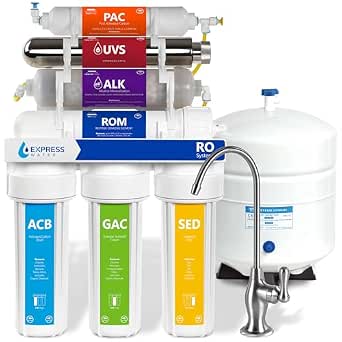 | Best All-in-One RO and UV System | Filtration stages: 11 | Purification methods: Reverse osmosis and ultraviolet | Maximum flow rate: 0.8 gpm | VIEW ON AMAZON | See Our Full Breakdown |
| JOREVS Under-Sink UV Water Purifier, 1 GPM |  | Best Long-Life UVC-LED Add-On | Purification method: Ultraviolet UVC-LED | Wavelength: 270–280 nm | Maximum flow rate: 1 gpm | VIEW ON AMAZON | See Our Full Breakdown |
| LCF 0.01 μm Under-Sink Ultra-Filtration Water Filter System with UV-C |  | Best No-Drain UV-C Filtration System | Filtration stages: 3 | Filtration size: 0.01 μm | UV-C faucet: LED; activates with water flow | VIEW ON AMAZON | See Our Full Breakdown |
| iSpring RCC7AK-UV 7-Stage Under-Sink Reverse Osmosis Water Filter System |  | Best Certified RO System with UV | Filtration stages: 7 | Purification methods: Reverse osmosis, alkaline, activated carbon, carbon block, and ultraviolet | RO membrane capacity: 75 gallons per day | VIEW ON AMAZON | See Our Full Breakdown |
| Eurolife EL-LS-A21 Faucet-Mount Water Filter with UV Light and LED Display |  | Best Faucet-Mount Option | Filtration: 8-stage; activated carbon and ultraviolet | Filter capacity: 400 gallons | Filter life: Up to 6 months | VIEW ON AMAZON | See Our Full Breakdown |
| uv water purifier for kitchen sink | Maximum flow rate | Dimensions | Filtration stages |
|---|---|---|---|
| iSpring UVF11A UV Water Filter | 1 GPM | 10 x 2 x 2 inches | — |
| Express Water ROALKUV10D 11-St | 0.8 gpm | 15 x 5 x 17 inches | 11 |
| JOREVS Under-Sink UV Water Pur | 1 gpm | 9.92 × 1.65 × 1.65 inches | — |
| LCF 0.01 μm Under-Sink Ultra-F | — | — | 3 |
| iSpring RCC7AK-UV 7-Stage Unde | — | 15 × 8 × 18 inches | 7 |
| Eurolife EL-LS-A21 Faucet-Moun | 1.05 gpm | — | — |
More Details on Our Top Picks
iSpring UVF11A UV Water Filter for Under-Sink and RO Systems
The iSpring UVF11A is a focused add-on, not a complete sink-water purifier: it adds UV treatment after an existing compatible filtration system, such as reverse osmosis. Its flow-activated 11-watt lamp switches on when water moves, so it avoids running continuously between uses. The stainless-steel chamber and included fittings make it a practical choice for buyers comfortable adding a final treatment stage under the sink. Compared with the JOREVS Under-Sink UV Water Purifier, it uses a conventional UV lamp rather than a UVC-LED and has a stated 8,000-hour lamp life, so replacement planning matters more. Its 1 GPM maximum flow rate suits typical point-of-use setups, but it will not filter water on its own. Skip it if you need a complete system or do not already have compatible filtration.
Pros:- Flow sensor activates the lamp when water moves instead of keeping it on continuously.
- Stainless-steel chamber provides a durable housing for the UV stage.
- 1 GPM maximum flow rate fits many under-sink point-of-use systems.
- Installation fittings and mounting brackets are included.
Cons:- Requires a separate compatible filtration system to treat water before the UV stage.
- The UV lamp is rated for 8,000 hours and needs eventual replacement.
- Requires a 110 V electrical connection beneath the sink.
Best for: Homeowners with a compatible under-sink or reverse osmosis system who want to add flow-activated UV treatment as a final stage.
Not ideal for: Buyers starting from scratch, or anyone without an existing compatible filtration system, since this is an add-on rather than a complete purifier.
- Lamp power:11 W
- Power source:110 V
- Maximum flow rate:1 GPM
- UV lamp life:8,000 hours
- Housing material:Stainless steel
- Inlet/outlet fittings:1/4-inch quick connect
- Dimensions:10 x 2 x 2 inches
- Operating pressure range:5–115 psi
Our verdict“Choose the UVF11A if you already have compatible under-sink filtration and want a dedicated, flow-activated UV add-on.”
Express Water ROALKUV10D 11-Stage Reverse Osmosis Water Filter System with Alkaline Filtration and UV Sterilization
The Express Water ROALKUV10D suits buyers who want UV treatment built into a complete under-sink system, rather than adding a UV unit to filtration they already own. Its 11-stage combination of reverse osmosis, UV, and mineralization pairs multiple treatment methods with added calcium, potassium, and magnesium. A storage tank and dedicated chrome faucet make this a fuller installation than the add-on iSpring UVF11A, which needs a separate compatible system. The included leak detector adds a useful safeguard by stopping water flow when it detects moisture. The tradeoff is a more involved under-sink setup, plus a maximum flow rate of 0.8 gpm—slower than the 1 GPM rating of the UVF11A and JOREVS purifier. Its listed capacity is 100 gallons, so check that figure against your household’s expected use.
Pros:- Combines reverse osmosis, ultraviolet treatment, and alkaline mineralization.
- Includes a storage tank, chrome faucet, filters, and UV bulb.
- Leak detector automatically shuts off water flow when moisture is detected.
- 11-stage setup offers a complete alternative to pairing a separate RO system with the iSpring UVF11A.
Cons:- Requires space and installation beneath the sink for a full system and storage tank.
- Maximum flow rate is 0.8 gpm, below the 1 GPM ratings of several UV add-ons.
- A multi-stage system has more components to install and maintain than a standalone UV unit.
Best for: Households replacing or building an under-sink water system that want reverse osmosis, UV treatment, mineralization, a storage tank, and a dedicated faucet in one package.
Not ideal for: Renters or buyers seeking a simple UV add-on, since this is a full under-sink installation with a lower maximum flow rate than the 1 GPM options.
- Filtration stages:11
- Purification methods:Reverse osmosis and ultraviolet
- Maximum flow rate:0.8 gpm
- Capacity:100 gallons
- Dimensions:15 x 5 x 17 inches
- Weight:31 lb
- Installation:Under sink
- Leak detection:Automatic shutoff
Our verdict“Pick the ROALKUV10D if you want a complete RO-and-UV installation with mineralization and built-in leak shutoff.”
JOREVS Under-Sink UV Water Purifier, 1 GPM
The JOREVS Under-Sink UV Water Purifier is a compact UV add-on for point-of-use and reverse osmosis systems, with a 270–280 nm UVC-LED that activates when water flows. Its stated LED life of up to 10 years may appeal to buyers who want less frequent lamp replacement than the iSpring UVF11A, whose conventional lamp is rated for 8,000 hours. Both list a 1 GPM maximum flow rate, so neither is aimed at whole-house treatment; JOREVS explicitly rules out that use. At just under 10 inches long, it is sized for under-sink installation, though buyers still need a corded power connection and compatible upstream filtration. Its UV treatment does not replace sediment or dissolved-contaminant filtration, making it a poor standalone choice for untreated water.
Pros:- Flow sensor runs the UVC-LED when water is flowing.
- 270–280 nm ultraviolet wavelength is specified for the LED treatment.
- Stated LED lifespan is up to 10 years.
- Compact under-sink body is designed to work with RO and other point-of-use systems.
Cons:- Not suitable for whole-house water treatment.
- Needs a corded electrical connection under the sink.
- Functions as a UV stage and does not replace a compatible filtration system.
Best for: Owners of an existing point-of-use or RO system who want a compact, flow-activated UVC-LED stage and prefer a long stated LED lifespan.
Not ideal for: Households seeking whole-house treatment or a standalone system that also filters sediment and dissolved contaminants.
- Purification method:Ultraviolet UVC-LED
- Wavelength:270–280 nm
- Maximum flow rate:1 gpm
- Stated LED life:Up to 10 years
- Temperature range:4–60 °C
- Maximum supported TDS:1,000 ppm
- Dimensions:9.92 × 1.65 × 1.65 inches
- Compatibility:Reverse osmosis and point-of-use systems
Our verdict“Choose JOREVS over the iSpring UVF11A if you want a compact UVC-LED add-on with a longer stated service life and already have upstream filtration.”
LCF 0.01 μm Under-Sink Ultra-Filtration Water Filter System with UV-C
The LCF 0.01 μm system is the most self-contained option here for buyers who want under-sink filtration without reverse osmosis or a drain connection. It combines three-stage ultrafiltration with an alkaline mineral addition and a UV-C LED faucet that activates with water flow. Twist-and-lock cartridges and a filter-life reminder also make routine changes more straightforward than maintaining a multi-stage RO system such as the iSpring RCC7AK-UV. That simpler installation comes with a clear limitation: LCF states that it does not lower TDS, unlike reverse osmosis. Its stated bacteria reduction of up to 99.9% applies only below 2 L/min, so the qualifying flow condition matters when selecting it. This makes more sense for buyers who value a no-wastewater setup than for those seeking dissolved-solids reduction.
Pros:- Combines 0.01 μm ultrafiltration, alkaline mineral addition, and a UV-C LED faucet.
- Twist-and-lock filters are designed for tool-free replacement.
- Filter-life reminder helps track cartridge changes.
- No drain connection is required.
Cons:- Does not lower total dissolved solids.
- The stated bacteria reduction of up to 99.9% applies only below 2 L/min.
- Requires sink-pipe compatibility with 1/2-inch or 3/8-inch connections.
Best for: Homeowners who want a multi-stage under-sink filter with UV-C, tool-free cartridge changes, and no drain connection, without needing TDS reduction.
Not ideal for: Buyers who want reverse-osmosis-level dissolved-solids reduction or who expect the stated bacteria reduction at flows above 2 L/min.
- Filtration stages:3
- Filtration size:0.01 μm
- UV-C faucet:LED; activates with water flow
- Stated bacteria reduction:Up to 99.9% at flow rates under 2 L/min
- Faucet material:Lead-free SUS304
- Compatible sink pipes:1/2-inch and 3/8-inch
- Filter replacement:Twist-and-lock quick-connect design
- Drain connection:Not required
Our verdict“Choose LCF over the iSpring RCC7AK-UV if you want a no-drain UV-C filtration setup and do not need reverse osmosis or TDS reduction.”
iSpring RCC7AK-UV 7-Stage Under-Sink Reverse Osmosis Water Filter System
The iSpring RCC7AK-UV is the stronger fit for buyers who want UV as part of a full reverse-osmosis setup, with a 75 GPD membrane, 3.2-gallon tank, and seven filtration stages that include alkaline treatment. Its listed NSF/ANSI 58 and 372 certifications distinguish it from the standalone UV add-ons in this roundup, which do not provide a complete RO system. The top-mounted faucet fastener is designed to ease installation, while the transparent first-stage housing lets owners see filter buildup. Compared with the Express Water ROALKUV10D, it has fewer stages and a smaller listed overall footprint, but its 75 GPD membrane and tank make it a substantial under-sink installation all the same. Check feed pressure before buying: the product notes that pressure below 45 psi may call for a booster-pump model, despite a listed operating range starting at 40 psi.
Pros:- Combines reverse osmosis, alkaline filtration, activated carbon, carbon block, and UV treatment.
- 75 GPD membrane and 3.2-gallon tank support stored purified water.
- NSF/ANSI 58 and 372 certifications are listed in the product information.
- Top-mounted faucet fastener is designed to simplify installation.
Cons:- Requires under-sink space and a corded electrical connection.
- Feed pressure below 45 psi may call for a booster-pump model.
- Water from the UV stage may be warm for the first few seconds.
Best for: Buyers who want certified reverse-osmosis filtration with alkaline treatment, UV protection, and a storage tank in one under-sink system.
Not ideal for: Households with limited under-sink space, no nearby electrical connection, or feed-water pressure below 45 psi without a suitable booster pump.
- Filtration stages:7
- Purification methods:Reverse osmosis, alkaline, activated carbon, carbon block, and ultraviolet
- RO membrane capacity:75 gallons per day
- Tank capacity:3.2 gallons
- Feed water pressure:40–95 psi
- Maximum feed water TDS:2,000 ppm
- Dimensions:15 × 8 × 18 inches
- Certifications:NSF/ANSI 58 and 372
Our verdict“Choose the RCC7AK-UV if certified RO filtration with alkaline treatment, a storage tank, and UV protection matters more than a compact add-on installation.”
Eurolife EL-LS-A21 Faucet-Mount Water Filter with UV Light and LED Display
The Eurolife EL-LS-A21 is the lineup’s most direct fit for renters or anyone who wants a UV-equipped filter at the tap without adding an under-sink system. Its eight-stage filtration combines activated carbon and UV light, while the display gives a quick read on water temperature and filter life. Compared with the JOREVS Under-Sink UV Water Purifier and the reverse-osmosis systems in this roundup, Eurolife is simpler to install and avoids a dedicated under-sink setup; it does not offer the same system-style treatment approach or capacity information as those options. Each cartridge handles up to 400 gallons, and three replacements are included, though cartridge changes remain part of ongoing upkeep. The main limitation is faucet fit: it is intended for standard kitchen faucets, so check compatibility before buying.
Pros:- Combines activated carbon filtration and UV light in an eight-stage faucet-mount unit
- LED display shows water temperature and filter life
- Tool-free installation includes six faucet adapters
- Package includes three replacement cartridges, each rated for up to 400 gallons
Cons:- Compatibility is limited to standard kitchen faucets, so some taps may not fit
- A 400-gallon cartridge capacity means replacement planning is still needed
- Faucet-mounted design may not suit buyers who prefer an under-sink installation
Best for: Renters and homeowners with a standard kitchen faucet who want UV light, taste-focused filtration, and a tool-free installation without plumbing changes.
Not ideal for: Buyers with nonstandard or incompatible faucets, or households seeking a dedicated under-sink reverse-osmosis system like the Express Water ROALKUV10D.
- Filtration:8-stage; activated carbon and ultraviolet
- Filter capacity:400 gallons
- Filter life:Up to 6 months
- Maximum flow rate:1.05 gpm
- Operating pressure:20–100 psi
- Temperature range:41–113 °F
- Dimensions and weight:5.9 × 2.67 × 5 in; 1.1 lb
- Installation and adapters:Tool-free faucet mount; includes 6 adapters
- Included cartridges and warranty:3 replacement cartridges; 1-year limited manufacturer warranty
Our verdict“Choose the Eurolife if you want a compact, tool-free UV faucet filter and your kitchen faucet is compatible.”

How We Picked
I compared these six products by how well their form and treatment approach fit a kitchen-sink installation: complete RO systems, an ultrafiltration system with UV-C, a UV unit intended to pair with other filtration, and a faucet-mount design. I gave more weight to a clear role, useful treatment combination, practical installation format, and the buyer’s ability to understand what the system does than to a high stage count alone. The ranking favors options that offer a coherent route from the buyer’s likely need to a usable kitchen setup.
The iSpring RCC7AK-UV ranks first as a combination RO-and-UV system, while the Express Water ROALKUV10D is a more elaborate alternative for shoppers who want alkaline filtration too. The JOREVS is a simpler dedicated UV pick; the LCF and iSpring UVF11A meet different needs—ultrafiltration with UV-C and UV as an add-on, respectively. The Eurolife’s faucet-mount format can suit buyers avoiding a conventional under-sink installation, but it is less directly comparable to the plumbed systems. Product claims, water test results, installation compatibility, and replacement-part availability should be checked before purchase; UV alone should not be treated as a complete contaminant-removal solution.
Factors to Consider When Choosing Uv Water Purifier For Kitchen Sink
Choosing a UV water purifier for a kitchen sink starts with the water problem, not the number of treatment stages. I’d first identify what is present in the supply, then match that concern to the right filtration method, plumbing format, and maintenance routine. These decisions help prevent paying for a system that treats the wrong issue or does not fit the kitchen.
Match UV Treatment to Your Water Test
UV is intended to inactivate susceptible microorganisms; it does not remove dissolved metals, salts, or many chemical contaminants. A home water test or local water-quality report can help distinguish a microbial concern from a taste, odor, sediment, or dissolved-contaminant issue. If the concern is chemical or mineral content, look for a compatible filtration method such as carbon or RO rather than expecting UV to handle it. A common mistake is to buy a UV unit based on a broad claim about cleaner water without checking which contaminants the system is certified or designed to reduce. Ask for the exact performance documentation and verify it applies to the full system, not just one component. Where microbial safety is at stake, consult local public-health guidance rather than relying on a consumer product description alone.
Choose Between RO, Ultrafiltration, and a UV Add-On
RO, ultrafiltration, and UV serve different functions, so the label “multi-stage” does not tell you which one suits your supply. RO is often selected for broad reduction of dissolved substances, while ultrafiltration targets particles and some larger organisms; UV adds a disinfection step but leaves contaminants in the water. A UV add-on can make sense when an existing filter already addresses the relevant non-microbial concerns. By contrast, buying a standalone UV product for water with a chemical or dissolved-contaminant issue leaves that issue untreated. Compare the system’s stated claims against your test results, and avoid assuming one technology substitutes for another.
Check Faucet, Cabinet, and Plumbing Compatibility
Under-sink systems may need cabinet room for treatment components, a storage tank, tubing, and access for future filter changes. Measure the available space and check whether the setup calls for a separate drinking-water faucet, a compatible existing faucet, or a faucet-mount attachment. Also confirm that your sink can accept another faucet hole if the system requires one; countertop material and rental rules can make drilling impractical. A faucet-mount model can reduce under-cabinet plumbing work, but it occupies the tap and may not suit every faucet design. Before ordering, verify connection sizes, included adapters, and whether installation requires a water line or electrical outlet nearby.
Account for Flow, Storage, and Water Use
Rated flow and actual household convenience are not always the same, especially when an RO system fills a storage tank rather than supplying water at the same pace as a standard tap. Check the manufacturer’s stated production rate and conditions, then consider how much drinking and cooking water your household uses at peak times. RO systems may send some water to drain during production, so review the system’s documented water-use details if conservation matters. A fast UV-only or UV-plus-filter arrangement may avoid the same storage routine, but it does not provide RO’s dissolved-contaminant reduction. Choose around your daily use rather than assuming the most elaborate setup will feel easiest.
Plan for Replacements and UV-Lamp Care
Filter and lamp replacement schedules affect long-term effort, even when the initial installation seems straightforward. Check the manufacturer’s instructions for replacement intervals, lamp-life indicators, compatible part numbers, and whether a lamp change calls for tools or a service visit. A UV lamp can still light while its disinfection output has declined, so visual brightness alone is not a reliable maintenance check. Multi-stage systems may require several distinct cartridges, while an add-on UV unit still depends on the condition of the filtration placed before it. Before choosing, confirm that replacement components are available and that the maintenance calendar fits your household.
Pay for Treatment You Can Explain
More stages can mean more components to maintain, but the stage count by itself does not establish better results for your water. Look for clear contaminant-reduction claims, supporting certifications where applicable, and documentation that matches the complete system configuration. Alkaline or remineralizing stages may change taste after RO treatment, but they are not a substitute for verified contaminant performance. A simpler setup can be the better buy if it addresses a known need and its upkeep is manageable. Spend more only when the added treatment or installation format solves a specific household requirement.
Frequently Asked Questions
Can a UV water purifier make unsafe tap water safe to drink by itself?
Not necessarily. UV treatment is designed to inactivate susceptible microorganisms, but it does not remove chemical contaminants, metals, salts, or particles from the water. Its performance also depends on the system being used and maintained as directed, including any required prefiltration. If your supply has a boil-water notice or a known microbial problem, follow local health guidance and verify that the specific unit is suitable for that use. Pair UV with filtration only where your water test or a qualified authority points to a need.
Should I choose an RO system with UV or add UV to filtration I already own?
Choose based on what your current system treats and what remains unresolved in your water. An RO system with UV combines treatment stages in one installation, which can suit a buyer replacing or building a complete setup. A UV add-on can be a sensible route if an existing filter already handles the other contaminants of concern and is compatible with the UV unit. Check flow, connection, and treatment requirements before combining products; adding UV does not automatically improve filtration for dissolved chemicals. Use test results and the product documentation to decide whether a complete system or an add-on is the better match.
Will an under-sink UV purifier remove chlorine or improve taste?
UV is not a chlorine-removal or taste-filtering method. A carbon filter is commonly used for chlorine taste and odor, while other concerns may call for different treatment media or RO. Some products in this roundup combine UV with additional filtration, but the exact effect depends on the full system and its verified claims. Check whether the relevant cartridge is included and how often it needs replacement. If taste is your main concern, do not pay for UV alone unless you also have a reason to address microorganisms.
Do I need a separate drinking-water faucet for an under-sink system?
It depends on the model. Many under-sink systems are designed to dispense through a dedicated faucet, while faucet-mount products attach at the existing tap; some configurations may support a compatible faucet already in place. Confirm the installation diagram before buying, including sink-hole requirements, tubing, adapters, and any power connection. If you rent or have a stone countertop, drilling a new hole may be difficult or prohibited. A faucet-mount format can reduce plumbing changes, though it may not fit every tap or provide the same integrated setup.
What should I verify before buying an RO system with UV for a small household?
Start with cabinet dimensions and the space needed for any storage tank, cartridges, tubing, and maintenance access. Then compare the system’s stated production rate and water-use information with your household’s drinking and cooking habits. A small household may not need a large or elaborate configuration if its water concerns are limited, and extra stages add replacement tasks. Check that the faucet arrangement and power requirements suit the sink area. Finally, confirm the exact replacement filters and UV components remain available for the model you plan to install.
Conclusion
My best overall pick is the iSpring RCC7AK-UV for buyers seeking an integrated RO-and-UV setup with alkaline remineralization. For a more elaborate RO configuration that also includes alkaline filtration, the Express Water ROALKUV10D is my premium-style choice, provided its added components match your needs. The iSpring UVF11A is the best value-style choice for someone who already has compatible under-sink or RO filtration and wants a UV add-on rather than another complete system. Beginners who want a dedicated under-sink UV product can start by comparing the simpler JOREVS setup with their water-test results; buyers seeking ultrafiltration alongside UV-C should look at the LCF. For kitchens where under-sink plumbing is the obstacle, the Eurolife faucet-mount unit offers a different installation route. I’d make the final call only after confirming the treatment claims, fit, and ongoing replacement requirements for the specific water and sink.