A microwave heats food by using electromagnetic waves that excite water, fat, and sugar molecules, causing them to vibrate rapidly. This vibration generates heat through friction, which then warms the food from the inside out. The microwave energy penetrates the food, and hot spots can happen if the placement isn’t even. If you want to understand exactly how this process works and how to get the best results, there’s more to discover.

Get kitchen gear delivered free with Prime
- Fast, free delivery on millions of items
- Prime Video, Amazon Music and more included
- Member-only deals all year
Key Takeaways
- Microwaves generate electromagnetic waves that excite water, fat, and sugar molecules in food.
- These molecules vibrate rapidly, producing heat through internal friction.
- The heat then spreads throughout the food via conduction and convection.
- Proper stirring and container choice help ensure even heating.
- Safety features prevent microwave radiation leaks and promote efficient operation.
What Are Microwaves and How Do They Work?
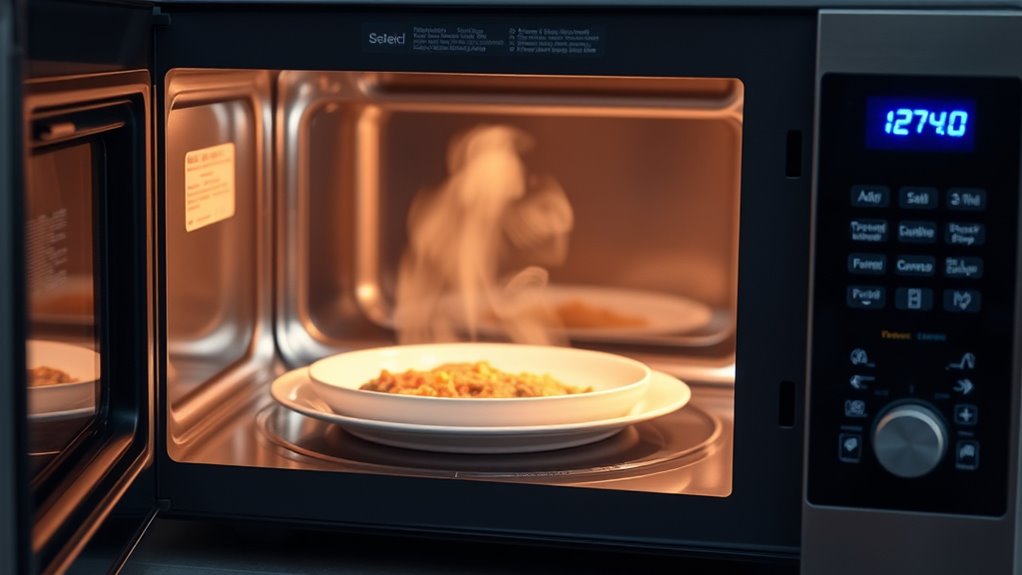
Microwaves are a type of electromagnetic radiation with wavelengths shorter than radio waves but longer than infrared light. The microwave history dates back to the 1940s when scientists discovered that these waves could heat food. Early appliance design focused on harnessing this energy safely, leading to the development of microwave ovens as household appliances. Modern microwaves use a magnetron to generate microwaves that bounce inside the metal interior, targeting water molecules in your food. As these molecules vibrate, they produce heat, which cooks your meal quickly. Your microwave’s design ensures even heating and safety features to prevent leaks. Additionally, advancements in microwave technology have improved energy efficiency and cooking precision. These innovations are part of European advancements in sustainable appliance design, making modern microwave ovens more energy-efficient and environmentally friendly. Thanks to this innovation, heating food has become faster, more efficient, and more convenient than ever before. Incorporating energy-efficient features has also helped reduce electricity consumption during operation.
The Role of Water Molecules in Heating Food
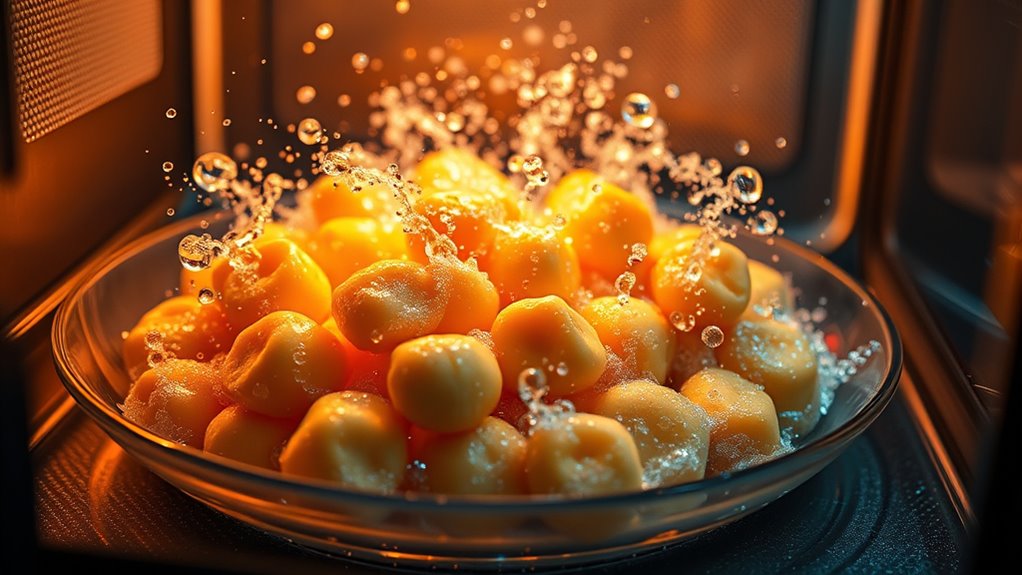
Have you ever wondered how microwaves heat your food so quickly? It all comes down to water molecules. These tiny particles are everywhere in your food, and they’re key to heat absorption. When microwaves pass through, they excite water molecules, causing them to vibrate rapidly. This vibration generates heat, which then spreads to the rest of your food, warming it evenly. To visualize this, consider the following:
| Water Molecules | Vibrate Rapidly | Generate Heat |
|---|---|---|
| Absorb Microwave Energy | Increase Motion | Transfer Heat to Food |
This process makes your food heat up fast and efficiently, thanks to the water molecules’ ability to convert microwave energy directly into heat. Understanding the microwave heating process helps explain why some foods heat unevenly if water content isn’t uniform. Additionally, the distribution of water molecules within different foods influences how evenly they heat, highlighting the importance of uniform water content in achieving consistent warming. Recognizing the water molecule behavior in different temperature ranges can also help optimize heating times and methods. Furthermore, variations in water content can lead to uneven heating, which is why stirring or rotating food during microwaving is often recommended. For optimal results, understanding how water molecules respond to microwave energy allows for better heating techniques and improved food safety.
How Electromagnetic Waves Interact With Food

Electromagnetic waves interact with food by transferring energy directly to its molecules, causing them to vibrate and generate heat. This process heats the food efficiently and quickly. Because microwaves target water, fat, and sugar molecules, the heat is distributed unevenly if the food isn’t stirred, which can affect its texture. Proper heating helps preserve the food’s original texture, keeping items tender or crispy where needed. Additionally, microwaves tend to preserve flavor better than some traditional methods, as they reduce the chances of overcooking or drying out food. This direct energy transfer minimizes nutrient loss and keeps flavors intact. Understanding the interaction of electromagnetic waves with food helps you achieve better results, maintaining both the texture and flavor during microwave heating. Recognizing how different food molecules respond to microwave energy can further enhance cooking efficiency and quality, especially when considering factors like molecular vibration and energy absorption. For instance, knowing how the molecular composition of different foods influences their heating behavior can lead to more consistent and effective microwave cooking. Moreover, considering the properties of food molecules can help optimize microwave settings for various dishes.
The Journey of Microwaves Inside the Oven

When you turn on your microwave, electromagnetic waves are generated by a magnetron. These waves travel through the oven, transferring energy directly to the food. Understanding this journey helps explain how heat is produced efficiently inside your microwave. The waves are finely tuned to excite water molecules in the food, causing them to vibrate and generate heat through Free Floating movement. This process relies on the principles of Comparative Advantage, which optimize resource utilization within the device to ensure effective heating. Additionally, necessary cookies help maintain the security and proper functioning of the microwave’s electronic components. Recognizing the importance of nutritional information can also guide you in choosing foods that heat evenly and retain their health benefits.
Microwave Wave Generation
Once you turn on the microwave, an internal component called the magnetron springs into action, generating high-frequency electromagnetic waves known as microwaves. These waves operate at a specific microwave frequency, typically around 2.45 GHz, which allows them to efficiently excite water molecules in your food. The waves are emitted with a particular wave polarization, guaranteeing they travel uniformly inside the oven. As the microwaves bounce off the metal interior, they create a standing wave pattern, helping distribute energy evenly. This wave polarization helps maintain a consistent direction for the waves, minimizing interference. The magnetron’s precise control over the microwave frequency and wave polarization ensures your food heats quickly and uniformly inside the oven. This control is essential for achieving even heating and preventing hot spots. Additionally, the microwave frequency is carefully calibrated to optimize energy transfer and safety. The design of the oven’s interior, including the placement of the turntable, also plays a crucial role in promoting uniform heating, making sure all parts of your food reach the desired temperature. Moreover, understanding the electromagnetic wave properties helps in designing safer and more efficient microwave ovens.
Heat Transfer Process
Have you ever wondered how microwaves travel through the oven to heat your food? Once generated, these microwaves bounce around inside the oven, penetrating the food and causing water molecules to vibrate. This vibration produces heat directly within the food, a process called dielectric heating. But heat transfer doesn’t stop there. As the food heats up, thermal conduction helps spread the heat from the inner layers to the outer parts, ensuring even cooking. Meanwhile, heat convection occurs as hot air or steam rises and circulates inside the oven, helping to distribute heat more evenly. This combination of microwave energy, thermal conduction, and heat convection ensures your food heats thoroughly and efficiently.
Why Microwaves Heat Food Unevenly
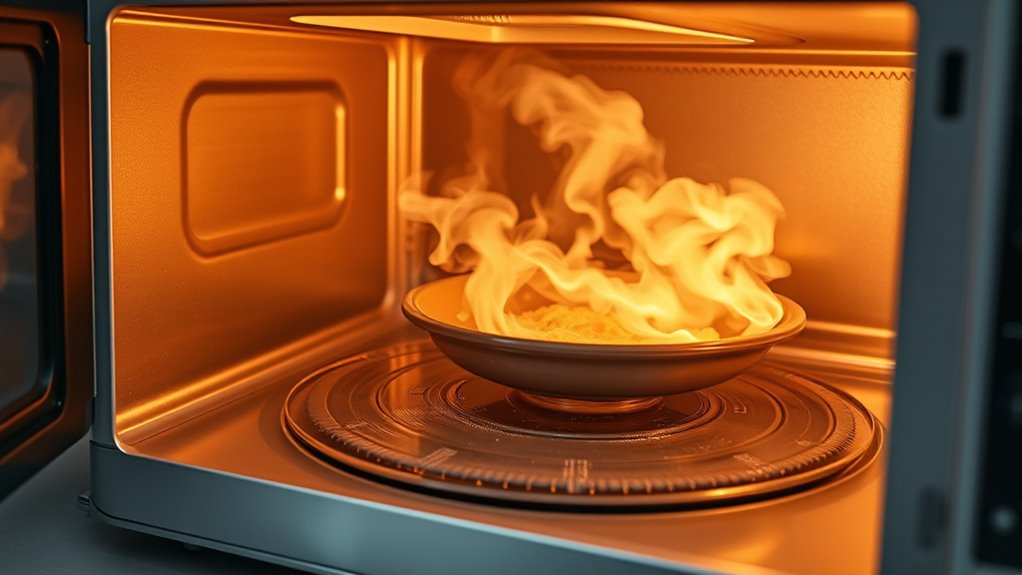
Microwaves often heat food unevenly because the microwave oven’s electromagnetic waves don’t distribute heat uniformly across the entire dish. Food density plays a big role—thicker, denser areas absorb more microwave energy and heat faster, while lighter regions may stay cooler. Additionally, the container material influences heating; some materials reflect microwaves, causing uneven distribution, while others absorb or allow waves to pass through more evenly. For example, a thick ceramic dish can create hot spots, and a plastic container may help distribute heat more uniformly. Your goal is to choose containers and arrange food wisely to promote even heating. Proper microwave techniques can also help improve heat distribution and ensure your food heats more consistently. Understanding these factors helps you avoid cold spots and guarantees your food heats more evenly. Proper piercing care and hygiene can also prevent issues that might affect heat distribution in certain foods. Being aware of microwave energy distribution can help you troubleshoot and optimize your heating process.
Safety and Efficiency of Microwave Heating

Ensuring safety and maximizing efficiency when using a microwave requires understanding how the appliance operates and following proper guidelines. Radiation safety is vital; confirm the microwave door seals properly and avoid using damaged units to prevent microwave leakage. Always use microwave-safe containers to prevent chemical leaching and accidents. To improve energy efficiency, cover food to retain heat and prevent moisture loss, reducing cooking time. Avoid overfilling the microwave, which can lead to uneven heating and waste energy. Regularly clean the interior to maintain peak performance. By following these practices, you minimize risks associated with microwave radiation and guarantee your appliance operates efficiently, saving energy and keeping you safe during food preparation.
Frequently Asked Questions
Can Microwaves Cook Food Evenly Without Stirring?
No, microwaves can’t cook food evenly without stirring because hotspot formation often occurs, leading to uneven heating. To improve results, you should use stirring techniques like pausing the microwave to stir or rotate the food regularly. This helps distribute heat more uniformly, reducing cold spots and ensuring your food heats evenly. Consistent stirring is key to avoiding hotspots and achieving better, more consistent cooking in your microwave.
Do Microwave Ovens Produce Harmful Radiation?
No, microwave ovens don’t produce harmful radiation that can cause radiation exposure. They use non-ionizing microwave radiation, which is contained within the oven and doesn’t leak out if it’s in good condition. To guarantee microwave safety, check the door seal and avoid using damaged units. As long as you follow safe practices, microwave radiation isn’t a health risk, and your appliance remains safe to use.
Why Do Some Foods Heat Faster Than Others?
You notice some foods heat faster, like they’re sprinting in a race. That’s because foods with high water content and low density absorb microwave energy more efficiently, making them heat quicker. Conversely, dense, low-water foods act like slow-moving turtles, taking longer to warm. So, your microwave’s speed depends on food density and water content, which dictate how rapidly they soak up those microwaves and heat up.
How Does Microwave Power Level Affect Cooking Time?
You’ll find that adjusting the microwave power level directly impacts cooking time and heating efficiency. When you lower the power, the microwave runs at a reduced intensity, so food heats more slowly and evenly, perfect for delicate dishes. Conversely, increasing power speeds up heating but might cause uneven warming or overcooking. Using the right power adjustment helps you control the process, ensuring your food heats thoroughly without burning or undercooking.
Are Any Foods Unsafe to Microwave?
Sure, microwaving some foods can be a real adventure—like risking food spoilage or uneven heating. You should avoid microwaving eggs in shells, as they might explode, or sealed containers that could burst. Microwave safety is key, so steer clear of metal or aluminum foil. Also, be cautious with greasy or fatty foods that can overheat and cause fires. When in doubt, check guidelines to keep your microwave safe and your food delicious.
Conclusion
Now that you know how microwaves heat food, you’ll see it’s all about water molecules vibrating and generating heat. Did you know that over 90% of microwave ovens are energy-efficient and heat food quickly? Understanding this process helps you use your microwave better and avoid uneven heating. So next time you nuke your meal, remember the tiny water molecules working hard to make your food hot in just seconds!
Halloween Picks
halloween
As an affiliate, we earn on qualifying purchases.