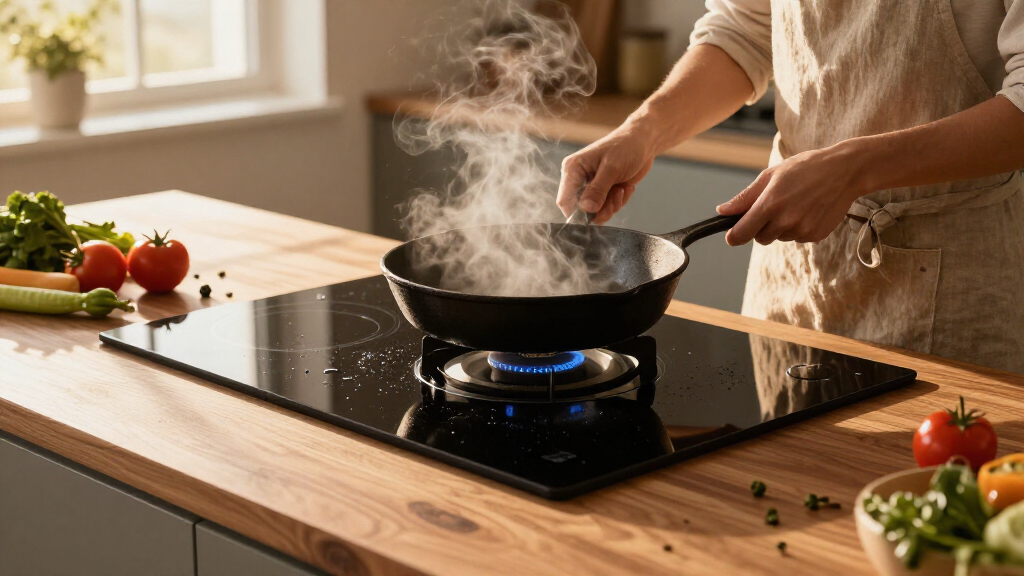

Choosing among the best induction stoves in 2026 comes down to one core decision: do you need a basic single burner for occasional cooking, or a double-burner unit that can genuinely replace a stovetop? After comparing features, build quality, and usability across 15 popular models, the Duxtop 9620LS double cooktop stands out as the best overall pick for its combination of dual-zone flexibility and precise LCD controls. If budget is the priority, the Duxtop 8100MC delivers dependable single-burner performance at an entry-level price, while the Nuwave Double Pro earns its place with an exceptionally wide temperature range for serious home cooks. The main tradeoffs in this category are portability versus cooking capacity, and consumer-grade convenience versus NSF-certified commercial durability. Read on for the full breakdown of all 15 models.

Get kitchen gear delivered free — and shop member deals
- Fast, free delivery on millions of items
- Access to Prime Big Deal Days deals on October 6–7
- Prime Video, Amazon Music and more included
Complete the kit


Key Takeaways
- The amazon.com/dp/B01FLR0ET8?tag=producttestkitchen.com-20&ascsubtag=dc-1083087″ target=”_blank” rel=”nofollow sponsored noopener”>Duxtop 9620LS won best overall because it’s the only double-burner model that splits its full 1800W flexibly between zones, letting you boil and simmer simultaneously without tripping breakers — something the fixed-split AMZCHEF double cooktop can’t do.
- NSF certification was the great divider in this lineup: all three ChangBERT models and the Nuwave Pro Chef are built for commercial kitchens, which means heavier stainless bodies and larger heating coils, but less convenience features like preset cooking modes.
- The Nuwave family dominates the precision niche — the Gold, Precision, and Flex models all offer fine temperature control in smaller packages, but the Flex’s 6.5-inch coil is the smallest in the roundup and struggles with large pots.
- Budget single burners from Amazon Basics and AAOBOSI proved nearly interchangeable on power; what separated them was safety features like child locks and the legibility of controls, not raw cooking performance.
- Double-burner units require a dedicated circuit in practice — all three two-zone models max out at 1800W total, so buyers expecting full power on both burners simultaneously will be disappointed unless they step up to hardwired built-in units.





More Details on Our Top Picks
Duxtop Portable Induction Cooktop, 1800W, Silver
The Duxtop 8100MC-line portable cooktop earns the top spot because it nails the fundamentals without overcomplicating things. Its 20 power levels and 20 temperature presets give it more granular control than the ChangBERT Chef Edition’s 18 temperature settings, while the 10-hour timer doubles what the AAOBOSI offers, making it far better for slow simmering stocks or braises. Compared with the Amazon Basics burner, the Duxtop’s digital touch panel feels faster and its auto shut-off logic is more predictable. The tradeoff is pickiness: certain cookware produces high-pitched whining, and anything under 5 inches in diameter simply won’t register. You also have to let the glass cool before wiping it down, which slows cleanup after a hot session.
Pros:- 20 power and 20 temperature levels for fine-grained control
- 10-hour timer handles long simmers and slow cooking
- Child safety lock plus automatic shut-off
- Compact, lightweight body stores easily in a cabinet
Cons:- Certain cookware produces high-pitched noise
- Requires magnetic cookware at least 5 inches across
- Glass must cool down before cleaning
Best for: Everyday home cooks who want a dependable, do-everything single burner for supplementary cooking
Not ideal for: Cooks who demand total silence — some pans audibly buzz at higher power settings
- Power:1800W
- Voltage:110/120V
- Energy Efficiency:83%
- Preset Power Levels:20
- Preset Temperature Levels:20
- Timer:Up to 10 hours
- Minimum Cookware Diameter:5 inches
Our verdict“If you want one burner that handles everything from boiling pasta to holding a braise, this is the safest all-around bet in the lineup.”
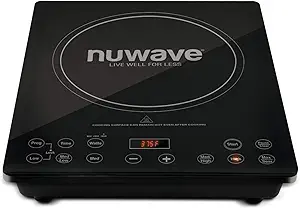
Nuwave Double Pro Cooktop Induction Countertop Burner, Portable, 50°F-575°F
Two independent zones make this the only burner here that can genuinely replace a stove section, not just supplement one. Where the Duxtop 9620LS double burner splits a fixed 1800W between its zones, the Nuwave’s Dynamic Watt Technology shifts power intelligently between burners, so a hard sear on one side doesn’t strand the other at a weak simmer. The 50°F-575°F range is the widest in this roundup — low enough for chocolate, high enough for wok-style heat that the Nuwave Precision’s 500°F ceiling can’t match. Be aware that both zones still draw from one outlet, so peak output per burner is lower than a dedicated single unit, and newcomers may need a few sessions to learn how the power-sharing behaves.
Pros:- Two independent zones for cooking two dishes simultaneously
- Widest temperature range here at 50°F to 575°F
- Dynamic Watt Technology balances power between burners
- Spill-resistant touch panel wipes clean easily
Cons:- Shared power means each burner underperforms a dedicated single cooktop
- Learning curve for users new to induction power-sharing
Best for: Small-apartment cooks and holiday hosts who need two dishes going at once without a full range
Not ideal for: Anyone wanting maximum single-burner firepower — power is shared, so each zone is weaker than a standalone 1800W unit
- Number of Burners:2 independent zones
- Temperature Range:50°F to 575°F
- Control Type:Touch panel
- Technology:Dynamic Watt Technology
- Surface Material:Glass
- Use Case:Countertop only
Our verdict“This is the pick when one burner just isn’t enough and you’d rather not juggle two separate units and outlets.”
ChangBERT Induction Cooktop Professional Chef Edition, NSF Certified Stove
NSF certification is what separates this unit from every consumer option here — it means the build is sanctioned for professional kitchens, not just home counters. The SCHOTT CERAN glass surface and stainless steel housing outclass the plastic-framed AAOBOSI in durability, and the 5-foot cord is a genuinely practical touch the Duxtop’s shorter cable can’t match when outlets are scarce in a catering setup. Compared with the Nuwave Pro Chef, this Chef Edition offers fewer presets (9 power levels versus endless temperature fine-tuning), but its 83% energy transfer and auto-pan detection make it efficient and forgiving in fast-paced environments. The catch: it’s overbuilt for casual cooks, and it demands a circuit that can comfortably supply full 1800W draw without tripping.
Pros:- NSF certified for commercial kitchen use
- SCHOTT CERAN shatter-resistant glass with stainless steel body
- Extra-long 5-foot power cord for flexible placement
- Auto-pan detection and over-heat protection
Cons:- Overkill for light, casual cooking needs
- Requires an outlet with sufficient power supply
- Premium build commands a higher price
Best for: Caterers, food-truck operators, and serious home cooks who need restaurant-grade durability
Not ideal for: Dorm-room or occasional-use cooks — the commercial-grade build adds cost and weight they’ll never benefit from
- Power Levels:9 presets (200-1800W)
- Temperature Settings:18 presets (120-460°F)
- Material:Stainless steel, SCHOTT CERAN glass
- Cord Length:5 ft
- Energy Transfer Efficiency:83%
- Certification:NSF certified
- Warranty:2 years home / 1 year commercial
Our verdict“Buy it if your cooktop takes real daily abuse; skip it if you’re just boiling water once a week.”
Nuwave Precision Induction Cooktop, 10.25” Shatter-Resistant Ceramic Glass
This model is built around one idea: exact temperature control. With 81 pre-programmed settings from 100°F to 500°F, it out-finesse everything here — the Duxtop’s 20 temperature presets feel coarse by comparison, which matters enormously for candy-making, yogurt, or holding delicate sauces. On-the-fly adjustments let you correct a dish mid-cook without restarting the cycle, a flexibility the simpler Amazon Basics unit lacks. The compromise is raw power: at 1400W, it trails the 1800W AAOBOSI and ChangBERT units, so searing and rapid stock-boiling take noticeably longer. The compact footprint is a plus for storage but a limit for cookware — oversized stockpots will overhang the heating area and heat unevenly.
Pros:- 81 pre-programmed temperature settings for exceptional precision
- On-the-fly temperature and time adjustments
- Shatter-proof ceramic glass surface
- Just 4 pounds — the lightest, most stashable unit here
Cons:- 1400W wattage limits searing and rapid boiling
- Small footprint struggles with large pots
- Induction-compatible cookware only
Best for: Precision-driven cooks — tempering chocolate, sous-vide-adjacent holding, sauces, and low-and-slow work
Not ideal for: Power users who need fast boils and hard sears — 1400W is the weakest output in this batch
- Wattage:1400 watts
- Temperature Settings:81 presets (100°F-500°F)
- Heating Elements:1
- Control Type:Digital touch
- Voltage:120V
- Surface Material:Shatter-resistant ceramic glass
- Dimensions:11.8″D x 10.3″W x 2.3″H
- Weight:4 lbs
Our verdict“Choose this when temperature accuracy matters more than brute force; choose an 1800W model when speed is the priority.”
AAOBOSI Portable Induction Cooktop, 1800W, 20 Temp & Power Levels, Timer
At 1.7 inches thick, this is the slimmest profile in the roundup — flat enough to slide into an RV drawer or a studio-apartment cabinet where the ChangBERT Chef Edition’s commercial housing would never fit. Like the Duxtop, it delivers 1800W with 20 power and temperature levels, but it goes further for specific cooking jobs with dedicated presets for Boil, Hot Pot, Stew, and Keep Warm — modes the AMZCHEF single-burner reserves for its pricier sibling. The 4-hour timer covers most one-pot meals, though long braise enthusiasts should note the Duxtop’s 10-hour range is far more generous. The honest weakness is uncertainty: there’s less track record on long-term reliability than Duxtop or Nuwave have established.
Pros:- Ultra-slim 1.7-inch profile for drawers and tight storage
- Full 1800W output despite the compact body
- Hot Pot, Boil, Stew, and Keep Warm presets
- Child lock and residual heat indicator
Cons:- 4-hour timer limits very long slow cooking
- Limited long-term reliability information
- Compatible cookware only
Best for: RV owners, dorm residents, and hot-pot fans who want full 1800W power in the most space-efficient package
Not ideal for: Buyers who prioritize proven durability — the brand has a shorter reliability track record than Duxtop or Nuwave
- Wattage:1800 watts
- Power Levels:20
- Temperature Levels:20
- Timer:4 hours
- Preset Modes:Boil, Hot Pot, Stew, Keep Warm
- Controls:Touch
- Surface Material:Ceramic glass
- Dimensions:11″D x 13.8″W x 1.7″H
Our verdict“The most space-smart 1800W option here — grab it for mobile and tiny kitchens, but pick the Duxtop if a decade of reliability matters more.”
Amazon Basics 1800W Portable Electric Induction Cooktop
For a first dip into induction cooking, this model strips the category down to what matters: full 1800W of power, a child lock, and overheat protection at the lowest barrier to entry in this lineup. Compared with the Nuwave Gold, it gives up the Gold’s enormous 575°F ceiling and its 96 pre-programmed settings, but most everyday cooking — boiling, frying, simmering sauces — never needs those extremes. The touch controls and tempered glass surface keep cleanup to a quick wipe. The honest tradeoff is finesse: with 8 power levels instead of the AMZCHEF’s 20, the difference between adjacent settings can feel jumpy, and the 440°F cap rules out serious wok-style searing. Cookware fit is also narrower, capped at a 5.7–8.2 inch diameter range.
Pros:- Full 1800W output despite the entry-level positioning
- Child lock and overheat protection included as standard
- Slim 1-inch profile slips into a drawer or cabinet
- Tempered glass surface wipes clean in seconds
Cons:- Only 8 power levels, making fine adjustments between settings coarse
- Cookware diameter restricted to 5.7–8.2 inches
- 440°F ceiling limits high-heat techniques
Best for: First-time induction buyers and students who want core safety features and real power without paying for premium presets
Not ideal for: Precision cooks and low-and-slow simmer fans — the coarse power steps and 440°F limit make delicate temperature work frustrating
- Wattage:1800 watts
- Power Levels:8
- Max Temperature:440°F
- Controls:Touch with LED display
- Surface:Tempered glass
- Safety Features:Child lock, overheat protection
- Cookware Range:5.7″–8.2″ induction-ready flat-bottomed
Our verdict“A sensible, low-commitment entry point for anyone testing whether induction fits their kitchen before upgrading.”
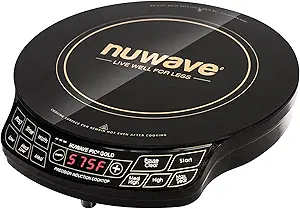
Nuwave Gold Precision Induction Cooktop
This is the pick for cooks who think in degrees rather than dial positions. With 96 pre-programmed settings and a span from 100°F up to 575°F, it covers everything from holding melted chocolate to near commercial searing — a range the Amazon Basics unit simply can’t touch. The shatter-proof ceramic glass also feels more durable than basic tempered glass alternatives. Where it gives ground is power: at 1500W it trails the AMZCHEF and the Nuwave Pro Chef, both at 1800W, so big pots of water take noticeably longer to reach a boil. And unlike the Duxtop LCD Double, you get a single burner only. Still, for tasks where holding an exact temperature matters more than raw speed — sous vide-style holds, candy making, tempering — this model’s precision is the reason to choose it.
Pros:- Widest temperature range in this batch at 100°F–575°F
- 96 pre-programmed settings for repeatable results
- Shatter-proof ceramic glass resists damage
- Efficient energy transfer heats pans directly
Cons:- 1500W output is lower than competing 1800W models
- Single burner with no expansion option
- Requires induction-compatible cookware
Best for: Precision-driven home cooks who make candy, temper chocolate, or hold sauces at exact temperatures
Not ideal for: Boil-it-fast cooks — the 1500W output lags behind 1800W rivals when racing large pots to a rolling boil
- Wattage:1500 watts
- Temperature Range:100°F–575°F
- Preset Settings:96 pre-programmed
- Controls:Touch
- Surface:Shatter-proof ceramic glass
- Heating Elements:1
- Voltage:120 volts
Our verdict“Choose this when exact temperature control matters more than raw boiling speed.”
Nuwave Flex Precision Induction Cooktop
The Flex sits deliberately between the Amazon Basics and its pricier Nuwave siblings. You get 81 preset temperatures across 100°F to 500°F — far finer control than the Basics model’s 8 power levels — without stepping up to the Gold’s full 96-setting spread. That makes it a smart middle path for someone who wants repeatable, degree-by-degree cooking on a smaller budget. Compared with the Nuwave Gold, the 500°F ceiling costs you some high-heat headroom, and the 6.5-inch heating coil demands smaller pans than the wide-coil ChangBERT Enhanced. Newcomers should also expect a learning curve: induction’s instant response and the digital preset system behave differently from a gas flame, and the first few sessions involve some recalibration. For skillets, sauces, and small-batch cooking, though, the balance of precision, price, and footprint is hard to beat.
Pros:- 81 preset temperatures give fine-grained control
- Shatter-resistant ceramic glass surface
- Fast, even heating from the induction coil
- More affordable path into precision cooking than the Gold
Cons:- 6.5-inch heating coil limits usable pan size
- 500°F maximum restricts high-heat searing
- Preset-heavy controls pose a learning curve for induction newcomers
Best for: Budget-conscious cooks who want Nuwave-grade temperature presets for small pans and everyday skillet work
Not ideal for: Large-family cooks — the 6.5-inch coil and 500°F cap restrict both pan size and searing power
- Heating Coil:6.5 inches
- Temperature Range:100°F–500°F
- Preset Temperatures:81
- Controls:Digital touch
- Surface:Shatter-resistant ceramic glass
- Color:Black
Our verdict“The sensible middle ground for small-pan cooking where precise presets matter more than maximum heat.”
Nuwave Pro Chef Induction Cooktop
Positioned as the workhorse of the portable Nuwave line, the Pro Chef pairs 94 preset settings with selectable 900, 1500, or 1800W operation — that wattage flexibility is its real differentiator, letting you dial down power on a crowded circuit in an RV or dorm and push to full output when the grid allows. Compared with the Nuwave Gold, you keep nearly the same 575°F ceiling but gain the higher 1800W top end for faster boils. Against the NSF-certified ChangBERT Commercial Grade, the Pro Chef feels more consumer-friendly in its controls but lacks that certification, which matters if you’re outfitting a licensed food operation. The shatter-proof ceramic glass and patented insulation handle sustained sessions well. One caution: even at max setting, the temperature ceiling may fall short of true restaurant-style searing, and it still demands a properly rated outlet.
Pros:- Selectable 900/1500/1800W settings adapt to limited circuits
- 94 presets with a 100°F–575°F range
- Shatter-proof ceramic glass built for sustained use
- Lightweight enough for genuine portability
Cons:- Lacks the NSF certification of commercial rivals
- Top temperature may disappoint hardcore searing enthusiasts
- Needs an outlet that can handle full 1800W draw
Best for: Serious home cooks and mobile setups — RVs, dorms, catering side gigs — that need flexible power draw and near-commercial control
Not ideal for: Licensed commercial kitchens, which should favor NSF-certified units like the ChangBERT line instead
- Wattage Settings:900 / 1500 / 1800 watts
- Temperature Range:100°F–575°F
- Preset Settings:94
- Surface:Shatter-proof ceramic glass
- Insulation:Patented insulation technology
- Portability:Lightweight for RVs, dorms, campsites
Our verdict“The most adaptable single-burner here for cooks who move between kitchens and circuits with different power budgets.”
AMZCHEF Portable Induction Cooktop
Where the Amazon Basics keeps things coarse with 8 power levels, this AMZCHEF doubles down on granularity: 20 power levels paired with 20 temperature settings, giving everyday cooks meaningful fine control without the preset overload of the Nuwave Gold’s 96 options. At a full 1800W, it boils faster than the 1500W Gold, and the 4-to-10-inch cookware range is the widest pan compatibility in this batch — no more checking whether your favorite skillet fits the coil. Practical touches like a safety lock and a waste-heat reminder (which alerts you the surface is still hot) show real attention to daily use. The tradeoffs are geographic and material: it’s built strictly for 110–120V North American outlets, so travelers abroad are out of luck, and performance depends entirely on using proper magnetic-bottomed cookware.
Pros:- 20 power and 20 temperature levels for genuinely fine control
- Accepts pans from 4 to 10 inches — the widest range here
- Safety lock plus waste-heat reminder
- At 5.5 pounds, it’s genuinely easy to move between rooms
Cons:- Locked to 110–120V North American power only
- Performance drops sharply with non-magnetic cookware
- Touch panel requires deliberate presses and can lag when hands are wet
Best for: Everyday home cooks who want maximum adjustment granularity and pan-size flexibility at a midrange price
Not ideal for: International travelers or anyone with a cabinet full of aluminum or non-magnetic cookware
- Wattage:1800W
- Power Levels:20
- Temperature Settings:20
- Controls:Touch
- Surface:Ceramic glass
- Compatible Pans:4″–10″ with magnetic bottoms
- Weight:5.5 pounds
- Voltage:120V
Our verdict“The best balance of control, pan compatibility, and portability for daily cooking at a fair price.”
ChangBERT Portable Induction Cooktop Enhanced Version, 1800W, Large Heating Coil, NSF Certified
This ChangBERT stands out for its commercial-grade certifications — NSF, UL, and ETL — which means it can legally be used in food trucks, catering operations, and professional kitchens where most home-focused units fall short. The 8-inch heating coil is larger than the typical 6-inch coils on models like the Duxtop 8100MC, translating to fewer hot spots and better results when searing or working with wide pots. A 100 lb load capacity and a 12-hour timer further separate it from consumer options that shut down after shorter runs. The tradeoff is footprint and appetite: it eats counter space that a compact single-burner like the Duxtop wouldn’t, and its 1800W draw demands a dedicated outlet. Compared with the other ChangBERT in this lineup, this Enhanced Version prioritizes longer run times and heavier-duty use over button-pushing simplicity.
Pros:- NSF, UL, and ETL certification for legitimate commercial use
- 8-inch coil delivers more even heat than smaller consumer burners
- 100 lb maximum load handles heavy commercial stock pots
- 12-hour timer supports long, unattended cooking sessions
Cons:- Large footprint takes up serious counter space
- Requires magnetic cookware and a robust 120V circuit
- Power-hungry at sustained high settings
Best for: Food service professionals, caterers, and food truck operators who need NSF-certified equipment that can run for hours under heavy pots
Not ideal for: Apartment dwellers or anyone with cramped counters — the oversized coil and housing make it bulkier than compact home units
- Power:1800W
- Preset Power Levels:9
- Temperature Settings:18 presets
- Heating Coil Diameter:8 inches
- Certification:NSF, UL, ETL
- Material:Stainless steel and glass
- Maximum Load:100 lbs
- Timer:12 hours
Our verdict“If you cook professionally or need certified equipment for long shifts, this is the burner built for that job — home cooks with limited space should look smaller.”
Duxtop LCD Portable Double Induction Cooktop 1800W Countertop Burner 9620LS
Having two independently controlled heating zones on a single countertop unit is the core appeal here, and the 9620LS executes it with a clean LCD touch panel that feels more refined than the knob-plus-touch hybrid on the AMZCHEF double burner. Each zone runs its own power or temperature mode, so you can simmer a sauce on one side while boiling pasta on the other — something no single-burner model in this roundup can do. Safety is handled well too, with a child lock plus low and high voltage warnings that cheaper units omit. The catch: that 1800W total is shared, not doubled, so pushing both zones hard means splitting the power. And cookware must be at least 5 inches in diameter or the zones won’t register it at all.
Pros:- Two heating zones with fully independent controls
- Touch panel with clear LCD display
- Child lock and voltage warnings add real safety
- Lightweight at 12.8 lbs for outdoor or portable use
Cons:- 1800W must be split between both zones
- Cookware must be magnetic and at least 5 inches in diameter
- No oven or secondary cooking functions
Best for: Home cooks who want a true two-zone cooking setup for holidays, entertaining, or replacing a missing stovetop burner
Not ideal for: Anyone expecting full-power output on both burners at once — 1800W is the shared ceiling, not per zone
- Heating Elements:2
- Wattage:1800 watts (shared)
- Controls:Touch with LCD
- Voltage:120 volts
- Material:Stainless steel
- Weight:12.8 pounds
- Color:Dark black
Our verdict“The most practical pick in this roundup if two simultaneous cooking zones matter more than raw single-burner power.”
AMZCHEF Double Induction Cooktop, 1800W 2 Burner with Griddle Pan, Grey
The bundled removable non-stick griddle pan is what makes this AMZCHEF more than just another double burner — it turns the unit into a breakfast station for pancakes, bacon, and grilled sandwiches without requiring you to own induction-ready flatware. Compared with the Duxtop 9620LS, it trades the LCD panel for a hybrid touch-and-knob interface, which some cooks will actually prefer when their fingers are wet or floury. Each burner has its own controls, and the ceramic surface wipes clean easily. The compromises are familiar ones: the 1800W total splits across both burners, and the burners accept a narrower cookware range (4.72 to 9.44 inches) than wider-coil single units like the ChangBERT Enhanced. If your vision of induction cooking includes griddled food, no other pick here covers both bases at once.
Pros:- Included non-stick griddle pan adds a whole cooking mode out of the box
- Independent controls for each burner with touch and knob options
- Easy-to-clean ceramic surface
- Works with cast iron, steel, and enameled iron cookware
Cons:- 1800W total output is shared, capping both-burner cooking
- Cookware diameter limited to 4.72–9.44 inches
- Griddle adds another piece to store
Best for: Buyers who want one appliance that handles both pot-based cooking and griddle favorites like pancakes, burgers, and quesadillas
Not ideal for: Power users who need both burners at high heat simultaneously — the shared 1800W cap limits dual-zone performance
- Power:1800W total (2 x 1100W burners)
- Voltage:120V/110V
- Burners:2
- Griddle Pan:Removable, non-stick
- Cookware Compatibility:Cast iron, steel, enameled iron
- Cookware Diameter:4.72 to 9.44 inches
Our verdict“The best choice if versatility — pot cooking plus griddling — matters more than maximum power or a premium display.”
ChangBERT Induction Cooktop, Commercial Grade Portable Cooker, NSF Certified, 8″ Heating Coil, 10-Hour Timer
Think of this as the practical sibling of the ChangBERT Enhanced Version: same NSF-certified stainless housing, same 8-inch coil, same 9 power levels and 18 temperature settings — but with a push-button interface instead of a sealed glass panel, and a 10-hour timer rather than 12. For most buyers, those differences are minor, and the solid warranty coverage (two years home, one year commercial) is a genuine differentiator in a category where support is often thin. At just 6.1 lbs and 2.8 inches tall, it slides into a cabinet far more easily than most NSF-rated gear. The drawbacks are real, though: push buttons are less intuitive than the touch controls on the Duxtop 8100MC, and 1800W won’t keep up with true high-volume kitchen demands.
Pros:- NSF certification and commercial-grade stainless housing at an accessible position
- 2-year home warranty beats most competitors in this class
- Slim 2.8-inch profile and 6.1 lb weight make it genuinely portable
- Auto-pan detection and overheat protection built in
Cons:- Push-button controls feel less intuitive than touch panels
- 1800W caps performance for high-volume cooking
- Requires standard 120V — no higher-voltage compatibility
Best for: Budget-conscious buyers who want NSF-certified, commercial-grade durability and warranty coverage without paying for the Enhanced Version’s extras
Not ideal for: Cooking professionals running nonstop high-volume service — 1800W and a 10-hour ceiling will bottleneck serious output
- Wattage:1800W
- Voltage:120V
- Heating Element:Induction, single burner
- Coil Diameter:8 inches
- Material:Stainless steel
- Dimensions:15″D x 12.2″W x 2.8″H
- Weight:6.1 pounds
- Timer:10 hours
- Warranty:2 years home / 1 year commercial
Our verdict“A smart middle path for buyers who want commercial build quality and certification while skipping the premium features of the Enhanced Version.”
Duxtop 1800W Portable Induction Cooktop Countertop Burner, Gold 8100MC
For straightforward, no-frills induction cooking, the 8100MC covers the fundamentals better than anything else at its price point: 15 temperature levels, 15 power levels, a countdown timer up to 170 minutes, and auto-pan detection that cuts power the moment you lift the pot. It’s the lightest, most storage-friendly option here compared with dual-zone units like the Duxtop 9620LS or the AMZCHEF griddle combo — but that also means one pot at a time. The 140°F to 460°F range handles everything from gentle melting to hard searing, though the Nuwave Double Pro reaches higher temperatures for extreme-heat cooking. Two quirks worth knowing: some layered cookware produces a faint high-pitched whine, and you’ll need induction-ready pans if your current set is aluminum or copper.
Pros:- 15 power and 15 temperature levels for fine control
- Compact and lightweight for storage and travel
- Auto-pan detection adds safety and saves energy
- Countdown timer up to 170 minutes for unattended cooking
Cons:- Requires induction-compatible cookware — an added cost if your pans are aluminum or copper
- Some layered cookware produces audible high-pitched noise
- 120V only, limiting use outside North America
Best for: First-time induction buyers, dorm and RV cooks, and anyone wanting an affordable extra burner without complexity
Not ideal for: Households cooking multi-dish meals — a single zone with a 170-minute timer ceiling limits big-batch sessions
- Power:1800 watts
- Voltage:120V
- Amperage:15A
- Temperature Range:140°F to 460°F
- Control Levels:15 power / 15 temperature
- Timer:Up to 170 minutes
- Cookware Compatibility:Cast iron, stainless steel, enameled aluminum
Our verdict“The simplest, most affordable entry point into induction cooking — ideal as a first unit or spare burner, as long as one zone is enough.”
How We Picked
My ranking logic starts with a question every induction buyer faces: what is this burner actually replacing? For single-burner models, I weighted heating coil size, temperature granularity, and control-panel usability, because those three factors determine whether a cooktop handles delicate sauces as well as rapid boils. For double-burner units, the criteria shifted toward power distribution between zones, footprint, and whether the unit could realistically serve as a temporary stovetop during kitchen renovations or in small apartments.
Build quality separated the commercial tier from the consumer tier. NSF-certified models like the ChangBERT line and Nuwave Pro Chef were judged against higher durability standards — stainless construction, larger coils, and longer-duty timers — while consumer models were evaluated on convenience features: presets, child locks, timers, and display readability. Finally, I factored in long-term ownership costs, including glass-surface fragility, warranty expectations, and how forgiving each model is of beginner mistakes like using incompatible cookware. No model ranked well on specs alone; every placement reflects who the stove is actually for.
Factors to Consider When Choosing Best Induction Stoves
Before picking a specific model, it helps to understand what actually separates a satisfying induction stove from a disappointing one. These are the factors that shaped my rankings — and the mistakes I see buyers make most often.Single Burner or Double: Match the Stove to Your Real Cooking Habits
The biggest mistake buyers make is assuming a double cooktop means double the power. Every double-burner model in this roundup runs on a standard 120V outlet capped at 1800W total, so power gets shared or split between zones — you cannot boil pasta at full blast on both burners at once. If you regularly cook one-pot meals, reheat, or need a burner beside your grill, a single-burner unit is the smarter buy: it costs less, takes up less counter space, and delivers all 1800W to one pan. Double burners make sense for temporary kitchens, dorms, RVs, and small apartments where they serve as the primary cooking surface. Be honest about whether you actually cook two things simultaneously; most people who buy doubles end up using one zone 80% of the time.
Heating Coil Size Matters More Than Wattage
Wattage gets all the marketing attention, but the diameter of the induction coil determines how evenly your pan heats. A small coil — like the 6.5-inch one on the Nuwave Flex — concentrates energy in the center of the pot, which means scorching in the middle and cool edges on anything wider than a saucepan. Larger coils, like the 8-inch commercial-grade ones on the ChangBERT models, distribute magnetic energy across more cookware surface, producing even sears and stable simmers. If you cook with stockpots, griddles, or large skillets, coil size should be your first spec check, not wattage. A 1800W burner with a tiny coil will underperform a modest-wattage burner with a wide coil on most real-world tasks.
Temperature Control: Presets vs. Precision Dials
Induction stoves fall into two control philosophies. Consumer models like the AAOBOSI and AMZCHEF offer 20 or more power and temperature levels plus preset cooking modes, which makes them approachable but sometimes fiddly — you may tap a button ten times to adjust heat. Precision-focused models like the Nuwave Gold let you set exact temperatures in fine increments, which matters enormously for candy-making, deep frying, and holding sauces. Commercial models like the ChangBERT Chef Edition favor straightforward dial-and-go operation built for speed in a working kitchen. Decide whether you want the stove to make decisions for you or give you raw control; beginners almost always prefer presets, while experienced cooks find them limiting.
Cookware Compatibility: The Cost Nobody Budgets For
Induction only works with magnetic cookware — cast iron, most stainless steel, and carbon steel, but not aluminum, copper, or non-magnetic stainless. Before buying any induction stove, test your current pans with a refrigerator magnet: if it doesn’t cling firmly to the base, the pan won’t heat. Many buyers discover their entire cookware set is incompatible and face an unplanned replacement cost that can exceed the price of the stove itself. Also check your largest pan’s base diameter against the burner’s coil size, since undersized pans on large coils trigger error codes or heat inefficiently. If you own mostly aluminum or nonstick-anodized cookware, factor new pots into your total budget before choosing a premium model.
Durability and Glass Surface Realities
Nearly every model here uses a ceramic glass cooking surface, which is easy to clean but vulnerable to impact, thermal shock, and sugar spills that etch permanently. Commercial-tier units like the Nuwave Pro Chef and ChangBERT line justify their sturdier build with stainless housings and components rated for all-day use, while budget models use lighter plastics that flex and wear faster under daily duty cycles. If your stove will live on the counter and see daily cooking, spending more on a heavier chassis pays off within a couple of years. For occasional use — vacation homes, holiday overflow cooking, dorm rooms — the lighter consumer models are perfectly adequate. Also consider the display and buttons: touch panels look sleek but can fail or become unresponsive with grease buildup, whereas physical buttons survive messier kitchens.
Safety Features Worth Paying For
Induction is inherently safer than gas or resistive electric — the surface doesn’t stay scorching hot and there’s no open flame — but feature differences still matter depending on your household. Child locks, like the one on the Amazon Basics model, prevent curious hands from activating a burner, while auto shutoff and pan detection cut power the moment cookware is removed, preventing forgotten-burner accidents. Overheat protection guards against running a burner empty or blocking its ventilation. These features matter most in households with kids, pets, or elderly family members, and in shared spaces like office kitchens. If none of those apply to you, safety features are nice-to-have rather than must-have, and you can prioritize cooking performance instead.
Frequently Asked Questions
Can a portable induction stove really replace my regular stovetop?
Yes, but with clear limits. A double-burner unit like the Duxtop 9620LS or Nuwave Double Pro can handle most daily cooking — sautéing, boiling, simmering, frying — and many people use them as their sole stove in small apartments or during kitchen renovations. The constraint is total power: with 1800W shared across two zones, you can’t run two high-heat tasks at once, so a weeknight stir-fry plus pasta simultaneously means sequencing your cooking. Also expect to give up oven-adjacent conveniences like a built-in griddle or bridge zone. For one to two people, the swap is genuinely workable; for a family of five cooking multiple dishes nightly, a portable unit becomes a supplement rather than a replacement.
Why does my induction cooktop show an error code with some pans?
That error is almost always cookware incompatibility. Induction burners create a magnetic field, and if your pan’s base isn’t ferromagnetic, the stove detects no pan (or an unusable one) and shuts down as a safety measure. Test any pan with a simple magnet — firm cling means it works, weak or no cling means it won’t. The other common cause is pan size: if your cookware’s base is much smaller than the burner’s coil, many models refuse to heat it to avoid wasting energy and damaging the glass. Some budget models are stricter about this than commercial units with oversized coils like the ChangBERT 8-inch model. Cast iron, enameled cast iron, carbon steel, and magnetic stainless steel are the reliable choices.
Are NSF-certified induction stoves worth the extra cost for home use?
For most home cooks, no — but for heavy users, absolutely. NSF certification means the unit meets commercial food-service standards for materials, cleanability, and durability, which translates into stainless construction, robust components, and the ability to run for hours daily without overheating. Models like the ChangBERT line and Nuwave Pro Chef are built for restaurant duty, so home use barely stresses them. The tradeoff is that commercial units often skip consumer conveniences — fewer presets, plainer interfaces, less intuitive controls — because professional cooks don’t want them. If you cook once or twice a day, a consumer model like the Duxtop 8100MC will last years. If your burner runs all day — catering, meal prep businesses, canning marathons — the commercial tier earns its price.
Do I need a special electrical outlet for an 1800W induction stove?
Generally no — 1800W is deliberately designed to stay within the limits of a standard 120V household outlet, which is why nearly every portable induction stove maxes out at exactly that figure. What matters is what else shares that circuit. If your induction burner is plugged into the same circuit as a microwave, toaster, or kettle, you’ll trip the breaker the moment both draw power together. Kitchens often have multiple circuits, so test which outlets are on which breaker before settling on a permanent spot. For double-burner units, this matters even more since the whole unit draws its 1800W through one plug. Dedicated counter space on its own circuit is the stress-free setup.
What’s the real difference between the cheap and expensive single-burner models?
Raw heating power is nearly identical across the category — 1800W is 1800W — so the money buys refinement rather than speed. Pricier models like the Nuwave Gold and Duxtop 9620LS offer finer temperature increments, better displays, more durable glass, and smarter power management that holds a simmer without cycling on and off. Budget models like the Amazon Basics and AAOBOSI units do the core job well but use coarser power steps, so hitting and holding a precise 185°F for hollandaise means more trial and error. Build quality also diverges: cheaper housings flex, and touch controls can get finicky after a year of greasy fingers. If you mostly boil, fry, and reheat, the budget tier is honest value; if you cook temperature-sensitive dishes regularly, precision controls justify the premium.
Conclusion
Mapping these 15 models to buyer types makes the decision straightforward. For best overall, the Duxtop 9620LS double cooktop wins on flexibility — its power-sharing between zones and precise LCD controls make it the most capable all-arounder for people who want one device that does everything. The best value pick is the Duxtop 8100MC, which delivers honest 1800W performance and reliable controls at an entry-level price, with the Amazon Basics model as the pick if a child lock matters in your home. On the premium end, the ChangBERT Chef Edition represents the commercial tier — NSF certification, a large 8-inch coil, and a 10-hour timer make it the choice for heavy daily use, with the Nuwave Pro Chef as a close alternative in a more polished package.
For beginners, the Nuwave Gold stands out for its forgiving preset programs and precise temperature display, taking the guesswork out of induction cooking. For specific needs: the Nuwave Double Pro suits cooks who want the widest temperature range for techniques like searing and low-temperature holding; the AMZCHEF double burner with griddle pan is ideal for anyone who wants a two-zone setup with breakfast cooking covered out of the box; and the compact Nuwave Flex fits dorm rooms and tight counters where a 6.5-inch coil matches the small pans you’ll actually use. Whatever you choose, verify your cookware is magnetic first — it’s the one mistake that ruins an otherwise perfect induction upgrade.
Fall Picks
fall essentials
As an affiliate, we earn on qualifying purchases.