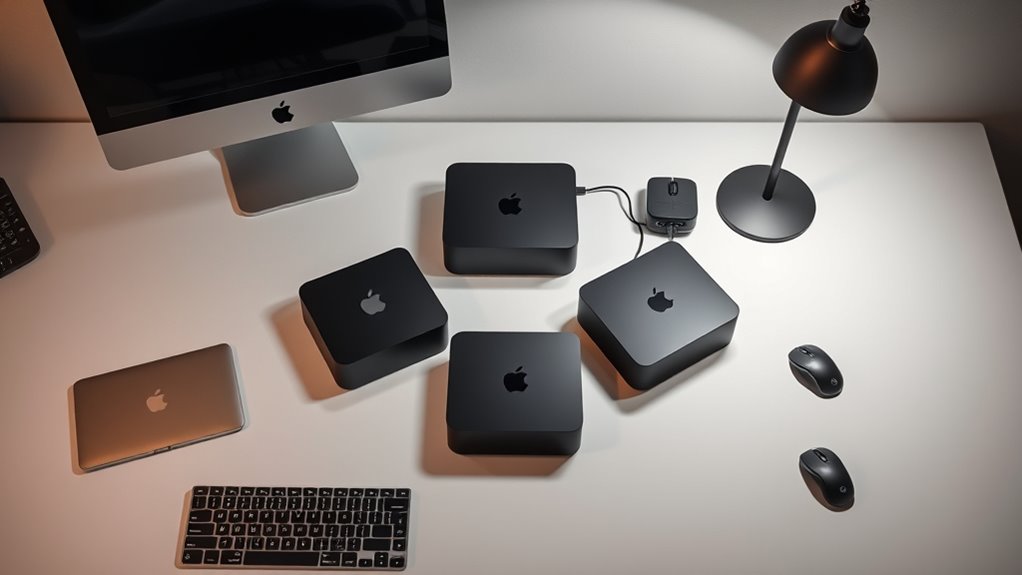

For most buyers seeking a compact workstation Mac, I’d start with the Apple Mac Studio with M5 Max: its high-end chip and 64GB of memory suit demanding creative workloads better than the Mac mini lineup. The 2026 Mac mini with M5 Pro is a more space-conscious choice for buyers who need strong performance without stepping up to a Studio, while the M4 Mac mini is the simpler pick for everyday work. The main tradeoffs are processing headroom, memory and storage capacity, footprint, and whether a renewed older model fits your workload. Older Intel and M1 options may handle basic tasks, but their age and lower specs narrow their appeal as workstation purchases. Read on for the full breakdown of these compact workstation Mac picks and how I’d match each one to a buyer.

Get kitchen gear delivered free with Prime
- Fast, free delivery on millions of items
- Prime Video, Amazon Music and more included
- Member-only deals all year
Complete the kit

Key Takeaways
- The M5 Max Mac Studio leads for demanding work: its 64GB memory and 1TB SSD configuration give it more headroom than the listed Mac mini options.
- The M5 Pro Mac mini is the compact performance compromise: it targets buyers who want a newer Pro-tier desktop without choosing a Studio.
- The M4 Mac mini is the practical everyday pick: its 16GB memory and 512GB SSD make it a more balanced starting point than the older, lower-capacity M1 and M2 configurations.
- Storage varies enough to affect the decision: the M4 Max Studio’s 2TB SSD is better suited to local project libraries than the 512GB and 256GB configurations.
- Renewed older Macs carry a different kind of tradeoff: the 2018 Intel and 2020 M1 minis may suit light or legacy needs, but they offer less runway than newer Apple silicon models.
| Apple Mac mini (2024) with M4 Chip, 10-Core CPU, 16GB Memory, 512GB SSD, Silver (Renewed) |  | Best Renewed Compact Mac | Processor: Apple M4, 10-core CPU | Memory: 16GB | Storage: 512GB SSD | VIEW ON AMAZON | See Our Full Breakdown |
| Apple Mac Studio with M5 Max, 18-core CPU, 40-core GPU, 64GB Memory, 1TB SSD |  | Best for Demanding Creative Work | Processor: Apple M5 Max, 18-core CPU | Graphics: 40-core integrated GPU | Memory: 64GB unified memory | VIEW ON AMAZON | See Our Full Breakdown |
| Apple Mac mini (Late 2018), 3.0 GHz Intel Core i5, 16 GB RAM, 512 GB SSD, Space Gray (Renewed) |  | Best for Legacy Intel Mac Needs | Release: Late 2018 | Processor: Intel Core i5-8500B, 3 GHz, 6 cores | Memory: 16GB DDR4; maximum 16GB | VIEW ON AMAZON | See Our Full Breakdown |
| Apple Mac mini Desktop Computer with M5 Pro Chip (2026) |  | Best Compact Workstation | Chip: Apple M5 Pro | Dimensions: 5 × 5 × 1.97 inches | Weight: 1.61 pounds | VIEW ON AMAZON | See Our Full Breakdown |
| Apple Mac mini with M2 chip, 16GB unified memory, 256GB SSD, Silver |  | Best for Basic Mac Work on a Tight Footprint | Processor: Apple M2, 8-core CPU | Memory: 16GB unified memory | Storage: 256GB SSD | VIEW ON AMAZON | See Our Full Breakdown |
| Apple Mac Studio (2026) with M5 Max Chip |  | Best Compact High-Memory Workstation | Chip: Apple M5 Max | Memory: Up to 128GB unified memory | Memory bandwidth: Up to 614GB/s | VIEW ON AMAZON | See Our Full Breakdown |
| Apple Mac mini (2026) with M5 Pro, 24GB Memory, 1TB SSD |  | Best Compact Pro Value | Processor: Apple M5 Pro, 15-core CPU and 16-core GPU | Memory: 24GB unified memory | Storage: 1TB SSD | VIEW ON AMAZON | See Our Full Breakdown |
| Apple Mac Studio with M4 Max, 16-Core CPU, 40-Core GPU, 64GB Unified Memory, 2TB SSD |  | Best Specified Creative Workstation | Processor: Apple M4 Max, 16-core CPU | Graphics: 40-core GPU | Unified memory: 64GB | VIEW ON AMAZON | See Our Full Breakdown |
| Apple 2023 Mac Studio with M2 Max, 12-Core CPU, 30-Core GPU, 32GB RAM, 512GB SSD (Renewed) |  | Best Renewed Studio for Legacy Workflows | Year: 2023 | Processor: Apple M2 Max, 12-core CPU | GPU: 30-core | VIEW ON AMAZON | See Our Full Breakdown |
| Apple Mac mini (2020) with M1 Chip, 8GB RAM, 256GB SSD, Silver (Renewed) |  | Best for Basic Mac Desktop Tasks | Year: 2020 | Processor: Apple M1, 8-core, 3.1 GHz | Memory: 8GB unified memory | VIEW ON AMAZON | See Our Full Breakdown |
| compact workstation macs mac studio pick | Processor | Memory | Storage | Weight |
|---|---|---|---|---|
| Apple Mac mini | Apple M4, 10-core CPU | 16GB | 512GB SSD | 2.9 pounds |
| Apple Mac Studio with M5 Max | Apple M5 Max, 18-core CPU | 64GB unified memory | 1TB SSD | 4 pounds |
| Apple Mac mini | Intel Core i5-8500B, 3 GHz, 6 cores | 16GB DDR4; maximum 16GB | 512GB SSD | — |
| Apple Mac mini Desktop Compute | — | — | — | 1.61 pounds |
| Apple Mac mini with M2 chip | Apple M2, 8-core CPU | 16GB unified memory | 256GB SSD | 1.18 kg |
| Apple Mac Studio | — | Up to 128GB unified memory | — | 5.94 pounds |
| Apple Mac mini | Apple M5 Pro, 15-core CPU and 16-core GPU | 24GB unified memory | 1TB SSD | 4 pounds |
| Apple Mac Studio with M4 Max | Apple M4 Max, 16-core CPU | — | 2TB SSD | 10.8 pounds |
| Apple 2023 Mac Studio with M2 | Apple M2 Max, 12-core CPU | 32GB | 512GB SSD | — |
| Apple Mac mini | Apple M1, 8-core, 3.1 GHz | 8GB unified memory | 256GB SSD | 1.18 kg |
More Details on Our Top Picks
Apple Mac mini (2024) with M4 Chip, 10-Core CPU, 16GB Memory, 512GB SSD, Silver (Renewed)
The 2024 Mac mini with M4 is my pick for a small-footprint desktop when everyday creative work matters more than workstation-class graphics. Its 5 × 5-inch chassis is easy to place on a crowded desk, while 16GB of memory and a 512GB SSD give it a more balanced starting point than the M2 Mac mini with 256GB storage. Front USB-C and headphone connections also make routine accessory changes less awkward, with Thunderbolt, HDMI, and Gigabit Ethernet around back. The tradeoff is its renewed condition and 90-day limited warranty, which offer less reassurance than a new machine with longer manufacturer coverage. I’d choose it for a compact general-purpose Mac, not sustained GPU-heavy production or buyers who want the security of a new unit.
Pros:- Compact 5 × 5-inch footprint fits tight workspaces.
- M4 10-core CPU is a newer platform than the Intel 2018 Mac mini.
- 512GB SSD provides more room than the M2 Mac mini’s 256GB drive.
- Front USB-C and rear Thunderbolt, HDMI, and Gigabit Ethernet support varied desk setups.
Cons:- Renewed condition may not suit buyers seeking a new machine.
- 90-day limited warranty is shorter than the one-year coverage listed for the M5 Max Mac Studio.
- 16GB memory and integrated graphics are less suited to demanding workstation-scale workloads.
Best for: Desk-limited buyers who want a recent M4 Mac for office work, coding, and moderate creative projects and are comfortable purchasing renewed hardware.
Not ideal for: Creative professionals running sustained GPU-intensive workloads or buyers who want new condition and a longer manufacturer warranty.
- Processor:Apple M4, 10-core CPU
- Memory:16GB
- Storage:512GB SSD
- Dimensions:5 × 5 × 2 inches
- Weight:2.9 pounds
- Ports:Thunderbolt, HDMI, Gigabit Ethernet, front USB-C, headphone jack
- Wireless:Wi-Fi 802.11ax, Bluetooth 5.3
- Condition and warranty:Renewed; 90-day limited warranty
Our verdict“Choose this renewed M4 Mac mini for a capable, space-saving everyday desktop if its condition and shorter warranty are acceptable.”
Apple Mac Studio with M5 Max, 18-core CPU, 40-core GPU, 64GB Memory, 1TB SSD
Among these compact workstation Macs, the M5 Max Mac Studio is the clear choice for workloads that can use its 18-core CPU, 40-core GPU, and 64GB unified memory. That extra headroom separates it from the M4 Mac mini, which takes up less desk space but has a more modest configuration for large media projects, graphics work, or on-device AI tasks. A 1TB SSD also gives active projects more local room than the 512GB drives in the two renewed Mac minis. The Studio remains compact beside a conventional tower, but its 7.7-inch-square footprint is larger than a Mac mini’s, and its single listed HDMI port may constrain some display arrangements. I’d reserve this premium-class configuration for buyers who can use its GPU and memory capacity rather than paying for unused capability.
Pros:- 40-core integrated GPU is better suited to graphics-heavy work than the Mac mini options listed.
- 64GB unified memory accommodates larger projects and demanding multitasking.
- 1TB SSD offers more onboard workspace than the 512GB renewed minis.
- One-year limited manufacturer coverage is longer than the 90-day coverage listed for several alternatives.
Cons:- Larger 7.7 × 7.7-inch footprint than the 5-inch-square Mac minis.
- Single HDMI port is listed, which may limit direct display connections.
- Its high-end CPU and GPU configuration may be unnecessary for everyday desktop tasks.
Best for: Video, 3D, and AI practitioners who need substantial unified memory and GPU capability in a compact desktop.
Not ideal for: General office users, casual creators, or anyone prioritizing the smallest footprint over graphics and memory capacity.
- Processor:Apple M5 Max, 18-core CPU
- Graphics:40-core integrated GPU
- Memory:64GB unified memory
- Storage:1TB SSD
- Dimensions:7.7 × 7.7 × 3.7 inches
- Weight:4 pounds
- Connectivity:Bluetooth, Ethernet, HDMI, Thunderbolt 32, Wi-Fi
- Warranty:1-year limited manufacturer coverage
Our verdict“Pick the M5 Max Mac Studio when GPU-heavy creative or AI work warrants its larger footprint and substantial memory.”
Apple Mac mini (Late 2018), 3.0 GHz Intel Core i5, 16 GB RAM, 512 GB SSD, Space Gray (Renewed)
This 2018 Intel Mac mini has a narrower role than the newer M4 and M5 Pro minis: it makes sense for buyers tied to Intel-era software or an existing Intel-based setup. Its six-core Core i5, 16GB DDR4, and 512GB SSD provide a familiar desktop configuration, but its Intel UHD Graphics 630 is far behind the GPU resources in the M5 Max Mac Studio and it is an older platform than either Apple silicon mini here. The listed memory tops out at 16GB, limiting room for heavier multitasking. It runs macOS Ventura and comes renewed with compatible, non-original accessories and a 90-day replacement or refund window. I’d avoid it as a forward-looking compact workstation; the M4 Mac mini is the more suitable general-purpose choice unless Intel compatibility is the deciding factor.
Pros:- Six-core Intel Core i5 suits buyers with Intel-specific software requirements.
- 16GB DDR4 memory and a 512GB SSD provide a useful basic configuration.
- Compact Mac mini format takes less desk space than the Mac Studio.
- Renewed listing includes a 90-day replacement or refund window.
Cons:- Older Intel platform is a less suitable starting point than the M4 Mac mini for general new purchases.
- Integrated Intel UHD Graphics 630 is limited for modern GPU-heavy work.
- Memory is capped at 16GB, and included accessories are compatible but not original.
Best for: Buyers who specifically need an Intel-based Mac mini for legacy software, testing, or an existing Intel Mac workflow.
Not ideal for: People starting a new workstation setup, running graphics-intensive work, or needing room to expand beyond 16GB of memory.
- Release:Late 2018
- Processor:Intel Core i5-8500B, 3 GHz, 6 cores
- Memory:16GB DDR4; maximum 16GB
- Storage:512GB SSD
- Graphics:Integrated Intel UHD Graphics 630
- Operating system:macOS Ventura
- Condition:Renewed; compatible, non-original accessories
- Warranty:90-day replacement or refund window
Our verdict“Choose this renewed 2018 Mac mini only when Intel compatibility matters more than newer performance and platform longevity.”
Apple Mac mini Desktop Computer with M5 Pro Chip (2026)
The M5 Pro Mac mini is the strongest fit here for buyers who need workstation-oriented capability without moving up to the larger Mac Studio. Its 5 × 5-inch body weighs 1.61 pounds and pairs a stated M5 Pro chip with Thunderbolt 5, 2.5Gb Ethernet, Wi-Fi 7, and support for up to three displays. Compared with the M4 Mac mini, it is aimed at more demanding technical, creative, and on-device AI work; compared with the M5 Max Mac Studio, it favors desk space over the Studio’s specified 40-core GPU and 64GB memory configuration. The provided details do not state memory or storage capacity, so buyers should verify the configuration before choosing it for large projects. A monitor and peripherals are separate purchases.
Pros:- M5 Pro chip is positioned for demanding creative, technical, and on-device AI workflows.
- Small 5 × 5-inch chassis takes less room than the Mac Studio.
- Three Thunderbolt 5 ports and 2.5Gb Ethernet offer a broad wired setup.
- Supports up to three external displays and includes Wi-Fi 7 and Bluetooth 6.
Cons:- Memory and storage capacities are not specified in the supplied product details.
- Display and peripherals may need to be purchased separately.
- The listed specs do not provide a CPU or GPU core count for direct comparison with the M5 Max Mac Studio.
Best for: Developers and compact-studio creators who want a small desktop with modern connectivity and support for a multi-display setup.
Not ideal for: Buyers who need confirmed high memory or storage capacity, maximum GPU performance, or a computer bundled with a display and peripherals.
- Chip:Apple M5 Pro
- Dimensions:5 × 5 × 1.97 inches
- Weight:1.61 pounds
- Ports:Three Thunderbolt 5, HDMI, 2.5Gb Ethernet, two USB-C, headphone jack
- Wireless:Wi-Fi 7, Bluetooth 6
- External display support:Up to three displays
- Model number:MHQN4LL/A
- Operating system:macOS
Our verdict“Choose the M5 Pro Mac mini for a compact, connected workstation setup, after confirming its memory and storage configuration meets your workload.”
Apple Mac mini with M2 chip, 16GB unified memory, 256GB SSD, Silver
The M2 Mac mini is the straightforward choice for routine desktop tasks when you want Apple silicon in a small computer and do not need a large internal drive. Its 16GB unified memory is a stronger starting point for multitasking than a basic low-memory desktop, but the 256GB SSD is half the capacity of the renewed M4 Mac mini’s drive and leaves less room for media libraries or large project files. The M2’s eight-core CPU is also an older generation than the M4 and M5 Pro options, so I would not treat it as a substitute for the M5 Max Mac Studio in GPU-heavy work. Wi-Fi and Bluetooth help keep the desk uncluttered, but the supplied details do not list specific ports. This pick is for everyday work, not a growing creative workstation.
Pros:- 16GB unified memory supports everyday multitasking.
- Apple M2 eight-core CPU provides an Apple silicon platform for general desktop use.
- Compact desktop design fits a small workspace.
- Built-in Wi-Fi and Bluetooth can reduce cable clutter.
Cons:- 256GB SSD provides less room than the 512GB drives in the M4 and renewed Intel Mac minis.
- M2 is an older chip generation than the M4 and M5 Pro options in this roundup.
- 90-day limited warranty is shorter than the one-year coverage listed for the M5 Max Mac Studio.
Best for: Home-office users and students who want a compact Apple silicon desktop for browsing, documents, communication, and modest multitasking.
Not ideal for: Video editors, large-file users, or buyers who need substantial local storage and newer-generation performance.
- Processor:Apple M2, 8-core CPU
- Memory:16GB unified memory
- Storage:256GB SSD
- Graphics:Integrated Apple M2 graphics
- Dimensions:10 × 9.75 × 4.75 inches
- Weight:1.18 kg
- Connectivity:Wi-Fi 802.11a/b/g/n/ac/ax, Bluetooth
- Warranty:90-day limited warranty
Our verdict“Pick the M2 Mac mini for everyday desktop work if 256GB is enough and you do not need the newer chips or workstation-class graphics.”
Apple Mac Studio (2026) with M5 Max Chip
I rank this Mac Studio first for buyers who need workstation-class capacity without a tower-sized desktop. The M5 Max, support for up to 128GB of unified memory, and up to 614GB/s memory bandwidth suit demanding creative work and on-device AI workloads. Its 7.76-inch square footprint is far smaller than the dimensions listed for the M4 Max Mac Studio in this lineup, though that listing’s measurements are inconsistent, so I would verify them before buying. Four Thunderbolt 5 ports, HDMI, USB-A, SDXC, Wi-Fi 7, and Bluetooth 6 make it the more flexible desk hub than the Mac mini M5 Pro. The tradeoff is that this configuration’s actual memory and storage are not specified, and the product data gives no price. I would choose it for headroom, not for a confirmed value advantage.
Pros:- M5 Max platform supports demanding creative and AI workloads
- Up to 128GB unified memory and 614GB/s memory bandwidth
- Compact 7.76-inch square footprint
- Broad connectivity, including four Thunderbolt 5 ports, HDMI, USB-A, and SDXC
Cons:- Specific memory and storage configuration for this listing is not stated
- No price is disclosed, making value comparisons difficult
- Its workstation capacity is unnecessary for basic everyday computing
Best for: Creative professionals and developers who need a compact desktop with room for memory-intensive projects, AI workloads, and multiple displays.
Not ideal for: Buyers with routine office or light media workloads, or anyone who needs confirmed configuration details before choosing.
- Chip:Apple M5 Max
- Memory:Up to 128GB unified memory
- Memory bandwidth:Up to 614GB/s
- Dimensions:7.76 × 7.76 × 3.74 inches
- Weight:5.94 pounds
- Ports:Four Thunderbolt 5, USB-C, USB-A, HDMI, SDXC, headphone jack
- Wireless:Wi-Fi 7 and Bluetooth 6
- Model number:MHL64LL/A
Our verdict“Choose this Mac Studio if you need substantial memory headroom and workstation connectivity in a compact enclosure, and can confirm the configuration details before purchase.”
Apple Mac mini (2026) with M5 Pro, 24GB Memory, 1TB SSD
This Mac mini is my pick for buyers who want a capable 2026 workstation without stepping up to a Mac Studio. Its M5 Pro with a 15-core CPU and 16-core GPU is paired with 24GB of unified memory and a 1TB SSD, giving this fixed configuration a useful balance for development, photo work, and sustained multitasking. Compared with the M5 Max Mac Studio, it offers less stated memory headroom and a less extensive port list, but its 5-inch square footprint is even easier to fit on a crowded desk. HDMI, Thunderbolt 5, Ethernet, Wi-Fi, and Bluetooth cover common setups. The main compromise is that 24GB is the listed memory, with no larger option described here. The listing also mentions a keyboard as an input device without specifying that one is included, so I would plan for separate peripherals.
Pros:- M5 Pro pairs a 15-core CPU with a 16-core GPU
- 24GB unified memory suits multitasking and many professional workflows
- 1TB SSD provides useful internal project and app space
- Small 5 × 5-inch footprint with Thunderbolt 5, HDMI, and Ethernet
Cons:- Only 24GB of memory is specified for this configuration
- Fewer listed ports than the M5 Max Mac Studio
- Keyboard inclusion is unclear
Best for: Developers, photographers, and home-office users who want a current-generation compact Mac with a 1TB SSD and do not need Mac Studio-level memory capacity.
Not ideal for: 3D artists and video teams whose projects need more than 24GB of unified memory or the Mac Studio’s broader workstation connectivity.
- Processor:Apple M5 Pro, 15-core CPU and 16-core GPU
- Memory:24GB unified memory
- Storage:1TB SSD
- Dimensions:5 × 5 × 2 inches
- Weight:4 pounds
- Connectivity:Bluetooth, Ethernet, HDMI, Thunderbolt 5, Wi-Fi
- Operating system:macOS
- Warranty:1-year limited manufacturer coverage
Our verdict“Pick this Mac mini for a compact, well-equipped M5 Pro desktop when 24GB of memory is enough and a full Mac Studio would be more machine than you need.”
Apple Mac Studio with M4 Max, 16-Core CPU, 40-Core GPU, 64GB Unified Memory, 2TB SSD
This M4 Max Mac Studio stands out for buyers who want a defined creative-work configuration rather than the M5 Max listing’s open-ended memory ceiling. The stated 16-core CPU, 40-core GPU, 64GB of unified memory, and 2TB SSD give video, effects, and 3D projects substantial resources and local storage. Against the Mac mini M5 Pro, it is the clearer fit for GPU-heavy work and large media libraries; against the newer M5 Max Mac Studio, it has a more complete configuration description but an older chip generation. I would not treat the listed dimensions of 11.5 × 11.1 × 8.5 inches as settled: they conflict with the compact Studio format described in the product data. That inconsistency makes physical-fit checks especially important. Quiet cooling is a useful aim, but the listing’s hardware details warrant verification before purchase.
Pros:- 40-core GPU is suited to graphics-heavy creative tasks
- 64GB unified memory supports larger active projects
- 2TB SSD offers more built-in workspace than the 1TB Mac mini M5 Pro
- Cooling system is described as designed for quiet operation
Cons:- Listed dimensions appear inconsistent with the compact desktop description
- Uses M4 Max rather than the newer M5 Max listed in this roundup
- Operating system is given only as Mac OS
Best for: Video editors, 3D creators, and effects artists who need 64GB of memory and a 2TB internal SSD in a Mac Studio-class system.
Not ideal for: Buyers who need dependable listing details about physical dimensions, or those seeking the latest-generation chip in this roundup.
- Processor:Apple M4 Max, 16-core CPU
- Graphics:40-core GPU
- Unified memory:64GB
- Storage:2TB SSD
- Operating system:Mac OS
- Dimensions:11.5 × 11.1 × 8.5 inches (listed)
- Weight:10.8 pounds
Our verdict“Choose this configuration for its stated 64GB memory and 2TB SSD if the seller confirms the dimensions and hardware details.”
Apple 2023 Mac Studio with M2 Max, 12-Core CPU, 30-Core GPU, 32GB RAM, 512GB SSD (Renewed)
This renewed 2023 Mac Studio is the entry point for buyers who specifically want a Studio-class desktop and can work within an older configuration. Its M2 Max, 30-core GPU, and 32GB of memory offer a more workstation-oriented foundation than the renewed M1 Mac mini, particularly for graphics-heavy projects. It also sits below the M4 Max and M5 Max Studio options in this roundup for generation and listed memory capacity. The 512GB SSD may fill quickly with video or 3D assets, and renewed condition plus a 90-day warranty adds more ownership uncertainty than the new 2026 Mac mini M5 Pro. The product data also lists macOS 10.12 Sierra, an unusually old version for this model; I would confirm the actual installed operating system and condition with the seller before relying on it for current software.
Pros:- M2 Max combines a 12-core CPU with a 30-core GPU
- 32GB memory gives it more workstation scope than the renewed M1 Mac mini
- 16-core Neural Engine is specified for machine-learning workloads
Cons:- Renewed condition comes with a 90-day limited warranty
- 512GB SSD may constrain large creative libraries
- Listed macOS 10.12 Sierra details should be verified before purchase
Best for: Budget-conscious creative users who need a Mac Studio form factor for established workflows and are comfortable verifying a renewed machine’s condition and software.
Not ideal for: Buyers who need a long warranty, ample built-in storage, newer-generation performance, or a verified current operating system.
- Year:2023
- Processor:Apple M2 Max, 12-core CPU
- GPU:30-core
- Neural Engine:16-core
- Memory:32GB
- Storage:512GB SSD
- Condition:Renewed
- Warranty:90-day limited warranty
- Operating system:macOS 10.12 Sierra (listed)
Our verdict“Consider this renewed Mac Studio only if its M2 Max capabilities fit your existing workflow and the seller confirms its condition and installed operating system.”
Apple Mac mini (2020) with M1 Chip, 8GB RAM, 256GB SSD, Silver (Renewed)
This renewed M1 Mac mini is the simplest fit here for basic office work, browsing, and everyday media tasks, not a modern workstation replacement. Its 8-core M1 CPU and 8-core GPU provide a compact desktop platform, and the stated support for video output up to 6K/4K can suit a multi-display or high-resolution setup. But the fixed 8GB memory and 256GB SSD leave little room for heavier creative apps or large local files. Compared with the renewed M2 Max Mac Studio, this mini has far less stated graphics and memory capacity; compared with the 2026 M5 Pro Mac mini, it is an older, more limited option. It is also renewed and carries only a 90-day warranty. I would choose it for modest needs and skip it for professional editing, 3D, or demanding AI work.
Pros:- M1 chip includes an 8-core CPU, 8-core GPU, and 16-core Neural Engine
- Compact desktop design suits a small desk or shared workspace
- Supports video output up to 6K/4K
- Includes a 90-day limited warranty
Cons:- 8GB unified memory is the maximum listed for this configuration
- 256GB SSD leaves limited room for apps and project files
- Renewed condition and 90-day coverage offer less assurance than the new M5 Pro Mac mini
Best for: Students, home-office users, and small businesses running web, document, and light media tasks who need a basic compact Mac desktop.
Not ideal for: Creative professionals, developers running memory-intensive tools, and buyers who need generous internal storage or a longer warranty.
- Year:2020
- Processor:Apple M1, 8-core, 3.1 GHz
- Memory:8GB unified memory
- Storage:256GB SSD
- Graphics:Integrated graphics
- Ports:3 USB ports and 1 HDMI port
- Wireless:Wi-Fi 802.11a/b/g/n/ac and Bluetooth
- Weight:1.18 kg
- Warranty:90-day limited warranty
Our verdict“Choose this renewed Mac mini for basic everyday computing only; the M5 Pro Mac mini is a better fit for sustained professional workloads.”

How We Picked
I ranked these compact workstations by how well their stated chips, memory, and storage suit real desktop workloads, from everyday productivity to sustained creative work. I gave priority to newer Apple silicon configurations with more memory and usable internal storage, while treating the Mac Studio’s larger performance focus as a benefit only for buyers who can use that headroom. Size matters, but a small footprint alone does not make an older or under-specced Mac a strong workstation choice.
The order also reflects versatility, configuration balance, and the compromises buyers accept. Newer M5 Max and M5 Pro models lead because their listed specifications point to greater capacity for demanding tasks; the M4 and M2 minis offer more modest roles, while renewed Intel and M1 models rank lower for buyers seeking a forward-looking workstation. Product names and configurations supplied for this roundup do not establish details such as ports, upgrade options, or benchmark results, so I avoid treating those as confirmed advantages.
| compact workstation macs mac studio pick | Operating system |
|---|---|
| Apple Mac mini | — |
| Apple Mac Studio with M5 Max | — |
| Apple Mac mini | macOS Ventura |
| Apple Mac mini Desktop Compute | macOS |
| Apple Mac mini with M2 chip | — |
| Apple Mac Studio | — |
| Apple Mac mini | macOS |
| Apple Mac Studio with M4 Max | Mac OS |
| Apple 2023 Mac Studio with M2 | macOS 10.12 Sierra (listed) |
| Apple Mac mini | — |
Factors to Consider When Choosing Compact Workstation Macs Mac Studio Picks
Choosing between Mac mini and Mac Studio is less about picking the smallest box and more about matching sustained workload, memory needs, and desk setup. I’d settle the workload and capacity questions before comparing generations, since a compact workstation can become limiting when its original configuration is too tight.
Match the Chip Tier to Sustained Work
Start by separating short everyday tasks from work that keeps the CPU or GPU busy for long stretches. Photo libraries, software development, and routine office work may not benefit from buying the largest chip available. Video timelines, 3D scenes, and parallel creative tasks can make higher-tier processing more useful, particularly when several demanding applications stay open. A Mac Studio makes more sense when that extra capacity will be used regularly; otherwise, a Pro-tier Mac mini may be the tidier fit. Avoid buying on chip labels alone, because application behavior and project size matter as much as the model name. If your workload is modest today, leave room in the budget for memory and storage rather than paying for processing headroom you may rarely use.
Choose Memory for Your Workload, Not Your Desk
Memory affects how comfortably a Mac can keep large projects and multiple applications active at once. Buyers working with sizable creative files or virtual machines should give memory more weight than someone handling browser, document, and communication tasks. The listed configurations range from 8GB and 16GB to 24GB and 64GB, so they are not interchangeable workstation choices. A common mistake is to focus on the chip while overlooking a low-memory configuration that may constrain the whole system. Since memory is part of the selected configuration, decide what your applications need before choosing a model. When uncertain, prioritize a configuration with more memory over an oversized SSD that can be supplemented with external storage.
Plan Storage Around Active Projects
Internal storage affects how much active work can stay on the Mac, not just how many files it can hold over time. The 256GB options suit lighter use or a storage plan built around external drives, while 1TB and 2TB configurations leave more room for large projects and working files. External storage can expand capacity, but it adds another device, cable, and backup decision to a compact desktop setup. Do not assume cloud storage will replace fast local space for every application or project. Think about the size of your current working set, not just your archive, and keep a separate backup plan whichever capacity you choose. Buyers who regularly move large media projects may value the larger internal configuration more than a small bump in chip tier.
Treat Mac mini and Mac Studio as Different Desk Strategies
The Mac mini is the smaller-footprint route for buyers who want a compact desktop and can meet their workload with its configuration. Mac Studio choices are aimed more clearly at people who need a higher ceiling for demanding work and are comfortable choosing a more workstation-focused machine. The distinction is not simply that one is small and the other is powerful; the right choice depends on whether the added capacity changes your daily work. Check your monitor, peripherals, and workspace plan before deciding, since the computer is only one part of a desktop setup. Avoid paying for a Studio just to have an impressive specification sheet if your applications rarely push a mini. Conversely, do not choose the mini purely for its footprint if recurring slowdowns would cost more time than the space saved.
Weigh Renewed Models Against Their Remaining Runway
A renewed Mac can be a sensible route for light workloads, but age and configuration deserve more attention than the label. The 2018 Intel mini and 2020 M1 mini in this lineup differ sharply from newer M-series options, and the Intel model may appeal mainly when a buyer has a specific compatibility need. Ask whether the software you rely on supports the system and whether its memory and storage match the work you expect to do. A low-capacity older machine can become a poor fit quickly if your projects grow. Check the seller’s condition, included accessories, and return terms before buying any renewed computer; those details are not established by the model name alone. For a workstation you plan to keep through more demanding projects, a newer configuration may be the safer long-term choice.
Spend on the Constraint You Actually Have
When moving up a configuration, identify what currently slows you down: processing, memory pressure, or running out of local space. Paying for a more powerful chip will not solve a storage shortage, and a larger SSD will not make a demanding render complete faster. Buyers starting fresh should estimate how their work may grow over the next few years, while established users can use existing project sizes and application habits as a guide. A balanced Mac mini may outperform a more expensive mismatch for a buyer whose real constraint is storage or memory. A Mac Studio earns its place when the extra processing and memory capacity are tied to regular work, not occasional curiosity. Make the upgrade decision around a measurable bottleneck rather than a general desire for the highest specification.
Frequently Asked Questions
Is a Mac Studio worth choosing over an M5 Pro Mac mini?
Choose the Mac Studio when your work regularly benefits from the higher-tier configuration and the listed 64GB memory, such as demanding creative projects or several heavy applications at once. The M5 Pro Mac mini is a better match when compact size and capable performance matter more than the Studio’s greater headroom. I would not choose the Studio solely because it is called a workstation; your software and project demands should justify the extra capacity. If you are unsure, look at how often your current computer is limited by processing or memory. Occasional heavy work may not warrant a Studio if your everyday tasks remain well within a mini’s capabilities.
Which Mac mini configuration makes the most sense for a first workstation?
The M4 Mac mini with 16GB memory and a 512GB SSD is a balanced starting point for buyers doing everyday work and moderate creative tasks. The M5 Pro mini is a stronger fit if you already know your workload needs more processing headroom or you expect more demanding projects. I would be cautious about starting with the 8GB M1 or the older Intel model for a new workstation, unless the needs are light or compatibility makes the Intel option relevant. A first workstation should leave some room for the applications and projects you expect to add. Choose based on your actual workload rather than assuming the cheapest or newest model is automatically the right fit.
Should I prioritize more memory or a larger SSD?
Prioritize memory if your applications keep large projects open, you multitask heavily, or your work involves memory-intensive software. Choose more internal storage when active projects, media files, or working assets need to stay on the computer. External drives can add space, but they require extra hardware and a backup routine, while a memory shortfall can be harder to work around. The configurations in this roundup make the tradeoff visible: a 64GB Studio is geared toward heavier workloads, while the 2TB M4 Max Studio favors buyers who want more local project capacity. Map your typical week of work before deciding which constraint is more likely to appear.
Is a renewed Intel or M1 Mac mini a sensible workstation purchase?
It can be sensible for light work, a secondary desktop, or a specific software requirement, but it is a weaker fit for a new workstation intended to handle growing workloads. The renewed 2018 Intel mini may matter to buyers with legacy software needs, while the 2020 M1 mini is a more recent Apple silicon option with a listed 8GB of memory. Both have less headroom than the newer M4 and M5 configurations here. Before buying, check application compatibility, the computer’s condition, and the seller’s return terms. If the machine will be central to professional work, compare the older configuration’s limitations against the longer runway of a newer model.
Do I need a Mac Studio for video editing or other creative work?
Not every creative workflow needs a Mac Studio. Editing simpler projects or working with moderate files may be well served by a Mac mini, especially when the workflow does not regularly push the computer’s processing or memory. A Studio becomes more compelling when projects are demanding, several creative applications run together, or higher memory capacity would make work smoother. Storage needs matter just as much: the 2TB Studio configuration can keep more active work local than the smaller SSD options. Review the resolution, project complexity, and software you use before paying for workstation-level headroom.
Conclusion
For the strongest all-around workstation configuration in this lineup, I’d choose the M5 Max Mac Studio; it combines a high-end chip with 64GB memory and a 1TB SSD. The best value for capable compact performance is the M5 Pro Mac mini for buyers who need more than everyday computing but do not need a Studio. For beginners, the M4 Mac mini with 16GB memory and 512GB SSD offers a balanced entry point, while the M2 mini is a simpler option for lighter workloads. Buyers who need more local project space should look at the M4 Max Mac Studio with a 2TB SSD; those with a specific need for an older system may consider the renewed Intel or M1 models with careful compatibility checks. If you cannot name a workload that needs Studio-level capacity, start with a Mac mini; if demanding work already defines your day, the M5 Max Studio is the clearest fit.
Fall Picks

Le Creuset Essential Non-Stick Ceramic Shallow Frying Pan, 12-Inch
As an affiliate, we earn on qualifying purchases.