Choosing among high end graphics cards in 2027 means balancing raw rasterization power against specialized AI acceleration and memory bandwidth. The ASUS TUF Gaming GeForce RTX 5090 stands out as the best overall choice for those who demand uncompromised 4K frame rates and future-proofed VRAM for professional workflows. However, the MSI Gaming RTX 5080 SUPRIM Liquid offers a compelling alternative for builders prioritizing thermal headroom and quiet operation over absolute peak clocks. While the GIGABYTE Radeon RX 9070 XT challenges NVIDIA’s dominance in value, it lacks the same depth of software ecosystem integration for creative professionals. This guide breaks down the specific tradeoffs in power consumption, physical size, and driver stability to help you match the right silicon to your specific workload.

Get kitchen gear delivered free with Prime
- Fast, free delivery on millions of items
- Prime Video, Amazon Music and more included
- Member-only deals all year
Complete the kit


Key Takeaways
- The shift to GDDR7 memory across the RTX 50-series provides a tangible bandwidth advantage for high-resolution textures and large AI models compared to the older GDDR6X on the RTX 3090 Ti.
- Liquid-cooled options like the MSI SUPRIM Liquid offer significantly lower noise levels and sustained boost clocks, but require careful case compatibility checks that air-cooled cards avoid.
- The RTX 5070 Ti hits a sweet spot for 1440p high-refresh gaming, but its 16GB VRAM buffer is becoming a limiting factor for 4K workloads with ray tracing enabled.
- NVIDIA‘s software ecosystem for AI and rendering remains a decisive advantage over AMD’s RX 9070 XT, despite AMD offering more raw rasterization performance per dollar in pure gaming scenarios.
- Physical dimensions have increased across the board; ASUS TUF and GIGABYTE Gaming OC models often exceed 3.5 slots, demanding modern cases with robust GPU support brackets.
| GIGABYTE GeForce RTX 5080 Gaming OC 16G Graphics Card |  | Best High-End Value | GPU Architecture: NVIDIA Blackwell | Memory: 16GB GDDR7 | Memory Interface: 256-bit | VIEW ON AMAZON | See Our Full Breakdown |
| GIGABYTE Radeon RX 9070 XT Gaming OC 16GB Graphics Card |  | Best AMD Alternative | GPU: Radeon RX 9070 XT | Memory: 16 GB GDDR6 | Interface: PCIe 5.0 | VIEW ON AMAZON | See Our Full Breakdown |
| ASUS Prime GeForce RTX 5070 OC Edition 12GB GDDR7 Graphics Card |  | Best for Small Form Factor | GPU: NVIDIA GeForce RTX 5070 | Memory: 12GB GDDR7 | Design: 2.5-slot SFF-ready | VIEW ON AMAZON | See Our Full Breakdown |
| NVIDIA GeForce RTX 3090 Ti Founders Edition |  | Best for VRAM Capacity | Graphics Coprocessor: NVIDIA GeForce RTX 3090 | VRAM: 24 GB GDDR6 | Cooling: Triple-fan solution | VIEW ON AMAZON | See Our Full Breakdown |
| ASUS TUF Gaming GeForce RTX 5070 Ti 16GB GDDR7 OC Edition Graphics Card |  | Best Durability & Cooling | GPU Model: NVIDIA GeForce RTX 5070 Ti | Memory: 16 GB GDDR7 | Boost Clock: 2610 MHz | VIEW ON AMAZON | See Our Full Breakdown |
| ASUS TUF Gaming GeForce RTX 5090 OC Edition 32GB GDDR7 Graphics Card |  | Best Overall Performance | GPU: NVIDIA GeForce RTX 5090 | Memory: 32GB GDDR7 | Boost Clock: Up to 2580 MHz (OC Mode) | VIEW ON AMAZON | See Our Full Breakdown |
| MSI Gaming RTX 5080 16G SUPRIM Liquid SOC Graphics Card |  | Best Premium Cooling & Aesthetics | Chipset: NVIDIA GeForce RTX 5080 | Video Memory: 16 GB GDDR7 | Core Clock (Boost): 2760 MHz | VIEW ON AMAZON | See Our Full Breakdown |
| ASUS TUF Gaming GeForce RTX 5080 16GB GDDR7 OC Edition Graphics Card | 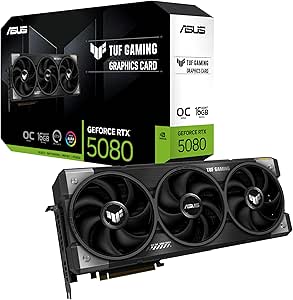 | Best Balanced High-End Performance | GPU: NVIDIA GeForce RTX 5080 | Memory: 16GB GDDR7 | Boost Clock: 2730 MHz (OC Mode) | VIEW ON AMAZON | See Our Full Breakdown |
| ASUS TUF Gaming GeForce RTX 5070 OC Graphics Card, 12GB GDDR7 |  | Best Entry-Level High-End Value | GPU: NVIDIA GeForce RTX 5070 | Memory: 12GB GDDR7 | Boost Clock: Up to 2640MHz | VIEW ON AMAZON | See Our Full Breakdown |
| high end graphics card | Memory | Cooling | Dimensions | GPU |
|---|---|---|---|---|
| GIGABYTE GeForce RTX 5080 Gami | 16GB GDDR7 | WINDFORCE 3-Fan | 13.46 x 5.59 inches | — |
| GIGABYTE Radeon RX 9070 XT Gam | 16 GB GDDR6 | WINDFORCE with Hawk Fans | — | Radeon RX 9070 XT |
| ASUS Prime GeForce RTX 5070 OC | 12GB GDDR7 | 3x Axial-tech Fans | 12 x 5 inches | NVIDIA GeForce RTX 5070 |
| NVIDIA GeForce RTX 3090 Ti Fou | — | Triple-fan solution | 12" L x 4" W | — |
| ASUS TUF Gaming GeForce RTX 50 | 16 GB GDDR7 | — | — | — |
| ASUS TUF Gaming GeForce RTX 50 | 32GB GDDR7 | Three Axial-tech fans and vapor chamber | 13.7 × 5.7 inches | NVIDIA GeForce RTX 5090 |
| MSI Gaming RTX 5080 16G SUPRIM | — | — | 10.5" L x 4.4" W | — |
| ASUS TUF Gaming GeForce RTX 50 | 16GB GDDR7 | Three Axial-tech fans with phase-change pad | — | NVIDIA GeForce RTX 5080 |
| ASUS TUF Gaming GeForce RTX 50 | 12GB GDDR7 | Three Axial-tech fans with phase-change pad | 13 × 5.5 inches | NVIDIA GeForce RTX 5070 |
More Details on Our Top Picks
GIGABYTE GeForce RTX 5080 Gaming OC 16G Graphics Card
This card strikes a compelling balance for high-end gaming without the extreme cost of the RTX 5090 models. Its 16GB GDDR7 memory ensures that texture streaming remains smooth even at 4K resolutions, a clear advantage over the 12GB options like the ASUS Prime RTX 5070. The WINDFORCE cooling system handles the Blackwell architecture’s heat output effectively, though the card’s substantial length demands a spacious chassis. While it lacks the liquid cooling potential of the MSI SUPRIM, it offers superior air-cooling reliability for most users. This model is better suited to those who want top-tier frame rates but prefer a traditional air-cooled build over complex liquid setups.
Pros:- 16GB of fast GDDR7 memory handles high-res textures
- DLSS 4 support maximizes frame rates in supported titles
- Three-fan WINDFORCE design provides consistent thermal headroom
Cons:- Physical size requires a mid-tower or larger case
- Lacks the raw compute power of the RTX 5090 variants
Best for: Gamers targeting 4K performance who want future-proof VRAM without paying for the absolute top-tier silicon.
Not ideal for: Users with small form factor cases, as the 13.46-inch length will not fit in compact chassis.
- GPU Architecture:NVIDIA Blackwell
- Memory:16GB GDDR7
- Memory Interface:256-bit
- Cooling:WINDFORCE 3-Fan
- Interface:PCIe 5.0
- Dimensions:13.46 x 5.59 inches
- Warranty:3 Years
Our verdict“The smart choice for high-end gamers who prioritize memory capacity and air-cooling simplicity over ultimate peak performance.”
GIGABYTE Radeon RX 9070 XT Gaming OC 16GB Graphics Card
For those loyal to the AMD ecosystem, this card offers competitive rasterization performance that rivals NVIDIA’s mid-high tier at a potentially better price-to-performance ratio. The 16GB GDDR6 memory matches the VRAM capacity of the GIGABYTE RTX 5080, ensuring longevity in memory-heavy games. However, it relies on server-grade thermal gel and Hawk fans, which manage heat well but may result in higher power draw compared to the more efficient Blackwell architecture. While it lacks the advanced ray tracing capabilities of NVIDIA’s latest cards, it remains a solid choice for traditional gaming. This option stands out for users who prioritize raw FPS over ray-tracing effects or specific NVIDIA-exclusive features.
Pros:- 16GB VRAM matches high-end NVIDIA competitors
- PCIe 5.0 support ensures maximum bandwidth
- Customizable RGB and efficient Hawk fan design
Cons:- Higher power consumption than equivalent NVIDIA cards
- Ray tracing performance trails behind Blackwell architecture
Best for: Builders who prefer AMD drivers or want strong rasterization performance without the NVIDIA price premium.
Not ideal for: Creators relying on CUDA-accelerated workflows or gamers who prioritize advanced ray tracing fidelity.
- GPU:Radeon RX 9070 XT
- Memory:16 GB GDDR6
- Interface:PCIe 5.0
- Cooling:WINDFORCE with Hawk Fans
- Thermal Solution:Server-grade conductive gel
- Lighting:RGB
Our verdict“A robust AMD option for gamers who value raw rasterization power and VRAM capacity over ray-tracing specialization.”
ASUS Prime GeForce RTX 5070 OC Edition 12GB GDDR7 Graphics Card
This card is engineered for compact builds, featuring a slim 2.5-slot design that fits where bulkier options like the ASUS TUF RTX 5070 Ti cannot. Despite its smaller footprint, the 12GB GDDR7 memory and Blackwell architecture deliver excellent 1440p to entry-4K performance. The dual BIOS profiles allow users to switch between quiet operation and maximum performance, a feature often missing in budget-oriented cards. However, the 12GB VRAM buffer is smaller than the 16GB found in the GIGABYTE RTX 5080, which may limit texture settings in future titles. This model is better suited to SFF enthusiasts who refuse to compromise on modern architecture but need to save space.
Pros:- Compact 2.5-slot design fits SFF cases
- Dual BIOS allows easy thermal/performance tuning
- Phase-change thermal pad improves long-term stability
Cons:- 12GB VRAM is less future-proof than 16GB alternatives
- May still be too large for very tiny ITX cases
Best for: Small form factor (SFF) PC builders who need high efficiency and compact dimensions.
Not ideal for: Users planning to run ultra-high-resolution textures at 4K, where 12GB VRAM may become a bottleneck.
- GPU:NVIDIA GeForce RTX 5070
- Memory:12GB GDDR7
- Design:2.5-slot SFF-ready
- Cooling:3x Axial-tech Fans
- Dimensions:12 x 5 inches
- Weight:2.3 pounds
- Warranty:3 Years
Our verdict“The ideal high-end card for compact builds, balancing modern performance with a space-efficient footprint.”
NVIDIA GeForce RTX 3090 Ti Founders Edition
Although it is an older generation, this card remains a powerhouse for professional workloads due to its massive 24GB of GDDR6 memory. For creators working with 8K video or large 3D scenes, it offers more VRAM headroom than the ASUS TUF RTX 5070 Ti, which caps out at 16GB. The Founders Edition design is iconic, but its triple-fan cooling solution is bulky and power-hungry compared to the more efficient Blackwell cards. It lacks the latest DLSS 4 features and ray-tracing optimizations found in the GIGABYTE RTX 5080. This pick makes the most sense for users who need raw memory capacity for productivity rather than pure gaming efficiency.
Pros:- 24GB VRAM is exceptional for professional applications
- Iconic Founders Edition build quality and aesthetics
- Capable of driving 8K displays
Cons:- High power consumption and heat output
- Lacks newer architecture features like DLSS 4
Best for: Content creators and 3D artists who require 24GB of VRAM for large datasets and rendering tasks.
Not ideal for: Gamers seeking the best power efficiency or latest AI upscaling features like DLSS 4.
- Graphics Coprocessor:NVIDIA GeForce RTX 3090
- VRAM:24 GB GDDR6
- Cooling:Triple-fan solution
- Max Resolution:8K
- Dimensions:12″ L x 4″ W
- Series:RTX 30 Series
Our verdict“A specialist card for professionals who prioritize maximum VRAM capacity over the latest gaming technologies.”
ASUS TUF Gaming GeForce RTX 5070 Ti 16GB GDDR7 OC Edition Graphics Card
Built with military-grade components and a protective PCB coating, this card is designed to withstand harsher environments and higher sustained loads. Its 3.125-slot design is significantly bulkier than the ASUS Prime RTX 5070, but this size allows for a larger fin array and superior thermal management. The 16GB GDDR7 memory matches the high-end tier, ensuring it doesn’t fall behind the GIGABYTE RTX 5080 in memory capacity. However, it requires a substantial 850W power supply and a specific 12VHPWR connector, adding complexity to the build. This option stands out for users who value long-term reliability and robust cooling over compactness or lower power requirements.
Pros:- Military-grade durability and PCB coating
- Massive cooling array maintains low temperatures
- 16GB GDDR7 ensures high-res texture support
Cons:- Extremely large 3.125-slot footprint
- Requires high-wattage PSU and specific connectors
Best for: Enthusiasts who prioritize build durability, thermal headroom, and long-term component longevity.
Not ideal for: Builders with limited PSU capacity or small cases, due to its massive 3.125-slot footprint.
- GPU Model:NVIDIA GeForce RTX 5070 Ti
- Memory:16 GB GDDR7
- Boost Clock:2610 MHz
- Slot Size:3.125-slot
- Power Requirement:850 W PSU
- Connectors:3x DP 2.1a, 2x HDMI 2.1b
- Warranty:3 Years
Our verdict“A rugged, high-performance choice for builders who want maximum cooling and durability in a traditional ATX case.”
ASUS TUF Gaming GeForce RTX 5090 OC Edition 32GB GDDR7 Graphics Card
This card stands as the absolute pinnacle of raw power in this lineup, leveraging the NVIDIA Blackwell architecture to deliver 772 AI TOPS. Compared to the ASUS TUF Gaming GeForce RTX 5080, the RTX 5090 offers double the memory capacity with 32GB of GDDR7, making it indispensable for professionals handling massive datasets or 8K rendering. The three Axial-tech fans and vapor chamber ensure it stays cool despite its immense thermal output, while the dual BIOS allows users to toggle between performance and quiet modes. However, this dominance comes at a physical cost; at 13.7 inches long, it demands a spacious case, unlike more compact alternatives. It is the clear choice for those who refuse to compromise on frame rates or compute speed, accepting the bulk and power requirements as the price of entry for top-tier performance.
Pros:- Massive 32GB GDDR7 memory handles the heaviest workloads and future-proofed textures.
- Advanced cooling with vapor chamber and dual-ball bearings ensures sustained boost clocks.
- Dual BIOS profiles offer flexibility between maximum performance and silent operation.
Cons:- Extremely large footprint (13.7 inches) limits compatibility with many standard PC cases.
- High power consumption requires a robust, high-wattage power supply and premium cooling setup.
Best for: Enthusiasts and professionals who need maximum VRAM for 8K gaming, AI workloads, or heavy 3D rendering without bottlenecks.
Not ideal for: Builders with mid-tower cases or limited PSU headroom, as the card’s size and power draw exceed standard configurations.
- GPU:NVIDIA GeForce RTX 5090
- Memory:32GB GDDR7
- Boost Clock:Up to 2580 MHz (OC Mode)
- AI Performance:772 AI TOPS
- Cooling:Three Axial-tech fans and vapor chamber
- Dimensions:13.7 × 5.7 inches
- Outputs:3 × DisplayPort 2.1a, 2 × HDMI 2.1b
Our verdict“Choose this if you demand the highest possible performance and have a case built to accommodate its imposing size.”
MSI Gaming RTX 5080 16G SUPRIM Liquid SOC Graphics Card
The MSI SUPRIM Liquid SOC distinguishes itself through its integrated liquid cooling solution, a rarity that keeps thermals exceptionally low compared to air-cooled rivals like the ASUS TUF Gaming GeForce RTX 5080. While both cards feature 16GB of GDDR7 memory and similar core specs, the MSI’s liquid loop allows for potentially higher sustained boost clocks at 2760 MHz without thermal throttling. Its sleek, premium build appeals to builders prioritizing aesthetics, though the single-fan design and liquid pump add complexity to installation. Unlike the bulky air coolers, this card maintains a more manageable length of 10.5 inches, offering a balance between high-end performance and case compatibility. It is ideal for users who value a quiet, cool system and are willing to manage the specific maintenance or mounting requirements of an AIO-style GPU.
Pros:- Liquid cooling delivers superior thermal headroom and quieter operation under heavy loads.
- Premium build quality and sleek design enhance the visual appeal of high-end builds.
- Compact length (10.5 inches) offers better case compatibility than many triple-fan air coolers.
Cons:- Liquid cooling adds complexity to installation and potential long-term maintenance concerns.
- Premium pricing typically reflects the advanced cooling technology and brand positioning.
Best for: High-end builders who prioritize quiet operation, low temperatures, and premium aesthetics over traditional air cooling simplicity.
Not ideal for: Users who prefer standard air cooling for ease of installation and maintenance, or those on a tighter budget who don’t need liquid cooling.
- Chipset:NVIDIA GeForce RTX 5080
- Video Memory:16 GB GDDR7
- Core Clock (Boost):2760 MHz
- Cooling Type:Integrated Liquid Cooling
- Dimensions:10.5″ L x 4.4″ W
- Outputs:3 × DisplayPort 2.1a, 1 × HDMI 2.1b
Our verdict“This is the definitive choice for enthusiasts who want the cleanest, coolest, and most visually striking RTX 5080 experience.”
ASUS TUF Gaming GeForce RTX 5080 16GB GDDR7 OC Edition Graphics Card
This card strikes an excellent balance between high-end gaming performance and practical buildability, sitting comfortably below the RTX 5090 in cost and size while outperforming the ASUS TUF Gaming GeForce RTX 5070 in memory capacity and raw speed. With 16GB of GDDR7 memory and a boost clock of 2730 MHz, it handles 4K gaming with ease, supported by DLSS 4 for future-proofing. The phase-change GPU thermal pad and protective PCB coating enhance durability, addressing common concerns about long-term reliability in high-stress environments. However, its 3.6-slot width and 348 mm length require careful case planning, potentially blocking other PCIe slots. It is the smart choice for gamers who want near-flagship performance without the extreme bulk and power demands of the 5090.
Pros:- 16GB GDDR7 memory provides ample headroom for high-texture 4K gaming and creative tasks.
- Protective PCB coating and automated manufacturing enhance long-term reliability and durability.
- GPU Tweak III software offers robust control over fan curves and performance profiles.
Cons:- Requires a minimum 850W power supply and a modern 16-pin connector.
- Bulky 3.6-slot design may interfere with other components in crowded motherboards.
Best for: Serious 4K gamers who want flagship-tier performance and durability without the extreme size and cost of the RTX 5090.
Not ideal for: Small form factor builds or cases with limited GPU clearance, as the 3.6-slot design is quite thick.
- GPU:NVIDIA GeForce RTX 5080
- Memory:16GB GDDR7
- Boost Clock:2730 MHz (OC Mode)
- Minimum PSU:850W
- Cooling:Three Axial-tech fans with phase-change pad
- Length:348 mm (13.7 in)
- Slot Width:3.6 slots
Our verdict“The ideal middle ground for high-end gamers seeking robust performance and build quality without the top-tier premium.”
ASUS TUF Gaming GeForce RTX 5070 OC Graphics Card, 12GB GDDR7
The ASUS TUF Gaming RTX 5070 serves as the accessible entry point into the Blackwell architecture, offering 12GB of GDDR7 memory and solid 1440p/4K performance. While it trails the ASUS TUF Gaming GeForce RTX 5080 in raw compute power and memory capacity, it compensates with a more manageable 3.125-slot design and lower power requirements. The three Axial-tech fans and phase-change thermal pad ensure it remains cool during extended sessions, while the protective PCB coating mirrors the durability found in higher-tier TUF models. This card is best suited for gamers who want modern features like DLSS 4 and DisplayPort 2.1a without investing in the top-tier silicon. It represents the sweet spot for those upgrading from older generations who seek significant performance gains at a more reasonable system footprint.
Pros:- More compact 3.125-slot design fits easier in mid-tower cases than larger 5080/5090 models.
- Protective PCB coating and reinforced mounting improve durability against physical stress.
- Supports latest display standards including DisplayPort 2.1a for future monitor compatibility.
Cons:- 12GB of memory may limit longevity in future titles demanding higher VRAM usage.
- Still requires substantial case space despite being smaller than the flagship models.
Best for: Gamers upgrading to high-end performance who prioritize 1440p/4K gaming and modern connectivity over maximum VRAM.
Not ideal for: Professionals handling large AI models or 3D scenes, as the 12GB memory buffer may become a bottleneck in heavy workloads.
- GPU:NVIDIA GeForce RTX 5070
- Memory:12GB GDDR7
- Boost Clock:Up to 2640MHz
- Interface:PCIe 5.0 x16
- Cooling:Three Axial-tech fans with phase-change pad
- Dimensions:13 × 5.5 inches
- Slot Design:3.125-slot
Our verdict“A practical high-end choice for gamers who want Blackwell architecture features without the extreme size or cost of the 5080/5090.”

How We Picked
To rank these high end graphics cards, I evaluated them based on a weighted criteria set that prioritizes long-term viability over short-term benchmark spikes. Raw performance was the primary metric, but I heavily penalized cards with poor thermal efficiency or excessive power draw that required expensive power supply upgrades. I also considered the practicality of installation, specifically looking at card length, thickness, and the necessity of liquid cooling infrastructure for models like the MSI SUPRIM Liquid.
Software support played a major role in the final ordering. Cards with robust driver stability and strong adoption in creative suites (Adobe, Blender, DaVinci Resolve) ranked higher than those relying solely on gaming benchmarks. I also factored in the availability of features like DLSS 4 and FSR 4, assessing how well each card leverages its architecture for frame generation and upscaling, which are now standard expectations for high-end builds.
| high end graphics card | GPU |
|---|---|
| GIGABYTE GeForce RTX 5080 Gami | — |
| GIGABYTE Radeon RX 9070 XT Gam | Radeon RX 9070 XT |
| ASUS Prime GeForce RTX 5070 OC | NVIDIA GeForce RTX 5070 |
| NVIDIA GeForce RTX 3090 Ti Fou | — |
| ASUS TUF Gaming GeForce RTX 50 | — |
| ASUS TUF Gaming GeForce RTX 50 | NVIDIA GeForce RTX 5090 |
| MSI Gaming RTX 5080 16G SUPRIM | — |
| ASUS TUF Gaming GeForce RTX 50 | NVIDIA GeForce RTX 5080 |
| ASUS TUF Gaming GeForce RTX 50 | NVIDIA GeForce RTX 5070 |
Factors to Consider When Choosing High End Graphics Cards
Selecting a high-end GPU is rarely about finding the ‘fastest’ card, but rather finding the one that fits your specific computational needs and case constraints without creating bottlenecks elsewhere in your system.VRAM Capacity and Memory Type
Memory capacity is no longer just about texture resolution; it dictates whether you can run large language models locally or edit 8K video timelines without crashing. 16GB of GDDR7 is becoming the new baseline for high-end cards, but 24GB or 32GB buffers on cards like the RTX 5090 provide necessary headroom for professional creators. The shift to GDDR7 offers higher bandwidth, which reduces stuttering in open-world games with dense geometry. Buyers often mistake higher clock speeds for better overall performance, but if your workload exceeds your VRAM, the system will swap to system RAM, causing massive frame drops regardless of core speed.
Thermal Design and Case Compatibility
Modern high-end cards are physically massive, often spanning 3.5 to 4 slots in thickness. This creates clearance issues for adjacent PCIe slots, M.2 SSD heatsinks, and front-mounted radiators. Air-cooled models like the ASUS TUF series rely on large fin stacks and multiple fans, requiring excellent case airflow to prevent thermal throttling. In contrast, liquid-cooled options like the MSI SUPRIM Liquid move heat away from the PCB but require space for radiators and tubes. Always measure your case’s GPU clearance and check for tube routing conflicts before purchasing a liquid model.
Power Consumption and PSU Requirements
The power draw of high end graphics cards has stabilized but remains high, with top-tier models pulling 450W to 575W under load. This requires a power supply unit (PSU) with a minimum of 1000W, preferably 1200W for headroom during transient power spikes. Transient spikes can cause older PSUs to trip their over-current protection, leading to system crashes. If you are upgrading from a previous generation, verify that your PSU supports the 12V-2×6 connector natively or use a high-quality adapter. Do not daisy-chain power cables from a single PSU rail to a high-end GPU.
Software Ecosystem and AI Acceleration
Hardware is only as good as the software that drives it. NVIDIA’s CUDA cores and Tensor cores remain the industry standard for AI acceleration, ray tracing denoising, and professional rendering applications. If your workflow involves Stable Diffusion, LLMs, or Adobe Premiere Pro, an NVIDIA card is practically mandatory for compatibility and speed. AMD’s ROCm stack has improved, but it still lags in out-of-the-box support for many creative and AI applications. Buyers who primarily game may find AMD’s value proposition stronger, but creators must weigh the software friction against the hardware savings.
Resale Value and Longevity
High-end GPUs are expensive investments, and resale value is a legitimate factor in the total cost of ownership. Cards with unique coolers, like the Founders Edition or limited SUPRIM models, often hold value better than generic reference designs due to their desirability among collectors and enthusiasts. Additionally, features like DLSS 4 extend the useful life of the card by allowing it to render at lower resolutions and upscale to 4K, maintaining playable frame rates in future titles. A card that is ‘future-proofed’ by software features often lasts longer than a raw hardware powerhouse that lacks upscaling support.
Frequently Asked Questions
Is the RTX 5070 Ti enough for 4K gaming in 2027?
The RTX 5070 Ti is capable of 4K gaming, but it often requires the use of DLSS or frame generation to maintain high frame rates in the most demanding titles. Its 16GB VRAM is adequate for most 4K textures, but it may struggle with ultra-high-resolution mods or future titles that demand larger buffers. For competitive 4K high-refresh gaming, the RTX 5080 or 5090 provides more consistent raw performance. If you are willing to tweak settings from ‘Ultra’ to ‘High’, the 5070 Ti remains a viable entry point into the 4K tier.
Do I need a liquid-cooled graphics card for a high-end build?
No, liquid cooling is not a requirement for performance, but it is beneficial for noise levels and thermal consistency. Cards like the MSI SUPRIM Liquid run cooler and quieter than their air-cooled counterparts, which is ideal for small form factor cases or silent builds. However, air-cooled cards like the ASUS TUF series are more reliable long-term because they lack pumps and tubes that can fail. Choose liquid cooling only if you have the case space for radiators and prioritize aesthetics and silence over maximum durability.
Is AMD’s RX 9070 XT a good alternative to NVIDIA for AI work?
While the RX 9070 XT offers excellent rasterization performance and competitive hardware specs, it is generally not recommended for serious AI workloads in 2027. Most AI frameworks and creative applications are optimized for NVIDIA’s CUDA architecture, leading to significantly faster setup times and execution speeds on RTX cards. AMD’s ROCm platform supports Python and PyTorch, but you will encounter more configuration hurdles and fewer pre-built containers. If AI is your primary focus, the software overhead of AMD hardware often outweighs the hardware savings.
Should I buy the older RTX 3090 Ti in 2027?
The RTX 3090 Ti is a powerful card with 24GB of VRAM, which is still valuable for memory-intensive tasks. However, it lacks the newer architecture’s efficiency, does not support the latest DLSS 4 features, and consumes significantly more power and heat. Buying it new is rarely cost-effective compared to the RTX 5070 Ti or 5080, which offer better performance per watt. It is only worth considering on the used market at a steep discount if you specifically need 24GB of VRAM on a tight budget and do not care about power efficiency or ray tracing improvements.
What power supply do I need for an RTX 5090?
For an RTX 5090, I recommend a minimum of a 1200W ATX 3.1 power supply with native 12V-2×6 connectivity. While 1000W might technically work with a power-efficient CPU, transient power spikes during heavy rendering or gaming sessions can push the system beyond safe limits. Using a PSU with a higher wattage headroom ensures stability and extends the lifespan of the components. Always avoid using multiple adapters or daisy-chained cables, as the 12V-2×6 connector is designed to handle the high current loads of these next-generation cards.
Conclusion
Selecting the right high end graphics card depends entirely on your specific use case and tolerance for physical and power constraints. For the Best Overall performance in gaming and professional workloads, the ASUS TUF Gaming GeForce RTX 5090 is the definitive winner, offering unmatched 32GB VRAM and raw power. If you need Best Value for pure rasterization and want to break free from NVIDIA’s ecosystem, the GIGABYTE Radeon RX 9070 XT is the strongest contender, provided you don’t rely heavily on CUDA-based software. For creators and AI developers who need stability and ecosystem compatibility without the top-tier price tag, the GIGABYTE GeForce RTX 5080 is the Best Premium choice. Finally, for those building in compact cases or prioritizing silence, the MSI Gaming RTX 5080 SUPRIM Liquid is the Best Compact/Silent option, balancing high performance with a sophisticated thermal design.