
TL;DR
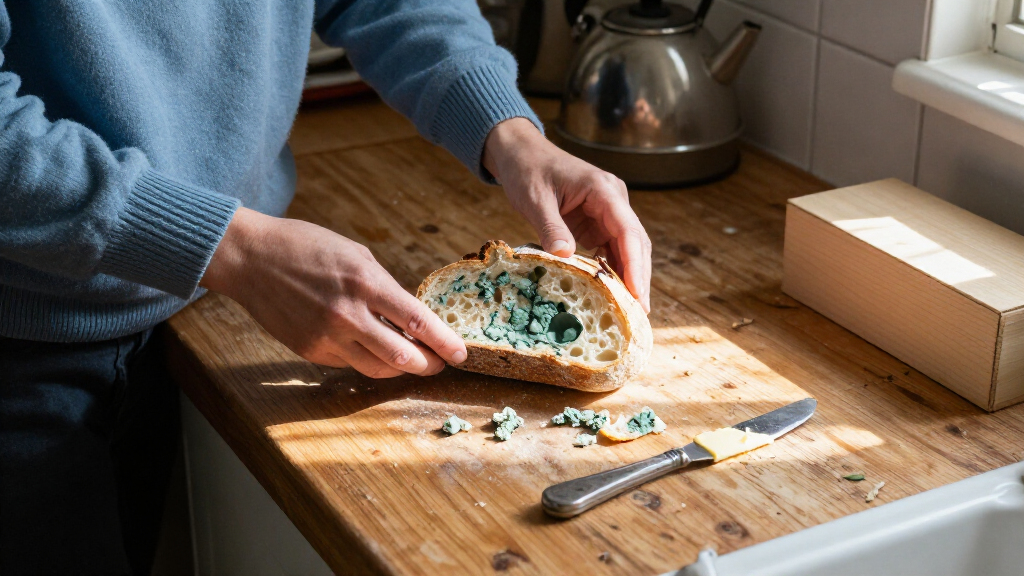
Good Housekeeping’s report advises discarding an entire loaf if any part of it is moldy. Food safety expert Darin Detwiler says mold’s microscopic threads can spread through soft bread beyond the visible patch, and removing that spot does not guarantee the rest is uncontaminated.
Good Housekeeping’s report says a loaf of bread should be thrown away or composted if even one part shows mold, citing food safety expert Darin Detwiler. The advice differs from trimming mold off some harder foods: bread is soft and porous, and mold may extend beyond the visible patch.
Detwiler, a food safety expert and professor emeritus of food regulatory affairs, says visible mold is only part of the picture. Mold can send microscopic threads into bread, where they cannot be seen without equipment. Removing the fuzzy area therefore does not guarantee the remaining bread is uncontaminated, according to the report.
The advice applies to sliced bread as well as unsliced loaves. If one slice appears moldy, the report recommends discarding the loaf rather than keeping the other slices. It also says bread mold can produce mycotoxins and that consuming or inhaling mold may cause health problems, including nausea, vomiting or breathing difficulties. The report emphasizes extra caution for people who are immunocompromised.
For storage, Detwiler recommends keeping bread dry. A breadbox or paper bag allows air to circulate and may help limit moisture buildup, according to the report. The freezer is described as a suitable option for longer storage, while refrigeration can make bread go stale faster than keeping it at room temperature.
Why One Moldy Spot Affects the Loaf
The guidance matters because visible mold can make it tempting to cut away a small patch and save the rest, especially when the loaf appears mostly fresh. But mold’s growth below the surface cannot be judged reliably by sight, and bread’s soft texture allows it to spread through the loaf. Trimming the visible area is not a reliable way to establish that the remaining bread is safe, the expert told Good Housekeeping.
Discarding the loaf may mean losing food, but the report presents that as the safer choice than guessing about unseen contamination. It also gives readers a practical prevention step: manage moisture through storage, and freeze bread that will not be used soon instead of putting it in the refrigerator.
As an affiliate, we earn on qualifying purchases.
Why Bread Is Different From Hard Cheese
The report contrasts bread with hard cheese, where people may sometimes cut away a moldy section. That comparison does not apply to bread, according to Detwiler, because its porous structure lets microscopic mold threads move into areas that look clean. The visible surface is not a dependable boundary for contamination in a soft loaf.
The article focuses on household guidance, not a newly announced food-safety rule or a study with new measurements. Its recommendations are presented through Detwiler’s expert explanation. The supplied report does not identify a particular mold species or describe laboratory testing of a specific loaf.
““If we see [mold], it’s like the tip-of-the-iceberg sort of thing.””
— Darin Detwiler, food safety expert and professor emeritus of food regulatory affairs, quoted by Good Housekeeping
As an affiliate, we earn on qualifying purchases.
What a Visible Patch Cannot Show
The supplied report does not say how far mold has spread in any particular loaf, and that cannot be determined from the visible patch alone. It gives no way for consumers to identify the mold species or assess whether mycotoxins are present. A clean-looking slice is not proof that it is free of mold, according to the expert’s explanation, but the report does not quantify the risk for a specific loaf or exposure.
The source material also does not provide a publication date, describe new testing, or indicate that a regulator issued a new warning. The advice is attributed to Detwiler and framed as practical food-safety guidance.
As an affiliate, we earn on qualifying purchases.
Safer Storage for the Next Loaf
If bread develops visible mold, follow the report’s advice and discard or compost the entire loaf; do not try to rescue it by cutting away the affected area. For bread that is still fresh, store it in a dry place in a breadbox or paper bag, or freeze it if it will not be used soon. Avoid the refrigerator if the goal is to keep bread from going stale quickly.
The report does not identify a forthcoming regulatory decision or additional investigation. Its practical next step for readers is prevention: keep bread dry, use the freezer for longer storage, and treat visible mold as a reason to stop eating the loaf.
As an affiliate, we earn on qualifying purchases.
Key Questions
Can I cut mold off a slice of bread and eat the rest?
No. The report says cutting off visible mold does not guarantee that the rest of the bread is uncontaminated, because mold threads may extend below the surface.
Should I throw away the whole loaf if only one slice is moldy?
Yes. Good Housekeeping’s report advises discarding the entire loaf, including sliced bread, if mold appears on any part of it.
How should I store bread to help it last?
Detwiler recommends keeping bread as dry as possible. A breadbox or paper bag can allow air to circulate; freezing is another option for bread you will use later.
Should bread be kept in the refrigerator?
The report advises against refrigeration for freshness, saying it can make bread go stale more quickly than room-temperature storage. It identifies the freezer, not the refrigerator, as the better choice for longer-term storage.
Source: rss