If you have a small kitchen, the air fryer question is not really “which brand” — it is “which format.” The two realistic candidates are the compact basket air fryer, the drawer-style unit around 2 to 4 quarts from brands like Ninja, Cosori, and Instant, and the small air fryer toaster oven, the boxy countertop unit from Breville, Cuisinart, and Instant that uses convection heat behind a glass door. Both sit on your counter, both crisp food with hot circulating air, and both promise to replace some of what your oven does. But they occupy very different amounts of your scarce counter space and solve very different problems.

Get kitchen gear delivered free with Prime
- Fast, free delivery on millions of items
- Prime Video, Amazon Music and more included
- Member-only deals all year

Ninja AF101 Air Fryer, 4 Qt, 4-in-1, Grey
- ✔ Capacity: 4 quarts
- ✔ Functions: Air Fry, Roast, Reheat, Dehydrate
- ✔ Temperature Range: 105°F–400°F
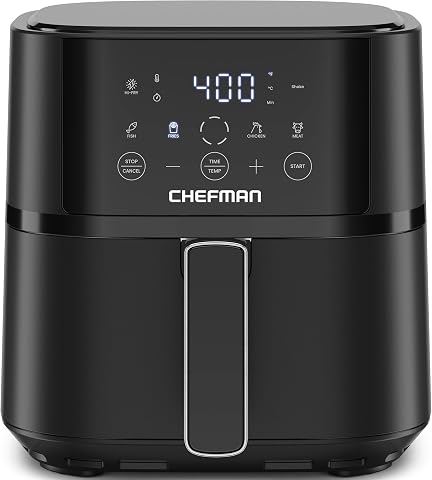
Chefman 4 QT Compact Air Fryer with Hi-Fry Technology, Touchscreen Controls and 4 Presets – Black
- ✔ Capacity: 4 quarts
- ✔ Max Temperature: 450°F
- ✔ Power: 1500W

Chefman 2-Quart Digital Mini Air Fryer, Black
- ✔ Capacity: 2 quarts
- ✔ Power: 900 watts
- ✔ Maximum Temperature: 400°F
The real tension is this: the basket air fryer is the smallest, fastest, cheapest way to get crispy food for one or two people, but it tops out quickly when you cook for guests or want to bake, toast, or roast anything with height. The air fryer oven takes more room and costs more, yet it can genuinely stand in for a full oven — which, in a small kitchen, might be a tiny apartment oven you would rather never heat. This guide compares the two formats head to head so you can decide which one earns a permanent spot on your counter.
At a Glance
| Criteria | Compact basket air fryer (2–4 quart drawer style) | Small air fryer toaster oven (countertop oven style) | Winner |
|---|---|---|---|
| Counter footprint and storage | Smallest footprint, roughly 10 x 12 inches; some fit in a cabinet | Larger footprint, roughly 12 x 16 inches or more; rarely stored away | A |
| Usable capacity | 2–4 quarts; fits 1–2 portions | 0.6–1.0 cu ft; fits a whole chicken or 4–6 portions | B |
| Cooking speed and crisping | Fastest preheat and crisping, direct small air chamber | Slightly slower preheat, excellent multi-shelf crisping | A |
| Versatility | Air frying, reheating, light roasting only | Toast, bake, broil, roast, dehydrate, reheat pizza | B |
| Ease of cleaning | Nonstick drawer, usually dishwasher-safe | Crumb tray plus racks to wash; interior wipes down | A |
| Energy use | Lowest draw, typically 800–1500W used briefly | Higher draw, 1500–1800W, but often replaces the big oven | Depends |
| Noise and heat in the kitchen | Moderately loud fan, minimal external heat | Quieter fan, but radiates more heat during use | Depends |
| Price | $40–$100 typical | $100–$250 typical | A |
Ninja AF101 Air Fryer, 4 Qt, 4-in-1, Grey
The Ninja AF101 takes our top spot because it does the most with the least counter space. Its 4-in-1 functionality — air fry, roast, reheat, and dehydrate — means it can replace not just a deep fryer but also contribute roasting and low-and-slow dehydration duties. That 105°F to 400°F temperature range is the widest in this lineup, and it is the reason: no other pick here can gently dehydrate fruit or make jerky, which matters in a small kitchen where every appliance must justify its footprint.Compared with the Chefman 4 QT, the Ninja trades a higher top temperature for functional breadth. The Chefman reaches 450°F while the Ninja tops out at 400°F, so the Chefman may edge it on final-crisp browning — but the Ninja’s ability to roast and reheat with dedicated programs makes it the more complete cooking tool for the same size basket. Its 1550 watts of power also edges out the Chefman’s 1500, and the included crisper plate helps air circulate beneath food rather than only around it.The drawbacks are real, though. The exterior requires manual wiping, and there is no shake reminder, so you will need to set your own timer for mid-cook tosses — something both Chefman models handle automatically. The 4-quart capacity also maxes out around 2 pounds of fries, which suits a couple or a side dish for a small family, not a full household spread.
Pros:
- 4-in-1 versatility with air fry, roast, reheat, and dehydrate functions
- Wide 105°F–400°F temperature range enables gentle dehydration
- Ceramic-coated nonstick basket and crisper plate are dishwasher safe
- Crispy results with up to 75% less fat than deep frying
Cons:
- No shake reminder, so mid-cook tossing is up to you
- Tops out at 400°F, lower than the Chefman 4 QT’s 450°F
- Exterior requires manual wiping to clean
Best for: Couples and small households who want one compact appliance to handle frying, roasting, reheating, and dehydrating
Not ideal for: Anyone who wants the highest searing temperature or automatic shake reminders
Bottom line: The most versatile compact air fryer in this lineup, and the one we would put on a small counter first.
“The most versatile compact air fryer in this lineup, and the one we would put on a small counter first.”
Chefman 4 QT Compact Air Fryer with Hi-Fry Technology, Touchscreen Controls and 4 Presets – Black
The Chefman 4 QT makes its case on a single, compelling point: it matches the Ninja’s 4-quart capacity while adding Hi-Fry technology that pushes temperatures to 450°F. That extra 50 degrees is not a spec-sheet gimmick — higher finishing heat means noticeably better browning on chicken skin, fries, and breaded items. If maximum crispiness is your priority, this model out-performs the Ninja on that specific metric.Where the Chefman pulls ahead in everyday convenience is its shake reminders and automatic shutoff. The Ninja leaves mid-cook tossing entirely to memory; the Chefman prompts you at the right moment, which translates to more even results with less attention. Its matte-black touchscreen design with four one-touch presets keeps operation simple for anyone who wants press-and-go cooking rather than a menu of functions to learn.The tradeoff is versatility. Unlike the Ninja, there is no dehydrate mode, no dedicated reheat program, and its 4 presets are fewer than what some competitors offer — this is a focused air fryer, not a multi-cooker. It shares the Ninja’s 4-quart limitation, too: fine for 2–4 people, tight for anything more. Still, for buyers who mainly want crispy food fast in a compact body, this option stands out for delivering exactly that without paying a premium for functions they will never use.
Pros:
- 450°F Hi-Fry technology delivers extra-crispy, well-browned results
- 4-quart capacity in a compact matte-black footprint
- Dishwasher-safe nonstick basket and rack
- Shake reminders and automatic shutoff for easier, safer cooking
Cons:
- Only 4 presets with no dehydrate or reheat modes
- Requires manual shaking for the crispiest outcomes
- Capacity may not suit households larger than four people
Best for: Budget-conscious cooks who prioritize crispiness and simplicity over multifunction features
Not ideal for: Buyers who want dehydration or roasting programs in one device
Bottom line: The sharpest price-to-crispiness ratio here, ideal if air frying is all you need.
“The sharpest price-to-crispiness ratio here, ideal if air frying is all you need.”
Chefman 2-Quart Digital Mini Air Fryer, Black
Not everyone needs four quarts, and this is where the Chefman 2-Quart Mini finds its purpose. Measuring just 10 × 10 × 8.3 inches and weighing 5.9 pounds, it takes up roughly half the counter space of the 4-quart models and is light enough to live in a cabinet between uses. For studio apartments, dorm rooms, offices, and RVs, this model is better suited than either larger pick because it simply fits where they cannot.The tradeoff is straightforward: 2 quarts serves one, maybe two, people. You will not roast a batch of wings for guests or cook a family side dish in one go. Its 900-watt heating element is the least powerful here, which means slightly longer cook times than the Ninja’s 1550 watts — though for small portions, the difference is minor. Its 400°F maximum matches the Ninja’s ceiling, so within its size limits it still delivers genuinely crispy results with little to no oil.Compared with its 4-quart Chefman sibling, it keeps the features that matter most: touch controls, a shake reminder, automatic shutoff, and a dishwasher-safe nonstick basket and rack in a practical square shape that uses its space efficiently. What you give up is capacity and the Hi-Fry 450°F boost. For a single cook, this pick makes the most sense in the lineup; for anyone else, we would point you to either 4-quart model instead.
Pros:
- Smallest footprint in the lineup at 10 × 10 inches and 5.9 pounds
- Cooks for 1–2 people with little to no oil
- Square, dishwasher-safe nonstick basket maximizes usable space
- Shake reminder and automatic shutoff included
Cons:
- 2-quart capacity limits you to one or two servings
- Least powerful heater at 900 watts means slower cooking
- No presets for one-touch cooking
Best for: Solo cooks, students, and anyone in a dorm, studio, or RV where counter space is the scarcest resource
Not ideal for: Couples who cook full meals or anyone who batches food for the week
Bottom line: The right choice when counter space matters more than serving size — and the wrong one for everyone else.
“The right choice when counter space matters more than serving size — and the wrong one for everyone else.”
As an Amazon Associate we earn from qualifying purchases.
Key Differences
The single biggest practical difference is capacity per square inch of counter. A 4-quart basket air fryer feeds two people comfortably in a footprint smaller than a toaster. An air fryer oven needs roughly half again to twice the counter space, but it holds a sheet pan’s worth of food, a 4-pound chicken, or two shelves of vegetables at once. If you cook for one or two and batch small, the basket’s smaller chamber is actually an advantage: less air to heat means faster preheat, faster crisping, and lower energy use per meal.
The second difference is role. A basket air fryer is a specialist — it crisps, reheats, and roasts small items beautifully, but try baking a small casserole, toasting four slices, or broiling open-faced sandwiches and it falls short. The air fryer oven is a generalist that genuinely replaces a full-size oven for most tasks, which matters enormously in a small kitchen where the built-in oven may be a cramped, slow-to-heat apartment unit. The tradeoff is that you live with a bigger appliance on display every day, because almost nobody lifts a 20-plus-pound oven-style unit into a cabinet after each use.
Cleaning and heat also split along format lines. The basket’s nonstick drawer pops out and often goes in the dishwasher; the oven style has racks, a crumb tray, and an interior to wipe, which is more fiddly but less frequent if you line the tray. The oven radiates more heat into a small kitchen during summer use, while the basket is louder but thermally lighter. Neither difference is decisive on its own — footprint, capacity, and versatility are what should drive your choice.
Detailed Comparison
Counter footprint and storage (Compact basket air fryer (2–4 quart drawer style) wins — major)
This is the criterion that defines the small-kitchen decision. A compact basket air fryer occupies roughly 10 by 12 inches and many models are light enough to slide into a lower cabinet between uses, effectively freeing the counter entirely. An air fryer oven needs around 12 by 16 inches of clear space plus several inches of clearance behind and above for ventilation — and because most weigh 20 pounds or more, it becomes a permanent counter resident. In a galley kitchen or a studio apartment with two feet of counter, that difference is the difference between fitting and not fitting. If your counter is truly minimal, the basket wins by default.
Usable capacity (Small air fryer toaster oven (countertop oven style) wins — major)
Quart numbers flatter the basket style: a 4-quart basket comfortably cooks about two chicken breast portions or a single layer of fries for two. Beyond that you cook in batches, which means the second batch sits cooling and soggy while the first cooks. A small air fryer oven at 0.6 to 1.0 cubic foot holds six slices of toast, a 4-pound chicken, a tray of roasted vegetables, or two shelves of food at once. For a household of three or more, or for anyone who entertains even occasionally, the oven style is the only format that avoids batch cooking. For a one- or two-person household, the basket’s capacity is usually sufficient, making the gap real but less relevant.
Cooking speed and crisping (Compact basket air fryer (2–4 quart drawer style) wins — moderate)
Physics favors the small chamber. A basket air fryer preheats in two to three minutes and throws concentrated hot air directly onto a small amount of food, which produces the fastest, crispiest results on fries, nuggets, wings, and reheated leftovers — its reheating of fried food beats a microwave and a conventional oven handily. The oven style takes five to ten minutes to preheat and circulates air through a larger cavity, so small-batch crisping is marginally slower. That said, when the oven style is loaded fully across its shelves, its per-meal time efficiency is better because everything finishes at once. For single portions and speed, the basket wins; for full meals, the gap closes.
Versatility (Small air fryer toaster oven (countertop oven style) wins — major)
This is not close. An air fryer oven toasts bread, bakes cookies and small casseroles, broils cheese-topped dishes, dehydrates fruit, roasts a chicken, and reheats pizza without the sogginess a basket can cause on flat items. A basket air fryer does one family of tasks — convective crisping of small items — and does it very well, but toast is awkward, baking is impractical, and tall dishes are impossible. In a small kitchen, versatility has extra value because the oven style can substitute for a cramped apartment oven most nights. If you currently avoid your big oven because it takes forever to heat, the oven style’s versatility is worth its counter cost.
Ease of cleaning (Compact basket air fryer (2–4 quart drawer style) wins — moderate)
The basket format wins on convenience: the nonstick drawer and basket pop out and usually go straight into the dishwasher, and a quick rinse handles most days. The oven style requires washing racks and a crumb tray, wiping the interior walls of grease splatter, and dealing with a door that collects grime. Neither is a burden, but the basket takes about two minutes of effort versus five to ten for the oven after a greasy session. Lining the oven’s tray with foil closes much of the gap, so this is a moderate advantage rather than a decisive one.
Energy use (minor difference)
A basket air fryer draws roughly 800 to 1500 watts for short bursts, making it one of the cheapest ways to cook a meal. The oven style draws 1500 to 1800 watts for longer cycles — but it often replaces firing up a full-size oven at 3000-plus watts, which means its real-world energy effect can be a saving. If the comparison is basket versus oven-style for the same small batch, the basket is cheaper to run. If the alternative is heating your big oven, the oven-style air fryer is the economical choice. The winner depends on what each appliance is displacing in your kitchen.
Noise and heat in the kitchen (minor difference)
Basket air fryers have a small, high-pitched fan that is noticeably loud in a compact space — comparable to a loud microwave — but they radiate little heat. Air fryer ovens run quieter yet pump more heat off their top and back, which matters in a small kitchen on a hot day with no ventilation. Neither is a dealbreaker: the noise is brief, and the heat is manageable if you respect clearance. Call it a wash, decided by your tolerance — noise annoyance versus summer heat.
Price (Compact basket air fryer (2–4 quart drawer style) wins — moderate)
Competent basket air fryers from Instant, Ninja, and Cosori regularly sell between $40 and $80 on sale, and the low end is genuinely good now. Decent small air fryer ovens start around $100 and good ones from Breville and Ninja run $180 to $250. The price gap is real but smaller than it appears once you count what the oven style replaces: if it substitutes for a toaster and covers your oven use, the premium buys two appliances in one. For pure air frying value, the basket is untouchable.
Compact basket air fryer (2–4 quart drawer style): Pros and Cons
Pros:
- Smallest footprint; many models store in a cabinet
- Fastest preheat and crisping for small batches
- Dishwasher-safe drawer makes cleanup trivial
- Lowest cost of entry, frequently $60 or less
- Lowest energy draw per meal
Cons:
- Capacity caps out at about two servings
- Batch cooking required for three or more people
- Cannot toast, bake, or fit tall dishes
- Fan noise is noticeable in a compact space
- Round or narrow baskets fit awkward shapes poorly
Small air fryer toaster oven (countertop oven style): Pros and Cons
Pros:
- Cooks full meals for four to six people at once
- Genuinely replaces a toaster and most oven tasks
- Fits a whole chicken, casseroles, and sheet-pan meals
- Glass door lets you monitor food without interrupting cooking
- Shelves allow separate foods at the same time
Cons:
- Largest counter footprint; effectively permanent placement
- Costs two to four times a budget basket model
- More parts to clean after greasy cooks
- Longer preheat for small single portions
- Radiates more heat into the kitchen
Who Should Choose What
Choose Compact basket air fryer (2–4 quart drawer style) if:
- You cook for one or two people most nights
- Your counter space is under about two feet or you want to store the appliance away
- Your main uses are fries, nuggets, wings, frozen snacks, and reheating
- Your budget is under $100
- You already own a toaster and a working oven you like
Choose Small air fryer toaster oven (countertop oven style) if:
- You regularly cook for three or more, or host guests monthly
- Your built-in oven is slow, tiny, or heats your whole apartment
- You want to retire your toaster and consolidate appliances
- You bake, broil, or roast with height — chickens, casseroles, pizza
- You have at least a dedicated 12 by 16 inch stretch of counter
Skip both if: You microwave almost everything and cook from scratch on a stovetop only — no air fryer earns its counter space if crispy reheating and convective roasting are not part of your routine.
Value for Money
For pure air-frying value, the compact basket wins without argument. Between frequent sales and mature designs, $60 to $80 buys a machine that performs its core job within a hair of models twice the price. Paying more than $100 for a basket unit buys capacity and extra presets, not meaningfully better food.
The air fryer oven’s premium is justified only when it consolidates roles. If it replaces your toaster, covers your oven work, and lets you skip heating a big apartment oven, a $180 oven-style unit is better long-term value than an $80 basket sitting next to a $40 toaster you still use. But if you buy the oven style and still use it mainly for frozen fries, you paid double for capacity you never load. Value here tracks your household size, not the spec sheet: singles get more per dollar from the basket; families get more per dollar from the oven.
Final Verdict
For the majority of small-kitchen buyers — singles and couples — the compact basket air fryer is the right call. It does the job that made air fryers popular, faster and cheaper, in the smallest possible footprint, and it can disappear into a cabinet. Choose it unless capacity or versatility genuinely blocks your cooking.
Choose the small air fryer oven if you cook for three or more, if your apartment oven is something you actively avoid, or if consolidating a toaster and oven into one appliance appeals to you. Its counter-space cost is the price of admission, and for a bigger household it is worth paying — the oven style is the better sole-appliance purchase, while the basket is the better second appliance.
The single deciding factor is household size. One or two people: basket, no hesitation. Three or more, or heavy bakers and roasters: oven style, and budget the counter space for it permanently.
Frequently Asked Questions
Can a 2-quart air fryer actually feed two people?
Barely, and that is the honest answer. A 2-quart basket handles one generous or two modest portions of fries or nuggets, but a full dinner for two usually means two batches. For a two-person household, a 4- or 5-quart basket is the sweet spot — still compact, but it cooks a real meal in one cycle.
Do air fryer ovens crisp as well as basket air fryers?
Yes, modern ones do, with a small caveat. Because the cavity is larger, preheating takes longer and single small batches crisp a touch slower than in a basket. Loaded fully across shelves, a good air fryer oven matches basket results and beats it on flat foods like pizza and breaded cutlets, where its flat trays and top broil element outperform a round basket.
Which format uses less electricity in a small apartment?
For the same small portion, the basket uses less — lower wattage for less time. But if the oven style replaces heating a full-size apartment oven several times a week, it delivers the bigger net saving despite its higher draw. Judge it by what each unit displaces, not the wattage sticker alone.
Is a dual-basket air fryer a good middle option for small kitchens?
It can be, with a warning. Dual-basket models like Ninja’s Foodi line solve the batch-cooking problem while staying drawer-based and dishwasher-friendly. However, they are wide — often 15 inches or more — so they consume nearly as much counter as a small oven style. Choose one only if you need two foods finished simultaneously and lack space for the oven format.
Where should an air fryer sit in a kitchen with almost no counter space?
Keep clearance in mind: manufacturers specify a few inches of open space above and behind for ventilation, so neither format belongs under a cabinet shelf. In a truly tight kitchen, the basket format wins because it can live in a lower cabinet or on a sturdy rolling cart and be lifted out when needed — something you will not do with a 20-pound oven-style unit.
Halloween Picks
halloween
As an affiliate, we earn on qualifying purchases.