When kitchen space is tight, the choice between the Ninja AF101 and Instant Vortex Mini comes down to how much counter room you can spare for cooking capacity. Both are compact basket-style air fryers from established brands, but the Ninja is the larger, more flexible appliance; the Instant is smaller and more affordable. Their listed capacities and dimensions can vary by model version and retailer, so check the exact product listing before buying.

Get kitchen gear delivered free with Prime
- Fast, free delivery on millions of items
- Prime Video, Amazon Music and more included
- Member-only deals all year
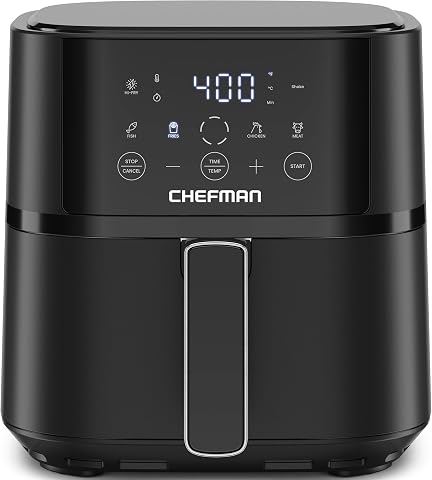
Chefman Air Fryer – 4 QT Compact Airfryer
- ✔ Capacity: 4 quarts
- ✔ Dimensions: 13.82 × 10.04 × 10.24 inches (D × W × H)
- ✔ Weight: 7.5 pounds

CHEFMAN 2 Qt Mini Air Fryer
- ✔ Capacity: 2 quarts
- ✔ Dimensions: 10 × 10 × 8.3 inches (D × W × H)
- ✔ Weight: 5.9 pounds

BLACK+DECKER Purifry 2QT Digital Air Fryer
- ✔ Capacity: 2 quarts
- ✔ Dimensions: 13.39 × 13.07 × 11.93 inches (D × W × H)
- ✔ Power: 1000 watts
The Ninja AF101 is the stronger fit for people who want to cook larger portions or value a wider temperature range. The Instant Vortex Mini suits solo cooks, couples with modest portions, and anyone who wants to reclaim every bit of counter space. If the smaller machine forces you to cook in extra batches, its footprint advantage may not be worth the trade.
At a Glance
| Criteria | Ninja AF101 | Instant Vortex Mini | Winner |
|---|---|---|---|
| Counter footprint | Compact, but generally larger than the Vortex Mini | Smaller body, easier to fit on crowded counters | B |
| Cooking capacity | About 4 quarts; better suited to larger portions | About 2 quarts; best for small servings | A |
| Temperature flexibility | Broad adjustable temperature range, typically 105–400°F | Adjustable temperature, with a narrower range than the Ninja | A |
| Cooking functions | Air fry, roast, reheat, and dehydrate | Air fry, bake, roast, and reheat, depending on version | Depends |
| Controls and ease of use | Digital controls with several cooking options | Simple digital controls and straightforward presets | Tie |
| Cleanup | Removable nonstick basket and crisper plate; confirm care guidance for your model | Removable nonstick basket; confirm care guidance for your model | Tie |
| Price and value | Usually costs more; extra room and flexibility can justify it | Usually less expensive and a good fit for light, small-batch use | Depends |
Chefman Air Fryer – 4 QT Compact Airfryer
For many small kitchens, the strongest space saver is the model that can replace repeat batches. This 4-quart Chefman is listed at 10.04 inches wide and 10.24 inches high, with a 13.82-inch depth. Its narrow profile is easier to accommodate across a crowded counter than a broad appliance, while its capacity is intended for two to four people. Compared with the two-quart CHEFMAN Mini and BLACK+DECKER, it takes up more front-to-back room, but can handle a larger serving in one go.Its touchscreen offers four presets alongside manual time and temperature controls. The distinctive extra is 450°F Hi-Fry technology for the final two minutes of cooking, giving buyers a high-heat finishing option that the two 2-quart alternatives do not list. A shake notification and dishwasher-safe nonstick basket and rack keep the routine approachable. The tradeoff is that a four-quart basket and 1500-watt rating may be more appliance than a solo cook needs, and the product listing gives no window for checking food without opening the basket.This is our lead pick for a compact kitchen shared by a couple or small household because its extra capacity has a direct practical benefit: fewer small batches. Choose the CHEFMAN Mini instead if cabinet storage and the smallest stated dimensions matter most. Choose the BLACK+DECKER if you would trade capacity for its broader set of presets and cooking functions. Before buying, measure the counter depth and allow room to pull the basket out.
Pros:
- Four-quart capacity is intended for two to four people.
- Listed width is just over 10 inches, a narrow profile for its capacity.
- Four presets, touchscreen controls, and manual settings offer straightforward choices.
- 450°F finishing function, shake reminder, and dishwasher-safe basket and rack.
Cons:
- Its 13.82-inch listed depth may be awkward on shallow counters.
- Four quarts may be unnecessarily large for one-person portions.
- No viewing window is listed, so checking food requires opening the basket.
Best for: Small households of two to four who want more food per batch while keeping appliance width modest.
Not ideal for: Solo cooks with very limited counter depth, or buyers who prioritize the smallest possible appliance for cabinet storage.
Bottom line: We recommend this as the best all-around small-kitchen pick when extra batch capacity matters more than the smallest possible footprint.
“We recommend this as the best all-around small-kitchen pick when extra batch capacity matters more than the smallest possible footprint.”
CHEFMAN 2 Qt Mini Air Fryer
If the main requirement is simply to make room for an air fryer, this is the clearest fit. The CHEFMAN 2 Qt Mini measures 10 by 10 by 8.3 inches and weighs 5.9 pounds, the smallest listed dimensions and weight in this lineup. Its square basket is designed to use the available two-quart capacity efficiently, and the narrow housing is described as suitable for a countertop or cabinet. Compared with the 4-quart Chefman, it gives up serving capacity; compared with the BLACK+DECKER, its listed dimensions are more compact.Controls are digital and touch-operated, with time and temperature settings up to 400°F and an audible shake reminder. That combination keeps the feature set focused on everyday air frying rather than a long menu of preset cooking modes. For one person or a pair cooking modest portions, the smaller basket may be all that is needed. Its limits become more apparent when food needs to be served to a group: the two-quart capacity is specified for one to two people, so larger meals may mean cooking in rounds.Cleanup and storage are the Mini’s strongest supporting arguments. The basket and rack are nonstick and dishwasher safe, and its low listed height makes it the most promising option to put away between uses. The BLACK+DECKER gives up that size advantage for nine presets and additional functions, while the four-quart Chefman is more convenient for shared meals. Pick this one when physical fit outranks batch size; skip it if you expect to cook family portions regularly.
Pros:
- Smallest listed dimensions in this comparison: 10 × 10 × 8.3 inches.
- Lightest listed model at 5.9 pounds, which helps with storage.
- Touch controls, adjustable temperature up to 400°F, and shake reminder.
- Nonstick basket and rack are dishwasher safe.
Cons:
- Two-quart capacity is intended for only one to two people.
- Larger meals may require cooking in multiple batches.
- Offers a more focused feature set than the BLACK+DECKER’s nine presets and functions.
Best for: One or two people in a kitchen where counter space is scarce and the appliance may need to be stored in a cabinet.
Not ideal for: Households that regularly cook larger portions or want several dedicated cooking presets and functions.
Bottom line: We would choose the CHEFMAN Mini when storage and a genuinely small listed footprint matter more than cooking larger portions.
“We would choose the CHEFMAN Mini when storage and a genuinely small listed footprint matter more than cooking larger portions.”
BLACK+DECKER Purifry 2QT Digital Air Fryer
The BLACK+DECKER Purifry takes a different approach to compact cooking: it keeps the basket at two quarts but adds nine one-touch presets and several named functions, including air fry, roast, bake, dehydrate, and keep warm. That range is broader than the more focused CHEFMAN Mini, and could make this model a better match for someone who wants one small appliance to cover a wider set of cooking tasks. Its shake reminder and automatic shutoff are also listed.Capacity, however, is not the only measure of compactness. The stated dimensions are 13.39 by 13.07 by 11.93 inches, making its base substantially wider and deeper than the CHEFMAN Mini’s 10-by-10-inch footprint. It is also larger across the base than the four-quart Chefman despite having half the capacity. Buyers should measure their actual counter or storage shelf carefully: this is the feature-rich two-quart choice, not the smallest physical option in the lineup.The 1000-watt unit reaches up to 400°F and includes a nonstick basket with dishwasher-safe parts. Those conveniences are similar to the other two models, so the case for choosing it rests on the extra presets and cooking functions. If those functions would be useful, its capacity stays manageable for a couple of servings. If your priority is counter clearance, the CHEFMAN Mini is more convincing; if fewer batches matter, the four-quart Chefman makes better use of its larger footprint. The supplied descriptions also differ on the stated fat reduction, so we leave that claim out of our comparison.
Pros:
- Nine one-touch presets cover common foods and functions.
- Adds roast, bake, dehydrate, and keep-warm options to air frying.
- Shake reminder and automatic shutoff are listed.
- Nonstick basket and dishwasher-safe parts simplify cleanup.
Cons:
- Two-quart capacity is listed for up to two servings.
- 13.39 × 13.07-inch base is larger than the CHEFMAN Mini’s listed footprint.
- Its larger base accompanies less capacity than the 4-quart Chefman.
Best for: Buyers who want dedicated cooking presets and multiple cooking functions in a two-quart appliance.
Not ideal for: Anyone seeking the narrowest or smallest listed footprint, or those who need capacity for more than a couple of servings.
Bottom line: We would pick the Purifry for its broader presets and cooking modes, provided its comparatively wide base fits the available counter.
“We would pick the Purifry for its broader presets and cooking modes, provided its comparatively wide base fits the available counter.”
As an Amazon Associate we earn from qualifying purchases.
Key Differences
The clearest difference is capacity. The Ninja AF101’s roughly 4-quart basket gives you more room for a meal or a larger side dish, while the Vortex Mini’s roughly 2-quart capacity is aimed at smaller servings. That distinction can affect weeknight routines: a compact appliance is only convenient if it can cook enough food in the number of batches you are willing to make. For a solo cook reheating leftovers, the Instant’s smaller basket may be plenty. For two people or regular batch cooking, the Ninja is more practical.
The Vortex Mini wins on space and typically on upfront cost. The Ninja gives up some of that compactness in return for capacity and a broader temperature range, which is useful when cooking more than frozen snacks. Neither is the automatic choice for every small kitchen. Choose the Instant when the smallest footprint matters most and servings are modest; choose the Ninja when cooking room matters more than shaving off a little counter space.
Detailed Comparison
Counter footprint (Instant Vortex Mini wins — moderate)
Winner: Instant Vortex Mini; moderate gap. Its smaller body is easier to place on a crowded counter, store in a cabinet, or fit into a compact kitchenette. The Ninja is still a compact appliance, but it asks for more space. Measure the available area, including clearance around the unit, before choosing; confirm dimensions for the exact version you plan to buy.
Cooking capacity (Ninja AF101 wins — major)
Winner: Ninja AF101; major gap for multi-person meals. At about 4 quarts versus about 2 quarts, the Ninja can accommodate more food at once. That can reduce batch cooking for a couple or anyone preparing generous portions. The Instant can be sufficient for one-person meals, snacks, and reheating, but its smaller basket limits how much fits in a single round.
Temperature flexibility (Ninja AF101 wins — moderate)
Winner: Ninja AF101; moderate gap. The AF101 commonly offers a wider adjustable temperature range, giving cooks more latitude for low-temperature tasks as well as high-heat crisping. The Vortex Mini covers everyday air-frying needs, though its range is narrower. If you mainly cook fries, vegetables, and reheated food, the practical difference may be minor; if you want broader control, the Ninja has the advantage.
Cooking functions (minor difference)
Winner: Depends; minor gap. Both models cover common air-fryer tasks, though listed functions vary by version and retailer. The Ninja AF101 is commonly described with air fry, roast, reheat, and dehydrate settings; Vortex Mini versions may list air fry, bake, roast, or reheat. Check the model’s control panel and product specifications against the functions you will actually use. Extra modes add little value if they stay untouched.
Controls and ease of use (minor difference)
Winner: Tie; minor difference. Both use digital controls and are designed for straightforward cooking. The Instant’s smaller, simpler setup may feel less imposing in a cramped kitchen. The Ninja’s additional settings offer more choices but can take slightly more attention. For basic meals, neither has a decisive usability edge; prioritize capacity and footprint instead.
Cleanup (minor difference)
Winner: Tie; minor difference. Each has a removable nonstick basket, making food removal and routine cleaning manageable. The Instant’s smaller basket is easier to handle in a small sink, while the Ninja’s larger basket may fit more food but take up more washing space. Nonstick care instructions differ by model, so follow the manufacturer’s guidance and avoid assuming every part is dishwasher-safe.
Price and value (moderate difference)
Winner: Depends; moderate gap for budget-conscious buyers. The Vortex Mini is generally the less expensive choice, and it is better value when you need a small appliance for light use. The Ninja’s higher price can be justified if its extra capacity prevents repeated batches or its broader temperature control serves regular cooking. Pay more for a practical improvement you will use; skip the upgrade if the smaller basket already matches your portions.
Ninja AF101: Pros and Cons
Pros:
- Larger basket handles bigger servings with fewer batches
- Broader adjustable temperature range
- Useful cooking modes for more than basic air frying
Cons:
- Takes up more counter and storage space than the Vortex Mini
- Usually costs more
- May be more capacity and control than a solo cook needs
Instant Vortex Mini: Pros and Cons
Pros:
- Smaller footprint suits crowded counters and compact kitchens
- Usually costs less upfront
- Small basket is convenient for snacks, reheating, and modest portions
Cons:
- About half the Ninja’s capacity, so larger meals may need multiple batches
- Narrower temperature range
- Less suitable for routine cooking for several people
Who Should Choose What
Choose Ninja AF101 if:
- You regularly cook for two or want room for larger portions.
- You would rather use a little more counter space than make extra batches.
- You want a wider temperature range or expect to use several cooking modes.
Choose Instant Vortex Mini if:
- You cook mainly for one and make small servings.
- Your counter or cabinet space is the top constraint.
- You want a lower-cost air fryer for snacks, reheating, or occasional meals.
Skip both if: You need to cook full family meals in one round, or your kitchen has no safe counter space for an air fryer. Consider a larger-capacity model only if you can accommodate it.
Value for Money
The Instant Vortex Mini is the better value for light use: it costs less and occupies less space, and its smaller basket is not a drawback if your servings are small. The Ninja AF101 earns its higher price when the added capacity saves time across regular meals or the wider temperature range supports cooking you actually plan to do. For a solo cook, the upgrade may buy unused room. For a couple that would otherwise split dinner into batches, paying more can be worthwhile. Compare current prices and exact model specifications, since retailer listings and promotions change.
Final Verdict
For most people choosing an air fryer specifically for a small kitchen, the Instant Vortex Mini is the sensible pick when meals are for one and counter space is scarce. It gives up cooking room to stay compact and affordable. Choose the Ninja AF101 if you cook larger portions or often feed two: its capacity is the biggest practical difference, and avoiding extra batches can outweigh the larger footprint and higher price. The deciding question is simple: will the smaller basket fit the meals you make most often? If yes, buy the Instant; if no, the Ninja is worth the added space.
Frequently Asked Questions
Which is better for a small kitchen, the Ninja AF101 or Instant Vortex Mini?
The Instant Vortex Mini is smaller and usually easier to fit on a crowded counter. The Ninja AF101 is also compact, but takes up more space in exchange for a larger basket. Choose based on both your available counter area and the portions you cook.
Can the Instant Vortex Mini cook dinner for two?
It can handle some meals for two if portions are small, but its roughly 2-quart basket may require multiple batches. If you regularly cook full portions for two, the Ninja’s roughly 4-quart capacity is more convenient.
Is the Ninja AF101 worth paying more for?
It can be worth the extra cost if the larger basket saves you from cooking in batches or you will use its broader temperature range. For occasional snacks or solo meals, the Vortex Mini is often the better value.
Do both models have the same cooking functions?
No. Their listed functions can differ by model version and retailer. Check the exact product specifications and control panel before buying, especially if you want a particular mode such as dehydrate or bake.