
For most home baristas, the Breville Barista Express is my best overall pick because its built-in grinder and hands-on controls make it a capable all-in-one starting point. The Breville Bambino suits smaller kitchens and buyers who already have a grinder, while the Ninja Luxe Café Premier stands out for households that want espresso alongside other coffee styles. The main tradeoff is between control and convenience: manual and semi-automatic machines invite more practice, while automatic models handle more of the routine. Counter space, milk drinks, and daily cleanup can matter as much as the espresso itself. Read on for how all 15 options compare and which fits your home routine.

Get kitchen gear delivered free — and shop member deals
- Fast, free delivery on millions of items
- Access to Prime Big Deal Days deals on October 6–7
- Prime Video, Amazon Music and more included
Complete the kit


Key Takeaways
- The Barista Express offers the most balanced all-in-one workflow in this lineup, pairing espresso preparation with an integrated grinder while keeping the process hands-on.
- The Bambino favors a compact setup for buyers who already own a grinder; its smaller footprint comes with less built-in equipment than the Barista Express.
- The Ninja Luxe Café Premier and Canoly 2-in-1 put drink variety first, making them more relevant to mixed-preference households than buyers focused only on espresso.
- Built-in grinders can simplify a first setup, as seen in the Spacekey and AMZCHEF options, but they also tie grinder choice and machine maintenance together.
- Entry-level compact machines trade capability for a smaller footprint; buyers should compare their controls and milk workflow rather than relying on pressure claims alone.




More Details on Our Top Picks
CASABREWS 3700 Essential Stainless Steel Espresso Machine with Steam Wand
The CASABREWS 3700 Essential is a straightforward fit for home drinkers who want espresso and steamed milk without a built-in grinder taking up more counter space. Its steam wand supports lattes and cappuccinos, while the removable 43.9-ounce tank means fewer refills than the smaller-tank CASABREWS CM5418. Both use ground coffee and semi-automatic brewing, but the CM5418 adds a pressure gauge that can help beginners see how a shot is extracting; this model keeps the setup simpler and leaves that feedback out. The tradeoff is that you’ll need a separate grinder for whole beans, and the first-use cycle adds a setup step. This pick makes sense for someone who already buys ground coffee or owns a grinder and wants a compact machine for everyday milk-based drinks.
Pros:- Steam wand allows milk frothing for lattes and cappuccinos
- 43.9-ounce removable tank reduces refill frequency
- Compact stainless steel design suits home or office counters
- One-cup and two-cup filters support different serving sizes
Cons:- No pressure gauge to show extraction pressure
- Ground coffee only, so whole-bean users need a separate grinder
- Requires a first-use cycle before brewing
Best for: Home latte and cappuccino drinkers who have a grinder or prefer pre-ground coffee and want a removable, relatively roomy water tank.
Not ideal for: Beginners who want visible extraction feedback, or buyers seeking an all-in-one machine with a built-in grinder.
- Operation:Semi-automatic
- Pump pressure:20 bar
- Power:1350 watts
- Voltage:120 volts
- Water tank:43.9 oz, removable
- Coffee input:Ground coffee
- Milk frothing:Steam wand
- Included filters:One-cup and two-cup
Our verdict“Choose the CASABREWS 3700 if you want a compact milk-drink machine and already have a way to grind or source coffee.”
Spacekey Espresso Machine with Grinder and Milk Frother
The Spacekey Espresso Machine combines a 30-setting conical burr grinder, espresso brewing, and a steam wand in one compact-bodied unit. That makes it a more self-contained bean-to-cup starting point than the CASABREWS 3700 Essential, which takes ground coffee and needs a separate grinder. Its PID temperature control is aimed at keeping brewing conditions steady, while the 61-ounce removable tank suits households making several drinks between refills. A cold brew function adds another drink option, though the supplied details don’t explain its brewing method or timing. The compromise is counter space: at 11.6 × 9 × 14 inches, it has more going on than a basic compact espresso machine. I’d shortlist it for buyers who want fewer separate appliances and are willing to learn grinder adjustments; those who want a simple entry setup may prefer the CM5418.
Pros:- Built-in conical burr grinder offers 30 settings
- PID temperature control supports steadier brewing conditions
- 61-ounce removable tank suits multiple drinks between refills
- Cold brew function broadens the listed drink options
Cons:- Its grinder and brewing components need more counter room than a basic compact machine
- Adjusting among 30 grind settings may add a learning curve
- One-year limited warranty offers a defined, relatively short coverage period
Best for: Home coffee drinkers who want to grind whole beans and make espresso or milk drinks from one appliance.
Not ideal for: Buyers with very limited counter space or those who prefer a simple machine without grinder settings to manage.
- Grinder:Built-in conical burr, 30 settings
- Pump pressure:20 bar
- Motor power:1350 W
- Temperature control:PID
- Water tank:61 oz, removable
- Dimensions:11.6 × 9 × 14 inches
- Portafilter:51 mm
- Warranty:One-year limited
Our verdict“Pick the Spacekey if you want an integrated grinder and multiple drink options in one home espresso setup.”
CASABREWS CM5418 Compact Espresso Machine with Milk Frothing Wand
The CASABREWS CM5418 gives home espresso beginners a useful bit of feedback that the CASABREWS 3700 Essential omits: a pressure gauge. It won’t dial in a shot for you, but it can make changes to grind and tamp easier to observe as you learn. The machine also includes a steam wand and filters for single or double shots, so it covers the basics without the Spacekey’s built-in grinder or extra drink functions. Its 34-ounce removable tank is smaller than the 3700’s 43.9-ounce tank, which means more frequent refills if you make several drinks in a row. One workflow wrinkle matters for milk drinks: the machine must cool after frothing before brewing. This pick suits a hands-on buyer who wants to practice espresso technique in a compact setup; it’s less convenient for back-to-back drinks.
Pros:- Pressure gauge provides visible extraction feedback
- Steam wand supports milk frothing and microfoam
- Removable tank simplifies refilling
- Includes one-cup and two-cup filters, portafilter, and tamper with spoon
Cons:- Must cool down after frothing milk before brewing
- 34-ounce tank is smaller than the CASABREWS 3700 Essential’s
- Low extraction pressure may require grind and tamp adjustments
Best for: New home espresso makers who want a pressure gauge and are prepared to adjust grind and tamp while learning.
Not ideal for: Households that regularly make several drinks back to back or want to brew espresso immediately after steaming milk.
- Type:Semi-automatic espresso machine
- Pump pressure:20 bar
- Power:1350 W
- Water tank:34 oz, removable
- Milk frother:Steam wand
- Included filters:One-cup and two-cup
- Included accessories:Portafilter, tamper with spoon, instruction manual
- Material and finish:Brushed stainless steel
Our verdict“Choose the CM5418 if learning to adjust espresso shots matters more to you than a larger tank or uninterrupted milk-drink workflow.”
Arecovas 20 Bar Espresso Machine with Touch Screen and Milk Frother
At a listed 5.2 inches wide, the Arecovas is the most space-focused choice among these five machines, while still offering a touchscreen, pressure gauge, steam wand, and dedicated Americano button. Its PID temperature control and low-pressure pre-infusion aim to keep brewing more consistent and begin extraction gently, giving it more visible controls than the simpler CASABREWS 3700 Essential. The 40-ounce removable tank is smaller than the Breville Barista Express’s 67-ounce reservoir, and the Arecovas lacks that machine’s integrated grinder, so bean preparation requires another appliance or ground coffee. Semi-automatic operation also leaves shot dialing to the owner. The listed 2.6-pound weight seems unusually light for a stainless steel espresso machine, so I would verify that detail before relying on it for a fixed setup. It suits cramped counters where width is the main constraint.
Pros:- Listed 5.2-inch width fits narrow counter spaces
- PID control and dual NTC sensors are specified to hold brew temperature within ±2°C
- Pressure gauge, pre-infusion, and one-touch shot modes provide useful controls
- Dedicated Americano button and steam wand expand drink options
Cons:- 40-ounce tank may need frequent refilling in multi-drink households
- Semi-automatic brewing requires practice dialing in shots
- No built-in grinder, unlike the Breville Barista Express
Best for: Apartment dwellers or coffee station owners who have very little counter width but still want a steam wand and espresso controls.
Not ideal for: People who need a built-in grinder, a large water reserve, or a machine that takes little hands-on dialing in.
- Pump pressure:20 bar
- Power:1300 watts
- Voltage:120 volts
- Water tank:40 oz / 1.2 L, removable
- Operation:Semi-automatic
- Interface:Touchscreen with LED display and real-time pressure gauge
- Dimensions:12 in D × 5.2 in W × 11.9 in H
- Special features:Cup warmer, pre-infusion, Americano button, milk frother
Our verdict“The Arecovas is a fit for narrow counters if you accept manual shot adjustments and a separate grinder.”
Breville BES870XL Barista Express Espresso Machine, Brushed Stainless Steel
The Breville Barista Express earns its premium role through a more complete bean-to-espresso workflow: its integrated conical burr grinder feeds a 54 mm portafilter, and digital PID control and low-pressure pre-infusion support repeatable brewing. Compared with the Spacekey, which also has an integrated grinder and PID, Breville specifies a 67-ounce water tank and a 1600-watt power rating; the Spacekey adds a listed cold brew function and 30 grinder settings. The Barista Express also includes a milk jug, tamper, trimming tool, and cleaning accessories, reducing the number of pieces a buyer needs to source separately. That convenience comes with a hands-on learning curve: grinding, dosing, and steaming still require practice. Its larger all-in-one footprint is less suited to a narrow counter than the Arecovas. I’d choose it for someone who wants room to build a repeatable home espresso routine.
Pros:- Integrated conical burr grinder grinds beans on demand
- Digital PID temperature control and low-pressure pre-infusion support controlled extraction
- 67-ounce water tank provides more capacity than the Spacekey’s listed 61-ounce tank
- Includes 54 mm portafilter, milk jug, tamper, trimming tool, and cleaning accessories
Cons:- Manual grinding, dosing, and steaming take practice
- Larger all-in-one design needs more counter space than the Arecovas
- One-year limited warranty
Best for: Home espresso enthusiasts who want an integrated grinder, temperature control, and included tools for developing a hands-on routine.
Not ideal for: Buyers with very narrow counters or anyone seeking automatic, low-effort espresso preparation.
- Model:BES870XL
- Power:1600 watts
- Voltage:120 volts
- Bean hopper:1/2 lb
- Water tank:67 oz
- Portafilter:54 mm stainless steel
- Grinder:Integrated conical burr
- Temperature control:Digital PID
Our verdict“Pick the Barista Express if you want an integrated grinder and are willing to learn the manual steps that shape each shot.”
Ninja Luxe Café Premier 3-in-1 Espresso Machine with Drip Coffee & Cold Brew
The Ninja Luxe Café Premier suits households that want espresso, drip coffee, and cold brew without keeping separate brewers on the counter. Its built-in grinder and Barista Assist features handle several steps that the manual De’Longhi Stilosa leaves to the user, which makes this a more approachable route to varied drinks. The dual frother presets also reduce guesswork when switching between steamed milk and cold foam. That range comes with a tradeoff: this is a larger, more involved machine than a dedicated espresso maker, and its features may go unused in a home that mainly drinks espresso. The 70 oz reservoir cuts down on refills, but regular cleaning and descaling remain part of ownership. I’d choose it for variety and guided preparation, not for a minimalist counter.
Pros:- Brews espresso, drip coffee, and cold brew in one machine
- Built-in conical burr grinder offers 25 settings
- Assisted grinding, dosing, and tamping help simplify preparation
- Frother includes presets for steamed milk, foam, and cold foam
Cons:- Large footprint can crowd a small kitchen counter
- Multiple brewing modes and accessories add complexity
- Requires ongoing cleaning, wand purging, and descaling
Best for: Households with different coffee preferences that want espresso, drip coffee, and cold brew from one countertop machine
Not ideal for: Espresso purists with limited counter space who want a simple, compact machine
- Beverage types:Espresso, drip coffee, and cold brew
- Grinder:Built-in conical burr grinder with 25 settings
- Water reservoir:70 oz, removable
- Frothing:Dual Froth System with four presets
- Assistance:Guided grinding, weight-based dosing, assisted tamping, and temperature/pressure adjustments
- Drip and cold brew sizes:6, 8, 10, 12, 14, 16, or 18 oz
Our verdict“Choose the Ninja if your home wants several coffee styles with guided preparation and has room for a feature-rich machine.”
SHARDOR 3.5-Bar Espresso Machine with Milk Frother
The SHARDOR 3.5-Bar is aimed at buyers who want a small machine with a steam wand but don’t need the extraction pressure of a traditional espresso maker. At 6 inches wide, it takes less counter space than the Breville Bambino, while its one-knob control keeps brewing and steaming straightforward. The tradeoff is central to the choice: its 3.5-bar pressure makes espresso-style coffee, so buyers seeking the stronger extraction associated with high-pressure machines should look to the Aromaster 1400W or Bambino instead. The adjustable wand gives more control over milk texture than a machine without steaming, but it requires hands-on frothing. I’d pick the SHARDOR for an occasional cappuccino in a compact kitchen, with modest expectations for espresso.
Pros:- Compact 6-inch width fits narrow counter spaces
- One-knob control keeps brewing and steaming simple
- Adjustable steam wand allows hands-on milk texturing
- Includes overheat and overpressure protection
Cons:- 3.5-bar pressure produces espresso-style coffee rather than traditional high-pressure espresso
- Milk frothing requires manual technique
- Offers fewer brewing options than multi-style machines such as the Ninja Luxe Café Premier
Best for: Apartment dwellers who want a narrow, simple machine for espresso-style drinks and manually frothed milk
Not ideal for: Buyers seeking traditional high-pressure espresso extraction or automatic milk preparation
- Power:800 W
- Pressure:3.5 bar
- Dimensions:11.8 × 8.3 × 6 in (H × D × W)
- Boiler:Die-cast aluminum
- Controls:One-knob brew and steam control
- Milk frother:Adjustable steam wand
- Safety:Overheat and overpressure protection
Our verdict“Pick the SHARDOR for a compact, basic espresso-style setup if its lower-pressure brewing matches your expectations.”
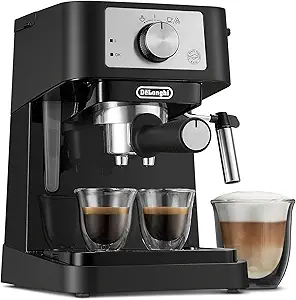
De’Longhi Stilosa Compact Manual Espresso Machine with Manual Milk Frother
The De’Longhi Stilosa keeps the home espresso setup compact and manual: it includes a portafilter with single and double filters, plus a wand for making milk drinks. That gives beginners a way to learn basic preparation without the grinder and guided workflow built into the Ninja Luxe Café Premier. Its stainless steel boiler and two-level cup holder support everyday use across different cup heights, but the process takes more effort than an assisted machine. Buyers also need a separate way to grind coffee, adding a step and potentially more counter equipment. Compared with the faster-heating Breville Bambino, the Stilosa’s appeal is a straightforward manual format rather than a quick heat-up feature. I’d choose it for someone willing to practice and handle each step themselves.
Pros:- Compact design saves counter space
- Stainless steel boiler
- Includes single- and double-shot filters
- Two-level cup holder accommodates different cup heights
Cons:- Manual preparation takes more effort than the assisted Ninja Luxe Café Premier
- No built-in grinder is listed, so coffee grinding requires a separate solution
- Manual milk frothing takes practice
Best for: New home espresso makers who want to learn portafilter preparation and milk frothing with a compact manual machine
Not ideal for: Busy buyers who want built-in grinding, assisted preparation, or less hands-on drink making
- Model:Stilosa
- Boiler:Stainless steel
- Frother:Manual milk frother
- Filters included:Two: single and double espresso
- Cup holder:Two-level
- Portafilter:Ergonomic portafilter
Our verdict“Choose the Stilosa if you want a compact machine for learning manual espresso and are comfortable managing the preparation yourself.”
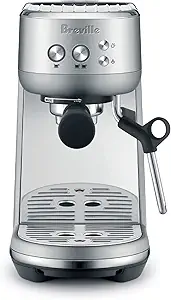
Breville Bambino Espresso Machine, Brushed Stainless Steel (BES450BSS)
The Breville Bambino is a strong fit for a small kitchen where quick startup matters: its ThermoJet system reaches extraction temperature in 3 seconds, so making a drink doesn’t require a long warm-up. It offers more temperature-focused espresso preparation than the basic SHARDOR, and its milk-texturing wand adds flexibility for cappuccinos and lattes. The Bambino remains a manual machine, though, so it does not take over grinding or preparation the way the Ninja Luxe Café Premier does. Its 54 mm portafilter and 19 g dose suit buyers ready to manage the coffee themselves. The 110–120 V rating also limits its fit for some international kitchens. I’d choose it for compact, quick-start espresso with hands-on control.
Pros:- ThermoJet reaches extraction temperature in 3 seconds
- Compact design suits smaller kitchens
- Milk-texturing wand supports milk-based drinks
- Includes portafilter, tamper, milk jug, and cleaning tools
Cons:- Manual espresso preparation requires hands-on work
- No built-in grinder is listed
- 110–120 V rating limits electrical compatibility
Best for: Home espresso drinkers with limited counter space who value rapid heat-up and want to prepare and texture drinks manually
Not ideal for: Buyers who need an automatic workflow, a built-in grinder, or compatibility beyond 110–120 V
- Model:BES450BSS
- Finish:Brushed stainless steel
- Heating system:ThermoJet
- Heat-up time:3 seconds
- Portafilter size:54 mm
- Coffee dose:19 g
- Power and voltage:1560 W; 110–120 V
- Settings:1 cup, 2 cups, hot water, and steam
Our verdict“Pick the Bambino if quick heat-up and a compact footprint matter more than automatic preparation or an all-in-one grinder.”
Aromaster 1400W Espresso Machine with Milk Frother
The Aromaster 1400W stands apart from simpler manual picks with PID and NTC temperature control, pre-infusion, and a listed 20-bar pump. Those features give it a more controlled brewing setup than the SHARDOR, whose 3.5-bar rating is aimed at espresso-style coffee. A swivel steam wand and removable tank make the Aromaster suited to regular milk drinks, while one-touch descaling helps with routine upkeep. It is still semi-automatic: the machine does not remove the need for hands-on preparation, unlike the guided Ninja Luxe Café Premier. Its listed brewing capacity is only 2.4 oz, which buyers should account for when planning drinks. I’d choose it for a compact setup with brewing controls and manual involvement, rather than for maximum convenience.
Pros:- PID and NTC temperature control support managed brewing
- Pre-infusion adds a brewing control feature
- Swivel steam wand supports milk frothing
- Removable tank and one-touch descaling support routine maintenance
Cons:- Semi-automatic operation still requires hands-on preparation
- Listed brewing capacity is 2.4 oz
- Requires more involvement than the guided Ninja Luxe Café Premier
Best for: Home baristas who want temperature control and pre-infusion in a compact semi-automatic machine
Not ideal for: Buyers who want an automatic, low-effort workflow or need a larger listed brewing capacity
- Power:1400 W
- Pump pressure:20 bar
- Water tank capacity:37 oz
- Brewing capacity:2.4 oz
- Dimensions:13 × 7 × 14 in
- Operation mode:Semi-automatic
- Temperature control:PID and NTC
- Special features:Pre-infusion, fast heat-up, descaling function, anti-dry-burn protection, low-noise operation, auto shut-off, cup warmer, and removable tank
Our verdict“Choose the Aromaster if you want temperature controls and pre-infusion in a compact machine and are willing to prepare drinks manually.”
XIXUBX Espresso Machine with Milk Frother for Cappuccino & Latte, Silver
The XIXUBX suits home espresso drinkers who want a straightforward machine with fewer refill interruptions. Its 42 oz water tank holds more than the Canoly 2-in-1’s listed 1.3-liter capacity, which can help in a household making several drinks each day. A visible pressure gauge gives beginners a useful visual reference, while instant heating and a rotating steam wand support a routine that includes milk drinks. It is a more hands-on choice than the De’Longhi Magnifica Duo, which automates grinding and offers preset recipes. That simplicity comes with tradeoffs: the XIXUBX needs ground coffee and manual milk-wand cleanup, and the brand has a limited track record. Choose it for basic espresso and cappuccino without an integrated grinder; skip it if you want automated drink preparation or established brand support.
Pros:- 42 oz tank reduces how often a multi-drink household needs to refill.
- Visible pressure gauge offers a helpful brewing reference for beginners.
- Instant heating supports a quicker espresso and milk-drink routine.
- Rotating, detachable steam wand and included pitcher allow home milk frothing.
Cons:- The steam wand requires manual cleaning after each use.
- No integrated grinder is listed, so buyers need a separate grinder or pre-ground coffee.
- The brand has a limited track record compared with De’Longhi.
Best for: Households making several espresso or milk drinks between water refills, who are comfortable using ground coffee and cleaning a steam wand.
Not ideal for: Buyers who want an integrated grinder, one-touch drink recipes, or a brand with a longer track record.
- Pressure:20 bar
- Water tank:42 oz
- Body:Stainless steel
- Steam wand:360° rotating, detachable
- Included:Milk frothing pitcher, manual, video tutorials
- Warranty:1 year
Our verdict“Pick the XIXUBX if a larger refill interval and simple manual milk frothing matter more than an integrated grinder or automated recipes.”
XIXUBX Semi-Automatic Espresso Machine with Milk Frother, Grey
This XIXUBX is aimed at beginners who want hot espresso drinks and a cold option from a push-button machine. Its 30-second heat-up and one-touch cold brew mode make it a more direct fit for quick drink changes than the Canoly 2-in-1, whose cold brew function is described as a dedicated pipeline. A 1350W heating system and NTC temperature control are intended to support consistent extraction, while the adjustable wand and included pitcher cover basic latte making. The tradeoff is limited manual feedback: unlike the AMZCHEF, it has no listed temperature display or adjustable grind settings, and its semi-automatic format may frustrate someone who wants to tune each shot. It makes sense for low-fuss home use, but not for buyers seeking detailed control or a built-in grinder.
Pros:- Listed 30-second heat-up helps shorten the wait before brewing.
- One-touch cold brew mode adds a cold option alongside hot espresso drinks.
- NTC temperature control is designed to support balanced extraction.
- Adjustable steam wand and included pitcher support milk drinks and latte art.
Cons:- No pressure gauge or temperature dial is listed for manual shot adjustments.
- No integrated grinder is specified, so coffee preparation requires separate equipment or pre-ground coffee.
- The semi-automatic controls offer less scope for advanced brewing adjustments than the AMZCHEF.
Best for: New home espresso drinkers who want a short warm-up, simple push-button controls, and both hot drinks and a cold brew mode.
Not ideal for: Espresso hobbyists who want to adjust grind and brewing temperature, or buyers who expect an integrated grinder.
- Power:1350W
- Pump pressure:20 bar
- Heat-up time:About 30 seconds
- Temperature control:NTC sensor
- Frother:Adjustable steam wand
- Included:Rust-resistant milk frothing pitcher
- Warranty:1 year
Our verdict“Choose this XIXUBX for quick, simple hot and cold drinks, and look elsewhere if you want fine control over grind or brew temperature.”
De’Longhi Magnifica Duo Automatic Espresso Machine with Milk Frother, Silver
The Magnifica Duo is the lineup’s strongest fit for homes where different people want different drinks and convenience matters more than manual technique. Its 20 preset hot and iced recipes, integrated conical burr grinder, and LatteCrema Hot and Cool frother combine steps that the Canoly 2-in-1 leaves to the user, including grinding and milk preparation. It also covers drip coffee and cold brew, making it broader than a dedicated espresso machine. The cost of that range is a more involved appliance: the feature set can take time to learn, and the grinder and removable frother add cleaning tasks. Buyers who mainly want to practice dialing in espresso may prefer the AMZCHEF’s listed grind and temperature adjustments. This De’Longhi makes more sense for shared kitchens seeking ready-made drink choices than for a minimalist setup.
Pros:- Twenty preset hot and iced recipes cover a broad range of household preferences.
- Integrated conical burr grinder handles fresh grinding without a separate appliance.
- Removable, dishwasher-safe frother works with dairy and plant-based milks.
- Cold Extraction Technology prepares cold brew in under three minutes, according to the product data.
Cons:- The broad feature set may take time to learn.
- The integrated grinder and frother require regular cleaning and maintenance.
- Preset automation gives less direct control than the AMZCHEF’s adjustable grind and temperature settings.
Best for: Households with varied coffee preferences that want an integrated grinder, preset recipes, and both hot and iced milk drinks.
Not ideal for: Minimalist kitchens or hands-on espresso enthusiasts who want a simpler machine or direct control over grind and brewing settings.
- Brand and model:De’Longhi Magnifica Duo
- Color:Silver
- Drink recipes:20 preset hot and iced recipes
- Brewing options:Espresso, drip coffee, and cold brew
- Grinder:Integrated conical burr grinder
- Milk frother:Removable, dishwasher-safe LatteCrema Hot and Cool
- Cold brew time:Under 3 minutes
Our verdict“Choose the Magnifica Duo if your household values preset drink variety and integrated grinding more than a simple, hands-on espresso setup.”
Canoly 2-in-1 Espresso Machine with Cold Brew & Milk Frother
The Canoly pairs home espresso with a dedicated cold brew pipeline in a footprint listed at 12.13 inches wide. That makes it a distinctive choice for a smaller counter when iced coffee matters, while the XIXUBX silver machine is better suited to buyers prioritizing a larger water tank. Its 30-second preheat, touch controls, steam wand, and cup warmer cover the basics of hot espresso and milk drinks without the recipe breadth of the De’Longhi Magnifica Duo. The tradeoff is a ground-coffee-only design: there is no pod compatibility or integrated grinder listed, so buyers must handle coffee preparation separately. The product describes its cold brew as ready in minutes, which serves a different routine from traditional slow extraction. I would choose it for compact, mixed hot-and-cold use, not for pod convenience or grinder-free setup.
Pros:- Dedicated cold brew function adds an iced coffee option alongside espresso.
- Listed 30-second preheat helps reduce waiting before brewing.
- Compact dimensions suit counters with limited width.
- Steam wand, touch panel, and cup warmer support a range of home drink routines.
Cons:- Uses ground coffee only and does not support pods.
- No integrated grinder is listed, so coffee must be ground separately or bought pre-ground.
- At 8.7 pounds, it may be cumbersome to move despite its compact dimensions.
Best for: Apartment dwellers who want espresso, milk drinks, and a quick cold brew option in a compact, ground-coffee machine.
Not ideal for: Pod users or buyers who want an integrated grinder, a larger water capacity, or traditional slow-steeped cold brew.
- Pressure:20 bar
- Power:1350W
- Capacity:1.3 liters
- Preheat time:30 seconds
- Input type:Ground coffee
- Dimensions:12.99D × 12.13W × 6.5H inches
- Weight:8.7 pounds
- Material:Stainless steel
- Special features:Cold brew, steam wand, cup warmer, touch panel
Our verdict“Pick the Canoly if you want compact ground-coffee espresso with a quick cold brew mode, and skip it if you need pods or an integrated grinder.”
AMZCHEF Espresso Machine with Grinder and Temperature Control, 44 Grind Settings
The AMZCHEF is the most adjustable option here for someone who wants to shape the drink around different beans. Its 44 grind settings and 190°F–201°F temperature range give home users more control over preparation than the preset-led De’Longhi Magnifica Duo. The integrated grinder, touch display, and 60 oz water tank also make it a self-contained setup for frequent brewing, while the steam wand supports milk drinks. Those controls bring complexity, and a combined grinder and espresso machine can be harder to repair if either part fails. Its cold brew mode is described as working in minutes, so it may not suit buyers who specifically want traditional slow-extracted cold brew. I would favor this model for experimentation and fresh grinding; the XIXUBX is a simpler fit for someone who mainly wants basic espresso and milk drinks.
Pros:- Forty-four grind settings span espresso through coarser coffee styles.
- Adjustable 190°F–201°F brewing temperature lets users tailor extraction to beans.
- Integrated grinder and 60 oz tank support frequent brewing in one setup.
- Touch display shows grind time, brew time, and temperature.
Cons:- Combining grinder and machine can make repair more involved if one component fails.
- The cold brew mode is described as taking minutes, which may not match traditional slow-extraction flavor.
- More adjustable settings may require experimentation compared with the De’Longhi’s preset recipes.
Best for: Home espresso drinkers who want an integrated grinder and room to adjust grind size and brewing temperature for different beans.
Not ideal for: Buyers who prefer preset simplicity, want separate grinder and machine components for easier replacement, or expect traditional slow-steeped cold brew.
- Temperature control:190°F–201°F
- Grind settings:44
- Water tank:60 oz
- Heating power:1350W
- Steam wand:8 mm stainless steel
- Display:IMD HD touch screen
- Special modes:Cold brew mode and descaling function
Our verdict“Choose the AMZCHEF if you want one appliance with a wide range of grind and temperature adjustments, and prefer simplicity if you do not.”

How We Picked
I ranked these machines for the realities of home use: how much equipment a buyer needs to assemble, how approachable the brewing and milk workflow appears, how well the format fits different kitchen routines, and how much choice it offers beyond espresso. I gave weight to integrated grinders, automatic drink functions, compact designs, and alternate brewing modes when those features solve a clear household need. I also considered the work each format asks of the owner, including grinding, steaming, and routine cleaning.
The order favors machines with a clear role and a useful balance of capability and usability. The Barista Express leads as a well-rounded hands-on setup; the Bambino ranks highly for compact kitchens when paired with a separate grinder; and the Ninja earns attention for drink variety. Automatic and grinder-equipped models can reduce setup steps, while simpler compact machines may suit tighter spaces or limited routines. Product names and listed features inform this comparison; the ranking does not imply hands-on testing, and buyers should check current model details before choosing.
Factors to Consider When Choosing Espresso Machines For Home
Choosing a home espresso machine starts with the routine you want to repeat, rather than a long feature list. These factors can help you match a machine to your kitchen, coffee habits, and tolerance for daily preparation.
Decide How Much of the Process You Want to Do
Manual and semi-automatic machines leave more decisions in your hands, from preparing the coffee to controlling the brew and steaming milk. That control can be rewarding, but it adds steps and practice to weekday mornings. Automatic machines can take more of the drink-making routine off your plate, though you may have fewer ways to shape the process. A common mistake is buying for an imagined weekend hobby when what you need is a fast daily cup. Think about who will use the machine and whether they want to learn its workflow. Pick the level of involvement you are likely to enjoy after the novelty wears off.
Treat the Grinder as Part of the Machine
Espresso requires coffee ground to suit the machine and the chosen beans, so a grinder is a core part of the setup rather than a minor accessory. A built-in grinder reduces the number of separate purchases and keeps the workflow together, but it can make grinder upgrades or replacements less flexible. A machine without one can suit someone who already owns a capable grinder or wants to choose one separately. Buyers sometimes compare machine features and forget to budget counter space for a separate grinder. Check how easy the grinder is to adjust and clean, and consider whether different household members will use different settings. The right choice depends on your full setup, not the machine alone.
Match Milk Features to the Drinks You Make
If you mostly drink straight espresso or americanos, a milk wand may add complexity without much daily benefit. Cappuccinos and lattes call for a milk workflow, whether that means learning to steam manually or choosing a machine with more assistance. Manual steaming gives you more direct control but needs a suitable pitcher, practice, and cleanup after each use. A built-in frother can simplify preparation, though the finished texture and available control vary by design. Count how many milk drinks your household makes in a typical week before paying for a feature you may rarely use. Also check whether the milk parts are easy to rinse and maintain.
Measure the Whole Countertop Footprint
A machine’s listed dimensions tell only part of the space story. Leave room for the portafilter handle, water-tank access, cup clearance, and any grinder or milk pitcher stored nearby. A compact body can still feel awkward if it needs to sit beneath low cabinets or be pulled forward for refilling. Before choosing, measure the intended spot and the route your hands need to reach the controls. Consider where grounds, cups, and cleaning supplies will go, too. A machine that fits neatly into the full routine is more likely to stay on the counter and get used.
Weigh Drink Variety Against a Focused Espresso Setup
Some home machines are built around espresso, while others add drip-style coffee, cold brew, or automatic drink programs. Extra modes can make one appliance useful to more people in a household and reduce the need for separate equipment. They also add controls and parts to learn, so they may be wasted complexity if everyone wants the same espresso-based drink. Consider how often each person makes a different style of coffee, rather than judging variety by the number of buttons. If alternate drinks are a regular part of your home routine, a multi-mode model can earn its space. If not, prioritize the espresso workflow you will use every day.
Plan for Cleaning Before You Buy
Every espresso setup creates routine work, but the specific chores depend on its grinder, milk system, and brewing parts. Milk residue needs prompt attention, while coffee grounds and water-system care call for their own regular habits. A machine with more integrated features may reduce steps at the start and add parts to clean afterward. Buyers often focus on making a drink and overlook how quickly a messy setup can become inconvenient. Look for accessible removable parts and read the care instructions for the components you expect to use. Choose a maintenance routine you can realistically keep up with.
Frequently Asked Questions
Should I choose a machine with a built-in grinder or buy a separate one?
A built-in grinder can make a first home setup simpler by keeping grinding and brewing in one appliance. A separate grinder gives you more freedom to choose or replace it independently and may suit buyers who already own one. Consider the space available, how much control you want over grind adjustments, and whether you prefer one appliance or a modular setup. Remember that either route needs a grinder suitable for espresso. The best fit is the complete setup you can use and maintain comfortably.
Is an automatic espresso machine a better choice for a beginner?
It can be a better fit if you want fewer preparation steps and a more guided drink routine. A semi-automatic machine can also work for a beginner who wants to learn espresso preparation and accepts a practice period. Think about whether you value convenience or hands-on control more than the label on the machine. Milk drinks add another part of the workflow, so check how the machine handles them if they are part of your daily order. Choose the process you are willing to repeat, not just the one that seems easiest in a product description.
Will a compact espresso machine fit a small kitchen?
A compact machine can help, but measure the usable space rather than relying on width alone. Leave clearance for the handle, water tank, cup, and any grinder that sits beside the machine. Low cabinets can make refilling or steaming awkward even when the body itself fits. If the machine lacks a built-in grinder, account for that separate footprint too. A quick countertop mock-up with the key dimensions can prevent a poor fit.
Do I need a milk frother if I mainly drink espresso?
If you usually drink espresso without milk, a frother may not add enough value to justify extra parts and cleanup. It becomes more useful if people in your household regularly make cappuccinos or lattes. A steam wand typically asks for more practice, while assisted frothing can reduce some of the manual work. Consider who makes drinks in the morning and how much time they have. A milk feature earns its place when it matches a repeated habit.
Are machines with cold brew or drip modes worth considering for an espresso-focused home?
They can make sense when household members regularly want different coffee styles and one counter appliance is preferable to several. If everyone drinks espresso-based beverages, alternate modes may add controls and maintenance without changing your everyday routine. Think about the drinks you make across a full week, including what guests or other household members prefer. Compare how much counter space the multi-mode machine needs with the appliances it could replace. Choose added versatility when you expect to use it, rather than treating it as a bonus by default.
Conclusion
For the best overall balance, I would start with the Breville Barista Express: its integrated grinder and hands-on workflow suit buyers who want one capable espresso setup. The best value in versatility depends on what your household will use; the Ninja Luxe Café Premier is a strong match when drip coffee and cold brew matter alongside espresso. For a premium, more automated routine, consider the De’Longhi Magnifica Duo, while the Breville Bambino is my beginner-friendly compact pick for someone willing to pair it with a grinder. If space is tight, compare the compact CASABREWS and De’Longhi Stilosa options; if your household wants multiple brew styles, look closely at the Canoly 2-in-1. Choose the machine whose daily workflow fits your counter, coffee habits, and appetite for hands-on preparation.
Evergreen bestsellers Picks
bestsellers
As an affiliate, we earn on qualifying purchases.