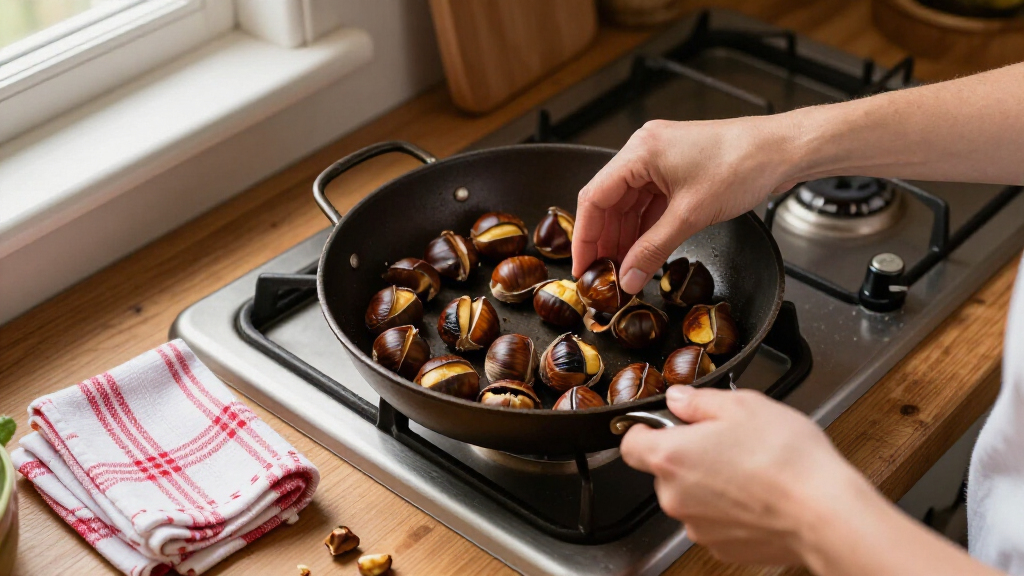

The best chestnut roasting pans balance even heat, useful ventilation, and safe handling for the way you plan to cook. I’d put the Esschert Design FF156 Cast Iron Chestnut Roaster first for its substantial cast-iron build, while the RSVP International Stainless Steel Nut and Seed Toasting Pan suits smaller batches and the AB Tools 600mm Steel Chestnut Roaster is aimed at open-fire cooking from a safer distance. The main tradeoffs are weight versus maneuverability, dedicated chestnut capacity versus versatility, and the care demands of different materials. Some models prioritize easy handling or coated surfaces, while others favor rugged construction for direct heat. Read on for my full comparison and advice on choosing the right pan for your cooking setup.

Get kitchen gear delivered free with Prime
- Fast, free delivery on millions of items
- Prime Video, Amazon Music and more included
- Member-only deals all year
Complete the kit


Key Takeaways
- Cast iron leads for heat retention, but the Esschert Design and Victor cast-iron models are heavier than steel or stainless options.
- Open-fire use changes the choice: the AB Tools model’s 600mm handle is designed for distance, unlike compact pans better suited to stovetop cooking.
- The RSVP stainless steel pan favors versatility for nuts and seeds as well as chestnuts, though its smaller format is less suited to large batches.
- Coated and enamelled pans trade easier cleanup for surface-care needs; avoid rough utensils and follow the maker’s heat guidance.
- Accessories and lids affect convenience, not just roasting: the Victor enamelled set includes a toasting fork, while the Miskall pan’s lid supports a different, more covered style of cooking.
| Esschert Design FF156 Cast Iron Chestnut Roaster |  | Best for Open-Fire Roasting | Brand: Esschert Design | Model: FF156 | Material: Cast iron | VIEW LATEST PRICE | See Our Full Breakdown |
| Miskall Speckled Enamel Roasting Pan with Lid, 28 cm |  | Best for Covered, Multi-Use Roasting | Brand: Miskall | Material: Enamel, iron, and stainless steel | Color: Black speckled | VIEW LATEST PRICE | See Our Full Breakdown |
| RSVP International Stainless Steel Nut and Seed Toasting Pan |  | Best for Small Batches | Material: Stainless steel | Pan diameter: 4.5 inches | Pan depth: 2 inches | VIEW LATEST PRICE | See Our Full Breakdown |
| Imex El Zorro 70751 Chestnut Roasting Pan, 30 cm |  | Best for Large Batches | Manufacturer: Imex El Zorro | Model: 70751 | Diameter: 30 cm | VIEW LATEST PRICE | See Our Full Breakdown |
| IBILI 26 cm Non-Stick Chestnut Pan |  | Best for Everyday Hob Cooking | Diameter: 26 cm | Material: Steel | Coating: Non-stick, PFOA-free | VIEW LATEST PRICE | See Our Full Breakdown |
| Victor Cast Iron Chestnut Roaster |  | Best Cast-Iron Pick | Brand: Victor | Material: Cast iron | Handle material: Cast iron | VIEW LATEST PRICE | See Our Full Breakdown |
| AB Tools Chestnut Roaster with Loop Handle – 600mm Steel |  | Best for Open-Fire Cooking | Material: Steel | Finish: Black | Total length: 23.5 inches (600 mm) | VIEW LATEST PRICE | See Our Full Breakdown |
| Victor Enamelled Chestnut Roaster and Toasting Fork Set |  | Best Set for Fireside Roasting | Material: Alloy steel | Handle material: Steel | Finish: Black enamel | VIEW LATEST PRICE | See Our Full Breakdown |
| KitchenCraft Carbon Steel Chestnut Roasting Pan, 27 cm, Black |  | Best for Stovetop Versatility | Material: Carbon steel | Handle material: Wood | Width: 27 cm (10.5 in) | VIEW LATEST PRICE | See Our Full Breakdown |
| chestnut roasting pan | Material | Color | Item weight |
|---|---|---|---|
| Esschert Design FF156 Cast Iro | Cast iron | — | — |
| Miskall Speckled Enamel Roasti | Enamel, iron, and stainless steel | Black speckled | — |
| RSVP International Stainless S | Stainless steel | — | 4.16 ounces |
| Imex El Zorro 70751 Chestnut R | — | — | 3.9 pounds |
| IBILI 26 cm Non-Stick Chestnut | Steel | Black/White | — |
| Victor Cast Iron Chestnut Roas | Cast iron | Black | — |
| AB Tools Chestnut Roaster with | Steel | — | 13.3 ounces |
| Victor Enamelled Chestnut Roas | Alloy steel | Black | 0.9 kg |
| KitchenCraft Carbon Steel Ches | Carbon steel | Black | 0.44 kg |
More Details on Our Top Picks
Esschert Design FF156 Cast Iron Chestnut Roaster
The Esschert Design FF156 is the clearest fit here for chestnuts roasted over an open fire. Its cast-iron construction suits outdoor cooking, while the 11-liter capacity gives it more room than the RSVP International pan, which is built for small batches of nuts and seeds. The round pan can also handle larger items, making it more versatile around a campfire or grill. That broader use comes with a less convenient cleanup routine: this model is hand-wash only, unlike the dishwasher-safe RSVP. At 1.6 pounds, it is also a more substantial option to carry than a lightweight tabletop toasting pan. I’d choose it for outdoor chestnut roasting, not for quick indoor batches or anyone who wants machine-washable cookware.
Pros:- Designed for roasting chestnuts over an open fire
- Cast-iron construction suits outdoor cooking
- 11-liter capacity accommodates larger quantities or foods
- Can also be used for grilling larger items
Cons:- Hand washing adds cleanup work
- Larger capacity may be unnecessary for small household batches
- Listed gas compatibility does not specify compatibility with other indoor cooktops
Best for: Outdoor cooks who roast chestnuts over an open fire and want a pan that can also grill larger foods.
Not ideal for: Apartment cooks and buyers who need a compact pan for small batches or dishwasher-safe cleanup.
- Brand:Esschert Design
- Model:FF156
- Material:Cast iron
- Shape:Round
- Capacity:11 liters
- Weight:1.6 pounds
- Recommended use:Roasting
- Care:Hand wash only
- Compatible device:Gas
Our verdict“Choose the Esschert Design if open-fire use and room for larger batches matter more than easy cleanup.”
Miskall Speckled Enamel Roasting Pan with Lid, 28 cm
The Miskall stands apart from dedicated perforated chestnut pans by including a cover and shelf, a setup aimed at broader roasting and barbecue tasks as well as chestnuts. Its combination of enamel, iron, and stainless steel is designed to circulate heat evenly, while the speckled enamel surface is intended to release food more easily. Compared with the IBILI 26 cm Non-Stick Chestnut Pan, Miskall offers a lid and shelf but does not list specific stovetop compatibility or a capacity. That makes it harder to judge as a direct hob-roasting choice. Its weight is also given as a range, and at roughly 1.1 kilograms it is not the lightest option. I’d favor it for cooks who want one covered pan for several roasting jobs, rather than a chestnut-focused tool.
Pros:- Includes a cover and shelf for broader roasting uses
- Enamel, iron, and stainless steel construction is designed for even heat circulation
- Speckled enamel surface is intended to help food release
- Suitable for roasting, baking, and barbecue
Cons:- Stovetop compatibility is not specified
- Weight is listed as a range rather than one figure
- No capacity is provided, making batch size harder to judge
Best for: Home cooks who want a covered roasting pan for chestnuts, sweet potatoes, and barbecue cooking.
Not ideal for: Buyers seeking a clearly specified chestnut pan for a particular stovetop, or those who prioritize a simple lightweight design.
- Brand:Miskall
- Material:Enamel, iron, and stainless steel
- Color:Black speckled
- Diameter:28 cm
- Weight:Approximately 1,088–1,157 g (38.4–40.8 oz)
- Included components:Roasting pan, cover, and shelf
- Intended uses:Roasting, baking, and barbecue
Our verdict“Pick the Miskall if you want a covered multi-use roaster; choose the IBILI instead for a more clearly specified hob-focused chestnut pan.”
RSVP International Stainless Steel Nut and Seed Toasting Pan
For a handful of chestnuts rather than a family-sized batch, the RSVP International is the most compact choice in this group. Its 4-ounce capacity, ridged interior, and locking mesh screen are designed to keep small ingredients contained and moving over medium-to-low heat. That makes it more suited to nuts, seeds, and spices than the 30 cm Imex El Zorro, which is built as a much larger chestnut roasting pan. The RSVP also offers the easiest cleanup here because it is dishwasher safe. Its limits are just as clear: the small capacity means repeat batches for groups, and the stated maximum temperature is only 300°F. I’d pick it for occasional small indoor toasting, not open-fire roasting or high-heat cooking.
Pros:- Locking mesh screen helps keep small ingredients contained
- Interior ridges are designed to reduce burning
- Suitable for nuts, seeds, and spices as well as chestnuts
- Dishwasher safe
Cons:- Four-ounce capacity is too small for group-sized batches
- Maximum temperature is listed as 300°F
- Designed for medium-to-low heat rather than high-heat roasting
Best for: Solo cooks and small households who toast a few chestnuts, nuts, seeds, or spices at a time.
Not ideal for: Families, outdoor cooks, and anyone who needs a larger batch pan or cooking above 300°F.
- Material:Stainless steel
- Pan diameter:4.5 inches
- Pan depth:2 inches
- Handle length:6.5 inches
- Capacity:4 ounces
- Item weight:4.16 ounces
- Maximum temperature:300°F
- Care:Dishwasher safe
Our verdict“Choose the RSVP for small, controlled batches and easy cleanup, but not when capacity or high heat is a priority.”
Imex El Zorro 70751 Chestnut Roasting Pan, 30 cm
The Imex El Zorro’s 30 cm diameter makes it the roomiest clearly sized chestnut-specific pan in this set. It is a better match for cooks preparing a substantial batch than the RSVP International, whose capacity is just four ounces, and the description positions it for both home and professional cooking. Its impact-resistant build is another point in its favor for regular use. The tradeoff is weight: at 3.9 pounds, it is considerably heavier than the RSVP and less appealing if you need to move a pan between indoor and outdoor cooking spots. The available specifications also do not identify its material, stovetop compatibility, or care method, so buyers have less guidance than they do with the IBILI. I’d choose it for capacity and robust handling, provided those missing details fit your setup.
Pros:- 30 cm diameter provides a broad cooking surface
- Designed specifically for roasting chestnuts
- Described as suitable for professional and home cooking
- Impact-resistant construction
Cons:- At 3.9 pounds, it is relatively heavy
- Material is not specified in the supplied product details
- Stovetop compatibility and care instructions are not provided
Best for: Home cooks or food-service users who want a 30 cm chestnut pan for preparing larger batches.
Not ideal for: Buyers who need a lightweight pan or require confirmed material, cooktop compatibility, and cleaning instructions before buying.
- Manufacturer:Imex El Zorro
- Model:70751
- Diameter:30 cm
- Item weight:3.9 pounds
- Package dimensions:30.51 × 13.62 × 5.51 inches
- Intended use:Chestnut roasting
- Use setting:Home or professional cooking
Our verdict“Pick the Imex El Zorro for a large chestnut-roasting surface, but choose the IBILI if confirmed hob compatibility matters more.”
IBILI 26 cm Non-Stick Chestnut Pan
The IBILI is a straightforward choice for chestnut roasting on common household hobs: its listed compatibility covers electric, ceramic, and gas cooktops, and the 26 cm size is more manageable than the 30 cm Imex El Zorro. Its PFOA-free non-stick coating is designed to make food release easier, though the pan still requires hand washing. Compared with the Miskall, it is more clearly aimed at stovetop use, while the Miskall includes a cover and shelf for broader roasting tasks. The IBILI’s steel construction keeps the design simple, but the supplied details do not identify it as suitable for open-fire cooking. I’d choose it for routine hob use and a moderate batch size, not for cooks who need dishwasher-safe care or a dedicated campfire pan.
Pros:- Compatible with electric, ceramic, and gas stovetops
- PFOA-free non-stick coating is designed to help food release
- 26 cm diameter offers a moderate cooking surface
- Steel construction keeps the pan focused on everyday hob use
Cons:- Hand wash only
- Open-fire compatibility is not specified
- Smaller than the 30 cm Imex El Zorro
Best for: Home cooks who roast chestnuts on electric, ceramic, or gas hobs and want a non-stick surface.
Not ideal for: Outdoor open-fire cooks and buyers who want dishwasher-safe cleanup or a larger 30 cm roasting surface.
- Diameter:26 cm
- Material:Steel
- Coating:Non-stick, PFOA-free
- Compatible stovetops:Electric, ceramic, and gas
- Care:Hand wash only
- Capacity:1 liter
- Color:Black/White
- Model number:450726
Our verdict“Choose the IBILI for regular chestnut roasting on a household hob, especially if a non-stick surface matters more than dishwasher-safe care.”
Victor Cast Iron Chestnut Roaster
The Victor Cast Iron Chestnut Roaster is the straightforward choice for buyers who want a traditional, heavy-duty material rather than a multipurpose pan. Its round cast-iron body and handle suit chestnut roasting, while the simple construction avoids the added parts of the Victor enamelled roaster-and-fork set. Compared with the KitchenCraft Carbon Steel Chestnut Roasting Pan, this model offers cast iron instead of a perforated pan designed for several stovetop types; the available details do not confirm compatible cooking surfaces for the Victor. That uncertainty is its main drawback, along with missing dimensions and care guidance, which make it harder to judge fit and upkeep before buying. I’d choose it for a buyer who values cast iron and can confirm that its intended heat source suits their setup.
Pros:- Cast-iron construction suits buyers seeking a traditional roasting material
- Cast-iron handle keeps the handle material consistent with the body
- Round shape is designed for roasting chestnuts
Cons:- Dimensions are not provided, making storage and capacity difficult to judge
- Care instructions are not specified
- The supplied product details do not identify compatible heat sources
Best for: Chestnut-roasting traditionalists who specifically want a cast-iron pan and can verify compatibility with their heat source
Not ideal for: Buyers who need stated dimensions, care instructions, or confirmed compatibility with a particular stovetop
- Brand:Victor
- Material:Cast iron
- Handle material:Cast iron
- Finish:Unfinished
- Color:Black
- Shape:Round
- Number of items:1
Our verdict“Choose this Victor if cast iron is your priority and you can confirm its size and heat-source compatibility before buying.”
AB Tools Chestnut Roaster with Loop Handle – 600mm Steel
The AB Tools Chestnut Roaster is aimed squarely at open-fire and wood-burner use: its 600 mm loop handle keeps the pan away from the fire and gives it a place to hang between uses. The 150 mm pan is larger than a compact roasting surface, but its listed dimensions still make this a relatively slim, single-purpose tool rather than a kitchen pan. Compared with the Victor Enamelled Chestnut Roaster and Toasting Fork Set, AB Tools offers a loop handle and a stated pan diameter, while Victor includes a separate fork. The AB Tools model’s 13.3-ounce weight may feel less substantial during repeated or forceful handling, and it is not described for indoor stovetops. I’d pick it for fireside roasting, not for an all-purpose hob setup.
Pros:- 600 mm total length keeps the handle well away from the fire
- Loop handle can be hung for storage
- 150 mm pan diameter is specified
- Designed for open fires and wood burners
Cons:- At 13.3 ounces, it may feel light during heavier or frequent use
- Not intended for indoor stovetop cooking
- A 150 mm pan limits the roasting surface compared with wider pans
Best for: Campers and wood-burner owners who want a hanging, long-handled pan for chestnuts over an open fire
Not ideal for: Indoor cooks who need a pan for a gas, electric, or ceramic stovetop, or buyers who prefer a heavier-feeling tool
- Material:Steel
- Finish:Black
- Total length:23.5 inches (600 mm)
- Pan diameter:150 mm
- Product dimensions:23.62 × 5.91 × 2.36 inches
- Item weight:13.3 ounces
- Intended heat source:Open fire or wood burner
Our verdict“Pick AB Tools for open-fire chestnut roasting and hanging storage, but skip it if you need an indoor stovetop pan.”
Victor Enamelled Chestnut Roaster and Toasting Fork Set
The Victor Enamelled Chestnut Roaster and Toasting Fork Set makes sense for buyers who want a ready-made fireside pairing rather than a pan alone. Its 57 cm handle provides reach over an open fire or barbecue, and the included fork adds a second tool for toasting. Compared with the AB Tools Chestnut Roaster, this set trades AB Tools’ hanging loop and specified 150 mm pan diameter for the extra fork; the supplied Victor details do not state the roaster’s pan diameter. The black enamel finish distinguishes it from the plain cast-iron Victor roaster, but the data does not include care guidance or confirm use on indoor stovetops. At 0.9 kg, it is also heavier than the AB Tools model. I’d choose it for a fireside setup where the paired fork is useful.
Pros:- Includes both a chestnut roaster and a toasting fork
- 57 cm total length adds reach when cooking over fire
- Designed for open fires and barbecues
- Black enamel finish distinguishes it from the plain cast-iron Victor roaster
Cons:- Pan diameter is not specified
- Indoor stovetop compatibility is not stated
- At 0.9 kg, it is heavier than the AB Tools roaster
Best for: Open-fire and barbecue cooks who want a long-handled chestnut roaster paired with a toasting fork
Not ideal for: Stovetop cooks or buyers who need a specified pan diameter and detailed care instructions before choosing
- Material:Alloy steel
- Handle material:Steel
- Finish:Black enamel
- Color:Black
- Total length:57 cm
- Dimensions:57 × 15.5 × 5 cm
- Item weight:0.9 kg
- Set includes:1 chestnut roaster and 1 toasting fork
- Intended heat source:Open fire or barbecue
Our verdict“Choose this Victor set for open-fire roasting when the extra toasting fork matters more than a stated pan diameter.”
KitchenCraft Carbon Steel Chestnut Roasting Pan, 27 cm, Black
The KitchenCraft Carbon Steel Chestnut Roasting Pan stands apart from the fire-focused AB Tools and Victor roasters because it is specified for gas, electric, and ceramic hobs, as well as barbecue use. Its perforated base lets steam escape while chestnuts roast, and the 27 cm round pan can also handle fish or vegetables on a barbecue. The long wooden handle keeps hands farther from the heat, though it still calls for care around flame. Compared with the Victor Cast Iron Chestnut Roaster, KitchenCraft gives buyers clearer size and heat-source information, but its 220 °C maximum temperature is a defined limit, not a cue for unrestricted high-heat cooking. Its chestnut-focused design may also see less use outside seasonal roasting. I’d favor it for buyers who need one pan for both hob and barbecue.
Pros:- Compatible with gas, electric, and ceramic hobs
- Perforated base lets steam escape during chestnut roasting
- 27 cm width offers a stated pan size
- Can also cook fish or vegetables on a barbecue
Cons:- Maximum temperature is limited to 220 °C
- Chestnut-focused shape may limit its everyday use
- Wooden handle requires care around barbecue flames
Best for: Home cooks who roast chestnuts on a gas, electric, or ceramic hob and want the option to use the pan on a barbecue
Not ideal for: Open-fire cooks seeking a long fire-poking handle, or buyers who need a pan for use above 220 °C
- Material:Carbon steel
- Handle material:Wood
- Width:27 cm (10.5 in)
- Color:Black
- Shape:Round
- Capacity:5 liters
- Item weight:0.44 kg
- Maximum temperature:220 °C
- Compatible cooking surfaces:Gas, electric, and ceramic hobs; barbecue
Our verdict“Choose KitchenCraft if you want a clearly specified chestnut pan for several stovetop types and occasional barbecue cooking.”
How We Picked
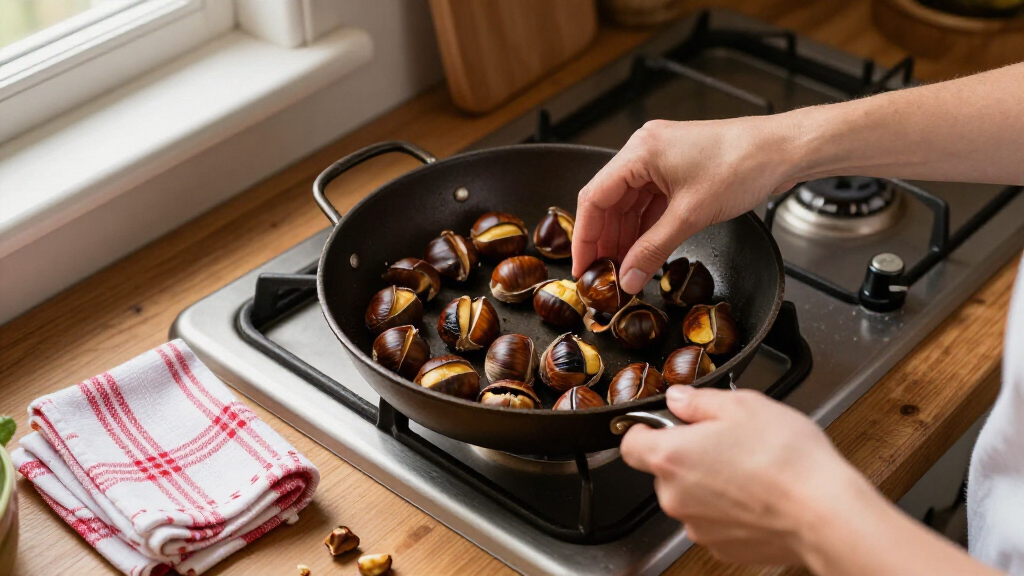
I compared these nine pans by how well their design matches chestnut roasting: ventilation and heat exposure, usable capacity, material, handle reach, and compatibility with likely heat sources. I also weighed practical ownership factors, including heft, cleaning demands, coating or enamel care, and whether added features such as a lid or fork solve a real cooking need. Because chestnut roasting can mean anything from a small stovetop batch to outdoor fire cooking, no single format suits every buyer.
The ranking favors clear chestnut-roasting utility and dependable handling over extra features alone. The Esschert Design cast-iron model takes the overall position for its purpose-built, heat-retaining format; the RSVP stainless pan ranks strongly for smaller, mixed-use batches, and the AB Tools long-handled model stands apart for open-fire distance. Coated, enamelled, and lidded options remain useful for particular priorities, but their care needs or less direct roasting format limit their appeal as all-purpose picks.
| chestnut roasting pan | Material | Color |
|---|---|---|
| Esschert Design FF156 Cast Iro | Cast iron | — |
| Miskall Speckled Enamel Roasti | Enamel, iron, and stainless steel | Black speckled |
| RSVP International Stainless S | Stainless steel | — |
| Imex El Zorro 70751 Chestnut R | — | — |
| IBILI 26 cm Non-Stick Chestnut | Steel | Black/White |
| Victor Cast Iron Chestnut Roas | Cast iron | Black |
| AB Tools Chestnut Roaster with | Steel | — |
| Victor Enamelled Chestnut Roas | Alloy steel | Black |
| KitchenCraft Carbon Steel Ches | Carbon steel | Black |
Factors to Consider When Choosing Best Chestnut Roasting Pans
Before choosing a pan, I’d match its design to where and how often you roast rather than treating all chestnut pans as interchangeable. These factors help avoid common mismatches that are easy to miss in a product comparison.
Match the Pan to Your Heat Source
Start by identifying whether you’ll cook on a stovetop, over a grill, or beside an open fire. A long handle can help keep hands farther from flames, but it can be awkward in a small kitchen or storage drawer. Shorter-handled pans are easier to maneuver indoors, yet may be less comfortable for fire-side use. Check the maker’s instructions for compatible heat sources rather than assuming every metal pan works on every burner or cooking surface. A common mistake is buying for occasional outdoor roasting and then finding the handle unwieldy for routine stovetop batches. Choose around your usual setup, not the most adventurous one you might try once.
Choose Capacity Around Batch Size
A wide pan can hold more chestnuts, but filling it too deeply may make it harder to turn them evenly. A smaller pan is more manageable for a snack or a household with limited storage, though multiple batches take longer when serving a group. Think about how much counter or burner space you can spare as well as the number of people you usually feed. The listed diameter is a starting point, not a guarantee of usable cooking area; handle placement and pan shape affect how much room remains. Avoid choosing the largest option simply because it sounds more efficient. For consistent results, a batch that can move freely may be more useful than maximum nominal capacity.
Weigh Heat Retention Against Ease of Handling
Cast iron retains heat well, which can help maintain a steady cooking surface, but its weight makes shaking and lifting more demanding. Stainless steel and carbon steel are typically easier to move, though their heat behavior differs by construction and thickness. If you expect to turn chestnuts frequently, pay attention to the handle’s length, grip, and balance as much as the pan material. Buyers with limited hand strength may prefer a lighter pan even if it gives up some thermal mass. Conversely, a heavy pan can feel cumbersome when transferring a full batch. The right choice depends on whether stable heat or easy movement matters more in your routine.
Treat Ventilation and Turning as Core Features
Chestnuts need exposure to heat, and roasting pans often use perforations to let hot air and flame reach the shells. Hole size and placement can affect how easily chestnuts shift or how small pieces behave, so inspect the pattern rather than focusing only on the pan’s material. You’ll also need a way to turn the chestnuts during cooking, whether by shaking the pan or using a utensil. A lid may help contain movement or heat, but it changes how directly the chestnuts are exposed and should not be assumed to improve every roasting method. If you want a crisp, direct-roasted result, prioritize an open, well-ventilated design. If containment matters more, confirm that the lid suits your intended heat source.
Account for Cleaning and Surface Care
Raw cast iron may need prompt drying and protective seasoning, while enamel and non-stick surfaces call for care that helps prevent chips or scratches. Stainless steel and carbon steel have their own maintenance needs, so read the manufacturer’s cleaning guidance before deciding that one material is effortless. Chestnut residue can lodge around perforations, making a brush or suitable cleaning tool more useful than a smooth surface alone. Avoid abrasive tools on coated finishes, even when stuck-on bits make scrubbing tempting. Buyers who want low-fuss cleanup should check both the cooking surface and the holes, not just whether a pan is described as non-stick. A small care routine can be easier than replacing a finish damaged by the wrong utensil.
Pay More Only for Features You Will Use
A higher-spec design makes sense when its build or accessories solve a repeated problem: long reach for fire cooking, a fork for serving, or a lid for a preferred method. Those extras add little value if you roast only occasional small batches on a standard stovetop. A versatile pan may earn more kitchen use by toasting seeds or other small ingredients, while a dedicated chestnut roaster may handle its main task more directly. Consider storage too: long handles and bulky cast iron can take more space than their cooking area suggests. New users often benefit more from a manageable, straightforward design than from a collection of accessories. Let frequency, heat source, and maintenance tolerance set the feature budget.
Frequently Asked Questions
Can I use a chestnut roasting pan on an open fire?
Some designs are better suited to open-fire cooking than others, particularly models with longer handles that keep hands farther from the heat. Do not assume a pan is fire-safe based on metal construction alone; check the manufacturer’s directions for approved heat sources and handle use. A long handle also needs room to move without striking nearby people or equipment. For a hearth or campfire, use heat-resistant gloves and keep the pan under control while turning chestnuts. If you mainly cook indoors, a shorter, more manageable pan may be the better choice.
Is cast iron worth choosing if I roast chestnuts only occasionally?
Cast iron can be a good fit if you value heat retention and a substantial cooking surface, but its weight and care routine may feel unnecessary for occasional small batches. Consider where you’ll store it and whether lifting and turning a full pan will be comfortable. A lighter steel or stainless option may be easier to bring out, use, and put away. Cast iron makes more sense when you also expect to use it regularly for other suitable cooking tasks. The decision is less about frequency alone and more about whether its weight and maintenance fit your kitchen habits.
Should I choose a perforated pan or one with a lid?
A perforated pan is designed to expose chestnuts directly to heat, which is the central feature many buyers want for roasting. A lid may help contain the contents or suit a covered cooking approach, but it can change airflow and the way heat reaches the shells. The better format depends on your preferred method and the heat source, not on the presence of a lid by itself. Check whether the pan’s instructions describe a lid-on roasting method before relying on it for that purpose. If direct exposure is your priority, favor ventilation and easy turning over extra coverage.
Can I use a chestnut pan for seeds or other small ingredients?
Some pans can serve for seeds or other small ingredients, and the RSVP stainless steel model is positioned for both nuts and seeds as well as chestnuts. Before using any perforated pan for smaller items, consider whether the openings could let them fall through. Also check whether the manufacturer lists other uses and whether the pan’s handle and surface suit your heat source. A dedicated chestnut pan may still be useful for broader roasting, but versatility varies by design. If mixed use matters, choose based on the smallest ingredient you plan to cook and the pan’s stated guidance.
What should I check before buying a non-stick or enamelled chestnut pan?
Look up the maker’s temperature and heat-source guidance, then check which utensils and cleaning methods are allowed. Coated surfaces can make cleanup more appealing, but scratches or chips may shorten their useful life. A perforated design also creates corners and openings where residue can collect, so find out how those areas should be cleaned. Consider whether you are willing to avoid abrasive tools and handle the pan with care during storage. If you prefer cookware that can take rougher handling, an uncoated model may suit you better, though it can bring different maintenance demands.
Conclusion
My best overall pick is the Esschert Design FF156 Cast Iron Chestnut Roaster for buyers who want a dedicated, heat-retaining pan and can manage its weight. For best value in everyday flexibility, the RSVP International Stainless Steel Nut and Seed Toasting Pan makes sense for smaller batches and other small-ingredient roasting. Beginners who want a more approachable coated format can look at the IBILI 26 cm Non-Stick Chestnut Pan, provided they follow its surface-care guidance. For a premium-style, traditional build, the Victor Cast Iron Chestnut Roaster suits cooks who prioritize cast iron and accept heavier handling. If your main need is outdoor fire cooking, choose the AB Tools 600mm Steel Chestnut Roaster for its long reach; the Victor enamelled set is the better match if the included toasting fork is useful to you.
Halloween Picks
halloween
As an affiliate, we earn on qualifying purchases.