For a car amplifier for subwoofers, my best overall pick is the Skar Audio RP-800.1D: its dedicated mono design and 800-watt rating make it a strong fit for many single-sub setups when the impedance and RMS ratings match. The Skar RP-350.1D is a better fit for a lower-powered system, while the Pioneer GM-A6704 suits buyers who want one amp to drive a subwoofer and speakers. The main tradeoffs are usable RMS power versus headline peak claims, mono versus multi-channel flexibility, and installation features such as a remote level control or included wiring. Continue reading for the full breakdown and guidance on matching an amp to your subwoofer.

Get kitchen gear delivered free with Prime
- Fast, free delivery on millions of items
- Prime Video, Amazon Music and more included
- Member-only deals all year
Complete the kit



Key Takeaways
- The Skar RP-800.1D leads this lineup for a dedicated single-sub setup because its 800-watt rating provides more headroom than the RP-350.1D without moving to the largest claimed power figures.
- The RP-350.1D and Taramps BASS 400 serve lower-power systems; they make more sense when a subwoofer needs controlled, moderate output rather than extra capacity.
- Mono amplifiers are the clearest fit for subwoofer-only duty, while the Pioneer GM-A6704 and GM-A5702 add flexibility for buyers who also need to power speakers.
- Headline wattage is not a safe matching shortcut: verify RMS power at your subwoofer’s impedance, since several products advertise peak or large model-number wattage figures.
- Included extras affect convenience, not electrical compatibility: the BOSS R1100MK includes a wiring kit, and the Skar RP-350.1D includes a remote level control, but each system still needs correctly sized wiring and a compatible load.
| BOSS Audio Systems R1100M-P Monoblock Car Amplifier |  | Best for Factory-System Upgrades | Amplifier topology: Class A/B | Channels: 1 | Maximum output at 2 ohms: 1100 watts | VIEW ON AMAZON | See Our Full Breakdown |
| Orion CBA2000.1D Cobalt 1-Channel Class D Monoblock Amplifier |  | Best for Load Flexibility | Amplifier class: Class D | Channels: 1 | RMS output: 500 W at 1 ohm; 260 W at 2 ohms; 160 W at 4 ohms | VIEW ON AMAZON | See Our Full Breakdown |
| BOSS Audio Systems R1100MK 1100-Watt Monoblock Car Amplifier with Wiring Kit |  | Best for a Kit-Included Installation | Amplifier topology: Class A/B | Maximum power at 2 ohms: 1100 W × 1 | Maximum power at 4 ohms: 550 W × 1 | VIEW ON AMAZON | See Our Full Breakdown |
| Skar Audio RP-350.1D Class D Monoblock Amplifier with Remote Subwoofer Level Control |  | Best for a Modest, Clearly Rated Subwoofer Setup | Amplifier type: Class D monoblock | Channels: 1 | RMS power at 1 ohm: 350 watts | VIEW ON AMAZON | See Our Full Breakdown |
| AUDISHAKO MHD1600.1D Class D Monoblock Car Amplifier |  | Best for High Stated RMS Output | Amplifier type: Class D monoblock | Channels: 1 | RMS output power: 400 W at 4 ohms; 800 W at 2 ohms; 1,600 W at 1 ohm | VIEW ON AMAZON | See Our Full Breakdown |
| Skar Audio RP-800.1D 800W Monoblock Class D Amplifier |  | Best for Adjustable 1-Ohm Bass | Amplifier type: Class D monoblock | Channels: 1 | RMS power at 1 ohm: 800 watts | VIEW ON AMAZON | See Our Full Breakdown |
| YaeCCC 4-Channel Car Amplifier, 3200W Peak |  | Best for Under-Seat Speaker-and-Sub Setups | Channels: 4 | Peak power: 3,200W | RMS power: 4 × 100W | VIEW ON AMAZON | See Our Full Breakdown |
| Pioneer GM-A6704 4-Channel Class AB Car Amplifier |  | Best for Bridged Speaker-and-Sub Systems | Amplifier class: Class AB | Channels: 4 | Maximum output power: 1,000 watts | VIEW ON AMAZON | See Our Full Breakdown |
| AUDIOZERONE ZE1000.1 Monoblock Class D Car Audio Amplifier | 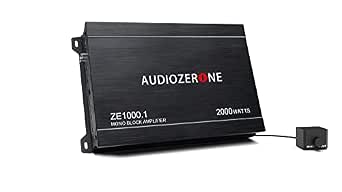 | Best for Higher-Power 1-Ohm Subwoofers | Amplifier class: Class D | Channels: 1 | Maximum output power: 2,000 W | VIEW ON AMAZON | See Our Full Breakdown |
| Taramps BASS 400 2-Ohm 400W RMS Monoblock Car Audio Amplifier |  | Best for Moderate 2-Ohm Bass | Channels: 1 | Output power: 400W RMS | Impedance: 2 ohms | VIEW ON AMAZON | See Our Full Breakdown |
| Pioneer GM-A5702 2-Channel Class AB Bridgeable Car Amplifier |  | Best Bridgeable Two-Channel Pick | Amplifier class: Class AB | Channels: 2 | Maximum output power: 1,000 watts | VIEW ON AMAZON | See Our Full Breakdown |
| BOSS Audio Systems R1100M 1100-Watt Monoblock Car Amplifier |  | Best for Remote Bass Adjustment | Amplifier type: Monoblock car amplifier | Class: A/B | Channels: 1 | VIEW ON AMAZON | See Our Full Breakdown |
| Pioneer GM-A3702 500W Max Class AB 2-Channel Car Amplifier |  | Best for a Modest Bridged Subwoofer Setup | Amplifier class: AB | Channels: 2 | Maximum output power: 500 watts | VIEW ON AMAZON | See Our Full Breakdown |
| car amplifier for subwoofer | Channels | Dimensions | Frequency response |
|---|---|---|---|
| BOSS Audio Systems R1100M-P Mo | 1 | 9.13 × 10.44 × 2.25 inches | — |
| Orion CBA2000.1D Cobalt 1-Chan | 1 | 14 × 8 × 3 inches | 10–250 Hz |
| BOSS Audio Systems R1100MK 110 | — | 9.13 × 10.44 × 2.25 inches | 9 Hz–50 kHz |
| Skar Audio RP-350.1D Class D M | 1 | 12.75 × 7 × 3 inches | 20 Hz–250 Hz |
| AUDISHAKO MHD1600.1D Class D M | 1 | 10.5 × 4.56 × 1.97 inches | 10–250 Hz |
| Skar Audio RP-800.1D 800W Mono | 1 | 16 × 7 × 3 inches | 20 Hz–250 Hz |
| YaeCCC 4-Channel Car Amplifier | 4 | — | 20Hz–20kHz |
| Pioneer GM-A6704 4-Channel Cla | 4 | 8.5 × 14 × 2.38 inches | — |
| AUDIOZERONE ZE1000.1 Monoblock | 1 | 11 × 6.9 × 2 in | — |
| Taramps BASS 400 2-Ohm 400W RM | 1 | 6 × 6 × 6 inches | 8Hz–250Hz |
| Pioneer GM-A5702 2-Channel Cla | 2 | 8.5 x 14 x 2.38 inches | — |
| BOSS Audio Systems R1100M 1100 | 1 | 10.43 x 9.21 x 2.25 inches | — |
| Pioneer GM-A3702 500W Max Clas | 2 | 7.13 x 9.58 x 2.38 inches | — |
More Details on Our Top Picks
BOSS Audio Systems R1100M-P Monoblock Car Amplifier
The R1100M-P is a practical choice for adding a subwoofer to a system that still uses a factory stereo: its high-level and RCA inputs support either a speaker-level signal or a preamp connection. Its variable low-pass crossover and switchable bass boost let you shape the subwoofer output, while the broad 2–8-ohm speaker range gives more wiring flexibility than the Orion CBA2000.1D, which is specified for 1, 2, and 4 ohms.
The main limitation is power clarity. BOSS lists maximum output figures of 1100 watts at 2 ohms and 550 watts at 4 ohms, but does not provide RMS output here, so matching it to a subwoofer’s continuous power rating is harder. Compared with the Skar RP-350.1D, this model offers less certain power planning rather than a clearly stated RMS figure. Choose it for flexible inputs and controls, not an assumed 1100-watt continuous output.
Pros:- High-level and RCA inputs accommodate factory and aftermarket source units.
- Variable low-pass crossover helps set the subwoofer’s upper frequency range.
- Switchable bass boost adds a basic option for adjusting low-frequency emphasis.
- Supports speaker loads from 2 to 8 ohms.
Cons:- RMS output power is not specified, making power matching less straightforward.
- Class A/B topology may be a less suitable fit for buyers prioritizing a compact, efficient Class D amp.
Best for: Drivers adding a subwoofer to a factory-stereo system who need high-level inputs and flexible speaker impedance support.
Not ideal for: Buyers matching an amplifier to a subwoofer by RMS output, since this listing gives maximum ratings but no RMS wattage.
- Amplifier topology:Class A/B
- Channels:1
- Maximum output at 2 ohms:1100 watts
- Maximum output at 4 ohms:550 watts
- Speaker impedance:2–8 ohms
- Inputs:Low-level RCA and high-level
- Crossover:Variable low-pass
- Dimensions:9.13 × 10.44 × 2.25 inches
Our verdict“Choose the R1100M-P when factory-stereo compatibility matters more than having clearly stated RMS power.”
Orion CBA2000.1D Cobalt 1-Channel Class D Monoblock Amplifier
The Orion CBA2000.1D stands out for its 1-, 2-, and 4-ohm stability, making it useful for buyers choosing among compatible subwoofer wiring configurations. Unlike the BOSS R1100M-P, Orion supplies RMS output by impedance: 500 watts at 1 ohm, 260 watts at 2 ohms, and 160 watts at 4 ohms. Those figures give a clearer basis for matching the amp to a subwoofer than a maximum-only rating.
Its low-pass filter, subsonic control, bass boost, and included remote bass knob provide more adjustment than the simpler BOSS R1100MK. The tradeoff is that its 2000-watt maximum headline is much higher than its listed RMS figures, so buyers should size a system around the RMS output, not the maximum. It also has RCA-only inputs and a one-year warranty, making it less accommodating for some factory-stereo upgrades than the high-level-input AUDISHAKO MHD1600.1D.
Pros:- Stable at 1, 2, and 4 ohms for several supported subwoofer configurations.
- RMS output is listed separately for each supported impedance.
- Subsonic control, low-pass filtering, and bass boost allow more system tuning.
- Includes a remote bass knob and thermal protection circuitry.
Cons:- RMS output falls to 160 watts at 4 ohms, so output depends heavily on load.
- Uses low-level RCA inputs only.
- The listed warranty is one year.
Best for: Subwoofer owners who want to choose between 1-, 2-, and 4-ohm loads and tune bass from the driver’s seat.
Not ideal for: Factory-stereo users needing high-level inputs, or buyers expecting the 2000-watt maximum rating as continuous output.
- Amplifier class:Class D
- Channels:1
- RMS output:500 W at 1 ohm; 260 W at 2 ohms; 160 W at 4 ohms
- Impedance stability:1, 2, and 4 ohms
- Maximum output power:2000 watts
- Frequency response:10–250 Hz
- Inputs:Low-level RCA
- Dimensions:14 × 8 × 3 inches
Our verdict“Pick the Orion when impedance flexibility and documented RMS output matter more than factory-level inputs or a longer listed warranty.”
BOSS Audio Systems R1100MK 1100-Watt Monoblock Car Amplifier with Wiring Kit
The R1100MK’s clearest advantage over the otherwise similar BOSS R1100M-P is its included wiring kit. It bundles power, ground, turn-on and speaker wire along with RCA interconnects and installation hardware, which can simplify sourcing parts for a basic subwoofer setup. The amplifier also has a variable low-pass crossover, switchable bass boost, and support for 2–8-ohm speaker loads.
That convenience does not resolve the main question raised by its headline: BOSS lists maximum ratings of 1100 watts at 2 ohms and 550 watts at 4 ohms, but the supplied data does not state RMS power. The Orion CBA2000.1D is a better fit for buyers who need documented continuous output at different loads, while the Skar RP-350.1D gives a clear RMS figure for a lower-output system. The R1100MK makes more sense when the bundled accessories are useful and the subwoofer match is already established.
Pros:- Includes power, ground, turn-on, speaker, and RCA wiring accessories.
- Variable low-pass crossover supports adjustment of the subwoofer’s frequency range.
- Switchable bass boost gives an additional bass adjustment.
- Supports 2–8-ohm speaker loads.
Cons:- RMS output wattage is not specified in the supplied product data.
- The included kit adds convenience but does not establish whether its components suit every installation.
Best for: Installers building a basic subwoofer system who want amplifier wiring accessories included with the unit.
Not ideal for: Buyers who need a stated RMS rating to confirm the amp’s continuous output will match their subwoofer.
- Amplifier topology:Class A/B
- Maximum power at 2 ohms:1100 W × 1
- Maximum power at 4 ohms:550 W × 1
- Speaker impedance:2–8 ohms
- Frequency response:9 Hz–50 kHz
- Fuse:1 × 30 A ATO blade
- Included accessories:Wiring kit with power, ground, turn-on, speaker, and RCA cables plus installation hardware
- Dimensions:9.13 × 10.44 × 2.25 inches
Our verdict“Choose the R1100MK if its bundled wiring kit suits your installation and you can verify the amp’s power match separately.”
Skar Audio RP-350.1D Class D Monoblock Amplifier with Remote Subwoofer Level Control
The Skar RP-350.1D is the straightforward pick for a lower-output subwoofer system because it specifies 350 watts RMS at 1 ohm, rather than relying on an unspecified RMS figure like the BOSS R1100M-P. Its remote subwoofer level control lets the driver adjust bass without reaching the amplifier, and the 0, +6, or +12 dB EQ settings at 45 Hz offer defined choices for bass emphasis.
Compared with the Orion CBA2000.1D, the Skar is less flexible across impedance options: its supplied stability specification is 1 ohm, not 1, 2, and 4 ohms. It also lacks the Orion’s listed subsonic control. In return, its stated RMS output is easy to match to a modest subwoofer, and its four-way protection circuitry adds safeguards. Skip it if you need to amplify full-range speakers or want a higher-output system.
Pros:- Lists 350 watts RMS at 1 ohm for clearer subwoofer matching.
- Remote subwoofer level control allows in-cabin bass adjustment.
- Bass EQ offers 0, +6, or +12 dB settings at 45 Hz.
- Four-way protection circuitry is included.
Cons:- The supplied stability specification is limited to 1 ohm.
- Designed for subwoofers rather than full-range speaker amplification.
- No subsonic control is listed in the supplied product data.
Best for: Drivers pairing a 1-ohm subwoofer with a modest power requirement who want a remote level control and clear RMS guidance.
Not ideal for: Buyers needing multi-impedance flexibility, a specified subsonic filter, or amplification for full-range speakers.
- Amplifier type:Class D monoblock
- Channels:1
- RMS power at 1 ohm:350 watts
- Peak power at 1 ohm:388 watts
- Stability:1 ohm
- Frequency response:20 Hz–250 Hz
- Bass EQ:0, +6, or +12 dB at 45 Hz
- Dimensions:12.75 × 7 × 3 inches
Our verdict“Choose the Skar for a modest 1-ohm subwoofer system where clear RMS output and remote level adjustment matter more than broader load flexibility.”
AUDISHAKO MHD1600.1D Class D Monoblock Car Amplifier
The AUDISHAKO MHD1600.1D is the high-output option in this group, with listed ratings of 400 watts RMS at 4 ohms, 800 watts at 2 ohms, and 1,600 watts at 1 ohm. That range gives buyers more stated output choices across compatible loads than the Skar RP-350.1D, whose listed RMS rating is 350 watts at 1 ohm. It also combines RCA and high-level inputs, so it can fit more source-unit setups than the RCA-only Orion CBA2000.1D.
Its compact aluminum chassis, remote bass control, and adjustable subsonic and low-pass filters suit a dedicated subwoofer installation. The tradeoff is that the strongest output depends on a 1-ohm load, so buyers should verify their subwoofer’s final wiring impedance before choosing it. Like the Skar, it is subwoofer-focused rather than full-range; its broad power claims are not a reason to overlook system compatibility or installation requirements.
Pros:- Lists RMS output at 1, 2, and 4 ohms.
- High-level and RCA inputs support different source-unit types.
- Includes subsonic and low-pass filters, bass boost, and remote bass level control.
- Compact aluminum chassis measures 10.5 × 4.56 × 1.97 inches.
Cons:- The highest listed RMS output requires a compatible 1-ohm load.
- Designed for subwoofer use rather than full-range speaker amplification.
- Requires a compatible 12 V car audio system.
Best for: Subwoofer owners seeking substantial stated RMS output across compatible 1–4-ohm loads, with both factory-level and RCA input options.
Not ideal for: Drivers with full-range speaker amplification needs or subwoofers that cannot be wired to a supported load.
- Amplifier type:Class D monoblock
- Channels:1
- RMS output power:400 W at 4 ohms; 800 W at 2 ohms; 1,600 W at 1 ohm
- Stable load:1–4 ohms
- Frequency response:10–250 Hz
- Inputs:High-level and RCA
- Efficiency:Up to 95%
- Dimensions:10.5 × 4.56 × 1.97 inches
Our verdict“Choose the AUDISHAKO if your subwoofer supports its intended load and you want substantially higher listed RMS output than the Skar RP-350.1D.”
Skar Audio RP-800.1D 800W Monoblock Class D Amplifier
The RP-800.1D is a strong fit for a subwoofer setup that needs 800 watts RMS at 1 ohm and simple control from the driver’s seat. Its included remote level control makes it easier to trim bass without reaching the amp, while the selectable 0, +6, or +12 dB bass EQ offers extra adjustment around 45 Hz. Compared with the AUDIOZERONE ZE1000.1, it supplies less rated power at 1 ohm, but it adds remote level control and a clearly specified bass-EQ setting. The tradeoff is a larger 16-inch chassis and a single-channel design; it is not meant to power a full speaker system. Its four-way protection circuitry is useful, though the installation still calls for 4-gauge power and ground wiring.
Pros:- Provides 800 watts RMS at 1 ohm for a substantial single-subwoofer setup.
- Includes a remote subwoofer level control for convenient listening adjustments.
- Offers selectable bass EQ at 45 Hz and adjustable gain and filter controls.
- Four-way protection circuitry adds safeguards against common electrical or thermal faults.
Cons:- Requires 4-gauge power and ground wiring, which adds installation demands.
- Single-channel design cannot directly power a multichannel speaker system.
- The 16-inch length may limit mounting choices in tighter vehicle spaces.
Best for: Drivers pairing one 1-ohm subwoofer load with an 800-watt-RMS-class amp who want remote level adjustment and bass EQ.
Not ideal for: Buyers who need one amplifier for both full-range speakers and a subwoofer, or who need a smaller chassis than 16 × 7 × 3 inches.
- Amplifier type:Class D monoblock
- Channels:1
- RMS power at 1 ohm:800 watts
- Peak power:1,200 watts
- Frequency response:20 Hz–250 Hz
- Impedance stability:1 ohm
- Bass EQ:0, +6, or +12 dB at 45 Hz
- Power and ground terminals:4 gauge
- Dimensions:16 × 7 × 3 inches
Our verdict“Choose the RP-800.1D if you want 800 watts at 1 ohm with useful remote and EQ controls, and can accommodate its wiring and chassis requirements.”
YaeCCC 4-Channel Car Amplifier, 3200W Peak
The YaeCCC takes a different route from the dedicated monoblocks in this roundup: its four channels and stated 4 × 100W RMS output suit buyers who want to power speakers and include a subwoofer in the same system. Its slim brushed-aluminum housing is designed for under-seat mounting, and mounting hardware is included. Compared with the Pioneer GM-A6704, the YaeCCC lists higher RMS output per channel, but its specifications leave more uncertainty: the stated 3,200W peak rating is not clearly reconciled with a 400W output figure. It also supports 2–4Ω loads, so this is not a match for a 1-ohm subwoofer configuration like the Skar RP-800.1D. The REM terminal must be connected for the indicator light to turn on, a detail worth accounting for during installation.
Pros:- Four-channel layout can serve speakers and a subwoofer in one installation.
- Lists 4 × 100W RMS output.
- Slim housing is designed for under-seat installation.
- Includes mounting hardware and supports 2–4Ω impedance.
Cons:- The relationship between the 3,200W peak rating and 400W output specification is unclear.
- Does not support a 1-ohm load, unlike the Skar RP-800.1D and AUDIOZERONE ZE1000.1.
- The indicator light requires a connected REM wire.
Best for: Installers building a compact 2–4-ohm system who want one four-channel amp for speakers and a subwoofer rather than a dedicated sub amp.
Not ideal for: Subwoofer-focused buyers needing a clearly rated 1-ohm monoblock, or shoppers who want power specifications with less ambiguity.
- Channels:4
- Peak power:3,200W
- RMS power:4 × 100W
- Output power:400W
- Impedance:2–4Ω
- Frequency response:20Hz–20kHz
- Signal-to-noise ratio:>90dB
- Distortion:<0.01%
- Housing height:3 inches
Our verdict“Pick the YaeCCC for a compact four-channel installation at 2–4Ω, but skip it if your subwoofer needs a dedicated 1-ohm amp or clearer power figures.”
Pioneer GM-A6704 4-Channel Class AB Car Amplifier
The GM-A6704 is a flexible choice for buyers who want to run front and rear speakers while adding a subwoofer through bridged operation. Its stated output is 60 watts RMS per channel at 4 ohms, or 190 watts RMS across each bridged pair, and variable high- and low-pass filters help divide speaker and subwoofer frequencies. That makes it a more clearly specified multi-channel option than the YaeCCC, whose peak and output figures are harder to reconcile. Compared with the Skar RP-800.1D, though, the Pioneer is not built around high-output subwoofer duty: its bridged rating is modest beside a dedicated monoblock’s 800 watts RMS. The Class AB design and 14-inch width also call for different installation planning than a compact Class D sub amp. Choose it for system flexibility, not maximum bass output.
Pros:- Four channels can power front and rear speakers.
- Bridged operation provides a route to adding a subwoofer.
- Variable high- and low-pass filters support frequency tuning.
- Automatic signal sensing and turn-on can simplify integration.
Cons:- Its 190W RMS bridged output is far below the dedicated Skar RP-800.1D’s 800W RMS at 1 ohm.
- The 1,000-watt maximum rating is much higher than the stated RMS figures and should not guide subwoofer matching.
- At 14 inches wide, it may take more mounting space than a compact monoblock.
Best for: Listeners who want to power front and rear speakers and add a modest subwoofer using one bridgeable amplifier.
Not ideal for: Owners of high-power or 1-ohm subwoofers seeking the output of a dedicated monoblock such as the Skar RP-800.1D.
- Amplifier class:Class AB
- Channels:4
- Maximum output power:1,000 watts
- RMS power at 4 ohms:60 watts × 4
- Bridged RMS power:190 watts × 2
- Filters:Variable high-pass and low-pass
- Dimensions:8.5 × 14 × 2.38 inches
- Mounting type:Surface mount
- Warranty:1 year
Our verdict“Choose the GM-A6704 when speaker power and a modest bridged subwoofer channel matter more than high-output bass.”
AUDIOZERONE ZE1000.1 Monoblock Class D Car Audio Amplifier
Among the dedicated subwoofer amps here, the ZE1000.1 has the strongest stated RMS output: 1,000 watts at 1 ohm, with figures also provided for 2- and 4-ohm loads. That makes matching easier across different subwoofer wiring configurations than with the Skar RP-800.1D, which is specified at 1 ohm. The AUDIOZERONE is a Class D monoblock with thermal, overload, and short-circuit protection, and its 11 × 6.9 × 2-inch case is smaller than the Skar’s. The tradeoff is fewer stated tuning details: the supplied specs do not list a remote level control or adjustable bass EQ like the Skar provides. It also calls for a 14.4V supply, so buyers should check that their electrical setup suits the stated operating requirement.
Pros:- Delivers 1,000 watts RMS at 1 ohm, exceeding the Skar RP-800.1D’s stated 800 watts at that load.
- Lists RMS output at 1, 2, and 4 ohms to help with subwoofer matching.
- Compact 11 × 6.9 × 2-inch dimensions ease mounting compared with the Skar.
- Includes thermal, overload, and short-circuit protection.
Cons:- Single-channel design is dedicated to a subwoofer rather than a full speaker system.
- The supplied specs do not list a remote level control or adjustable bass EQ.
- Requires a 14.4V supply, which buyers should verify against their installation.
Best for: Subwoofer owners who need up to 1,000 watts RMS at 1 ohm, want output figures across several impedances, and have a suitable 14.4V supply.
Not ideal for: Buyers who prioritize a supplied remote subwoofer level control and specified bass EQ, or who need a multichannel amplifier for speakers.
- Amplifier class:Class D
- Channels:1
- Maximum output power:2,000 W
- RMS output at 1 ohm:1,000 W
- RMS output at 2 ohms:650 W
- RMS output at 4 ohms:400 W
- Impedance stability:1 ohm
- Voltage:14.4 V
- Dimensions:11 × 6.9 × 2 in
Our verdict“Choose the ZE1000.1 for higher stated 1-ohm RMS output and compact dimensions, provided its power-supply requirement fits your vehicle.”
Taramps BASS 400 2-Ohm 400W RMS Monoblock Car Audio Amplifier
The BASS 400 is the restrained option for a 2-ohm subwoofer rated around 400 watts RMS, rather than a route to the higher output offered by the Skar RP-800.1D or AUDIOZERONE ZE1000.1. Its tuning tools are unusually specific for this output class: a variable low-pass filter and parametric boost from 35–55 Hz, adjustable up to +12 dB, let buyers shape bass around the subwoofer and enclosure. High-level and RCA inputs also give it more flexibility when connecting to different source systems. Its 6 × 6 × 6-inch dimensions are easy to plan around, but the square form and freestanding mounting type still need a secure location. The main limitation is its 2-ohm-only stated output and 14–16V supply range, so it is not the choice for a 1-ohm setup or every vehicle electrical configuration.
Pros:- Provides 400W RMS at 2 ohms for a moderate single-subwoofer setup.
- Parametric bass boost covers 35–55 Hz with up to +12 dB adjustment.
- Variable low-pass filter supports subwoofer frequency tuning.
- High-level and RCA inputs support different source-system connections.
Cons:- Single-channel design does not power a full-range speaker system.
- The stated output is for 2-ohm operation, unlike the 1-ohm-capable Skar and AUDIOZERONE monoblocks.
- Requires a 14–16V DC supply, which may not suit every vehicle installation.
Best for: Drivers with a 2-ohm subwoofer needing about 400 watts RMS, adjustable low-frequency tuning, and both high-level and RCA input options.
Not ideal for: Owners of 1-ohm subwoofers or higher-power setups who need more output than 400 watts RMS, such as what the ZE1000.1 is specified to provide.
- Channels:1
- Output power:400W RMS
- Impedance:2 ohms
- Frequency response:8Hz–250Hz
- Bass boost:35–55Hz, up to +12dB
- Inputs:High-level and RCA
- Voltage:14.4V DC
- Supply voltage range:14–16V DC
- Dimensions:6 × 6 × 6 inches
Our verdict“Choose the BASS 400 for a 2-ohm subwoofer and flexible bass tuning, but move to a higher-output monoblock for 1-ohm or more demanding systems.”
Pioneer GM-A5702 2-Channel Class AB Bridgeable Car Amplifier
The Pioneer GM-A5702 suits a buyer who wants one amplifier that can run a subwoofer in bridged mode rather than a dedicated monoblock. Its stated 480 watts RMS bridged output, adjustable bass boost, and variable low-pass filter provide more subwoofer-specific control than the smaller GM-A3702, whose bridged rating is 190 watts RMS. Automatic signal sensing and turn-on can also make it easier to pair with a factory radio. The tradeoff is its two-channel Class AB design: it is larger than the GM-A3702 and less purpose-built than the single-channel BOSS R1100M. The supplied specifications give power at 2 ohms and in bridged mode, but do not state a continuous 4-ohm rating, so I would match it to the subwoofer using the confirmed figures rather than its 1,000-watt maximum claim.
Pros:- Bridged mode provides a stated 480 watts RMS for a subwoofer.
- Variable low-pass filtering and adjustable bass boost allow bass response adjustments.
- Automatic signal sensing and turn-on support factory-radio integration.
- Two-channel design can serve setups that need more than a basic single-channel subwoofer amplifier.
Cons:- Its 8.5 x 14-inch footprint is larger than the GM-A3702.
- The provided specifications do not state continuous RMS output at 4 ohms.
- Class AB two-channel design is less subwoofer-focused than a dedicated monoblock such as the BOSS R1100M.
Best for: Drivers who want adjustable bass filtering and a bridged subwoofer setup with factory-radio signal-sensing support.
Not ideal for: Shoppers who need a dedicated monoblock or a clearly stated continuous 4-ohm rating before matching an amplifier to their subwoofer.
- Amplifier class:Class AB
- Channels:2
- Maximum output power:1,000 watts
- RMS output at 2 ohms:240 watts x 2
- Bridged output:480 watts RMS x 1
- Bass controls:Adjustable bass boost; variable low-pass filter
- Dimensions:8.5 x 14 x 2.38 inches
- Voltage:12 volts DC
Our verdict“Choose the GM-A5702 if you want a bridgeable two-channel amplifier with useful bass controls and a stated 480-watt RMS bridged output.”
BOSS Audio Systems R1100M 1100-Watt Monoblock Car Amplifier
The BOSS Audio Systems R1100M is the clearest fit here for a buyer who wants a dedicated single-channel amplifier with a remote subwoofer level control. That control lets the driver adjust subwoofer output from the cabin, while RCA and speaker-level inputs offer two ways to connect a source. Its low-pass filter, bass boost, and thermal, short-circuit, and overload protection add useful setup and protection features. Unlike the Pioneer GM-A5702, it is a monoblock, so it avoids a bridged two-channel configuration; however, its listed 1,100 watts at 2 ohms is maximum power, not a stated RMS figure. I would not match it to a subwoofer by treating that maximum as continuous output. Professional installation is encouraged, and the six-year warranty depends on qualifying seller conditions.
Pros:- Remote subwoofer level control allows in-cabin output adjustment.
- RCA and speaker-level inputs support different source-unit connections.
- Low-pass filtering and bass boost offer basic subwoofer tuning.
- Thermal, short-circuit, and overload protection are included.
Cons:- The listed 1,100-watt 2-ohm figure is maximum power, not a stated RMS rating.
- Professional installation is encouraged.
- The six-year warranty applies only to qualifying purchases and seller conditions.
Best for: Drivers who want a monoblock with a cabin-accessible subwoofer level control and both RCA and speaker-level input options.
Not ideal for: Buyers who need clearly stated continuous RMS output for subwoofer matching or prefer a setup that does not call for professional installation.
- Amplifier type:Monoblock car amplifier
- Class:A/B
- Channels:1
- Maximum power at 2 ohms:1,100 watts x 1
- Maximum power at 4 ohms:550 watts x 1
- Stability:2 ohms
- Inputs:RCA and speaker-level
- Dimensions:10.43 x 9.21 x 2.25 inches
Our verdict“Pick the R1100M if remote bass adjustment and flexible input connections matter more to you than a clearly specified RMS output rating.”
Pioneer GM-A3702 500W Max Class AB 2-Channel Car Amplifier
The Pioneer GM-A3702 is the more restrained Pioneer choice for a subwoofer setup that calls for a modest amount of power. It supplies 190 watts RMS in bridged mode, well below the GM-A5702’s 480-watt bridged rating, which can make it a better match for a lower-powered subwoofer rather than a bid for maximum output. Its speaker-level inputs support factory-radio connections, and the selectable 80 Hz low-pass filter helps keep higher frequencies out of the subwoofer signal. That fixed cutoff offers less adjustment than the GM-A5702’s variable filter. The 500-watt maximum figure also should not be confused with the listed RMS output, and the provided data does not specify a bridged impedance rating. I would verify compatibility with the subwoofer before choosing it.
Pros:- Bridged output is specified at 190 watts RMS for a subwoofer.
- Speaker-level inputs can support factory-radio integration.
- Selectable 80 Hz low-pass filter limits higher frequencies sent to the subwoofer.
- Smaller listed dimensions than the GM-A5702.
Cons:- Bridged RMS output is substantially lower than the GM-A5702’s 480 watts.
- The low-pass filter has a fixed 80 Hz cutoff rather than variable adjustment.
- The 500-watt maximum rating exceeds the stated RMS figures and should not guide continuous-power matching.
Best for: Drivers building a modest subwoofer system who want a compact, bridgeable two-channel amplifier with speaker-level inputs for a factory radio.
Not ideal for: Buyers seeking stronger subwoofer output, a variable low-pass filter, or a broad range of cutoff adjustment.
- Amplifier class:AB
- Channels:2
- Maximum output power:500 watts
- RMS output at 2 ohms:60 watts x 2
- Bridged output:190 watts RMS x 1
- Low-pass filter:80 Hz cutoff; 12 dB per octave slope
- Dimensions:7.13 x 9.58 x 2.38 inches
- Material:Aluminum alloy
Our verdict“Choose the GM-A3702 for a lower-powered bridged subwoofer setup where factory-radio inputs matter more than high output or flexible filtering.”

How We Picked
I ranked these amplifiers by how clearly their stated design and specifications serve subwoofer duty. The main criteria were mono or bridgeable channel configuration, stated RMS output where available, compatibility considerations such as load impedance, and useful setup features. I gave more weight to interpretable subwoofer-oriented specifications than to peak-watt claims, since peak figures alone do not tell a buyer whether an amp can deliver suitable continuous power.
The order also reflects fit and tradeoffs, not simply the largest number in a product name. Dedicated mono models rise when their stated role is clear; multi-channel and two-channel amps remain useful for mixed systems but rank lower for a subwoofer-only installation. I also considered beginner-friendly extras, flexibility, and the limitations implied by sparse or peak-focused specifications. Buyers should confirm current manufacturer data, RMS output at the intended impedance, and wiring requirements before choosing.
Factors to Consider When Choosing Car Amplifier For Subwoofers
Choosing a subwoofer amp is less about chasing the biggest advertised wattage and more about making the electrical and installation details line up. These checks help narrow the field before comparing individual models.
Match RMS Power, Not the Biggest Number
Start with the subwoofer’s continuous RMS power rating and compare it with the amplifier’s RMS output at the load you plan to use. A peak or maximum wattage figure is not a reliable measure of sustained output, so it should not drive the match. An amp with far more capacity than the sub can handle may create damage if gains are set carelessly, while an undersized amp pushed into clipping can also put the sub at risk. A little headroom can help, but it does not replace correct setup. If a listing does not clearly state RMS output, check manufacturer documentation before treating its wattage claim as comparable.
Check the Subwoofer’s Final Impedance
Voice-coil wiring determines the final load the amplifier sees, and that load can change the amp’s available output. Confirm the impedance supported by the amplifier before selecting a series or parallel wiring arrangement. Do not assume a model described as stable at one ohm will provide the same power at two or four ohms; output ratings often vary by load. For dual-voice-coil subwoofers, map the coil options first, then choose an amp that supports the resulting impedance. This step can prevent buying an amplifier that cannot safely run the configuration you already own.
Choose Mono or Multi-Channel for the Whole System
A monoblock amp is usually the straightforward choice when the amplifier’s only job is driving a subwoofer. A two-channel amp can often be bridged for a sub, but its bridged impedance limits and output need checking before use. Four-channel models can support a subwoofer alongside speakers, though splitting their channels may require more planning and can limit low-frequency output. One amp for the whole system may simplify installation, but separate amps make it easier to set subwoofer power without changing speaker amplification. Decide based on the full system layout, not the channel count alone.
Plan the Electrical System and Installation
Amplifier output draws current from the vehicle’s electrical system, so cable size, fuse rating, grounding, and battery capacity need to suit the installation. A wiring kit can save a separate purchase, but check its wire gauge and fuse rather than assuming every included kit is adequate for the intended load. Long power-wire runs and poor grounds can contribute to voltage drop and unreliable performance. Also check the amp’s dimensions and ventilation needs; a compact mounting spot with no airflow may cause thermal problems. If you are unsure about power wiring or fusing, a qualified installer can help reduce electrical and vehicle-safety risks.
Look for Controls That Match How You Listen
A remote subwoofer level control is useful when you want to adjust bass from the driver’s seat, but it does not replace setting gain correctly at installation. Crossovers and bass-boost controls can help integrate a subwoofer with the rest of the system, yet aggressive boosts can increase distortion and heat. Consider how often you change music sources or listening levels before prioritizing extra controls. Keep the amp’s gain as a signal-matching adjustment rather than a volume knob. Simpler controls may be preferable if you want fewer settings to misadjust.
Pay More for a Clear Need, Not a Larger Claim
Extra spending makes sense when it buys a needed capability, such as higher verified RMS output, a suitable impedance range, stronger installation flexibility, or useful system controls. It is harder to justify when the main difference is a bigger peak-watt figure with no clear continuous-power data. Buyers with a modest sub may get better results from a properly matched lower-output amp than from an oversized model run carelessly. For a future upgrade, compare the likely subwoofer and electrical-system requirements rather than buying for an unspecified later setup. A clear match today is usually more useful than unused capacity on paper.
Frequently Asked Questions
Can I use a four-channel amplifier to power one subwoofer?
Yes, some four-channel amplifiers can be bridged, but the manual must confirm which channels can be combined and the minimum impedance allowed in bridged mode. Bridging usually combines channel output; it does not make every four-channel amp equivalent to a dedicated monoblock. Check the bridged RMS rating against the subwoofer’s final impedance and power needs. If you also want the amp to run door speakers, confirm how many channels remain available after bridging. For a subwoofer-only system, a mono amp is often simpler to match.
Is an amplifier with a higher wattage number always better for my subwoofer?
No. Product listings may show peak or maximum wattage that cannot be compared directly with continuous RMS output. The useful comparison is the amp’s RMS power at the impedance created by your subwoofer wiring. Too much available power can damage a sub if gains are set too high, and too little power can cause trouble if the amp is driven into clipping to chase more volume. Match the amp to the subwoofer’s RMS range and use proper gain setup rather than picking by the largest advertised figure.
Should I wire my dual-voice-coil subwoofer for a lower impedance?
Only if the amplifier supports the resulting load and the subwoofer’s wiring options allow it. Parallel and series wiring change the final impedance, which can change both amplifier output and operating safety. Check the subwoofer’s coil impedance, the amp’s stable load, and its rated output at that load before wiring anything. A lower impedance is not automatically better; it can demand more current and place greater demands on the amp and vehicle electrical system. If the ratings are unclear, ask an installer to verify the configuration.
Do I need a wiring kit if an amplifier listing includes one?
Not necessarily, since included kits vary in wire gauge, fuse hardware, and suitability for the amplifier’s current draw. Check the manufacturer’s recommended power-wire size and fuse rating, then compare those requirements with the kit contents. The kit must also be long enough for your vehicle and include the parts needed for a safe ground and connection. An included kit can reduce setup work, but it should not be treated as proof that the wiring is adequate. Replace undersized or incomplete parts before installation.
Can I replace my current amplifier without changing my subwoofer wiring?
Possibly, but first confirm the new amp supports the existing final impedance and that its output at that load suits the subwoofer. A change in amplifier power or fuse requirements may call for different power wiring, ground wiring, or protection. Also check signal inputs and crossover settings so the replacement works with the head unit and existing speakers. Never assume that matching brand or channel count means the wiring will transfer safely. Compare both manuals and have an installer inspect the setup if the load or cable specifications are uncertain.
Conclusion
For most buyers seeking a dedicated subwoofer amp, I would start with the Skar Audio RP-800.1D as best overall, provided its output matches the subwoofer and final impedance. The RP-350.1D is my best value-style pick for lower-power systems, while its remote level control also makes it a sensible beginner choice when convenient adjustment matters. For a mixed speaker-and-subwoofer setup, the Pioneer GM-A6704 is the best fit among these picks; buyers who need a bridgeable two-channel option can compare the Pioneer GM-A5702 and GM-A3702. The BOSS R1100MK suits shoppers who want an included wiring kit, though the kit still needs checking against the installation’s requirements. I would choose the higher-output or less-documented models only after verifying RMS power, impedance support, and electrical demands against the actual subwoofer—those details matter more than a headline wattage claim.
Columbus Day / Indigenous Peoples' Day Picks
long weekend sales
As an affiliate, we earn on qualifying purchases.