The Rheem RTEX-24 is my best overall pick in this electric tankless heater roundup because its 24 kW capacity suits more demanding household use than the compact point-of-use models. For a lower-demand setup, the Rheem 11 kW offers a middle ground, while the ThermoMate 3500W is better matched to a single sink. The main tradeoff is straightforward: higher-output heaters can serve more fixtures, but they need more electrical capacity and careful installation planning. Smaller 110V and under-sink units are easier to target at one tap, but they are not substitutes for whole-home hot water. Read on for how the 15 options compare and how to match a heater to your wiring, climate, and hot-water demand.

Get kitchen gear delivered free with Prime
- Fast, free delivery on millions of items
- Prime Video, Amazon Music and more included
- Member-only deals all year
Complete the kit

Key Takeaways
Use case matters more than headline wattage: the 110V and under-sink models are point-of-use choices, while the 14–27 kW units are aimed at broader household demand.
The Rheem RTEX-24 leads for capacity: its 24 kW rating places it above the 18 kW models for buyers with higher simultaneous demand, provided the electrical system can support it.
Several 18 kW models create a crowded middle: Rheem, Ranein, NOVIEEX, and the WiFi-listed option share a similar output class, so installation details, controls, and verified specifications should guide the choice.
Compact 120V heaters solve a narrower problem: the ThermoMate 3500W and two 3000W digital-display listings are better considered for one sink than for showers or whole-home service.
Electrical readiness is a deciding factor: even a well-matched 240V heater can be the wrong choice if the home lacks the required circuit capacity or compatible wiring.




| electric tankless heater | Voltage | Dimensions | Power | Temperature range |
|---|---|---|---|---|
| ThermoMate 3500W Tankless Elec | 120V AC | — | 3500W | 86°F–131°F |
| Tankless Electric Water Heater | — | 4.32 × 7.86 inches (W × H) | — | — |
| ThermoMate 27kW Tankless Water | 240V | 13.15 × 17.09 × 3.15 inches | — | 80°F–140°F |
| Rheem 8 kW Multi-Fixture Tankl | 240V | 8.25 × 12.63 × 12.625 inches | — | 80°F–140°F |
| Rheem 11 kW Multi-Fixture Tank | 240V | 8.25 × 12.63 inches | 11 kW | 80°F–140°F |
| ThermoMate 4.5 kW Tankless Und | 110–120 V | 10.95 × 2.52 × 7.4 in | 4,500 W | 85°F–131°F |
| Rheem RTEX-24 24 kW Electric T | 240 V, single-phase | 17.63 × 18.25 × 3.5 in | 24 kW | 80°F–140°F |
| Ranein 18kW Tankless Electric | 240 V | 13.8 × 18.7 × 3.1 in | 18 kW | — |
| 18 kW Electric Tankless Water | 240 V | 11.1 × 19.2 × 4 in | 18 kW | — |
| ORBEK 14 kW Electric Tankless | 240 V | 14.2 × 9.5 × 3.1 in | 14 kW | 86°F–140°F |
| NOVIEEX 18 kW Electric Tankles | 240 V | 11.14 × 15.86 × 3.18 inches (W × H × D) | 18 kW | 77°F–140°F |
| 110V 3000W Tankless Electric W | 110 V | 4.32 in W × 7.86 in H | 3000 W | — |
| Rheem 18 kW 240 V Tankless Ele | 240 V | 14.5 in W × 18.25 in H | 18 kW | — |
| SIVUATEK 14 kW Electric Tankle | 240 V | 15.87 × 11.14 × 2.87 inches in description; 12.2 × 17.25 inches in product information | — | 86°F–131°F, adjustable in 1°F increments |
| ThermoMate 6kW Tankless Water | 240 V | 7.5 × 11.2 × 2.52 inches (W × H × D) | — | — |
More Details on Our Top Picks
ThermoMate 3500W Tankless Electric Water Heater, 120V
I’d choose this 120V, 3500W unit for a single sink where a compact footprint and adjustable temperature matter more than higher flow. Its 0.4–0.66 GPM range is suited to modest handwashing or sink use, not supplying several fixtures. The digital display adjusts in one-degree steps, giving more precise control than the simpler point-of-use setup of the 3000W Under Sink model, which tops out at a lower stated temperature. The tradeoff is electrical: this heater needs hardwiring, a dedicated 32A double-pole breaker, and at least 10 AWG wire. Its small wall-mounted body saves cabinet space, but buyers should match the flow and electrical requirements to the intended sink before choosing it.
Pros:- Compact wall-mounted body fits under or near a sink.
- Digital temperature display supports one-degree adjustments.
- Self-modulating heating and overheat protection are built in.
- Cast aluminum heating element is separated from the water line.
Cons:- Requires hardwiring, a dedicated 32A double-pole breaker, and minimum 10 AWG wire.
- Limited flow is better suited to one sink than simultaneous outlets.
Best for: Homeowners adding on-demand hot water to one sink who have suitable 120V wiring and room for a dedicated circuit.
Not ideal for: Buyers seeking shower or multi-fixture hot water, or anyone unable to provide the specified 32A circuit and hardwired installation.
- Power:3500W
- Voltage:120V AC
- Current:29.2A
- Flow rate:0.4–0.66 GPM
- Temperature range:86°F–131°F
- Electrical installation:Hardwired; 32A double-pole breaker and minimum 10 AWG wire
- Water connections:1/2-inch NPT
- Dimensions and weight:7.9 × 6.4 × 2.5 inches; 3.1 pounds
- Certification:ETL
Our verdict“Choose this ThermoMate for precise, on-demand hot water at one sink if its dedicated circuit and modest flow fit your installation.”
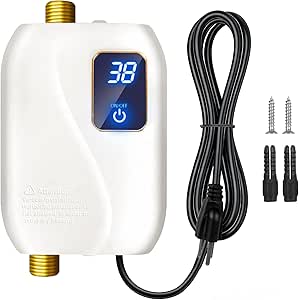
Tankless Electric Water Heater 110V 3000W Under Sink with Digital Display
This is the smallest-footprint choice in this group for buyers who need a point-of-use heater rather than whole-home hot water. Its 110V, 3000W design and stated 0.3 GPM flow at an 82°F rise put it firmly in the sink-use category; it is not a practical substitute for the Rheem 8 kW Multi-Fixture when more than one outlet needs hot water. The LED display offers Fahrenheit or Celsius settings, while leak protection, dry-boil shutoff, and IPX4 protection add safeguards in a wet under-sink location. The compact format has limits: installation must be vertical, heavy-gauge wiring and a 32A breaker are specified, and the ABS construction may not suit buyers seeking a metal-bodied unit.
Pros:- Slim body is suited to tight under-sink or RV installations.
- LED display supports temperature setting in Fahrenheit or Celsius.
- Includes leak protection, dry-boil shutoff, and IPX4 waterproofing.
- Stated thermal efficiency is approximately 98%.
Cons:- Low flow rate limits it to point-of-use sink applications.
- Requires vertical installation, heavy-gauge wiring, and a 32A breaker.
- ABS construction may be less appealing to buyers seeking a metal-bodied heater.
Best for: RV owners, campers, and homeowners who want a compact heater for one sink and can meet its wiring and vertical-mount requirements.
Not ideal for: Households needing shower service, multiple simultaneous fixtures, or a heater with a stainless-steel water path.
- Power source:AC 110V
- Wattage:3000W
- Flow rate:0.3 GPM at an 82°F rise; 0.5 GPM at a 131°F rise
- Maximum temperature:122°F
- Display:LED digital; Fahrenheit or Celsius
- Dimensions:4.32 × 7.86 inches (W × H)
- Material:ABS
- Installation:Wall-mounted vertically; heavy-gauge wiring (at least 2.5 mm²) and 32A breaker
- Warranty:24 months
Our verdict“Pick this model for a compact, single-sink installation where its low flow and specified electrical setup are acceptable.”
ThermoMate 27kW Tankless Water Heater Electric Max 6.6 GPM ETL Certified
Among these five heaters, the 27 kW ThermoMate is the clear choice for buyers seeking substantially more flow than a point-of-use unit can provide. Its stated maximum of 6.6 GPM and 80°F–140°F control range target multiple fixtures, putting it in a different class from the Rheem 11 kW, which is rated up to 2.68 GPM. That extra capacity comes with a serious electrical commitment: the product data calls for a 150A panel and three 40A double-pole breakers, so a panel assessment and professional installation are part of the decision. Self-modulation adjusts power to demand, while the compact wall-mounted body avoids a storage tank. I’d skip it for a single sink or a home that cannot support the stated electrical load.
Pros:- Highest stated flow rate in this five-product group at up to 6.6 GPM.
- Temperature control spans 80°F–140°F.
- Self-modulating operation adjusts heating output to demand.
- Wall-mounted design saves floor space compared with a storage tank.
Cons:- Requires a 150A panel and three 40A double-pole breakers per the product data.
- Professional installation and a careful electrical-service check are needed.
- Oversized for a single sink or other low-demand point-of-use job.
Best for: Owners of larger homes who want an electric tankless system for multiple fixtures and have adequate electrical service or a planned service upgrade.
Not ideal for: Small households seeking point-of-use hot water, or homes whose electrical panel cannot accommodate the specified 150A capacity and three breakers.
- Wattage:27 kW
- Voltage:240V
- Maximum flow rate:6.6 GPM
- Temperature range:80°F–140°F
- Maximum pressure:150 psi
- Electrical capacity:150A panel; three 40A double-pole breakers
- Dimensions:13.15 × 17.09 × 3.15 inches
- Weight:19 pounds
- Mount type:Wall-mounted
Our verdict“Choose the 27 kW ThermoMate when multiple fixtures need hot water and your electrical service can support its demanding installation.”
Rheem 8 kW Multi-Fixture Tankless Electric Water Heater, 240 V
The Rheem RTEX-08 is a middle ground between sink-only heaters and the larger whole-home-style ThermoMate 27 kW. Its stated 1.95 GPM maximum flow can suit modest point-of-use or limited multi-fixture demand, but it is not built for several high-demand outlets running together. Temperature adjustment in one-degree steps from 80°F to 140°F gives it more control than the ThermoMate 3500W, whose lower flow is better matched to a single sink. A wall-mounted stainless-steel body keeps the unit compact, and it heats only when water is called for. The main hurdle is installation: it needs 240V power, a dedicated 40A double-pole breaker, and professional setup, so it is a poor choice where that circuit is unavailable.
Pros:- Up to 1.95 GPM offers more capacity than the 120V sink-focused models.
- Digital controls adjust temperature in one-degree increments.
- Stainless-steel construction and compact wall mounting suit point-of-use installations.
- Heats water on demand without a storage tank.
Cons:- Limited flow may not support several high-demand fixtures simultaneously.
- Requires 240V power and a dedicated 40A double-pole breaker.
- Professional installation may be needed to meet electrical requirements.
Best for: Households adding hot water to a nearby bathroom or small set of fixtures that do not run at high flow simultaneously.
Not ideal for: Families expecting whole-home capacity for multiple showers, or buyers who need a low-voltage sink heater with simpler electrical requirements.
- Wattage:8 kW
- Voltage:240V
- Maximum flow rate:1.95 GPM
- Temperature range:80°F–140°F
- Maximum pressure:150 psi
- Electrical requirement:Dedicated 40A double-pole breaker
- Dimensions:8.25 × 12.63 × 12.625 inches
- Material:Stainless steel
- Warranty:5-year leak; 1-year parts
Our verdict“Choose the Rheem RTEX-08 for modest 240V multi-fixture demand, not for simultaneous showers or whole-home high flow.”
Rheem 11 kW Multi-Fixture Tankless Electric Water Heater, 240V
The Rheem 11 kW steps up from the RTEX-08 for buyers who need more flow but do not have a use case for the 27 kW ThermoMate. Its stated up to 2.68 GPM gives it a useful capacity bump over the 8 kW Rheem’s 1.95 GPM, though inlet-water temperature and simultaneous demand still shape real-world output. The digital control range runs from 80°F to 140°F, and the wall-mounted, no-vent design keeps installation compact. Its electrical demands are substantial for a point-of-use heater: the listing specifies a 50A double-pole breaker, #8 AWG copper conductors with ground, and a recommended 100A household panel. I’d favor it over the smaller Rheem for added capacity, but not for whole-home demand or a home with limited panel headroom.
Pros:- Up to 2.68 GPM provides more flow than the Rheem 8 kW model.
- Digital temperature controls adjust in one-degree increments.
- Wall-mounted design requires no venting.
- Stainless-steel construction and a compact footprint suit utility spaces.
Cons:- Requires a 50A double-pole breaker and #8 AWG copper conductors with ground.
- A minimum 100A household service panel is recommended.
- Actual flow and suitability depend on inlet-water temperature and fixture demand.
Best for: Homeowners with a suitable 240V electrical service who want more point-of-use or limited multi-fixture flow than an 8 kW heater provides.
Not ideal for: Buyers seeking whole-home, high-flow service or households with limited electrical panel capacity.
- Power:11 kW
- Voltage:240V
- Maximum flow rate:Up to 2.68 GPM
- Temperature range:80°F–140°F
- Efficiency:99.8%
- Electrical requirements:One 50A double-pole breaker; #8 AWG copper conductors with ground; 100A household service panel recommended
- Dimensions:8.25 × 12.63 inches
- Weight:3.2 kg
- Warranty:5-year leak; 1-year parts
Our verdict“Pick the Rheem 11 kW over the RTEX-08 when you need a moderate flow increase and can support its larger electrical requirements.”
ThermoMate 4.5 kW Tankless Under-Sink Water Heater – Electric, ETL Approved
For a sink that takes too long to deliver hot water, the ThermoMate 4.5 kW is a focused point-of-use option rather than a whole-house heater. Its 0.26–1.0 GPM flow range suits handwashing and light sink use, while the compact body can fit under a cabinet. Compared with the ORBEK 14 kW, it asks much less of the home’s electrical system, but it also supplies far less water and is not meant to serve several fixtures. The digital control adjusts temperature in one-degree steps, which helps set a comfortable output for the intended sink. The tradeoff is installation: this small unit still calls for a dedicated 40 A circuit and hardwiring, so it is not a simple plug-in fix.
Pros:- Compact body fits beneath many sinks or countertops.
- Self-modulating operation is specified at 99.8% efficiency.
- Digital control provides one-degree temperature adjustments.
- Provides on-demand hot water at the point of use.
Cons:- Requires hardwired installation and a dedicated 40 A double-pole breaker.
- Limited flow is not suited to high-demand or whole-house use.
Best for: Homeowners who want faster hot water at one sink and have space beneath the counter plus the required dedicated circuit.
Not ideal for: Buyers seeking a whole-house heater or simultaneous supply to multiple fixtures; its flow capacity is limited to point-of-use duty.
- Power:4,500 W
- Voltage:110–120 V
- Flow rate:0.26–1.0 GPM; 0.85 GPM at a 35°F rise
- Temperature range:85°F–131°F
- Dimensions:10.95 × 2.52 × 7.4 in
- Electrical requirement:40 A double-pole breaker; minimum 8 AWG wire
- Connections:1/2 in NPT
- Water tube material:SUS304 stainless steel
Our verdict“Choose this ThermoMate for one sink when compact point-of-use heating matters more than serving multiple fixtures.”
Rheem RTEX-24 24 kW Electric Tankless Water Heater, 240 V, Gray
The Rheem RTEX-24 is the highest-capacity option in this group, with a stated maximum flow of 5.9 GPM that gives it more headroom than the 18 kW Ranein and WN-18 models. That extra capacity can help households running several hot-water fixtures, though actual flow depends on incoming water temperature and demand. Its wall-mounted, vent-free design avoids a storage tank and its standby heat loss, while digital controls adjust the set point in one-degree increments. The main tradeoff is electrical: this heater needs three 40 A double-pole breakers, three conductor sets, and a recommended 200 A service panel. Compared with the smaller ORBEK, it serves a broader load, but installation planning is substantially more demanding.
Pros:- Highest stated maximum flow in this five-product group at up to 5.9 GPM.
- Digital temperature adjustment in one-degree increments.
- Wall-mounted, vent-free construction saves space compared with a storage tank.
- Specified 99.8% efficiency with no tank standby heat loss.
Cons:- Requires three 40 A double-pole breakers and a recommended 200 A household service.
- Maximum flow varies with groundwater temperature and concurrent use.
- Professional installation is recommended.
Best for: Households with multiple bathrooms that need more simultaneous hot-water capacity and have adequate electrical service.
Not ideal for: Homes with limited panel capacity or buyers who want a modest, low-disruption installation; its electrical requirements are substantial.
- Model:RTEX-24
- Power:24 kW
- Voltage:240 V, single-phase
- Maximum flow rate:Up to 5.9 GPM
- Temperature range:80°F–140°F
- Electrical requirements:Three 40 A double-pole breakers; three sets of #8 AWG copper conductors with ground
- Recommended service panel:200 A household electrical service
- Dimensions:17.63 × 18.25 × 3.5 in
- Warranty:5-year leak; 1-year parts
Our verdict“Pick the RTEX-24 when household demand justifies its higher capacity and the electrical panel can support its demanding installation.”
Ranein 18kW Tankless Electric Water Heater, Max 4.3 GPM, 240V, Whole House
The Ranein 18 kW sits between compact point-of-use heaters and the larger Rheem RTEX-24: its stated 4.3 GPM can support several fixtures, but it has less maximum flow headroom than Rheem’s 24 kW model. A wall-mounted body and LED display suit buyers replacing a tank who want a smaller, vent-free installation. The listed controls offer one-degree temperature adjustments, and the product data cites leak and overheat protection. Its claims of up to 60% energy savings should not be treated as a guaranteed household result; hot-water demand and usage patterns affect energy use. Although its 18 kW rating is below the Rheem’s, the Ranein still needs two dedicated 240 V, 40 A circuits, so it is not an easy fit for every panel.
Pros:- Stated flow up to 4.3 GPM for multiple hot-water outlets.
- Wall-mounted design uses less space than a storage tank.
- LED display and one-degree temperature adjustment.
- CSA certification and listed leak and overheat protections.
Cons:- Requires two dedicated 240 V, 40 A circuits and professional installation.
- Its 4.3 GPM maximum is below the Rheem RTEX-24’s stated 5.9 GPM.
- Actual usable flow depends on inlet-water temperature and concurrent demand.
Best for: Households seeking a compact, wall-mounted 18 kW heater for several fixtures, with an electrician available to check circuit capacity.
Not ideal for: Homes with limited electrical service or buyers who need the greater stated flow capacity of the Rheem RTEX-24.
- Power:18 kW
- Voltage:240 V
- Maximum flow rate:4.3 GPM
- Temperature adjustment:86°F–131°F listed for adjustment; maximum temperature listed as 140°F
- Maximum pressure:130 psi
- Dimensions:13.8 × 18.7 × 3.1 in
- Weight:7.9 kg
- Certification:CSA certified
Our verdict“Choose the Ranein for a compact 18 kW whole-home setup when its flow capacity fits your climate and electrical service.”
18 kW Electric Tankless Water Heater 240V ETL Certified WiFi
The WN-18 pairs an 18 kW rating and stated 4.3 GPM flow with Wi-Fi temperature control, making remote adjustment its clearest distinction from the similarly rated Ranein. That feature may suit a household that wants to change the set point without reaching the wall-mounted unit; it does not add hot-water capacity, so the Ranein remains a close alternative for buyers who prefer its listed LED controls and CSA certification. The WN-18 is described as suited to two or three bathrooms in mild climates, a useful limit for setting expectations rather than assuming 4.3 GPM is available in every home. It also calls for two 40 A breakers and a recommended 150 A service, plus professional electrical installation.
Pros:- Wi-Fi control allows remote temperature adjustments.
- Stated maximum flow of 4.3 GPM for multiple hot-water uses.
- Self-modulating operation and a compact wall-mounted design.
- ETL certification and a listed two-year limited manufacturer warranty.
Cons:- Requires two 40 A breakers and a recommended 150 A electrical service.
- Professional electrician installation is necessary.
- Flow capacity depends on incoming water temperature and household demand.
Best for: Households in mild climates with two or three bathrooms that value remote temperature adjustment and can support the electrical load.
Not ideal for: Buyers who do not need Wi-Fi control, have constrained panel capacity, or live where colder incoming water reduces available flow.
- Power:18 kW
- Voltage:240 V
- Maximum flow rate:4.3 GPM
- Maximum temperature:140°F
- Maximum pressure:130 psi
- Mount:Wall-mounted
- Dimensions:11.1 × 19.2 × 4 in
- Electrical guidance:Two 40 A breakers; 150 A service recommended
- Warranty:2-year limited manufacturer warranty
Our verdict“Choose the WN-18 over the Ranein if remote temperature control is useful and your home can meet its electrical requirements.”
ORBEK 14 kW Electric Tankless Water Heater, 240 V, 3.38 GPM
The ORBEK 14 kW is a middle-ground choice for two or three points of use, with a stated maximum of 3.38 GPM. It offers more reach than the ThermoMate under-sink unit, which is designed for one sink, while drawing less power than the 18 kW Ranein and WN-18. That balance makes sense when a home needs more than point-of-use heating but does not require the higher stated flow of those 18 kW options. Its LED display, temperature range, and listed leakage, over-temperature, and dry-heating protections add practical control and safeguards. The tradeoff is that 3.38 GPM can constrain simultaneous use, and the installation still calls for a 240 V, 60 A circuit, 6 AWG wire, and at least a 150 A panel.
Pros:- Stated 3.38 GPM flow serves more than a single point-of-use sink.
- Uses less rated power than the 18 kW Ranein and WN-18.
- LED display with adjustable 86°F–140°F temperature range.
- ETL certification and listed leakage, over-temperature, and dry-heating protections.
Cons:- Maximum flow may limit simultaneous hot-water use.
- Requires a 240 V, 60 A two-pole breaker and 6 AWG wire.
- Listed panel capacity requirement is at least 150 A.
Best for: Homeowners who need hot water for two or three nearby points of use and have the specified 240 V circuit and panel capacity.
Not ideal for: Larger households expecting several showers or high-demand fixtures to run at once; its maximum flow is lower than the 18 kW models.
- Power:14 kW
- Voltage:240 V
- Maximum flow rate:3.38 GPM
- Temperature range:86°F–140°F
- Temperature stability:Within 1°F
- Electrical requirement:60 A two-pole breaker; 6 AWG wire; at least 150 A household panel
- Water connections:1/2 in NPT
- Dimensions:14.2 × 9.5 × 3.1 in
- Certification:ETL
Our verdict“Pick the ORBEK for moderate multi-point demand when you want a step up from a sink heater without the 18 kW models’ higher power rating.”
NOVIEEX 18 kW Electric Tankless Water Heater, 240 V
The NOVIEEX is the stronger fit in this group for households that want one electric unit to serve several hot-water uses: its stated 4.9 GPM maximum exceeds the Rheem RTEX-18’s 4.4 GPM. That headline flow is not a guarantee for every climate or inlet-water temperature, so buyers should check expected demand before relying on multiple fixtures at once. Its 77°F–140°F adjustment range and digital display make temperature selection straightforward, while on-demand heating avoids keeping stored water hot. The main tradeoff is electrical: it calls for two 40 A double-pole breakers and two sets of 8 AWG wiring, so an electrician should confirm the home’s panel and circuit capacity. Compared with the lower-powered SIVUATEK 14 kW, this offers more stated flow but demands a more substantial electrical setup; its one-year warranty is also relatively short.
Pros:- Highest stated maximum flow in this five-product group at 4.9 GPM
- Adjustable 77°F–140°F range and digital display
- On-demand operation avoids standby heating
- Multiple safety protections are included
Cons:- Requires two 40 A double-pole breakers and substantial wiring
- Installation may require electrical panel work and a qualified electrician
- One-year warranty is shorter than the 24-month warranty listed for the 110 V sink heater
Best for: Households seeking a wall-mounted 240 V heater for several nearby hot-water uses, with enough electrical capacity for its specified circuits.
Not ideal for: Buyers with limited panel capacity, a single sink-only need, or a preference for a longer stated warranty.
- Power:18 kW
- Voltage:240 V
- Maximum current:75 A
- Maximum flow rate:4.9 GPM
- Temperature range:77°F–140°F
- Electrical requirements:2 × 40 A double-pole breakers; 2 sets of 8 AWG wires with ground
- Water connections:3/4-inch NPT
- Dimensions:11.14 × 15.86 × 3.18 inches (W × H × D)
- Warranty:1 year
Our verdict“Choose the NOVIEEX if you need greater stated flow for multiple uses and your electrical system can support its demanding installation.”
110V 3000W Tankless Electric Water Heater with Digital Display
This compact 110 V unit is a point-of-use heater, not a whole-home alternative. The manufacturer says it is unsuitable for showers, and its stated temperature-rise figures show why flow matters: it lists an 82°F rise at 0.3 GPM and 131°F at 0.5 GPM. That makes it more appropriate for a small sink than for a high-demand fixture. Compared with the 240 V ThermoMate 6kW, it asks for less power but also serves a narrower job; the ThermoMate’s listed 1.07 GPM makes it the more capable sink option where the circuit and wiring are available. The NOVIEEX and other 18 kW heaters are in a different class for household demand. Here, the appeal is compact wall mounting, digital controls, and stated safety protections, balanced against vertical-only installation and specific wiring requirements.
Pros:- Compact wall-mounted design for point-of-use placement
- Runs on 110 V rather than the 240 V circuits used by larger models
- Digital display supports Fahrenheit and Celsius
- Includes leakage, dry-boil, and overheat protection
Cons:- Manufacturer says it is not suitable for showers
- Temperature-rise figures depend on low flow rates
- Requires vertical installation and wiring that meets its specific requirements
Best for: Apartment, RV, or secondary-sink owners who need modest on-demand hot water and have a suitable 110 V installation location.
Not ideal for: Anyone seeking shower water, multiple-fixture service, or a stronger sink flow than this 3 kW unit is specified to provide.
- Voltage:110 V
- Power:3000 W
- Maximum temperature:131°F
- Temperature rise:82°F at 0.3 GPM; 131°F at 0.5 GPM
- Thermal efficiency:Up to 98%
- Connections:1/2-inch NPT
- Installation:Wall-mounted; vertical installation only
- Dimensions:4.32 in W × 7.86 in H
- Warranty:24 months
Our verdict“Pick this model for a small sink where compact 110 V operation matters more than shower-level flow.”
Rheem 18 kW 240 V Tankless Electric Water Heater
The Rheem RTEX-18 is positioned for single-shower or point-of-use service, rather than as the highest-flow choice in this batch. Its 4.4 GPM stated maximum is below the NOVIEEX 18 kW’s 4.9 GPM, while the product description frames this Rheem around one shower and household demand conditions. That makes it a more focused pick for buyers who want a familiar 18 kW format with self-modulating power: output adjusts to demand instead of running at full power continuously. The LED display and stated ±1-degree accuracy help with temperature setting, but maximum flow alone does not predict shower performance; incoming water temperature and simultaneous use matter. Like the NOVIEEX, it needs a 240 V installation, and it is not a substitute for checking available electrical capacity. Buyers seeking a smaller sink-only setup should compare it with the ThermoMate 6kW instead.
Pros:- Self-modulating power adjusts to hot-water demand
- Stated maximum flow of 4.4 GPM
- LED temperature display with stated ±1-degree accuracy
- Compact wall-mounted design requires no venting
Cons:- Actual shower suitability depends on inlet-water temperature and household demand
- Its stated maximum flow is lower than the NOVIEEX 18 kW
- Requires a 240 V installation
Best for: Homeowners planning a 240 V electric heater for one shower or a comparable point-of-use demand, after checking local inlet-water temperatures.
Not ideal for: Households expecting several high-flow fixtures at once or buyers who need only a low-power under-sink heater.
- Model:RTEX-18
- Power:18 kW
- Voltage:240 V
- Flow rate:Up to 4.4 GPM
- Maximum temperature:140°F
- Efficiency:99.8%
- Maximum pressure:150
- Dimensions:14.5 in W × 18.25 in H
- Weight:14.8 lbs
Our verdict“Choose the Rheem RTEX-18 for a single-shower-focused installation where self-modulating operation and clear temperature control matter more than the lineup’s highest stated flow.”
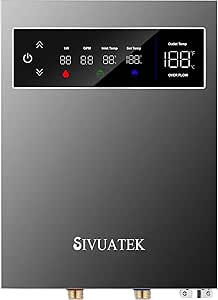
SIVUATEK 14 kW Electric Tankless Water Heater, 240V
The SIVUATEK fills the middle ground between small sink heaters and the 18 kW models: it is rated for one or two usage points, with a maximum flow of 3.3 GPM. That is less than the NOVIEEX and Rheem 18 kW units, but the narrower intended use can suit a bathroom or nearby fixtures without choosing a larger heater than the job calls for. Its 1°F temperature adjustments and LED display give buyers direct control within an 86°F–131°F range. Installation is still a major part of the decision: it calls for a dedicated 60 A breaker, so its 14 kW rating does not make it a plug-in upgrade. The ThermoMate 6kW is more focused on a single sink and specifies a 30 A breaker; SIVUATEK offers more stated flow, but needs a larger circuit and remains limited to modest simultaneous demand. The listed dimensions also differ between the description and product information, so verify fit before mounting.
Pros:- Rated for one to two usage points with a 3.3 GPM maximum flow
- LED display and temperature adjustment in 1°F increments
- Includes leakage, overheating, and automatic shutoff protection
- ETL certified
Cons:- Requires a dedicated 60 A circuit breaker
- Not intended for heavy simultaneous demand across a home
- Product information lists conflicting dimensions
Best for: Buyers needing hot water for one or two nearby fixtures who can provide a dedicated 60 A circuit and want fine temperature adjustment.
Not ideal for: Whole-home users with several simultaneous hot-water demands, or anyone whose panel cannot support the specified 60 A breaker.
- Model:TSB-140
- Heating power:14 kW
- Voltage:240 V
- Required circuit breaker:1 × 60 A
- Maximum flow rate:3.3 GPM
- Temperature range:86°F–131°F, adjustable in 1°F increments
- Water connection:1/2-inch NPT
- Certification:ETL certified
- Dimensions:15.87 × 11.14 × 2.87 inches in description; 12.2 × 17.25 inches in product information
Our verdict“Choose the SIVUATEK for modest one- or two-fixture demand if its 60 A electrical requirement and physical fit work for your installation.”
ThermoMate 6kW Tankless Water Heater Electric for Sink Washing, ETL Listed
The ThermoMate 6kW is a purpose-built sink heater, with a listed 1.07 GPM flow at a 35°F temperature rise. That makes it more capable for a sink than the 110 V 3000 W model’s low-flow temperature-rise figures, but it is still not a multi-fixture or shower heater. Its self-modulating power and digital touch controls, including 1° adjustments, suit buyers who want to set a precise point-of-use temperature without storing hot water. The compact 7.5-inch-wide body can fit under many counters, though buyers need to confirm cabinet clearance and installation requirements. The tradeoff is electrical commitment: unlike the 110 V unit, this one needs a hardwired 240 V circuit with a 30 A breaker and minimum 10 AWG wire. Compared with the 14 kW SIVUATEK, it offers less flow but is aimed at one sink and specifies a smaller breaker.
Pros:- Listed 1.07 GPM flow at a 35°F temperature rise for sink use
- Self-modulating operation is stated as up to 99.8% efficient
- Digital touch controls adjust temperature in 1° increments
- Compact 7.5-inch width suits many under-counter locations
Cons:- Requires hardwiring to 240 V with a 30 A breaker and minimum 10 AWG wire
- Limited flow is intended for sink applications, not shower or multi-fixture use
- Installation requires checking cabinet clearance and electrical capacity
Best for: Homeowners adding on-demand hot water at one sink who have a dedicated 240 V, 30 A circuit and limited under-counter space.
Not ideal for: Buyers needing a shower, several simultaneous fixtures, or a heater that can use a standard 110 V connection.
- Wattage:6000 W
- Voltage:240 V
- Flow rate:1.07 GPM at a 35°F rise
- Maximum temperature:131°F
- Maximum pressure:150 psi
- Installation:Hardwired; requires 30 A breaker and minimum 10 AWG wire
- Dimensions:7.5 × 11.2 × 2.52 inches (W × H × D)
- Mount type:Wall-mounted
Our verdict“Choose the ThermoMate 6kW for a single sink when its 240 V circuit requirement is acceptable and you want more stated flow than a small 3 kW unit.”

How We Picked
I ranked these electric tankless heaters by fit for their stated use, not by treating every model as a whole-house contender. I weighed power and voltage against likely demand, distinguishing compact sink-focused units from multi-fixture and higher-output heaters. Within similar output classes, I looked for useful stated details such as flow-rate claims, multi-fixture positioning, digital controls, WiFi, and certification language; those claims should be checked against the manufacturer’s current documentation before purchase.
Capacity and installation fit drive the order: the Rheem RTEX-24 ranks first for its stronger stated output and recognizable household-use positioning, while lower-powered options rank well only for targeted sink use. The 18 kW and 14 kW units follow as potential middle-ground choices, with less ranking separation where the supplied product details are sparse. I also factored in the tradeoff between broader hot-water coverage and greater electrical demands, plus whether a product listing gives enough information for a buyer to verify compatibility. No heater can be ranked as a sound fit without checking site-specific flow, incoming water temperature, and circuit requirements.
Factors to Consider When Choosing Electric Tankless Heater
Choosing an electric tankless heater starts with the job it must do, then works backward to the electrical system and expected flow. The product names alone do not confirm that a unit will provide comfortable hot water at every tap; local conditions and installation details can change the result. These checks help separate a suitable point-of-use heater from a whole-home purchase that may exceed the home’s capacity.
Match Output to the Number of Fixtures
List the fixtures that may run at the same time, rather than counting every tap in the home as if they will all run together. A sink-only heater has a much narrower job than a unit expected to supply a shower and kitchen tap at once. Higher output can support more demand, but it does not guarantee a particular flow at a comfortable temperature in every climate. Incoming water temperature affects how much the heater must raise the water temperature, so a unit that works in a warm region may feel undersized in a colder one. Avoid buying from a maximum GPM claim alone; check the conditions behind that figure and compare them with your household’s actual use. If you rarely need simultaneous hot water, a smaller heater may be a more sensible fit than wiring for excess capacity.
Check Voltage, Breakers, and Available Electrical Capacity
A 110V or 120V model and a 240V heater are not interchangeable purchases. Higher-output electric heaters can place a substantial load on a home’s electrical service, and a suitable voltage label does not confirm that the existing panel, breaker spaces, wire gauge, and circuit arrangement are adequate. Review the manufacturer’s installation requirements and have a qualified electrician assess the planned location and service capacity before ordering. A common mistake is to compare heaters by wattage while overlooking the cost and feasibility of the electrical work they may require. If adding circuits or upgrading service would be difficult, a point-of-use unit may address one problem without pretending to heat the whole house. Treat electrical compatibility as a pass-or-fail check, not a detail to resolve after purchase.
Choose Point-of-Use or Whole-Home Placement
Point-of-use placement puts a compact heater near a single sink or fixture, which can reduce the wait for hot water at that location. It will not replace a central heater when several distant fixtures need hot water. A whole-home installation can serve a broader set of taps, but the unit must be sized for combined demand and installed where plumbing and electrical connections are practical. Think about pipe distance, mounting space, access for service, and the route from the panel before settling on a format. Buyers sometimes choose a small under-sink unit expecting it to improve every bathroom; that mismatch is more about placement than product quality. Pick the coverage area first, then compare models within that category.
Compare Flow Claims on the Same Conditions
Maximum flow figures are only useful when you know the temperature rise and test conditions behind them. A heater’s output must raise incoming water to the desired temperature while maintaining the flow your fixtures require. In colder climates, a published maximum may not reflect the flow available during winter use. Compare manufacturers’ sizing charts using your local incoming water temperature and the temperature you want at the tap. When a listing gives a GPM figure without clear conditions, treat it as a prompt to verify rather than a dependable household result. This prevents a frequent mismatch: choosing a unit that appears to support multiple fixtures on paper but cannot do so comfortably in the home.
Verify Certifications, Warranty, and Service Details
Certification language in a listing is a useful starting point, but confirm the exact model and certification with the manufacturer or a recognized certification directory. Check whether the warranty covers the heat exchanger, electronics, and labor separately, and note any installation rules that could affect coverage. Ask how replacement parts and technical support are handled, especially for lesser-known brands or models with limited published details. A digital display or WiFi feature may make controls more convenient, but neither one compensates for unclear safety documentation or difficult service access. Also review maintenance guidance for scale buildup, since hard water can shorten component life or affect performance. Prioritize verifiable support and installation instructions over feature names alone.
Decide When Higher Capacity Is Worth the Electrical Work
Paying for a higher-output unit makes sense only if your household needs the additional flow and the electrical system can support it. A 24 kW or 27 kW model may suit heavier demand better than a 14 kW unit, yet the added capacity can bring more demanding circuit requirements. For a single sink or occasional handwashing, a compact heater avoids sizing for a workload it will never face. For homes with several simultaneous hot-water uses, the cost and disruption of electrical upgrades may be part of the project rather than a reason to choose an underpowered unit. Compare the full installation plan, not just the heater’s rated output. If your demand is uncertain, record which fixtures run together and consult a qualified installer before choosing a capacity class.
Frequently Asked Questions
Can a 110V or 120V electric tankless heater run a shower?
These listings are low-wattage models generally better suited to a sink or other limited point-of-use task than a typical shower. Whether any specific heater can serve a shower depends on its verified flow at the temperature rise your location requires, not voltage alone. A shower needs sustained hot-water output, and cold incoming water makes that harder to achieve. Check the manufacturer’s sizing data for shower use before buying, and do not infer whole-home or shower capability from the word “tankless.” If shower supply is the goal, compare higher-output models and have the electrical requirements checked first.
Will an 18 kW electric tankless heater supply my whole house?
It may work for some homes, but the 18 kW label by itself cannot confirm whole-house suitability. The answer depends on incoming water temperature, desired outlet temperature, simultaneous fixture demand, and the unit’s flow at that temperature rise. A household in a colder region or one that runs multiple showers and taps together may need more capacity than a household with staggered use. Check the manufacturer’s sizing chart against your actual conditions rather than relying on a maximum GPM claim. Also confirm that the electrical service can support the required circuit configuration before treating an 18 kW model as a whole-home solution.
Should I choose a 14 kW, 18 kW, or 24 kW model?
Start with the fixtures you expect to use at the same time and your local incoming water temperature. The 14 kW class is a more limited middle-ground option, 18 kW models may support more demand, and the Rheem RTEX-24 offers the strongest stated capacity among those three classes in this lineup. That comparison does not make 24 kW the right choice for every home: its electrical demands may exceed what a panel can support without changes. Use manufacturer sizing information and an electrician’s assessment to narrow the choice. If the intended use is one sink, a smaller point-of-use heater may be a better match than any of these higher-output units.
Do I need an electrician before replacing a tank water heater with an electric tankless model?
Yes, arrange an electrical assessment before choosing a high-output electric tankless heater. Tankless models can require different circuit capacity and wiring from the existing tank heater, so an existing connection does not prove compatibility. The electrician can check panel capacity, breaker space, wiring, and the manufacturer’s installation requirements. This step can reveal that electrical upgrades are needed or that a lower-demand point-of-use approach is more practical. It also helps you avoid buying a unit that cannot be installed safely in your home.
Is WiFi or a digital display worth prioritizing over heater capacity?
Usually, capacity and installation fit should come first because they determine whether the heater can supply the intended fixtures. A display can make temperature settings easier to read, while WiFi may add remote monitoring or control if the specific model supports it. Neither feature increases the unit’s heating output or resolves an undersized circuit. Confirm the feature set and app support in the manufacturer’s documentation, since a listing title may not explain its limits. Choose convenience features after verifying flow, voltage, and electrical compatibility.
Conclusion
For the broadest household-use case in this lineup, I’d start with the Rheem RTEX-24 as my best overall pick, subject to an electrical capacity check. The ThermoMate 3500W is my best value-style fit for a buyer who only needs to serve one sink, while the ThermoMate 6kW offers a higher-power compact option for targeted sink washing. For a premium-capacity direction, the ThermoMate 27kW has the highest stated output here, but it makes sense only when the home’s demand and electrical system justify it. Beginners should focus on intended placement and verified installation requirements before choosing among the simpler 110V or 120V units. For a middle-ground multi-fixture need, compare the Rheem 11 kW and Rheem 18 kW against your sizing chart and wiring; the right answer depends on actual flow needs, not a model name alone.