
If you’re looking for the best field flatteners for refractor telescopes that give you crisp, clear images across the entire field, I recommend options like the Astromania 2″ Flattener, SVBONY SV503 Portable, and Focal Reducers designed specifically for f/4 to f/8 ratios. These models feature high-quality coatings, durable construction, and flexible focusing to guarantee sharp stars edge-to-edge. Keep exploring the options to find the perfect match for your setup and imaging goals.
Key Takeaways
- Ensure compatibility with refractors f/4 to f/8 and proper full aperture illumination at 2 inches (M48 threading).
- Prioritize multi-coated lenses for high contrast, minimal reflections, and durable, weatherproof construction.
- Look for a flattener with a flexible back focus (around 109mm) for precise focusing and minimal vignetting.
- Confirm suitability for your telescope’s focal ratio to prevent aberrations and star distortions at the edges.
- Balance cost and optical quality; premium models offer sharper images with better coatings, while budget options may need careful setup.
Astromania 2″ Field Flattener for Astronomy Photos

If you’re serious about capturing sharp, edge-to-edge astronomy images, the Astromania 2″ Field Flattener is an excellent choice for refractor telescope users. It corrects common field curvature, delivering pin-sharp stars across the entire image. Compatible with telescopes from f4 to f8, it features a 109mm back focus for easy adjustments and accessory fitting. Its multi-coated lenses reduce reflections, boosting contrast and clarity. Designed for full aperture illumination at 2 inches, it ensures uniform brightness and minimal optical defects. Whether you’re into astrophotography or detailed imaging, this flattener helps you achieve high-quality, flat images with minimal effort.
Best For: astrophotographers and amateur astronomers using refractor telescopes from f4 to f8 who want sharp, flat, edge-to-edge images with minimal optical defects.
Pros:
- Corrects common field curvature for sharp stars across the entire image
- Compatible with telescopes f4 to f8 and features 109mm back focus for easy adjustments
- Equipped with multi-coated lenses that enhance contrast and reduce reflections
Cons:
- Designed specifically for refractors, not suitable for other telescope types
- May require precise focusing adjustments to achieve optimal results
- Slightly limited to full aperture illumination at 2 inches, which may not fit all setups
SVBONY SV503 Portable Telescope, 70ED F6 Optical Tube for Astrophotography
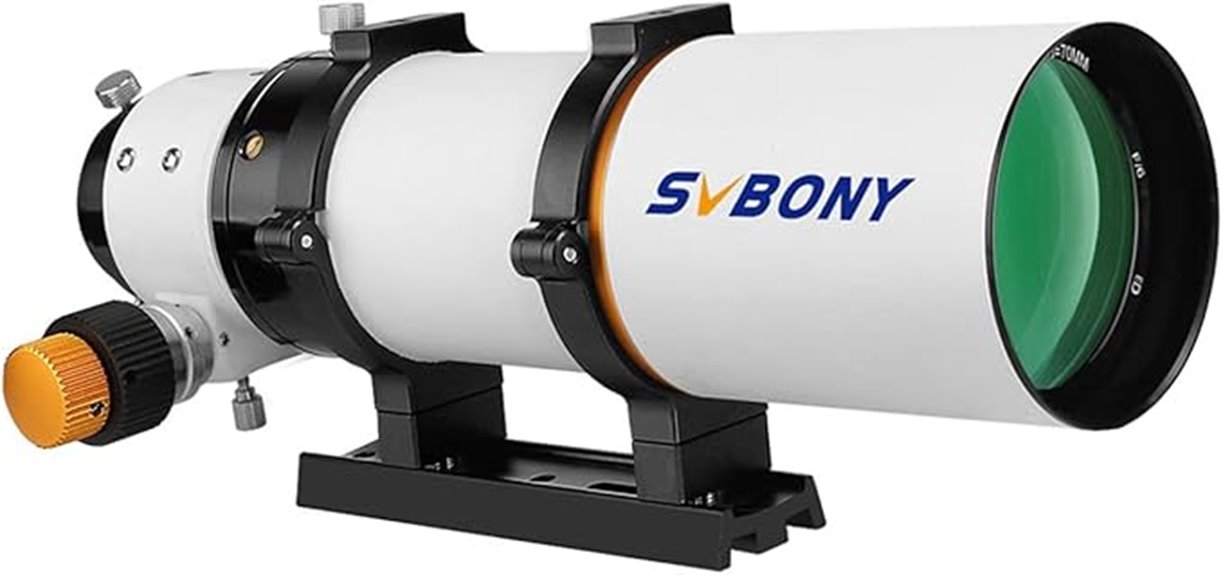
Looking for a portable telescope that combines exceptional optical quality with versatile astrophotography capabilities? The SVBONY SV503 fits the bill perfectly. Its 70ED F6 optical tube features high-quality S-FPL51 ED glass, virtually eliminating chromatic aberration for sharp, high-contrast images. The 2-element doublet air-spaced achromatic objective ensures detailed views of the moon, nebulae, and galaxies. Designed for portability, it’s built to withstand travel while supporting heavy photographic accessories with its precise 2-inch focuser. Whether you’re an experienced astronomer or a passionate beginner, the SV503 offers reliable, high-performance imaging for both visual observation and astrophotography adventures.
Best For: amateur and experienced astronomers seeking a portable, high-quality telescope for astrophotography, lunar, nebulae, and galaxy observations.
Pros:
- Exceptional optical quality with S-FPL51 ED glass virtually eliminating chromatic aberration.
- Portable and durable design ideal for travel and mobile use.
- Supports heavy photographic accessories with a precise 2-inch focuser for accurate focusing.
Cons:
- May require additional accessories such as mounts or adapters for complete astrophotography setups.
- Limited aperture size (70mm), which might restrict deep-sky imaging compared to larger telescopes.
- Slightly higher cost compared to entry-level beginner telescopes with similar features.
Astromania 2″ Field Flattener for Astronomy Photos

The Astromania 2″ Field Flattener is an excellent choice for astrophotographers who want sharp, distortion-free images across their entire field of view. It’s compatible with refractors having focal ratios from f/4 to f/8 and features M48 threading for full aperture illumination at 2 inches. Designed to correct field curvature, it produces pin-sharp stars from center to edge, even on large camera chips. Its multi-coated lenses boost light transmission and reduce reflections, enhancing image quality. Whether you’re capturing detailed celestial features or wide-field shots, this flattener ensures consistent, high-quality results with minimal optical distortions.
Best For: astrophotographers seeking sharp, flat-field images across large camera chips with refractor telescopes in focal ratios from f/4 to f/8.
Pros:
- Corrects field curvature for uniformly sharp stars across the entire image field
- Multi-coated lenses enhance light transmission and reduce reflections for clearer images
- Compatible with 2-inch accessories and full aperture illumination at M48 threading
Cons:
- Designed specifically for refractor telescopes within certain focal ratios, limiting use with other types of telescopes
- May require precise back focus adjustments to achieve optimal performance
- Not suitable for telescopes with focal ratios outside the specified range of f/4 to f/8
SVBONY Focal Reducer for SV503 102mm ED Telescope
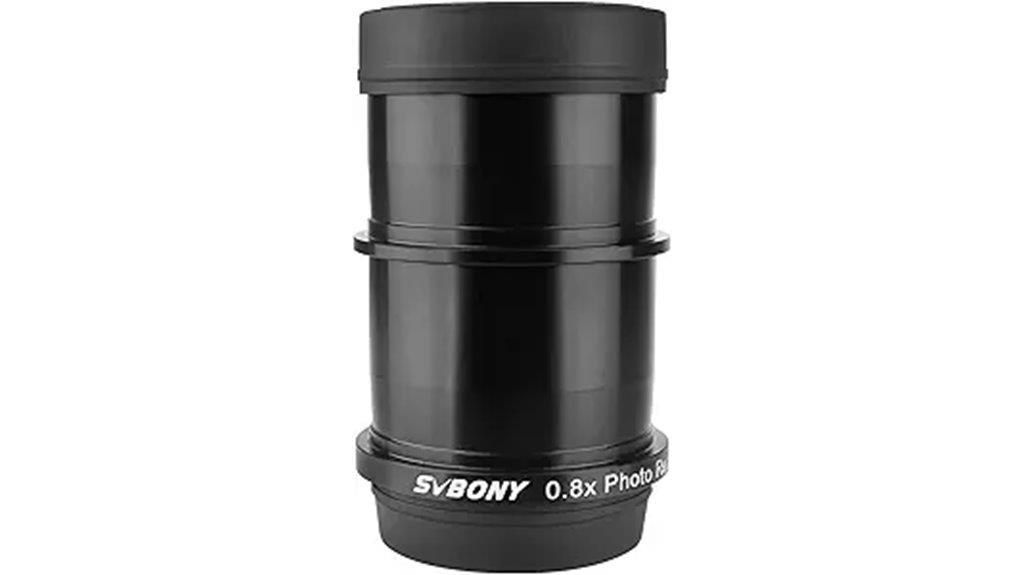
The SVBONY Focal Reducer for the SV503 102mm ED Telescope stands out as an essential tool for astrophotographers aiming to capture wide, detailed images of the night sky. It offers a 0.8x reduction, which broadens your field of view and enhances illumination for full-frame astrophotography. Designed with multi-coated optics and a durable aluminum body, it guarantees sharp, high-quality images with minimal star distortion. Its compatibility with standard filters and camera threads makes setup seamless. Whether you’re focusing on deep-sky objects or wide-field shots, this focal reducer helps you achieve clearer, more vibrant celestial images with improved focus and signal-to-noise ratio.
Best For: astrophotographers seeking to capture wide-field, high-quality celestial images with enhanced illumination and minimal star distortion using the SV503 102mm ED telescope.
Pros:
- Provides a 0.8x reduction for wider sky coverage and improved framing.
- Multi-coated optics ensure clear, high-clarity images with minimal distortion.
- Durable aluminum construction with a lightweight design for stability and ease of handling.
Cons:
- May require precise focus adjustment due to focal reduction effects.
- Compatibility limited to specific telescope models and threaded accessories.
- Slightly increased setup complexity for beginners unfamiliar with astrophotography accessories.
SVBONY SV503 Refractor Telescope with Built-in Field Flattener and SV305C Pro Telescope Camera

If you’re seeking a refractor telescope that delivers sharp, flat images across the entire field of view, the SVBONY SV503 with its built-in field flattener is an excellent choice. Its design minimizes chromatic aberration and field curvature, providing true-to-life colors and crisp details from edge to edge. The 70mm aperture and F/6.78 focal ratio produce bright, detailed images of galaxies, nebulae, and star clusters. Paired with the SV305C Pro camera, which offers low noise and high sensitivity, this system captures stunning planetary and deep-sky images. It’s a versatile setup perfect for astronomers aiming for high-quality, distortion-free astrophotography.
Best For: amateur astronomers and astrophotographers seeking a high-quality, distortion-free refractor telescope with excellent planetary and deep-sky imaging capabilities.
Pros:
- Built-in field flattener ensures flat, edge-to-edge sharp images with minimal aberration
- 70mm aperture and F/6.78 focal ratio provide bright, detailed views of celestial objects
- Low-noise, high-sensitivity IMX662 camera captures clear, high-quality planetary and deep-sky images
Cons:
- May require additional accessories or mounts for optimal use and stability
- The system’s sophistication might involve a learning curve for beginners
- Limited aperture size compared to larger telescopes may restrict extremely faint object observation
Factors to Consider When Choosing Field Flatteners for Refractor Telescopes

When selecting a field flattener, I consider how well it matches my telescope’s F-ratio and the quality of its optics and coatings. I also look at whether it provides even illumination across my camera’s aperture, offers flexible focusing, and is built to last. These factors guarantee I get sharp, consistent images with minimal hassle.
Compatibility With F-Ratio
Choosing the right field flattener means paying close attention to its compatibility with your telescope’s f-ratio, since these accessories are typically designed to work within specific focal ratio ranges—usually from f/4 to f/8. Using a flattener outside its recommended range can cause poor image flatness or increase aberrations, compromising image quality. It’s crucial to match the flattener’s designed focal ratio to your telescope’s f-ratio to guarantee even illumination and sharpness across the entire field. Some flatteners offer adjustable elements or specifications, providing flexibility for different setups. Ignoring this compatibility can lead to vignetting, star distortion, or edge softness, diminishing the overall clarity of your images. Ensuring proper f-ratio compatibility is indispensable for achieving ideal results.
Optics and Coatings Quality
Optics and coatings quality play a vital role in ensuring your field flattener delivers sharp, clear images across the entire field of view. High-quality flateners use multi-coated lenses that markedly reduce reflections and enhance light transmission, resulting in brighter, more detailed images. Superior coatings also minimize optical aberrations like ghosting and flare, boosting overall contrast and image clarity. Some coatings are tailored for specific wavelengths, optimizing performance with various astrophotography filters and cameras. Additionally, multi-coating layers improve durability, making the flatener resistant to environmental factors such as humidity and dust. The quality of these coatings directly impacts the flatness and sharpness across your entire image, ensuring consistent, high-quality results whether you’re observing planets or capturing deep-sky objects.
Aperture Illumination Coverage
Ever wondered how to guarantee your field flattener delivers consistent brightness across the entire image? Ensuring full aperture illumination is vital. A good field flattener should evenly light the entire field, preventing darkening at the edges. It needs to match your telescope’s aperture size and focal ratio to avoid vignetting or uneven light distribution. Adequate back focus distance is also essential, allowing room for accessories without sacrificing illumination quality. Proper design ensures the light cone is evenly spread, preventing brightness falloff or uneven illumination. Compatibility with your telescope’s thread size and optical setup is fundamental, too. When these factors align, you’ll enjoy a uniformly bright, crisp image across the entire field of view, making your astrophotography or visual observing much more satisfying.
Focusing Flexibility
When selecting a field flattener for your refractor telescope, focusing flexibility becomes a key consideration because it directly impacts how easily you can achieve sharp, well-focused images across the entire field. Many flatteners have a specific back focus requirement, which can limit focusing adjustments and may require additional spacers or extension tubes. Adjusting focus usually involves moving the focuser or accessories, but too much extension can cause vignetting or degrade image quality. Some flatteners feature a generous back focus, like 109mm, giving more room for fine-tuning without compromising optics. Keep in mind that switching between different cameras or accessories often demands refocusing, which can be inconvenient. Choosing a flattener that offers ample focusing flexibility ensures easier, more precise adjustments during your imaging sessions.
Build Durability
Choosing a durable field flattener is essential because it guarantees reliable performance through frequent use and handling. I look for models made from sturdy materials like aluminum or high-quality plastics, which resist wear and tear. Multi-coated lenses are a must—they protect against scratches, reflections, and environmental damage, extending the flattener’s lifespan. Proper sealing and weatherproofing also matter, as they shield internal components from dust, moisture, and corrosion, ensuring consistent performance. Additionally, robust threading and secure connection points prevent deterioration during attachment and removal, reducing the risk of damage. A well-built flatener maintains optical alignment over time, minimizing the need for recalibration or replacement. Prioritizing build quality ensures my equipment stays reliable, delivering sharp images session after session.
Size and Weight
The size and weight of a field flattener directly influence how well it fits your refractor telescope and how easy it is to handle during setup and use. A properly matched size ensures compatibility with your optical design, preventing vignetting and optical issues. Lightweight flatteners are ideal for portable setups, reducing strain on the focuser and mount, making adjustments smoother. Larger, heavier flatteners might require sturdier focusers and mounts to support the extra weight safely, which could add to your equipment costs. Compact designs are especially beneficial for travel or mobile astronomy, as they minimize bulk without sacrificing image quality. Overall, choosing a flattener that balances size and weight with your telescope’s specifications ensures easier handling and maintains excellent performance.
Ease of Installation
Ease of installation plays a crucial role in selecting a field flattener, as it determines how quickly and accurately you can set up your refractor telescope for imaging. Many flatteners are designed with standard threading, like M48 or M54, which simplifies compatibility with common accessories. Adjustable or lockable focusing mechanisms make aligning the flattener straightforward, saving time and frustration. Some models even include clear instructions or integrated guides to ensure proper setup with minimal effort. A lightweight and compact design also enhances ease of handling during installation. Additionally, compatibility with existing focusers and the availability of adapters can greatly reduce setup time. All these factors contribute to a smoother, faster installation process, helping you focus more on capturing stunning images.
Price and Value
When evaluating field flatteners, it’s essential to take into account how their price reflects the overall value they offer. Higher-priced models often feature premium optical coatings and advanced lens elements, which enhance image quality and durability. While these cost more, they can deliver sharper, more consistent images across the entire field. On the other hand, budget-friendly flatteners may lack multi-coatings or use simpler designs, resulting in reduced contrast and more reflections. However, a well-chosen, reasonably priced flattener can save money in the long run by minimizing post-processing to correct distortions. The best value balances optical performance, build quality, compatibility, and affordability, ensuring you get the most effective performance for your specific astrophotography needs.
Frequently Asked Questions
How Do Field Flatteners Affect Overall Image Brightness?
Field flatteners can slightly reduce overall image brightness, but the impact is usually minimal. I’ve noticed that they help produce sharper, more uniform images across the field, which outweighs the small brightness loss. To compensate, I often increase the exposure time or adjust my telescope’s settings. Overall, I think the improved image clarity and flatness make field flatteners a worthwhile addition, especially for astrophotography and detailed viewing.
Can Field Flatteners Be Used With All Refractor Telescopes?
Yes, field flatteners can be used with most refractor telescopes, but not all. I recommend checking your telescope’s specifications first, as some models may not be compatible due to size or optical design. Generally, they’re most effective with faster refractors or those with a longer focal length. If you’re unsure, consulting your telescope’s manual or an expert can help guarantee compatibility and ideal performance.
What Maintenance Is Required for a Field Flattener?
Using a field flattener is like having a trusty sidekick—minimal maintenance is needed. I regularly check for dust or dirt on the lens and gently clean it with a soft cloth if necessary. guaranteeing the threads are tight and the lens stays correctly aligned keeps it performing well. Occasionally, I inspect for any signs of damage or fogging. Proper care ensures your images stay crisp and clear, like a well-maintained vintage gadget.
Are There Specific Brands Recommended for High-End Astrophotography?
For high-end astrophotography, I recommend brands like William Optics, Tele Vue, and Astro-Physics. These brands are known for their premium quality, precise craftsmanship, and excellent optical performance. I’ve personally used their field flatteners and seen how they consistently produce sharp, clear images across the entire field of view. Investing in these trusted brands guarantees you get the best possible results, especially when capturing detailed celestial objects.
How Does Focal Length Influence Flattener Selection?
Focal length is the backbone when choosing a flattener because it determines the ideal distance and design needed. Longer focal lengths require more precise flatteners to avoid image distortion, while shorter ones are more forgiving. Think of it as the foundation for a house; the right flattener guarantees your images stay sharp across the entire field. Always match your flattener’s specifications to your telescope’s focal length for best results.
Conclusion
Did you know that using the right field flattener can improve your astrophotography by up to 50%? Choosing the best one for your refractor telescope guarantees sharp, crisp images that truly showcase the night sky’s beauty. With options like the Astromania 2″ or SVBONY models, you’re well on your way to capturing stunning celestial shots. Don’t settle for blurry stars—invest in a quality field flattener and elevate your astrophotography game today!