For a flat burr grinder for espresso, I’d put the Tuni G3 64 mm near the top for its broad grind adjustment, while the SHARDOR 64mm models stand out for buyers who want many settings and an anti-static option. The lineup ranges from 64mm grinders with 100 settings to simpler models with fewer adjustments, so the main tradeoff is fine control versus ease of use and feature complexity. A larger setting count can help with dialing in, but it does not by itself guarantee consistent espresso grounds. I compare grind adjustment, usability, maintenance, and the differences between closely related models below. Read on for the full breakdown and a guide to choosing the right grinder for your setup.

Get kitchen gear delivered free with Prime
- Fast, free delivery on millions of items
- Prime Video, Amazon Music and more included
- Member-only deals all year
Complete the kit

Key Takeaways
- Several 64mm models offer 100 grind settings, including SHARDOR, Tuni G3, DAOFEL, and MOKKOM; the choice between them calls for checking practical features and model differences, not relying on the setting count alone.
- The SHARDOR white anti-static version has a distinct convenience angle compared with the similarly named SHARDOR grinders, which may matter to buyers focused on reducing mess.
- GeniCup’s 35 settings and Amazon Basics’ 30 settings stand apart from the 90- and 100-setting options, making them simpler alternatives but potentially less flexible for fine espresso adjustments.
- AMZCHEF’s 90 settings sit between the two main adjustment groups; a slightly lower count than 100 does not automatically make it a weaker espresso choice.
- The MOKKOM Titanium model is the lineup’s premium-leaning option, while the standard MOKKOM 100-setting grinder presents a direct alternative for buyers deciding whether a specialty material feature matters to them.
| SHARDOR 64mm Flat Burr Coffee Grinder with 100 Settings | 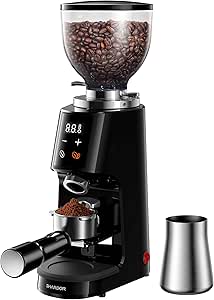 | Best for Espresso-to-Brew Versatility | Model: CG301 | Burr size: 64 mm | Grind settings: 100 | VIEW ON AMAZON | See Our Full Breakdown |
| SHARDOR 64 mm Flat Burr Coffee Grinder with 100 Settings, Anti-Static System, White |  | Best White-Finish Pick | Model: CG301 | Burr type: 64 mm flat burr | Grind settings: 100 | VIEW ON AMAZON | See Our Full Breakdown |
| SHARDOR 64mm Electric Burr Coffee Grinder with 100 Grind Settings |  | Best for Larger-Hopper Espresso Setups | Model: CG305B | Burr size: 64 mm | Burr material: SUS420 stainless steel | VIEW ON AMAZON | See Our Full Breakdown |
| Tuni G3 64 mm Flat Burr Coffee Grinder with 100 Grind Settings |  | Best for Single-Dose Flexibility | Model: G3 | Burr type: 64 mm stainless steel flat burr | Grind adjustment: Stepless | VIEW ON AMAZON | See Our Full Breakdown |
| GeniCup 64mm Flat Burr Coffee Grinder with 35 Grind Settings |  | Best Compact, Quieter Pick | Model: CG-3406-A | Burr size: 64 mm | Grind settings: 35 | VIEW ON AMAZON | See Our Full Breakdown |
| DAOFEL 64mm Flat Burr Electric Coffee Grinder with 100 Adjustable Settings |  | Best for Multi-Brew Households | Burr type: 64mm stainless steel flat burr | Grind settings: 100 adjustable | Hopper capacity: 12.35 oz bulk hopper plus single-dose hopper | VIEW ON AMAZON | See Our Full Breakdown |
| MOKKOM 64mm Flat Burr Coffee Grinder with 100 Grind Settings |  | Best for Timed Dosing | Burr size and material: 64mm stainless steel | Grind settings: 100 | Hopper capacity: 350g / 12.35 oz large hopper, plus a single-dose hopper | VIEW ON AMAZON | See Our Full Breakdown |
| Tuni G3 64mm Flat Burr Coffee Grinder with 100 Grind Settings |  | Best for Single-Dose Flexibility | Burr type: 64mm stainless steel flat burrs | Grind adjustment: Stepless, with 100 settings | Hopper capacities: 250g / 8.8 oz and 50g / 1.7 oz | VIEW ON AMAZON | See Our Full Breakdown |
| AMZCHEF 64mm Flat Burr Coffee Grinder with 90 Grind Settings |  | Best for Espresso Portafilter Workflow | Burr type: 64mm stainless steel flat burrs | Grind settings: 90 | Timer precision: 0.1-second increments | VIEW ON AMAZON | See Our Full Breakdown |
| Amazon Basics Burr Coffee Grinder with 30 Grind Settings |  | Best Entry-Level Pick | Grind settings: 30 | Bean hopper capacity: 6.5 oz | Grounds chamber capacity: 7 oz | VIEW ON AMAZON | See Our Full Breakdown |
| MOKKOM Titanium 64mm Flat Burr Coffee Grinder |  | Best for Flexible Dosing | Brand: MOKKOM | Model number: BD-CG308 | Burr type: 64mm titanium-coated flat burrs | VIEW ON AMAZON | See Our Full Breakdown |
| flat burr grinder for espresso | Grind settings | Power | Dimensions | Burr type |
|---|---|---|---|---|
| SHARDOR 64mm Flat Burr Coffee | 100 | 260 W | 8.15 × 5.2 × 15.28 in | — |
| SHARDOR 64 mm Flat Burr Coffee | 100 | 260 W | 8.15 × 5.2 × 15.28 in | 64 mm flat burr |
| SHARDOR 64mm Electric Burr Cof | 100 | 350 W | 14.4 × 8.9 × 16.1 in | — |
| Tuni G3 64 mm Flat Burr Coffee | — | — | — | 64 mm stainless steel flat burr |
| GeniCup 64mm Flat Burr Coffee | 35 | 100 W | — | — |
| DAOFEL 64mm Flat Burr Electric | 100 adjustable | 260 watts, 120 volts | 8.8 × 5.1 × 16 inches | 64mm stainless steel flat burr |
| MOKKOM 64mm Flat Burr Coffee G | 100 | 260 watts, 120 volts | — | — |
| Tuni G3 64mm Flat Burr Coffee | — | — | — | 64mm stainless steel flat burrs |
| AMZCHEF 64mm Flat Burr Coffee | 90 | 200 watts, 120 volts AC | 13.23 × 7.4 × 16.27 inches | 64mm stainless steel flat burrs |
| Amazon Basics Burr Coffee Grin | 30 | 150 watts | 8 × 5.25 × 11.6 inches | — |
| MOKKOM Titanium 64mm Flat Burr | 100 | 260 watts | — | 64mm titanium-coated flat burrs |
More Details on Our Top Picks
SHARDOR 64mm Flat Burr Coffee Grinder with 100 Settings
The CG301’s 100 grind settings make it a flexible choice for households that switch between espresso and coarser brewing methods. Its 64 mm flat burrs, LED timer with 0.1-second adjustments, and portafilter holder give espresso drinkers useful control over grind size and dosing workflow. Compared with the GeniCup CG-3406-A, this SHARDOR offers far more grind settings, while the GeniCup is smaller and specifies a quieter brushless motor. The CG301 also includes a stainless steel grounds cup, removable parts, and anti-static features to help manage cleanup. The tradeoff is that 100 settings do not by themselves guarantee espresso-level adjustment precision, and this model is 120 V only. Its standard hopper suits batch grinding, but single-dose users need to source a separate hopper.
Pros:- 100 settings cover espresso through coarse brewing methods.
- 0.1-second LED timer adjustments support repeatable timed dosing.
- Anti-static features and included stainless steel cup help contain grounds.
- Removable components make routine cleaning easier.
Cons:- Designed for 120 V; using 220 V may damage the grinder.
- A single-dose hopper is sold separately.
- The wide setting range does not specify how finely adjustments are spaced for espresso.
Best for: Home espresso drinkers who also brew French press or cold brew and want one grinder with a broad adjustment range.
Not ideal for: Single-dose espresso users or buyers outside 120 V regions who need a supplied single-dose hopper or different voltage support.
- Model:CG301
- Burr size:64 mm
- Grind settings:100
- Bean hopper capacity:250 g
- Power:260 W
- Voltage:120 V
- Dimensions:8.15 × 5.2 × 15.28 in
- Timer accuracy:0.1 seconds
Our verdict“Choose this CG301 if you want one 64 mm flat-burr grinder for espresso and several other brew styles, and can work with its 120 V, hopper-based setup.”
SHARDOR 64 mm Flat Burr Coffee Grinder with 100 Settings, Anti-Static System, White
This white SHARDOR CG301 makes the most sense for espresso buyers who want the same broad grind range and dosing features as the black CG301, but prefer a lighter finish. It pairs 64 mm flat burrs with 100 settings, a 0.1-second LED timer, and a portafilter holder, so it can cover espresso alongside coarser brew methods. Its removable metal grinding chamber and burr make cleaning more accessible than a grinder with fewer removable components. Against the black CG301, the practical difference in the supplied details is the color, not a distinct espresso feature set; against the GeniCup, it offers more settings but takes up more vertical space and lacks a stated quiet-motor specification. It remains a 120 V-only choice, and single-dose grinding requires a separately purchased hopper.
Pros:- 100 settings support espresso and a range of coarser brew methods.
- LED timer adjusts in 0.1-second increments.
- Removable metal chamber and burr support cleaning access.
- Anti-static system and included portafilter holder suit an espresso workflow.
Cons:- Limited to 120 V; 220 V use may damage the grinder.
- Single-dose hopper is sold separately.
- The white version has no stated functional advantage over the black CG301.
Best for: Espresso drinkers furnishing a light-colored coffee station who want a wide grind range and timed dosing for multiple brew methods.
Not ideal for: Buyers who need a single-dose setup in the box, a compact grinder, or compatibility with 220 V power.
- Model:CG301
- Burr type:64 mm flat burr
- Grind settings:100
- Timer accuracy:0.1 seconds
- Bean hopper capacity:250 g
- Power:260 W
- Voltage:120 V
- Dimensions:8.15 × 5.2 × 15.28 in
Our verdict“Pick this version when its white finish fits your setup and you want CG301 features, but skip it if you need a supplied single-dose hopper or non-120 V operation.”
SHARDOR 64mm Electric Burr Coffee Grinder with 100 Grind Settings
The CG305B is the hopper-focused option among these SHARDOR grinders, with a listed 17.6 oz capacity and a direct-grinding portafilter holder. That larger stated capacity may suit espresso drinkers who keep several coffees ready for repeated use, while its touchscreen and anti-static system support a tidy countertop routine. Compared with the CG301 models, it lists a 350 W motor and aluminum housing and chamber; the CG301 instead provides a specified 0.1-second timer and a 250 g hopper. The CG305B’s 100 settings cover multiple brew styles, but the product details do not specify timer accuracy or a single-dose hopper. Its listed 11.4-pound weight and larger dimensions also make it less appealing for cramped counters. Hopper capacity is reported inconsistently, so buyers should not rely on the stated volume without checking the listing.
Pros:- 64 mm stainless steel flat burrs and 100 settings span espresso and other brew styles.
- Adjustable portafilter holder supports direct dosing.
- Aluminum housing and grinding chamber provide a metal-bodied construction.
- Anti-static system is intended to reduce clumping and mess.
Cons:- At 11.4 pounds and 14.4 × 8.9 × 16.1 inches, it needs substantial counter space.
- Hopper capacity is listed inconsistently as 17.6 oz and 1.1 pounds.
- No timer accuracy or included single-dose hopper is specified.
Best for: Home baristas who grind frequently into a portafilter, have room for a larger countertop unit, and prefer a substantial hopper.
Not ideal for: Small-kitchen owners, frequent single-dose switchers, or buyers who need unambiguous hopper-capacity details before choosing.
- Model:CG305B
- Burr size:64 mm
- Burr material:SUS420 stainless steel
- Grind settings:100
- Hopper capacity:17.6 oz (also listed as 1.1 lb)
- Power:350 W
- Weight:11.4 lb
- Dimensions:14.4 × 8.9 × 16.1 in
Our verdict“Choose the CG305B for a larger hopper and direct portafilter workflow if you have counter space, but favor a CG301 for clearer capacity and timer details.”
Tuni G3 64 mm Flat Burr Coffee Grinder with 100 Grind Settings
The Tuni G3 earns its place for espresso buyers who want to move between hopper-fed and single-dose grinding without buying a separate accessory. It includes both a 250 g hopper and a 50 g hopper, plus a dosing cup, ring, and bellow blower. Its stepless adjustment gives the user continuous movement between settings, unlike the numbered 100-setting systems on the SHARDOR CG301 models; that can make small espresso changes easier to dial in, though the controls may feel less defined to shoppers who prefer fixed steps. The touchscreen offers timed single-shot, double-shot, and continuous modes, and the portafilter holder fits 51–58 mm baskets. The tradeoff is limited published physical information: dimensions, weight, and noise level are not provided. Its 0.5-second timing increments are also less fine than the CG301’s stated 0.1-second increments.
Pros:- Includes 250 g and 50 g hoppers for batch and single-dose workflows.
- Stepless grind adjustment supports small changes when dialing in espresso.
- Timed single-shot, double-shot, and continuous grinding modes.
- Portafilter holder fits 51–58 mm portafilters and accessories include a dosing ring and bellow blower.
Cons:- Dimensions, weight, and noise level are not specified.
- 0.5-second timing increments are coarser than the CG301’s 0.1-second increments.
- Stepless adjustment may be less intuitive for buyers who prefer fixed, labeled settings.
Best for: Espresso drinkers who alternate between single-dose beans and hopper use, and want stepless adjustment with included dosing accessories.
Not ideal for: Buyers who need published size and noise details, or who prefer clearly numbered grind steps and finer timer increments.
- Model:G3
- Burr type:64 mm stainless steel flat burr
- Grind adjustment:Stepless
- Hopper capacities:250 g and 50 g
- Timer increments:0.5 seconds
- Controls:LED touchscreen
- Portafilter compatibility:51–58 mm
- Warranty:1 year with lifetime tech support
Our verdict“Choose the Tuni G3 if you want stepless espresso adjustment and both hopper and single-dose options included, and can accept missing size and noise specifications.”
GeniCup 64mm Flat Burr Coffee Grinder with 35 Grind Settings
The GeniCup is the most compact choice in this group, measuring 8.75 × 3.54 × 10.83 inches and weighing 5.5 pounds. Its 64 mm flat burrs and 35 grind settings cover espresso and several coarser brew methods, though the smaller adjustment count gives less room to fine-tune than the 100-setting SHARDOR and Tuni models. That distinction matters most to espresso drinkers who regularly make small grind changes while dialing in different beans. A 500 rpm brushless motor is specified to run below 70 dB, a useful fit for shared kitchens, and the magnetic dosing cup and outlet detach for cleaning. Unlike the Tuni G3, it does not include a second hopper or list stepless adjustment. Its lower stated wattage and limited setting detail also leave less information for buyers comparing espresso adjustment control.
Pros:- Compact 8.75 × 3.54 × 10.83-inch footprint and 5.5-pound weight.
- Brushless DC motor is specified below 70 dB.
- Magnetic dosing cup and powder outlet detach for cleaning.
- 64 mm flat burrs support espresso and other brewing methods.
Cons:- 35 settings offer fewer adjustment points than the SHARDOR CG301 and Tuni G3.
- No stepless adjustment is specified.
- 120 V operation limits suitability for other voltage regions.
Best for: Apartment dwellers and espresso drinkers with limited counter space who value a specified quieter motor and easy-to-remove dosing parts.
Not ideal for: Espresso hobbyists who want stepless adjustment or the widest range of grind settings for fine dialing-in.
- Model:CG-3406-A
- Burr size:64 mm
- Grind settings:35
- Motor:Brushless DC, 500 rpm
- Noise level:Below 70 dB
- Power:100 W
- Voltage:120 V
- Dimensions and weight:8.75 × 3.54 × 10.83 in; 5.5 lb
Our verdict“Pick the GeniCup if counter space and a specified quiet motor matter more than the finer adjustment range offered by the 100-setting grinders.”
DAOFEL 64mm Flat Burr Electric Coffee Grinder with 100 Adjustable Settings
The DAOFEL is a flexible choice for espresso drinkers who also grind for other brew styles: its 100 settings span espresso through French press, while the dual-hopper setup lets you switch between a 12.35-ounce bean supply and single-dose grinding. Compared with the more espresso-focused AMZCHEF, it gives up a more precise 0.1-second timer in favor of broad adjustment and a larger bulk hopper. The touchscreen and adjustable portafilter stand add convenience, and the anti-static system is intended to limit grounds scattering across the counter. Its 260-watt motor and 7.9-pound weight make it a substantial countertop appliance rather than a portable one. I’d shortlist it for households that change brew methods often, but buyers seeking explicitly stated fine timer increments or a lighter grinder should compare alternatives.
Pros:- 100 settings cover espresso through French press
- Bulk and single-dose hoppers support different dosing routines
- Anti-static system is designed to reduce scattered grounds
- Touchscreen controls and adjustable portafilter stand add workflow flexibility
Cons:- At 7.9 pounds, it is less convenient to move than the lighter Amazon Basics grinder
- Timer increment precision is not specified in the provided product data
Best for: Households that pull espresso regularly but also grind larger amounts for drip or French press.
Not ideal for: Espresso-focused buyers who want a stated 0.1-second timer increment, or anyone who needs a lightweight grinder to move between locations.
- Burr type:64mm stainless steel flat burr
- Grind settings:100 adjustable
- Hopper capacity:12.35 oz bulk hopper plus single-dose hopper
- Controls:Touchscreen with timer
- Power:260 watts, 120 volts
- Weight:7.9 lbs
- Dimensions:8.8 × 5.1 × 16 inches
- Materials:Stainless steel body, aluminum alloy base
Our verdict“Choose the DAOFEL if you want one flat-burr grinder for espresso and several other brew methods, with both bulk and single-dose options.”
MOKKOM 64mm Flat Burr Coffee Grinder with 100 Grind Settings
The MOKKOM pairs 64mm stainless steel flat burrs and 100 grind settings with a 0.1-second timer, giving espresso drinkers a clear route to repeatable timed doses while retaining room to grind for other methods. Its plasma anti-static system and grounds press target mess and cleanup, and the included large and single-dose hoppers make it adaptable to different routines. Compared with the DAOFEL, MOKKOM states its timer precision more specifically; both offer dual hoppers and a broad setting range. The tradeoff is that the single-dose hopper is a separate component, so changing workflows means swapping parts rather than using one hopper for every task. I’d favor it over the simpler Amazon Basics model for espresso dial-in, but its many adjustments may be unnecessary for buyers who rarely change beans or recipes.
Pros:- 0.1-second timer increments support repeatable timed grinding
- 100 settings cover a broad range of brewing styles
- Plasma generator is designed to reduce static and scattered grounds
- Large and single-dose hoppers accommodate different bean workflows
Cons:- The single-dose hopper must be swapped in separately
- The wide adjustment range may be more involved than needed for buyers with a fixed brew routine
Best for: Espresso drinkers who want repeatable timed dosing and also switch between bulk and single-dose grinding.
Not ideal for: Buyers who want to use a single hopper for every routine or prefer a simple grinder with fewer adjustments.
- Burr size and material:64mm stainless steel
- Grind settings:100
- Hopper capacity:350g / 12.35 oz large hopper, plus a single-dose hopper
- Timer precision:0.1-second increments
- Anti-static feature:Plasma generator
- Power:260 watts, 120 volts
- Power source:AC adapter
- Included components:Lid
Our verdict“Pick the MOKKOM if timed dosing precision and the option to switch between bulk and single-dose grinding matter more than a one-hopper workflow.”
Tuni G3 64mm Flat Burr Coffee Grinder with 100 Grind Settings
The Tuni G3 stands out for espresso drinkers who want to alternate between hopper-fed grinding and small single-dose batches. Its two hoppers hold 250g and 50g, and the product data lists stepless adjustment alongside 100 settings, a touchscreen, and timed single, double, or continuous grinding. That combination offers more workflow options than the Amazon Basics grinder, whose smaller adjustment range and chamber-based design suit simpler routines. The G3 also includes a portafilter holder and dosing accessories, but its 50g hopper is limiting for larger batches, and the holder is specified for 51–58mm portafilters. Timer changes are in 0.5-second increments, less fine than the MOKKOM’s stated 0.1-second steps. I’d choose it for flexible home espresso prep, not for large-volume grinding or buyers needing finer timer increments.
Pros:- Interchangeable 250g and 50g hoppers support bulk and single-dose routines
- Stepless adjustment and 100 settings offer flexibility for espresso and other brew methods
- Timed single, double, and continuous grinding modes suit different dosing habits
- Includes a portafilter holder, dosing cup, dosing ring, and hopper bellows
Cons:- The 50g hopper is too small for larger batches
- Portafilter holder compatibility is limited to 51–58mm
- 0.5-second timer increments are less fine than the MOKKOM’s stated 0.1-second increments
Best for: Home espresso drinkers who want to switch between a moderate-capacity hopper and single-dose grinding, with compatible 51–58mm portafilters.
Not ideal for: People who regularly grind large batches through the small hopper, use a portafilter outside the stated size range, or want 0.1-second timer adjustments.
- Burr type:64mm stainless steel flat burrs
- Grind adjustment:Stepless, with 100 settings
- Hopper capacities:250g / 8.8 oz and 50g / 1.7 oz
- Controls:LED touchscreen
- Timer increments:0.5 seconds
- Portafilter compatibility:51–58mm
- Warranty:1 year with lifetime technical support
- Included accessories:Portafilter holder, 100g dosing cup, dosing ring, hopper bellows, two soft brushes
Our verdict“Choose the Tuni G3 if you want flexible single-dose and hopper grinding with included espresso workflow accessories and can work within its portafilter fit limits.”
AMZCHEF 64mm Flat Burr Coffee Grinder with 90 Grind Settings
The AMZCHEF is the most workflow-specific pick here for espresso drinkers using a 58mm portafilter. Its holder, magnetic dosing cup, and 0.1-second timer adjustments are designed to make direct grinding and repeatable dosing easier, while 90 settings still leave room for coarser coffee styles. Compared with the MOKKOM, it offers fewer grind settings but a clearly specified portafilter holder and dosing-cup setup; compared with the DAOFEL, its stated timer increments are finer. That focus comes with limits: the portafilter is not included, and the holder and cup are designed only for 58mm portafilters. At 12 pounds, it is also the heaviest option among these five. I’d pick it for a compatible espresso setup, but skip it if you need hopper flexibility or use another portafilter size.
Pros:- 0.1-second timer adjustments support repeatable timed doses
- 58mm portafilter holder enables direct grinding into a compatible portafilter
- Magnetic dosing cup and anti-static system are designed to reduce mess
- 90 settings cover espresso through coarser brewing
Cons:- Portafilter is not included
- Holder and dosing cup are designed only for 58mm portafilters
- At 12 pounds, it is heavier than the DAOFEL and MOKKOM
Best for: Espresso users with a 58mm portafilter who want direct grinding, a magnetic dosing cup, and fine timer adjustments.
Not ideal for: Buyers using 51mm or other non-58mm portafilters, or those who want a lighter grinder or included portafilter.
- Burr type:64mm stainless steel flat burrs
- Grind settings:90
- Timer precision:0.1-second increments
- Capacity:9.88 oz
- Portafilter compatibility:58mm holder; portafilter not included
- Power:200 watts, 120 volts AC
- Weight:12 lbs
- Dimensions:13.23 × 7.4 × 16.27 inches
Our verdict“Choose the AMZCHEF for a 58mm espresso setup that benefits from direct portafilter grinding and fine timer control.”
Amazon Basics Burr Coffee Grinder with 30 Grind Settings
The Amazon Basics grinder is the straightforward choice for buyers who want a compact, lighter burr grinder with basic espresso capability rather than the broad adjustment and accessories of the 64mm models. Its 30 settings cover several brewing styles, and removable dishwasher-safe parts make routine cleanup less demanding. Compared with the DAOFEL, MOKKOM, Tuni G3, and AMZCHEF, it offers far fewer grind adjustments and does not list a dedicated portafilter holder, so it is less tailored to fine espresso workflow changes. Its 3.7-pound weight and 11.6-inch height make it easier to fit and move than the heavier AMZCHEF. The plastic components are a durability tradeoff against the stainless-steel-bodied alternatives, and the 7-ounce grounds chamber may constrain bigger batches. I’d choose it for occasional home espresso and multi-method use, not intensive dial-in.
Pros:- 30 settings accommodate several brewing methods
- Removable hopper and grounds chamber are dishwasher safe
- Anti-static system is designed to reduce mess
- At 3.7 pounds, it is lighter than the AMZCHEF
Cons:- Fewer settings than the 90- and 100-setting alternatives, limiting adjustment choices for espresso
- Plastic components may be less durable than the stainless-steel-bodied options
- The 7-ounce grounds chamber can limit larger batches
Best for: New home espresso drinkers who want an easy-to-clean grinder for occasional espresso, drip, and French press without a large countertop footprint.
Not ideal for: Enthusiasts who frequently adjust espresso grind size, need a dedicated portafilter holder, or grind large batches at once.
- Grind settings:30
- Bean hopper capacity:6.5 oz
- Grounds chamber capacity:7 oz
- Coffee amount setting:4–12 cups
- Power:150 watts
- Weight:3.7 lbs
- Dimensions:8 × 5.25 × 11.6 inches
- Materials:Plastic and stainless steel
Our verdict“Pick the Amazon Basics grinder for an accessible, easy-to-clean starting point, but choose a 64mm model if espresso grind adjustment is your main priority.”
MOKKOM Titanium 64mm Flat Burr Coffee Grinder
The MOKKOM stands out among this lineup for including both a large hopper and a single-dose silicone hopper, letting espresso drinkers choose between keeping beans ready and grinding only what a recipe calls for. Its 64mm titanium-coated flat burrs and 100 settings offer a similar broad grind range to the standard MOKKOM 64mm Flat Burr Coffee Grinder, while the anti-static system is intended to limit grounds clinging to the chute and counter. The LED display adds a clear dosing interface, though the provided details do not specify timed-dose accuracy or adjustment increments. Compared with the GeniCup 64mm, which has 35 settings, this model offers finer adjustment choices on paper; that alone does not establish superior espresso performance. Its 350g hopper and 260-watt motor also make it less suited to buyers seeking a compact, low-capacity setup.
Pros:- Includes both a 350g hopper and a single-dose silicone hopper for different workflows
- 100 grind settings provide a broad adjustment range from espresso to French press
- Titanium-coated 64mm flat burrs are specified as an upgraded, durable burr set
- Anti-static system is designed to reduce clinging grounds and mess
Cons:- The large hopper may take up more space than a compact, single-dose-focused setup
- The supplied product details do not explain adjustment increments or how reliably settings repeat
- A 260-watt motor specification alone does not clarify grinding speed or performance with light-roast espresso beans
Best for: Espresso drinkers who alternate between keeping a bean supply in the hopper and weighing single doses, and who want a wide range of grind settings for other brew methods.
Not ideal for: Minimalist or low-volume users who want a small grinder, or espresso buyers who need documented information about grind adjustment increments and dosing precision before choosing.
- Brand:MOKKOM
- Model number:BD-CG308
- Burr type:64mm titanium-coated flat burrs
- Grind settings:100
- Material:Stainless steel
- Power:260 watts
- Voltage:120 volts
- Hopper capacity:350g / 12.35oz
- Included components:Lid, large hopper, single-dose silicone hopper
Our verdict“Choose the MOKKOM Titanium if you want both hopper-based and single-dose workflows, but favor a simpler or smaller grinder if that flexibility is not useful to you.”

How We Picked
I ranked these grinders around their stated suitability for espresso, giving weight to grind adjustment range, burr size, usability, maintenance needs, and build-related features. For espresso, small adjustments can help a buyer respond when a shot runs too quickly or slowly; I treated the number of settings as a useful clue, not proof of grind quality or consistency. I also looked at how clearly each model distinguishes itself, such as the SHARDOR white grinder’s anti-static feature or the Titanium MOKKOM’s material-focused positioning.
The ranking favors products that appear to offer a practical balance of espresso-oriented adjustment and usable features, while simpler or less differentiated options sit lower. Several entries have nearly identical names or specifications, so I avoid treating them as meaningfully different without a clear distinguishing feature. Because the supplied product information does not establish measured grind performance, I do not claim that one grinder produces better shots in testing. Buyers should confirm the exact model, included parts, warranty, and manufacturer guidance before choosing.
Factors to Consider When Choosing Flat Burr Grinder For Espresso
Choosing an espresso grinder involves more than comparing burr diameter or counting settings. I’d focus on how precisely you can adjust the grind, how you plan to dose coffee, and whether the grinder’s workflow suits your routine. These broader checks can help avoid paying for features that do not improve your particular setup.
Prioritize useful adjustment, not the biggest setting count
Espresso often needs small grind changes because a modest adjustment can affect shot flow. A high setting count can offer more room to tune, but only if the steps are consistent and the adjustment mechanism is practical to use. Before buying, check whether the grinder marks settings clearly and whether you can return to a previous setting after switching coffees. Do not assume that a 100-setting model automatically gives finer control than a 90-setting one; the spacing between steps matters. If you mainly brew espresso with one coffee, a straightforward dial may be more helpful than a long list of numbers. Buyers who switch between espresso and other brew methods should check whether moving between grind ranges is easy and repeatable.
Match burr size and grinder format to your routine
A 64mm burr size appears across much of this roundup, but burr diameter alone cannot tell you how evenly a grinder will perform. Consider the grinder’s overall footprint, hopper or dosing arrangement, and how much coffee you typically prepare. A larger grinder may suit frequent use but take up more counter space than a simple home setup needs. For espresso, workflow details matter: a convenient way to dose and a clean path for grounds can make daily use less frustrating. Check the manufacturer’s instructions for the intended grind range rather than assuming every burr grinder is designed for espresso. If you make only occasional espresso, a compact or simpler option may be a better fit than a feature-heavy machine.
Think about retention, static, and cleanup before purchase
Ground coffee left inside a grinder can make doses less predictable and complicate switching between beans. Static can also scatter grounds around the counter, so anti-static features may appeal to people who value a tidy workflow. Still, a feature label does not tell the whole story: look for clear cleaning instructions and whether the parts that collect grounds are accessible. Regular cleaning helps limit stale residue, especially if you change coffees often. Avoid choosing a model solely because it advertises reduced static; weigh that benefit against how easy the grinder is to maintain. A buyer who prioritizes quick cleanup may prefer a simpler design over extra controls.
Decide whether you need one grinder for several brew methods
Espresso and coarser brew methods call for different grind ranges, and switching between them can add friction. If espresso is your only method, prioritize repeatable fine adjustment and a workflow that supports daily dialing in. If you also make pour-over or French press, check whether the grinder covers those ranges and whether returning to your espresso setting is manageable. A high setting count may help with flexibility, but it does not remove the need to note or reproduce settings. Some buyers are better served by a dedicated espresso grinder than by a machine expected to do everything. Think about how often you will switch methods before paying for versatility you may rarely use.
Compare near-identical listings carefully
This roundup includes multiple SHARDOR, Tuni G3, and MOKKOM entries with overlapping names and stated settings. Similar labels can hide differences in color, anti-static features, included components, or even the exact version being sold. Check the model identifier and product details rather than relying on a listing title alone. Pay special attention to whether a claimed feature belongs to the specific version in your cart. If two models appear otherwise alike, choose based on the feature you can confirm and the support terms offered by the manufacturer. This quick check can prevent paying for a feature that is not part of the model you intended to buy.
Pay more for a feature you will use
A premium-leaning model can make sense when its materials, controls, or workflow address a real need in your kitchen. It is harder to justify an upgrade based only on a premium-sounding name or a larger setting count. Compare the feature list against your habits: frequent espresso dialing, switching beans, cleanup needs, and available counter space. Beginners may benefit more from clear controls and accessible instructions than from extra complexity. Experienced home baristas may value finer adjustment or a more considered build, provided those details are confirmed for the exact model. Set your priorities before comparing options, so a specification sheet does not distract from the way you actually make coffee.
Frequently Asked Questions
Is a 64mm flat burr grinder a good choice for home espresso?
A 64mm burr size is a common feature among several grinders in this lineup, but it does not guarantee espresso-ready performance by itself. Adjustment precision, grind consistency, and the grinder’s intended use all matter. Check the manufacturer’s specifications and guidance for espresso, then look at how easily the grinder can make small, repeatable changes. If you are choosing between two 64mm models, compare their controls, maintenance, and confirmed features rather than treating burr diameter as the deciding factor. A larger burr also does not automatically mean a better fit for a small or occasional-use setup.
Should I choose a grinder with 100 settings over one with 30 or 35?
More settings can give you more adjustment points, which may help when dialing in espresso. But the number alone does not show how much the grind changes from one step to the next or whether those steps are repeatable. The 30- and 35-setting options in this roundup may suit buyers who prefer a simpler adjustment range, while the 90- and 100-setting models offer a broader stated range. If espresso tuning is your priority, check for clearly marked controls and manufacturer information about the adjustment mechanism. Choose based on usable control, not the largest number on a listing.
Are the similarly named SHARDOR grinders different enough to compare separately?
The lineup includes multiple SHARDOR listings with overlapping 64mm and 100-setting descriptions, plus a white version that specifies an anti-static system. Those details suggest a potential distinction, but the exact differences should be confirmed on the listing for the model you plan to buy. Compare model identifiers, included parts, colors, and feature descriptions before treating two versions as separate upgrades. If anti-static cleanup is a priority, confirm that the feature is included on the specific grinder rather than assuming it applies across the range. When the listings appear otherwise alike, warranty and seller support can help break the tie.
Can one of these grinders handle both espresso and pour-over?
Some grinders with a broad stated adjustment range may be suited to more than one brew method, but the setting count alone cannot confirm that. Check the manufacturer’s stated grind range and whether the grinder can move between fine and coarse settings without awkward adjustments. Frequent switching can make it harder to return to a dialed-in espresso setting, so note the setting that works for each coffee. If you make espresso most days and pour-over only occasionally, a grinder with easy, repeatable adjustments may be more useful than one with the widest advertised range. Buyers who switch methods often should prioritize clear calibration and a workflow they can reproduce.
What should I check before buying a grinder from a near-identical listing?
Start with the exact model name and identifier, then verify the burr description, adjustment range, and any feature that matters to you. In this roundup, product names overlap across SHARDOR, Tuni G3, and MOKKOM models, so the listing title may not reveal every difference. Confirm what comes in the box and review the manufacturer’s cleaning, warranty, and support information. Do not assume a feature such as anti-static operation or a specific material applies to every model in a product family. If two listings remain difficult to distinguish, choose the one with clearer specifications and support details.
Conclusion
For the best overall, I’d start with the Tuni G3 64 mm, whose 100-setting range gives espresso-focused buyers room to tune; compare the two Tuni listings carefully because their supplied names are identical. The best value direction is a standard 64mm grinder with a broad adjustment range, such as the SHARDOR or standard MOKKOM, chosen by confirmed features rather than setting count alone. For a premium-leaning pick, consider the MOKKOM Titanium if its material-focused feature set suits your needs. Beginners may prefer a simpler grinder such as the GeniCup or Amazon Basics if ease of use matters more than extensive adjustment, while espresso drinkers focused on a tidier counter can investigate the SHARDOR white anti-static version. For specific needs, compare AMZCHEF’s 90 settings with the 100-setting options and verify the exact model features before buying; the best choice is the one whose adjustment and workflow match your coffee routine.