A countertop gravity water filter can provide filtered water without plumbing or electricity, but capacity, filter design, and upkeep vary widely. My best overall pick is the Purewell 9-Stage Gravity Water Filter System, which pairs a layered filtration approach with a water-level window. The Pureday 3-Gallon Stainless Steel stands out for households that want more storage, while the Purewell 3-Stage 2.25-Gallon models suit buyers who prefer a simpler setup. The main tradeoffs are counter space, refill frequency, filter replacement, and how well a system matches your source water. Read on for the full comparison and guidance on choosing between these 11 options.

Get kitchen gear delivered free with Prime
- Fast, free delivery on millions of items
- Prime Video, Amazon Music and more included
- Member-only deals all year
Complete the kit


Key Takeaways
- The Purewell 9-Stage leads this lineup for feature balance: its water-level window helps monitor supply, while buyers should still check the specific filter claims against their water concerns.
- The Pureday 3-Gallon model prioritizes reserve capacity: its larger volume can reduce refill interruptions, but it asks for more counter space than the many 2.25-gallon systems.
- Purewell’s 3-stage options favor a simpler filtration setup: they may appeal to buyers who want fewer stated stages, though stage count alone does not establish contaminant reduction.
- Several Purewell products share a 2.25-gallon format: compare filter configuration, stand, window, and exact model details rather than assuming similar names mean identical kits.
- Material and capacity separate the outliers: the Tamraya copper dispenser is a distinctive large-format choice, while the Culligan, GLACIER FRESH, and Purewell systems offer alternatives within the smaller countertop class.
| Tamraya Living 20L Pure Copper Gravity Water Filter Dispenser with Ceramic Filters |  | Best for High-Capacity Copper Style | Capacity: 20 liters (5.28 gallons) | Material: Food-grade copper | Purification method: Gravity-fed ceramic filtration | VIEW ON AMAZON | See Our Full Breakdown |
| Purewell 9-Stage Gravity Water Filter System with Water Level Window | 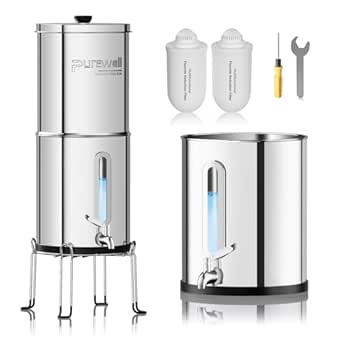 | Best for Filter Detail and Water-Level Monitoring | Filtration stages: 9 | Filtration membrane: 0.01 μm hollow fiber UF | Fluoride reduction: Up to 90% | VIEW ON AMAZON | See Our Full Breakdown |
| Pureday 3-Gallon Stainless Steel Gravity Water Filter |  | Best for PFAS-Focused Household Filtration | Capacity: 3 gallons | Material: 304 stainless steel | Included filters: 2 carbon filters and 2 PFOA/PFOS reduction filters | VIEW ON AMAZON | See Our Full Breakdown |
| Purewell 3-Stage Gravity Water Filter System, 2.25 Gallons |  | Best for Defined Flow Rate and Filter Life | Filtration stages: 3 | Filter pore size: 0.01 microns | Capacity: 2.25 gallons | VIEW ON AMAZON | See Our Full Breakdown |
| Purewell 3-Stage Gravity-Fed Water Filter System, 2.25-Gallon Stainless Steel Countertop, PW-OBT |  | Best for Washable Filters | Filtration stages: 3 | Capacity: 2.25 gallons | Filter type: Washable ceramic | VIEW ON AMAZON | See Our Full Breakdown |
| Purewell 8-Stage Ultra-Filtration Countertop Water Filter System, 2.25 Gallons |  | Best for Fluoride Reduction | Capacity: 2.25 gallons | Filtration: 8-stage | UF membrane pore size: 0.01 μm | VIEW ON AMAZON | See Our Full Breakdown |
| Purewell 2.25-Gallon Gravity Water Filter System with Water Level Window, Stainless Steel, 2 Filters and Stand | 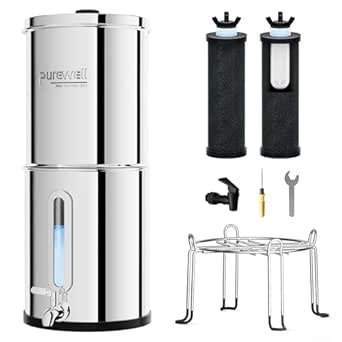 | Best for Easy Water-Level Checks | Capacity: 2.25 gallons | Filtration stages: 3 | Filter pore size: 0.01 microns | VIEW ON AMAZON | See Our Full Breakdown |
| Culligan MaxClear Gravity Water Filter System, 2.25-Gallon Stainless Steel |  | Best for PFAS and Microplastic Reduction | Model: MCS701B | Capacity: 2.25 gallons | Dimensions: 8.6 x 8.6 x 26 inches | VIEW ON AMAZON | See Our Full Breakdown |
| GLACIER FRESH PC04 Gravity-Fed Countertop Water Filtration System |  | Best for Simple, Tool-Free Setup | Capacity: 2.25 gallons | Material: Stainless steel | Installation: Countertop; no plumbing or tools required | VIEW ON AMAZON | See Our Full Breakdown |
| Purewell 8-Stage Gravity-Fed Countertop Water Filter System, 2.25 Gallons |  | Best for Scrubbable Ceramic Filters | Capacity: 2.25 gallons | Filtration: 8-stage gravity-fed filtration | Housing: 304 food-grade stainless steel | VIEW ON AMAZON | See Our Full Breakdown |
| Purewell 3-Stage Gravity Water Filter System, 2.25-Gallon Stainless Steel Countertop Unit |  | Best for Simple, High-Flow Filtration | Capacity: 2.25 gallons | Filtration stages: 3 | Filter pore size: 0.01 microns | VIEW ON AMAZON | See Our Full Breakdown |
| gravity water filter countertop | Capacity | Included filters | Material |
|---|---|---|---|
| Tamraya Living 20L Pure Copper | 20 liters (5.28 gallons) | 2 reusable ceramic filters | Food-grade copper |
| Purewell 9-Stage Gravity Water | — | 2 | Stainless steel |
| Pureday 3-Gallon Stainless Ste | 3 gallons | 2 carbon filters and 2 PFOA/PFOS reduction filters | 304 stainless steel |
| Purewell 3-Stage Gravity Water | 2.25 gallons | — | — |
| Purewell 3-Stage Gravity-Fed W | 2.25 gallons | — | — |
| Purewell 8-Stage Ultra-Filtrat | 2.25 gallons | 2 carbon filters and 2 fluoride filters | — |
| Purewell 2.25-Gallon Gravity W | 2.25 gallons | 2 | Stainless steel |
| Culligan MaxClear Gravity Wate | 2.25 gallons | — | Stainless steel |
| GLACIER FRESH PC04 Gravity-Fed | 2.25 gallons | — | Stainless steel |
| Purewell 8-Stage Gravity-Fed C | 2.25 gallons | 2 ceramic filters and 2 fluoride filters | — |
| Purewell 3-Stage Gravity Water | 2.25 gallons | 2 | — |
More Details on Our Top Picks
Tamraya Living 20L Pure Copper Gravity Water Filter Dispenser with Ceramic Filters
The 20-liter capacity sets this dispenser apart from the smaller Purewell 2.25-gallon systems: it can hold more water between refills, which suits a busy household or shared space. Its food-grade copper body and hammered finish also make it a more decorative countertop choice than the stainless steel alternatives. Filtration is gravity-fed through two reusable ceramic filters, so it needs no power, but the product data does not specify contaminant-reduction performance comparable to the Purewell 9-Stage system’s listed targets. The tradeoff is practical as well as visual: a large vessel takes substantial counter space, and reusable filters still need regular cleaning and care. I’d choose it for capacity and copper construction, not for shoppers seeking detailed filtration claims or a compact setup.
Pros:- 20-liter capacity reduces how often the upper chamber needs refilling
- Food-grade copper hammered finish offers a distinct alternative to stainless steel housings
- Two reusable ceramic filters are included
- Gravity operation requires no electricity
Cons:- Large countertop footprint may be difficult to accommodate
- Ceramic filters require manual cleaning and maintenance
- Provided product details do not specify contaminant-reduction rates
Best for: Households or shared spaces that want a large, non-electric dispenser with a decorative copper finish and reusable ceramic filters.
Not ideal for: Small kitchens or buyers who need specific contaminant-reduction data, a compact footprint, or low-maintenance filter care.
- Capacity:20 liters (5.28 gallons)
- Material:Food-grade copper
- Purification method:Gravity-fed ceramic filtration
- Included filters:2 reusable ceramic filters
- Power source:Non-electric
- Installation type:Countertop
- Dimensions:8 × 5 × 20 inches
- Included components:Hammered copper upper and lower chambers, brass spigot, ceramic filters
Our verdict“Choose this dispenser if capacity and copper styling matter more to you than a compact footprint or detailed filtration claims.”
Purewell 9-Stage Gravity Water Filter System with Water Level Window
The transparent water-level window gives this stainless steel system a useful advantage over the Purewell 3-Stage 2.25-Gallon model, whose listed design does not include a viewing window. Its nine-stage process is also described with specific reduction targets, including up to 90% fluoride reduction, along with chlorine, sediment, rust, organic matter, and heavy metals. That makes the product details more informative for buyers comparing filtration claims, though it does not lower TDS. The two filters are rated for up to 1,000 gallons each, but actual life can vary with water quality, and replacements are limited to Purewell filters. I’d favor this model when visibility and listed reduction targets matter; buyers who want broader filter compatibility or TDS reduction should look elsewhere.
Pros:- Transparent window makes it easier to check the water level
- Nine-stage filtration lists reduction targets for several contaminants
- Two included filters are rated for up to 2,000 gallons combined
- Stainless steel construction suits countertop use
Cons:- Does not lower TDS
- Compatible only with Purewell filter elements
- Adding water when the bottom chamber is full can cause leaks
Best for: Buyers who want a countertop gravity system with a visible water-level window and stated reduction targets for several listed contaminants.
Not ideal for: Shoppers seeking TDS reduction, compatibility with third-party filters, or a system that can be refilled without watching the lower chamber level.
- Filtration stages:9
- Filtration membrane:0.01 μm hollow fiber UF
- Fluoride reduction:Up to 90%
- Included filters:2
- Filter capacity:Up to 1,000 gallons per filter
- Recommended replacement interval:Every 6 months
- Material:Stainless steel
- TDS reduction:Does not lower TDS
- Filter compatibility:Purewell filters only
Our verdict“Pick this over the Purewell 3-Stage model if a viewing window and more specific filtration claims matter more than filter flexibility or TDS reduction.”
Pureday 3-Gallon Stainless Steel Gravity Water Filter
The separate carbon and PFOA/PFOS reduction filters give the Pureday a distinct role beside the Purewell 3-Stage 2.25-Gallon system, which lists a different combination of UF, silver-ion, and carbon filtration. Pureday’s 3-gallon capacity also offers more room between refills, while its stainless steel stand and water-level indicator support everyday countertop dispensing. The product data lists NSF/ANSI 42, 53, and 401 standards, plus a maximum supported TDS of 500 ppm; those details help define its intended use, but do not mean it lowers TDS. The main tradeoff is upkeep: the two filter types have different replacement schedules, with the PFOA/PFOS filters rated for a shorter period than the carbon filters. Its tall 28.15-inch profile also needs clearance.
Pros:- Includes carbon and PFOA/PFOS reduction filters
- Three-gallon tank holds more than the 2.25-gallon Purewell systems
- Water-level indicator and stainless steel stand support countertop dispensing
- Product data lists NSF/ANSI 42, 53, and 401 standards
Cons:- PFOA/PFOS filters have a shorter stated life than the carbon filters
- 28.15-inch height may not fit beneath cabinets
- Maximum supported TDS is specified, but TDS reduction is not claimed
Best for: Households prioritizing listed PFAS reduction, a three-gallon reserve, and a countertop system with a water-level indicator and stand.
Not ideal for: Buyers with low overhead clearance or anyone who prefers one filter type and a single replacement schedule.
- Capacity:3 gallons
- Material:304 stainless steel
- Included filters:2 carbon filters and 2 PFOA/PFOS reduction filters
- Carbon filter life:6 months or 3,000 gallons each
- PFOA/PFOS filter life:3 months or 1,000 gallons each
- Dimensions:9.25 × 9.25 × 28.15 inches
- Weight:9.3 pounds
- Maximum supported TDS:500 ppm
- Certifications:Meets NSF/ANSI 42, 53, and 401 standards
Our verdict“Choose the Pureday if its listed PFAS-focused filtration and larger capacity suit your household and you can manage separate filter schedules.”
Purewell 3-Stage Gravity Water Filter System, 2.25 Gallons
Compared with the washable-ceramic Purewell PW-OBT, this 3-stage model specifies a 4-gallon-per-hour flow rate and a 0.01-micron hollow fiber membrane, giving buyers more concrete operating details. Its stainless steel housing, included stand, and 2.25-gallon capacity make it a practical fit for countertop or outdoor use without electricity. The two filters are rated for up to 3,000 gallons each, with replacement recommended every six months, though real service life depends on water quality. It is designed to reduce chlorine and filter rust, sediment, organic matter, and some heavy metals, but it does not reduce TDS. Careful refilling matters too: adding water when the lower chamber is full can lead to leaks. I’d choose this version for stated flow and membrane specs, not for TDS reduction.
Pros:- 0.01-micron hollow fiber membrane and three-stage filtration
- Stated flow rate of 4 gallons per hour helps set expectations for dispensing
- Includes two filters, a stainless steel spigot, and a non-slip stand
- Non-electric design works indoors or outdoors
Cons:- Does not lower TDS
- Refilling when the lower chamber is full can cause leakage
- Filter life varies with water quality
Best for: Buyers who want a non-electric stainless steel gravity filter with a stated flow rate, included stand, and defined filter-life guidance.
Not ideal for: People who need TDS reduction, a larger reserve than 2.25 gallons, or a system that tolerates careless refilling.
- Filtration stages:3
- Filter pore size:0.01 microns
- Capacity:2.25 gallons
- Flow rate:4 gallons per hour
- Filter life:Up to 3,000 gallons per filter; replace every 6 months
- Dimensions:8.9 × 8.9 × 20 inches
- Weight:8.5 pounds
- Materials:Polypropylene and 304 stainless steel
- Certifications:NSF/ANSI 42 and NSF/ANSI 372
Our verdict“Choose this model over the washable-ceramic PW-OBT if you prefer a stated flow rate and membrane specification to scrub-cleanable filters.”
Purewell 3-Stage Gravity-Fed Water Filter System, 2.25-Gallon Stainless Steel Countertop, PW-OBT
The PW-OBT’s main difference from the Purewell 3-Stage model with a hollow fiber membrane is its washable ceramic filter design: the filters can be scrubbed, which may suit buyers who prefer cleaning reusable elements over relying on a stated replacement interval. Its 304 food-grade stainless steel housing, spigot, stand, and included cleaning sponge make it a ready-to-set-up countertop option, and gravity operation avoids electricity. The listed filtration layers reduce chlorine and block larger particulates, but the system does not lower TDS, and the product information says filter life varies with water quality. The headline lifespan is up to 5,000 gallons per filter, but that should not be treated as a guarantee for every water source. Like the other Purewell 2.25-gallon unit, it can leak if refilled while the lower chamber is full.
Pros:- Washable ceramic filters can be scrubbed to extend their service life
- Three filtration layers include ceramic, activated carbon, and silver ion
- Includes stainless steel spigot, non-slip stand, and cleaning sponge
- Gravity-fed operation requires no electricity
Cons:- Does not reduce TDS
- Filter lifespan varies with water quality
- Adding water when the lower chamber is full can cause leaks
Best for: Buyers who want a stainless steel countertop gravity filter with washable ceramic elements and are willing to clean and maintain them.
Not ideal for: Shoppers seeking TDS reduction, quantified contaminant claims beyond those listed, or a filter system that needs little hands-on care.
- Filtration stages:3
- Capacity:2.25 gallons
- Filter type:Washable ceramic
- Filter lifespan:Up to 5,000 gallons per filter; up to 10,000 gallons total
- Housing material:304 food-grade stainless steel
- Power:Gravity-fed; no electricity required
- TDS reduction:Does not lower TDS
- Certification:NSF/ANSI 372 for lead-free materials
Our verdict“Pick the PW-OBT over the Purewell hollow-fiber model if washable ceramic filters matter more to you than a specified membrane pore size and flow rate.”
Purewell 8-Stage Ultra-Filtration Countertop Water Filter System, 2.25 Gallons
I’d choose this Purewell when fluoride reduction is a priority within a non-electric countertop setup. Its included carbon and fluoride elements are designed to address fluoride alongside chlorine, sediment, rust, and heavy metals; the stated fluoride reduction is up to 90%. That gives it a more specific filtration focus than the Culligan MaxClear, which lists microplastics, lead, and total PFAS as its targets instead. The 2.25-gallon stainless steel housing, metal spigot, and stand make it a self-contained dispenser, but the system does not lower TDS, so it is not a choice for reducing dissolved mineral content. Filter capacity also differs by element: fluoride filters are rated for up to 1,000 gallons, while carbon filters are rated for up to 6,000. I’d leave room for careful filling, since topping up the upper chamber while the lower one is full can cause leaks.
Pros:- Designed to reduce fluoride, chlorine, sediment, rust, and heavy metals
- Gravity-fed operation needs no electricity
- 304 food-grade stainless steel housing includes a metal spigot and stand
- Carbon filters are rated for up to 6,000 gallons
Cons:- Does not lower TDS
- Fluoride filters are rated for up to 1,000 gallons, shorter than the carbon filter capacity
- Filling the upper chamber when the lower chamber is full can cause leaks
Best for: Households seeking a gravity-fed stainless steel filter with a stated fluoride-reduction claim and no need for electricity.
Not ideal for: Buyers who want lower TDS or a forgiving fill-and-forget dispenser, since it does not reduce TDS and can leak if the upper chamber is filled while the lower one is full.
- Capacity:2.25 gallons
- Filtration:8-stage
- UF membrane pore size:0.01 μm
- Housing:304 food-grade stainless steel
- Included filters:2 carbon filters and 2 fluoride filters
- Fluoride reduction:Up to 90%
- Filter capacity:Carbon: up to 6,000 gallons; fluoride: up to 1,000 gallons
- Power:Gravity-fed; no electricity required
- TDS reduction:Does not lower TDS
Our verdict“Choose this Purewell if fluoride reduction is a priority, but skip it if TDS reduction or spill-tolerant filling matters more.”
Purewell 2.25-Gallon Gravity Water Filter System with Water Level Window, Stainless Steel, 2 Filters and Stand
The clearest advantage here is practical rather than a more elaborate filtration claim: a transparent water-level window lets me see how much filtered water remains without opening the stainless steel unit. That can make this Purewell easier to manage day to day than the 8-stage Purewell B09C5HZS87, which instead adds dedicated fluoride filters and a stated fluoride-reduction claim. This model uses a 0.01-micron, three-stage filter with hollow fiber, silver ion, and activated carbon components, and its stated flow rate is up to 4 gallons per hour. Two filters are rated for up to 3,000 gallons each, though the listed six-month replacement guidance and water quality still matter. Like the fluoride-focused Purewell, it does not reduce TDS, and the upper chamber should not be filled when the lower chamber is full.
Pros:- Transparent window makes the water level easy to check
- Three-stage filtration uses a 0.01-micron hollow fiber membrane
- Stated flow rate is up to 4 gallons per hour
- Two included filters are rated for up to 3,000 gallons each
Cons:- Does not lower TDS
- Upper-chamber filling while the lower chamber is full can cause leakage
- Filter lifespan varies with water quality
Best for: Households that want a 2.25-gallon gravity filter and an at-a-glance way to check remaining water before refilling.
Not ideal for: Buyers specifically seeking fluoride reduction or lower TDS, since this model does not list fluoride reduction and does not lower TDS.
- Capacity:2.25 gallons
- Filtration stages:3
- Filter pore size:0.01 microns
- Flow rate:Up to 4 gallons per hour
- Included filters:2
- Filter life:Up to 3,000 gallons per filter
- Material:Stainless steel
- Power:No electricity required
- TDS reduction:No
Our verdict“Pick this Purewell for convenient water-level monitoring and a stated fast flow rate, not for fluoride or TDS reduction.”
Culligan MaxClear Gravity Water Filter System, 2.25-Gallon Stainless Steel
I’d put the Culligan MaxClear on the shortlist for buyers whose main concern is its stated focus on microplastics, lead, and total PFAS. It uses a ceramic and granular activated carbon filter in a 2.25-gallon stainless steel dispenser, with no power or plumbing needed. That makes it a different proposition from the Purewell 8-stage B09C5HZS87, which includes fluoride filters and specifies up to 90% fluoride reduction. The tradeoff is a simpler replacement schedule: this unit includes one filter rated for up to six months, rather than multiple filter elements with separately stated gallon capacities. It is also gravity-fed, so dispensing depends on the water passing through the filter rather than on-demand pumping. At 26 inches tall, its listed dimensions call for checking counter clearance before buying; the nesting feature helps with portability, but does not make the assembled unit short.
Pros:- Designed to reduce microplastics, lead, and total PFAS
- 2.25-gallon stainless steel dispenser needs no electricity or plumbing
- Ceramic and granular activated carbon filtration
- Nesting feature supports portability
Cons:- Included filter is rated for up to six months
- Gravity-fed dispensing is not on-demand
- Listed height of 26 inches may not suit counters with limited clearance
Best for: Buyers prioritizing a stainless steel gravity dispenser with stated reduction targets for microplastics, lead, and total PFAS.
Not ideal for: People with low overhead counter space or those wanting fluoride reduction specifically, since the unit is listed at 26 inches tall and its provided targets do not include fluoride.
- Model:MCS701B
- Capacity:2.25 gallons
- Dimensions:8.6 x 8.6 x 26 inches
- Weight:4.55 kg
- Material:Stainless steel
- Purification method:Ceramic and granular activated carbon
- Included filter:1 ceramic and carbon filter
- Filter life:Up to 6 months
- Power source:Gravity-fed
Our verdict“Choose the Culligan MaxClear for its stated PFAS, lead, and microplastic targets, provided its height and gravity-fed pace suit your kitchen.”
GLACIER FRESH PC04 Gravity-Fed Countertop Water Filtration System
The GLACIER FRESH PC04 is the straightforward choice for someone who wants a countertop gravity dispenser without plumbing or tools. Its 2.25-gallon stainless steel body gives it the same listed capacity as the Culligan MaxClear, but its Elarisey electrosorption filter has a notably shorter stated service life: up to 200 gallons, with replacement recommended every three months. That makes this a less maintenance-light option than either Purewell model, whose listed filter capacities reach thousands of gallons. The supplied description says the cartridge is intended to reduce heavy metals and other impurities, but it does not give the same specific contaminant list as Culligan’s microplastics, lead, and total PFAS targets. I’d also account for the initial flush of two gallons before use. With those limits in mind, its appeal is an uncomplicated, non-electric setup rather than long filter life or a detailed list of reduction claims.
Pros:- Installs on a countertop without plumbing or tools
- Gravity-fed operation works without electricity
- 2.25-gallon stainless steel dispenser
- Described as reducing heavy metals and other impurities
Cons:- Cartridge is rated for up to 200 gallons and replacement is recommended every three months
- Filter performance may vary with water quality
- Requires a two-gallon flush before first use
Best for: Households of up to four people seeking a tool-free, non-electric countertop dispenser and willing to replace cartridges every three months.
Not ideal for: Buyers who want long cartridge life or specific, detailed contaminant targets, since the cartridge is rated for up to 200 gallons and the description gives broader claims.
- Capacity:2.25 gallons
- Material:Stainless steel
- Installation:Countertop; no plumbing or tools required
- Power source:Gravity-fed
- Purification method:Elarisey electrosorption
- Filter life:Up to 200 gallons; replace every 3 months
- Dimensions:14.25 x 13.58 x 16.14 inches
- Included components:Filter
- Initial use:Flush with 2 gallons before first use
Our verdict“Pick the PC04 for simple tool-free setup, but choose one of the Purewell models if longer stated filter capacity is a priority.”
Purewell 8-Stage Gravity-Fed Countertop Water Filter System, 2.25 Gallons
This Purewell’s differentiator is its combination of ceramic filters that can be scrubbed clean and separate fluoride filters. The ceramic elements are rated for up to 10,000 gallons, while the fluoride filters are rated for up to 1,000, so the longer figure does not apply to every filter in the system. Compared with the other 8-stage Purewell in this roundup, B09C5HZS87, this model specifies ceramic rather than carbon filters and lists NSF/ANSI 372 alongside NSF/ANSI 42. Both versions are designed for fluoride reduction and both leave TDS unchanged. The stainless steel unit includes a metal water-level spigot and non-slip stand, which add useful everyday details without changing its gravity-fed pace. Ceramic upkeep is hands-on: cleaning must be done without soap or other cleaning products, and actual filter life can vary with water quality.
Pros:- Ceramic filters can be scrubbed clean to extend service life
- Includes two ceramic filters and two fluoride filters
- Designed to reduce fluoride, chlorine, sediment, and heavy metals
- Metal water-level spigot and non-slip stand are included
Cons:- Does not lower TDS
- Ceramic filters must be cleaned without soap or other cleaning products
- Filter lifespan varies with water quality
Best for: Buyers who want a gravity-fed stainless steel system with fluoride filters and are comfortable maintaining scrubbable ceramic elements.
Not ideal for: People seeking TDS reduction or a low-maintenance filter routine, since the system does not lower TDS and ceramic elements need careful cleaning.
- Capacity:2.25 gallons
- Filtration:8-stage gravity-fed filtration
- Housing:304 food-grade stainless steel
- Included filters:2 ceramic filters and 2 fluoride filters
- Fluoride reduction:Up to 90%
- Filter lifespan:Ceramic: up to 10,000 gallons; fluoride: up to 1,000 gallons
- Certifications:NSF/ANSI 42 and NSF/ANSI 372
- Additional features:Metal water-level spigot, non-slip stand, BPA-free filter housing
- TDS reduction:Does not lower TDS
Our verdict“Choose this Purewell if you value maintainable ceramic filters and fluoride reduction, but not if you want TDS reduction or minimal upkeep.”
Purewell 3-Stage Gravity Water Filter System, 2.25-Gallon Stainless Steel Countertop Unit
This Purewell is a practical choice for buyers who want a stainless steel gravity countertop filter with a faster stated flow rate than many compact systems. Its three-stage setup combines a 0.01-micron hollow fiber membrane, silver ion membrane, and activated carbon block to target sediment, rust, chlorine, organic matter, and some heavy metals. The stated rate of up to four gallons per hour can make refills less of a wait, though actual flow may vary with water quality and filter condition.
Compared with the larger Tamraya Living 20L dispenser, this 2.25-gallon unit takes a smaller-capacity approach that suits a countertop and routine household use. It includes two filters, a metal spigot, and a non-slip stand, and needs no power. The tradeoffs are its modest capacity, the risk of leaking if the lower chamber is overfilled, and no TDS reduction; it is not a choice for lowering dissolved solids.
Pros:- Three-stage filtration includes a 0.01-micron hollow fiber membrane.
- Stated flow rate of up to four gallons per hour can reduce refill wait time.
- Stainless steel housing, metal spigot, and non-slip stand suit countertop or outdoor setups.
- Two filters are included, and the unit operates without electricity.
Cons:- Does not lower TDS, so it will not address dissolved-solids content.
- Filter life depends on incoming water quality, despite the stated 3,000-gallon rating per filter.
- Adding water while the lower chamber is full can cause leaking.
Best for: Households seeking a compact, electricity-free countertop filter with a stated fast flow rate and stainless steel construction.
Not ideal for: Buyers who need a large dispenser for frequent group use or want lower TDS; the 2.25-gallon capacity is limited and the system does not reduce dissolved solids.
- Capacity:2.25 gallons
- Filtration stages:3
- Filter pore size:0.01 microns
- Flow rate:Up to 4 gallons per hour
- Housing material:304 food-grade stainless steel
- Included filters:2
- Filter lifespan:Up to 3,000 gallons per filter; replacement recommended every 6 months
- Certifications:NSF/ANSI 42 and NSF/ANSI 372
- Power and TDS:Gravity-fed; no electricity required; does not lower TDS
Our verdict“Choose this Purewell for a compact stainless steel gravity filter with a fast stated flow rate, but skip it if you need high capacity or TDS reduction.”

How We Picked
I ranked these systems for the specific job of storing and dispensing filtered water on a countertop. I weighed stated capacity, filter configuration, construction, water-level visibility, included accessories, and the likely effort involved in refilling and maintaining each unit. I also treated model identification and clearly described features as useful buying information, since several products have similar names and capacities.
The order reflects how well each product appears to balance everyday convenience with a clear, usable setup—not a claim that one filter removes every contaminant. A larger tank earns credit for fewer refills but loses some appeal if counter space is tight; extra filtration stages matter only when supported by relevant performance information. Before buying, I recommend matching the manufacturer’s contaminant-reduction documentation and replacement-filter guidance to your water source. Product claims and included parts can vary by listing, so confirm the exact model configuration.
Factors to Consider When Choosing Gravity Water Filter Countertop
Choosing among countertop gravity filters is less about picking the biggest stage count and more about matching the system to your water, routine, and available space. These broader checks can help avoid a poor fit even when two products look similar on paper.
Match Filter Claims to Your Water
Start with what you want to reduce, not the number of stages printed in a product name. A municipal water report or a suitable water test can help identify concerns such as chlorine, lead, or other specific contaminants. Then look for documentation naming those contaminants and the conditions under which reduction was measured. A claim about one substance does not mean the filter addresses all water-quality issues. If your concern involves bacteria, viruses, or water from an untreated source, verify that the system is specifically rated for that use rather than assuming gravity filtration makes it safe.
Choose Capacity Around Your Household’s Routine
Tank capacity affects how often you refill, but advertised volume is not the same as a full supply of ready-to-drink water: the upper chamber feeds the lower reservoir over time. A larger dispenser can suit a busy household or frequent cooking, while a smaller unit may be easier to place and manage for one or two people. Think about peak use, such as filling bottles before work, rather than average daily consumption alone. Also check the unit’s height and footprint, including room to lift the upper chamber during cleaning. Buying more capacity than you can comfortably fit can make routine care awkward.
Compare Filter Replacement and Ongoing Care
Before choosing a system, find out which replacement elements fit it, how often the manufacturer recommends changing them, and whether the guidance depends on water quality or volume. A low-maintenance claim is less useful if replacement parts are difficult to identify or if the product page leaves service intervals unclear. Gravity systems also need regular cleaning of the chambers, spigot, and seals to prevent residue or slow flow from becoming a recurring nuisance. Avoid letting a nearly exhausted filter dictate your schedule; keep track of installation dates and follow the maker’s instructions. Ease of care can matter more over time than a long stage list.
Measure the Counter and Plan for Dispensing
Measure the surface where the filter will sit, but also check overhead clearance for removing the lid and filling the upper chamber. A stand can improve spigot access over a tall glass or pitcher, though it adds height and another part to clean. Window-equipped models make it easier to see remaining water without lifting the lid, but they do not replace checking that the unit is assembled correctly. Consider where a full system will be filled and whether you can lift its upper chamber safely. A countertop filter that fits only in a rarely used corner may be less convenient than a smaller one kept within easy reach.
Treat Stage Count as a Starting Point, Not a Verdict
Stage labels describe a filter arrangement, not a universal measure of effectiveness. A 9-stage system is not automatically a better match than a 3-stage model if its documentation does not address your water concern or explain filter life. Compare the exact filtration media, claimed reductions, flow guidance, and replacement schedule where the manufacturer provides them. Be cautious about comparing products by headline terminology alone, especially when similarly named models may use different cartridges. Spend more for a feature that solves a real need—such as a useful window or added capacity—rather than for a larger number without supporting details.
Frequently Asked Questions
Is the Purewell 9-Stage model a better choice than the Purewell 3-Stage models?
Not automatically. The 9-stage model may appeal if its specific filtration claims and water-level window fit your priorities, while a 3-stage option may offer a more straightforward configuration. Stage count alone does not show which contaminants a system reduces or how long its filters last. Compare the documentation for the exact model and cartridge, then choose based on your water source and maintenance preferences. If the claims you need are not clearly supported, do not rely on the stage label as a substitute.
Should I choose a 3-gallon filter or a 2.25-gallon model?
Choose the larger capacity if several people draw water throughout the day and you have enough room for the dispenser. It can reduce how often you refill, though the full system may be harder to lift, clean, and fit beneath cabinets. A 2.25-gallon model is a more compact starting point for smaller households or limited counters, but may need topping up more often. Remember that the upper chamber’s volume does not equal immediately available water in the lower reservoir. Match capacity to both your household’s busiest use and your ability to handle the unit.
Can I use a countertop gravity filter for well water or untreated water?
Do not assume that a countertop gravity system is suitable for every well or untreated source. Water can contain contaminants that require treatment methods beyond the claims of a standard household filter, and the risk varies by location and source. Get a water test and compare the results with the manufacturer’s documented reduction claims for the exact system. If microbial safety is a concern, use a treatment method specifically rated for that purpose and follow local health guidance. A gravity-fed design describes how water moves through the unit, not what hazards it can remove.
Does stainless steel make a filter system a better buy than the copper Tamraya dispenser?
Material preference alone does not establish filtration performance. Stainless steel is common among the 2.25-gallon options here, while the Tamraya is a larger copper dispenser with ceramic filters, making its capacity and construction a different proposition. Compare chamber dimensions, cleaning instructions, replacement-filter availability, and the claims for the included elements. Also check whether the materials that contact water and the spigot are described clearly. Choose the finish and format you can maintain comfortably, while judging water treatment by the filter’s documentation.
What should I verify before ordering one of the similarly named Purewell systems?
Check the full model name and included parts rather than relying on the brand and capacity alone. This lineup includes 3-stage and 8-stage systems, a 9-stage model, and versions that list features such as a water-level window or stand. Confirm the number and type of filters included, the replacement cartridge that fits, the unit’s dimensions, and whether a stand is part of the package. Read the exact listing’s maintenance directions and filter-life guidance as well. Those details can change the day-to-day experience even when two systems share a similar countertop format.
Conclusion
For most buyers seeking a feature-balanced countertop setup, I would start with the Purewell 9-Stage Gravity Water Filter System, while checking its documented claims against the water issue at hand. The Purewell 3-Stage 2.25-gallon models are my value-oriented choices for shoppers who prefer a simpler configuration, and the Pureday 3-Gallon Stainless Steel is the better fit when extra stored capacity matters more than a compact footprint. Beginners should favor a clearly specified model with straightforward assembly, visible replacement-filter details, and a size they can manage; a water-level window can make routine monitoring easier. For a distinctive large-format dispenser, consider the Tamraya copper model, while buyers who need a particular contaminant addressed should select only a system with matching documentation, including among the Culligan, GLACIER FRESH, and Purewell alternatives. My final choice would depend on the water test, available counter space, and how often the household is willing to refill and clean the unit.