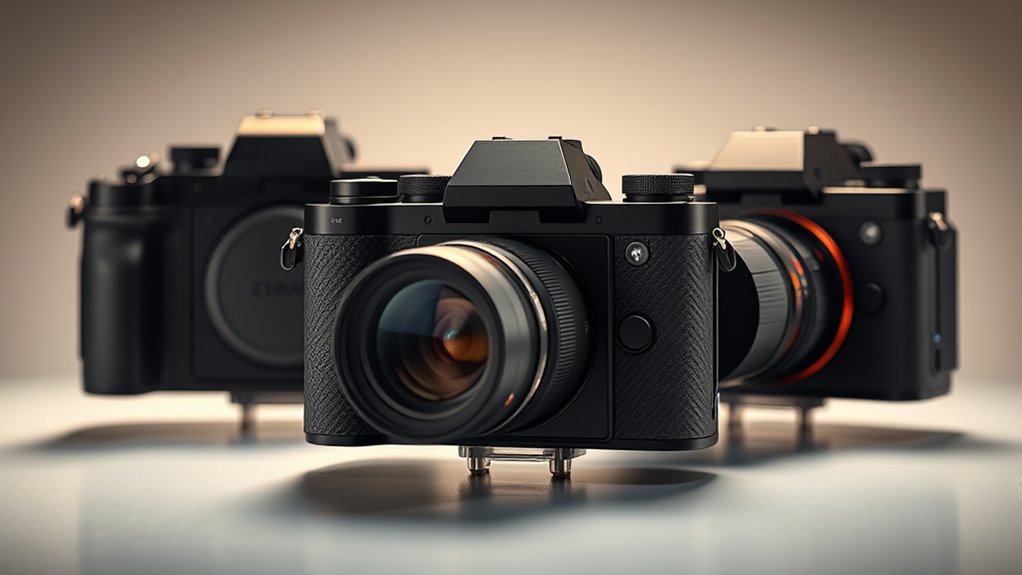

Choosing among the best medium format cameras comes down to how you want to use the large sensor: as a studio-quality interchangeable-lens system, a compact fixed-lens camera, or a hybrid stills-and-video tool. I rank the Hasselblad X2D II 100C first for its advanced autofocus and stabilization, the Fujifilm GFX100 II for buyers who need serious video as well as high-resolution stills, and the Hasselblad X2D 100C for photographers who value a built-in 1TB SSD and a simpler high-resolution workflow.

Get kitchen gear delivered free with Prime
- Fast, free delivery on millions of items
- Prime Video, Amazon Music and more included
- Member-only deals all year
The main tradeoff is flexibility versus portability. The two Fujifilm GFX100RF listings offer a distinctive, carry-friendly 28mm-equivalent fixed-lens setup, but cannot change focal length. The Hasselblad and GFX100 II bodies accept interchangeable lenses, though their weight and system needs make them less casual companions. I treat the duplicated GFX100RF listings as separate entries because their supplied specifications differ, and flag those differences rather than assuming they describe identical configurations.
Complete the kit


Key Takeaways
- Best all-around interchangeable-lens pick: I rank the Hasselblad X2D II 100C first for its 425 PDAF zones, LiDAR-assisted subject detection, and up to 10-stop stabilization.
- Best for hybrid production: The Fujifilm GFX100 II combines a 102MP sensor with 4K/60p, 10-bit ProRes support, and up to 8 fps shooting.
- Best for a self-contained workflow: The Hasselblad X2D 100C pairs 100MP capture and 7-stop stabilization with a built-in 1TB SSD.
- Best compact fixed-lens approach: Both Fujifilm GFX100RF entries weigh about 735g and offer a 28mm-equivalent view, but neither can change lenses.
- Check the GFX100RF listing details: One entry specifies an f/4 lens and a 3.15-inch screen; the other lists an f/2.8 lens and a 3-inch screen, so verify the exact configuration before buying.
| Hasselblad X2D II 100C Medium Format Mirrorless Camera |  | Best Overall | Sensor: 100MP medium-format CMOS | Color and dynamic range: 16-bit; up to 15.3 stops | Autofocus: AF-S and AF-C; 425 PDAF zones with LiDAR | VIEW ON AMAZON | See Our Full Breakdown |
| Fujifilm GFX100 II Medium Format Mirrorless Camera Body |  | Best for Hybrid Video and Still Photography | Sensor: 102MP medium-format CMOS | Continuous shooting: Up to 8 fps | Video: Full-width 4K/60p | VIEW ON AMAZON | See Our Full Breakdown |
| Hasselblad X2D 100C 100MP Medium Format Mirrorless Camera |  | Best for a Self-Contained Stills Workflow | Sensor: 100MP medium-format BSI CMOS | Native ISO: 64 | Color and dynamic range: 16-bit; up to 15 stops | VIEW ON AMAZON | See Our Full Breakdown |
| Fujifilm GFX100RF Medium Format Mirrorless Camera, Black |  | Best Compact Fixed-Lens Pick | Sensor: 102MP BSI CMOS, medium format | Lens: Fixed 35mm f/2.8; 28mm-equivalent field of view | Stabilization: Sensor-shift | VIEW ON AMAZON | See Our Full Breakdown |
| Fujifilm GFX100RF Medium Format Camera, Black | | Best for a Ready-to-Carry 28mm View | Sensor: 102MP medium-format CMOS | Lens: Fixed 35mm f/4; 28mm-equivalent field of view | Aspect ratios and looks: Nine aspect ratios; 20 Film Simulations | VIEW ON AMAZON | See Our Full Breakdown |
| medium format camera | Sensor | Stabilization | Video |
|---|---|---|---|
| Hasselblad X2D II 100C Medium | 100MP medium-format CMOS | 5-axis, up to 10 stops | — |
| Fujifilm GFX100 II Medium Form | 102MP medium-format CMOS | In-body, up to 8 stops | Full-width 4K/60p |
| Hasselblad X2D 100C 100MP Medi | 100MP medium-format BSI CMOS | 5-axis, 7-stop IBIS | — |
| Fujifilm GFX100RF Medium Forma | 102MP BSI CMOS, medium format | Sensor-shift | 4320p |
| Fujifilm GFX100RF Medium Forma | 102MP medium-format CMOS | Sensor-shift | 4320p |
More Details on Our Top Picks
Hasselblad X2D II 100C Medium Format Mirrorless Camera
I put the Hasselblad X2D II 100C first because it pairs high-resolution medium-format capture with the strongest stated autofocus and stabilization package in this group. Its 100MP sensor, 16-bit color, and 15.3 stops of dynamic range suit detailed still photography, while 425 PDAF zones, LiDAR, and subject detection make it the most feature-rich Hasselblad here for following a moving subject. The up-to-10-stop stabilization rating also gives handheld shooting a useful advantage over the original X2D 100C’s stated 7 stops.
That does not make it the best fit for everyone. At 5 pounds, it is the heaviest option listed, and the camera is not water resistant. The original X2D 100C is a more appealing alternative for someone who values its specified built-in 1TB SSD and wants a lighter Hasselblad body, although it gives up the newer model’s subject-detection details and extra stabilization. The Fujifilm GFX100 II makes more sense when motion-oriented video is a priority; this Hasselblad listing emphasizes still-image features and does not provide comparable video specifications.
I would choose the X2D II for deliberate, high-detail work where autofocus assistance and stabilization matter more than carrying weight. Its XCD lens mount supports an interchangeable-lens approach, unlike either fixed-lens GFX100RF. The trade is a substantial camera system with no stated weather protection, so it is less convincing as an all-weather travel camera.
Pros:- 100MP medium-format sensor with 16-bit color and up to 15.3 stops of dynamic range
- 425 PDAF zones, LiDAR, and subject detection
- Up to 10-stop, 5-axis image stabilization
- Interchangeable Hasselblad XCD lens mount
Cons:- Listed weight of 5 pounds makes it the heaviest camera in this roundup
- Not water resistant
- The supplied specifications do not detail video recording capabilities
Best for: Photographers seeking a premium 100MP interchangeable-lens system with strong stabilization and subject-aware autofocus.
Not ideal for: Travelers prioritizing low weight, buyers who need stated water resistance, or video-first creators who want detailed recording specifications.
- Sensor:100MP medium-format CMOS
- Color and dynamic range:16-bit; up to 15.3 stops
- Autofocus:AF-S and AF-C; 425 PDAF zones with LiDAR
- Stabilization:5-axis, up to 10 stops
- Mount:Hasselblad XCD
- ISO range:100–102400
- Screen:3.6-inch
- Weight and protection:5 pounds; not water resistant
Our verdict“I rank the X2D II 100C first for still photographers who want the most advanced stated autofocus and stabilization in a high-resolution medium-format body and can accept its weight.”
Fujifilm GFX100 II Medium Format Mirrorless Camera Body
The Fujifilm GFX100 II is my pick for creators who need medium-format resolution without limiting the camera to stills. Its 102MP sensor is paired with full-width 4K/60p video and 10-bit Apple ProRes recording, plus HDMI output supporting ProRes RAW or Blackmagic RAW. That gives it a much clearer production role than the X2D II 100C, whose supplied details focus on still photography.
It also offers up to 8 fps continuous shooting, subject-tracking autofocus, in-body stabilization rated up to 8 stops, and a high-resolution EVF with a stated live-view rate up to 120 fps. Those features make it the more action-capable hybrid on paper, though 8 fps is not the reason to buy medium format if fast burst work is your main need. Unlike the GFX100RF, the GFX100 II is a body-only listing: I would budget for a compatible Fujifilm X-mount lens and choose focal lengths to match the job.
The cost of its broader role is a more involved system than the compact GFX100RF’s built-in 28mm-equivalent lens. It may be the smarter production tool, but not the easiest one to carry casually. The X2D 100C offers built-in 1TB storage, whereas this Fujifilm listing emphasizes recording formats and cloud delivery to Frame.io. I would choose between them based on workflow: video and lens flexibility point here; a self-contained high-resolution stills setup points toward the original Hasselblad.
Pros:- 102MP medium-format CMOS sensor
- Full-width 4K/60p and 10-bit ProRes recording
- Up to 8 fps shooting with subject tracking
- Up to 8-stop in-body stabilization and Frame.io cloud integration
Cons:- This listing is for the camera body only; a lens is not included
- Interchangeable-lens flexibility adds system size and setup needs
- Some timecode synchronization workflows may have at least a one-frame delay
Best for: Hybrid creators who need high-resolution stills, professional video recording options, tracking autofocus, and interchangeable lenses.
Not ideal for: Buyers seeking a complete ready-to-shoot package, a compact fixed-lens camera, or a model whose listed details prioritize stills over video.
- Sensor:102MP medium-format CMOS
- Continuous shooting:Up to 8 fps
- Video:Full-width 4K/60p
- Recording:10-bit Apple ProRes; HDMI output supports ProRes RAW or Blackmagic RAW
- Stabilization:In-body, up to 8 stops
- Viewfinder:9.44-million-dot EVF; up to 120 fps live view
- Mount:Fujifilm X
- Aspect ratio:16:9
Our verdict“I recommend the GFX100 II over the Hasselblad X2D models when video formats and a hybrid production workflow are central to the purchase.”
Hasselblad X2D 100C 100MP Medium Format Mirrorless Camera
The original Hasselblad X2D 100C remains a compelling high-resolution stills camera because it combines a 100MP BSI CMOS sensor, 16-bit color, and up to 15 stops of dynamic range with a particularly useful storage feature: a built-in 1TB SSD. I rank it below the X2D II because the newer model lists subject detection, 425 PDAF zones, LiDAR, and up to 10-stop stabilization. This version specifies phase-detection autofocus across 294 zones and 7-stop stabilization, which is capable on paper but less advanced by the details supplied.
The internal SSD can simplify a workflow for photographers who want substantial storage built into the camera, rather than relying only on removable media. It also accepts Hasselblad XCD lenses and can support H and V system lenses with optional adapters, giving it more focal-length flexibility than the fixed-lens GFX100RF. Its 4.1-pound listed weight still makes it a substantial carry, and the specs list no built-in flash. Buyers should plan their lighting setup rather than expect an always-ready flash solution.
Compared with the Fujifilm GFX100 II, this Hasselblad is presented more clearly as a stills-first choice: its supplied details emphasize color, dynamic range, storage, and stabilization, while the Fujifilm spells out video formats and recording options. I would favor the X2D 100C for high-detail photography and a tidy in-camera storage setup. For action tracking, the X2D II has the stronger stated autofocus system; for hybrid video, the GFX100 II is the clearer fit.
Pros:- 100MP BSI CMOS sensor with 16-bit color
- Up to 15 stops of stated dynamic range
- Built-in 1TB SSD
- 7-stop, 5-axis in-body stabilization
Cons:- Listed weight of 4.1 pounds may be cumbersome for extended handheld use
- No built-in flash
- Autofocus and stabilization specifications are less advanced than those listed for the X2D II
Best for: Stills photographers who want 100MP capture, broad dynamic range, an interchangeable-lens system, and built-in storage.
Not ideal for: Video-first creators, lightweight travel shooters, or buyers who need a built-in flash or the newer X2D II autofocus features.
- Sensor:100MP medium-format BSI CMOS
- Native ISO:64
- Color and dynamic range:16-bit; up to 15 stops
- Autofocus:Phase detection with 294 zones
- Stabilization:5-axis, 7-stop IBIS
- Storage:Built-in 1TB SSD
- Lens compatibility:XCD; H and V system lenses with optional adapters
- Weight:4.1 pounds
Our verdict“I would choose the X2D 100C over the X2D II when built-in 1TB storage and a stills-centered workflow matter more than newer subject detection and stronger stated stabilization.”
Fujifilm GFX100RF Medium Format Mirrorless Camera, Black
This GFX100RF listing describes the more aperture-forward version of Fujifilm’s compact medium-format concept: a 102MP BSI CMOS sensor behind a fixed 35mm f/2.8 lens, giving a 28mm-equivalent view. At a stated 735g, it is far easier to carry than the 4.1-pound X2D 100C or 5-pound X2D II. For street, travel, and everyday documentary work, that portability may matter more than changing lenses, especially if a wide-normal perspective is already the buyer’s preferred view.
Its 20 Film Simulations and nine aspect ratios encourage an in-camera style-led workflow, while the internal ND filter, leaf shutter, sensor-shift stabilization, and digital teleconverter options add practical ways to adjust shooting without a lens change. Compared with the interchangeable-lens GFX100 II, the GFX100RF is simpler to carry and frame with, but it cannot take a different lens when a scene calls for a tighter portrait or a longer reach. Digital teleconverter options do not provide the same flexibility as changing focal length optically.
I would check this listing carefully before purchase: it specifies an f/2.8 lens, a 3-inch screen, an electronic viewfinder, Wi-Fi, and no water resistance. The other GFX100RF entry lists an f/4 lens and a 3.15-inch tilting touchscreen, so the supplied product information is not consistent across the two entries. This makes the camera’s compact fixed-lens role easy to understand, but the exact configuration should be confirmed. Its listed 90-minute battery life is another reason to plan for longer outings.
Pros:- 102MP BSI CMOS medium-format sensor
- 735g listed weight and a 28mm-equivalent field of view
- 20 Film Simulations and nine selectable aspect ratios
- Internal ND filter, leaf shutter, and sensor-shift stabilization
Cons:- Fixed lens limits optical focal-length choices
- Not water resistant
- Listed battery life is approximately 90 minutes
Best for: Travel and street photographers who want a compact, high-resolution medium-format camera with a fixed wide-angle view.
Not ideal for: Photographers who need multiple focal lengths, water resistance, long battery endurance, or a clearly consistent listing specification.
- Sensor:102MP BSI CMOS, medium format
- Lens:Fixed 35mm f/2.8; 28mm-equivalent field of view
- Stabilization:Sensor-shift
- Creative options:20 Film Simulations; nine aspect ratios
- Shutter and filter:Leaf shutter; internal 4-stop ND filter
- Viewfinder and screen:Electronic viewfinder; 3-inch screen
- Video:4320p
- Weight and battery:735g; approximately 90 minutes
Our verdict“I favor this GFX100RF entry over the larger interchangeable-lens bodies when portability and a fixed 28mm-equivalent view take precedence over lens choice.”
Fujifilm GFX100RF Medium Format Camera, Black
The second Fujifilm GFX100RF listing shares the core appeal of the other entry: a 102MP medium-format sensor, a fixed lens with a 28mm-equivalent view, and a 735g body. I place it fifth because its supplied description lists an f/4 maximum aperture, compared with f/2.8 for the other GFX100RF entry, and provides less detail about the viewfinder and connectivity. That difference could matter in lower light or when comparing the exact camera configuration, so I would verify the listing rather than assume the two records are identical.
For buyers who are certain they want one wide-angle field of view, the GFX100RF avoids the lens selection and system bulk associated with the GFX100 II and Hasselblad X2D bodies. The nine aspect ratios, 20 Film Simulations, internal 4-stop ND filter, leaf shutter, and digital teleconverter choices offer room to vary the output without swapping glass. The 3.15-inch three-way tilting touchscreen is a practical compositional tool, and the stated 4320p video specification adds a capability not detailed for the Hasselblad X2D entries.
The same fixed-lens compromise remains decisive: an in-camera crop or digital teleconverter cannot replace the framing choices of an interchangeable-lens system. There is no built-in flash, and the stated battery life is about 90 minutes. Compared with the f/2.8 GFX100RF listing, this version’s listed f/4 aperture is a meaningful specification distinction, while the compact size and core shooting concept remain similar. I would only select this listing after confirming what lens and configuration it actually includes.
Pros:- 102MP medium-format sensor in a 735g body
- Fixed lens provides a 28mm-equivalent field of view
- 20 Film Simulations and nine aspect ratios
- Internal ND filter, leaf shutter, and three-way tilting touchscreen
Cons:- Fixed 35mm lens limits focal-length flexibility
- The listing specifies an f/4 lens, unlike the other GFX100RF entry
- No built-in flash; stated battery life is approximately 90 minutes
Best for: Buyers who want a lightweight, fixed-lens medium-format camera with a tilting touchscreen and a wide everyday perspective.
Not ideal for: Low-light photographers who want the wider aperture listed by the other GFX100RF entry, or anyone who needs interchangeable lenses.
- Sensor:102MP medium-format CMOS
- Lens:Fixed 35mm f/4; 28mm-equivalent field of view
- Aspect ratios and looks:Nine aspect ratios; 20 Film Simulations
- Stabilization:Sensor-shift
- ND filter and shutter:Internal 4-stop ND filter; leaf shutter
- Screen:3.15-inch, three-way tilting touchscreen
- Video:4320p
- Weight and battery:735g; approximately 90 minutes
Our verdict“I would consider this GFX100RF for a compact, single-viewpoint kit, but I would confirm its f/4 configuration before choosing it over the other GFX100RF listing.”

How We Picked
I ranked these cameras by the decisions that matter most when buying into medium format: sensor and color capability, the practical flexibility of the lens system, stabilization and autofocus, portability, and video features. A 100MP-class sensor is a strong starting point, but resolution alone does not tell me whether a camera fits a landscape photographer, a traveling street shooter, or a production team.
I gave interchangeable-lens bodies an advantage for buyers who need to shape their kit around different subjects. That benefits the Hasselblad X2D models and Fujifilm GFX100 II, while the fixed-lens GFX100RF models earn their place through smaller size and a clear, ready-to-carry field of view. I also weighed how each camera handles movement: stabilization can help with slower handheld shutter speeds, while autofocus tracking and burst speed matter more for active subjects.
The ranking reflects the supplied specifications, not firsthand testing. I have not treated incomplete or conflicting listing details as settled facts. In particular, the two GFX100RF entries describe different lens apertures and screen sizes, so I call out that mismatch. I also distinguish camera-body-only bundles from cameras described with a lens. My ordering favors useful overall capability, then specialized strengths, while noting the compromises that could make a lower-ranked pick the better choice for a particular buyer.
Factors to Consider When Choosing Medium Format Cameras
Medium format is not a single camera style. These five entries split between interchangeable-lens bodies for adaptable systems and compact fixed-lens bodies built around one consistent view. I would choose the camera by the work it needs to do, not by megapixel count alone.Choose a lens system before comparing resolution
The Hasselblad X2D models and Fujifilm GFX100 II use interchangeable-lens systems, which lets me match focal length to landscapes, portraits, architecture, or video. That flexibility also means selecting and carrying lenses separately. Both GFX100RF listings take the opposite approach: their fixed 35mm lens provides a 28mm-equivalent view and keeps the kit compact, but it locks the photographer into that perspective. A digital teleconverter can offer alternate framing options, but it is not the same as mounting a different lens.
Treat resolution as one part of image quality
All five cameras list around 100MP, so headline resolution does little to separate them. I would look next at bit depth and dynamic range: the Hasselblad X2D 100C and X2D II both list 16-bit color, while the newer Hasselblad claims up to 15.3 stops of dynamic range. Those specifications may matter to photographers who need latitude in demanding still-image work. The GFX100 II’s distinction is a more explicit video and recording feature set, while the GFX100RF models trade system flexibility for a compact body.
Match stabilization and autofocus to the subject
For still subjects and slower handheld work, stabilization can help reduce camera shake. The X2D II lists up to 10 stops, compared with 7 stops for the original X2D and up to 8 stops for the GFX100 II. Those figures come from the supplied specifications and should not be treated as a guarantee for every lens or shooting situation. For moving subjects, autofocus features may matter more: the X2D II lists subject detection, LiDAR, and 425 PDAF zones, while the GFX100 II specifies subject tracking. The GFX100RF entries list sensor-shift stabilization but less autofocus detail in the supplied descriptions.
Plan for weight, storage, and accessories
The GFX100RF bodies have the clearest portability advantage at a listed 735g. The original X2D 100C is listed at 4.1 pounds, and the X2D II at 5 pounds, before any additional accessories. The GFX100 II listing is a camera body only, so a lens is not included. By contrast, the original X2D 100C has a built-in 1TB SSD, a useful distinction for buyers who value internal storage. Neither Hasselblad listing nor the GFX100RF descriptions specify a built-in flash, and the X2D II and one GFX100RF entry are explicitly listed as not water resistant.
Buy around the kind of production you do
For high-resolution stills and a rich color workflow, I would compare the two Hasselblads closely: the X2D II has the stronger listed autofocus and stabilization, while the original includes the built-in SSD. For hybrid capture, the GFX100 II’s full-width 4K/60p and 10-bit ProRes support are more directly relevant than the stills-focused details supplied for the X2D models. For travel or street work with a wide-angle perspective, the GFX100RF may be the most practical camera to bring, provided one fixed focal length suits the assignment.
Resolve the two GFX100RF listing differences
The two GFX100RF entries agree on their core concept but differ in supplied specifications. One lists a fixed 35mm f/4 lens and a 3.15-inch three-way tilting touchscreen; the other lists a 35mm f/2.8 lens and a 3-inch screen. I would not assume those records describe an identical configuration. Confirm the lens aperture, screen, and included equipment in the specific listing before choosing between them, especially if low-light shooting is part of the plan.
Frequently Asked Questions
Which camera in this roundup is the best overall medium format choice?
I rank the Hasselblad X2D II 100C first for its combination of 100MP resolution, 16-bit color, up to 15.3 stops of dynamic range, subject detection, LiDAR, and up to 10-stop stabilization. It is not the lightest choice, and a video-first creator may prefer the Fujifilm GFX100 II. My ranking favors the X2D II as the strongest stated all-around stills body in this particular group.
Which option makes the most sense for video?
The Fujifilm GFX100 II is the clearest video pick because its supplied specifications include full-width 4K/60p, 10-bit Apple ProRes recording, and HDMI output supporting ProRes RAW or Blackmagic RAW. It also records high-resolution stills and offers up to 8 fps shooting. The listing is for the camera body only, so I would include the cost and choice of a compatible lens in the system plan.
Are the Fujifilm GFX100RF entries interchangeable-lens cameras?
No. Both GFX100RF listings describe a fixed 35mm lens with a 28mm-equivalent field of view. That design makes the camera more compact than the interchangeable-lens Hasselblad and GFX100 II bodies, but it restricts optical focal-length choices. The two supplied entries also disagree about lens aperture and screen size, so I would confirm the exact listing configuration before ordering.
Is the Hasselblad X2D II worth choosing over the original X2D 100C?
I would choose the X2D II when the listed subject detection, 425 PDAF zones with LiDAR, and up to 10-stop stabilization matter most. The original X2D 100C remains appealing for its built-in 1TB SSD, 7-stop stabilization, and lower listed weight of 4.1 pounds versus 5 pounds for the X2D II. The right choice depends on whether newer autofocus features or built-in storage and a lighter listed body better match the workflow.
What should I check before buying one of these medium format cameras?
I would first confirm whether the camera includes a lens, since the GFX100 II listing is body-only and the GFX100RF cameras have fixed lenses. Next, check the exact GFX100RF configuration because the two entries list different apertures and screen sizes. Then weigh the body, review the required mount and accessories, and decide whether you need video recording options, built-in storage, weather protection, or a flash solution. Those practical details can matter more to daily use than small differences in megapixel count.
Conclusion
I would choose the Hasselblad X2D II 100C for high-resolution still photography when subject-aware autofocus and strong listed stabilization are the priority. The Fujifilm GFX100 II suits hybrid creators who need explicit 4K/60p and ProRes options, while the Hasselblad X2D 100C is the better match for a stills workflow that benefits from its built-in 1TB SSD. For a compact kit and a fixed 28mm-equivalent view, I would look at the GFX100RF, but confirm which lens aperture and screen configuration the listing includes. The best medium format camera here is the one whose lens approach, weight, and workflow fit the work I actually plan to shoot.