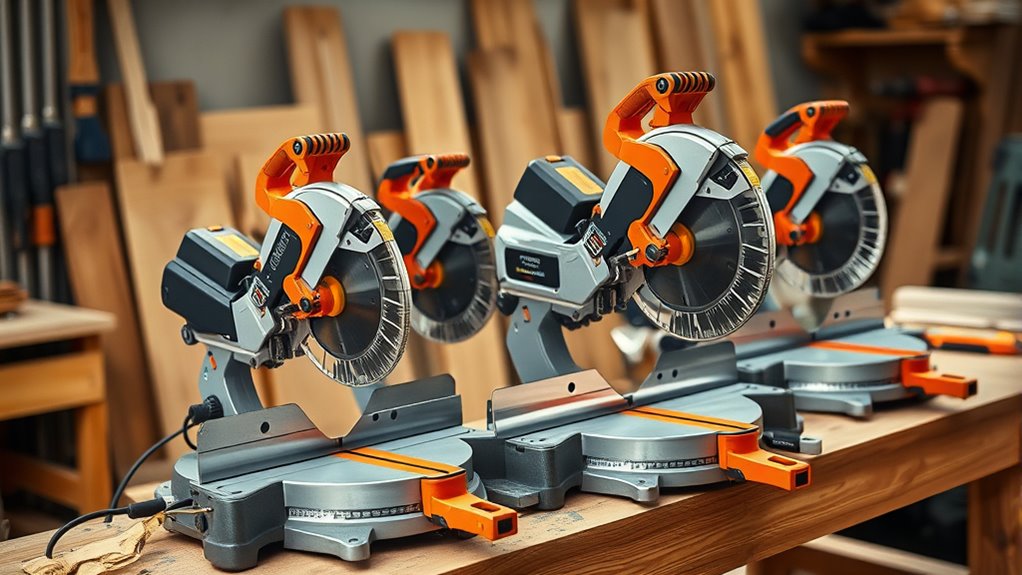

For most buyers, I’d start with the DEWALT DWS779: its 12-inch blade and sliding, double-bevel design suit a wide range of trim and framing tasks. The SKIL MS6305-00 is a strong alternative if you want sliding cuts and dual-bevel capability in a 10-inch saw, while the DEWALT DWS780 adds a shadow-line cut guide for buyers willing to prioritize setup visibility. The main tradeoffs are cutting capacity versus portability, single versus dual bevel, and a useful cut guide versus a simpler, less feature-heavy setup. Smaller 7-1/4-inch models can be easier to move, but they limit the width and thickness of stock you can cut. Read on for the full breakdown and help matching a saw to your work.

Get kitchen gear delivered free with Prime
- Fast, free delivery on millions of items
- Prime Video, Amazon Music and more included
- Member-only deals all year
Complete the kit


Key Takeaways
- The DWS779 is the broadest all-around fit: its 12-inch blade, sliding action, and double bevel cover more varied work than the simpler fixed or single-bevel options.
- Sliding action matters more than blade size alone for wide stock: a 10-inch slider such as the SKIL MS6305-00 may handle wider boards than a non-sliding 12-inch saw, depending on the cut and material.
- The DWS780 separates itself through cut visibility: its XPS LED shadow line is a distinct setup aid, while the DWS779 offers a more basic approach to the same broad cutting category.
- Compact 7-1/4-inch saws trade capacity for easier handling: the Hoteche and Evolution models suit lighter-duty or mobile work better than repeated cuts on wide, thick stock.
- The lineup spans simple and feature-heavy choices: single-bevel, non-sliding saws can suit straightforward trim work, while dual-bevel sliders reduce repositioning when projects involve varied angles and wider material.
| DOVAMAN 10-Inch Sliding Miter Saw |  | Best for Versatile DIY Materials | Blade size: 10 inches | Motor: 15 A, 2,000 W | Speed settings: 4,500 rpm and 3,200 rpm | VIEW ON AMAZON | See Our Full Breakdown |
| DOVAMAN 1700W Compound Miter Saw with Laser Guide |  | Best for Compact DIY Setups | Blade diameter: 8.25 inches | Motor power: 1,700 W | Motor speed: 4,900 rpm | VIEW ON AMAZON | See Our Full Breakdown |
| MarvTool 10-Inch Sliding Compound Miter Saw, 15 Amp |  | Best Portable Sliding Pick | Blade diameter: 10 inches | Motor: 15 A | Speed: 5,000 rpm | VIEW ON AMAZON | See Our Full Breakdown |
| DEWALT DWS779 12-Inch Double-Bevel Sliding Compound Miter Saw |  | Best for Large, Demanding Cuts | Blade size: 12 inches, 80 teeth | Motor: 15 A | Speed: 3,800 rpm | VIEW ON AMAZON | See Our Full Breakdown |
| DEWALT DWS713 10-Inch Single-Bevel Compound Miter Saw, 15-Amp |  | Best for Repeatable Everyday Cuts | Blade diameter: 10 inches | Motor: 15 A | Speed: 5,000 rpm | VIEW ON AMAZON | See Our Full Breakdown |
| SKIL 10-Inch Dual Bevel Sliding Compound Miter Saw (MS6305-00) |  | Best Value Dual-Bevel Slider | Blade diameter: 10 inches | Motor: 15 A | Speed: 4,800 RPM | VIEW ON AMAZON | See Our Full Breakdown |
| DEWALT DWS780 12-Inch Double-Bevel Sliding Compound Miter Saw with XPS LED Shadow Line |  | Best for Wide-Capacity Trim Work | Blade diameter: 12 inches | Motor: 15 amp, 1,100 watts | No-load speed: 3,800 rpm | VIEW ON AMAZON | See Our Full Breakdown |
| DEWALT DWS715 12-Inch Single-Bevel Compound Miter Saw, 15-Amp |  | Best for Repeatable Crosscuts | Blade size: 12 inches | Motor: 15 A | Power source: Corded electric, 120 V | VIEW ON AMAZON | See Our Full Breakdown |
| Metabo HPT 10-Inch Single Bevel Compound Miter Saw (C10FCG2) |  | Best Lightweight Job-Site Saw | Blade diameter: 10 inches | Motor: 15 A | No-load speed: 5,000 RPM | VIEW ON AMAZON | See Our Full Breakdown |
| MarvTool 10-Inch Compound Miter Saw, 15 Amp, 5000 RPM |  | Best Lightweight Basic Compound Saw | Blade diameter: 10 inches | Motor: 15 A | Speed: 5,000 rpm | VIEW ON AMAZON | See Our Full Breakdown |
| DOVAMAN 10-Inch Sliding Miter Saw, 15A, Dual-Speed |  | Best for Versatile Material Cutting | Blade diameter: 10 inches | Motor: 15 A, 2000 W | Speed settings: 5000 rpm and 3200 rpm | VIEW ON AMAZON | See Our Full Breakdown |
| Hoteche 7-1/4-Inch Compound Miter Saw with Laser |  | Best for Compact Trim Work | Blade size: 7-1/4 inches | Motor: 7.5 A, 900 W | Voltage: 120 V | VIEW ON AMAZON | See Our Full Breakdown |
| Evolution R185SMS+ 7-1/4-Inch Sliding Compound Miter Saw |  | Best Compact Sliding Saw for Mixed Materials | Blade diameter: 7-1/4 inches | Power: 1200 W | Voltage: 120 V | VIEW ON AMAZON | See Our Full Breakdown |
| miter saw | Motor | Weight | Blade diameter | Speed |
|---|---|---|---|---|
| DOVAMAN 10-Inch Sliding Miter | 15 A, 2,000 W | 17 kg | — | — |
| DOVAMAN 1700W Compound Miter S | — | 19 pounds | 8.25 inches | — |
| MarvTool 10-Inch Sliding Compo | 15 A | 25.6 pounds | 10 inches | 5,000 rpm |
| DEWALT DWS779 12-Inch Double-B | 15 A | 67.7 pounds | — | 3,800 rpm |
| DEWALT DWS713 10-Inch Single-B | 15 A | 31 pounds | 10 inches | 5,000 rpm |
| SKIL 10-Inch Dual Bevel Slidin | 15 A | 39.4 lbs | 10 inches | 4,800 RPM |
| DEWALT DWS780 12-Inch Double-B | 15 amp, 1,100 watts | 58 lbs | 12 inches | — |
| DEWALT DWS715 12-Inch Single-B | 15 A | 42.8 pounds | — | Listed as 4,000 rpm in description and 4,500 rpm in specifications |
| Metabo HPT 10-Inch Single Beve | 15 A | 24.2 lb | 10 inches | — |
| MarvTool 10-Inch Compound Mite | 15 A | 20.5 pounds | 10 inches | 5,000 rpm |
| DOVAMAN 10-Inch Sliding Miter | 15 A, 2000 W | 17 kg | 10 inches | — |
| Hoteche 7-1/4-Inch Compound Mi | 7.5 A, 900 W | — | — | 5500 rpm |
| Evolution R185SMS+ 7-1/4-Inch | — | — | 7-1/4 inches | 3700 rpm |
More Details on Our Top Picks
DOVAMAN 10-Inch Sliding Miter Saw
The DOVAMAN 10-Inch Sliding Miter Saw suits DIYers who want a sliding saw with more than one material in mind. Its two speed settings let buyers choose between 4,500 and 3,200 rpm, while the product description lists cutting wood, plastic, and soft metal. That makes it more adaptable on paper than the wood-focused DEWALT DWS713, which is a simpler choice for routine lumber cuts. The 13-inch rail, bevel adjustment, laser guide, and three included blades add flexibility without requiring an immediate blade purchase. There are tradeoffs: its 17 kg weight makes moving it less convenient than the 19-pound DOVAMAN DS10A, and the listed cutting capacity is inconsistent across the description. I’d choose it for material variety, not when a clearly stated capacity or easy portability matters most.
Pros:- Two speed settings provide options for different materials and cutting tasks.
- Includes three TCT blades and a laser guide.
- Sliding rail, bevel adjustment, and extendable side tables support a range of cuts and workpiece sizes.
- Designed for left- and right-handed operation.
Cons:- At 17 kg, it is less convenient to move than the lighter DOVAMAN DS10A.
- The product description gives conflicting maximum cutting capacity information.
- The included material range does not establish specific cutting capacity for each material.
Best for: DIYers who want a sliding saw and plan to cut wood, plastic, or soft metal with different speed settings.
Not ideal for: Buyers who need a precisely documented cutting capacity or expect to carry the saw between jobs often; the capacity details conflict and it weighs 17 kg.
- Blade size:10 inches
- Motor:15 A, 2,000 W
- Speed settings:4,500 rpm and 3,200 rpm
- Maximum cutting capacity:Listed as 4 × 13 inches; description notes differing capacity figures
- Bevel range:0–45°
- Sliding rail:13 inches
- Included blades:3 TCT blades
- Power source:Corded electric, 120 V
- Weight:17 kg
Our verdict“Choose this DOVAMAN for a versatile home workshop that values speed and material options over portability and unambiguous capacity figures.”
DOVAMAN 1700W Compound Miter Saw with Laser Guide
The DOVAMAN DS10A is a compact, straightforward compound saw for DIYers making common crosscuts and angled cuts in smaller stock. At 19 pounds, it is much easier to reposition than the 67.7-pound DEWALT DWS779, though that larger saw offers sliding capacity for substantially wider boards. This DOVAMAN instead uses an 8.25-inch blade, with stated capacity of 4.5 × 2.375 inches at 0°; buyers should match that limit to their projects. A laser guide and LED light help show the cut line, while the clamp, dust bag, and blade provide useful starting accessories. Its single-bevel design adjusts only to 45° on one side, so repeated bevel work in both directions takes more repositioning than with the DWS779. I’d favor it for modest home projects, not wide lumber or demanding trim production.
Pros:- At 19 pounds, it is easier to move and store than the DEWALT DWS779.
- Laser guide and LED light aid cut-line visibility.
- Includes a tungsten-carbide blade, dust bag, work clamp, and hex wrench.
- Dual safety switches and left- and right-handed operation support practical workshop use.
Cons:- The 8.25-inch blade has less cutting capacity than the 10- and 12-inch saws in this roundup.
- Single-bevel adjustment is limited to 0–45° in one direction.
- The stated 0° capacity is limited to 4.5 × 2.375 inches.
Best for: Home DIYers with limited storage who mainly cut narrower boards and want a lighter saw with cut-line lighting.
Not ideal for: Carpenters working with wide dimensional lumber or making frequent bevel cuts in both directions; its small blade and single-bevel setup limit those jobs.
- Blade diameter:8.25 inches
- Motor power:1,700 W
- Motor speed:4,900 rpm
- Cutting capacity at 0°:4.5 × 2.375 inches
- Cutting capacity at 45°:3.15625 × 2.375 inches
- Bevel adjustment:0–45°
- Power source:Corded electric
- Weight:19 pounds
- Included components:Saw blade, dust bag, work clamp, hex wrench
Our verdict“Pick the DS10A for lighter, smaller-scale DIY work where compact storage and visible cut lines matter more than wide-board capacity.”
MarvTool 10-Inch Sliding Compound Miter Saw, 15 Amp
For buyers who want a sliding mechanism without the heft of a large site saw, the MarvTool JS-1013C4 occupies a useful middle ground. It weighs 25.6 pounds, far less than the 67.7-pound DEWALT DWS779, and still offers 10-inch blade capacity with miter and bevel cuts up to 45°. Its extension tables, vise clamp, and dust bag make it better equipped for basic setup than a bare-bones portable saw. The key limitation is missing from the supplied data: no cutting capacity is specified, so I can’t recommend it for projects that demand a verified board width or thickness. The DWS779 is the safer pick for large lumber and documented capacity; this MarvTool is more appealing when portability and storage matter more than proven reach. The handle also requires installation after delivery.
Pros:- At 25.6 pounds, it is much easier to transport than the DEWALT DWS779.
- Sliding design combines with 10-inch blade size for broader flexibility than a compact fixed saw.
- Miter and bevel adjustments both reach 45°.
- Includes two extension tables, vise clamp, dust bag, and 36-tooth blade.
Cons:- The supplied product information does not specify cutting capacity.
- Upper handle requires installation after delivery.
- Its 36-tooth blade may be less suited to fine finishing than a higher-tooth-count blade.
Best for: DIYers who need a relatively light sliding saw for occasional trim and general projects, and can confirm its capacity for their stock.
Not ideal for: Buyers cutting wide or thick lumber to a strict capacity requirement, or anyone who wants a saw ready to use without assembling the upper handle.
- Blade diameter:10 inches
- Motor:15 A
- Speed:5,000 rpm
- Miter angle:0–45°
- Bevel angle:0–45°
- Blade teeth:36
- Weight:25.6 pounds
- Power source:Corded electric, 120 V
- Warranty:2 years
Our verdict“Choose the MarvTool if you want a more portable sliding saw for general DIY cuts and can verify its capacity before buying.”
DEWALT DWS779 12-Inch Double-Bevel Sliding Compound Miter Saw
The DEWALT DWS779 earns its place for buyers who regularly cut wide dimensional lumber and want a saw with documented reach. Its 12-inch sliding setup handles stock up to 2 × 14 inches at 90°, well beyond the stated capacity of the smaller DOVAMAN DS10A. Double-bevel adjustment to 49° in either direction also reduces the need to flip workpieces for opposing bevels, while 10 miter detents help with repeatable angle settings. The tradeoff is substantial: at 67.7 pounds, it is far less portable than the MarvTool JS-1013C4, and its large footprint asks for dedicated bench or jobsite space. Dust collection is listed as capturing over 75% of generated dust, but that still leaves dust to manage. I’d choose it for capacity and repeated work, not a compact home setup.
Pros:- 12-inch sliding design cuts stock up to 2 × 14 inches at 90°.
- Double-bevel range reaches 49° left and right.
- Miter range extends 60° right and 50° left, with 10 detents.
- Dust system is specified to capture over 75% of generated dust.
Cons:- At 67.7 pounds, it is much heavier than the portable MarvTool and DOVAMAN options.
- Large dimensions require substantial storage or bench space.
- Dust collection captures much, but not all, of the generated dust.
Best for: Carpenters and serious DIYers who routinely cut wide boards, trim, or dimensional lumber and can leave a heavy saw set up.
Not ideal for: Small-shop users who must store the saw after each session or carry it frequently; its 67.7-pound weight and large dimensions work against that use.
- Blade size:12 inches, 80 teeth
- Motor:15 A
- Speed:3,800 rpm
- Cut capacity at 90°:2 × 14 inches
- Cut capacity at 45°:2 × 10 inches
- Miter range:60° right, 50° left
- Bevel range:49° left and right
- Dust collection:Captures over 75% of generated dust
- Weight:67.7 pounds
Our verdict“Choose the DWS779 when wide-board capacity and double-bevel flexibility outweigh portability and storage demands.”
DEWALT DWS713 10-Inch Single-Bevel Compound Miter Saw, 15-Amp
The DEWALT DWS713 is a practical pick for repeatable crosscuts and trim work when sliding capacity is not a requirement. Its 14 positive miter stops make common angles easier to set consistently, and the tall sliding fence supports upright workpieces such as crown molding. At 31 pounds, it is easier to move than the 67.7-pound sliding DEWALT DWS779, but it gives up that model’s much greater capacity for wide boards. This is also a single-bevel saw: it tilts up to 48° left but only 3° right, so bevel cuts in the opposite direction can mean repositioning the workpiece. For a buyer focused on standard lumber sizes and straightforward setup, those limits may be acceptable. I would skip it for wide stock or frequent two-direction bevel work.
Pros:- 14 positive miter stops support repeatable settings for common angles.
- Sliding fence supports taller workpieces such as crown molding.
- At 31 pounds, it is easier to move than the DEWALT DWS779.
- Includes a carbide-tipped blade, dust bag, wrench, and vertical clamp.
Cons:- Single-bevel design limits flexibility compared with the double-bevel DEWALT DWS779.
- Right bevel range is only 3°.
- Crosscut capacity is limited to 2 × 6 inches at 90° and 2 × 4 inches at 45°.
Best for: Trim installers and home woodworkers who want repeatable miter settings, a fence for taller stock, and a saw they can move around the shop.
Not ideal for: Buyers who frequently cut wide boards or need bevel adjustment in both directions; the saw does not slide and has only 3° of right bevel.
- Blade diameter:10 inches
- Motor:15 A
- Speed:5,000 rpm
- Miter detents:14 positive stops
- Bevel range:0–48° left; 0–3° right
- Crosscut capacity at 90°:2 × 6 inches
- Crosscut capacity at 45°:2 × 4 inches
- Weight:31 pounds
- Included components:Carbide-tipped blade, wrench, dust bag, vertical clamp
Our verdict“Choose the DWS713 for portable, repeatable trim and crosscuts, but move up to a sliding double-bevel saw for wide stock or frequent compound cuts.”
SKIL 10-Inch Dual Bevel Sliding Compound Miter Saw (MS6305-00)
The SKIL MS6305-00 combines a 10-inch sliding blade with dual-bevel cutting, a useful pairing for trim and framing work when you want to avoid repeatedly flipping material. Its listed capacity reaches 2×12 lumber at 90 degrees, while the LED shadow line gives a visible cut reference without relying on a laser. Compared with the simpler DEWALT DWS715, it adds sliding and right-side bevel capability, though the DWS715 uses a 12-inch blade and has a stainless-steel detent plate with 14 positive stops. The SKIL’s 39.4-pound weight and included clamp, extension rods, and dust bag make it a practical shop or occasional job-site option. Its tradeoffs are cord dependence and a heavier carry than the Metabo HPT C10FCG2.
Pros:- Dual bevel reduces the need to reposition work for opposite-side bevel cuts.
- Sliding capacity handles boards up to 2×12 at 90 degrees.
- LED shadow line provides a clear cut reference.
- Includes a work clamp, extension rods, and dust bag.
Cons:- Corded power limits use where an outlet is unavailable.
- Heavier to move than the 24.2-pound Metabo HPT C10FCG2.
- Its 10-inch blade offers less blade diameter than the DEWALT DWS780’s 12-inch blade.
Best for: DIY remodelers and trim workers who want sliding capacity and bevel cuts in both directions without stepping up to a 12-inch saw.
Not ideal for: Tradespeople who frequently carry a saw between work areas or need cordless operation; it weighs 39.4 pounds and requires an outlet.
- Blade diameter:10 inches
- Motor:15 A
- Speed:4,800 RPM
- Cutting capacity:2×12 at 90 degrees; 2×8 at 45 degrees
- Miter range:Up to 50 degrees left and right
- Weight:39.4 lbs
- Power source:Corded electric, 120 V
- Warranty:3-year limited
Our verdict“Choose the SKIL if you want a capable 10-inch dual-bevel slider for a home shop and can accept corded power and moderate carry weight.”
DEWALT DWS780 12-Inch Double-Bevel Sliding Compound Miter Saw with XPS LED Shadow Line
The DWS780 is the capacity-focused pick here: its 12-inch blade and sliding design cut up to 13-7/8 inches horizontally, while its stated nested crown capacity suits large molding that can exceed the reach of the SKIL MS6305-00. The XPS LED shadow line aligns the blade shadow with the cut path, giving a direct reference without a laser line to interpret. Double-bevel adjustment and a 60-degree right miter range also make it more adaptable for complex trim than the single-bevel DEWALT DWS715. Dust collection is specified to capture over 75% of generated dust, a useful advantage in a shop, though it should not be read as dust-free operation. At 58 pounds, this is a substantial saw to move; its capacity makes more sense for a stationary setup than frequent carrying.
Pros:- 13-7/8-inch horizontal cut capacity accommodates wide stock.
- XPS LED shadow line provides a visible cut alignment reference.
- Double bevel and broad miter range support complex trim cuts.
- Dust collection is specified to capture over 75% of generated dust.
Cons:- At 58 pounds, frequent transport is demanding.
- The larger 12-inch format is less compact than the 10-inch SKIL MS6305-00.
- Dust capture does not eliminate the need for cleanup or appropriate dust protection.
Best for: Finish carpenters and remodelers cutting wide boards or nested crown molding who want a 12-inch double-bevel slider and can keep it near a workbench.
Not ideal for: Mobile tradespeople or homeowners with limited storage who need a lightweight saw; this 58-pound model is heavier than every other saw in this batch.
- Blade diameter:12 inches
- Motor:15 amp, 1,100 watts
- No-load speed:3,800 rpm
- Bevel range:0–49 degrees left and right
- Miter range:50 degrees left, 60 degrees right
- Cut capacity:Up to 13-7/8 inches horizontal; 7-1/2 inches nested crown
- Dust collection:Captures over 75% of generated dust
- Weight:58 lbs
Our verdict“Pick the DWS780 for wide stock and crown work when cutting capacity matters more than portability.”
DEWALT DWS715 12-Inch Single-Bevel Compound Miter Saw, 15-Amp
The DWS715 suits buyers who value repeatable miter settings and a larger blade but do not need a sliding rail. Its 12-inch blade cuts 2×8 lumber at 90 degrees, and the stainless-steel detent plate offers 14 positive stops for returning to common angles. Tall sliding fences support base and crown molding, a practical benefit for trim work that does not require the wide-board capacity of the sliding DEWALT DWS780. The main compromise is its single-bevel design: unlike the SKIL MS6305-00, it cannot bevel in both directions, so some angled cuts require turning the workpiece. It is also worth noting that the supplied speed information conflicts, listing 4,000 rpm in the description and 4,500 rpm in the specifications. Its carry handle and 42.8-pound weight help with occasional moves, not constant hauling.
Pros:- Stainless-steel detent plate provides 14 positive miter stops.
- 12-inch blade handles 2×8 lumber at 90 degrees.
- Tall sliding fences support base and crown molding.
- Carry handle and 42.8-pound weight make occasional relocation manageable.
Cons:- Single-bevel design can require flipping or repositioning work for opposite bevels.
- No sliding function limits capacity on wider stock compared with the DWS780.
- Provided speed figures conflict between 4,000 and 4,500 rpm.
Best for: Home renovators and trim installers who make repeated crosscuts and miter cuts, want a 12-inch blade, and do not need a sliding saw or dual bevel.
Not ideal for: Users cutting wide boards beyond its stated capacity or regularly making opposite-side bevel cuts; a sliding or dual-bevel model such as the SKIL MS6305-00 fits those jobs better.
- Blade size:12 inches
- Motor:15 A
- Power source:Corded electric, 120 V
- Miter detents:14 positive stops
- Bevel range:0–48 degrees left; 0–3 degrees right
- Cutting capacity:2×8 lumber at 90 degrees; 2×6 lumber at 45 degrees
- Weight:42.8 pounds
- Speed:Listed as 4,000 rpm in description and 4,500 rpm in specifications
Our verdict“Choose the DWS715 for repeatable trim and crosscuts with a 12-inch blade if you can work within its single-bevel, non-sliding design.”
Metabo HPT 10-Inch Single Bevel Compound Miter Saw (C10FCG2)
At 24.2 pounds, the Metabo HPT C10FCG2 is the easy choice when moving a miter saw matters more than having a sliding rail. Its 10-inch blade, 15-amp motor, and listed 5,000-rpm no-load speed suit routine crosscuts and miter work, while a 52-degree left/right miter range offers more adjustment than the MarvTool JS-1017C3’s 45-degree range. It also bevels left up to 45 degrees, but not right; the dual-bevel SKIL MS6305-00 is more convenient for repeated bevel work from both sides. The package includes a 40-tooth blade, vise assembly, dust bag, and wrench, and its five-year limited warranty is longer than the MarvTool’s two-year coverage. Its core limitation is capacity: this is a non-sliding saw, so wide boards may call for a different design.
Pros:- 24.2-pound weight is the lightest among these five saws.
- 52-degree miter range works beyond the 45-degree range of the MarvTool JS-1017C3.
- Includes a 40-tooth blade, vise assembly, dust bag, and wrench.
- Five-year limited warranty.
Cons:- No sliding action limits capacity on wide material.
- Single left bevel is less flexible than the dual-bevel SKIL MS6305-00.
- Corded operation still requires access to an outlet on site.
Best for: Carpenters, installers, and DIYers who carry a saw between work areas and mostly cut standard-width lumber, trim, and framing stock.
Not ideal for: Buyers who regularly cut wide boards or need bevels in both directions; the saw has no slide and only bevels left.
- Blade diameter:10 inches
- Motor:15 A
- No-load speed:5,000 RPM
- Miter range:0–52 degrees left and right
- Bevel range:0–45 degrees left
- Weight:24.2 lb
- Power source:Corded electric, 120 V
- Warranty:5-year limited
Our verdict“Choose the Metabo HPT if portability and a broad miter range matter more than sliding capacity or right-side bevel adjustment.”
MarvTool 10-Inch Compound Miter Saw, 15 Amp, 5000 RPM
The MarvTool JS-1017C3 is a straightforward pick for basic crosscuts and angled cuts in a compact package. At 20.5 pounds, it is lighter than the Metabo HPT C10FCG2 and includes two extension tables, a vise clamp, and a dust bag, which can help support longer stock without buying accessories separately. Its 10-inch blade and stated 5,000-rpm speed cover routine wood-cutting tasks, while the 0–45-degree miter and bevel ranges are narrower than the Metabo’s 52-degree miter range. Both saws are single-bevel and non-sliding, but the MarvTool’s data describes cutting soft metal and plastic as well as wood; that should not be treated as a claim of suitability for every metal type. The 36-tooth blade and two-year warranty are more modest than the Metabo’s supplied 40-tooth blade and five-year warranty.
Pros:- 20.5-pound body is lighter than the Metabo HPT C10FCG2.
- Includes two extension tables, a vise clamp, and dust bag.
- 15-amp motor is listed at up to 5,000 rpm.
- Supports miter and bevel cuts from 0 to 45 degrees.
Cons:- Single-bevel design cannot bevel in both directions.
- No sliding function limits cuts on wider stock.
- Two-year warranty is shorter than the Metabo HPT’s five-year limited warranty.
Best for: DIYers who need a light, corded saw for basic wood cuts and want extension tables, a clamp, and a dust bag included.
Not ideal for: Finish carpenters needing wider miter settings, sliding capacity, or dual bevels, and anyone who needs to cut metal types beyond the product’s stated soft-metal use.
- Blade diameter:10 inches
- Motor:15 A
- Speed:5,000 rpm
- Blade teeth:36
- Miter range:0–45 degrees
- Bevel range:0–45 degrees
- Weight:20.5 pounds
- Warranty:2 years
Our verdict“Pick the MarvTool for light, basic cutting with useful included supports, but choose a sliding or wider-range saw for more demanding trim work.”
DOVAMAN 10-Inch Sliding Miter Saw, 15A, Dual-Speed
The DOVAMAN’s strongest distinction is its two speed settings and stated ability to cut wood, plastic, and soft metals, making it a flexible choice for mixed-material projects. Its 10-inch blade and 13-inch slide provide more reach for wide stock than the compact Hoteche 7-1/4-inch compound saw, while the laser guide can help align cuts. Three included TCT blades give buyers options for different materials without having to source every blade separately.
That wider cutting range comes with a real portability cost: at 17 kg, it is heavier than a small trim-focused saw, and its corded design keeps it near an outlet. The listed bevel capability reaches 45 degrees, but the product data does not specify a dual-bevel setup. I’d choose this over the Evolution R185SMS+ when wider capacity and selectable speeds matter more than a lighter 7-1/4-inch format.
Pros:- 13-inch sliding rail and stated 3.5 x 13.4-inch maximum capacity support wider workpieces.
- Two speed settings provide different operating speeds for varied materials and tasks.
- Includes three TCT blades, a laser guide, and a support clamp.
- Cuts wood, plastic, and soft metals according to the product description.
Cons:- At 17 kg, it is a substantial load to move between job sites.
- Corded power requires access to an outlet and limits placement flexibility.
- The product data does not establish a dual-bevel design.
Best for: DIYers and home workshop owners who cut wide boards as well as wood, plastic, or soft metal and can leave a corded saw set up.
Not ideal for: Mobile trim installers or buyers prioritizing easy carrying; its 17 kg weight and corded power limit portability.
- Blade diameter:10 inches
- Motor:15 A, 2000 W
- Speed settings:5000 rpm and 3200 rpm
- Maximum cutting capacity:3.5 x 13.4 inches
- Sliding rail:13 inches
- Cutting angle:Up to 45 degrees
- Included blades:3 TCT blades
- Weight:17 kg
Our verdict“Choose the DOVAMAN if you want a sliding 10-inch saw with broad material claims and useful included blades, and can accept its weight and cord.”
Hoteche 7-1/4-Inch Compound Miter Saw with Laser
The Hoteche is the most compact-format choice in this group, aimed at straightforward trim cuts rather than wide stock. Its built-in laser and positive miter stops help guide repeat cuts at common angles, while the included extension bars and dust bag make it a practical basic setup. The product description lists wood, PVC, aluminum trim, and soft metals, offering more material flexibility than a wood-only trim saw.
Its capacity is the clear boundary: the listed cut at 90 degrees is just 120 x 45 mm, and the single-bevel design means angled bevel work requires repositioning the workpiece rather than tilting the saw both ways. Compared with the DOVAMAN 10-inch slider, the Hoteche gives up blade size and sliding reach in exchange for a smaller format and simpler setup. I’d favor it for occasional trim jobs, not projects involving wide boards or frequent bevel cuts.
Pros:- Built-in laser helps indicate the cut line.
- Positive miter stops support repeat cuts at common angles.
- Product description lists wood, PVC, aluminum trim, and soft-metal cutting.
- Includes extension bars, a dust bag, hex wrenches, and replacement carbon brushes.
Cons:- Listed 90-degree cutting capacity is limited to 120 x 45 mm.
- Single-bevel design is less convenient for repeated compound cuts than a dual-bevel saw.
- The 7.5 A motor and 7-1/4-inch blade suit smaller work better than demanding, wide-stock cuts.
Best for: DIYers doing room trim, PVC, or small aluminum-trim jobs who want a compact corded saw with angle guidance.
Not ideal for: Woodworkers cutting wide boards or making frequent bevel cuts in both directions; its listed capacity is limited and its bevel is single-sided.
- Blade size:7-1/4 inches
- Motor:7.5 A, 900 W
- Voltage:120 V
- Speed:5500 rpm
- Blade teeth:24
- Maximum cutting angle:45 degrees
- Listed capacity at 90 degrees:120 x 45 mm
- Bevel design:Single bevel
Our verdict“Pick the Hoteche for modest trim projects where a laser and compact blade format matter more than cutting capacity or dual-bevel convenience.”
Evolution R185SMS+ 7-1/4-Inch Sliding Compound Miter Saw
The Evolution R185SMS+ pairs a 7-1/4-inch blade with a 210 mm slide, giving it a more compact footprint than the DOVAMAN 10-inch slider while retaining sliding action for wider cuts than a basic fixed-head saw. Its stated ability to cut wood, plastic, and metal makes it a notable option for buyers whose projects mix materials. A 50-degree miter range also gives it more miter travel than the Hoteche, whose listed maximum is 45 degrees.
The smaller blade and 1200 W motor make this a different kind of tool from a larger 10-inch saw: it favors a manageable format over maximum capacity. It offers a 45-degree bevel, but the supplied specifications do not identify it as dual-bevel, so repeated compound cuts may call for repositioning the work. The included blade and dust bag are useful basics; buyers who need the DOVAMAN’s listed 13-inch rail should look elsewhere.
Pros:- Sliding action adds cutting reach beyond a fixed-head 7-1/4-inch saw.
- Product description lists cutting wood, plastic, and metal.
- 50-degree miter range extends beyond the Hoteche’s listed 45-degree maximum.
- Includes a tungsten-carbide blade and dust bag.
Cons:- Corded power limits use away from an outlet.
- Its 7-1/4-inch blade is less suited to larger stock than the DOVAMAN’s 10-inch blade.
- The supplied data does not confirm a dual-bevel design or state maximum cutting capacity.
Best for: DIYers and small-workshop owners who need a sliding saw for mixed-material projects but prefer a smaller 7-1/4-inch format.
Not ideal for: Users who regularly cut very wide stock, need a documented long slide, or want cordless portability.
- Blade diameter:7-1/4 inches
- Power:1200 W
- Voltage:120 V
- Speed:3700 rpm
- Slide length:210 mm
- Bevel angle:45 degrees
- Miter angle:50 degrees
- Blade material:Tungsten carbide
- Warranty:3 years limited
Our verdict“Choose the Evolution if you want sliding reach and mixed-material capability in a smaller blade format, but not the wider capacity of a 10-inch slider.”

How We Picked
I compared the 13 saws by the problems buyers need them to solve: how much material they can cut, how easily they handle bevels and compound angles, and whether their size and layout suit a fixed shop or mobile work. I also weighed practical usability, including cut-line visibility, portability, and the learning curve created by sliding and dual-bevel mechanisms. Blade diameter alone did not decide the order; a slider can be a better match for wide boards than a larger non-sliding saw, while a smaller saw can make more sense when carrying weight and storage matter most.
The ranking gives priority to versatility for common home-shop and jobsite projects, then distinguishes specialized options by their strongest buyer fit. The DWS779 leads for its combination of 12-inch capacity, sliding action, and double bevel; the DWS780 follows for buyers who value its shadow-line guide. The SKIL MS6305-00 stands out as a capable 10-inch sliding, dual-bevel alternative. Simpler, single-bevel models rank lower for broad use, not because they lack a purpose, but because they place more limits on angle work or material width. The compact 7-1/4-inch picks are included for portability and lighter-duty needs rather than maximum capacity.
Factors to Consider When Choosing Miter Saws
Before choosing a miter saw, match its cutting range and movement to the material and cuts you actually make. A larger, more capable saw can save repositioning, but it also takes up more space and can be harder to move. These factors help separate useful capability from features that may sit unused.
Choose Sliding Action for Width, Not as a Default
A sliding saw lets the blade travel across the work, which helps when cutting wider boards that a fixed-head saw may not span in one pass. That extra reach is useful for broad trim, shelving stock, and some framing pieces, but it adds bulk and another movement to control. Measure the widest material you expect to cut and check the saw’s stated capacity at the angles you use; capacity often changes between straight and angled cuts. Buyers sometimes focus on blade diameter and overlook whether the saw slides. A non-sliding 12-inch model may not handle every wide cut as well as a smaller slider. If your work mostly involves narrow trim or repeated short crosscuts, a fixed-head design may be the simpler choice.
Decide Whether You Need a Double Bevel
A double-bevel saw tilts both left and right, so you can cut opposing bevels without turning the workpiece around. That can speed up trim projects with repeated compound angles and reduce the chance of flipping a board the wrong way. A single-bevel model can still make many accurate cuts, but you may need to reposition stock or change your setup for the opposite direction. That extra step matters less for occasional cuts than for long runs of matching trim. Consider the size and shape of your material, too: some pieces are awkward to rotate safely or consistently. Pay for double bevel when the work calls for it regularly, not simply because it sounds like the more capable specification.
Treat Blade Diameter and Capacity as Separate Questions
A larger blade can increase cutting depth and capacity, but it does not tell the whole story about what a saw can cut. Sliding travel, fence design, bevel angle, and the dimensions of the workpiece all affect usable capacity. Check the manufacturer’s capacity figures for the cuts you plan to make rather than assuming a 12-inch saw handles every larger board. A smaller 7-1/4-inch model can be easier to carry and store, which may outweigh its limits for punch-list work or compact workshops. Also think about blade availability and the kinds of materials you cut; the right blade can matter as much as the saw’s nominal diameter. Match the saw to your most demanding regular task, not a rare cut you could handle another way.
Plan Around Portability and Workshop Space
Sliding rails and larger blades can make a saw less convenient to move and may require more clearance behind the tool. In a small shop, that can affect where the saw sits and how long the material can extend on either side. For mobile work, account for the saw’s weight, handle placement, and whether you have a stand or a stable surface at each location. Compact models are easier to transport, but a smaller cutting range may mean more setup or a different tool for larger stock. A frequent mistake is buying a powerful saw before measuring the bench, storage area, and doorways it must pass through. If the saw will live in one place, capacity may matter more than portability; for repeated transport, those priorities can reverse.
Choose Cut-Line Aids for Your Lighting and Work Habits
Lasers and LED shadow lines help show where the blade will meet the work, but they serve as setup aids rather than substitutes for checking alignment. A shadow-line system projects the blade’s outline, while a laser marks a line that may need adjustment to match the blade. Bright outdoor conditions, dusty work, and blade changes can affect how useful either system feels. If you make repeated cuts to a marked line, a visible guide can reduce setup friction. If you already rely on a square, stop, and careful test cut, you may prefer to prioritize capacity or build instead. Confirm that you can see the guide from your usual working position and follow the manual’s instructions for alignment.
Factor in Dust, Support, and Blade Upkeep
Miter saws create a concentrated spray of sawdust, and the included collection arrangement may not capture it all. In a home shop, plan for a vacuum connection, cleanup, and enough room to support long stock safely. A stand or extension supports can improve repeatability, but they add cost, transport effort, and storage needs beyond the saw itself. Keep blades clean and sharp, and choose a tooth pattern suited to the material and finish you want; a dull or mismatched blade can produce rough cuts and strain the motor. Buyers often compare saw features without budgeting space and accessories for safe, consistent work. If you need fine finish cuts, consider the blade and support setup as part of the purchase decision.
Frequently Asked Questions
Should I choose a 10-inch sliding saw or a 12-inch non-sliding saw?
Start with the widest and thickest material you cut regularly, then check each saw’s published capacity for the cut angle you need. Sliding action can give a 10-inch saw more reach across a board, while a 12-inch blade can offer useful depth without a slide. Neither size guarantees higher capacity in every direction. Also compare the footprint and weight, since sliding rails can call for more space behind the saw. If your work mixes wide boards and varied angles, a 10-inch slider may fit better than a fixed 12-inch model.
Is a double-bevel saw worth it for DIY trim projects?
It is most useful when your project calls for repeated bevel cuts in both directions, such as trim runs that meet at different corners. Tilting the head both ways can reduce the need to flip or reposition a workpiece, helping keep a sequence of cuts organized. For occasional trim or simple crosscuts, a single-bevel saw can do the job with more setup between certain cuts. Consider how often you will make compound angles and whether your stock is easy to turn around. The extra capability pays off most when it removes a recurring step from your work.
Do I need a sliding miter saw for baseboards and trim?
Not always: many common trim pieces are narrow enough for a non-sliding saw, depending on their dimensions and the angle of the cut. Sliding action becomes more useful with wider profiles or when you need to crosscut stock that exceeds a fixed saw’s capacity. Check the saw’s capacity at the miter and bevel angles you plan to use, since angled cuts can reduce the usable range. For tall baseboards, also confirm the fence can support the material in the orientation you intend to cut. A slider adds reach, but it takes more room and can be unnecessary for smaller trim.
Can a 7-1/4-inch miter saw handle regular remodeling work?
It can suit lighter remodeling tasks, short crosscuts, and work where carrying and storing the saw matter more than cutting larger stock. Its smaller blade limits capacity, so it may not handle every board or trim profile in one pass. Before choosing one, compare its published cut capacity with the materials on your project list, including angled cuts. A compact saw can be a sensible mobile helper, but it may leave you needing another tool for broader work. If remodeling is frequent and varied, a 10-inch slider or a larger model offers more room for change.
Should I prioritize a laser or an LED shadow line?
Both can help you line up a cut, but they show the cut path in different ways. A shadow line uses the blade’s outline as a visual reference, while a laser projects a line that may require calibration to match the blade. Visibility depends on lighting, dust, and your position at the saw, so neither removes the need for a test cut when accuracy matters. If you make repeated cuts to marks, compare how clearly each guide can be seen from your normal stance. If the guide is a secondary convenience, cutting capacity and bevel range may matter more to your choice.
Conclusion
For the widest mix of common projects, I’d choose the DEWALT DWS779 as best overall for its 12-inch sliding, double-bevel setup. The Metabo HPT C10FCG2 is my best value-style pick for buyers who want a straightforward 10-inch single-bevel saw for simpler cuts, while the DEWALT DWS780 is best premium for shoppers who want a shadow-line guide alongside broad cutting capability. For beginners, I’d start with a simpler non-sliding saw if most cuts are basic and the material fits; the DEWALT DWS713 offers that more focused 10-inch format. For compact or mobile work, compare the Hoteche and Evolution R185SMS+ 7-1/4-inch options, checking capacity against your actual stock before choosing. If you need wide cuts without stepping up to a 12-inch saw, the SKIL MS6305-00 is the standout 10-inch dual-bevel slider. The right pick is the one whose capacity, movement, and size match the cuts you make most often.
Columbus Day / Indigenous Peoples' Day Picks
long weekend sales
As an affiliate, we earn on qualifying purchases.