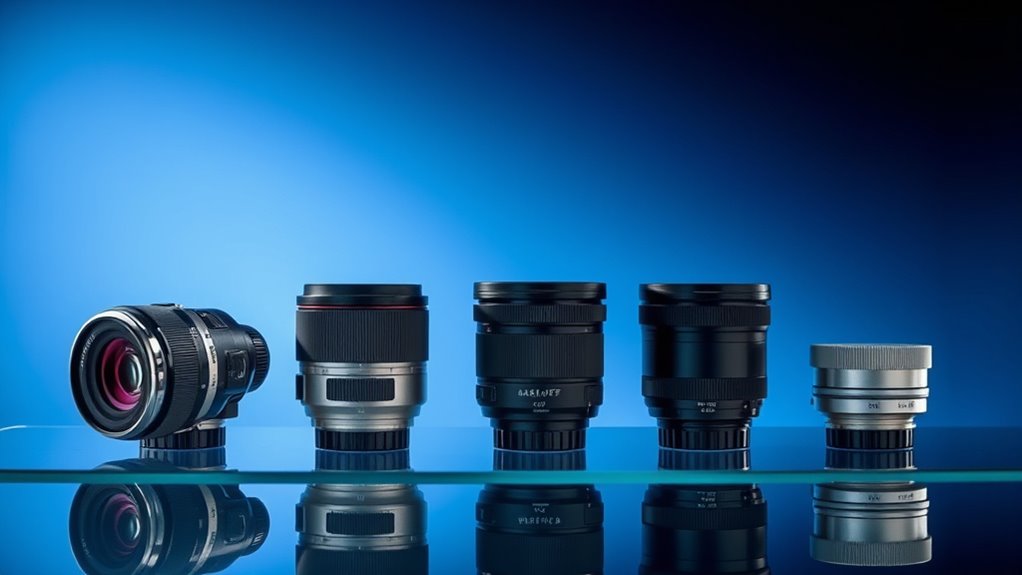

If you’re aiming for stunning photos in 2026, I recommend considering the Canon EF 50mm f/1.8 STM for sharp portraits, the EF 85mm f/1.8 for beautiful bokeh, the Meike 85mm f/1.8 Pro II for Nikon Z users, and the Meike 55mm F/1.8 prime for versatile mirrorless shots. These lenses combine excellent optical quality, fast autofocus, durability, and portability. Keep exploring to find out more about how these options can elevate your photography game.
Key Takeaways
- Prioritize lenses with high-quality optics and advanced coatings for maximum sharpness and minimal aberrations.
- Choose versatile focal lengths like 24-70mm or 70-200mm for professional versatility across genres.
- Opt for wide apertures (f/1.4–2.8) to achieve stunning bokeh and excellent low-light performance.
- Select lenses with durable, weather-sealed construction for reliable shooting in diverse environments.
- Ensure compatibility with your camera system, focusing on fast autofocus and image stabilization features.
| Canon EF 50mm f/1.8 STM Lens | Compact Portrait Essential | Mount Compatibility: Canon EF/EF-S mount | Aperture Range: f/1.8 (max) | Focus Mechanism: STM stepping motor | VIEW LATEST PRICE | See Our Full Breakdown | |
| EF 85mm f1.8 Portrait Lens for Canon DSLR | Artistic Manual Focus | Mount Compatibility: Canon EF/EF-S mount | Aperture Range: f/1.8 (fixed) | Focus Mechanism: Manual focus (no electronic contacts) | VIEW LATEST PRICE | See Our Full Breakdown | |
| Meike 85mm f1.8 Pro II Portrait Lens for Nikon Z | Professional Video Ready | Mount Compatibility: Nikon Z mount | Aperture Range: f/1.8 (fixed) | Focus Mechanism: AF STM stepping motor | VIEW LATEST PRICE | See Our Full Breakdown | |
| Meike 55mm F1.8 Prime Lens for Mirrorless Cameras | Versatile Prime Choice | Mount Compatibility: L-mount | Aperture Range: f/1.8 (fixed) | Focus Mechanism: AF STM stepping motor | VIEW LATEST PRICE | See Our Full Breakdown |

More Details on Our Top Picks
-

EF 85mm f1.8 Portrait Lens - MF for Canon EOS Rebel T8i/T7i/T7/T6i/T5/T3i/T3/T2i/XSi/XS/SL3/SL2/T100/90D/80D/70D/50D/5D Mark IV/6D II/7D II/1D X III II-Manual Focus DSLR Cameras Lenses(EF/EF-S Mount)
- Manual Focus Design: Fully manual focus for precision control
- Compatibility: For Canon EOS Rebel series cameras
- Focus Tips: Switch to full manual mode to avoid errors
As an affiliate, we earn on qualifying purchases.
Canon EF 50mm f/1.8 STM Lens
If you’re looking for a versatile lens that’s perfect for both amateur and professional photographers, the Canon EF 50mm f/1.8 STM is an excellent choice. With a bright f/1.8 aperture, it excels in low-light conditions and creates beautiful background blur. Its compact, lightweight design makes it easy to carry around, ideal for portraits, street photography, and nighttime shots. The stepping motor (STM) ensures near-silent autofocus, perfect for videos and sharp stills. Designed for full-frame cameras but effective on APS-C, it offers an 80mm equivalent focal length. This lens balances quality, affordability, and versatility for all your photography needs.
- Mount Compatibility:Canon EF/EF-S mount
- Aperture Range:f/1.8 (max)
- Focus Mechanism:STM stepping motor
- Image Stabilization:No
- Focal Length:50mm (full frame), 80mm (APS-C)
- Construction Elements:6 elements in 5 groups
- Additional Feature:Near silent STM autofocus
- Additional Feature:Compact lightweight design
- Additional Feature:Effective on APS-C sensors
-

Meike 85mm F1.8 II AF Lens for Nikon Z Mount Full Frame Camera,Wide Angle
- Compatibility: Nikon Z mount full frame and APS-C cameras
- Portrait Photography: f/1.8 aperture with smooth background blur
- Autofocus System: STM stepping motor with NanoDrive for quiet focus
As an affiliate, we earn on qualifying purchases.
EF 85mm f1.8 Portrait Lens for Canon DSLR
The EF 85mm f1.8 Portrait Lens for Canon DSLR stands out as an excellent choice for photographers who crave precise manual focus control and artistic flexibility. This lens is designed for Canon EOS DSLRs, offering superb image quality and beautiful background blur thanks to its 6 rounded aperture blades. Its hybrid aspherical element and multi-coating minimize aberrations and glare, ensuring sharp, stunning portraits. Fully manual with no electronic contacts, it demands deliberate focus, giving you complete creative control. Perfect for those looking to develop their skills or explore artistic photography, this lens combines durability, adaptability, and a unique manual experience.
- Mount Compatibility:Canon EF/EF-S mount
- Aperture Range:f/1.8 (fixed)
- Focus Mechanism:Manual focus (no electronic contacts)
- Image Stabilization:No
- Focal Length:85mm
- Construction Elements:6 rounded aperture blades, 6 elements
- Additional Feature:Manual focus only
- Additional Feature:No electronic contacts
- Additional Feature:Creative control emphasis
-

Meike 55mm F1.8 Pro AF Lens for Sigma Leica L Mount Full-Frame S1 Cameras
- Camera Compatibility: L full frame mirrorless cameras
- Lens Type: 55mm portrait prime lens
- Aperture: f/1.8 wide aperture
As an affiliate, we earn on qualifying purchases.
Meike 85mm f1.8 Pro II Portrait Lens for Nikon Z
Photographers seeking a versatile portrait lens for Nikon Z mirrorless cameras will appreciate the Meike 85mm f1.8 Pro II for its exceptional optical quality and fast aperture. Its wide f/1.8 allows stunning background blur and performs well in low light. With 8 groups and 11 elements, it delivers sharp images with minimal distortion and purple fringing. The autofocus, driven by AF STM and NanoDrive, is smooth and quick, perfect for portraits and moving subjects. Its lightweight, compact design makes it ideal for outdoor shoots. Plus, firmware upgrades enhance autofocus and performance, ensuring this lens remains reliable for professional photography in 2026.
- Mount Compatibility:Nikon Z mount
- Aperture Range:f/1.8 (fixed)
- Focus Mechanism:AF STM stepping motor
- Image Stabilization:Reduces shake, no explicit stabilization
- Focal Length:85mm
- Construction Elements:11 elements in 8 groups
- Additional Feature:Supports 8K video recording
- Additional Feature:Zero distortion support
- Additional Feature:NanoDrive Auxiliary System
Meike 55mm F1.8 Prime Lens for Mirrorless Cameras
Designed for mirrorless camera users seeking high-quality portraits, the Meike 55mm F1.8 Prime Lens delivers sharp images with beautiful background blur, even in low light. It’s compatible with L-mount full-frame systems like Panasonic Lumix S, Sigma, Leica, and more. The lens features an 11-element design with extra-low dispersion and high refractive index elements, reducing chromatic aberration and flare. Its AF STM motor provides fast, quiet autofocus, perfect for portraits. Firmware updates via Type-C enhance performance, making it a versatile choice for professionals and enthusiasts alike. Overall, the Meike 55mm F1.8 is a reliable, high-performance lens for stunning, high-resolution portraits in any lighting.
- Mount Compatibility:L-mount
- Aperture Range:f/1.8 (fixed)
- Focus Mechanism:AF STM stepping motor
- Image Stabilization:No
- Focal Length:55mm
- Construction Elements:11 elements in 8 groups
- Additional Feature:Supports firmware upgrades
- Additional Feature:Multi-coatings reduce flare
- Additional Feature:Compact and lightweight
Factors to Consider When Choosing Professional Camera Lenses

When choosing professional camera lenses, I focus on compatibility with my camera body and how well they gather light through aperture settings. I also consider how quickly and accurately they autofocus, especially for fast-moving subjects, along with features like image stabilization. Most importantly, I look for lenses that deliver sharp, clear images with excellent optical quality.
Lens Compatibility Requirements
Choosing the right professional camera lens starts with guaranteeing compatibility with your camera body. First, check that the lens mount type matches your camera, whether it’s Canon EF, Nikon Z, or L-mount, to proper fit and functionality. Next, verify the lens supports your camera’s sensor size—full-frame or APS-C—for ideal image quality and framing. It’s also essential to see if the lens has electronic contacts for autofocus and aperture control; some lenses require manual operation, which may limit features. Additionally, confirm that the autofocus motor type, like STM or NanoDrive, is compatible with your camera’s autofocus system for smooth, silent operation. Finally, consider firmware update options to maintain compatibility as technology evolves.
Aperture and Light Gathering
Aperture plays a crucial role in capturing high-quality images, especially in challenging lighting conditions. A wider aperture, like f/1.8 or f/1.4, lets in more light, making it perfect for low-light scenarios. This allows me to shoot with faster shutter speeds, which helps freeze motion and reduces blur. Additionally, a lens with a large maximum aperture creates a shallow depth of field, producing beautiful background bokeh that adds depth to my photos. The aperture size directly impacts exposure, so I need to adjust ISO and shutter speed accordingly. In dim environments, lenses with bigger apertures are indispensable for capturing bright, clear images without extra lighting. Choosing the right aperture ensures ideal light gathering and image quality in any situation.
Autofocus Performance and Speed
Fast autofocus performance is essential for capturing sharp images, especially in dynamic or unpredictable scenes. I look for lenses with advanced motors like STM or NanoDrive, which enable quick focus even in low-light conditions. The number of focus points and the autofocus algorithm play a big role in how well a lens tracks moving subjects and maintains focus. A reliable autofocus system helps me capture decisive moments without hesitation. Silent autofocus motors are also a plus, especially when shooting video, as they minimize noise and prevent audio disruptions. Consistency across different lighting conditions and distances is critical for professional results. Overall, a fast, accurate, and reliable autofocus system ensures I can trust my lens to perform precisely when it matters most.
Image Stabilization Features
Image stabilization (IS) is an essential feature to contemplate because it markedly enhances image sharpness, especially in challenging shooting conditions. It helps reduce camera shake, allowing me to capture clearer photos even in low-light situations or at slow shutter speeds. Different lenses use optical or sensor-shift stabilization methods, and some combine both for better performance. Effective IS lets me shoot at slower shutter speeds—up to 2-3 stops—without risking blur, which is invaluable in many scenarios. It’s particularly beneficial for handheld video recording, providing smoother footage. However, not all professional lenses include stabilization, so I weigh the need for IS based on my shooting style and environments. This feature can make a significant difference in achieving sharp, professional-quality images.
Optical Quality and Sharpness
Choosing a professional lens means paying close attention to optical quality and sharpness, which directly impact image clarity. High-quality lenses use advanced optical designs with multiple elements like aspherical and low-dispersion glass to reduce aberrations and distortions. Sharpness is boosted by precise manufacturing tolerances and high-quality coatings that cut down flare and ghosting, ensuring crisp details. Larger apertures, such as f/1.8 or wider, let in more light and give better control over depth of field, enhancing overall sharpness. Specialized coatings improve contrast and color fidelity, making images more vibrant and crisp. Additionally, optical performance is assessed through resolution and MTF charts, which show how well a lens preserves fine details across the entire frame. This combination guarantees stunning, sharp photos every time.
Build and Portability
When selecting a professional camera lens, considering its build and portability is essential for ensuring it fits your shooting style and environment. A lightweight, compact lens makes outdoor or travel photography more manageable, reducing fatigue and increasing convenience. Durability matters too; a sturdy build with weather-sealing protects the lens from dust, moisture, and harsh conditions during demanding shoots. Metal mounts and high-quality materials enhance longevity and stability when mounted on your camera. Foldable or retractable designs can considerably cut down size, making storage and transport easier. Additionally, ergonomic features like textured focus and zoom rings improve handling, especially during extended sessions. Balancing these factors helps you choose a lens that’s both functional and comfortable for your specific needs.
Cost and Budget Considerations
Budget plays a significant role in selecting the right professional camera lens. With prices ranging from a few hundred to several thousand dollars, setting a clear budget helps narrow your options and focus on what’s feasible. Higher-end lenses often offer advanced optics, superior build quality, and faster, quieter autofocus, which can justify their cost. Balancing price with your photography style ensures you invest in lenses that provide the best image quality within your budget. Considering long-term value and durability also makes higher upfront costs worthwhile, especially for professional-grade equipment. Keep in mind, budget constraints may lead you to choose between prime lenses, which tend to be less inexpensive, and versatile zoom lenses that cover multiple focal lengths. Prioritizing your needs will help you make the best investment.
Frequently Asked Questions
How Do Lens Coatings Affect Image Quality?
Lens coatings directly impact image quality by reducing reflections, glare, and lens flare, which can otherwise spoil a photo. They improve contrast and color accuracy, ensuring sharper, more vibrant images. I’ve noticed that coated lenses deliver clearer shots even in challenging lighting conditions. Coatings also protect the lens surface, maintaining quality over time. Overall, investing in good coatings means my photos turn out clearer, more detailed, and true to life.
What Is the Best Lens for Low-Light Photography?
When it comes to low-light photography, I swear by a fast prime lens like the 50mm f/1.4 or an equivalent. These lenses have wide apertures, letting in more light and helping me capture sharp images even in dim settings. I always keep one handy because they’re the best tools in my kit for shooting indoors or at night without a flash. Trust me, they make a world of difference!
How Does Focal Length Impact Portrait Photography?
Focal length plays a vital role in portrait photography because it affects perspective and composition. I prefer using lenses between 85mm and 135mm because they offer flattering subject proportions and beautiful background blur. Longer focal lengths compress facial features, making portraits look more natural and pleasing. Shorter focal lengths, like 50mm, can distort features if you’re too close, so I choose my lens based on the desired look and distance from my subject.
Are There Any Budget-Friendly Professional Lens Options?
Think of budget-friendly professional lenses as hidden gems waiting to be uncovered. Yes, there are options like the Sigma Art series and Tamron’s high-quality zooms that won’t break the bank but still deliver stunning results. I’ve used these myself, and they produce sharp images with beautiful bokeh. You don’t need to spend a fortune to elevate your photography—smart choices and research make all the difference.
How Important Is Autofocus Speed in Professional Lenses?
Autofocus speed is really vital in professional lenses because it directly impacts my ability to capture sharp, timely shots, especially in fast-moving situations like sports or wildlife photography. I prioritize lenses with quick, accurate autofocus to avoid missed moments. Faster autofocus ensures I don’t have to waste time adjusting or waiting, helping me stay ready for any shot and deliver high-quality images efficiently.
Conclusion
Choosing the right lens is like finding the perfect brush for a masterpiece; it transforms your vision into reality. I once switched from a basic lens to a prime, and suddenly my photos felt sharper and more vibrant—like upgrading from a sketch to a detailed painting. Remember, the right lens doesn’t just capture an image; it captures emotions. So, invest thoughtfully, and let your creativity speak through every shot you take.