A serger sewing machine trims fabric edges while stitching and overcasting them, helping seams look tidy and resist fraying. My best overall pick is the Brother 1034D for its practical balance of everyday serging features and approachable operation, while the SINGER Professional 5 14T968DC stands out for sewists who want more stitch-format flexibility. For a heavy-duty-focused alternative, the SINGER X5004-HD is worth comparing. The main tradeoffs are threading ease, stitch versatility, speed, and how much machine you need for your fabrics and projects. Read on for the full comparison, buying advice, and recommendations by sewing style.

Get kitchen gear delivered free with Prime
- Fast, free delivery on millions of items
- Prime Video, Amazon Music and more included
- Member-only deals all year
Complete the kit


Key Takeaways
- The Brother 1034D is the strongest all-round starting point in this lineup, while the Professional 5 14T968DC is the more feature-oriented choice for sewists seeking broader stitch options.
- Thread count alone does not define capability: many listed machines support 2-, 3-, and 4-thread setups, so threading layout, stitch selection, and control matter when choosing between them.
- Several SINGER models target different priorities despite sharing the brand: the Professional 5 emphasizes versatility, the S0100 and S0230 highlight high-speed operation, and the Heavy Duty models emphasize a sturdier-use positioning.
- The Janome MOD-8933’s lay-in threading is a practical differentiator for buyers who put setup convenience ahead of a broad feature list.
- The two VEVOR machines and the MARG model offer distinct feature profiles—including a stated 1,250-stitches-per-minute specification on one VEVOR and 12 stitch patterns on the MARG—so compare their documented capabilities rather than assuming similar names mean similar machines.
| VEVOR Serger Overlock Sewing Machine, 3/4-Thread, White |  | Best for Multiple Hem Styles | Thread capability: 3- and 4-thread | Maximum speed: 1,250 stitches per minute | Motor power: 112W listed; power-source information also describes it as hand-powered | VIEW ON AMAZON | See Our Full Breakdown |
| Singer X5004-HD Serger Overlock Machine, 2-, 3-, and 4-Thread |  | Best for Heavy-Duty Fabric Work | Thread capability: 2, 3, or 4 threads | Stitch types: 8 | Maximum speed: 1,300 stitches per minute | VIEW ON AMAZON | See Our Full Breakdown |
| VEVOR Serger Overlock Sewing Machine, 2/3/4-Thread, 1,250 Stitches per Minute | 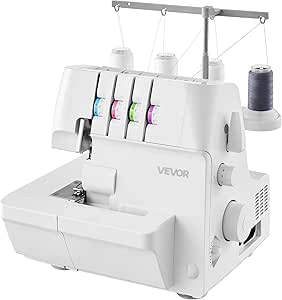 | Best Value for Stretch-Fabric Control | Thread capability: 2, 3, or 4 threads | Maximum speed: 1,250 stitches per minute | Differential feed: 0.7–2.0 | VIEW ON AMAZON | See Our Full Breakdown |
| SINGER S14-78 Serger Overlock Machine, 2–4 Thread |  | Best for Cuffs and Sleeves | Thread capability: 2, 3, or 4 threads | Maximum speed: Up to 1,300 stitches per minute, as listed | Feed: Differential feed | VIEW ON AMAZON | See Our Full Breakdown |
| SINGER S0080 Serger Overlock Machine with 8 Built-In Stitches |  | Best for Guided, Everyday Finishing | Thread capability: 4/3 thread | Built-in stitches: 8 | Differential feed: Adjustable | VIEW ON AMAZON | See Our Full Breakdown |
| Janome MOD-8933 Serger with Lay-In Threading |  | Best Compact Serger | Brand: Janome | Model: MOD-8933 (0018933D) | Stitch options: 3- and 4-thread | VIEW ON AMAZON | See Our Full Breakdown |
| MARGAR Serger Overlock Sewing Machine, 3/4-Thread, 12 Stitch Patterns |  | Best for Stitch Variety in a Compact Footprint | Brand: MARGAR | Thread capability: 3- and 4-thread | Stitch patterns: 12 | VIEW ON AMAZON | See Our Full Breakdown |
| Brother 1034D Serger Overlock Sewing Machine |  | Best for Beginners | Brand: Brother | Model: 1034D | Thread options: 3 or 4 | VIEW ON AMAZON | See Our Full Breakdown |
| SINGER Professional 5 14T968DC Serger Overlock Machine with Accessory Kit |  | Best for Advanced Stitch Versatility | Brand: SINGER | Model: 14T968DC | Stitch capability: 2, 3, 4, and 5 threads; cover stitches | VIEW ON AMAZON | See Our Full Breakdown |
| SINGER Heavy Duty 0460 Serger Overlock Machine |  | Best for Heavy-Duty Fabric Handling | Brand: SINGER | Model: HD0460 | Machine type: Serger | VIEW ON AMAZON | See Our Full Breakdown |
| Singer Heavy Duty 0420 Next Evolution Serger Overlock Machine |  | Best for Heavy Fabrics | Brand: Singer | Model: HD0420 | Stitch options: 13 | VIEW ON AMAZON | See Our Full Breakdown |
| SINGER HD0500S Heavy Duty Serger Overlock Machine, 2-3-4 Thread, Black |  | Best for Fast, Straightforward Finishing | Brand: SINGER | Model: HD0500S | Thread configurations: 2, 3, and 4 | VIEW ON AMAZON | See Our Full Breakdown |
| SINGER S0100 High-Speed Serger Overlock Machine |  | Best for a Ready-to-Start Setup | Brand: SINGER | Model: S0100 | Thread options: 2, 3, or 4 | VIEW ON AMAZON | See Our Full Breakdown |
| SINGER S0230 Navy Blue High-Speed Overlock Serger, 2-, 3-, and 4-Thread |  | Best for Color and Core Serger Functions | Brand: SINGER | Model: S0230 | Color: Navy blue | VIEW ON AMAZON | See Our Full Breakdown |
| serger sewing machine | Thread capability | Brand | Maximum speed | Model |
|---|---|---|---|---|
| VEVOR Serger Overlock Sewing M | 3- and 4-thread | — | 1,250 stitches per minute | — |
| Singer X5004-HD Serger Overloc | 2, 3, or 4 threads | — | 1,300 stitches per minute | — |
| VEVOR Serger Overlock Sewing M | 2, 3, or 4 threads | — | 1,250 stitches per minute | — |
| SINGER S14-78 Serger Overlock | 2, 3, or 4 threads | — | Up to 1,300 stitches per minute, as listed | — |
| SINGER S0080 Serger Overlock M | 4/3 thread | — | — | — |
| Janome MOD-8933 Serger with La | — | Janome | — | MOD-8933 (0018933D) |
| MARGAR Serger Overlock Sewing | 3- and 4-thread | MARGAR | 1,250 stitches per minute | — |
| Brother 1034D Serger Overlock | — | Brother | — | 1034D |
| SINGER Professional 5 14T968DC | — | SINGER | — | 14T968DC |
| SINGER Heavy Duty 0460 Serger | 4-, 3-, and 2-thread | SINGER | — | HD0460 |
| Singer Heavy Duty 0420 Next Ev | 4-, 3-, or 2-thread | Singer | — | HD0420 |
| SINGER HD0500S Heavy Duty Serg | — | SINGER | 1,300 stitches per minute | HD0500S |
| SINGER S0100 High-Speed Serger | — | SINGER | 1,300 stitches per minute | S0100 |
| SINGER S0230 Navy Blue High-Sp | 2, 3, or 4 | SINGER | 1,300 stitches per minute | S0230 |
More Details on Our Top Picks
VEVOR Serger Overlock Sewing Machine, 3/4-Thread, White
I’d shortlist this VEVOR for sewists who want a dedicated 3- and 4-thread serger with several ways to finish fabric edges. Its listed rolled hem, edging, and lettuce hem options make it more technique-focused than the SINGER S14-78, whose description highlights rolled and narrow hems. At up to 1,250 stitches per minute, it is also a little slower on paper than the SINGER X5004-HD’s 1,300-stitch maximum, though that difference may matter less for home sewing than stitch choice and setup.
Color-coded threading and an LED light give new serger owners useful setup cues, while adjustable stitch settings support different fabrics. The tradeoff is its 3/4-thread-only configuration: unlike the 2/3/4-thread VEVOR 336, it does not offer the listed 2-thread option. I’d also verify the power details before buying, since the supplied information conflicts on power source.
Pros:- Offers 3- and 4-thread sewing with several listed edge-finishing styles.
- Adjustable stitch length and width give users control over seam appearance.
- Color-coded threading and LED lighting provide practical setup assistance.
- Includes needles, tools, and spool holders for basic setup and upkeep.
Cons:- Does not list 2-thread sewing, unlike the VEVOR 336 and both SINGER alternatives in this group.
- The product information conflicts, describing a 112W motor while listing a hand-powered source.
- Iron-and-plastic construction may be less robust than the SINGER X5004-HD’s heavy-duty metal frame.
Best for: Home sewists who mainly want 3- or 4-thread seam finishing and plan to use rolled hems, edging, or lettuce hems.
Not ideal for: Buyers who need 2-thread stitching, want clearly documented electrical specifications, or prioritize an all-metal construction.
- Thread capability:3- and 4-thread
- Maximum speed:1,250 stitches per minute
- Motor power:112W listed; power-source information also describes it as hand-powered
- Stitch styles:Overlock, rolled hem, edging, lettuce hem
- Stitch adjustments:Adjustable stitch length and width
- Material:Iron and plastic
- Dimensions:10.63 × 10.24 × 10.63 in
- Weight:17.8 lb
- Lighting and threading:LED light and color-coded threading
Our verdict“Choose this VEVOR if varied hemming styles matter more to you than 2-thread capability or fully consistent power specifications.”
Singer X5004-HD Serger Overlock Machine, 2-, 3-, and 4-Thread
I’d place the SINGER X5004-HD high for sewists who expect to serge sturdier materials and want a substantial frame behind the cutting action. Its heavy-duty metal frame, stainless steel bed plate, and larger cutting knife set it apart from the iron-and-plastic VEVOR models in this group, particularly the VEVOR 4-434. That construction is paired with 2-, 3-, and 4-thread options and eight stitch types, so the machine is not limited to one kind of seam finishing.
The listed 1,300-stitch-per-minute speed edges past the VEVOR models’ 1,250 maximum, and adjustable differential feed helps accommodate fabrics that stretch or shift. The tradeoff is a less complete size picture: no dimensions or weight are provided, making workspace planning harder. Compared with the SINGER S0080, this pick puts more emphasis on cutting and frame construction than on a stated set of eight built-in stitches.
Pros:- Supports 2-, 3-, and 4-thread stitching across a range of seam-finishing needs.
- Heavy-duty metal frame and stainless steel bed plate provide a sturdier listed construction.
- Larger cutting knife is intended to handle thicker fabrics more effectively.
- Adjustable differential feed and dual LED lights support fabric control and visibility.
Cons:- Dimensions and weight are not provided, complicating workspace and storage planning.
- Its heavier-duty build may be more machine than needed for occasional lightweight hemming.
- The description lists eight stitch types but does not name them individually.
Best for: Garment makers who regularly serge denim or other heavier fabrics and want multiple thread configurations with a metal frame.
Not ideal for: Sewists who need known machine dimensions before arranging a small sewing space or who prefer a more specifically documented stitch menu.
- Thread capability:2, 3, or 4 threads
- Stitch types:8
- Maximum speed:1,300 stitches per minute
- Frame:Heavy-duty metal
- Bed plate:Stainless steel
- Cutting knife:60% larger than standard SINGER serger knives
- Feed:Adjustable differential feed
- Lighting:Dual LED lights
Our verdict“Pick the X5004-HD if a robust frame and larger cutting knife matter more than a compact footprint or fully detailed stitch list.”
VEVOR Serger Overlock Sewing Machine, 2/3/4-Thread, 1,250 Stitches per Minute
Among the two VEVOR options here, I’d favor the 336 for buyers who want the widest listed thread range and a feature aimed at managing stretchy fabric. It supports 2-, 3-, and 4-thread sewing, unlike the 3/4-thread VEVOR 4-434, and its 0.7–2.0 differential feed gives users a stated adjustment range for reducing distortion as fabric moves under the foot. That makes it a more flexible choice for knits and mixed sewing projects.
The machine also includes a free arm, LED lighting, color-coded threading, and several edge-finishing styles. Its 1,250-stitch-per-minute ceiling is below the SINGER S14-78’s listed 1,300, but both VEVOR models offer useful stitch options at a moderate listed speed. The main drawback is documentation: setup and maintenance instructions are not detailed in the supplied information, which may leave first-time serger owners wanting clearer guidance.
Pros:- Offers 2-, 3-, and 4-thread configurations for a broad range of seam-finishing tasks.
- Differential feed has a listed 0.7–2.0 range for adjusting fabric movement.
- Free arm helps with tubular projects such as cuffs and sleeves.
- LED light, color-coded threading, and multiple stitch options support varied projects.
Cons:- The supplied listing lacks detailed setup and maintenance instructions.
- Its 1,250-stitch-per-minute maximum is below the listed 1,300 maximum of the SINGER S14-78 and X5004-HD.
- Iron-and-plastic construction is less substantial on paper than the X5004-HD’s heavy-duty metal frame.
Best for: Sewists who work with knits and want 2-, 3-, and 4-thread options, differential-feed adjustment, and a free arm.
Not ideal for: Beginners who need detailed setup and maintenance guidance, or buyers whose priority is the higher listed speed of the SINGER S14-78.
- Thread capability:2, 3, or 4 threads
- Maximum speed:1,250 stitches per minute
- Differential feed:0.7–2.0
- Stitch options:Overlock, rolled hem, edging, lettuce hem
- Free arm:Yes
- Lighting and threading:LED light and color-coded threading
- Dimensions:11 × 12.6 × 12.6 in
- Weight:16.5 lb
- Input voltage:120 V
Our verdict“Choose the VEVOR 336 if flexible thread options and differential-feed control for stretch fabrics outweigh the need for detailed guidance or a higher listed speed.”
SINGER S14-78 Serger Overlock Machine, 2–4 Thread
The SINGER S14-78 earns its place for sewists who often finish small, tubular pieces rather than only long, flat seams. Its free arm makes cuffs and sleeves easier to handle, while differential feed can help limit stretching or puckering as fabrics pass through. Like the VEVOR 336 and SINGER X5004-HD, it supports 2-, 3-, and 4-thread stitching; its listed 1,300-stitch-per-minute maximum also matches the X5004-HD.
Where this SINGER is more focused is the combination of rolled and narrow hemming with a useful accessory set, including a 2-thread converter and dust cover. The VEVOR 336 lists more named edge styles, including lettuce hems, while this model’s description centers on practical seam and hem finishing. New serger owners should expect a learning curve with threading and setup, and the one-year warranty is shorter than some buyers may prefer.
Pros:- Free arm is useful for sewing around sleeves, cuffs, and other tubular sections.
- Supports 2-, 3-, and 4-thread stitching for varied seam finishes.
- Differential feed helps manage stretching and puckering.
- Includes a 2-thread converter, foot control, and dust cover.
Cons:- Threading and setup may take practice for new serger owners.
- The listed warranty is one year.
- The description names rolled and narrow hems but fewer decorative edge styles than the VEVOR models.
Best for: Garment sewists who frequently finish sleeves, cuffs, and narrow hems and want a free arm with 2–4-thread flexibility.
Not ideal for: First-time users seeking especially detailed setup support, or buyers who want a longer stated warranty or more named decorative hem options.
- Thread capability:2, 3, or 4 threads
- Maximum speed:Up to 1,300 stitches per minute, as listed
- Feed:Differential feed
- Free arm:Yes
- Hemming:Rolled and narrow hems
- Included accessories:Sewing foot, needles, tweezers, screwdriver, Allen key, 2-thread converter, foot control, dust cover
- Warranty:1 year
Our verdict“Choose the S14-78 if free-arm access for garment details is your priority and you are comfortable learning serger threading.”
SINGER S0080 Serger Overlock Machine with 8 Built-In Stitches
I’d pick the SINGER S0080 for everyday serging when a clearly stated stitch set and a more substantial internal frame matter more than a specific high-speed claim. Its eight built-in stitches cover common edge-finishing needs, while color-coded threading gives users a visual aid during setup. Compared with the VEVOR 336, the S0080 does not list a differential-feed range or a maximum speed, so buyers have less detail for judging its fabric-control range and pace.
It does, however, combine adjustable differential feed, a free arm, LED lighting, and a full metal interior frame, a well-rounded mix for garments and varied fabrics. The included lint brush, oil, needles, and dust cover also support routine care. Threading still takes practice, so I would not treat the color coding as a substitute for learning the machine. Unlike the SINGER X5004-HD, the supplied description does not specify a larger cutting knife or 2-thread configuration.
Pros:- Eight built-in stitches cover common serging and fabric-edge finishing tasks.
- Color-coded threading offers a helpful visual setup guide.
- Adjustable differential feed and a free arm support a range of fabrics and garment sections.
- Full metal interior frame, LED lighting, and maintenance accessories add practical utility.
Cons:- The supplied product details do not state a maximum sewing speed.
- Threading and setup may still require practice for new serger users.
- The listed thread capability is 4/3 thread, not the 2/3/4-thread range offered by the SINGER X5004-HD.
Best for: Home garment sewists who want eight built-in stitches, adjustable differential feed, and a free arm for regular finishing projects.
Not ideal for: Buyers who need a stated maximum speed, documented 2-thread capability, or a cutting-knife specification for heavier fabric work.
- Thread capability:4/3 thread
- Built-in stitches:8
- Differential feed:Adjustable
- Frame:Full metal interior frame
- Lighting:LED
- Free arm:Yes
- Threading aid:Color-coded threading
- Included accessories:Standard presser foot, spool holders, tweezers, screwdriver, lint brush, machine oil, soft dust cover, needles
Our verdict“Choose the S0080 for a well-equipped everyday serger with eight stitches and a free arm, but look elsewhere if you need documented speed or 2-thread sewing.”
Janome MOD-8933 Serger with Lay-In Threading
The Janome MOD-8933 is a space-conscious choice for sewists who want the core advantages of a serger without a large machine footprint. Its 3- and 4-thread options, differential feed, and adjustable presser foot pressure make it useful across knits, denim, and hems; the differential feed can help limit stretching or puckering as fabric moves through. Color-coded lay-in threading and a quick-change rolled hem keep common setup and finishing tasks straightforward. Compared with the feature-rich SINGER Professional 5 14T968DC, the Janome offers fewer stitch configurations, but takes up less room and weighs less. That compact design is a practical fit for smaller sewing spaces, though it may feel limiting when handling larger projects. The listed included components are sparse, so I would check what tools and accessories are supplied before buying.
Pros:- Compact 11 × 12-inch footprint fits smaller sewing areas.
- Offers both 3- and 4-thread stitching.
- Differential feed and adjustable presser foot pressure help manage different fabrics.
- Color-coded lay-in threading and quick-change rolled hem support routine setup and finishing.
Cons:- Compact size may be restrictive when working with large pieces of fabric.
- Product information lists only a screwdriver among the included components.
Best for: Sewists with limited workspace who mainly need dependable 3- and 4-thread finishing for garments, knits, and hems.
Not ideal for: Buyers planning large projects or seeking a broad stitch selection and a substantial included accessory kit.
- Brand:Janome
- Model:MOD-8933 (0018933D)
- Stitch options:3- and 4-thread
- Threading:Color-coded lay-in system
- Feed:Differential feed
- Dimensions:11 × 12 × 10.7 inches
- Weight:14.3 pounds
- Warranty:25-year limited
Our verdict“Choose the MOD-8933 if compact dimensions and practical 3- and 4-thread serging matter more than extensive stitch options or bundled accessories.”
MARGAR Serger Overlock Sewing Machine, 3/4-Thread, 12 Stitch Patterns
The MARGAR Serger pairs a relatively compact footprint with 12 stitch patterns, making it appealing to sewists who want more built-in choices than the Janome MOD-8933’s core 3- and 4-thread setup. Differential feed, adjustable cutting blades, and adjustable presser foot pressure offer useful control as fabric passes through, while the LED and color-coded guides make the threading area easier to follow. Its stated speed of up to 1,250 stitches per minute suits regular garment finishing, and the metal frame and vibration-damping base are intended to steady operation. The tradeoff is that its threading may take practice; the supplied rethreading instructions and video tutorial can help, but this is less straightforward than a simple setup-focused pick. I’d also plan to use quality thread, since the product information flags breakage and skipped stitches as possible concerns.
Pros:- Provides 12 stitch patterns alongside 3- and 4-thread overlocking.
- Differential feed and adjustable presser foot pressure support work with varied fabrics.
- LED lighting and color-coded guides help with threading and visibility.
- Includes rethreading instructions and an accessory kit.
Cons:- Rethreading may take practice, with the video tutorial recommended for beginners.
- Quality thread may be needed to reduce breakage and skipped stitches.
Best for: Sewists who want several built-in stitch patterns, adjustable fabric handling, and a compact machine for frequent garment finishing.
Not ideal for: First-time serger owners who want an especially simple threading process or buyers unwilling to follow setup instructions carefully.
- Brand:MARGAR
- Thread capability:3- and 4-thread
- Stitch patterns:12
- Maximum speed:1,250 stitches per minute
- Features:Differential feed, adjustable cutting blades and presser foot, LED light, color-coded threading guides
- Frame material:Alloy steel
- Dimensions:10.2 × 11.8 × 10.2 inches
- Weight:19.8 pounds
Our verdict“Pick the MARGAR if built-in stitch variety and adjustable controls appeal more than the Janome MOD-8933’s simpler, compact feature set.”
Brother 1034D Serger Overlock Sewing Machine
The Brother 1034D is a practical entry point for sewists who want a straightforward 3- or 4-thread serger with useful threading aids. Color-coded guides and a lower looper threader address a task that often makes sergers less approachable, while the differential feed helps keep stretch and lightweight fabric from distorting as it is sewn. The included standard, gathering, and blind stitch feet give it more out-of-the-box utility than the Janome MOD-8933, whose listed components are limited. It also reaches 1,300 stitches per minute and has a convertible free-arm and flat-bed surface for different sewing tasks. The tradeoffs are its US-specific 120-volt setup and a five-year limited parts warranty with only 90 days of labor coverage. Additional stitch options call for optional presser feet.
Pros:- Color-coded guides and a lower looper threader simplify key threading steps.
- Differential feed helps manage stretch and lightweight fabrics.
- Includes standard, gathering, and blind stitch presser feet.
- Convertible free-arm and flat-bed surface accommodates different sewing tasks.
Cons:- Designed for 120-volt use in the US; use or sale elsewhere voids the warranty.
- Additional stitch options require optional presser feet.
- Labor coverage is limited to 90 days.
Best for: New serger owners in the US who want threading aids, three included presser feet, and a machine for garment sewing across varied fabrics.
Not ideal for: Buyers outside the US, anyone needing a broad set of stitch options without purchasing extra feet, or shoppers seeking longer labor coverage.
- Brand:Brother
- Model:1034D
- Thread options:3 or 4
- Maximum sewing speed:1,300 stitches per minute
- Frame:Metal
- Included presser feet:Standard, gathering, blind stitch
- Dimensions:10 × 11 × 13 inches
- Weight:8 pounds
- Warranty:5-year limited parts; 90-day labor
Our verdict“Choose the Brother 1034D if you want beginner-friendly threading aids and useful included feet, and its US-only power and warranty terms suit you.”
SINGER Professional 5 14T968DC Serger Overlock Machine with Accessory Kit
The SINGER Professional 5 14T968DC is the most versatile choice here for sewists who want more than standard overlocking: it supports 2-, 3-, 4-, and 5-thread stitching as well as cover stitches. That range makes it better suited than the Brother 1034D to projects where stitch type and seam finish change from one garment to the next. Differential feed helps reduce distortion on stretch fabric and puckering on sheers, while automatic tension adjustment and speeds up to 1,300 stitches per minute support a more efficient workflow. Its accessory kit also includes tools and maintenance supplies, unlike the Janome MOD-8933’s sparse listed components. The tradeoff is a more involved setup: the threading diagram is helpful, but threading can still take time. Its broader capability is best put to use by sewists willing to learn the setup.
Pros:- Supports 2-, 3-, 4-, and 5-thread configurations plus cover stitches.
- Differential feed helps handle stretchy and sheer fabrics.
- Automatic tension adjustment supports changes between fabric and stitch tasks.
- Includes a broad range of sewing, threading, and maintenance accessories.
Cons:- Threading and setup may take time even with the threading diagram.
- Its expanded stitch range may be unnecessary for sewists who only need basic overlocking.
Best for: Experienced garment sewists who want multiple thread configurations, cover stitches, and a substantial assortment of setup and maintenance accessories.
Not ideal for: Beginners seeking a simple first serger or occasional sewists who are unlikely to use its expanded stitch capabilities.
- Brand:SINGER
- Model:14T968DC
- Stitch capability:2, 3, 4, and 5 threads; cover stitches
- Maximum sewing speed:1,300 stitches per minute
- Machine size:13.5 × 10.5 × 11.5 inches
- Machine weight:18.6 pounds
- Power:120 V, 114 W, 0.5 A, 60 Hz
- Warranty:25-year limited
- Included accessories:General purpose foot, screwdrivers, clean pocket, extra knife, spool caps, thread nets, oiler, brush, tweezers, needles, cone adapters, soft dust cover
Our verdict“Choose the Professional 5 if you will use its cover stitches and multiple thread configurations; the Brother 1034D is a simpler fit for basic serging.”
SINGER Heavy Duty 0460 Serger Overlock Machine
The SINGER Heavy Duty 0460 is aimed at sewists who need a serger that can work across lightweight, stretchy, and heavier fabrics. Its heavy-duty motor, full metal interior frame, and stainless steel bed plate distinguish it from the lighter Brother 1034D, while differential feed helps control stretching and puckering. With 13 built-in stitches and 2-, 3-, and 4-thread capability, it covers common serging, flatlock, and rolled hem tasks without matching the Professional 5’s 5-thread and cover-stitch range. LED lighting around the threading area is a practical aid, though it does not remove the need to follow setup instructions and use the included tools. Optional presser feet are sold separately, and the listed one-year warranty is shorter than the 25-year limited warranties listed for the Janome MOD-8933 and Professional 5.
Pros:- Heavy-duty motor and full metal interior frame are suited to work across fabric weights.
- Differential feed helps reduce stretching and puckering.
- 13 built-in stitches include serging, flatlock, and rolled hem techniques.
- LED-lit threading area and stainless steel bed plate support setup and fabric handling.
Cons:- Optional presser feet are sold separately.
- Threading and setup may require close attention to the tools and instructions.
- Listed one-year warranty is shorter than those of the Janome MOD-8933 and SINGER Professional 5.
Best for: Sewists who regularly finish thicker fabrics as well as knits and lightweight material, and want a metal-framed machine with multiple built-in stitches.
Not ideal for: Buyers who need cover stitches or a 5-thread option, want optional presser feet included, or place high priority on a longer listed warranty.
- Brand:SINGER
- Model:HD0460
- Machine type:Serger
- Built-in stitches:13
- Thread capability:4-, 3-, and 2-thread
- Differential feed:Yes
- Frame:Full metal interior frame
- Bed plate:Stainless steel
- Warranty:1 year
Our verdict“Pick the Heavy Duty 0460 for a metal-framed serger aimed at thicker fabrics, but choose the Professional 5 if cover stitches and 5-thread capability matter more.”
Singer Heavy Duty 0420 Next Evolution Serger Overlock Machine
I’d choose the Singer Heavy Duty 0420 when handling thicker materials is a bigger priority than keeping the setup especially simple. Its heavy-duty motor and full metal interior frame are aimed at steadier sewing across different fabric weights, while differential feed helps reduce stretching on knits and puckering on delicate fabrics. Compared with the SINGER HD0500S, the 0420 offers 13 stitch options rather than six, giving sewists more choice for hems and seam finishes. Color-coded threading can make initial setup less confusing, but it does not remove the effort involved in threading a serger. The tradeoff is that specialized presser feet are sold separately, and regular cleaning and oiling are part of ownership. I’d favor this over the SINGER S0100 for buyers who value stitch variety and a sturdier build more than a simpler feature set.
Pros:- Heavy-duty motor and full metal interior frame support work across varied fabric weights.
- Differential feed helps limit wavy seams on knits and puckering on delicate materials.
- Thirteen stitch options offer more finishing choices than the six on the HD0500S and S0100.
- Color-coded threading paths make setup easier to follow.
Cons:- Specialized presser feet are sold separately.
- Regular cleaning and oiling are required for maintenance.
- The broader stitch selection may be more than a basic seam-finishing routine needs.
Best for: Sewists who regularly finish denim, heavier apparel fabrics, or mixed-weight projects and want multiple stitch options.
Not ideal for: Occasional sewists seeking minimal upkeep or buyers who need specialized presser feet included from the start.
- Brand:Singer
- Model:HD0420
- Stitch options:13
- Thread capability:4-, 3-, or 2-thread
- Frame:Full metal interior
- Motor:Heavy-duty
- Features:Differential feed, large cutting blade, LED lighting, color-coded threading
- Included accessories:Standard presser foot, spool holders, tweezers, 2-thread converter, screwdriver, lint brush, sewing machine oil, spare lower-cutter knife blade, needles, soft dust cover
Our verdict“Choose the Heavy Duty 0420 if you want a sturdy serger with broad stitch choice for varied fabric weights and can handle routine maintenance.”
SINGER HD0500S Heavy Duty Serger Overlock Machine, 2-3-4 Thread, Black
The SINGER HD0500S suits sewists who want a fast everyday overlock machine without needing a long list of stitch variations. It reaches 1,300 stitches per minute and covers six stitch types, with 2-, 3-, and 4-thread configurations for common seams, hems, and decorative edges. Compared with the Heavy Duty 0420, it gives up stitch variety but keeps useful conveniences such as an LED-lit lower looper, color-coded threading, and adjustable differential feed. The removable free arm is handy for sewing around smaller, tubular sections, while the included waste tray helps collect trimmings. Its 7.2 kg weight makes it less appealing for frequent moving, and the accessory details are not as extensive as the 0420’s listed kit. I’d pick this over the SINGER S0100 when a free arm and lower-looper light are priorities.
Pros:- Sews at up to 1,300 stitches per minute for quick seam finishing.
- Supports 2-, 3-, and 4-thread configurations across six stitch types.
- LED-lit lower looper and color-coded threading help with setup.
- Adjustable differential feed and removable free arm support varied sewing tasks.
Cons:- At 7.2 kg, it may be inconvenient to move often.
- Six stitch types offer less variety than the Heavy Duty 0420’s 13 options.
- The listed included components provide limited detail about the full accessory package.
Best for: Home sewists who want a fast machine for routine garment seams and value a free arm and illuminated looper area.
Not ideal for: Sewists who frequently carry their machine between workspaces or want a wide selection of built-in stitch types.
- Brand:SINGER
- Model:HD0500S
- Thread configurations:2, 3, and 4
- Stitch types:6
- Maximum speed:1,300 stitches per minute
- Stitch length:1.0–4.0 mm
- Weight and frame:7.2 kg; metal frame
- Features:Lower looper LED, removable free arm, adjustable differential feed
- Included accessories:2-thread converter, extra needles, spare knife, tweezers, screwdriver, lint brush, waste tray
Our verdict“Choose the HD0500S for quick everyday serging with a free arm and looper lighting, but skip it if portability or stitch variety leads your priorities.”
SINGER S0100 High-Speed Serger Overlock Machine
Among these options, I’d point new serger owners toward the SINGER S0100 if they want a machine that arrives pre-threaded and includes accessories in a front compartment. It trims and sews in one step, supports 2-, 3-, or 4-thread work, and runs at up to 1,300 stitches per minute. Its adjustable differential feed can help keep knit seams from stretching and delicate fabric from puckering. The six built-in stitches make it more focused than the Heavy Duty 0420, which offers 13 choices, but that narrower menu may be enough for everyday seams, hems, and decorative edges. The built-in free arm adds flexibility on smaller garment sections. Pre-threading helps with the initial start, though changing projects still takes setup effort; the HD0500S also offers a free arm and the same listed maximum speed.
Pros:- Arrives pre-threaded, providing a more approachable initial setup.
- Sews and trims fabric in one operation.
- Adjustable differential feed helps manage knits and delicate fabrics.
- Includes a built-in free arm and useful setup accessories.
Cons:- Threading and setup still take effort when changing projects.
- Six built-in stitches provide less variety than the Heavy Duty 0420.
- The listed warranty is one year.
Best for: First-time serger owners who want a pre-threaded starting point for garment seams, hems, and occasional knits.
Not ideal for: Experienced sewists seeking many stitch variations or buyers who expect project changes to require no rethreading effort.
- Brand:SINGER
- Model:S0100
- Thread options:2, 3, or 4
- Built-in stitches:6
- Maximum speed:1,300 stitches per minute
- Differential feed:Adjustable
- Frame and free arm:Metal frame; built-in free arm
- Threading:Color-coded; arrives pre-threaded
- Warranty:1 year
Our verdict“Choose the S0100 if pre-threading and a focused set of everyday serger functions matter more than extensive stitch choice.”
SINGER S0230 Navy Blue High-Speed Overlock Serger, 2-, 3-, and 4-Thread
The SINGER S0230 is a straightforward choice for buyers who want core overlock functions in a navy-blue finish. It sews, trims, and finishes in one operation, with 2-, 3-, and 4-thread capability for seams, rolled hems, and decorative edges. Adjustable differential feed helps manage stretching and puckering, while color-coded threading and a built-in free arm add practical flexibility. Compared with the SINGER S0100, the S0230’s supplied details do not list a stitch count, pre-threaded setup, maximum speed, or warranty, so it is harder to compare on those points. The S0100 is a clearer fit for a buyer who values a documented 1,300-stitches-per-minute speed and arrival pre-threaded. Threading still takes setup on the S0230, and its accessory information is broad rather than itemized.
Pros:- Combines trimming and seam finishing in one operation.
- Supports 2-, 3-, and 4-thread stitching for several common finishes.
- Adjustable differential feed helps with knits and delicate fabrics.
- Color-coded threading and a built-in free arm support setup and garment sewing.
Cons:- The supplied product details do not state a stitch count or maximum speed.
- Threading still requires setup despite color-coded guides.
- Included components are described generally as serger and accessories, without an itemized list.
Best for: Home sewists who want a basic 2-, 3-, and 4-thread serger with a free arm and prefer a navy-blue machine.
Not ideal for: Buyers who need a clearly specified stitch count, detailed accessory list, or documented speed before choosing.
- Brand:SINGER
- Model:S0230
- Color:Navy blue
- Thread capability:2, 3, or 4
- Maximum speed:1,300 stitches per minute
- Feed:Adjustable differential feed
- Features:Color-coded threading; built-in free arm
- Included components:Serger and accessories
- Part number:230622112
Our verdict“Choose the S0230 for its core serger functions, free arm, and navy finish, but favor the S0100 if detailed specifications and pre-threaded setup matter more.”

How We Picked
I ranked these machines around the decisions that affect daily serging: supported thread configurations, stitch variety, threading and adjustment demands, speed information, and the intended balance of capability and ease of use. A feature only mattered when it could change the work a buyer can do or the effort required to set up a seam; a long feature list by itself did not earn a higher position.
The Brother 1034D leads as the most balanced choice for a wide range of home sewing needs, while the SINGER Professional 5 14T968DC ranks as a stronger fit for buyers prioritizing versatility. Models with specific strengths—such as lay-in threading, heavy-duty positioning, or stated high-speed operation—rank well for those needs but are not automatic upgrades for every sewer. Because the supplied product information does not establish comparable performance tests or construction details across all 14 machines, I avoid treating brand labels or speed claims as proof of better seam quality; buyers should check included accessories, manuals, and local service support before purchasing.
Factors to Consider When Choosing Serger Sewing Machine
A serger can complement a regular sewing machine, but choosing well means matching its capabilities to your actual projects. I’d start with the fabrics and finishes you sew most often, then weigh setup effort against the range of stitches you expect to use.
Match Thread Configurations to Your Projects
Thread count affects the kind of seam or edge finish a serger can produce, but more configurations do not automatically make a machine the right fit. A 3- or 4-thread setup covers many common seam and overcast tasks, while 2-thread options can suit particular lightweight finishing needs. Before buying, list the finishes you want to make and check that the machine’s manual explains how to set them up. A common mistake is choosing by the largest thread-count number and overlooking whether you will actually use the additional settings. If your projects are mostly garment seams and edge finishing, reliable access to the settings you need matters more than an impressive-sounding count.
Treat Threading Convenience as a Real Workload Factor
Serger threading can take more attention than changing thread on a basic sewing machine, so the path and clarity of the threading instructions affect how often you’ll want to switch colors or stitch setups. Lay-in threading, like the feature called out on the Janome MOD-8933, may appeal if you want a more direct setup process. Still, the presence of a convenience feature does not tell the whole story: check whether the machine’s diagrams are clear and whether the manual covers rethreading after a break. Buyers often underestimate this step and focus only on sewing speed or stitch count. If you expect frequent changes, give setup usability more weight than a feature you may rarely use.
Choose Speed for Control, Not Just Throughput
A higher stated stitch speed can help when you are finishing long seams, but it does not guarantee cleaner results or better control. New users may prefer a pace they can manage while guiding stretchy or slippery fabric, even if the machine can run faster. When comparing speed claims, look for information about foot control and how the machine behaves at lower speeds, not just its maximum figure. One VEVOR listing specifies 1,250 stitches per minute, while SINGER’s S0100 and S0230 are identified as high-speed models; those labels should be compared with your need for steady handling. A short practice session on fabric scraps is a sensible way to learn the machine’s response before sewing a finished garment.
Decide Whether Stitch Variety Will Earn Its Place
More stitch options are useful when your projects call for different edge finishes, decorative effects, or construction methods. They add less value if you mainly want a dependable overcast edge and rarely change settings. Check the stitch list and the adjustment steps in the manual instead of relying on a headline number such as the MARG model’s 12 stitch patterns or the SINGER S0080’s eight built-in stitches. The common buying error is paying attention to the count without checking which stitches are included and what each one can do. Choose variety when it matches a real project plan, not simply because it sounds like room to grow.
Interpret Heavy-Duty Labels Through Your Fabric Mix
Heavy-duty branding may signal that a machine is aimed at more demanding use, but it does not replace specific information about the fabrics, needles, and thread it handles. Denim hems, multiple fabric layers, and frequent production work place different demands on a serger than occasional knitwear finishing. Check the manual’s guidance for suitable materials and confirm that replacement parts and service are accessible where you live. A common mistake is assuming a heavy-duty label means every thick or layered project will feed cleanly. If you mostly sew light and medium-weight garments, threading ease and stitch control may matter more than a rugged positioning.
Compare Ownership Details Before You Commit
Two machines with similar thread configurations can differ in the accessories supplied, maintenance instructions, warranty terms, and ease of finding service. These details shape the cost and effort of ownership even when they do not appear in a stitch chart. Check whether the package includes the tools and feet you expect, and confirm which consumables—such as needles and loopers—are readily available. Buyers can overlook service access when a machine is purchased online, then face delays if a part needs replacement or adjustment. A clear manual and reachable support can be more valuable than a small feature advantage you may seldom use.
Frequently Asked Questions
Can a serger replace my regular sewing machine?
Usually, no: a serger excels at trimming and finishing fabric edges, while a regular sewing machine handles many tasks a serger is not designed for, such as topstitching, buttonholes, and certain construction seams. Some sergers offer several stitch formats, but that does not make them a full substitute for a conventional machine. If you sew garments, using both lets you construct seams on the regular machine and finish edges with the serger. Buyers with limited space should compare the tasks they actually need to do before deciding to own only one machine. For finishing-focused work, a serger can still make a useful standalone addition.
Should a beginner choose a 2-, 3-, or 4-thread serger?
For many new serger owners, a machine that supports 3- and 4-thread sewing provides a practical range for common seams and edge finishes. A 2-thread option can be useful for particular finishing tasks, but it may not be the first setup a beginner uses most often. Thread count does not indicate how easy a machine is to thread or adjust, so inspect the manual and threading diagrams before deciding. The Janome MOD-8933’s lay-in threading feature may be relevant if setup is a priority, while the Brother 1034D is the roundup’s balanced starting recommendation. Choose based on the projects you plan to sew, not on the assumption that the most configurations are automatically easiest.
Is a high-speed serger a good choice for someone new to serging?
It can be, but maximum speed is less important for a beginner than predictable control at a comfortable pace. Learning to guide fabric, manage thread tension, and follow seam allowances takes practice, especially on knits or slippery materials. Models identified as high-speed, including the SINGER S0100 and S0230, may suit buyers who value faster sewing once their technique is settled. Check the manual for speed control information and practice on scraps before working on a project garment. If you expect to sew slowly while learning, prioritize setup clarity and control over the speed label.
Is a heavy-duty serger necessary for sewing denim or multiple layers?
Not automatically: a heavy-duty label does not by itself confirm that a machine will handle every thickness or combination of layers. Check the manufacturer’s fabric guidance, needle recommendations, and instructions for the exact model before using it on dense seams. The SINGER heavy-duty options may appeal to buyers seeking that positioning, but the right match still depends on the garments and seam construction involved. Test on scraps that use the same fabric and number of layers, and avoid forcing material through the machine. If thick seams are a frequent part of your work, service availability and compatible needles deserve attention alongside the label.
How much should I prioritize extra stitch patterns?
Prioritize them when you can name the finishes or project types you expect to use; otherwise, a smaller set of clear, useful stitches may be enough. The MARG listing calls out 12 stitch patterns, and the SINGER S0080 lists eight built-in stitches, but counts alone do not show which settings suit your work. Compare the stitch descriptions and instructions, then look at how easily the machine switches between them. If you mainly need neat edge finishing, threading and adjustment usability may make a bigger difference day to day. If you regularly experiment with garment finishes, a broader selection may justify the added learning effort.
Conclusion
For most home sewists, I’d start with the Brother 1034D as the best overall balance in this group. The best value pick is the VEVOR 2/3/4-thread model when its stated 1,250-stitches-per-minute capability matches your needs and its documentation and support check out; buyers who value setup convenience should compare the Janome MOD-8933. For a best premium choice focused on wider stitch-format flexibility, consider the SINGER Professional 5 14T968DC. Beginners should favor the Brother 1034D or the Janome if lay-in threading is the deciding factor, while sewists seeking a heavy-duty-oriented option can compare the SINGER X5004-HD and SINGER Heavy Duty models against the fabric guidance for their exact projects. Before choosing, verify the included accessories, threading instructions, and service options; those details can outweigh small differences in headline features.
Halloween Picks
halloween
As an affiliate, we earn on qualifying purchases.