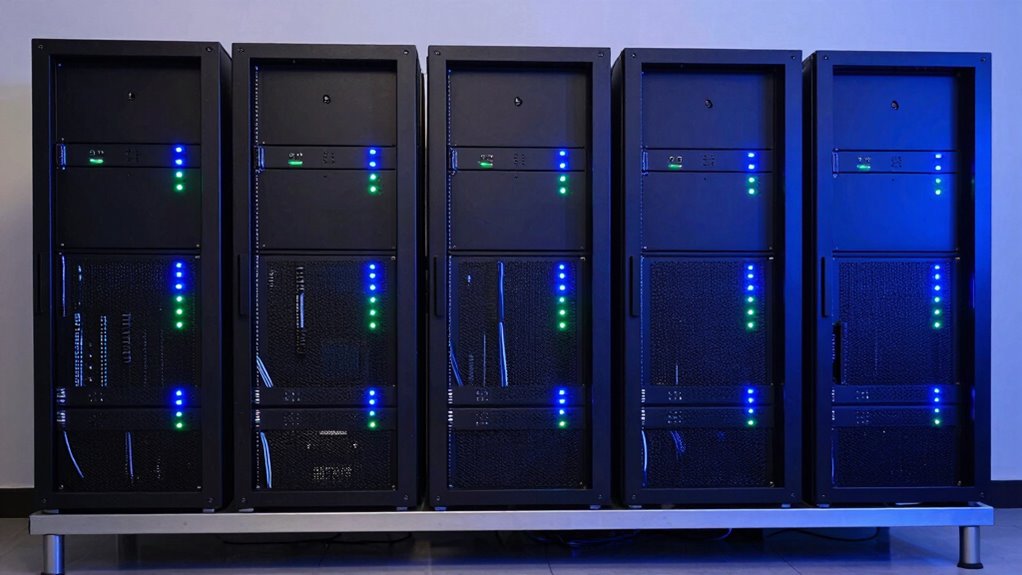

If you’re looking to build a powerful, reliable home lab in 2026, I recommend considering enterprise-grade servers like the HP ProLiant DL360p or Dell PowerEdge R710, which offer great performance and expandability. Compact racks such as GeeekPi’s 4U and 8U models help save space without sacrificing cooling. For storage, options like the Dell R730xd and HPE MicroServer are excellent. Managing power and remote access is essential, so choose servers with smart management tools. Keep exploring to find the best fit for your needs.
Key Takeaways
- Highlight enterprise-grade servers like HP ProLiant DL360p and Dell R710 for reliability and performance in home labs.
- Emphasize scalable storage options with RAID support and expansion capabilities for growing needs.
- Include remote management features such as iDRAC, iLO6, and IPMI for easy maintenance and troubleshooting.
- Recommend space-efficient rack solutions like GeeekPi mini racks for compact, organized setups.
- Stress considerations for physical space, power efficiency, budget, and remote control features in server selection.
| HP ProLiant DL360p Gen8 1U Server with 64GB RAM | 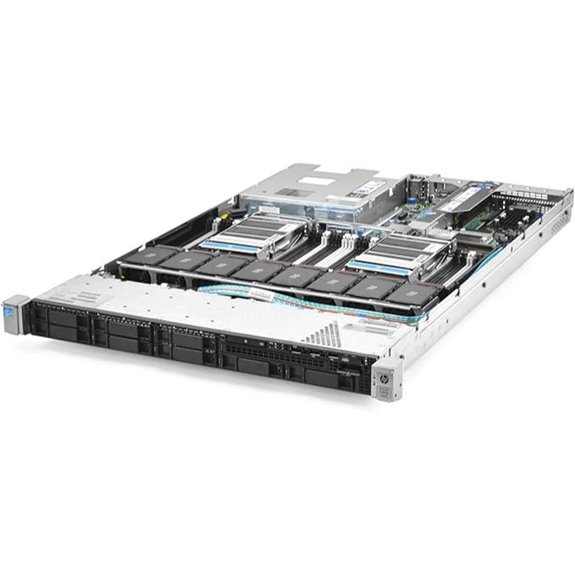 | Enterprise Powerhouse | Processor Type: Dual Intel Xeon E5-2640 (6-core, 2.5GHz) | RAM Capacity: 64GB | Storage Support: 8x 300GB SAS drives | VIEW LATEST PRICE | See Our Full Breakdown |
| Renewed Dell PowerEdge R710 12-Core Virtualization Server | 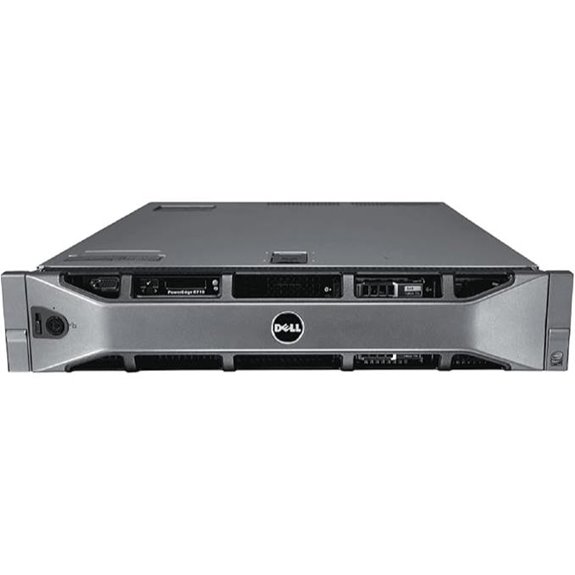 | Virtualization Champion | Processor Type: 2 Intel Xeon X5670 (6-core, 2.93GHz) | RAM Capacity: 64GB | Storage Support: 6x 2TB SATA HDDs | VIEW LATEST PRICE | See Our Full Breakdown |
| GeeekPi 4U Mini Server Rack for Network Equipment |  | Compact Network Hub | Processor Type: Raspberry Pi 5 (ARM-based, not x86) | RAM Capacity: Not applicable (Raspberry Pi) | Storage Support: Not applicable (Rack mount for devices) | VIEW LATEST PRICE | See Our Full Breakdown |
| Dell PowerEdge R730xd Server with Dual Xeon Processors | 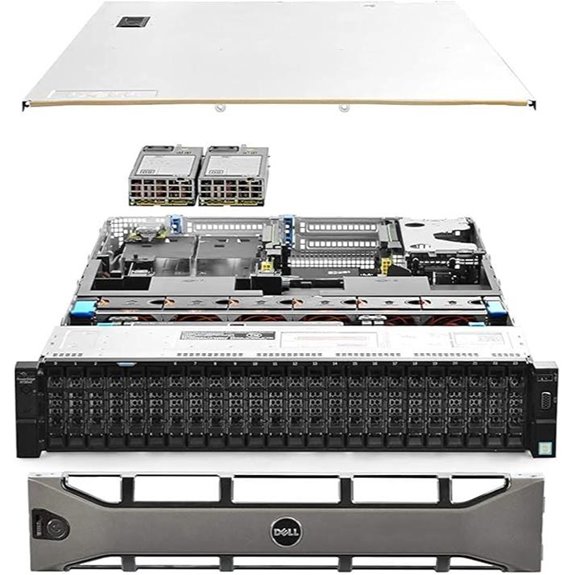 | High-Performance Storage | Processor Type: Dual Intel Xeon E5-2690 v4 (14-core, 2.6GHz) | RAM Capacity: 128GB (expandable to 3TB) | Storage Support: 4x 1.2TB SAS drives | VIEW LATEST PRICE | See Our Full Breakdown |
| GeeekPi 10″ Rack Mount for Raspberry Pi 5 | 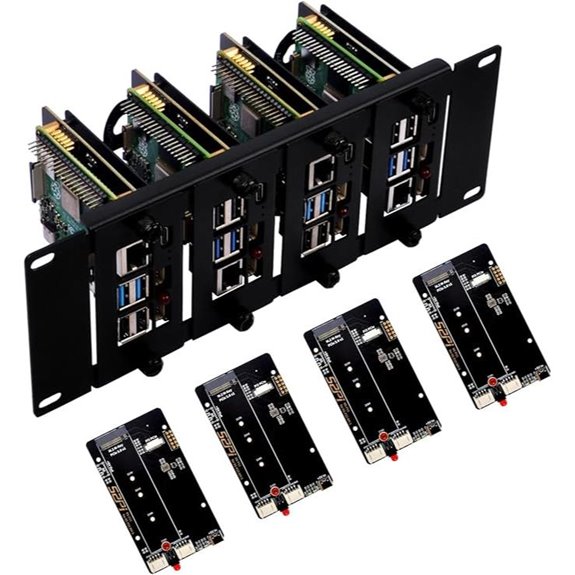 | Small Footprint Rack | Processor Type: Raspberry Pi 5 (ARM-based, not x86) | RAM Capacity: Not applicable (Raspberry Pi) | Storage Support: Not applicable (Raspberry Pi) | VIEW LATEST PRICE | See Our Full Breakdown |
| GeeekPi 8U Server Rack for Network Equipment |  | Space-Saving Design | Processor Type: Not specified (Rack, not a server) | RAM Capacity: Not applicable (Rack) | Storage Support: Not applicable (Rack mount) | VIEW LATEST PRICE | See Our Full Breakdown |
| HPE ProLiant MicroServer Gen11 Xeon 32GB 4TB | 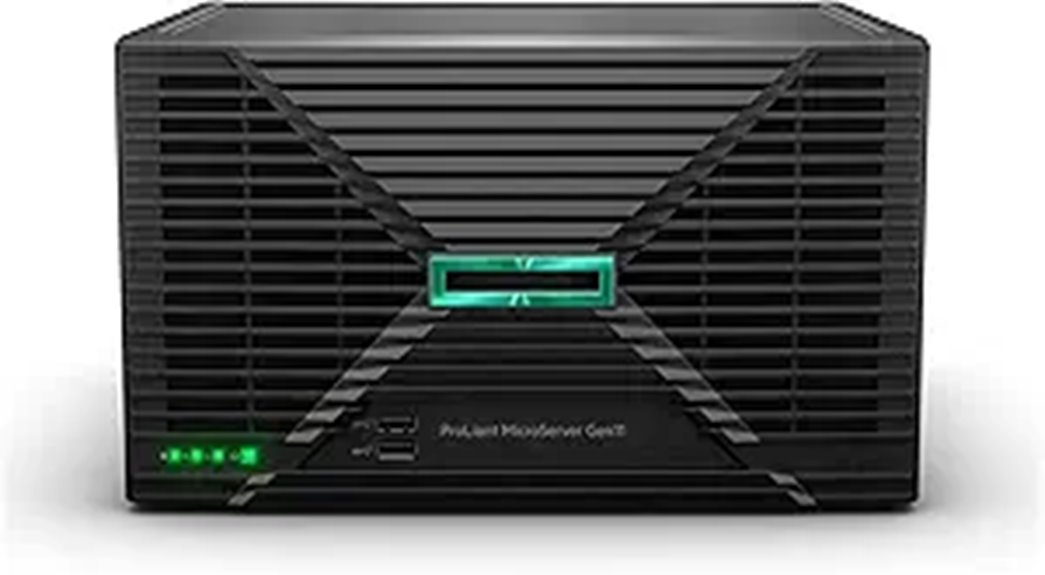 | Mini Enterprise Server | Processor Type: Intel Xeon E-2434 (4-core, 3.4GHz) | RAM Capacity: 32GB (expandable to 128GB) | Storage Support: 4TB HDD (internal, for server) | VIEW LATEST PRICE | See Our Full Breakdown |
More Details on Our Top Picks
HP ProLiant DL360p Gen8 1U Server with 64GB RAM
Looking for a reliable, enterprise-grade server that won’t break the bank for your home lab? The HP ProLiant DL360p Gen8 is a perfect choice. It’s a 1U rackmount with dual 6-core Intel Xeon E5-2640 processors at 2.5GHz and 64GB of RAM, offering solid performance for demanding tasks. Equipped with eight 300GB SAS drives and a P420i RAID controller, it handles storage with ease. Four Gigabit Ethernet ports ensure robust connectivity, while its tested, refurbished condition guarantees quality at a lower cost. Compact and powerful, this server balances enterprise features with affordability, making it ideal for serious home lab setups.
- Processor Type:Dual Intel Xeon E5-2640 (6-core, 2.5GHz)
- RAM Capacity:64GB
- Storage Support:8x 300GB SAS drives
- Form Factor:1U rackmount
- Network Connectivity:4 Gigabit Ethernet ports
- Management Features:No pre-installed OS, basic management
- Additional Feature:Dual 6-core CPUs
- Additional Feature:8 SAS Hot-Swap Drives
- Additional Feature:No pre-installed OS
Renewed Dell PowerEdge R710 12-Core Virtualization Server
The Renewed Dell PowerEdge R710 with dual 12-core processors is an excellent choice for home lab enthusiasts who need reliable virtualization performance without breaking the bank. It features two Intel Xeon X5670 CPUs, each with 6 cores at 2.93GHz, providing a solid 12-core processing power. With 64GB of DDR3 RAM and six 2TB SATA drives in a RAID setup, it offers ample storage and speed for multiple virtual machines. Dual 8700W power supplies ensure uptime, while the iDRAC6 remote management simplifies maintenance. Although the bezel isn’t included, this server delivers powerful virtualization capabilities at a renewed price point, making it a versatile home lab cornerstone.
- Processor Type:2 Intel Xeon X5670 (6-core, 2.93GHz)
- RAM Capacity:64GB
- Storage Support:6x 2TB SATA HDDs
- Form Factor:Tower/server
- Network Connectivity:4 1GbE ports
- Management Features:iDRAC6 remote management
- Additional Feature:12-core CPU configuration
- Additional Feature:Remote management via iDRAC6
- Additional Feature:Redundant power supplies
GeeekPi 4U Mini Server Rack for Network Equipment
For those managing limited space but needing reliable organization, the GeeekPi 4U Mini Server Rack offers a compact solution with its 4U height and open design. Made from durable aluminum alloy and acrylic, it allows easy access for installation and maintenance. The perforated side panels enhance airflow, keeping equipment cool and performing at its best. With dimensions of just 10 inches wide and 7 inches tall, it’s perfect for small offices, home labs, or space-constrained environments. Whether setting up network, server, or media equipment, this rack helps keep everything neatly organized while ensuring reliable cooling and accessibility.
- Processor Type:Raspberry Pi 5 (ARM-based, not x86)
- RAM Capacity:Not applicable (Raspberry Pi)
- Storage Support:Not applicable (Rack mount for devices)
- Form Factor:Rack mount (mini, 4U)
- Network Connectivity:Not applicable (Rack mount)
- Management Features:Not applicable (Rack mount)
- Additional Feature:Aluminum and acrylic frame
- Additional Feature:Perforated airflow panels
- Additional Feature:Supports cluster setups
Dell PowerEdge R730xd Server with Dual Xeon Processors
If you’re building a powerful home lab in 2026, the Dell PowerEdge R730xd Server with Dual Xeon Processors stands out as an ideal choice for demanding workloads. It features dual Intel Xeon E5-2690 v4 processors with 28 cores, 128GB DDR4 RAM (expandable to 3TB), and four 1.2TB SAS drives for fast storage. The server offers high-speed network options, including 10Gbps SFP+ ports, and remote management via iDRAC8. As a renewed product, it’s tested and certified to perform like new, with a 90-day warranty. Its reliability, scalability, and enterprise features make it perfect for intensive data processing and virtualization.
- Processor Type:Dual Intel Xeon E5-2690 v4 (14-core, 2.6GHz)
- RAM Capacity:128GB (expandable to 3TB)
- Storage Support:4x 1.2TB SAS drives
- Form Factor:2U rackmount
- Network Connectivity:2x 10GbE, 2x 1GbE ports
- Management Features:iDRAC8 Express remote management
- Additional Feature:28 total cores
- Additional Feature:128GB DDR4 RAM
- Additional Feature:4x 1.2TB SAS Drives
GeeekPi 10″ Rack Mount for Raspberry Pi 5
Looking to maximize your Raspberry Pi 5’s potential in a home lab setup? The GeeekPi 10″ Rack Mount is a compact, 2U housing designed for easy integration into standard 10-inch server racks. It supports Raspberry Pi 5 with accessible ports and slots for M.2 NVMe SSDs, including PCIe high-speed transfer capabilities. With four PCIe to M.2 adapters, you can expand storage considerably. The rack mount includes features like a GPIO pin for programmable LED indicators, aiding in device management. Its compatibility with Raspberry Pi OS and focus on performance make it an excellent choice for building a reliable, scalable, and efficient home lab server.
- Processor Type:Raspberry Pi 5 (ARM-based, not x86)
- RAM Capacity:Not applicable (Raspberry Pi)
- Storage Support:Not applicable (Raspberry Pi)
- Form Factor:Rack mount (10-inch)
- Network Connectivity:Not applicable (Rack mount)
- Management Features:Not applicable (Rack mount)
- Additional Feature:Supports M.2 NVMe SSDs
- Additional Feature:PCIe to M.2 adapters
- Additional Feature:Raspberry Pi 5 compatibility
GeeekPi 8U Server Rack for Network Equipment
The GeeekPi 8U Server Rack stands out as an excellent choice for home lab enthusiasts who need a compact yet versatile solution. Its 10-inch width and dimensions of 11 x 7.8 x 16 inches make it ideal for small spaces, whether at home or in a small office. The open design allows for easy access, installation, and cooling, while translucent acrylic sides offer dust resistance and visibility of the interior. Constructed from durable aluminum alloy and acrylic, it’s lightweight yet sturdy. Arriving flat-packed with all hardware included, it’s simple to assemble, making it perfect for setting up custom clusters or network equipment efficiently.
- Processor Type:Not specified (Rack, not a server)
- RAM Capacity:Not applicable (Rack)
- Storage Support:Not applicable (Rack mount)
- Form Factor:Rack mount (8U)
- Network Connectivity:Not applicable (Rack mount)
- Management Features:Not applicable (Rack mount)
- Additional Feature:8U open design
- Additional Feature:Translucent acrylic sides
- Additional Feature:Modular small chassis
HPE ProLiant MicroServer Gen11 Xeon 32GB 4TB
For small business owners and home lab enthusiasts seeking a reliable, compact server, the HPE ProLiant MicroServer Gen11 stands out with its powerful Xeon processor and ample memory. It features an Intel Xeon E-2434 3.4GHz quad-core CPU, ensuring solid performance for various workloads. With 32GB of DDR5 RAM, expandable to 128GB, and a 4TB SATA HDD, it offers plenty of storage and flexibility. Its mini tower design allows easy placement in small spaces and supports multiple mounting options. Equipped with remote management tools like HPE iLO6 and security features such as TPM 2.0, it combines power, security, and convenience for home labs.
- Processor Type:Intel Xeon E-2434 (4-core, 3.4GHz)
- RAM Capacity:32GB (expandable to 128GB)
- Storage Support:4TB HDD (internal, for server)
- Form Factor:Tower/server
- Network Connectivity:Multiple Ethernet options (not specified exactly)
- Management Features:iLO6 remote management
- Additional Feature:Compact mini tower form
- Additional Feature:Supports wall mounting
- Additional Feature:Advanced security features
Factors to Consider When Choosing Servers for a Home Lab
When selecting a server for my home lab, I focus on key factors like processing power, storage capacity, and network features to meet my needs. I also consider physical space and power efficiency to make certain the setup is practical and sustainable. Understanding these points helps me choose a server that balances performance and convenience effectively.
Processing Power Needs
Choosing the right processing power for your home lab hinges on understanding your workload requirements. If you’re running multiple virtual machines or data-heavy applications, you’ll need CPUs with more cores and higher clock speeds. Consider whether a multi-processor setup is necessary to meet demanding tasks efficiently. Compatibility is also key—ensure the CPU architecture and generation match your planned software and future upgrade paths. Support for virtualization technologies like Intel VT-x or AMD-V is essential for smooth virtual machine management. Balance is essential; don’t overspend on processing power if it leads to excessive energy use or heat output, which can complicate your setup. Ultimately, selecting a CPU that aligns with your workload, upgrade plans, and energy considerations will give your home lab the power and flexibility it needs.
Storage Capacity Options
Selecting the right server for your home lab means paying close attention to storage capacity options that can grow with your needs. You’ll want to take into account the maximum supported storage, such as 4TB, 8TB, or more, to guarantee ample space for data and applications. Evaluate the number and type of drive bays—whether they support HDDs, SSDs, or NVMe drives—to provide flexibility for expansion. Check if the server supports RAID configurations; they enhance data redundancy and performance. Also, look for support for multiple storage interfaces like SATA, SAS, or PCIe, which accommodate various device types. Finally, verify the hardware can handle future upgrades, allowing you to increase capacity as your data demands grow over time.
Network Connectivity Features
A home lab’s performance depends heavily on robust network connectivity features. I look for servers with multiple Gigabit or higher Ethernet ports to assure reliable, high-speed connections for all my devices. If I need faster data transfers, I prioritize servers with 10GbE or faster interfaces. Remote management capabilities like iDRAC or iLO are essential, as they let me configure and troubleshoot networks remotely. I also check for network redundancy—dual ports or link aggregation—to prevent single points of failure. Compatibility with my existing network infrastructure matters too; the server should support standard Ethernet protocols and have enough ports for my setup. These features guarantee a resilient, flexible, and high-performing network foundation for my home lab.
Physical Space Requirements
Ensuring your home lab fits comfortably in your available space is vital to avoid overcrowding and maintain easy access. First, measure the area to confirm the server will fit without cramping your setup. Consider the server’s size—typically 1U to 4U rack units or compact towers—and leave room for ventilation, cable management, and maintenance. Adequate clearance around the server is essential for airflow and cooling, preventing overheating during operation. Also, evaluate if your space can support the weight of the server, especially for rack-mounted units or multiple devices. Proper placement guarantees easy access for upgrades and troubleshooting. Taking these factors into account helps you choose a server that fits well physically, promotes efficient airflow, and keeps your home lab organized and accessible.
Power Consumption Efficiency
Have you ever considered how much energy your home lab servers consume and the impact it has on your running costs? Power consumption efficiency is vital for keeping expenses manageable and extending hardware lifespan. Energy-efficient servers use advanced power management technologies that adjust energy use based on workload, saving power during idle times. Opting for servers with lower TDP ratings helps reduce heat output and cooling needs, further lowering costs. Power supply ratings like 80 Plus certification indicate high efficiency, meaning less energy waste during conversion. By prioritizing power consumption efficiency, you not only cut costs but also support eco-friendly operations. This focus on energy management can result in significant savings over time, making it a smart choice for any home lab enthusiast.
Remote Management Capabilities
Remote management capabilities are essential when selecting servers for a home lab because they allow you to monitor and control your system from anywhere, saving time and effort. Features like iDRAC, iLO, or IPMI enable remote BIOS configuration, hardware monitoring, and troubleshooting without physical access. These tools provide real-time alerts for hardware issues, letting you address problems proactively and minimize downtime. This is especially important for headless servers, which lack monitors or keyboards. Robust remote management simplifies maintenance, updates, and recovery processes, making your home lab more efficient and reliable. With these capabilities, you can manage your setup seamlessly, troubleshoot issues quickly, and ensure your environment stays operational without constantly being physically present.
Budget and Cost
When selecting a server for your home lab, setting a clear budget range helps you focus your options and avoid overspending. I recommend determining the maximum amount you’re willing to spend upfront, considering both the initial purchase price and long-term costs. It’s vital to factor in the total cost of ownership, including potential upgrades, maintenance, and energy expenses. Comparing prices from different vendors and exploring refurbished or pre-owned options can help you get the best value. Be aware of hidden costs like additional RAM, storage drives, or network accessories that may be necessary for your setup. Striking a balance between your budget and required specifications ensures you don’t overspend on unnecessary features or fall short on performance needs, making your investment more effective.
Frequently Asked Questions
How Do I Determine the Best Server Specs for My Home Lab Needs?
To determine the best server specs for my home lab, I start by evaluating my workloads—do I need virtualization, media streaming, or development? I consider CPU power, RAM, storage capacity, and network speed based on those needs. I also think about future expansion. Matching these specs to my budget helps me choose a server that’s reliable and powerful enough without overspending, ensuring a smooth home lab experience.
What Are the Energy Consumption Considerations for Home Lab Servers?
They say “every penny counts,” and that’s especially true for home lab servers. I always consider energy efficiency because power consumption impacts my bills and environmental footprint. I look for servers with low TDP and energy-saving features, like efficient power supplies and idle states. Choosing hardware with good power management helps me run a reliable, high-performance home lab without skyrocketing energy costs or wasting resources.
How Can I Ensure Data Security on My Home Lab Servers?
To guarantee data security on my home lab servers, I always use strong, unique passwords and enable multi-factor authentication whenever possible. I keep my software and firmware up to date to patch vulnerabilities, and I regularly back up my data offline. I also set up a dedicated network segment for my lab, use firewalls, and monitor my system logs for unusual activity. These steps help me protect my data effectively.
What Are the Upgrade Options for Aging Home Lab Servers?
When my home lab servers start aging, I upgrade by replacing the RAM, adding SSDs for faster storage, and upgrading the CPU if compatible. I also update the firmware and BIOS to improve stability and security. Sometimes, I swap out older power supplies or cooling systems to guarantee reliable performance. These upgrades keep my servers efficient, secure, and ready for new projects without the need for a complete overhaul.
How Do Noise Levels Impact Server Placement in a Home Environment?
Noise levels really matter when placing servers at home because loud servers can disturb your peace or sleep. I always consider how much noise a server makes before setting it up, especially in shared spaces. Using quieter models or soundproofing helps reduce disruption. Proper placement, like in a basement or dedicated server room, minimizes noise impact and keeps my living space comfortable while still getting top performance from my servers.
Conclusion
In the end, choosing the right server for your home lab is all about balancing power, reliability, and your specific needs. Whether you opt for a compact mini server or a robust rack-mounted unit, there’s no one-size-fits-all. Remember, it’s better to have a good foundation than to bite off more than you can chew. Pick what works for you, and you’ll be up and running in no time—nothing ventured, nothing gained!