A computerized sewing machine can make stitch selection, buttonholes, and repeatable settings easier, but the right choice depends on what you sew and how much control you need. My best overall pick is the Brother CP100X for its sewing-and-quilting focus, while the Janome JW8100 stands out for its broad feature set and the Brother CS5055 for a simpler everyday setup. This lineup ranges from straightforward computerized machines to models with extensive stitch libraries, heavy-duty positioning, and embroidery capability. More stitches do not automatically mean a better fit: workspace, fabric handling, controls, and the features you will use matter just as much. Read on for the full comparison and a guide to choosing among them.

Get kitchen gear delivered free with Prime
- Fast, free delivery on millions of items
- Prime Video, Amazon Music and more included
- Member-only deals all year
Complete the kit


Key Takeaways
The strongest all-round choices emphasize practical sewing and quilting features, not just large stitch counts; the Brother CP100X and Janome JW8100 represent different approaches to that balance.
Stitch count alone is a weak way to rank machines. A large library helps when you regularly use decorative or specialty stitches, but a smaller set can be easier to navigate for routine repairs and garment sewing.
Quilting calls for workspace as well as stitch options. Models such as the Brother CS7205 include a wide table, while buyers should still check the machine’s footprint and available room around it.
Heavy-duty branding does not make every thick-fabric project easy. The Brother ST150HDH and computerized Singer Heavy Duty models are aimed at sturdier sewing, but needle, thread, presser-foot clearance, and fabric-feed limits still matter.
Embroidery changes the job, not just the feature list. The Brother SE700 is the standout for buyers who want embroidery alongside sewing; it is a different kind of purchase from the sewing-and-quilting machines in this roundup.
| SewLaVie 1130 Computerized Sewing and Quilting Machine with 300 Stitches |  | Best for Stitch Variety and Thick Fabrics | Built-in stitches: 300 | Feed dog: 7-point | Maximum denim capacity: Up to 9 layers | VIEW ON AMAZON | See Our Full Breakdown |
| Brother CP100X Computerized Sewing and Quilting Machine |  | Best for a Stable, Ready-to-Quilt Setup | Built-in stitches: 100 | Buttonholes: 8 one-step auto-size styles | Needle threader: One-step automatic | VIEW ON AMAZON | See Our Full Breakdown |
| Brother ST150HDH Strong & Tough Sewing Machine with 50 Stitches and LCD Display |  | Best for Mixed-Weight Fabrics | Built-in stitches: 50 | Buttonholes: 5 one-step, auto-sized styles | Display: LCD | VIEW ON AMAZON | See Our Full Breakdown |
| Brother CS7205 Computerized Sewing and Quilting Machine with Wide Table |  | Best for Decorative Stitches and Buttonholes | Built-in stitches: 150 listed; product information gives conflicting counts | Alphanumeric fonts: 1 | Buttonhole styles: 8 one-step | VIEW ON AMAZON | See Our Full Breakdown |
| Brother ST150HDH Strong & Tough Sewing Machine with Accessories |  | Best Accessory Bundle for Fabric-Mixing Projects | Built-in stitches: 50 | Buttonholes: 5 one-step, auto-sized styles | Maximum stitch width: 7 mm | VIEW ON AMAZON | See Our Full Breakdown |
| Janome JW8100 Fully-Featured Computerized Sewing Machine with 100 Stitches, 7 Buttonholes, Hard Cover, Extension Table and 22 Accessories |  | Best for Sewing and Quilting Workspaces | Brand: Janome | Model: 001JW8100 | Built-in stitches: 100 | VIEW ON AMAZON | See Our Full Breakdown |
| Brother HC1850 Sewing and Quilting Machine with 185 Built-In Stitches and LCD Display | 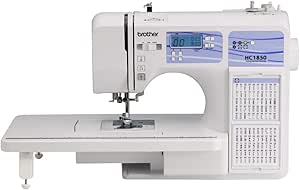 | Best for Stitch Variety and Lettering | Brand: Brother | Model: HC1850 | Built-in stitches: 185 | VIEW ON AMAZON | See Our Full Breakdown |
| Singer 6700C Heavy Duty Computerized Sewing Machine with Accessory Kit |  | Best for Thick Fabrics | Brand: Singer | Stitch applications: 411 | Motor: Heavy-duty powerful motor | VIEW ON AMAZON | See Our Full Breakdown |
| Brother SE700 Sewing and Embroidery Machine with Wireless LAN and 8 Included Feet |  | Best for Sewing and Embroidery | Embroidery area: 4 × 4 inches | Touchscreen: 3.7-inch color LCD | Built-in designs: 135 | VIEW ON AMAZON | See Our Full Breakdown |
| SINGER Quantum Stylist 9960 Computerized Sewing and Quilting Machine |  | Best for Maximum Stitch Selection | Brand: SINGER | Model: 9960 | Built-in stitches: 600 | VIEW ON AMAZON | See Our Full Breakdown |
| SINGER Smart Heavy Duty 9120 Computerized Sewing Machine |  | Best for App-Guided Stitch Variety | Stitch options: 200+ through the CREATIVATE app, plus built-in straight stitch | Stitch types: Utility, stretch, decorative, lettering, and buttonhole styles | Maximum sewing speed: 900 stitches per minute | VIEW ON AMAZON | See Our Full Breakdown |
| Brother CS5055 Computerized Sewing Machine with LCD Display |  | Best for Straightforward Everyday Sewing | Built-in stitches: 60 | Buttonhole styles: 7 one-step | Display: LCD | VIEW ON AMAZON | See Our Full Breakdown |
| Brother XR9550 Computerized Sewing and Quilting Machine |  | Best for Built-In Stitch Range and Quilting Extras | Built-in stitches: 165 | Buttonhole styles: 8 auto-size styles | Display: LCD | VIEW ON AMAZON | See Our Full Breakdown |
| Brother CS7000X Sewing and Quilting Machine with LCD Display |  | Best for Quilting Accessories | Built-in stitches: 70 | Display: LCD | Presser feet: 10 included | VIEW ON AMAZON | See Our Full Breakdown |
| SINGER 6600C Sterling Heavy Duty Computerized Sewing Machine |  | Best for Fast Sewing Across Fabric Weights | Built-in stitches: 100 | Stitch applications: 215 | Maximum sewing speed: 1,100 stitches per minute | VIEW ON AMAZON | See Our Full Breakdown |
| sewing machine computerized | Built-in stitches | Display | Buttonhole styles |
|---|---|---|---|
| SewLaVie 1130 Computerized Sew | 300 | LCD screen | — |
| Brother CP100X Computerized Se | 100 | — | — |
| Brother ST150HDH Strong & Toug | 50 | LCD | — |
| Brother CS7205 Computerized Se | 150 listed; product information gives conflicting counts | LCD | 8 one-step |
| Brother ST150HDH Strong & Toug | 50 | — | — |
| Janome JW8100 Fully-Featured C | 100 | — | 7 one-step styles |
| Brother HC1850 Sewing and Quil | 185 | Backlit LCD | 8 one-step auto-size styles |
| Singer 6700C Heavy Duty Comput | — | LCD screen | 7 one-step styles |
| Brother SE700 Sewing and Embro | — | — | 10 auto-size styles |
| SINGER Quantum Stylist 9960 Co | 600 | — | 13 automatic one-step styles |
| SINGER Smart Heavy Duty 9120 C | — | — | — |
| Brother CS5055 Computerized Se | 60 | LCD | 7 one-step |
| Brother XR9550 Computerized Se | 165 | LCD | 8 auto-size styles |
| Brother CS7000X Sewing and Qui | 70 | LCD | — |
| SINGER 6600C Sterling Heavy Du | 100 | LCD screen | — |
More Details on Our Top Picks
SewLaVie 1130 Computerized Sewing and Quilting Machine with 300 Stitches
The SewLaVie 1130 pairs an unusually broad 300-stitch selection with a stated capacity of up to nine denim layers, giving it a wider creative and heavy-fabric brief than the Brother CP100X, which has 100 stitches and a metal frame. Its start/stop button and speed slider let you sew without relying on the foot controller, while programmable needle positioning helps with pivots and seam finishing. The extension table supports larger quilting pieces; the free arm is useful for sleeves and other small cylindrical projects. The tradeoff is less certainty around the product information: the supplied description is fragmented, and the included character board and broad stitch count may matter less to practical sewing than clear setup guidance. Choose it for variety and thick-fabric ambitions, not for the most reassuringly documented package.
Pros:- 300 built-in stitches, including alphanumeric fonts, offer more decorative choice than the Brother CP100X.
- Specified capacity of up to nine denim layers suits projects involving heavy seams.
- Start/stop button and speed slider allow pedal-free sewing with adjustable pace.
- Extension table and free arm cover both larger quilting work and garment details.
Cons:- The supplied product description is fragmented, making some details harder to verify.
- A large stitch library may add complexity without helping buyers focused on basic construction sewing.
- The available information gives limited detail about the included presser feet and support beyond the listed components.
Best for: Sewers who want a large selection of decorative and character stitches, pedal-free speed control, and capacity for bulky denim projects.
Not ideal for: Buyers who prioritize clear product documentation or want a well-established accessory and support package over a high stitch count.
- Built-in stitches:300
- Feed dog:7-point
- Maximum denim capacity:Up to 9 layers
- Buttonhole:1-step auto-size
- Display:LCD screen
- Controls:Start/stop button and speed control slider
- Needle position:Programmable up/down
- Warranty:2 years
Our verdict“Choose the SewLaVie 1130 if stitch variety and heavy-fabric capacity matter more to you than the clearer feature documentation of the Brother CP100X.”
Brother CP100X Computerized Sewing and Quilting Machine
The CP100X earns its place through a practical balance of computerized controls and a metal frame, rather than an especially large stitch library. Its 100 stitches and eight one-step buttonhole styles give it useful range, while the wide table, hard case, and 10 sewing feet make it a more complete quilting setup than the Brother ST150HDH bundles, which emphasize specialty feet and fabric range. The automatic needle threader and adjustable speed reduce setup and control friction for regular sewing. The fixed needle bar is intended to support steady stitching, but this is not the pick for buyers who want hundreds of decorative options like the SewLaVie 1130. It is also specified for 120 V US use, limiting its fit outside that market. Its strengths are stability and included quilting gear, not maximum stitch choice.
Pros:- Metal frame and fixed needle bar are designed to support steady stitching.
- Wide table, hard case, and 10 sewing feet provide a strong out-of-box quilting setup.
- One-step automatic needle threader and adjustable sewing speed simplify routine use.
- Eight one-step auto-size buttonhole styles offer more choice than a single buttonhole setting.
Cons:- Designed for 120 V use in the US, so it is a poor fit for buyers in regions with different electrical standards.
- Its 100 stitches offer less variety than the SewLaVie 1130’s 300.
- The included monogramming foot does not provide a monogramming function by itself.
Best for: US-based quilters and garment sewists who want a stable computerized machine with a table, hard case, and a useful set of feet included.
Not ideal for: Buyers outside the US, or stitch collectors who want a much larger decorative library than its 100 built-in stitches.
- Built-in stitches:100
- Buttonholes:8 one-step auto-size styles
- Needle threader:One-step automatic
- Included sewing feet:10
- Frame:Metal
- Power source:Corded electric
- Input voltage:120 V
- Included accessories:Wide table, hard case, quilt guide, 3 bobbins, needle set, accessory pouch, and other accessories
Our verdict“Pick the CP100X for a steady, accessory-rich quilting setup in the US, but choose the SewLaVie 1130 if stitch variety is your main priority.”
Brother ST150HDH Strong & Tough Sewing Machine with 50 Stitches and LCD Display
The ST150HDH is the most focused choice here for sewing across heavy and lightweight fabrics: its description covers denim and multiple heavyweight layers as well as silk. That versatility matters more than a large stitch count for garment makers who switch fabric types. The walking foot and nine included sewing feet also give it a practical advantage for managing difficult layers, while five one-step buttonhole styles and an LCD keep computerized functions straightforward. Compared with the Brother CP100X, it has half as many stitches and fewer listed buttonhole styles, but the supplied package emphasizes fabric handling and specialty feet instead of a hard case and broad quilting accessories. The 6.4-by-4.1-inch needle-to-arm space gives useful room, though it is not a substitute for a larger quilting setup. Buyers seeking decorative variety should look to the SewLaVie 1130 instead.
Pros:- Described for work with both heavyweight layers and lightweight silk.
- Walking foot and a range of included feet support varied fabric handling.
- LCD display, adjustable speed, and five one-step buttonhole styles provide useful computerized controls.
- Jam-resistant drop-in top bobbin simplifies bobbin loading.
Cons:- Its 50 built-in stitches are fewer than the Brother CP100X’s 100 and the SewLaVie 1130’s 300.
- The listed needle-to-arm workspace may feel restrictive for bulky quilt projects.
- The supplied listing does not specify a warranty or include a wide table or hard case.
Best for: Garment makers who sew both denim or layered materials and lightweight fabrics, and want a walking foot and specialty feet in the package.
Not ideal for: Quilters who want a hard case, wide table, or a larger stitch library as the main reason for choosing a computerized machine.
- Built-in stitches:50
- Buttonholes:5 one-step, auto-sized styles
- Display:LCD
- Maximum stitch width:Up to 7 mm
- Workspace:6.4 in wide × 4.1 in high needle-to-arm space
- Sewing feet:9 included, plus 5 specialty feet in the bundle
- Needles:6 included
- Bobbin:Jam-resistant drop-in top bobbin
Our verdict“Choose this ST150HDH bundle if your projects span heavy and delicate fabrics and the walking foot matters more than a large stitch collection.”
Brother CS7205 Computerized Sewing and Quilting Machine with Wide Table
The CS7205 sits between the CP100X and ST150HDH in stitch variety, with 150 built-in stitches, an alphanumeric font, and eight one-step buttonholes. That makes it a stronger match than the ST150HDH for buyers who want lettering and decorative options, while the wide table and 11 sewing feet support quilting and varied everyday tasks. Automatic needle threading, a quick-set drop-in bobbin, and variable speed make common setup and control steps easier. The limitation is that the supplied product information gives conflicting stitch counts, so I would verify the count before treating it as a deciding feature. It is also specified for 120-volt use and has a stated use restriction outside the US. Compared with the CP100X, it offers more listed stitches and feet but does not list a hard case.
Pros:- 150 listed stitches and an alphanumeric font add creative options beyond the Brother CP100X’s 100 stitches.
- Eight one-step buttonhole styles offer useful garment-making flexibility.
- Wide table and 11 sewing feet suit quilting and a variety of sewing tasks.
- Automatic needle threader, quick-set bobbin, LCD, and variable speed simplify operation.
Cons:- The product information gives conflicting stitch counts.
- Specified for 120-volt use, with other use stated to void the warranty.
- Unlike the Brother CP100X, the listed package does not include a hard case.
Best for: US-based home sewists who want an LCD-controlled machine with lettering, varied buttonholes, and a wide table for quilting.
Not ideal for: International buyers or shoppers who need fully consistent product specifications and a hard case included.
- Built-in stitches:150 listed; product information gives conflicting counts
- Alphanumeric fonts:1
- Buttonhole styles:8 one-step
- Included sewing feet:11
- Display:LCD
- Input voltage:120 volts
- Dimensions:12.52 in D × 16.26 in W × 7.01 in H
- Warranty:25-year limited
Our verdict“Choose the CS7205 for its listed stitch range, lettering, and quilting table if you are in its intended US market and can confirm the stitch-count details.”
Brother ST150HDH Strong & Tough Sewing Machine with Accessories
This ST150HDH bundle shares the same 50 stitches and five one-step buttonhole styles as the other ST150HDH listed here, so its distinction is the added supplies rather than a different computerized machine. The package includes specialty feet, six thread colors, needles, and water-soluble stabilizer, which can help buyers start projects without sourcing those materials separately. Its stated ability to sew denim, multiple layers, and lightweight silk keeps it more versatile across fabric weights than the Brother CS7205, whose appeal leans more toward stitch variety and quilting accessories. The tradeoff is that the extra supplies may go unused by someone doing basic repairs or straightforward garment sewing. With only 50 stitches, it also offers much less decorative choice than the SewLaVie 1130. Pick this version for the bundle contents, not for a different stitch or buttonhole system.
Pros:- Designed for heavyweight layers and lightweight fabrics, including silk.
- Bundle adds five specialty feet, six thread colors, needles, and water-soluble stabilizer.
- Adjustable speed and start/stop and needle-position controls support flexible sewing.
- LCD display and jam-resistant drop-in bobbin provide useful computerized and setup features.
Cons:- The 50-stitch selection is smaller than the Brother CS7205’s listed 150 and the SewLaVie 1130’s 300.
- Extra bundle materials may be unnecessary for basic sewing.
- The product description contains a minor typo in its bobbin-system details.
Best for: Sewists who plan to work with varied fabric weights and will use specialty feet, multiple thread colors, and stabilizer for their projects.
Not ideal for: Beginners focused on simple repairs or basic seams who would rather avoid extra supplies they may not use.
- Built-in stitches:50
- Buttonholes:5 one-step, auto-sized styles
- Maximum stitch width:7 mm
- Needle-to-arm workspace:6.4 in wide × 4.1 in high
- Sewing feet:9 included, plus 5 specialty feet in the bundle
- Included thread colors:Black, white, grey, blue, pink, and taupe
- Stabilizer:Water-soluble, 3.2 yards
- Included needles:Needles included; quantity not specified
Our verdict“Choose this ST150HDH bundle over the other ST150HDH listing if you will use the included stabilizer and thread, rather than paying attention only to the machine’s shared features.”
Janome JW8100 Fully-Featured Computerized Sewing Machine with 100 Stitches, 7 Buttonholes, Hard Cover, Extension Table and 22 Accessories
The Janome JW8100 makes the most sense for sewists who want a balanced stitch selection and useful quilting setup rather than the largest possible stitch count. Its 100 built-in stitches and seven one-step buttonholes cover everyday sewing and decorative projects, while the extra-wide extension table gives larger fabric pieces room to sit flat. The even-feed system is a practical advantage when handling multiple layers. Compared with the Brother HC1850, the Janome offers fewer stitches, but its included table and specialty feet make it a strong choice for projects that need workspace and fabric control. The LCD, speed control, and start/stop button help with pacing, though this larger setup needs a dedicated surface. Choose it for sewing and quilting versatility, not compact storage.
Pros:- 100 stitches and seven one-step buttonhole styles cover a broad range of everyday and decorative work.
- Extra-wide extension table supports larger quilt pieces and fabric panels.
- Even-feed system helps manage multiple layers.
- LCD interface, speed control, and start/stop button offer useful sewing adjustments.
Cons:- Large footprint can be difficult to accommodate in a small sewing area.
- Offers fewer built-in stitches than the Brother HC1850 and SINGER Quantum Stylist 9960.
Best for: Quilters and home sewists who regularly handle large projects and want an extension table and specialty feet included.
Not ideal for: Sewists with limited table space or anyone who prioritizes a compact machine for frequent storage.
- Brand:Janome
- Model:001JW8100
- Built-in stitches:100
- Buttonhole styles:7 one-step styles
- Maximum stitch length:5 mm
- Feed system:Even-feed system
- Included workspace accessory:Extra-wide extension table
- Warranty:25 years mechanical, 2 years electrical, 1 year labor
Our verdict“Choose the JW8100 if you want quilting-friendly workspace and fabric control more than an expansive stitch library.”
Brother HC1850 Sewing and Quilting Machine with 185 Built-In Stitches and LCD Display
The Brother HC1850 is the stitch-variety pick for sewists who want decorative options and basic lettering without moving to a dedicated embroidery machine. Its 185 built-in stitches include 55 alphanumeric stitches, and eight auto-size buttonhole styles give it more built-in lettering and buttonhole variety than the Janome JW8100. A wide table and spring-action quilting foot also make it more than a basic garment machine. Automatic needle threading and a jam-resistant top bobbin reduce setup interruptions, while adjustable speed supports more controlled sewing. The tradeoff is that its large stitch count is not the same as embroidery capability: it is a sewing and quilting machine, not a substitute for the Brother SE700. It is also designed for US 120V power, and the USB cable is not included.
Pros:- 185 built-in stitches include 55 alphanumeric options for adding lettering to projects.
- Eight auto-size one-step buttonholes provide useful variety for garment sewing.
- Wide table and spring-action quilting foot support quilting tasks.
- Automatic needle threading and a jam-resistant top bobbin simplify setup.
Cons:- Does not embroider designs, unlike the Brother SE700.
- 120V US power specification limits straightforward use in regions with incompatible voltage.
- USB cable is not included.
Best for: Home sewists who want decorative stitches, simple lettering, quilting accessories, and an approachable computerized interface.
Not ideal for: Buyers seeking embroidery design stitching, or those outside the US who cannot use 120V power without suitable equipment.
- Brand:Brother
- Model:HC1850
- Built-in stitches:185
- Alphanumeric stitches:55
- Buttonhole styles:8 one-step auto-size styles
- Display:Backlit LCD
- Bobbin:Jam-resistant drop-in top bobbin
- Included presser feet:8
- Power compatibility:120V AC; intended for sale in the US
Our verdict“Pick the HC1850 for a wide sewing-stitch selection and quilting features, but choose the SE700 if embroidery is a priority.”
Singer 6700C Heavy Duty Computerized Sewing Machine with Accessory Kit
The Singer HD6700C stands apart from the lighter, feature-focused machines in this group by pairing computerized stitch selection with a heavy-duty metal frame and powerful motor. That combination is aimed at people who sew denim, leather, or several fabric layers and need more than a decorative stitch menu. Its 411 stitch applications, seven one-step buttonholes, and adjustable speed control still give it range for routine and creative sewing. Compared with the SINGER Quantum Stylist 9960, the HD6700C emphasizes strength and thick-material handling, while the 9960 offers more listed stitch applications and lettering fonts. Ten presser feet make the HD6700C ready for varied tasks, but its substantial size and weight can make it less convenient to move or store. This is a capability-first choice, not a compact one.
Pros:- Heavy-duty frame and powerful motor are suited to thick fabrics and multiple layers.
- 411 stitch applications include basic, stretch, decorative, and lettering options.
- Ten included presser feet cover a range of sewing techniques.
- LCD screen and adjustable speed support more controlled stitch selection and pacing.
Cons:- Large, heavy construction can be awkward to move and store.
- The SINGER Quantum Stylist 9960 offers more stitch applications and five lettering fonts.
Best for: Sewists who frequently work with denim, leather, or layered materials and want computerized controls alongside a strong frame.
Not ideal for: People who need a lightweight machine for small workspaces or prioritize maximum lettering and stitch-application variety.
- Brand:Singer
- Stitch applications:411
- Motor:Heavy-duty powerful motor
- Frame:Metal frame
- Buttonhole styles:7 one-step styles
- Display:LCD screen
- Speed control:Adjustable maximum speed
- Included presser feet:10
- Included accessories:4 transparent bobbins, seam ripper, needles, and soft cover
Our verdict“Choose the HD6700C if thick materials are your main challenge and you can accommodate a larger machine.”
Brother SE700 Sewing and Embroidery Machine with Wireless LAN and 8 Included Feet
The Brother SE700 is the clear choice here for buyers who want embroidery as well as computerized sewing. Its 4-by-4-inch embroidery area, 135 built-in designs, and 10 embroidery fonts add a creative function that the sewing-focused Brother HC1850 does not provide. A 3.7-inch color touchscreen helps users preview and edit designs, while wireless LAN and USB connectivity offer ways to transfer files. It also has 103 sewing stitches and 10 auto-size buttonhole styles, so it can handle ordinary sewing between embroidery projects. The main limit is the hoop area: larger designs may need to be split or worked on a machine with a larger embroidery field. Its US-only 120V specification also narrows where it can be used directly. Choose it for compact embroidery projects, not oversized motifs.
Pros:- Combines sewing and embroidery functions in one machine.
- Wireless LAN and USB support design-file transfer.
- Color touchscreen supports design preview and editing.
- Built-in designs, embroidery fonts, and sewing stitches offer flexibility across projects.
Cons:- The 4-by-4-inch embroidery area restricts larger designs.
- 120V US-only power specification limits direct use in many countries.
- Its embroidery features add complexity that sewing-only buyers may not need.
Best for: Crafters who want one computerized machine for everyday sewing, small embroidery designs, and wireless file transfer.
Not ideal for: Embroidery users who need a field larger than 4 by 4 inches, or international buyers without compatible 120V power.
- Embroidery area:4 × 4 inches
- Touchscreen:3.7-inch color LCD
- Built-in designs:135
- Embroidery lettering fonts:10
- Sewing stitches:103
- Buttonhole styles:10 auto-size styles
- Connectivity:Wireless LAN and USB
- Included sewing feet:8
- Voltage:120V; US only
Our verdict“Choose the SE700 if you want built-in embroidery and wireless design transfer; skip it if a larger embroidery field or sewing-only simplicity matters more.”
SINGER Quantum Stylist 9960 Computerized Sewing and Quilting Machine
The SINGER Quantum Stylist 9960 is the lineup’s pick for sewists who want the broadest documented selection of stitches and applications in a sewing-and-quilting machine. Its 600 built-in stitches, 1,172 stitch applications, five lettering fonts, and 13 one-step buttonhole styles offer room for varied garment, craft, and decorative projects. An extension table supports quilting, while speed control, a start/stop button, and automatic needle threading help make that variety manageable. Compared with the Brother HC1850, the 9960 lists far more stitches and applications, but its 14.6-pound weight makes it less convenient to carry. It also lacks the embroidery function of the Brother SE700, so its large stitch library should not be mistaken for embroidery capability. Warranty coverage varies by component, another detail buyers should check.
Pros:- 600 built-in stitches and 1,172 stitch applications provide extensive creative range.
- Five lettering fonts and 13 automatic one-step buttonhole styles support customization.
- Includes 13 presser feet and an extension table for varied sewing and quilting tasks.
- Automatic needle threading, speed control, and a start/stop button add convenience.
Cons:- At 14.6 pounds, it is less convenient to move than a lighter portable machine.
- Warranty terms vary by component.
- It is a sewing and quilting machine, not an embroidery machine like the Brother SE700.
Best for: Experienced home sewists and quilters who want extensive stitch options, lettering, and a broad set of included feet.
Not ideal for: Buyers who need a machine for regular transport or want dedicated embroidery rather than sewing stitches.
- Brand:SINGER
- Model:9960
- Built-in stitches:600
- Stitch applications:1,172
- Lettering fonts:5
- Buttonhole styles:13 automatic one-step styles
- Included presser feet:13
- Dimensions:15 × 6.25 × 12 inches
- Weight:14.6 pounds
Our verdict“Choose the 9960 if stitch variety and included quilting accessories matter more than portability or embroidery.”
SINGER Smart Heavy Duty 9120 Computerized Sewing Machine
The SINGER Smart Heavy Duty 9120 stands apart from machines with fixed stitch libraries: its 200+ stitch options are accessed through the CREATIVATE app, which also offers stitch guidance and tutorials. That makes it a good fit for sewists who like digital help and want utility, decorative, lettering, and buttonhole choices in one machine. Its metal interior frame, DC motor, and speed control support work across varied fabrics while giving you control over pace. Compared with the Brother XR9550, whose 165 stitches are built in, the 9120 relies more heavily on a compatible mobile device. Embroidery is possible, but the attachment is sold separately, so this is less ready for embroidery than a machine supplied with that equipment. Choose it for app-connected sewing, not for an all-in-one embroidery setup.
Pros:- Offers more than 200 stitch options through the CREATIVATE app, including lettering and decorative stitches.
- App guidance and tutorials can help users choose stitches and learn techniques.
- Speed control and a start/stop button support measured sewing.
- Full metal interior frame and strong piercing power suit a range of fabrics.
Cons:- App-based features depend on access to a compatible iOS or Android device.
- The embroidery attachment is sold separately.
- The app-centered stitch selection may be less convenient than the Brother XR9550’s built-in stitch controls.
Best for: Sewists who want app-based stitch guidance, a broad range of stitch choices, and speed control for varied projects.
Not ideal for: Buyers who want all stitch controls on the machine itself, lack a compatible mobile device, or need embroidery equipment included.
- Stitch options:200+ through the CREATIVATE app, plus built-in straight stitch
- Stitch types:Utility, stretch, decorative, lettering, and buttonhole styles
- Maximum sewing speed:900 stitches per minute
- Motor:DC motor
- Frame:Full metal interior frame
- Bobbin:Drop & Sew system; Class 15 transparent bobbin
- Embroidery:Optional attachment; 170 mm x 100 mm hoop size
- Included presser feet:All-purpose, decorative stitch, zipper, blind hem, and one-step buttonhole
Our verdict“Choose the 9120 if app guidance and a large expandable stitch selection matter more than built-in embroidery equipment or phone-free controls.”
Brother CS5055 Computerized Sewing Machine with LCD Display
The Brother CS5055 keeps computerized sewing approachable with 60 built-in stitches, seven one-step buttonhole styles, and an LCD display. Its automatic needle threader and jam-resistant drop-in bobbin simplify setup, while the included seven feet give newer sewists useful options without requiring an app. Compared with the Brother CS7000X, it offers fewer stitches and feet and does not list a wide table, so it is a more focused choice for everyday garment repairs and smaller projects rather than quilting larger pieces. The metal frame and spacious work area add practical support, but the 120-volt US specification limits where it is suitable: using it elsewhere may void the warranty. This makes sense for buyers who value uncomplicated built-in controls over a broader quilting setup.
Pros:- Provides 60 built-in stitches and seven one-step buttonhole styles.
- Automatic needle threader and drop-in bobbin ease routine setup.
- Includes seven sewing feet and other accessories.
- Metal frame and spacious work area support everyday sewing tasks.
Cons:- Designed for 120-volt use in the US; other use may void the warranty.
- Has fewer stitches and included feet than the Brother CS7000X.
- No wide table is listed for supporting large quilting projects.
Best for: US-based beginners and home sewists who want built-in stitch selection, simple threading, and a useful set of feet for everyday projects.
Not ideal for: Quilters who need a wide table, buyers seeking a large stitch library, or users outside the US who need equipment suited to other voltage standards.
- Built-in stitches:60
- Buttonhole styles:7 one-step
- Display:LCD
- Included sewing feet:7
- Frame:Metal
- Input voltage:120 volts
- Dimensions:7 x 17 x 12 inches
- Weight:10.5 pounds
- Warranty:25-year limited
Our verdict“Pick the CS5055 for accessible, built-in controls and everyday sewing, but choose the CS7000X if quilting space and extra accessories matter more.”
Brother XR9550 Computerized Sewing and Quilting Machine
The Brother XR9550 combines a substantial 165-stitch built-in library with practical quilting support: a wide table, drop feed, free arm, and protective hard case are included. Unlike the SINGER Smart Heavy Duty 9120, it does not depend on an app for its listed stitch selection, so choosing among utility, decorative, heirloom, and alphanumeric options happens through the machine’s LCD interface. Eight auto-size buttonhole styles and eight presser feet add useful range, though the Brother CS7000X includes more feet and also supplies a wide table. The XR9550’s case and table make it a stronger bundled choice for sewists who want accessories ready for quilting and storage, but it remains a 120 V US-market machine. Its broader stitch set is most useful to people who will actually use the variety, rather than those focused on basic seams.
Pros:- Offers 165 built-in stitches, including utility, decorative, heirloom, and alphanumeric options.
- Includes a wide table, protective hard case, and accessory pouch.
- Eight auto-size buttonhole styles and eight presser feet support varied projects.
- LCD display, automatic needle threader, and drop-in bobbin simplify operation.
Cons:- Intended for use and sale only in the US at 120 volts.
- Includes fewer presser feet than the Brother CS7000X.
- Its large stitch library may add little value for sewists who mainly make basic repairs.
Best for: US-based hobbyists who want a wide built-in stitch selection, quilting accessories, and a protective case in one package.
Not ideal for: Buyers outside the US, sewists who only need basic stitches, or quilters who prefer the CS7000X’s larger set of included presser feet.
- Built-in stitches:165
- Buttonhole styles:8 auto-size styles
- Display:LCD
- Presser feet:8 included
- Quilting accessories:Wide table and drop feed
- Other included accessories:Protective hard case, accessory pouch, needles, and bobbins
- Voltage:120 V
- Warranty:25-year limited warranty; lifetime technical support
Our verdict“Choose the XR9550 if you want a broad built-in stitch library and bundled quilting and storage accessories in a US-voltage machine.”
Brother CS7000X Sewing and Quilting Machine with LCD Display
The Brother CS7000X is the strongest fit here for a sewist who wants quilting support supplied with the machine: its wide table, quilt guide, and 10 presser feet make it more project-ready than the CS5055, which has fewer feet and no listed wide table. Its 70 built-in stitches cover practical and decorative work, and the LCD plus automatic needle threader keep routine operation accessible. The Brother XR9550 has a larger 165-stitch library and a hard case, so it may suit buyers who value stitch variety and storage more than the CS7000X’s extra feet. Tradeoffs include a fixed needle bar that can restrict some free-arm techniques and a heavier metal-frame build. This is a sensible quilting-centered choice, not the lightest machine for frequent transport.
Pros:- Includes a wide table and quilt guide for handling larger fabric sections.
- Ten presser feet provide flexibility across sewing tasks.
- Automatic needle threader and LCD display simplify setup and stitch selection.
- Seventy built-in stitches cover utility, decorative, and quilting work.
Cons:- Fixed needle bar can limit some free-arm techniques.
- Metal-frame construction makes it relatively heavy.
- The Brother XR9550 offers a larger built-in stitch library and includes a protective hard case.
Best for: Home quilters and garment sewists who want a wide work surface, quilt guide, and multiple included feet for varied projects.
Not ideal for: Sewists who need a lightweight machine to carry often, rely on particular free-arm techniques, or want a larger stitch selection than 70 built-in options.
- Built-in stitches:70
- Display:LCD
- Presser feet:10 included
- Quilting accessories:Wide table and quilt guide
- Needle threader:Automatic
- Frame:Metal
- Warranty:25-year limited
Our verdict“Choose the CS7000X if quilting accessories and a wide work surface matter more than portability or the XR9550’s larger stitch library.”
SINGER 6600C Sterling Heavy Duty Computerized Sewing Machine
For buyers who prioritize sewing speed and control across fabric weights, the SINGER 6600C Sterling brings a 1,100-stitch-per-minute maximum, adjustable presser-foot pressure, and a metal frame to the lineup. Its pressure adjustment is particularly useful when switching between light fabrics and thicker materials such as denim or canvas; the Brother CS7000X offers more quilting-specific bundled accessories, but not the same stated maximum speed or pressure adjustment. A stainless-steel bedplate and 6.4-inch throat space add working room, while 100 built-in stitches and 215 applications cover more than basic construction. The tradeoff is a steeper setup and learning curve: its many stitch choices and accessories can take time to sort out. Choose it for pace and fabric flexibility, not the simplest first computerized machine.
Pros:- Maximum speed of 1,100 stitches per minute supports faster project work.
- Adjustable presser-foot pressure helps accommodate both light and thick fabrics.
- Metal frame and stainless-steel bedplate suit demanding sewing tasks.
- Offers 100 built-in stitches and 215 stitch applications.
Cons:- The many stitch options and accessories may take time to learn and organize.
- No wide table or quilt guide is listed, unlike the Brother CS7000X.
- Its higher maximum speed may be less useful to beginners who prefer a slower, simpler setup.
Best for: Experienced home sewists who move between lightweight fabric and denim or canvas and want higher sewing speed with presser-foot pressure adjustment.
Not ideal for: Beginners seeking the simplest controls, or quilters who prioritize a wide table and dedicated quilt guide included with the Brother CS7000X.
- Built-in stitches:100
- Stitch applications:215
- Maximum sewing speed:1,100 stitches per minute
- Throat space:6.4 inches (163 mm)
- Buttonhole:One-step
- Display:LCD screen
- Frame and bedplate:Interior metal frame; stainless-steel bedplate
- Bobbin:Top drop-in
Our verdict“Pick the 6600C Sterling if speed and adjustment for different fabric weights matter more than beginner simplicity or bundled quilting support.”

How We Picked
I compared these machines around the decisions that shape daily use: stitch and buttonhole options, control clarity, workspace, stated fabric focus, included accessories, and versatility. I also weighed whether a machine’s features serve a distinct buyer need, such as quilting, heavier materials, embroidery, or straightforward garment sewing. A broad stitch library earns value only when it is usable and relevant; an extension table matters most to someone handling larger projects.
The ranking gives priority to useful capability across common sewing tasks, then recognizes specialist strengths rather than treating every machine as a universal choice. Models with overlapping roles are separated by their stated focus and included features, while heavy-duty and embroidery options are judged against their own intended work. Product names and listed specifications guide this comparison; buyers should verify included accessories and machine compatibility for their particular projects before purchasing.
Factors to Consider When Choosing Sewing Machine Computerized
Computerization can simplify stitch selection, but it does not settle every fit question. I would start with the projects you make most, then check how the machine’s controls, work area, and fabric handling match those tasks.
Match the Stitch Library to Your Actual Projects
Before comparing stitch counts, list the stitches you use or expect to use: straight, zigzag, stretch, buttonhole, and perhaps a few decorative options. A large library can be useful for embellishment, but it can also add menus and choices that a basic mending routine never needs. Check how stitches are selected and whether the display makes settings easy to identify. Buttonhole styles and the process for making them may matter more than dozens of decorative patterns if you sew garments. Avoid paying for a feature list built around projects you do not plan to make. A smaller, clear set of controls can be a better everyday fit than a bigger library that slows you down.
Treat Quilting Space as a Work-Flow Requirement
Quilting puts pressure on the area around the needle, not only on the machine’s stitch menu. A wide table can support fabric and reduce the pull that makes long seams harder to guide, but it does not turn a compact machine into a long-arm setup. Think about the size of your usual blocks, the bulk of a quilt sandwich, and the table or desk where the machine will sit. Check whether the included extension table and quilting feet match the way you work, and whether extra accessories are sold separately. A common mistake is choosing by the word “quilting” without checking support for the project size. If you sew large quilts often, room to manage fabric may matter more than decorative stitches.
Be Specific About Heavy Fabrics
“Heavy duty” is a useful clue, not a guarantee that a machine will sew every dense material comfortably. Denim hems, layered canvas, leather, and upholstery fabric place different demands on the motor, needle, foot clearance, and feed system. Match the machine to the actual thickness and frequency of your work, and confirm the manufacturer’s guidance for materials and needles. Correct needle size, thread, and slower sewing can make a difference, but they cannot overcome every mechanical limit. If most of your projects use light or medium fabrics, a heavy-duty label may be less useful than easy controls and a good stitch selection. For frequent thick-material work, prioritize documented support for those layers rather than the label alone.
Choose Controls You Can Use Without Guesswork
An LCD and computerized stitch selection can make settings clearer, especially when a machine offers many options. Still, a display is only helpful if the information and adjustment process make sense to you. Look for clear stitch identification, accessible length and width controls, and instructions that explain threading and routine setup. Beginners may benefit more from a manageable interface than from a large number of advanced functions. If you are moving from a mechanical machine, check whether the computerized controls add steps to changes you make often. A quick look at the manual can reveal more about the learning curve than the headline feature count.
Compare Included Accessories With Your Planned Work
Presser feet, extension tables, hard covers, and specialty accessories can change how ready a machine is for your projects. Make a list of what you would otherwise need to buy, then check that each included item supports the relevant task and fits the machine. A broad accessory kit is not automatically useful if it contains feet you will rarely use. Quilters may value a walking or quilting foot, while garment sewists may care more about zipper and buttonhole feet. Also check storage and protection: a hard cover can matter if the machine sits in a shared room or gets put away between sessions. Compare the complete setup, not just the number of included pieces.
Decide Whether You Need Sewing, Quilting, or Embroidery
Machines marketed for sewing and quilting usually add workspace or quilting-oriented features to a standard sewing workflow. Embroidery is a more distinct capability, with different setup, software or design considerations, and a dedicated project style. Do not choose an embroidery machine simply because it appears to offer more functions if you mainly want to sew seams and hems. Conversely, if stitched designs are central to your plans, a standard sewing machine will not replace embroidery capability. Consider how often you will use each function and whether you have room to store any additional accessories. Paying for a specialist feature makes sense when it changes what you can create, not merely because it expands the specification sheet.
Frequently Asked Questions
Is a higher stitch count a good reason to choose one computerized machine over another?
Only if you expect to use the extra stitches. For everyday repairs and most garment seams, a dependable set of utility and stretch stitches may cover your needs. Decorative sewing and personalized projects can make a broader library more worthwhile. Check how easily you can find and adjust the stitches, since a large selection is less useful when controls are confusing. Compare buttonhole options and practical accessories alongside the count.
Can a computerized sewing machine handle denim or canvas?
Some models are aimed at heavier sewing, but fabric thickness and the number of layers affect results. Denim hems, canvas seams, and coated or unusually dense materials are not interchangeable workloads. Check the manufacturer’s fabric guidance, presser-foot clearance, needle recommendations, and suitable thread before choosing. Using the right needle and sewing at a controlled pace can help, but those steps do not make every machine suitable for heavy work. If thick layers are a regular part of your sewing, prioritize a model specifically positioned for that use.
Do I need an extension table if I plan to quilt?
An extension table can support fabric beside the needle and make it easier to guide larger pieces. It is particularly helpful when the project tends to drag or bunch at the edge of a small sewing surface. It does not provide the same working area as a dedicated quilting setup, so check the size of your projects and the table space available at home. Also confirm which quilting feet are included or compatible. Occasional small quilting projects may not justify making table size your leading requirement.
Should a beginner choose a basic computerized machine or one with many features?
A beginner often benefits from clear controls, straightforward threading, and the stitches needed for common projects more than from a very large feature set. A more advanced machine can still be a sensible choice if you already have specific plans for quilting, decorative stitching, or embroidery. Consider whether you can find basic settings quickly and whether the manual explains setup clearly. Extra features are easier to grow into when they do not complicate your everyday sewing. Pick for the projects you expect to do soon, with room to expand if that matters to you.
Is an embroidery-capable machine worth choosing if I mostly sew clothes?
It depends on whether embroidery is a real part of your plans. A machine with embroidery capability can add a new kind of project, but that feature brings its own setup, design, and workspace needs. If you mainly sew clothing, prioritize seam quality, useful garment stitches, buttonholes, and compatible presser feet. If you want to add logos, names, or decorative motifs often, an embroidery model may earn its extra complexity. Decide based on how frequently you expect to use embroidery rather than treating it as a bonus feature.
Conclusion
For the broadest balance of computerized sewing and quilting, I would start with the Brother CP100X as best overall; the Brother CS5055 is my best value direction for shoppers who want a more straightforward everyday machine, while the feature-rich Janome JW8100 is the best premium-style pick for buyers who want an expansive setup. Beginners should compare the Brother CS5055 and Brother CS7000X around the controls and quilting features they will actually use. Quilters can focus on the Brother CS7205, Brother XR9550, and other sewing-and-quilting options, with workspace and included feet guiding the choice. For heavier materials, look at the Brother ST150HDH and Singer Heavy Duty computerized models; for embroidery, the Brother SE700 is the distinct specialist. Choose the machine whose strongest feature matches your most frequent project, not the one with the longest list.