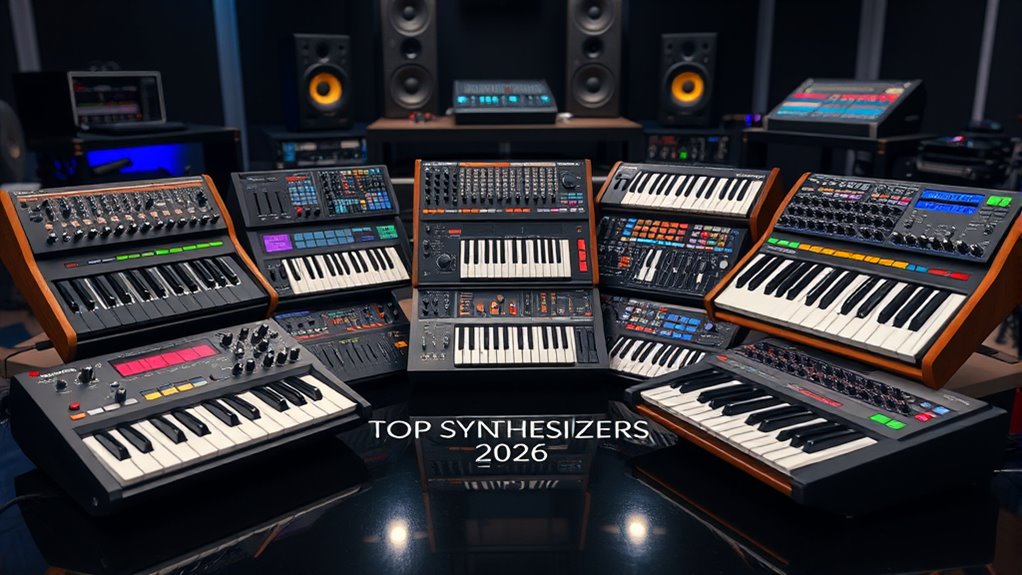

The Arturia MicroFreak is my best overall synthesizer here, pairing broad sound-design options with a playable keyboard in a compact format. For hands-on analog control, the Moog Subsequent 37 is the premium standout, while the M-VAVE FM-1 offers a portable route into FM synthesis. These options differ sharply in price tier, controls, portability, and how much sound-design depth they offer. The Stylophone models favor immediate, playful performance, while the M-VAVE variations center on compact FM sound and built-in-speaker convenience. Read on for the full breakdown and help matching a synthesizer to your setup and way of making music.

Get kitchen gear delivered free with Prime
- Fast, free delivery on millions of items
- Prime Video, Amazon Music and more included
- Member-only deals all year
Complete the kit


Key Takeaways
- The MicroFreak is the most adaptable pick in this lineup, making it a strong choice for musicians who want varied synthesis in a small instrument.
- The Subsequent 37 prioritizes tactile analog control over compactness and convenience, so it makes the most sense when hands-on performance is worth the larger commitment.
- The M-VAVE FM-1 models focus on portability and FM synthesis; choose among them by the specific features and format you need rather than assuming every variant is interchangeable.
- The Stylophone options are geared toward direct, playful music making, not the deeper keyboard workflow offered by the MicroFreak or Moog.
- Built-in speakers change where an instrument can be played, but they should not be mistaken for a replacement for studio monitoring or a dedicated amplifier.
| Bowie Stylophone Limited Edition Synthesizer |  | Best for Stylus-Played Retro Sounds | Type: Analog synthesizer | Modes: 3 | Power: Battery-powered | VIEW ON AMAZON | See Our Full Breakdown |
| M-VAVE FM-1 Portable FM Synthesizer |  | Best for Portable FM Sound Design | Synthesis: 6-operator FM with 32 algorithms | Factory presets: 128 | Keyboard: 27-key silicone keyboard spanning 8 octaves | VIEW ON AMAZON | See Our Full Breakdown |
| M-VAVE Portable FM Synthesizer with Built-In Speaker |  | Best Compact FM Sketchpad | FM engine: 6 operators and 32 algorithms | Presets: 128 | Keyboard: 27 full-range silicone keys | VIEW ON AMAZON | See Our Full Breakdown |
| Stylophone Original Pocket Electronic Synthesizer |  | Best for Beginners and Retro Tones | Sound profile: Warm, vintage, rich, retro organ-like | Playing range: Three octaves | Feature: Optional vibrato | VIEW ON AMAZON | See Our Full Breakdown |
| M-VAVE Portable Wireless FM Synthesizer with Built-In Speaker |  | Best White Portable FM Synth | Sound engine: 6 operators and 32 algorithms | Presets: 128 | Keyboard: 27 full-range silicone keys | VIEW ON AMAZON | See Our Full Breakdown |
| M-VAVE FM-1 Orange 6-Operator FM Synthesizer |  | Best for Portable FM Sound Design | Synthesis: 6-operator FM; 32 algorithms | Presets: 128 | Polyphony: Up to 12 voices | VIEW ON AMAZON | See Our Full Breakdown |
| Arturia MicroFreak Synthesizer Keyboard |  | Best for Experimental Hybrid Synthesis | Keys: 25-key touch-plate PCB keyboard with polyphonic aftertouch | Oscillator modes: 17 paraphonic modes | Filter: State-variable 12 dB Oberheim SEM filter | VIEW ON AMAZON | See Our Full Breakdown |
| Moog Subsequent 37 Paraphonic Analog Synthesizer |  | Best for Hands-On Analog Performance | Keyboard: 37 semi-weighted keys with velocity and aftertouch | Polyphony: Two-note paraphonic | Presets: 256 | VIEW ON AMAZON | See Our Full Breakdown |
| synthesizer | Dimensions | Weight | Keyboard | Connectivity |
|---|---|---|---|---|
| Bowie Stylophone Limited Editi | 7.09 x 4.16 x 1.82 inches | 16 ounces | — | — |
| M-VAVE FM-1 Portable FM Synthe | — | — | 27-key silicone keyboard spanning 8 octaves | USB-C, Bluetooth BLE MIDI, and 3.5 mm MIDI IN |
| M-VAVE Portable FM Synthesizer | 6.4 x 3.8 x 1.2 inches | 9.6 ounces | 27 full-range silicone keys | USB MIDI, Bluetooth MIDI, and 3.5 mm MIDI IN |
| Stylophone Original Pocket Ele | 2.05 x 3.41 x 1.86 inches | 8.8 ounces | — | Headphone socket and auxiliary |
| M-VAVE Portable Wireless FM Sy | 6.4 x 3.8 x 1.2 inches | 9.6 ounces | 27 full-range silicone keys | — |
| M-VAVE FM-1 Orange 6-Operator | — | — | 27-key silicone keyboard with octave shift | USB-C, Bluetooth BLE MIDI, 3.5 mm MIDI IN |
| Arturia MicroFreak Synthesizer | 12.2 × 9.2 × 2.2 inches | 2.3 lb | — | CV, USB, MIDI, 1/4-inch audio output, 3.5 mm headphone output |
| Moog Subsequent 37 Paraphonic | — | — | 37 semi-weighted keys with velocity and aftertouch | — |
More Details on Our Top Picks
Bowie Stylophone Limited Edition Synthesizer
The Bowie Stylophone is the most characterful pick here for buyers who want a compact instrument built around direct, stylus-based playing. Its three modes cover synth and bass sounds, while battery power makes it easy to play away from a desk. Compared with the standard Stylophone Original, this edition adds a white finish and embossed Bowie logo rather than a more expansive playing system, so the appeal is as much its distinctive design as its simple performance format. The tradeoff is limited scope: it does not offer the preset library, sequencer, or MIDI options found on the M-VAVE FM-1. I’d choose it for quick riffs and hands-on novelty, not as a flexible centerpiece for a larger production setup.
Pros:- Three modes provide synth and bass sounds in a compact instrument
- Stylus controls offer a distinctive, direct playing approach
- Battery-powered design supports portable use
- White finish and embossed Bowie logo give it a distinctive look
Cons:- Limited modes and control range compared with the M-VAVE FM-1’s FM engine and presets
- Stylus playing is less familiar than using a conventional keyboard
- No sequencer or MIDI connectivity is listed
Best for: David Bowie fans and players who want a highly portable stylus instrument for simple synth and bass riffs.
Not ideal for: Musicians who need a conventional keyboard, broad sound editing, sequencing, or MIDI integration should choose an FM-1-style instrument instead.
- Type:Analog synthesizer
- Modes:3
- Power:Battery-powered
- Connector:Auxiliary
- Color:White
- Dimensions:7.09 x 4.16 x 1.82 inches
- Weight:16 ounces
Our verdict“Choose the Bowie Stylophone for portable stylus-played riffs and Bowie-themed design, rather than broad sound design or studio control.”
M-VAVE FM-1 Portable FM Synthesizer
The M-VAVE FM-1 earns this slot by combining a substantial FM palette with performance tools in a small, self-contained package. Its six-operator engine and 32 algorithms offer more room for sound variation than the Stylophone models, while 128 presets give players ready-made starting points instead of requiring every sound to be built from scratch. The arpeggiator, sequencer, effects, speaker, and rechargeable battery make it useful for sketching away from a computer; USB-C, Bluetooth BLE MIDI, and 3.5 mm MIDI IN also give it several ways to connect. Compared with the FM001 models in this roundup, its stated battery life and USB-C details are useful specifics. The compromise is the 27-key silicone keyboard, which can restrict two-handed playing and may not suit players wanting a conventional keybed.
Pros:- Six-operator FM engine with 32 algorithms supports varied sound creation
- 128 presets, six effects, an arpeggiator, and a 16-step sequencer provide strong onboard tools
- Rechargeable battery is specified for up to 12 hours, with a built-in speaker for untethered play
- USB-C, Bluetooth BLE MIDI, and 3.5 mm MIDI input support several connection setups
Cons:- The 27-key silicone keyboard can feel cramped for extended or two-handed playing
- FM programming may be less immediate than the Stylophone’s simple stylus controls
- Compact keys are a compromise for players accustomed to a traditional keyboard
Best for: Electronic musicians who want a portable FM instrument for sound exploration, sequencing, and MIDI-connected sketches.
Not ideal for: Keyboard players who need a full-size keybed or a broad playing range under both hands should look beyond its 27-key layout.
- Synthesis:6-operator FM with 32 algorithms
- Factory presets:128
- Keyboard:27-key silicone keyboard spanning 8 octaves
- Polyphony:12 voices
- Arpeggiator:7 modes
- Sequencer:16-step, 16 independent sequences
- Effects:Filter, reverb, delay, distortion, chorus, and phaser
- Connectivity:USB-C, Bluetooth BLE MIDI, and 3.5 mm MIDI IN
- Battery:2000 mAh rechargeable; up to 12 hours
Our verdict“Pick the FM-1 if you want portable FM sound design and built-in sequencing, and can work comfortably with a compact silicone keyboard.”
M-VAVE Portable FM Synthesizer with Built-In Speaker
This M-VAVE FM001 is a strong fit for players who want an unusually small FM instrument with enough onboard features to build quick ideas. It pairs 128 presets and a six-operator, 32-algorithm engine with six effects, an arpeggiator, and a 16-step sequencer, so it reaches well beyond the Stylophone Original’s simpler stylus-led sound-making. USB MIDI, Bluetooth MIDI, and 3.5 mm MIDI IN also let it connect to other gear, while the built-in speaker supports immediate playback. Compared with the FM-1, this model is lighter and more explicitly pocket-sized, but its product data does not state battery life or polyphony. That makes it harder to judge for longer sessions or dense parts. I’d treat it as a portable sketchpad, not a known quantity for extended standalone use.
Pros:- Six-operator FM engine with 32 algorithms and 128 presets offers a wide starting palette
- Built-in speaker and battery operation suit portable idea-making
- Arpeggiator, 16-step sequencer, and six effects add creative tools without extra gear
- USB MIDI, Bluetooth MIDI, and 3.5 mm MIDI IN support varied setups
Cons:- The 27-key layout limits comfortable range for some playing styles
- Battery life is not specified, unlike the FM-1’s stated runtime
- Polyphony is not listed in the supplied product data
Best for: Producers and synth-curious players who want a lightweight FM sketch instrument with a speaker and several MIDI connection options.
Not ideal for: Buyers who need specified battery runtime, a larger keyboard, or confirmed polyphony should favor a model with those details clearly listed.
- FM engine:6 operators and 32 algorithms
- Presets:128
- Keyboard:27 full-range silicone keys
- Built-in effects:6: filter, reverb, delay, distortion, chorus, and phaser
- Sequencer:16 steps
- Connectivity:USB MIDI, Bluetooth MIDI, and 3.5 mm MIDI IN
- Dimensions:6.4 x 3.8 x 1.2 inches
- Weight:9.6 ounces
- Materials:Plastic body and silicone keys
Our verdict“Choose this FM001 for a lightweight, feature-rich sketchpad, but not if battery runtime or polyphony needs to be clear before buying.”
Stylophone Original Pocket Electronic Synthesizer
The Stylophone Original is the most straightforward entry point in this group: move the stylus across its touch-sensitive metal surface and hear a distinctive retro tone without learning FM programming or setting up a MIDI controller. Its three-octave range and optional vibrato add enough variation for short melodic lines, while the built-in speaker makes practice immediate. Compared with the Bowie Limited Edition, it offers a silver, classic presentation rather than Bowie branding; compared with the M-VAVE FM001, it has far fewer sound-shaping and sequencing options. That simplicity is its strength and its ceiling. The small playing surface takes practice, and the three AA batteries add a separate power requirement. I’d pick it for playful first steps and vintage character, not for layered arrangements or detailed sound design.
Pros:- Stylus-based controls make sound creation approachable without a conventional keyboard
- Three octaves and optional vibrato provide simple melodic expression
- Built-in speaker and headphone socket support both quick practice and private listening
- Auxiliary connectivity supports recording or connecting with other gear
Cons:- Small playing surface can take practice to control accurately
- Requires three AA batteries
- Offers far fewer sound-design and sequencing options than the M-VAVE FM models
Best for: Beginners, casual players, and retro-sound fans who want a simple battery-powered instrument for short melodies.
Not ideal for: Producers who need presets, sequencing, polyphonic keyboard performance, or modern MIDI connectivity should choose an FM synth instead.
- Sound profile:Warm, vintage, rich, retro organ-like
- Playing range:Three octaves
- Feature:Optional vibrato
- Power:3 x AA batteries
- Built-in speaker:Yes
- Connectivity:Headphone socket and auxiliary
- Dimensions:2.05 x 3.41 x 1.86 inches
- Weight:8.8 ounces
Our verdict“Choose the Original Stylophone for accessible retro tones and simple melodies, rather than a versatile production instrument.”
M-VAVE Portable Wireless FM Synthesizer with Built-In Speaker
This white M-VAVE FM001 offers the same central appeal as the black FM001: a small, battery-powered instrument with 128 presets, FM sound creation, effects, and sequencing. Its color and compact 9.6-ounce body make it an easy pick for players who want a portable setup that stands apart visually, while the built-in speaker allows quick playback without extra equipment. Compared with the FM-1, the feature set is broadly similar, but the FM-1 supplies a stated 12-hour battery figure and 12-voice polyphony; neither detail is provided here. Like the other FM options, its 27 silicone keys are a real limit for players who need a conventional keyboard range. This model is best judged as a self-contained portable tool, not as a full-size performance keyboard.
Pros:- Six-operator engine and 32 algorithms provide a broad FM foundation
- 128 presets, six effects, an arpeggiator, and a 16-step sequencer support varied sketches
- Battery operation and built-in speaker suit portable use
- USB MIDI, Bluetooth MIDI, and 3.5 mm MIDI IN offer multiple connection paths
Cons:- The 27-key silicone keyboard may restrict broader or two-handed playing
- Battery runtime and polyphony are not specified in the supplied product data
- The product’s feature set overlaps with the black FM001, so the white finish is the clearest listed distinction
Best for: Portable synth buyers who want an FM sound palette, built-in speaker, and white finish for compact practice or idea-making.
Not ideal for: Players who need a conventional keyboard, verified polyphony, or a stated battery runtime should compare it with the M-VAVE FM-1.
- Sound engine:6 operators and 32 algorithms
- Presets:128
- Keyboard:27 full-range silicone keys
- Effects:6: filter, reverb, delay, distortion, chorus, and phaser
- Sequencer:16-step
- MIDI connectivity:USB MIDI, Bluetooth MIDI, and 3.5 mm MIDI IN
- Power:Battery operation
- Dimensions:6.4 x 3.8 x 1.2 inches
- Weight:9.6 ounces
Our verdict“Choose this model for portable FM features in a white finish, but favor the FM-1 if stated battery runtime and polyphony matter to your setup.”
M-VAVE FM-1 Orange 6-Operator FM Synthesizer
The M-VAVE FM-1 is the most self-contained choice here for sketching bright, complex FM tones away from a desk. Its six-operator engine and 32 algorithms give sound designers more room to shape tones than a simple preset-focused pocket synth, while the 16-step sequencer and seven-mode arpeggiator make short ideas easy to build into patterns. A built-in speaker, rechargeable battery, and Bluetooth MIDI also mean fewer cables than the Arturia MicroFreak, which offers broader experimental synthesis and CV connections but is less focused on grab-and-go independence. The tradeoff is the FM-1’s 27-key silicone keyboard: octave shifts stand in for a wider playing range, and detailed FM editing may take patience on a compact instrument. Its small size favors portability over a conventional keyboard feel.
Pros:- Six-operator FM engine with 32 algorithms supports varied, editable digital tones.
- Sequencer, arpeggiator, and six effects provide tools for developing ideas on the instrument.
- Built-in speaker and rechargeable battery support standalone portable use.
- USB-C, Bluetooth BLE MIDI, and 3.5 mm MIDI input offer flexible connections.
Cons:- The 27-key keyboard limits comfortable playing across a wide range.
- Compact silicone keys may not suit players accustomed to conventional synth keybeds.
- FM editing can be demanding for buyers who mainly want immediate, simple sound shaping.
Best for: Traveling producers and FM enthusiasts who want a battery-powered instrument for programming sequences and editing tones without relying on a computer.
Not ideal for: Players who need a full-range keyboard or a traditional keybed; its 27 silicone keys require octave shifting and offer a different feel from standard synth keys.
- Synthesis:6-operator FM; 32 algorithms
- Presets:128
- Polyphony:Up to 12 voices
- Keyboard:27-key silicone keyboard with octave shift
- Sequencer and arpeggiator:16-step sequencer storing up to 16 sequences; arpeggiator with 7 modes
- Effects:Filter, reverb, delay, distortion, chorus, and phaser
- Connectivity:USB-C, Bluetooth BLE MIDI, 3.5 mm MIDI IN
- Battery and weight:2000 mAh rechargeable battery; up to 12 hours; 251 g
Our verdict“Choose the FM-1 if portable, editable FM synthesis matters more than a full-size keyboard or a familiar playing feel.”
Arturia MicroFreak Synthesizer Keyboard
The Arturia MicroFreak earns its place for players who want unusual textures and hands-on modulation rather than a conventional keyboard experience. Its 17 oscillator modes span a wide range of digital and paraphonic characters, while the resonant SEM-style filter adds an analog voice-shaping stage. The touch-plate keyboard detects pressure per note, giving expressive control that the M-VAVE FM-1’s compact silicone keys do not offer; CV, USB, and MIDI also make the MicroFreak a stronger fit for modular or hybrid setups. That flexibility comes with a learning curve, and the PCB playing surface feels unlike standard keys. Compared with the Moog Subsequent 37, it is lighter and more varied in oscillator character, but it does not provide the Moog’s semi-weighted keys or its focused analog architecture.
Pros:- 17 oscillator modes provide a broad palette for experimental sound design.
- Touch-plate keyboard supports polyphonic aftertouch for expressive note-by-note control.
- CV, USB, and MIDI connections suit modular and computer-based setups.
- Spice and Dice sequencer features can generate evolving patterns.
Cons:- The PCB touch keyboard has a learning curve for players used to conventional keys.
- Its 25-key range is limited for two-handed parts.
- The many sound-shaping options can feel less direct to beginners than a more conventional synth.
Best for: Sound designers and modular synth owners who want varied oscillator modes, per-note pressure control, and CV connectivity in a compact instrument.
Not ideal for: Keyboard players who want familiar piano-style keys, or beginners seeking a straightforward, traditional subtractive synth layout.
- Keys:25-key touch-plate PCB keyboard with polyphonic aftertouch
- Oscillator modes:17 paraphonic modes
- Filter:State-variable 12 dB Oberheim SEM filter
- Connectivity:CV, USB, MIDI, 1/4-inch audio output, 3.5 mm headphone output
- Dimensions:12.2 × 9.2 × 2.2 inches
- Weight:2.3 lb
- Supported operating systems:Windows, macOS, Linux
Our verdict“Pick the MicroFreak for experimental tones and expressive control, especially if CV integration matters more than a familiar keyboard.”
Moog Subsequent 37 Paraphonic Analog Synthesizer
The Moog Subsequent 37 is the performance-centered pick for players who value direct control and a substantial analog signal path. Its 40 knobs and 74 switches put sound shaping within reach, while two variable-waveshape oscillators, a sub oscillator, noise, and the re-tuned Multidrive circuit support weighty basses and assertive leads. The 37 semi-weighted keys with velocity and aftertouch make it more comfortable for extended playing than the Arturia MicroFreak and its 25-key touch plate. The major compromise is two-note paraphony: it can sound layered, but it does not behave like a fully polyphonic keyboard synth for independent chords. It is also less portable than the M-VAVE FM-1. Choose it for tactile analog performance, not compact battery-powered sketching.
Pros:- Two variable-waveshape oscillators, sub oscillator, and noise generator offer a substantial analog voice.
- Extensive knobs and switches support immediate hands-on editing.
- 37 semi-weighted keys include velocity and aftertouch for expressive performance.
- MIDI, USB, audio, CV/Gate, and editor/librarian software support studio and performance setups.
Cons:- Two-note paraphonic operation cannot provide fully independent polyphonic note voices.
- Larger, keyboard-centered design is less suited to portable use than the M-VAVE FM-1.
- Its analog-focused sound engine offers less oscillator variety than the MicroFreak’s 17 modes.
Best for: Performers and studio producers who want hands-on analog controls, a larger expressive keyboard, and strong monophonic or two-note parts.
Not ideal for: Players who need full polyphony for chords, a lightweight portable instrument, or a compact setup for making music on the move.
- Keyboard:37 semi-weighted keys with velocity and aftertouch
- Polyphony:Two-note paraphonic
- Presets:256
- Sound sources:Two variable-waveshape oscillators, one square-wave sub oscillator, analog noise generator
- Controls:40 knobs and 74 switches
- Modulation:Two modulation busses, each with an LFO and programmable routing
- Connections:MIDI In/Out/USB; 1/4-inch TS audio In/Out; 1/4-inch TRS headphone output; CV/Gate inputs
- Included software:Editor/librarian for Windows and Mac
Our verdict“Choose the Subsequent 37 for tactile analog leads and basses with expressive keys, provided two-note paraphony fits your playing.”

How We Picked
I compared these synthesizers by asking what each one adds to a real setup: sound-shaping range, control layout, playability, portability, and usefulness for practice, performance, or recording. I also considered whether the instrument’s format makes it easy to start making sounds or instead rewards musicians willing to learn a more involved workflow. Each product has a distinct role, from pocket-sized novelty and portable FM to broad sound design and premium analog performance.
The ranking favors the MicroFreak for balancing creative range, approachable operation, and compactness. The Subsequent 37 ranks as the premium choice rather than the default recommendation because its analog focus and larger commitment will not suit every buyer. M-VAVE and Stylophone models follow for specific portable or playful needs; their narrower workflows make them less versatile as a sole synthesizer. Closely related variants are differentiated by their stated features, not treated as automatically equivalent.
| synthesizer | Connectivity |
|---|---|
| Bowie Stylophone Limited Editi | — |
| M-VAVE FM-1 Portable FM Synthe | USB-C, Bluetooth BLE MIDI, and 3.5 mm MIDI IN |
| M-VAVE Portable FM Synthesizer | USB MIDI, Bluetooth MIDI, and 3.5 mm MIDI IN |
| Stylophone Original Pocket Ele | Headphone socket and auxiliary |
| M-VAVE Portable Wireless FM Sy | — |
| M-VAVE FM-1 Orange 6-Operator | USB-C, Bluetooth BLE MIDI, 3.5 mm MIDI IN |
| Arturia MicroFreak Synthesizer | CV, USB, MIDI, 1/4-inch audio output, 3.5 mm headphone output |
| Moog Subsequent 37 Paraphonic | — |
Factors to Consider When Choosing Synthesizers
Before choosing, decide how a synthesizer will fit into your music-making routine. A low-cost or pocket format can be a good way to explore, but it may not replace a keyboard-centered instrument or a studio sound-design hub. These factors can help clarify which compromises are useful for you.
Choose a synthesis style that suits how you like to create
Synthesis describes how an instrument generates and shapes sound, and different approaches invite different habits. FM synthesis can produce bright, metallic, or complex tones, but its parameter relationships may take practice to understand. Analog-focused instruments often make sound shaping feel direct through physical controls, while broader digital instruments can offer a wider palette. Do not pick only by the sound demos you like; ask whether you want to build tones from a few immediate controls or explore many settings. A compact FM model can be rewarding as a focused voice, but a more versatile instrument may be a better first and only synthesizer.
Match the controls to your playing style
A synthesizer can be powerful on paper and still feel limiting if its playing surface does not match your music. Keyboard players may want familiar keys for melodies and chords, while experimental performers may prefer unusual touch surfaces or direct sound controls. Pocket instruments trade conventional playing range for portability and a distinctive performance feel. Think about whether you will play with two hands, enter parts into a computer, or use the synthesizer mainly for sound effects and short phrases. Buyers often underestimate how much the interface shapes the sounds they actually make. If possible, review the control layout before deciding.
Treat portability and speakers as workflow choices
Small size matters most when it changes where you can make music: on a trip, at a desk with limited room, or away from a full studio. A built-in speaker can make quick practice and spontaneous playing easier without extra gear. It is not the same as a monitoring setup, though, and its sound may not tell you how a part will sit in a mix. Also check what connections and power arrangements fit your intended use rather than assuming a portable instrument is fully self-contained. A speaker-equipped model favors immediacy; a compact instrument without one may suit a setup that already has headphones or amplification.
Decide whether this will be your only synthesizer
A dedicated instrument can be a great addition when you already have keyboards, software, or other sound sources. As a first or only synthesizer, it should cover enough ground to support more than one musical role. Consider whether you need basses, leads, textures, and playable parts from one device, or whether a focused instrument is exactly what your setup lacks. This distinction helps avoid buying a specialized model and later expecting it to serve as a complete workstation. The MicroFreak’s broad creative scope makes it easier to use as a central instrument, while a pocket FM unit may work better as a complementary voice.
Pay for depth and performance control, not feature count alone
More controls and sound options matter only when you will use them. A premium instrument can earn its place through expressive hands-on operation, performance flexibility, and a sound-making approach that invites regular use. A simpler design may be a better fit if fast setup and a small footprint matter more than deep editing. Before spending more, identify a specific limitation you need to solve, such as wanting richer sound design or more tactile control. Avoid treating a longer feature list as a guarantee of a better fit. The right value comes from features that support your music, not features that stay untouched.
Check how the instrument will connect to your setup
Plan how audio will move from the synthesizer to headphones, speakers, a mixer, or a recording device. A device that is easy to play on its own may still need extra connections or gear to become part of a larger studio workflow. Consider whether you want to record live performances, sequence parts, or use the instrument mainly for practice. Verify the specific connectivity and power details for the exact model and variant you are buying, since similarly named products can differ. This step prevents a portable instrument from becoming inconvenient once you try to integrate it with other equipment. Choose for the setup you actually have, not one you may build someday.
Frequently Asked Questions
Which synthesizer in this roundup makes the most sense as a first instrument?
I would start with the Arturia MicroFreak if you want one compact instrument with room to explore different sounds and playing ideas. Its broader creative scope makes it a more flexible starting point than a pocket-focused Stylophone or an FM model built around a narrower approach. If you want the simplest, most playful way to experiment, a Stylophone may feel less demanding, but it offers a different kind of workflow. Choose based on whether you want an instrument to grow with your skills or a small, immediate musical diversion. Check the layout and play surface before buying, since the interface will shape your learning experience.
Should I choose an FM synthesizer or an analog synthesizer?
Choose FM if you want crisp, complex tones and enjoy exploring how parameters interact. Choose an analog-focused instrument if you prefer shaping sounds through direct controls and want that hands-on process to be central to playing. Neither approach is inherently better for every genre, and both can produce a wide range of useful sounds. In this roundup, the M-VAVE FM-1 options are the compact FM route, while the Moog Subsequent 37 is the premium analog-focused pick. Consider which workflow you will return to, not just which sound is most appealing in a short demo.
Is a synthesizer with a built-in speaker a good choice for recording music?
A built-in speaker is useful for quick practice, testing an idea, or playing away from other equipment. It does not by itself determine whether a synthesizer can be recorded; that depends on the instrument’s available audio connections and your recording setup. For production, you will usually want headphones, studio monitors, or another suitable way to hear the instrument clearly. Check the exact model’s connectivity before buying, especially when comparing similar M-VAVE variants. Choose the speaker feature for convenience, not as a substitute for studio playback.
Are the different M-VAVE FM-1 models interchangeable?
No: the names describe related portable FM synthesizers, but the variants are presented with different features, including versions with a built-in speaker and a wireless model. Compare the exact listing and model details rather than assuming an accessory or feature carries across the whole family. Decide whether portability, speaker access, or another stated feature matters most in your routine. If you already have headphones or amplification, a built-in speaker may matter less. Confirm the connections and power details for the specific version before making a choice.
When is it worth choosing the Moog Subsequent 37 over the MicroFreak?
The Subsequent 37 makes more sense if you want a premium, hands-on analog instrument and value its performance-oriented control approach. The MicroFreak is the stronger fit for buyers who want a compact synthesizer with a broader range of sound-making possibilities and a lower commitment to a single analog workflow. Think about whether tactile analog performance is a central part of your music or simply a feature you find appealing. A larger, more focused instrument is not automatically a better purchase if portability or versatility matters more. Choose the Moog when its particular approach fills a real role in your setup.
Conclusion
My best overall recommendation is the Arturia MicroFreak for musicians who want one compact instrument with broad creative range. For best premium, choose the Moog Subsequent 37 if hands-on analog performance is your priority; for best value, the M-VAVE FM-1 is the portable FM option to compare closely against your needs and the features of each variant. Beginners who want flexibility should start with the MicroFreak, while a Stylophone makes more sense for approachable, playful experimentation. Choose an M-VAVE model for specific portable FM needs, especially if the built-in-speaker format suits where you play. The right synthesizer is the one whose sound, controls, and setup fit how you plan to make music.