For a telescope for planetary viewing, I’d choose the Celestron NexStar 8SE as the best overall pick in this lineup: its large aperture and computerized tracking suit detailed, sustained viewing of the Moon and planets. The Hawkko 90mm Refractor is a simpler long-focal-length option, while the SVBONY SV503 102mm ED Refractor appeals to buyers who prioritize cleaner color and optical refinement. The main tradeoffs are aperture versus portability, tracking versus setup simplicity, and optical quality versus cost. A high magnification claim alone does not guarantee a sharp planetary image; aperture, stable mounting, and atmospheric conditions matter more. Continue reading for the full breakdown and help matching a telescope to your observing habits.

Get kitchen gear delivered free with Prime
- Fast, free delivery on millions of items
- Prime Video, Amazon Music and more included
- Member-only deals all year
Complete the kit


Key Takeaways
- The Celestron NexStar 8SE leads for planetary detail because its 8-inch aperture gathers far more light than the 70mm and 90mm refractors, though its computerized mount adds setup demands.
- Long focal length helps frame planets at useful image scales, making the Hawkko and HETEKAN 90mm refractors more planet-oriented than short-tube 70mm models, but neither can match the light gathering of larger designs.
- The SVBONY SV503 102mm ED stands apart on color correction; its ED optics are aimed at reducing distracting color fringing, while the less costly achromatic refractors accept more optical compromise.
- Portability and planetary performance often pull in opposite directions: the Travel Scope 70 and ToyerBee 70mm are easier to carry, while the larger-aperture reflectors and 8SE demand more space and setup.
- Tripod and mount stability matter as much as advertised magnification. A shaky view can erase the benefit of added magnification, particularly with entry-level packages and tall, adjustable tripods.
| Fuoibl 70mm Refracting Telescope with Phone Adapter |  | Best for Phone-Assisted Beginners | Telescope type: Refracting | Objective aperture: 70 mm | Focal length: 300 mm | VIEW ON AMAZON | See Our Full Breakdown |
| Celestron Travel Scope 70 Portable Refractor Telescope |  | Best for Grab-and-Go Viewing | Telescope type: Refractor | Aperture: 70 mm | Focal length: 400 mm | VIEW ON AMAZON | See Our Full Breakdown |
| Celestron AstroMaster 70AZ Refractor Telescope |  | Best Beginner Refractor for Planetary Viewing | Optical design: Achromatic refractor | Objective aperture: 70 mm (2.8 inches) | Focal length: 900 mm | VIEW ON AMAZON | See Our Full Breakdown |
| Gskyer 130EQ 130mm Reflector Telescope |  | Best Aperture for the Included Price-Free Starter Kit | Telescope type: Reflector | Aperture: 130 mm (5.1 inches) | Focal length: 650 mm | VIEW ON AMAZON | See Our Full Breakdown |
| Celestron NexStar 8SE Computerized Schmidt-Cassegrain Telescope |  | Best Premium Planetary and GoTo Upgrade | Optical design: Schmidt-Cassegrain | Aperture: 8 inches | Mount: Computerized GoTo, single-arm | VIEW ON AMAZON | See Our Full Breakdown |
| Celestron PowerSeeker 127EQ Reflector Telescope |  | Best for Manual Planetary Tracking | Optical design: Newtonian reflector | Aperture: 127 mm | Focal length: 1000 mm | VIEW ON AMAZON | See Our Full Breakdown |
| Hawkko 90mm Aperture Refractor Telescope, 900mm Focal Length, 36x–270x Magnification |  | Best Beginner Refractor for Planetary Viewing | Aperture: 90 mm | Focal length: 900 mm | Magnification: 36×–270× | VIEW ON AMAZON | See Our Full Breakdown |
| ToyerBee 70mm Refractor Telescope, 300mm Focal Length, 15x–150x Magnification |  | Best Lightweight Starter Kit | Telescope type: Refractor | Objective lens diameter: 70 mm | Focal length: 300 mm | VIEW ON AMAZON | See Our Full Breakdown |
| HETEKAN 90mm Aperture Refractor Telescope, 900mm Focal Length |  | Best Accessory-Rich 90mm Refractor | Telescope type: Refractor | Aperture: 90 mm | Focal length: 900 mm | VIEW ON AMAZON | See Our Full Breakdown |
| SVBONY SV48P 102mm f/6.5 Achromatic Refractor Telescope |  | Best Optical Tube for Wide-Field Versatility | Optical design: Achromatic refractor | Aperture: 102 mm | Focal ratio: f/6.5 | VIEW ON AMAZON | See Our Full Breakdown |
| MEEZAA 90mm Refractor Telescope, 800mm Focal Length | 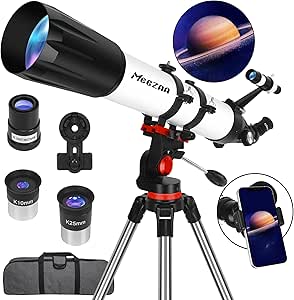 | Best for Longer-Focal-Length Beginner Viewing | Telescope type: Refractor | Aperture: 90 mm | Focal length: 800 mm | VIEW ON AMAZON | See Our Full Breakdown |
| WOSPORTS 90mm Refractor Telescope with Adjustable Tripod |  | Best for Straightforward Beginner Setup | Telescope type: Refractor | Aperture: 90 mm | Focal length: 600 mm | VIEW ON AMAZON | See Our Full Breakdown |
| Celestron AstroMaster 130EQ Telescope |  | Best for Aperture and Manual Tracking Control | Optical design: Newtonian reflector | Aperture: 130 mm (5.1 in) | Focal length: 650 mm | VIEW ON AMAZON | See Our Full Breakdown |
| Gskyer 90mm Aperture, 600mm Focal Length Refractor Telescope |  | Best for Eyepiece Variety Out of the Box | Telescope type: Refractor | Aperture: 90 mm (3.5 in) | Focal length: 600 mm | VIEW ON AMAZON | See Our Full Breakdown |
| SVBONY SV503 102mm f/7 ED Refractor Telescope |  | Best Premium Optical Tube | Telescope type: Refractor | Aperture: 102 mm | Focal length: 714 mm | VIEW ON AMAZON | See Our Full Breakdown |
| telescope for planetary viewing | Focal length | Aperture | Eyepieces | Telescope type |
|---|---|---|---|---|
| Fuoibl 70mm Refracting Telesco | 300 mm | — | 6 mm and 20 mm | Refracting |
| Celestron Travel Scope 70 Port | 400 mm | 70 mm | 20 mm and 10 mm | Refractor |
| Celestron AstroMaster 70AZ Ref | 900 mm | — | 20 mm and 10 mm | — |
| Gskyer 130EQ 130mm Reflector T | 650 mm | 130 mm (5.1 inches) | — | Reflector |
| Celestron NexStar 8SE Computer | — | 8 inches | — | — |
| Celestron PowerSeeker 127EQ Re | 1000 mm | 127 mm | 20 mm and 4 mm | — |
| Hawkko 90mm Aperture Refractor | 900 mm | 90 mm | 10 mm and 25 mm | — |
| ToyerBee 70mm Refractor Telesc | 300 mm | — | 20 mm and 6 mm | Refractor |
| HETEKAN 90mm Aperture Refracto | 900 mm | 90 mm | 6 mm, 10 mm, and 25 mm | Refractor |
| SVBONY SV48P 102mm f/6.5 Achro | 744.3 mm | 102 mm | — | — |
| MEEZAA 90mm Refractor Telescop | 800 mm | 90 mm | 10 mm and 25 mm | Refractor |
| WOSPORTS 90mm Refractor Telesc | 600 mm | 90 mm | 25 mm and 10 mm | Refractor |
| Celestron AstroMaster 130EQ Te | 650 mm | 130 mm (5.1 in) | — | — |
| Gskyer 90mm Aperture | 600 mm | 90 mm (3.5 in) | 25 mm, 10 mm, and 5 mm | Refractor |
| SVBONY SV503 102mm f/7 ED Refr | 714 mm | 102 mm | — | Refractor |
More Details on Our Top Picks
Fuoibl 70mm Refracting Telescope with Phone Adapter
The Fuoibl is a starter scope for buyers who want a simple way to view the Moon and try basic phone photography. Its 70mm aperture and included eyepieces suit bright targets, while the phone adapter and wireless remote make capturing a view less fiddly than holding a phone against the eyepiece. Compared with the Celestron AstroMaster 70AZ, the Fuoibl has a much shorter focal length, so it favors a compact kit and broad, lower-power views over the AstroMaster’s longer-focal-length setup for closer views. The supplied 3× Barlow expands the stated magnification range, but added magnification cannot create extra detail beyond what the aperture and seeing conditions allow. Manual focusing and an inverted finderscope image add a learning curve, and this is not the pick for sustained, high-detail planetary observing.
Pros:- 70mm aperture with fully multi-coated optics for bright lunar views
- Includes 6mm and 20mm eyepieces plus a 3× Barlow lens
- Phone adapter and wireless remote support basic smartphone image capture
- Tool-free setup and adjustable tripod
Cons:- 300mm focal length favors lower-power views over close planetary framing
- Manual focus and altazimuth pointing require hands-on adjustment
- Finderscope image appears inverted, which can complicate target acquisition
Best for: Young beginners or families who want a lightweight-style starter setup with a phone adapter for casual Moon photos.
Not ideal for: Planetary observers seeking consistently detailed high-power views or anyone who wants powered tracking and automatic target finding.
- Telescope type:Refracting
- Objective aperture:70 mm
- Focal length:300 mm
- Stated magnification range:15×–150×
- Eyepieces:6 mm and 20 mm
- Mount and focus:Altazimuth mount; manual focus
- Finderscope:5×24
- Included phone accessories:Phone adapter and wireless remote
Our verdict“Choose the Fuoibl for accessible lunar viewing and phone snapshots, not for the strongest planetary detail in this lineup.”
Celestron Travel Scope 70 Portable Refractor Telescope
The Travel Scope 70 earns its place for buyers who value portability as much as a first look at the planets. At 4.2 pounds, with a padded backpack and tool-free setup, it is easier to carry to a darker observing spot than the heavier Celestron AstroMaster 70AZ. Its 400mm focal length is also longer than the Fuoibl’s 300mm, giving the included 10mm eyepiece a more useful starting point for bringing bright targets closer. Still, the 70mm aperture sets a modest ceiling for fine planetary detail, and the manual altazimuth mount means the user must keep nudging the telescope as objects move. I’d choose it for portable, casual sessions rather than high-power planetary study; observers wanting a more substantial planetary setup should look toward the larger-aperture Gskyer 130EQ or NexStar 8SE.
Pros:- Lightweight 4.2-pound design includes a padded backpack
- 70mm coated-glass optics are suited to bright lunar and planetary targets
- 400mm focal length is longer than the Fuoibl 70mm’s 300mm
- Tool-free setup and included full-height tripod support quick sessions
Cons:- 70mm aperture limits fine detail compared with the Gskyer 130EQ and NexStar 8SE
- Manual altazimuth mount requires the observer to point and track by hand
- Beginner-oriented package offers less room for advanced observing
Best for: Beginners who need a light, packable telescope for occasional Moon and planet viewing from home or a travel destination.
Not ideal for: Buyers prioritizing fine planetary detail, automated tracking, or a mount that holds targets without frequent manual adjustments.
- Telescope type:Refractor
- Aperture:70 mm
- Focal length:400 mm
- Eyepieces:20 mm and 10 mm
- Mount and focus:Altazimuth mount; manual focus
- Optical tube length:17 inches
- Weight:4.2 pounds
- Included accessories:Tripod, backpack, finderscope, star diagonal, and eyepieces
- Warranty:2 years
Our verdict“Pick the Travel Scope 70 if easy transport matters more than high-power planetary performance.”
Celestron AstroMaster 70AZ Refractor Telescope
Among the small refractors here, the AstroMaster 70AZ makes the clearest case for beginning with the Moon and planets: its 900mm focal length is three times the Fuoibl’s, so the included 10mm eyepiece reaches 90× without a Barlow. That gives bright targets a more planet-oriented starting view, though its 70mm aperture still limits how much fine detail the scope can show. The red-dot StarPointer is a straightforward aid for aiming, and the full-height tripod supports a more conventional backyard setup than the Travel Scope 70’s packable design. In return, the AstroMaster weighs 10.8 pounds and uses a manual mount; it is less convenient to carry and still needs frequent hand tracking. I’d choose it over the Fuoibl for a longer-focal-length beginner refractor, but not over the 130mm Gskyer for light gathering.
Pros:- 900mm focal length provides a more planet-oriented view than the short Fuoibl 70mm
- Includes 20mm and 10mm eyepieces for 45× and 90× views
- StarPointer red-dot finder simplifies initial aiming
- Full-height adjustable tripod and erect image diagonal also support daytime viewing
Cons:- 70mm aperture gathers less light than the Gskyer 130EQ or NexStar 8SE
- Manual altazimuth mount requires continuous user pointing and tracking
- At 10.8 pounds, it is less portable than the Celestron Travel Scope 70
Best for: First-time backyard observers who want a straightforward refractor with a longer focal length for bright lunar and planetary targets.
Not ideal for: Travel-focused buyers or observers expecting detailed views of faint features and steady high-power tracking.
- Optical design:Achromatic refractor
- Objective aperture:70 mm (2.8 inches)
- Focal length:900 mm
- Included magnifications:45× and 90×
- Eyepieces:20 mm and 10 mm
- Mount:Manual altazimuth
- Finderscope:StarPointer red dot
- Weight:10.8 pounds (4.9 kg)
- Warranty:2 years
Our verdict“Choose the AstroMaster 70AZ for a simple, longer-focal-length first refractor, while accepting manual tracking and modest aperture.”
Gskyer 130EQ 130mm Reflector Telescope
The Gskyer 130EQ is the step-up choice here for buyers who want a larger aperture before moving to a computerized telescope. Its 130mm reflector gathers substantially more light than the 70mm Celestron refractors, giving bright planets and the Moon more potential for visible detail when atmospheric conditions cooperate. The German equatorial mount can make following a target more manageable once aligned, unlike the manual altazimuth mounts on the AstroMaster 70AZ and Travel Scope 70. That capability brings extra setup and learning demands, though, and the 30.1-pound assembly is a poor match for frequent carrying. The 650mm focal length and included eyepieces and Barlow offer flexible magnification, but the stated maximum should not be treated as a promise of sharp views. I’d favor this over the small refractors for aperture, and the NexStar 8SE for convenience.
Pros:- 130mm aperture gathers more light than the 70mm refractors in this batch
- Equatorial mount supports following celestial targets after setup
- Three eyepieces and a 3× Barlow provide viewing options
- Bluetooth camera remote supports basic smartphone capture
Cons:- 30.1-pound weight makes transport and storage less convenient
- Equatorial alignment and manual tracking involve a steeper learning curve than altazimuth scopes
- 650mm focal length and stated 307× maximum do not guarantee sharp planetary detail
Best for: Beginners ready to learn an equatorial mount who want more light-gathering capacity for planets, the Moon, and brighter deep-sky targets.
Not ideal for: Travelers, young users needing a light setup, or buyers who prefer automated alignment and target tracking.
- Telescope type:Reflector
- Aperture:130 mm (5.1 inches)
- Focal length:650 mm
- Focal ratio:f/5
- Stated maximum magnification:307×
- Mount:German equatorial
- Focus:Manual
- Weight:30.1 pounds
- Included accessories:Three eyepieces, 3× Barlow lens, finderscope, adjustable tripod, and Bluetooth camera remote
Our verdict“Choose the Gskyer 130EQ for greater aperture and hands-on tracking, provided you can manage its weight and mount setup.”
Celestron NexStar 8SE Computerized Schmidt-Cassegrain Telescope
The NexStar 8SE is the premium choice in this group for observers who want substantial aperture and automated target finding rather than a manual starter kit. Its 8-inch Schmidt-Cassegrain optics collect far more light than the Gskyer 130EQ or any 70mm refractor listed here, creating greater potential for detailed planetary views and broader observing beyond the planets. The GoTo mount can locate and track selected objects from its database, a major convenience compared with the Gskyer’s equatorial mount, but it must be aligned before use. SkyAlign helps with that process, though setup is still more involved than simply pointing a manual refractor at the Moon. The main buying uncertainty is the supplied kit: the product data does not specify eyepieces or other observing accessories. I’d choose it for capability and automation, not for an all-in-one, ready-to-go package.
Pros:- 8-inch aperture has much greater light-gathering capacity than the Gskyer 130EQ
- Computerized GoTo mount locates and tracks selected targets
- SkyAlign supports alignment using bright stars or planets
- StarBright XLT coatings and compatibility with optional Celestron accessories
Cons:- Computerized mount requires alignment before observing
- Included eyepieces and other viewing accessories are not specified in the product data
- More setup complexity than the manual refractors in this roundup
Best for: Committed observers seeking a large-aperture planetary telescope with computerized locating and tracking, and who are prepared to align the mount.
Not ideal for: First-time buyers wanting the simplest setup, or anyone who needs confirmed included eyepieces and accessories in the supplied package.
- Optical design:Schmidt-Cassegrain
- Aperture:8 inches
- Mount:Computerized GoTo, single-arm
- Object database:Over 40,000 celestial objects
- Alignment technology:SkyAlign
- Included controller:NexStar+ hand control
- Coatings:StarBright XLT
- Warranty:2 years
Our verdict“Choose the NexStar 8SE if aperture and automated tracking matter more than simple setup or a clearly specified accessory kit.”
Celestron PowerSeeker 127EQ Reflector Telescope
The PowerSeeker 127EQ earns its place for buyers who want 127 mm of aperture and a mount that can follow a planet as Earth turns. Its manual German equatorial mount takes more setup and learning than the altazimuth mounts on the Hawkko 90mm and HETEKAN 90mm, but once aligned, tracking can be done with a single axis adjustment rather than repeatedly nudging in two directions. That helps keep a planet in view at higher magnification. The included 4 mm eyepiece and 3× Barlow offer several viewing combinations, though advertised magnification is not a guarantee of sharp planetary detail. At 13 pounds, it is portable enough for many outings, but its manual controls and reflector design ask more of a beginner than a simple refractor setup. I’d choose it for hands-on observers who value tracking over quick setup.
Pros:- 127 mm reflector aperture offers more light gathering than the 90 mm Hawkko and HETEKAN refractors
- Manual German equatorial mount supports tracking with one axis after alignment
- Includes 20 mm and 4 mm eyepieces plus a 3× Barlow lens
- Adjustable full-height tripod and accessory tray are included
Cons:- Equatorial mount alignment and manual tracking add a learning curve
- Manual focus and controls require ongoing hands-on adjustments
- Included high-power optics do not guarantee crisp views under unsteady atmospheric conditions
Best for: Beginners or intermediate observers willing to learn equatorial alignment for steadier manual tracking of the Moon and planets
Not ideal for: Buyers who want a quick, point-and-view setup or dislike adjusting and aligning a manual mount
- Optical design:Newtonian reflector
- Aperture:127 mm
- Focal length:1000 mm
- Mount:Manual German equatorial
- Eyepieces:20 mm and 4 mm
- Barlow lens:3×
- Field of view:2.5 degrees
- Item weight:13 pounds
Our verdict“Choose the PowerSeeker 127EQ if you want a larger-aperture planetary scope with manual equatorial tracking and are prepared to learn its setup.”
Hawkko 90mm Aperture Refractor Telescope, 900mm Focal Length, 36x–270x Magnification
The Hawkko’s 90 mm refractor aperture and 900 mm focal length make it a straightforward starting point for lunar and planetary observing, with less mount complexity than the Celestron PowerSeeker 127EQ’s equatorial setup. Its altazimuth mount is intuitive to aim, though following a planet at higher power means making frequent adjustments in two directions. The 10 mm and 25 mm eyepieces, 3× Barlow, and smartphone adapter give beginners several ways to explore and document what they see. The stated 270× upper magnification should be treated as a ceiling, not a promise of useful planetary detail; atmospheric steadiness and mount stability matter. Compared with the lighter ToyerBee 70mm, Hawkko gathers more light but weighs 5 kg and is less convenient to carry. It suits home or backyard beginners more than frequent pack-and-go observers.
Pros:- 90 mm multi-coated objective gathers more light than the ToyerBee 70mm
- Altazimuth mount is simpler to aim than the PowerSeeker 127EQ’s equatorial mount
- Includes 10 mm and 25 mm eyepieces, a 3× Barlow, and a smartphone adapter
- Adjustable tripod and carry bag are supplied
Cons:- Manual altazimuth tracking requires frequent adjustments as a planet moves
- At 5 kg, it is heavier to carry than the ToyerBee 70mm
- The listed 270× magnification may not deliver sharp views in typical observing conditions
Best for: First-time backyard observers who want an intuitive refractor, a 90 mm aperture, and a phone adapter for casual lunar imaging
Not ideal for: Travelers seeking a lightweight kit or observers who want a mount that tracks planets without frequent manual nudges
- Aperture:90 mm
- Focal length:900 mm
- Magnification:36×–270×
- Mount:Altazimuth
- Eyepieces:10 mm and 25 mm
- Barlow lens:3×
- Tripod height:28–46 inches
- Item weight:5 kg
- Optical coating:Multi-coated
Our verdict“Pick the Hawkko for an accessible home refractor with a useful accessory kit, but skip it if low weight or effortless tracking is a priority.”
ToyerBee 70mm Refractor Telescope, 300mm Focal Length, 15x–150x Magnification
The ToyerBee is the most portable option here, weighing 3.5 pounds and pairing its 70 mm refractor with a short 300 mm focal length. That makes setup and wide, low-power views approachable, but it is a less compelling choice for close planetary detail than the Hawkko 90mm or HETEKAN 90mm, which have larger apertures and longer focal lengths. The included 20 mm and 6 mm eyepieces, 3× Barlow, star chart, and wireless camera remote offer a generous beginner kit; the remote can reduce shake when taking phone images. Its 150× listed maximum is not a reliable target for sharp views, especially when the lightweight tripod is unsettled. I’d treat this as a casual learning scope for the Moon and brighter targets, not a dedicated planetary-detail instrument.
Pros:- At 3.5 pounds, it is easier to carry than the 5 kg Hawkko and HETEKAN refractors
- Fully multi-coated optics and a 70 mm objective suit casual lunar observing
- Includes two eyepieces, a 3× Barlow, and a star chart
- Smartphone adapter and wireless remote support basic phone photography
Cons:- 70 mm aperture is smaller than the 90 mm options and gathers less light
- Short 300 mm focal length makes it less suited to detailed planetary views
- The lightweight setup can make the listed 150× magnification difficult to use steadily
Best for: Younger or first-time observers who want a light, inexpensive-to-carry learning kit for the Moon and occasional planetary viewing
Not ideal for: Planetary observers prioritizing finer detail, steady high-magnification viewing, or a longer-focal-length telescope
- Telescope type:Refractor
- Objective lens diameter:70 mm
- Focal length:300 mm
- Magnification:15×–150×
- Eyepieces:20 mm and 6 mm
- Barlow lens:3×
- Finderscope:5×24
- Item weight:3.5 pounds
Our verdict“Choose the ToyerBee for portability and beginner-friendly extras, not if planetary detail is the main reason for buying a telescope.”
HETEKAN 90mm Aperture Refractor Telescope, 900mm Focal Length
For planetary beginners choosing between similarly sized refractors, the HETEKAN stands out for its three eyepieces: 6 mm, 10 mm, and 25 mm. That gives more direct focal-length choices than the Hawkko 90mm’s two eyepieces, while both provide a 90 mm aperture, 900 mm focal length, and manual altazimuth mount. The extra 6 mm eyepiece can support higher-power viewing without relying only on a Barlow, although the stated 450× maximum is not a realistic guarantee of usable detail. Its phone adapter, carry bag, adjustable tripod, and accessory tray make the kit ready for a range of casual observing situations. The tradeoff is bulk: at 5.6 kg, it weighs more than the Hawkko and is far heavier than the ToyerBee 70mm. It fits stationary backyard use better than frequent travel.
Pros:- 90 mm aperture and 900 mm focal length are suited to lunar and planetary observing
- Three eyepieces provide more direct magnification choices than the Hawkko 90mm
- Includes a 3× Barlow, finder scope, phone adapter, and carry bag
- Adjustable 29–46 inch tripod and accessory tray support flexible setup
Cons:- At 5.6 kg, it is heavier than the Hawkko 90mm and much heavier than the ToyerBee 70mm
- Manual altazimuth tracking requires frequent corrections at higher magnification
- The listed 450× maximum is unlikely to provide sharp planetary views in ordinary conditions
Best for: Backyard beginners who want a 90 mm refractor with several eyepiece choices and phone-adapter accessories in one package
Not ideal for: Traveling observers who need a lighter telescope, or buyers expecting the stated 450× figure to produce sharp views
- Telescope type:Refractor
- Aperture:90 mm
- Focal length:900 mm
- Magnification:36×–450×
- Eyepieces:6 mm, 10 mm, and 25 mm
- Barlow lens:3×
- Mount:Altazimuth
- Item weight:5.6 kg
- Optical coating:Fully coated
Our verdict“Choose the HETEKAN if you want an accessory-rich 90 mm backyard refractor, but favor the lighter Hawkko for easier handling.”
SVBONY SV48P 102mm f/6.5 Achromatic Refractor Telescope
The SV48P brings the largest refractor aperture in this batch at 102 mm, along with fully multi-coated optics and a dual-speed focuser for fine adjustments. That focuser is a practical advantage over the manual focusing on the Hawkko and HETEKAN, especially when trying to settle on focus at higher power. Still, this is not the most ready-to-use planetary package: it arrives without a mount or finderscope, so those additions affect setup and tracking. Its 744.3 mm focal length and 1.86-degree field favor broad sky views and astrophotography more than the longer 900 mm Hawkko and HETEKAN. As an achromatic refractor, it may also show color fringing around bright objects such as planets. I’d choose it for an observer building a flexible system, not someone seeking an all-in-one planetary starter telescope.
Pros:- 102 mm aperture is larger than the 90 mm Hawkko and HETEKAN refractors
- Dual-speed focuser allows more controlled fine focusing than basic manual focusers
- Fully multi-coated, anti-reflective optics and a wide 1.86-degree field suit broad views
- Optical tube is designed for quick assembly without additional tools
Cons:- Mount and finderscope are not included, adding components to source before observing
- Achromatic optics may show chromatic aberration around bright planetary targets
- 744.3 mm focal length is shorter than the 900 mm Hawkko and HETEKAN for planetary viewing
Best for: Experienced beginners or hobbyists who already own a compatible mount and want a larger-aperture refractor for wide-field viewing and imaging
Not ideal for: First-time planetary observers who need a complete mount-and-finder package or want minimal color fringing on bright planets
- Optical design:Achromatic refractor
- Aperture:102 mm
- Focal ratio:f/6.5
- Focal length:744.3 mm
- Focuser:2.5-inch dual-speed
- Field of view:1.86 degrees
- Optical tube length:72 cm
- Optical tube weight:7 pounds
- Mount and finderscope:Not included
Our verdict“Pick the SV48P if you already have a mount and want a versatile wide-field tube; choose a complete 90 mm kit for simpler planetary observing.”
MEEZAA 90mm Refractor Telescope, 800mm Focal Length
I’d choose the MEEZAA 90mm for a beginner who wants a longer focal length than the 600mm WOSPORTS and Gskyer refractors. Its 800mm focal length gives the included eyepieces higher magnification before adding the 3× Barlow, a useful starting point for observing the Moon and trying planetary views. The 90mm aperture and fully multi-coated optics provide a sound entry-level base, while the carry bag and adjustable tripod suit occasional trips outside. The tradeoff is that the advertised 32×–240× range does not mean every setting will show a steady, detailed planet; high magnification is sensitive to atmospheric conditions and mount movement. Manual focusing and an altazimuth mount also ask the user to make adjustments by hand. Compared with the WOSPORTS, this model favors reach over a shorter tube and lower starting magnification.
Pros:- 90mm aperture with fully multi-coated optics
- 800mm focal length offers more native magnification than the 600mm WOSPORTS and Gskyer
- Includes 10mm and 25mm eyepieces plus a 3× Barlow
- Carry bag and adjustable tripod support portable beginner use
Cons:- Manual focusing and altazimuth pointing require hands-on adjustment
- The 240× upper range may not produce steady, useful planetary detail
- Longer focal length gives a narrower field than comparable 600mm refractors
Best for: New observers who want a portable 90mm refractor with a longer focal length for lunar and introductory planetary sessions.
Not ideal for: Buyers who want effortless high-magnification tracking or a computerized mount; focusing and pointing are manual, and the top of the stated range can be difficult to use.
- Telescope type:Refractor
- Aperture:90 mm
- Focal length:800 mm
- Focal ratio:f/8.88
- Magnification range:32×–240×
- Eyepieces:10 mm and 25 mm
- Mount:Altazimuth
- Optical coating:Fully multi-coated
- Tripod height:28–46 in
Our verdict“Choose the MEEZAA if you want a beginner-friendly 90mm refractor with more focal reach than the WOSPORTS or Gskyer, and are comfortable aiming and focusing manually.”
WOSPORTS 90mm Refractor Telescope with Adjustable Tripod
The WOSPORTS 90mm is a practical pick for beginners who want a 90mm refractor without the longer tube and higher starting magnification of the MEEZAA 90mm. Its 600mm focal length and included 25mm eyepiece start at 24×, giving a wider, easier-to-find view before moving to the 10mm eyepiece or 3× Barlow. The erect-image diagonal also makes daytime viewing more intuitive than a standard astronomical view, though planetary observing remains the main lens here. A stated weight of 5 pounds, tool-free setup, case, and adjustable tripod make it appealing for a first scope that may be carried outdoors. The tradeoff is manual focusing and a shorter focal length, which offers less magnification with a given eyepiece than the MEEZAA. Its 180× maximum is a ceiling, not a promise of steady detail.
Pros:- 90mm aperture and fully multi-coated optics
- 24× low-power starting magnification helps with locating objects
- Includes 25mm and 10mm eyepieces, 3× Barlow, and erect-image diagonal
- 5-pound weight, adjustable tripod, and carrying case support portability
Cons:- Manual focus and altazimuth mount require user adjustments
- 600mm focal length provides less magnification per eyepiece than the MEEZAA 90mm
- The stated 180× maximum may be hard to use under unsteady atmospheric conditions
Best for: First-time observers and families who want a manageable 90mm refractor with a low-power starting view, carrying case, and simple setup.
Not ideal for: Planet viewers seeking longer focal length or tracking assistance; it has a manual altazimuth mount, and its 600mm focal length trails the MEEZAA 90mm for native magnification.
- Telescope type:Refractor
- Aperture:90 mm
- Focal length:600 mm
- Magnification:24×–180×
- Eyepieces:25 mm and 10 mm
- Finderscope:3×24 reflex
- Diagonal:45° erect-image
- Tripod height:29–49 in
- Weight:5 lb
Our verdict“Pick the WOSPORTS for an accessible, portable first refractor with an easy low-power starting view, rather than the longer-reach MEEZAA.”
Celestron AstroMaster 130EQ Telescope
For buyers prioritizing light-gathering capacity, I’d rank the Celestron AstroMaster 130EQ ahead of the 90mm refractors here. Its 130mm Newtonian mirror gathers more light, supporting brighter views of the Moon and giving it broader deep-sky usefulness alongside planetary observing. The German equatorial mount has slow-motion controls, which let users make more measured adjustments as an object moves; that is a different experience from the basic altazimuth mounts on the MEEZAA and Gskyer. Its included 20mm and 10mm eyepieces supply only 33× and 65×, however, so planetary viewing at higher power calls for additional eyepieces or a suitable Barlow. The mount is manual, and the assembled 17-pound setup is less convenient to carry than the 5-pound WOSPORTS. I’d favor it for a buyer willing to learn setup and tracking in exchange for more aperture.
Pros:- 130mm aperture exceeds the 90mm refractors in this batch
- Newtonian design supports both planetary and deep-sky observing
- Equatorial mount includes slow-motion controls for measured tracking adjustments
- Includes two eyepieces and a StarPointer red dot finderscope
Cons:- Included eyepieces provide only 33× and 65×, so higher planetary power may require extra accessories
- Manual equatorial mount takes learning and ongoing adjustment
- 17-pound assembled weight is less portable than the WOSPORTS 90mm
Best for: Beginners ready to learn an equatorial mount who want more aperture for planets, lunar viewing, and occasional deep-sky observing.
Not ideal for: Anyone seeking a grab-and-go planetary scope or high magnification straight from the box; it weighs 17 pounds and the included eyepieces reach only 65×.
- Optical design:Newtonian reflector
- Aperture:130 mm (5.1 in)
- Focal length:650 mm
- Mount:German equatorial with slow-motion controls
- Included eyepieces:20 mm and 10 mm
- Magnification with included eyepieces:33× and 65×
- Finderscope:StarPointer red dot
- Field of view:0.67°
- Weight:17 lb (7.71 kg)
Our verdict“Choose the AstroMaster 130EQ if you want greater aperture and are willing to learn an equatorial mount and add eyepieces for higher-power planetary views.”
Gskyer 90mm Aperture, 600mm Focal Length Refractor Telescope
The Gskyer 90mm refractor stands apart from the WOSPORTS 90mm by including three eyepieces, including a 5mm option, so buyers can try several magnifications without relying on the 3× Barlow alone. That makes it a flexible starter kit for lunar and planetary sessions, while the 90mm aperture and coated optics match the basic light-gathering class of the other 90mm refractors here. Its 600mm focal length is shared with the WOSPORTS, so neither has the MEEZAA’s longer 800mm reach with the same eyepiece. The 360× maximum listed in the product details is far beyond what the supplied eyepieces alone provide and should not be treated as a dependable planetary setting. Manual focus and an altazimuth mount keep operation simple but leave aiming and tracking to the user. Its 17.5-pound listed weight also makes it less portable than the WOSPORTS.
Pros:- 90mm aperture with fully coated, multi-coated optics
- Includes 25mm, 10mm, and 5mm eyepieces for varied starting magnifications
- 3× Barlow, finderscope, and erecting prism add flexibility
- Erecting prism supports terrestrial as well as astronomical viewing
Cons:- Listed 360× maximum exceeds the supplied eyepiece magnifications and may be unrealistic for steady views
- Manual focusing and altazimuth pointing require hands-on tracking
- 17.5-pound listed weight is heavier than the WOSPORTS 90mm
Best for: New observers who want several eyepiece choices included and plan to use one telescope for planetary, lunar, and daytime viewing.
Not ideal for: Buyers seeking a lightweight travel setup or dependable very-high-power views; the telescope is listed at 17.5 pounds, and 360× is not a practical guarantee.
- Telescope type:Refractor
- Aperture:90 mm (3.5 in)
- Focal length:600 mm
- Focal ratio:f/6.7
- Eyepieces:25 mm, 10 mm, and 5 mm
- Magnifications:24×, 60×, and 120×
- Maximum magnification:360×
- Mount:AZ altazimuth
- Tripod height:31.5–49 in
Our verdict“Choose the Gskyer if included eyepiece variety matters more than portability, but treat its 360× claim as a theoretical limit rather than a useful target.”
SVBONY SV503 102mm f/7 ED Refractor Telescope
The SVBONY SV503 102mm ED is the premium optical choice in this batch, aimed at observers who care more about image control and color correction than an all-in-one beginner package. Its S-FPL51 ED glass is designed to reduce chromatic aberration, which can otherwise show as colored fringes around bright objects such as the Moon and planets. The 102mm aperture is larger than the MEEZAA, WOSPORTS, and Gskyer refractors, while the dual-speed 1:10 focuser allows finer focus adjustments than the manual focusing described for those entry-level scopes. The 360° field rotator is useful for camera alignment, though planetary viewing does not require imaging. The main tradeoff is substantial: the provided details specify no mount or accessories, so this is not a ready-to-observe beginner bundle. I’d choose it over the Celestron AstroMaster only when ED refractor optics and precise focusing outweigh the Newtonian’s complete setup.
Pros:- 102mm aperture is larger than the 90mm refractors in this batch
- S-FPL51 ED glass is designed to reduce chromatic aberration on bright targets
- Dual-speed 1:10 focuser supports fine focus adjustments
- 360° field rotator aids camera alignment without rotating the optical tube
Cons:- No mount or accessories are specified, so additional equipment is needed for observing
- Premium optical features do not provide automated tracking
- At f/7, it has less focal length than the MEEZAA’s 800mm tube despite its larger aperture
Best for: Experienced visual observers or aspiring planetary imagers who already own a compatible mount and want ED glass with fine focusing control.
Not ideal for: First-time buyers seeking a complete telescope kit; no mount, eyepieces, diagonal, or other accessories are specified in the supplied product details.
- Telescope type:Refractor
- Aperture:102 mm
- Focal length:714 mm
- Focal ratio:f/7
- Glass:S-FPL51 ED
- Coating:FMC
- Focuser:Dual-speed, 1:10
- Field rotator:360°
- Dew shield:133mm retractable aluminum hood
Our verdict“Choose the SV503 if you already have mounting gear and want ED refractor optics and precise focusing, not a complete beginner telescope package.”

How We Picked
I compared these 15 telescopes for the demands of planetary viewing rather than treating general-purpose versatility as the main goal. The ranking weighs aperture and optical design, focal length, expected color correction, mount stability and tracking, setup complexity, portability, and how well each option fits its intended buyer. I gave extra weight to features that can support a steady, well-scaled view of the Moon and planets, while treating bundled phone adapters and high magnification claims as secondary unless the underlying optics and mount can make useful images possible.
The order reflects practical tradeoffs, not a single specification contest. The NexStar 8SE ranks first for its aperture and tracking, while the SV503 102mm ED earns a distinct place for buyers prioritizing refractor image quality. Long-focus 90mm refractors follow as accessible planetary choices; compact 70mm scopes rank lower for detail but higher for portability and approachability. Larger Newtonian reflectors offer aperture for their size, yet mount demands, collimation, and handling affect their fit. I treat listed magnification ranges as claims rather than guarantees, since usable power depends on optics, steadiness, and atmospheric conditions.
| telescope for planetary viewing | Telescope type |
|---|---|
| Fuoibl 70mm Refracting Telesco | Refracting |
| Celestron Travel Scope 70 Port | Refractor |
| Celestron AstroMaster 70AZ Ref | — |
| Gskyer 130EQ 130mm Reflector T | Reflector |
| Celestron NexStar 8SE Computer | — |
| Celestron PowerSeeker 127EQ Re | — |
| Hawkko 90mm Aperture Refractor | — |
| ToyerBee 70mm Refractor Telesc | Refractor |
| HETEKAN 90mm Aperture Refracto | Refractor |
| SVBONY SV48P 102mm f/6.5 Achro | — |
| MEEZAA 90mm Refractor Telescop | Refractor |
| WOSPORTS 90mm Refractor Telesc | Refractor |
| Celestron AstroMaster 130EQ Te | — |
| Gskyer 90mm Aperture | Refractor |
| SVBONY SV503 102mm f/7 ED Refr | Refractor |
Factors to Consider When Choosing Telescope For Planetary Viewing
Choosing a planetary telescope is less about chasing the biggest magnification number and more about matching optics and mounting to where and how you observe. I’d start with your tolerance for setup, the amount of detail you hope to see, and whether you need to carry the scope regularly.
Prioritize Aperture, Then Match It to Your Conditions
Aperture sets the ceiling for how much fine detail a telescope can reveal, but larger optics also bring more weight, bulk, and setup effort. A 70mm scope can show the Moon and the brighter planets, yet it will not resolve the same subtle features as a larger instrument. Moving up to a 90mm refractor or a larger reflector can improve detail, provided the mount holds the view steady. Local atmospheric turbulence often limits sharpness before a telescope reaches its theoretical capability. Buyers in places with frequent unstable air may get more satisfying views from a smaller scope at moderate power than from a large instrument pushed too hard. Choose aperture for both your ambitions and the conditions where you’ll actually observe.
Treat Magnification as a Result, Not a Promise
Magnification comes from combining a telescope’s focal length with an eyepiece, so it is not a fixed measure of planetary performance. A package advertising very high power may still produce a dim, blurry view if the optics or mount cannot support it. Start with a clear, lower-power image, then increase magnification until detail stops improving. Planetary observing often rewards a sharp, stable view more than a large but soft image. Short-focal-length instruments can reach higher magnification with shorter eyepieces, but that alone does not add detail. Before buying extra eyepieces or a Barlow lens, learn which magnifications your skies and telescope can use well.
Choose the Mount for the Way You Observe
Planetary targets move across the sky as Earth rotates, so tracking can make a major difference during extended viewing. A computerized mount such as the one on the NexStar 8SE can follow a target, but it requires power, alignment, and a willingness to learn the controls. Manual alt-azimuth mounts are simpler for quick sessions, though you must nudge the telescope to keep a planet centered. Equatorial mounts can track after alignment, but their setup and balancing can frustrate a first-time observer. In any design, tripod vibration becomes more noticeable as magnification rises. If you mostly observe from a balcony or carry the scope outside for brief sessions, ease and steadiness may matter more than automation.
Understand Refractor and Reflector Tradeoffs
Refractors are usually straightforward to set up and do not need mirror collimation, which suits buyers who want to observe without much maintenance. Achromatic refractors can show color fringing around bright targets, while ED optics are designed to reduce that effect and can raise the purchase commitment. Reflectors can provide more aperture for a manageable tube size, but their mirrors may need occasional alignment, and open tubes collect dust over time. A long focal-length refractor can give planets a convenient image scale, but its long tube may be awkward on a light tripod. Neither optical design wins for every household: weigh maintenance, tube size, and the kind of image compromise you’ll accept.
Plan for Setup, Storage, and Your Observing Spot
A telescope that stays packed away because it is cumbersome will not deliver much observing time. Check the assembled footprint, tripod height, tube length, and whether your storage area can protect the optics from dust and knocks. A compact scope is easier to transport, but a lighter tripod can shake in a breeze or when focusing. Larger instruments may call for a sturdy surface and room to let the optics adjust to outdoor temperatures. Urban observers should also think about nearby lights and a clear view above rooftops, since location can limit planetary sessions regardless of telescope choice. Pick a setup you can deploy regularly, not merely one that looks capable on paper.
Decide Whether Phone Photography Is a Real Priority
A phone adapter can help you record a quick Moon image or share a view, but it does not turn a visual telescope into a dedicated planetary imaging system. Holding a phone in alignment with an eyepiece takes patience, and small shifts can move the target out of frame. Planetary imaging also benefits from steady tracking, careful focus, and video capture, so mount capability may matter more than a bundled adapter. If your main goal is observing with your eyes, do not pay extra solely for a phone holder. If recording planets is central, check how the telescope accepts a camera and whether its mount can keep the target centered. Keep expectations modest for simple phone-through-eyepiece setups.
Frequently Asked Questions
Is the Celestron NexStar 8SE worth choosing over a simpler 90mm refractor for planets?
I’d choose the 8SE if planetary detail and automatic tracking matter more than portability and a quick manual setup. Its larger aperture can show finer detail, and tracking helps keep a planet centered while observing at higher magnification. A 90mm refractor is easier to approach and typically avoids reflector collimation, making it a better fit for casual sessions or buyers who want fewer setup steps. The 8SE also needs power, alignment, and more room to store and transport. If those demands would keep you from using it, the smaller refractor may be the better practical choice.
Can a 70mm telescope show Jupiter and Saturn well enough for a beginner?
Yes, a 70mm telescope can show Jupiter’s main disk and its brightest moons, along with Saturn’s rings when viewing conditions cooperate. Expect a modest image rather than the fine, high-contrast detail a larger aperture can reveal. A stable tripod and a clear night will do more for the experience than pushing the scope to its advertised maximum magnification. The Travel Scope 70 and similar compact models make sense if easy carrying and simple sessions are priorities. If planetary detail is your main long-term goal, a 90mm refractor or a larger-aperture telescope offers more room to grow.
Should I choose an ED refractor or a larger reflector for planetary viewing?
I’d favor the SVBONY SV503 102mm ED if reduced color fringing, refractor-style setup, and optical refinement are central to your choice. A larger reflector can gather more light and reveal finer detail, but it brings mirror alignment and a different maintenance routine. The ED refractor does not automatically outperform a reflector with substantially more aperture, especially when resolving fine features. Your choice depends on whether you value a cleaner color rendition and simpler upkeep or greater light gathering and are willing to manage collimation. Also compare mount stability, since either optical design can disappoint on a shaky support.
Do computerized tracking and an equatorial mount make a telescope better for planetary viewing?
Tracking helps keep a planet centered, which is useful when observing at higher power or sharing the view with others. A computerized mount can locate and follow targets after alignment, while an equatorial mount can track after careful setup and balancing. Neither option improves the telescope’s optical resolution by itself, and both add setup steps compared with a simple manual alt-azimuth mount. For short, casual sessions, a stable manual mount may be faster and less frustrating. Choose tracking when you expect to observe for longer stretches or want to record planetary video.
Are the bundled eyepieces and advertised magnification ranges enough for planetary observing?
Bundled eyepieces can get a beginner started, but their number and maximum claimed magnification do not tell you how sharp the view will be. High power magnifies atmospheric blur, mount vibration, and focusing errors along with the planet. Begin with the eyepiece that gives a comfortable, steady view, then move up only if the image remains crisp. A well-matched eyepiece can improve convenience, but it cannot create detail the aperture and optics do not resolve. I’d prioritize a solid mount and realistic expectations before buying a large accessory set.
Conclusion
My best overall choice is the Celestron NexStar 8SE for buyers who want the strongest planetary detail in this group and are comfortable with alignment and powered tracking. For best value in a straightforward planetary setup, I’d look at the Hawkko 90mm Refractor, while accepting that its aperture and optical refinement remain below the larger premium options. The SVBONY SV503 102mm ED is my best premium refractor for buyers who place a high priority on color correction and cleaner views. Beginners who want a simpler, portable instrument can start with the Celestron Travel Scope 70, though it is not the choice for maximum planetary detail. For specific needs, choose a larger reflector such as the Gskyer 130EQ or AstroMaster 130EQ when aperture matters and you can manage alignment; choose a compact 70mm model when easy transport matters most. Match your telescope to the sessions you’ll actually have, and the right pick becomes much clearer.