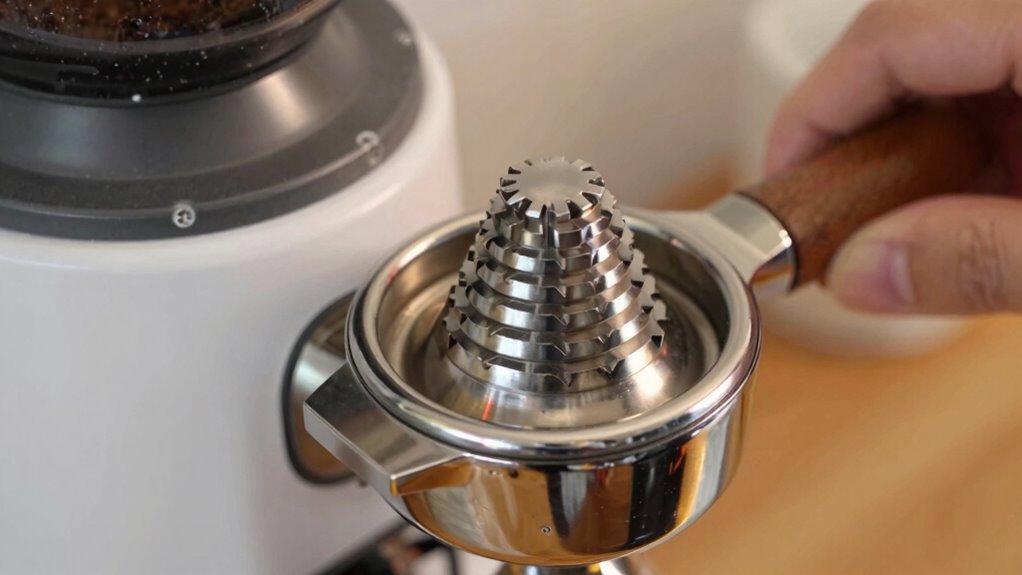
Espresso grinders are built to produce a super fine, consistent grind that guarantees precise extraction and better flavor. They have specially designed burrs, often conical or flat, to achieve uniform grounds, unlike regular grinders with blade mechanisms or cheaper burrs. These grinders focus on precision over speed, allowing you to fine-tune the grind size for the best espresso shots. If you want to understand how this improves your coffee, keep exploring what sets them apart.
Listen free for 30 days with Audible
Thousands of audiobooks and originals — cancel anytime.
As an affiliate, we earn on qualifying purchases.
Key Takeaways
- Espresso grinders produce ultra-fine, uniform grounds essential for proper extraction and rich crema, unlike coarser regular grinders.
- They feature specially designed burrs for precise, consistent grinding, whereas regular grinders often use blades or cheaper burrs.
- Focused on precision and consistency over speed and volume, ensuring steady shot quality for espresso.
- Offer adjustable grind settings tailored for espresso machines, enabling fine-tuning for optimal flavor extraction.
- Uniform grounds from espresso grinders lead to better flavor balance, extraction consistency, and overall espresso quality.
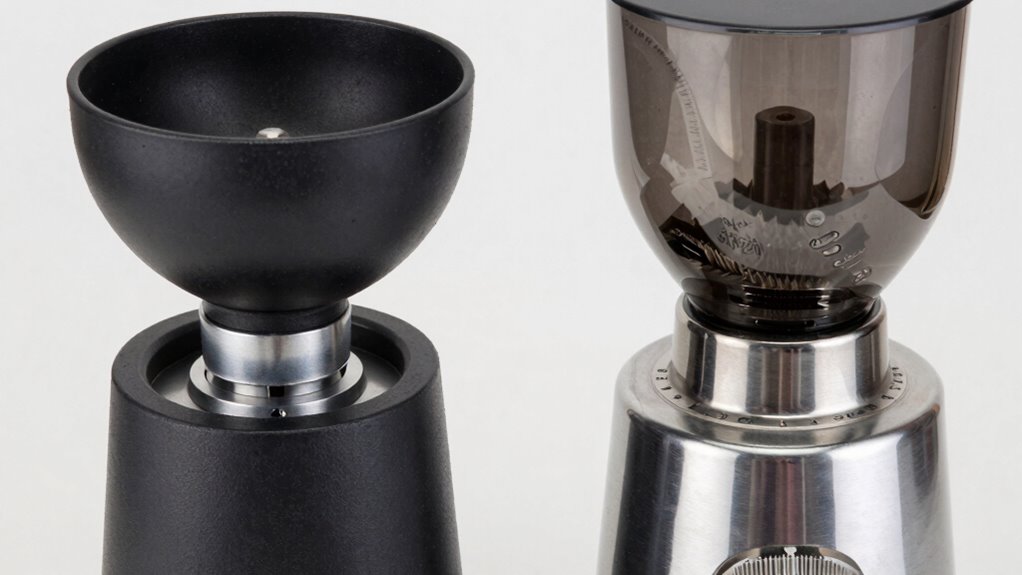
If you’re serious about making great espresso at home, understanding how espresso grinders differ from regular coffee grinders is indispensable. The key difference lies in their ability to produce a consistent, fine grind size necessary for espresso extraction. Unlike standard coffee grinders, which often emphasize speed and volume, espresso grinders focus on precision. The grind size for espresso needs to be super fine and uniform, allowing hot water to pass through the coffee grounds at just the right rate. Any inconsistency in grind size can lead to over-extraction or under-extraction, ruining the flavor and crema of your espresso shot. That’s why espresso grinders are built with burrs designed specifically to achieve that level of fineness and consistency. Additionally, grind uniformity plays a crucial role in ensuring each shot has a balanced flavor profile, making the quality of the grind even more vital for espresso brewing. The design of the grinder’s burrs and the quality of their manufacturing significantly influence this uniformity and overall performance. Machine compatibility is another essential aspect. Not all grinders are suitable for use with espresso machines. Regular coffee grinders, especially blade types, might struggle to produce the fine, uniform grounds required for espresso, and their inconsistent grind sizes can cause problems like clogging or uneven extraction. Espresso grinders, on the other hand, are engineered to work seamlessly with espresso machines, often featuring adjustable grind settings that allow you to fine-tune the grind size to match your specific machine. This compatibility guarantees that you can get the best extraction every time, maximizing flavor and aroma. When choosing an espresso grinder, you need to consider whether it’s compatible with your espresso machine’s brewing method and grind requirements. Some grinders are versatile and can switch between brew types, but many are designed solely for espresso, making them a better choice if that’s your primary focus. Additionally, espresso grinders are built with more precise burr mechanisms, often conical or flat burrs, which help produce a consistent grind size at a finer level. Regular grinders may use cheaper blade mechanisms or less sophisticated burrs that can’t reliably reach the fine grind needed for espresso. This precision extends to the consistency of each grind, which is fundamental for maintaining a steady shot quality. When you’re investing in an espresso grinder, you’re paying for that ability to produce uniform grounds, which directly influences the quality of your espresso.
As an affiliate, we earn on qualifying purchases.
Frequently Asked Questions
Can I Use a Regular Grinder for Espresso?
You can use a regular grinder for espresso, but it might not deliver the best results. Regular grinders often lack the fine grind consistency needed for espresso, which is essential for ideal extraction. Consider your coffee bean roasting preferences and grinder capacity too; a burr grinder can provide more uniform grounds. For the best espresso, investing in a grinder designed specifically for espresso will give you better control and flavor.
How Does Grind Size Affect Espresso Extraction?
Imagine a delicate dance—your grind size sets the rhythm for perfect espresso extraction. When your grind is too coarse, water flows quickly, resulting in weak flavor. Too fine, and water struggles to pass, causing over-extraction and bitterness. Grind consistency guarantees uniform particles, giving you precise extraction control. Adjusting grind size directly influences flavor, aroma, and body, making it essential for a rich, balanced espresso experience.
Are Manual Espresso Grinders Effective?
Yes, manual espresso grinders are effective, especially if you value manual precision and grind consistency. They give you better control over the grind size, which is essential for extracting rich, flavorful espresso. While they may require more effort than electric grinders, many enthusiasts prefer them for their ability to produce uniform grounds. With patience and practice, a manual grinder can deliver a high-quality espresso experience right at home.
Do Espresso Grinders Need Special Maintenance?
Think of your espresso grinder as a finely tuned sports car—it needs regular upkeep to stay in top shape. Yes, espresso grinders require special maintenance, mainly because of their precision parts. To keep them performing at their best, you should schedule maintenance frequently, focusing on cleaning and lubrication. This guarantees grinder durability and prevents build-up, so your espresso remains consistently rich and flavorful.
What’s the Ideal Burr Size for Espresso Grinding?
The ideal burr size for espresso grinding is typically between 58mm and 65mm, as larger burrs help you achieve better grind consistency essential for a rich espresso shot. A bigger burr size allows for more uniform particle size, reducing the chances of over or under-extraction. If you want best flavor, choose a grinder with a burr size that balances grind consistency and speed, usually around 58mm for home use.
As an affiliate, we earn on qualifying purchases.
Conclusion
So, now you know that espresso grinders are basically the high-maintenance divas of the coffee world—demanding, precise, and utterly obsessed with perfection. Regular grinders? They’re your laid-back buddies, happy to churn out whatever grounds you toss in. But if you’re aiming for that barista-level shot, you’ll want to splurge on the fancy, fine-tuned espresso grinder. Otherwise, stick with your humble, no-nonsense regular grinder—after all, who needs precision when you can have convenience?
adjustable grind size espresso grinder
As an affiliate, we earn on qualifying purchases.
As an affiliate, we earn on qualifying purchases.
As an affiliate, we earn on qualifying purchases.
Flea & tick season Picks
flea and tick prevention
As an affiliate, we earn on qualifying purchases.