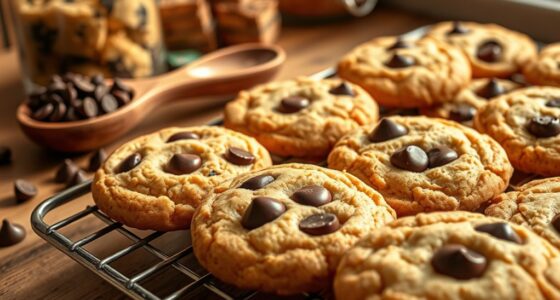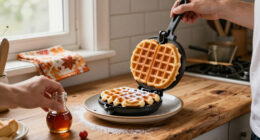
Baking at high altitude requires some adjustments to get the best results. To prevent over-rising, reduce your baking powder or soda by 1/4 to 1/2 teaspoon per teaspoon. Increase the oven temperature by 15-25°F to help set the structure quickly. Add 1-2 tablespoons more liquid since moisture evaporates faster. Ultimately, keep an eye on your baked goods; they may need less time in the oven. There’s more to master about baking at altitude, so keep exploring!

Get kitchen gear delivered free with Prime
- Fast, free delivery on millions of items
- Prime Video, Amazon Music and more included
- Member-only deals all year
Key Takeaways
- Reduce baking powder or baking soda by 1/4 to 1/2 teaspoon per teaspoon to prevent over-rising at high altitudes.
- Increase oven temperature by 15-25°F to help set the structure of baked goods faster.
- Slightly increase liquid ingredients by 1-2 tablespoons to compensate for faster evaporation at high elevations.
- Monitor baking time closely and check for doneness earlier than the original recipe suggests.
- Balance flour-to-liquid ratio to maintain dough stability and ensure optimal texture and rise.

Have you ever wondered why your baked goods don’t rise as expected at high altitudes? If you’ve recently moved to a higher elevation or are just trying your hand at altitude baking, you might be facing some unique challenges. The thinner air at high altitudes affects how your recipes behave, and if you don’t make the necessary recipe modifications, you’re likely to end up with dense, sunken cakes or flat cookies.
One of the primary reasons for this issue is the decrease in atmospheric pressure. At higher elevations, the air pressure is lower, which means that your baked goods can rise faster than they would at sea level. While this might sound like a good thing, it can actually cause your batter or dough to expand too quickly and then collapse. To counteract this, you’ll want to make specific alterations to your recipes.
The decrease in atmospheric pressure at high altitudes causes baked goods to rise too quickly, risking collapse without recipe adjustments.
One key adjustment is to reduce the amount of baking powder or baking soda you use. Generally, cutting back by about 1/4 to 1/2 teaspoon per teaspoon of leavening agent can help you achieve better results. This helps prevent that rapid rise and keeps your baked goods from deflating. Additionally, you might want to increase the oven temperature by about 15 to 25 degrees Fahrenheit. A hotter oven can help set the structure of your baked goods more quickly, providing the support they need to rise properly.
Another important factor in altitude baking is the amount of liquid in your recipes. At high elevations, liquids evaporate faster, so you might need to increase the liquid content slightly. Adding an extra tablespoon or two of water, milk, or any other liquid can help maintain the moisture your baked goods need to rise and stay fluffy.
You should also consider the flour-to-liquid ratio. Reducing the amount of flour or increasing the liquid can help balance out the dough’s consistency. Experiment with your recipes until you find the right balance that works for your altitude.
Finally, don’t forget about the baking time. Because your oven’s temperature and the structure of the batter have changed, you may need to check for doneness earlier than the original recipe suggests.
With these recipe modifications in mind, you can conquer high-altitude baking challenges and enjoy delicious, fluffy baked goods that rise beautifully, no matter where you are.
high altitude baking powder reduction
As an affiliate, we earn on qualifying purchases.
As an affiliate, we earn on qualifying purchases.
Frequently Asked Questions
How Does Altitude Affect Baking Time and Temperature?
Altitude affects baking time and temperature primarily due to lower air pressure and increased moisture evaporation rates. At higher elevations, your baked goods may rise faster but can also dry out quickly. You’ll need to adjust your baking time, often reducing it, and increase the temperature slightly to compensate for the rapid evaporation. Pay attention to your dough or batter; it may need more liquid to stay moist and achieve the right texture.
Can I Use My Regular Recipes at High Altitude?
Sure, you can use your regular recipes at high altitude—if you enjoy baking disasters! Just toss in some recipe modifications and ingredient substitutions like confetti at a party. You’ll want to reduce sugar, increase flour, and maybe even add an extra egg. Who doesn’t love a science experiment? But hey, if you’re aiming for a flat cake, go ahead and ignore those adjustments. It’s all about the thrill of the bake, right?
What Common Ingredients Require Adjustments at High Altitude?
At high altitude, you’ll need to make some ingredient substitutions and leavening adjustments. For instance, reduce the amount of baking powder or baking soda to prevent over-expansion of your baked goods. You might also find that using less sugar helps, as sugar can intensify dryness. Additionally, consider increasing your liquid ingredients to keep moisture. Make these tweaks to guarantee your recipes turn out light and fluffy at higher elevations!
Are There Specific Baking Tools Recommended for High-Altitude Baking?
Yes, there are specific baking tools that can help you at high altitudes. You’ll find specialty measuring cups useful for precise ingredient measurements, which is vital when adjusting recipes. Additionally, altitude-specific spatulas can enhance your mixing and folding techniques, ensuring even distribution of ingredients. These tools can make a significant difference in achieving the right texture and consistency in your baked goods, so consider adding them to your kitchen arsenal!
How Can I Tell if My Baked Goods Are Over or Undercooked?
When you’re baking, look for visual cues and texture differences to determine if your goods are perfectly baked. If the edges are golden and the center springs back when gently pressed, you’ve likely nailed it. On the flip side, if it’s too jiggly or the edges are darkening, you might’ve undercooked. Trust your senses; a toothpick test can also help—if it comes out clean, you’re golden! Enjoy your baking adventures!
oven thermometer for high altitude baking
As an affiliate, we earn on qualifying purchases.
As an affiliate, we earn on qualifying purchases.
Conclusion
Baking at high altitude can be a challenge, but with the right adjustments, you can achieve delicious results. Did you know that for every 1,000 feet above sea level, the boiling point of water decreases by about 2°F? This means you’ll need to tweak your recipes to account for this change. By reducing sugar, increasing flour, and adjusting baking times, you’ll master the art of high-altitude baking and enjoy treats that rise to the occasion.
liquid measuring cups for baking
As an affiliate, we earn on qualifying purchases.
As an affiliate, we earn on qualifying purchases.
As an affiliate, we earn on qualifying purchases.
Halloween Picks
halloween
As an affiliate, we earn on qualifying purchases.