Choosing your first KitchenAid stand mixer comes down to more than bowl size: how often you bake, how much counter space you have, and how comfortable you are handling a heavier machine all matter. I rank the Artisan 5-Qt first for beginners who want useful room to grow without starting with a very large bowl-lift mixer. The Classic 4.5-Qt is my straightforward pick for smaller batches and a simpler entry point, while the 7-Quart Bowl-Lift suits frequent bakers who make large or dense batches and can accommodate its weight.

Get kitchen gear delivered free with Prime
- Fast, free delivery on millions of items
- Prime Video, Amazon Music and more included
- Member-only deals all year
The tradeoff is practical: a larger bowl and extra tools can help with bigger jobs, but they also mean more machine to store and manage. A tilt-head gives easier access while adding ingredients; a bowl-lift design holds the bowl securely for substantial mixing. I’ve ordered these picks around beginner-friendly usability, capacity, and the balance between capability and day-to-day convenience—not on a claim that one model suits every kitchen.
Complete the kit


Key Takeaways
- The Artisan 5-Qt is my best overall beginner pick for a useful capacity, tilt-head access, and 10 speeds.
- The Classic 4.5-Qt is the simpler choice for modest batches, though its bowl is smaller than the Artisan’s.
- The 7-Quart Bowl-Lift is better suited to frequent large-batch baking than to a first-time baker with limited storage.
- All three include core mixing tools, but KitchenAid hub-powered attachments are sold separately.
- Choose tilt-head for easy bowl access; choose bowl-lift when stability and large-batch capacity matter more.
| KitchenAid Artisan 5-Qt Tilt-Head Stand Mixer, Almond Cream |  | Best Overall for Beginners | Capacity: 5 quarts | Speeds: 10 | Wattage: 325 watts | VIEW ON AMAZON | See Our Full Breakdown |
| KitchenAid Classic Series 4.5-Quart Tilt-Head Stand Mixer, White | 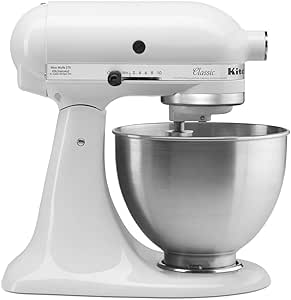 | Best Straightforward Starter | Model: K45SSWH | Capacity: 4.5 quarts | Speeds: 10 | VIEW ON AMAZON | See Our Full Breakdown |
| KitchenAid 7-Quart Bowl-Lift Stand Mixer with Accessories, KSM70SKXX |  | Best for Large Batches and Frequent Baking | Model: KSM70SKXX | Capacity: 7 quarts | Speeds: 11, including 1/2 speed | VIEW ON AMAZON | See Our Full Breakdown |
| kitchenaid stand mixer for beginners top picks tip | Capacity | Speeds | Warranty | Wattage |
|---|---|---|---|---|
| KitchenAid Artisan 5-Qt Tilt-H | 5 quarts | 10 | 1-year hassle-free replacement | 325 watts |
| KitchenAid Classic Series 4.5- | 4.5 quarts | 10 | 1-year limited | — |
| KitchenAid 7-Quart Bowl-Lift S | 7 quarts | 11, including 1/2 speed | 1-year limited | 500 watts |
More Details on Our Top Picks
KitchenAid Artisan 5-Qt Tilt-Head Stand Mixer, Almond Cream
The Artisan is my first choice for a beginner who expects baking to become a regular hobby. Its 5-quart bowl gives a little more capacity than the Classic’s 4.5-quart bowl, while its tilt-head layout keeps the bowl accessible for scraping, adding flour, or switching tools. That small capacity difference does not make it a commercial-scale mixer, but it gives a new owner a practical amount of room for family baking and larger cookie batches.
Its 10 speeds cover the familiar jobs a beginner is likely to tackle: combining ingredients, whipping, and kneading. The supplied description says it can mix dough for up to nine dozen cookies in one batch using the flat beater, a useful indication of its batch potential. Still, that stated capacity does not mean every recipe or dough behaves the same way; dense mixtures and bowl volume call for sensible recipe-size judgment. Compared with the Classic, the Artisan’s clearest advantage is extra capacity, not a different basic mixing approach.
There are tradeoffs. The listed package includes a pouring shield, but it does not list the same set of beaters and dough tools that comes with the 7-quart model. Optional hub-powered attachments are sold separately, so buyers should not assume the mixer includes pasta or food-preparation tools. Its listed weight is 11 kg, which may make frequent cupboard storage less appealing. I’d choose it for a settled countertop spot and routine baking, not for someone who needs a light appliance to lift in and out of storage after every use.
Pros:- 5-quart stainless steel bowl offers more capacity than the Classic’s 4.5-quart bowl.
- Tilt-head makes it easier to access the bowl and add ingredients.
- 10 speeds cover mixing, whipping, and kneading tasks.
- Dishwasher-safe bowl makes cleanup simpler.
Cons:- Optional hub-powered attachments are sold separately.
- Its listed 11 kg weight may be awkward for frequent cupboard storage.
- The supplied component list is less extensive than the 7-quart model’s accessory set.
Best for: A first-time baker who wants a versatile tilt-head mixer, a little more room than the Classic, and capacity for regular home batches.
Not ideal for: Someone who needs the lightest machine to store away, wants a compact bowl for occasional small recipes, or expects hub attachments to be included.
- Capacity:5 quarts
- Speeds:10
- Wattage:325 watts
- Design:Tilt-head
- Bowl:Stainless steel; dishwasher-safe
- Weight:11 kg
- Included components:Stand mixer and pouring shield
- Warranty:1-year hassle-free replacement
Our verdict“I recommend the Artisan as the most balanced first KitchenAid for beginners who want easy bowl access and useful capacity without moving to a large bowl-lift machine.”
KitchenAid Classic Series 4.5-Quart Tilt-Head Stand Mixer, White
The Classic is the more pared-back alternative to the Artisan: it keeps the approachable tilt-head design and 10 speeds but pairs them with a 4.5-quart bowl. For someone learning to make cookies, whipped toppings, or occasional dough, that smaller capacity can be a sensible match rather than a shortcoming. It takes up less room in a recipe plan than the 7-quart bowl-lift model, and the tilt head makes it easier to reach the bowl than a bowl-lift setup.
Its included kit gives a beginner the basic tools for common tasks: a coated flat beater, coated dough hook, and wire whip, along with the stainless steel bowl. That makes the Classic’s package feel more immediately useful than the Artisan’s listed components, which specify the mixer and pouring shield. Compared with the Artisan, however, the Classic gives up half a quart of bowl capacity. A household that often doubles recipes may prefer the Artisan’s extra room; someone who bakes smaller batches may not gain much from it.
The all-metal construction is a useful point for buyers looking for a durable-feeling machine, and support for optional KitchenAid attachments adds a path to expand its uses later. But those attachments are not included, so I would not pick the Classic on the assumption that the mixer arrives ready for every specialty job. Its 275-watt motor is the listed figure, but wattage alone does not tell a beginner exactly how a particular dense dough will perform. This is a solid basic choice, not the most spacious or the most accessorized model in this comparison.
Pros:- Tilt-head design gives easy access to the bowl.
- Includes a flat beater, dough hook, and wire whip for common baking tasks.
- All-metal construction and stainless steel bowl.
- 10 speeds and compatibility with optional KitchenAid attachments.
Cons:- The 4.5-quart bowl is smaller than the Artisan’s 5-quart bowl.
- Optional hub-powered attachments are sold separately.
- The supplied information does not list a pouring shield.
Best for: A beginner who mostly makes smaller home batches and values a simple tilt-head mixer with the core beater, dough hook, and whip included.
Not ideal for: A baker who regularly prepares large batches, wants the Artisan’s extra bowl capacity, or needs more accessories in the package.
- Model:K45SSWH
- Capacity:4.5 quarts
- Speeds:10
- Motor power:275 W
- Construction:All-metal
- Bowl:Stainless steel
- Included tools:Coated flat beater, coated dough hook, 6-wire whip
- Warranty:1-year limited
Our verdict“I’d choose the Classic for a beginner who wants the core stand-mixer setup and expects to make modest batches more often than oversized ones.”
KitchenAid 7-Quart Bowl-Lift Stand Mixer with Accessories, KSM70SKXX
This bowl-lift mixer is the specialist in the group: its 7-quart capacity, 11 speeds, and included selection of mixing tools suit a household that bakes in volume. A beginner who already knows they want to make large batches may appreciate having room for substantial recipes instead of outgrowing a smaller bowl quickly. The extra half speed for gentle folding also gives more control for delicate mixing than the 10-speed Classic and Artisan provide in their listed specifications.
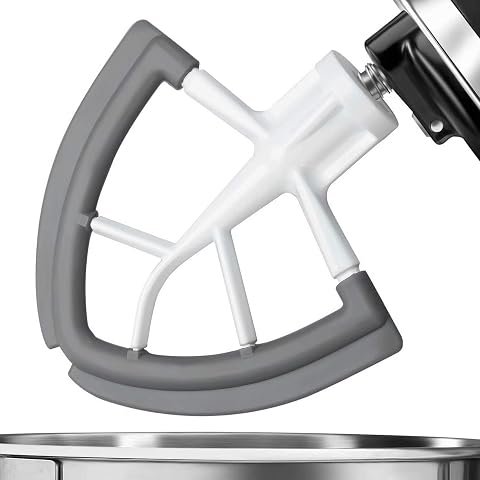
Unlike the tilt-head models, this mixer raises and locks the bowl into position. The three-point locking bowl is designed to stay stable during mixing, which makes sense for substantial or dense batches. Its package is also the most extensive here: a double flex edge beater, coated flat beater, coated dough hook, 11-wire whip, and pouring shield accompany the stainless steel bowl. Compared with the Classic, that is more included equipment; compared with the Artisan, it offers a much larger bowl and a broader listed tool set.
Those gains come with a real beginner tradeoff: at 28 pounds, it is a heavy machine to move, and its 16.5-inch height may complicate storage beneath some cabinets. Bowl-lift operation also does not give the same quick tilt-back access as the Classic or Artisan. A new baker who makes small recipes now and then may find the capacity excessive rather than useful. I rank it third for beginners overall because its advantages matter most to frequent, high-volume bakers, not because it is short on capability. Additional hub attachments are sold separately.
Pros:- 7-quart bowl accommodates larger batches than either tilt-head option.
- 11 speeds include a gentle half speed for folding.
- Includes several beaters, a dough hook, a whip, and a pouring shield.
- Three-point locking bowl supports stability during mixing.
Cons:- At 28 pounds, it is the heaviest option in this comparison.
- Bowl-lift design is less convenient for quick bowl access than a tilt head.
- Additional hub-powered attachments are sold separately.
Best for: A beginner who already bakes frequently, makes large batches, and has stable counter space for a heavy bowl-lift mixer.
Not ideal for: Someone who bakes occasionally, has limited counter or cabinet clearance, or wants an appliance that is easy to lift and store.
- Model:KSM70SKXX
- Capacity:7 quarts
- Speeds:11, including 1/2 speed
- Wattage:500 watts
- Design:Bowl-lift with three-point locking bowl
- Weight:28 pounds
- Dimensions:14.63 x 11.31 x 16.5 inches
- Included tools:Double flex edge beater, coated flat beater, coated dough hook, 11-wire whip, pouring shield
- Warranty:1-year limited
Our verdict“I recommend this model to beginners with frequent large-batch plans and permanent counter space, but most occasional bakers will find a tilt-head pick easier to live with.”

How We Picked
I compared these mixers around the needs of a first-time stand-mixer owner: ease of access, useful capacity, everyday versatility, and the practical burden of size and weight. Beginners often benefit from a machine that handles basic mixing, whipping, and dough work without requiring a large dedicated storage area or a learning curve around a less familiar setup. That makes the two tilt-head models strong contenders, but their capacities and included features still differ.
I also weighed what each specification means in the kitchen. A 4.5- or 5-quart bowl is a more manageable starting point for routine home baking, while a 7-quart bowl can accommodate substantially larger batches. The bowl-lift model adds a gentle half speed and more mixing tools, but its 28-pound weight and taller form are real considerations. By contrast, tilt-head access can make it easier to scrape the bowl or add ingredients, though the Classic and Artisan offer fewer speeds than the bowl-lift model.
My ranking favors a blend of approachability and room to grow. The Artisan takes first place because its 5-quart capacity and tilt-head design offer a helpful middle ground. The Classic comes next for buyers who want a more modest bowl and a straightforward feature set. The 7-quart model ranks third for a beginner-focused list—not because it lacks capability, but because its size and weight are more than many new bakers need. I judge each against those specific needs, rather than treating a bigger machine as automatically better.
| kitchenaid stand mixer for beginners top picks tip | Design | Bowl | Model | Included tools |
|---|---|---|---|---|
| KitchenAid Artisan 5-Qt Tilt-H | Tilt-head | Stainless steel; dishwasher-safe | — | — |
| KitchenAid Classic Series 4.5- | — | Stainless steel | K45SSWH | Coated flat beater, coated dough hook, 6-wire whip |
| KitchenAid 7-Quart Bowl-Lift S | Bowl-lift with three-point locking bowl | — | KSM70SKXX | Double flex edge beater, coated flat beater, coated dough hook, 11-wire whip, pouring shield |
Factors to Consider When Choosing Kitchenaid Stand Mixer For Beginners Top Picks Tips
I’d start with the recipes you actually expect to make, then match the mixer’s layout and size to your kitchen. A beginner does not need the largest machine by default; the right choice is the one whose capacity and handling suit likely use.
Choose bowl size for your usual batch
The Classic’s 4.5-quart bowl is a good fit for smaller, routine baking sessions. The Artisan adds half a quart, which can be useful if you regularly make larger cookie or cake batches. The 7-quart bowl is a different class of capacity: it makes more sense for frequent large recipes or a busy household than for occasional mixing. Capacity is not a promise that every dough recipe will fit comfortably, so follow recipe quantities and avoid forcing a mixer beyond a sensible batch size.
Tilt-head or bowl-lift?
A tilt-head mixer swings back to expose the bowl, making it convenient to add ingredients, scrape the sides, and change tools. Both the Classic and Artisan use this layout, which is why I rank them ahead for many beginners. The bowl-lift model raises its bowl into the mixing position and locks it in place. That setup is designed for stability with larger batches, but accessing the bowl is less direct. Choose based on the jobs you repeat, not on the idea that one mechanism is universally superior.
Look beyond the speed count
All three have multiple speeds for mixing, whipping, and kneading. The 7-quart model lists 11 speeds, including a gentle half speed for folding, while the Classic and Artisan list 10. That extra setting may help with a delicate step, but it should not be the only factor in your decision. For a beginner, straightforward access, a bowl suited to recipe sizes, and the right included tool set are just as relevant as the number of speed settings.
Check what comes in the box
The Classic includes a coated flat beater, coated dough hook, and wire whip, covering common mixing tasks. The 7-quart model provides several tools, including a double flex edge beater and pouring shield. The Artisan’s listed package includes a pouring shield, while its supplied component list does not enumerate the same tool collection. Hub-powered attachments are sold separately for these mixers, so account for that if you are considering pasta-making or food-preparation accessories. Confirm the exact package contents before buying, since included accessories shape what you can do straight away.
Plan for counter space and lifting
Beginners often focus on mixing performance and forget where the appliance will live. The 7-quart mixer weighs 28 pounds and stands 16.5 inches high, so measure your counter and cabinet clearance and decide whether it will stay out. The Artisan’s listed weight is 11 kg, which also deserves attention if you expect to store it in a cupboard. If you will move your mixer after every use, a heavy machine can become a nuisance; a permanent countertop spot makes a larger model easier to manage.
Match the purchase to your baking habits
If you are still learning what you like to bake, I’d favor the Artisan’s middle-ground capacity and tilt-head access. Choose the Classic when you expect smaller batches and want the listed core tools included. Move to the bowl-lift option when large batches, added mixing accessories, and stability outweigh its weight and less convenient bowl access. None is automatically the right first mixer: the useful choice is the one that fits your current recipes and likely routine without creating a storage problem.
Frequently Asked Questions
Which KitchenAid stand mixer is easiest for a beginner to use?
I’d point most first-time owners toward either tilt-head model, especially the Artisan for its 5-quart capacity. The head tilts back for access to the bowl, which helps when adding ingredients or changing tools. The Classic uses the same basic layout with a smaller 4.5-quart bowl. If your baking plans already involve large batches, the bowl-lift mixer may fit better, but its heavier build and bowl-lift setup are less convenient for quick access.
Is the Artisan worth choosing over the Classic for a first mixer?
The Artisan is the better fit if you want the extra half quart of capacity for regular or somewhat larger batches. The Classic remains a sensible choice for smaller baking sessions and includes a flat beater, dough hook, and wire whip in its listed package. Both have tilt heads and 10 speeds. I’d choose between them by comparing your typical recipe size and the accessories included in the exact package, rather than assuming the larger bowl is always necessary.
Should a beginner buy the 7-quart bowl-lift mixer?
It makes sense for a beginner who already expects to bake often or prepare large batches and has space to leave a 28-pound mixer on the counter. Its 7-quart bowl, gentle half speed, and wide selection of included tools can support varied work. For occasional baking or a small kitchen, the Artisan or Classic is likely easier to store and access. The bowl-lift design is stable for substantial mixing, but it does not provide the same quick tilt-back access as the other two.
Do these mixers include KitchenAid attachments for pasta or food preparation?
No hub-powered attachments are included in the supplied product details; they are sold separately. The mixers do include standard tools for common mixing tasks, though the exact list differs by model. The Classic lists a flat beater, dough hook, and wire whip, while the 7-quart model lists several beaters and a whip. Check the package contents for the specific model you are buying, especially if included tools are central to your plans.
How should I decide between bowl capacity and ease of storage?
Start with the recipes you make most often and then check the room where the mixer will be used and stored. A smaller bowl is easier to justify for occasional, modest batches, while the Artisan adds useful capacity for a regular home baker. The 7-quart model is best when larger batches are a routine need, but its 28-pound weight and 16.5-inch height can make moving or storing it harder. If you expect to put the mixer away after every use, make weight and cabinet clearance part of the decision.
Conclusion
For most first-time KitchenAid owners, I recommend the Artisan 5-Qt: its tilt-head access and capacity sit between the smaller Classic and the much larger bowl-lift model. Pick the Classic 4.5-Qt if your batches are usually modest and you want the listed basic tools included. Choose the 7-Quart Bowl-Lift if frequent large-batch baking is already part of your routine and you have a permanent place for a heavy mixer. The best beginner option is the one that fits your recipes, counter, and storage habits—not simply the one with the biggest bowl.
Halloween Picks
halloween
As an affiliate, we earn on qualifying purchases.