This guide walks you through the complete process of choosing an air fryer that fits a small kitchen, finding a safe place to use it, setting it up correctly, and cooking your first batch of food. By the end, you will have a working air fryer producing crispy food without taking over your counter, plus the routine knowledge to use it daily. This guide is written for beginners with no air fryer experience and for anyone whose kitchen has limited counter space, minimal outlets, or cramped storage. Expect to spend 30-60 minutes on setup and 20-30 minutes on your first cook once the appliance arrives.

Get kitchen gear delivered free with Prime
- Fast, free delivery on millions of items
- Prime Video, Amazon Music and more included
- Member-only deals all year
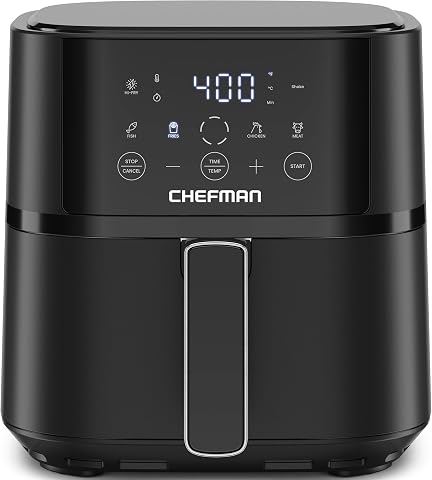
Chefman 4-Quart Compact Air Fryer
- ✔ Capacity: 4 quarts
- ✔ Power: 1500 W
- ✔ Maximum temperature: 450°F (Hi-Fry)

Cosori TurboBlaze 9-in-1 Air Fryer, 6-Quart
- ✔ Capacity: 6 quarts
- ✔ Functions: 9-in-1
- ✔ Temperature range: 90°F–450°F

Chefman 2-Quart Digital Mini Air Fryer
- ✔ Capacity: 2 quarts
- ✔ Power: 900 watts
- ✔ Maximum temperature: 400°F
Difficulty: Beginner | Time: 1-2 hours (including shopping; first cook takes 20-30 minutes)
What You’ll Need
Tools & Materials:
- A compact air fryer (2-4 quart basket model, roughly 10-13 inches wide, recommended for 1-2 people)
- A clear spot on the counter, table, or cart with at least 5 inches of open space behind and on both sides of the unit
- A standard 3-prong grounded outlet on its own circuit (avoid plug strips shared with a microwave or kettle)
- Heat-resistant trivet or cutting board (optional, for placing the hot basket on)
- Paper towels or a soft cloth for cleaning
- Mild dish soap and a non-abrasive sponge
- Food for a first test batch: frozen fries, chicken wings, or breaded nuggets work best
- A kitchen timer or the fryer’s built-in timer
- Tongs for turning food midway through cooking
Knowledge:
- No cooking experience required — air fryers are among the simplest appliances to operate
- Basic ability to read temperature and time settings on a dial or digital display
Before buying, measure your available counter space and the height clearance under any cabinets above the counter. Many air fryers vent hot air upward and need at least 5 inches of overhead clearance. Write down your measurements (width, depth, height) and bring them with you when shopping or check the product dimensions listed online before ordering. If your counter is truly full, plan for a rolling cart, a microwave stand, or a sturdy side table near an outlet — the air fryer must stay level and stable while running.
Chefman 4-Quart Compact Air Fryer
The middle child of this lineup is, in our view, the smartest buy for most small kitchens. A 4-quart basket comfortably serves 2–4 people, which covers everything from a solo dinner to a couple’s weeknight meal with leftovers. Compared with the Chefman 2-Quart Mini, you gain roughly double the cooking capacity while the machine remains compact enough to live on a counter or slide into a cabinet without rearranging your kitchen.Its standout feature is the Hi-Fry setting, which pushes the temperature to 450°F for the final two minutes of cooking. That extra burst of heat is what turns acceptable fries into genuinely crispy ones, and neither the smaller Chefman nor most budget compacts offer an equivalent. The touchscreen interface with four presets keeps operation simple — a genuine benefit for anyone who wants to press a button and walk away, though cooks who like to fine-tune temperature curves will find it limiting next to the Cosori’s nine functions and five fan speeds.Cleanup and safety are well handled: the nonstick basket and rack are dishwasher safe, and automatic shutoff means no anxiety about leaving the unit running. The tradeoff is straightforward — if you regularly cook for four or more, the basket will feel cramped, and the Cosori TurboBlaze is the better fit despite its larger footprint.
Pros:
- Hi-Fry setting boosts temperature to 450°F for extra crisping in the final two minutes
- 4-quart capacity serves 2–4 people while staying counter-friendly
- Dishwasher-safe nonstick basket and rack
- Automatic shutoff adds peace of mind
Cons:
- Only four presets limits cooking flexibility
- Capacity is tight for larger households
Best for: Couples and small families who want real cooking capacity without surrendering much counter space
Not ideal for: Households of four or more, or cooks who want granular control over temperature and fan speed
Bottom line: The best balance of capacity, footprint, and crisping performance in this lineup — the default choice for most small kitchens.
“The best balance of capacity, footprint, and crisping performance in this lineup — the default choice for most small kitchens.”
Cosori TurboBlaze 9-in-1 Air Fryer, 6-Quart
Among these three, the Cosori TurboBlaze is the most capable cooking machine — and the biggest space commitment. Its 6-quart square basket handles family-size batches that would require two rounds in either Chefman, and its 90°F–450°F temperature range covers everything from gentle dehydrating to high-heat searing. Five adjustable fan speeds, topping out at 3600 rpm, give it a level of control neither Chefman approaches; this is the pick for cooks who treat an air fryer as a mini convection oven rather than a single-purpose crisping box.Two details elevate it for daily use. First, the PFAS-free ceramic coating on the basket and crisper tray addresses growing concerns about traditional nonstick coatings — a meaningful differentiator if coating chemistry matters to you. Second, it runs at under 53 dB, making it noticeably quieter than typical air fryers, which matters a lot in an apartment or open-plan layout where the kitchen shares space with everything else.The honest tradeoff is footprint. Six quarts means a physically larger unit, and in a genuinely tiny kitchen it may monopolize the counter or demand a dedicated cabinet shelf. If your space cannot absorb it, the Chefman 4-Quart delivers most of the everyday crisping performance in a smaller package. This model makes the most sense for buyers who have measured their space and know the capacity will be used.
Pros:
- 6-quart square basket suits family meals in a single batch
- 90°F–450°F range with five fan speeds offers real cooking control
- PFAS-free ceramic-coated, dishwasher-safe basket and tray
- Quiet operation under 53 dB
Cons:
- Largest footprint in this lineup — a real consideration for tiny kitchens
- More functions than most compact-kitchen cooks will use
Best for: Small kitchens that can spare the space, and cooks who want maximum versatility and family-size capacity
Not ideal for: Counters or cabinets that genuinely cannot fit a 6-quart unit, or buyers who only cook single servings
Bottom line: The most powerful and versatile option here — choose it only if your kitchen can genuinely accommodate the footprint.
“The most powerful and versatile option here — choose it only if your kitchen can genuinely accommodate the footprint.”
Chefman 2-Quart Digital Mini Air Fryer
At roughly 10 inches square and under six pounds, this is the true space-saver of the group. If your kitchen is a studio galley, a dorm, an RV, or an office nook, the Chefman 2-Quart Mini is the only option here that disappears into storage entirely — a cabinet shelf, or even a deep drawer, swallows it without complaint.What surprises us is how much thoughtful design Chefman packed into the small body. The shake reminder prompts you mid-cook to toss fries or vegetables, which small baskets especially benefit from since food piles up quickly. Automatic shutoff and a dishwasher-safe nonstick basket and rack match the safety and cleanup conveniences of its 4-quart sibling. Compared with the larger Chefman, you lose the 450°F Hi-Fry finishing power (this model tops out at 400°F) and half the capacity, but you keep the same effortless operation.The limitations are inherent to the format: this is a one-to-two-person machine, full stop. Attempting to cook for guests means staggered batches and cold first rounds. And next to the Cosori TurboBlaze, it offers a fraction of the versatility — no preheat customization, no low-temperature functions. But that comparison misses the point. This pick exists for buyers whose first criterion is smallest possible footprint, and on that measure it wins decisively.
Pros:
- Genuinely tiny footprint — fits in a cabinet or drawer at under six pounds
- Shake reminder improves results in the small basket
- Dishwasher-safe nonstick basket and rack
- Automatic shutoff and simple touch controls
Cons:
- 2-quart capacity limits you to 1–2 servings
- 400°F maximum temperature reduces crisping power versus the 4-quart Chefman
Best for: Singles, couples, dorms, RVs, and anyone whose primary requirement is minimal footprint
Not ideal for: Families, entertainers, or anyone who regularly cooks more than two servings at once
Bottom line: The right choice when space is the non-negotiable constraint — as long as you only ever cook for one or two.
“The right choice when space is the non-negotiable constraint — as long as you only ever cook for one or two.”
As an Amazon Associate we earn from qualifying purchases.
Before You Start
Three safety points to handle before plugging anything in. First, air fryers pull 800-1500 watts; never run one on the same outlet or power strip as a microwave, electric kettle, or toaster, because you can trip the breaker or overheat the strip. Plug it directly into a wall outlet. Second, never place the unit against a wall — the back vent blows hot air and can scorch wallpaper or drywall over time. Third, keep the air fryer away from your sink and any water source, and never submerge the main unit in water; only the basket and tray are washable.
Also decide where the air fryer will live between uses. If you plan to store it in a cabinet, confirm it fits with the cord tucked in, and expect to carry a warm-to-hot appliance if you put it away immediately after cooking — let it cool for 30 minutes first.
Step-by-Step Instructions
Step 1: Measure your space and confirm the outlet situation
Take a tape measure and record the width, depth, and available height of the spot where the air fryer will sit. Then check that a grounded 3-prong wall outlet is within cord reach (most cords are 3-4 feet and do not detach). Confirm nothing high-wattage shares that outlet.
Tip: If the only outlet is behind a refrigerator or under a cabinet with less than 5 inches of clearance above the counter, move on to a cart or table location now rather than forcing it.
Check: You have written measurements and a confirmed outlet within reach that is not shared with another major appliance.
Step 2: Choose the right size and type of air fryer
Compare your measurements against product dimensions and pick a 2-4 quart basket-style air fryer for 1-2 people, or a 5-6 quart model only if your space allows. Basket-style units (a drawer that slides out) are the most compact and easiest to use. Avoid large oven-style or dual-basket models unless you have at least 16 inches of width to spare. Check reviews for noise level and simple mechanical controls if you prefer dials over digital buttons.
Tip: A 2-3 quart unit is roughly the footprint of a large coffee can and is usually plenty for one or two people. Bigger is not better in a small kitchen.
Check: You have ordered or purchased a model whose listed dimensions are at least 2 inches smaller than your measured space in every direction.
Step 3: Unbox, clean, and position the unit
Remove all packaging, including any tape or plastic film on the basket, tray, and inside the unit. Wash the basket and crisper tray with warm soapy water, dry them fully, and slide them back into the body. Wipe the outside of the unit with a damp cloth. Place the air fryer on your prepared spot, pushed no closer than 5 inches to the wall behind it and with open air on both sides.
Tip: Skipping the first wash is the most common setup error — manufacturing residue can smoke and give food an off taste on the first use.
Check: The basket slides in and out smoothly, the unit sits level, and nothing is within 5 inches of the vents on the back or sides.
Step 4: Run an empty test cycle
Plug in the unit and run it empty at 400°F for 5 minutes. Some light odor or faint smoke from residual manufacturing oils is normal during this burn-in. Open a window or run your range hood if you have one. Let the unit cool for 10 minutes afterward.
Tip: If heavy smoke appears (not just odor), unplug immediately, let it cool, and wash the basket and tray again — a protective coating was likely left in place.
Check: The unit heats, the fan runs, the timer counts down, and the smell dissipates within a few minutes.
Step 5: Preheat and load your first batch
Set the air fryer to 380-400°F and let it run empty for 3 minutes to preheat. Pull the basket out, add a single layer of frozen fries or wings — do not stack or overcrowd, and leave the top of the food at least an inch below the element. Lightly spray breaded items with oil for extra crispness if desired. Slide the basket back in firmly.
Tip: Overfilling is the number one cause of soggy results. If food is touching or piled, cook two smaller batches instead.
Check: Food sits in one even layer and the basket closes completely with no resistance.
Step 6: Set time, shake, and finish
Set the timer for the package time minus 2 minutes (typically 12-15 minutes for fries at 400°F). Halfway through, pull the basket out, shake it or flip the food with tongs, and slide it back in — pausing the timer is automatic on most models. When the timer ends, check one piece for doneness and crispness before adding salt and serving onto a plate, never directly onto your counter.
Tip: The basket and food coming out are much hotter than they look. Always use the handle and set the hot basket on a trivet or plate.
Check: Food is golden, crisp on the outside, hot in the center, and releases from the basket without sticking.
Step 7: Clean up and establish your storage routine
Let the unit cool for at least 30 minutes. Remove the basket and tray, wash them in warm soapy water (or in the dishwasher if the manual says they are dishwasher-safe), and wipe the inside of the unit with a damp cloth to remove grease splatter. Dry everything before reassembling. If you store the fryer in a cabinet, wrap the cord underneath and stand it upright — never on its side.
Tip: A quick wipe after every use prevents baked-on grease, which is far harder to clean later and can cause smoking.
Check: The basket is grease-free to the touch, the unit is dry, and it fits back into your storage or counter spot without forcing.
Common Mistakes to Avoid
- Buying a unit too large for the counter, then abandoning it in a closet — Measure first and buy based on your written dimensions, not on serving-capacity claims. A 2-3 quart model handles most small-kitchen cooking.
- Placing the air fryer under cabinets or against a wall — Keep at least 5 inches of clearance above and behind the unit. Trapped heat can damage cabinet finishes and walls.
- Overcrowding the basket, producing soggy, unevenly cooked food — Cook in a single layer with space between pieces. Run two batches — the second batch takes less time because the unit is already hot.
- Running the air fryer on a shared power strip with other appliances — Plug directly into a dedicated wall outlet and avoid using the microwave or kettle while the air fryer runs.
Troubleshooting
Problem: Food comes out soggy or pale
Solution: Three likely causes: overcrowding (cook in one layer), skipped preheat (run 3 minutes empty first), or temperature too low (raise to 400°F and add 2-3 minutes). A light spray of oil also helps breaded items brown.
Problem: The breaker trips when the air fryer runs
Solution: The circuit is overloaded. Move the air fryer to an outlet on a different circuit — often the one in a hallway, living room, or opposite counter — and stop running it alongside a microwave or kettle.
Problem: Smoke comes from the unit during cooking
Solution: Grease has built up in the basket or the pan beneath, or fatty food is dripping. Stop cooking, let it cool, wash the basket and tray, and add a tablespoon of water or a slice of bread to the bottom of the drawer when cooking fatty items like bacon.
Problem: The basket will not slide in fully or the unit will not start
Solution: The tray is seated incorrectly or the basket is misaligned. Remove everything, confirm the tray clicks into the basket, and reinsert until you feel it lock. Most units refuse to run if the basket is not fully engaged.
What Success Looks Like
You have succeeded when: (1) the air fryer sits in a stable spot with 5 inches of clearance on all vented sides, plugged into its own wall outlet; (2) it heats, runs, and times correctly; (3) your first batch of food came out crisp and evenly cooked in a single layer; (4) cleanup took under 10 minutes; and (5) the unit fits your counter or storage spot without crowding anything else. If you can repeat the cook cycle tomorrow without consulting instructions, the setup is complete.
Next Steps
Expand what you cook: try chicken thighs (380°F, 20-22 minutes, flip once), salmon (390°F, 8-10 minutes), or reheating leftover pizza (370°F, 3-4 minutes) — the air fryer outperforms a microwave for crispness on nearly all reheated food. Keep a small notebook or notes app list of times and temperatures that worked for your favorite foods, since models vary. If counter space stays tight, consider a wall-mounted shelf or a rolling cart dedicated to the air fryer and toaster. Clean the basket and interior weekly, and check the heating element area for grease buildup monthly. If the unit develops consistent uneven cooking or the fan rattles after a few months, contact the manufacturer — most brands carry a one-year warranty.
Frequently Asked Questions
How much counter space does an air fryer really need?
Plan for the unit’s footprint plus 5 inches behind it and 5 inches of clearance above for hot exhaust. A typical compact 2-4 quart model needs roughly a 12 by 15 inch zone with open air above. You can store it in a cabinet between uses, but it must operate on a stable, open surface.
Can I use an air fryer in a kitchen with almost no outlets?
Yes, but only on a wall outlet, never a lightweight extension cord or a power strip shared with other appliances. If your kitchen outlets are all occupied, a heavy-duty appliance extension cord rated for 1500 watts is acceptable, or run the air fryer from an outlet in an adjacent room on a table.
Do I need to add oil when air frying?
A light spray or half-teaspoon of oil improves browning on fresh vegetables, potatoes, and breaded items. Frozen foods that are pre-fried usually need none. Never pour oil into the basket — spray or brush it onto the food directly.
Is a small air fryer big enough for real meals?
A 2-3 quart model fits about 1-1.5 pounds of food, which serves one to two people. It handles fries, wings, chicken breasts, and vegetables well. For a family of four, a 5-6 quart model is better, but verify you have the counter space before sizing up.
Where should I not put an air fryer?
Avoid placing it under upper cabinets, against a wall, next to the sink or stove, on an uneven surface, or on top of a refrigerator or microwave (heat and unstable surfaces are problems). It also should not run unattended, especially in a first use or with greasy food.
Columbus Day / Indigenous Peoples' Day Picks
long weekend sales
As an affiliate, we earn on qualifying purchases.