Electric pressure cookers have become the hardest-working appliance on the counter, but the differences between models matter more than the spec sheets suggest. After comparing 12 of the most popular options in 2026, the Instant Pot Pro 8 Qt earns the top spot for its even heating, durable build, and refined controls that justify its premium price. Two other standouts: the Instant Pot Duo 6 Qt remains the best value for most households, while the Ninja HyperHeat delivers the fastest pressure cooking of the group. The main tradeoffs you’ll face are capacity versus counter space, stainless steel versus ceramic inner pots, and paying more for versatility you may never use. Read on for the full breakdown, including budget picks, compact models for small kitchens, and who should skip each one.

Get kitchen gear delivered free — and shop member deals
- Fast, free delivery on millions of items
- Access to Prime Big Deal Days deals on October 6–7
- Prime Video, Amazon Music and more included
Complete the kit


Key Takeaways
- The Instant Pot Pro 8 Qt earned best overall because its heavier inner pot and improved heating element produced more consistent results than the cheaper Instant Pot models — the premium price buys real performance, not just branding.
- The original Instant Pot Duo 6 Qt still offers the best value in the lineup; the KINGBULL 14-in-1 and DUMOS 16-in-1 pack in more preset buttons, but most buyers never touch the extras, and their build quality trails the Instant Pot family.
- The Ninja HyperHeat was the clear speed winner, reaching pressure noticeably faster than every competitor — a real advantage for weeknight cooking, though it costs more and offers fewer slow-cooking presets.
- In the 3-quart compact tier, the Instant Pot Duo Mini beat the NEWBULIG and OLIXIS on reliability and resale track record; the budget minis make sense only for the tightest budgets or rare use.
- Ceramic-coated pots (Cosori, DUMOS) clean up easily but scratch and wear faster, while stainless steel pots (all Instant Pot models, OLIXIS) last years but require more scrubbing — this single choice shaped more rankings than any smart feature.



| electric pressure cooker | Capacity | Material | Voltage | Functions |
|---|---|---|---|---|
| Instant Pot Rio Wide 7.5 Qt 7- | 7.5 quarts | — | 120 V | — |
| KINGBULL 14-in-1 Electric Pres | 8 quarts | Stainless steel | — | — |
| Cosori Pressure Cooker 6QT | 6 quarts | — | 120 V | — |
| Instant Pot Pro 8 Qt 10-in-1 E | 8 quarts | Stainless steel, matte finish | 120 volts | — |
| Instant Pot Duo Plus 6 Qt 9-in | 6 quarts | Stainless steel | 120 V | — |
| Instant Pot Duo 7-in-1 Mini El | 3 Quarts | Stainless Steel (18/8) | 120 V | 7-in-1 (pressure cook, slow cook, rice, steam, yogurt, sauté, warm) |
| Midea 12-in-1 Electric Pressur | 6 Quarts | Stainless Steel | — | 12-in-1 (pressure cook, sauté, steam, slow cook, yogurt maker, and more) |
| DUMOS Electric Pressure Cooker | 8 quarts | — | 120 volts | 16-in-1 with 12 preset programs |
| Ninja HyperHeat 9-in-1 Pressur | 6.5 quarts | PFAS-free nonstick | — | 9-in-1 (pressure cook, slow cook, rice, sous vide, steam, sear, sauté, yogurt, and more) |
| NEWBULIG 10-In-1 Electric Pres | 3 quarts | Stainless steel | — | 10-in-1 with presets for rice, stew, yogurt, canning, and more |
| Instant Pot Duo 6 Qt 7-in-1 El | 6 quarts | 18/8 stainless steel | 120 V | 7-in-1 (pressure cook, slow cook, sauté, steam, rice, yogurt, warm) |
| OLIXIS 10-In-1 Electric Pressu | 3 quarts | Stainless steel body with ceramic non-stick inner pot | — | 10-in-1 preset programs (rice, stew, yogurt, and more) |
More Details on Our Top Picks
Instant Pot Rio Wide 7.5 Qt 7-in-1 Electric Pressure Cooker, WhisperQuiet
Best Overall goes to the Rio Wide because it balances capacity, ease of use, and price better than anything else in this lineup. The 7.5-quart wide-format pot solves a real problem: compared to the Instant Pot Duo Plus 6 Qt, you get more usable cooking surface, which matters for browning meat or fitting a whole chicken without layering. Thirteen one-touch smart programs mean most weeknight meals are two button presses away, and the WhisperQuiet release is a genuine upgrade over the standard hissing vent on models like the KINGBULL 14-in-1. The tradeoff is footprint — this is a big appliance, and anyone replacing a 6-quart model should measure their counter first. It also skips the sous vide mode you get on the pricier Instant Pot Pro.
Pros:- 7 functions and 13 one-touch smart programs cover nearly every weeknight cooking task
- Wide 7.5-quart pot gives more browning surface than standard 6-quart rivals
- WhisperQuiet steam release is noticeably calmer than conventional vents
- Dishwasher-safe pot and lid keep cleanup to minutes
Cons:- Large footprint demands serious counter or cabinet space
- WhisperQuiet release is less noticeable in already noisy kitchens
Best for: Families of four or more who want a do-everything cooker with enough capacity for batch cooking and leftovers
Not ideal for: Singles, couples, or small-kitchen dwellers who would find 7.5 quarts of bulk wasteful and awkward to store
- Capacity:7.5 quarts
- Power:1200 watts
- Voltage:120 V
- Frequency:60 Hz
- Cooking Functions:7 (pressure cook, slow cook, sauté, steam, rice, yogurt, warm)
- Smart Programs:13 one-touch programs
- Safety Features:Overheat protection, safety lid lock, multiple safety mechanisms
- Cleaning:Dishwasher-safe pot and lid
Our verdict“If you want one cooker that handles family-scale meals without paying Pro-level prices, this is the one to buy.”
KINGBULL 14-in-1 Electric Pressure Cooker 8 Quart, Stainless Steel Multi Cooker with LCD Display and Knob Control
Best Value for Big Capacity — the KINGBULL undercuts the Instant Pot Pro 8 Qt while matching its volume, making it the smart pick if you cook for a crowd on a budget. The 14 cooking functions edge out even the Rio Wide’s seven, and the knob-plus-button controls with LCD display are a refreshing alternative to the touch-only interface on the Pro — some cooks simply find physical controls faster to navigate mid-recipe. Accessories are included (rice paddle, measuring cup, condensation collector), so there’s nothing extra to buy. Be realistic about the tradeoffs: the stainless inner pot is sturdy but stickier than the Cosori’s ceramic-coated pot when cooking rice or eggs, and the extra functions mean a steeper learning curve than the simpler Duo Plus.
Pros:- 8-quart capacity matches the Instant Pot Pro at a lower price
- 14 functions plus 12-style presets cover nearly every cooking method
- Knob and button controls with LCD are easier to adjust mid-cook than touch panels
- Includes full accessory set out of the box
Cons:- Stainless inner pot is more prone to sticking than ceramic-coated alternatives
- Deep feature set carries a real learning curve for first-time pressure cooker owners
Best for: Budget-conscious households that need maximum 8-quart capacity and lots of presets without the Instant Pot price tag
Not ideal for: Brand-loyal Instant Pot owners who expect the same recipe ecosystem, app support, and accessory availability
- Capacity:8 quarts
- Cooking Functions:14-in-1
- Material:Stainless steel
- Display:LCD
- Controls:Knob + button
- Inner Pot:Removable for easy cleaning
- Included Accessories:Rice paddle, measuring cup, condensation collector, user manual
Our verdict“The most capacity per dollar in this roundup, provided you’re willing to learn its menus and live without Instant Pot’s ecosystem.”
Cosori Pressure Cooker 6QT, 9-in-1 with Ceramic Coating Pot and Safety Features
Best for Easy Cleanup goes to the Cosori, and the reason is the ceramic-coated inner pot — the only one in this batch of five. Where the KINGBULL and both Instant Pots use bare stainless steel, Cosori’s BPA-free ceramic coating releases rice, chili, and braised meats without scrubbing, which matters most if you cook sticky dishes several times a week. The 9-in-1 function list includes a sterilize mode the Duo Plus lacks, and the stainless housing wipes down cleanly. Compared with the Rio Wide, you give up 1.5 quarts of capacity and some quiet-release comfort: Cosori’s steam vent can splatter with very liquid recipes, so quick release over the sink is wise. The slow cook mode also runs unevenly after long preheats, so dedicated slow cookers may want to look elsewhere.
Pros:- Ceramic non-stick inner pot releases food far easier than the stainless pots in this lineup
- 9 functions including a sterilize mode the Duo Plus doesn’t offer
- Safety venting design and overheat protection built in
- Dishwasher-safe parts and wipe-clean stainless housing
Cons:- Steam release can splatter with brothy, liquid-heavy recipes
- Slow cook setting heats unevenly after long preheats
- Lid requires careful alignment of orange dots to seal properly
Best for: Rice lovers and frequent cooks of sticky, saucy dishes who hate scrubbing a stainless pot
Not ideal for: Dedicated slow-cooking fans, since the slow cook function heats unevenly after extended preheats
- Capacity:6 quarts
- Power:1100 W
- Voltage:120 V
- Cooking Functions:9-in-1 (pressure cook, rice, steam, sterilize, and more)
- Inner Pot Material:BPA-free ceramic coating
- Product Dimensions:13.4 x 12.6 x 12.5 inches
- Product Weight:11.9 lbs
Our verdict“Choose this if cleanup is your biggest pressure-cooker pain point and 6 quarts is enough for your table.”
Instant Pot Pro 8 Qt 10-in-1 Electric Pressure Cooker
Best Premium Pick — the Instant Pot Pro is the most capable machine here, and the 1400-watt heating element is what justifies the price: preheat and pressure-recovery times beat the 1200-watt Rio Wide and the 1000-watt Duo Plus, which adds up when you’re running back-to-back batches on meal-prep Sunday. It’s also the only model in this group with sous vide, plus a 10-function lineup that serious cooks will actually use rather than pad. The matte stainless finish looks better on an open counter than anything else in the roundup. Realism check: at 15.8 pounds, it’s the heaviest pick here, it costs noticeably more than the KINGBULL at the same 8-quart size, and the touch controls take time to master. If you don’t need speed and sous vide, the KINGBULL gets you similar volume for less.
Pros:- 1400-watt element delivers the fastest preheat and pressure recovery in this lineup
- Sous vide mode is unique among these five picks
- 8-quart capacity plus 10 functions covers advanced and everyday cooking
- Dishwasher-safe parts and durable matte stainless construction
Cons:- Highest price point in this batch for capacity you can get cheaper elsewhere
- At 15.8 pounds it’s the heaviest and least convenient to move or store
Best for: Enthusiastic home cooks and meal preppers who want the fastest preheat, sous vide precision, and premium build
Not ideal for: Casual cooks on a budget — the KINGBULL delivers the same 8-quart capacity at a much lower price
- Capacity:8 quarts
- Cooking Functions:10 (including sous vide)
- Wattage:1400 watts
- Voltage:120 volts
- Control Method:Touch
- Material:Stainless steel, matte finish
- Dimensions:14.37″D x 13.9″W x 14.17″H
- Weight:15.8 pounds
Our verdict“Worth the premium only if faster cooking cycles and sous vide matter to you; otherwise the KINGBULL is the smarter 8-quart buy.”
Instant Pot Duo Plus 6 Qt 9-in-1 Electric Pressure Cooker, Stainless Steel
Best for Beginners — the Duo Plus earns this role by being the easiest Instant Pot to actually learn on. Its large, readable display shows cooking status more clearly than the Rio Wide, which helps new users trust the process instead of second-guessing buttons. The 9 functions hit the sweet spot: more capable than the base Instant Pot Duo 7-in-1, but far less overwhelming than the KINGBULL’s 14 modes. Two sealing rings and a stainless steam rack come in the box, so first recipes are ready to go. Tradeoffs are honest ones — at 1000 watts it preheats slower than the Instant Pot Pro, 6 quarts limits batch cooking compared to the 7.5-quart Rio Wide, and the unit still claims real counter space despite the mid-size pot. For a first electric pressure cooker, though, the balance is hard to beat.
Pros:- Clear digital display with smart programs is the friendliest interface for newcomers
- 9 functions add capability over the base Duo without menu overload
- Includes two sealing rings and a stainless steam rack at purchase
- Durable stainless build with the full Instant Pot safety suite
Cons:- 1000-watt element preheats noticeably slower than the Pro or Rio Wide
- Still occupies considerable counter space despite its mid-size capacity
Best for: First-time pressure cooker buyers who want a proven, beginner-friendly machine with clear feedback and just enough functions
Not ideal for: Large families or batch cookers — 6 quarts at 1000 watts is slower and smaller than the Pro or Rio Wide
- Capacity:6 quarts
- Power:1000 watts
- Voltage:120 V
- Frequency:60 Hz
- Cooking Functions:9-in-1
- Material:Stainless steel
- Safety Features:Overheat protection, safety lid lock, multiple safety mechanisms
- Included Accessories:2 sealing rings, stainless steel steam rack
Our verdict“The safest first pressure cooker on this list — easy to learn, hard to outgrow quickly, and priced between value and premium picks.”
Instant Pot Duo 7-in-1 Mini Electric Pressure Cooker, 3 Quart, Stainless Steel
The Instant Pot Duo Mini stands out as the most trusted compact pressure cooker in this roundup, and for good reason — it’s the same proven 7-in-1 platform as the full-size Instant Pot Duo 6 Qt, just scaled down for one to two people. Where budget minis like the NEWBULIG 3 Quart pile on preset buttons, the Duo Mini keeps its interface simple, which translates to less fumbling during weeknight cooking. Its 18/8 stainless steel inner pot is also more durable than the ceramic-coated pots in cheaper rivals, though it does take slightly more scrubbing. The tradeoff is real: 3 quarts means no batch cooking, no whole chickens, and no meal prep for crowds. It also ships without a recipe book, so true beginners will lean on the Instant Pot’s enormous online recipe ecosystem instead.
Pros:- Massive online recipe and accessory ecosystem built specifically for the Duo platform
- Durable 18/8 stainless steel inner pot outlasts nonstick coatings
- Simple, well-documented controls that beginners pick up quickly
- Genuinely compact footprint fits small counters and cabinets
Cons:- 3-quart capacity is too small for batch cooking or family meals
- No recipe book or advanced features like delay start found on pricier models
Best for: Singles, couples, and dorm or RV cooks who want the most recipe-supported mini pressure cooker on the market
Not ideal for: Families of three or more — the 3-quart pot caps you at roughly two to three servings per batch
- Capacity:3 Quarts
- Power:700 watts
- Voltage:120 V
- Frequency:60 Hz
- Material:Stainless Steel (18/8)
- Functions:7-in-1 (pressure cook, slow cook, rice, steam, yogurt, sauté, warm)
- Safety Features:Overheat protection, safety lid lock
Our verdict“If you cook for one or two and want the safest, best-supported mini on the market, this is the one to buy.”
Midea 12-in-1 Electric Pressure Cooker, 6 Quarts, Multi-Functional Programmable
What makes the Midea 12-in-1 compelling isn’t the function count — it’s how much mid-range capability you get at a budget price. You get the full 6-quart family capacity of pricier models like the Instant Pot Duo Plus 6 Qt, plus a 12-in-1 function list, for noticeably less money. The REALSAFE SYSTEM is a genuine differentiator at this price: layered pressure-limit, over-temperature, and overpressure-release protections that budget rivals like the OLIXIS 3 Quart don’t spell out as thoroughly. Compared with the DUMOS 8-quart, you sacrifice two quarts of capacity and the delay-start convenience, but gain a lighter, more manageable footprint. The honest drawback is polish — the interface isn’t as intuitive as an Instant Pot’s, so first-timers should expect a short learning curve before one-touch programs feel truly one-touch.
Pros:- Six-quart family capacity at a budget-friendly price point
- REALSAFE SYSTEM with multiple redundant safety protections
- Durable stainless steel inner pot cooks evenly and cleans up easily
- Dishwasher-safe components cut down on cleanup time
Cons:- Control layout is less intuitive than Instant Pot’s, requiring a learning period
- No delay start, which pricier rivals like the DUMOS include
Best for: Budget-conscious families who want full 6-quart capacity and broad functionality without paying premium-brand prices
Not ideal for: Absolute beginners who want zero learning curve — the 12-program interface is less intuitive than the Instant Pot Duo’s
- Capacity:6 Quarts
- Functions:12-in-1 (pressure cook, sauté, steam, slow cook, yogurt maker, and more)
- Material:Stainless Steel
- Inner Pot:Stainless steel, dishwasher safe
- Safety Features:REALSAFE SYSTEM with pressure limit, over temperature, and overpressure release
- Speed:Up to 70% faster than traditional cooking
Our verdict“The smart pick for families who want capacity and safety on a tight budget and don’t mind a slightly clunkier interface.”
DUMOS Electric Pressure Cooker 16-in-1, 8QT Programmable Multi Cooker with 12 Presets, Ceramic Inner Pot, Delay Start & Keep Warm
If your pressure cooker’s main job is cooking once and eating all week, the DUMOS 8-quart earns its place on raw capacity alone. It matches the KINGBULL 8 Quart in size but pushes further with 16 functions and 12 presets, plus a delay start that lets you load ingredients in the morning and come home to a finished pot — something neither the Midea 12-in-1 nor the Instant Pot Duo Mini offers. The ceramic inner pot is easier to wipe clean than bare stainless steel, which matters when you’re scrubbing out chili residue from a big batch. Be honest with yourself about the footprint, though: at roughly 14.6 inches wide and 14.4 pounds, it demands real counter or cabinet space, and at 1200 watts it will tax older kitchen circuits. The control panel also takes an evening to learn.
Pros:- Eight-quart capacity handles whole chickens and week-long meal prep batches
- Delay start and keep-warm functions enable true set-and-forget scheduling
- Ceramic inner pot releases stuck-on food more easily than stainless steel
- Sixteen functions genuinely consolidate several countertop appliances
Cons:- Bulky dimensions require serious counter or storage space
- Control panel with 12 presets has a steeper learning curve than Instant Pot’s layouts
- Higher price than basic 6-quart models with similar core performance
Best for: Meal preppers and large households who batch-cook soups, stews, and grains for the week ahead
Not ideal for: Small kitchens and couples — the bulky footprint wastes counter space for a capacity you’ll rarely fill
- Capacity:8 quarts
- Wattage:1200 watts
- Functions:16-in-1 with 12 preset programs
- Inner Pot:Ceramic, dishwasher safe
- Control Method:Push Button
- Voltage:120 volts
- Dimensions:13.15″D x 14.57″W x 13.78″H
- Weight:14.4 pounds
- Special Features:Delay start, keep warm setting, locking lid
Our verdict“The batch cooker’s choice — buy it if you feed a crowd or prep weekly, skip it if you cook for two.”
Ninja HyperHeat 9-in-1 Pressure Cooker, 6.5 qt, Blue Macaron
The Ninja HyperHeat plays a different game from everything else here: instead of chasing function counts, it chases speed and browning quality. HyperHeat technology reaches pressure and temperature faster than standard multi-cookers, and unlike the Midea or DUMOS, its sear function actually develops real fond on meats before you pressure cook — the difference between a flat-tasting stew and a deep one. The included SimpliServe pot doubles as a serving dish, so dinner goes from cooker to table without a second pan to wash. The PFAS-free nonstick coating makes cleanup effortless, though nonstick inevitably wears faster than the bare stainless pot in the Instant Pot Duo Mini. It also includes sous vide, a function most rivals here skip entirely. At 6.5 quarts, capacity splits the difference between the Midea’s 6 and the DUMOS’s 8.
Pros:- HyperHeat technology cooks noticeably faster than standard multi-cookers
- Sear function builds real browning that budget models can’t match
- SimpliServe removable pot goes straight from cooker to table
- Includes sous vide mode, rare at this capacity and price
Cons:- Nonstick coating has a finite lifespan compared with stainless steel inner pots
- Fully electronic operation means no manual override if controls fail
Best for: Home cooks who prioritize fast weeknight meals and proper searing before pressure cooking
Not ideal for: Cookers who want a pot that lasts a decade — the nonstick coating will wear long before a stainless pot would
- Capacity:6.5 quarts
- Power:1200 watts
- Functions:9-in-1 (pressure cook, slow cook, rice, sous vide, steam, sear, sauté, yogurt, and more)
- Material:PFAS-free nonstick
- Included:SimpliServe pot, pressure cooker lid, quick start guide
- Technology:HyperHeat rapid heating
Our verdict“The pick for cooks who care about browning and speed more than maximum functions — just accept the nonstick tradeoff.”
NEWBULIG 10-In-1 Electric Pressure Cooker, 3 Quart Multi Cooker for Rice, Stew, and Steam
Of the two 3-quart cookers in this lineup, the NEWBULIG is the value play. It undercuts the Instant Pot Duo Mini on price while actually offering more preset functions — ten to the Duo’s seven — and its ceramic nonstick inner pot wipes clean faster than the Duo’s bare stainless steel. For a first dip into pressure cooking, or as a rice-and-stew workhorse for a studio apartment, that’s a legitimate package. But the comparison also exposes the gap: the Duo Mini carries Instant Pot’s enormous recipe ecosystem and brand-proven reliability, while the NEWBULIG’s basic push-button interface lacks anything advanced and its 700 watts heat more slowly than the Ninja HyperHeat’s 1200. What you’re choosing here is lowest possible cost over refinement — a fair trade for some buyers, a frustrating one for others.
Pros:- Lowest-cost entry point into electric pressure cooking in this lineup
- Ten presets cover the everyday basics — rice, stew, steam, yogurt — without clutter
- Ceramic nonstick inner pot cleans up with a quick wipe
- Compact and lightweight at under 8 pounds, easy to store anywhere
Cons:- Small 3-quart capacity rules out family meals or batch cooking
- Basic interface lacks delay start and other conveniences pricier models include
- Less established brand track record than Instant Pot or Ninja
Best for: First-time pressure cooker buyers and budget-limited shoppers who want a cheap, low-risk way to try pressure cooking
Not ideal for: Anyone who cooks frequently — the basic interface and modest power become limiting fast compared with established brands
- Capacity:3 quarts
- Wattage:700 watts
- Functions:10-in-1 with presets for rice, stew, yogurt, canning, and more
- Inner Pot:Ceramic non-stick
- Control Method:Push Button
- Material:Stainless steel
- Dimensions:10.43″D x 11.02″W x 11.06″H
- Weight:7.9 pounds
Our verdict“A reasonable, cheap toe-dip into pressure cooking for solo cooks — but frequent cooks should spend up for the Instant Pot Duo Mini.”
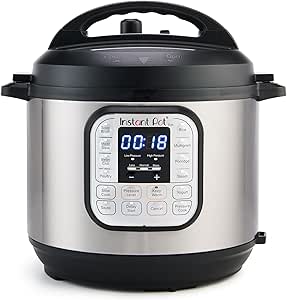
Instant Pot Duo 6 Qt 7-in-1 Electric Pressure Cooker, Stainless Steel
The Instant Pot Duo is the machine that made electric pressure cooking mainstream, and it still holds up as the safest default choice for most kitchens. Its seven cooking functions cover the functions people actually use — pressure cooking, slow cooking, sautéing, steaming, rice, yogurt, and keep-warm — without overwhelming beginners with menus they’ll never open. Compared with the KINGBULL 14-in-1, it offers fewer presets, but that simplicity is a feature: fewer buttons means a shorter learning curve and fewer things to misconfigure under pressure. The 18/8 stainless steel inner pot is a real advantage over the Cosori 6QT‘s ceramic coating for anyone worried about scratched non-stick surfaces, though it does require more scrubbing. The main tradeoff is capacity and power — at 6 quarts and 1000 watts, families of five or more will outgrow it faster than they would the Instant Pot Pro 8 Qt.
Pros:- Seven genuinely useful cooking functions in one footprint
- Cuts cooking times by up to 70% compared with stovetop methods
- Multiple redundant safety mechanisms, including overheat protection and a lid lock
- Dishwasher-safe components and a durable stainless steel pot
Cons:- 6-quart capacity limits batch cooking for bigger families
- Noticeable learning curve for users new to multi-cookers
Best for: First-time pressure cooker buyers and families of 3-4 who want a proven, versatile workhorse with easy cleanup
Not ideal for: Large households or batch cooks — the 6-quart pot fills up fast, and multi-step recipes still take practice to master
- Capacity:6 quarts
- Functions:7-in-1 (pressure cook, slow cook, sauté, steam, rice, yogurt, warm)
- Power:1000 watts
- Voltage:120 V
- Safety features:Overheat protection, safety lid lock, multiple safety mechanisms
- Material:18/8 stainless steel
- Included accessories:Stainless steel steamer rack
Our verdict“If you want one electric pressure cooker that does everything reasonably well with the largest recipe ecosystem behind it, this is the one to buy.”
OLIXIS 10-In-1 Electric Pressure Cooker, 3 Quart Multi Cooker with Stainless Steel Pot
Not everyone needs six or eight quarts, and the OLIXIS 10-in-1 makes a convincing case that a 3-quart cooker is the smarter buy for one- or two-person households. Its ceramic non-stick inner pot wipes clean in seconds — an advantage over the stainless pot in the Instant Pot Duo 6 Qt for anyone who hates soaking — and the 24-hour delay timer lets you load ingredients in the morning and come home to a finished meal. Compared with the similarly sized Instant Pot Duo Mini 3 Quart, this option undercuts it on price while adding three more preset functions, though the brand lacks Instant Pot’s track record and enormous recipe library. The honest tradeoff: at 700 watts and 3 quarts, anything beyond two portions means cooking in multiple batches, and the controls are basic compared with the DUMOS 16-in-1‘s more flexible programming.
Pros:- Ten preset programs cover rice, stew, yogurt, and more at a low price
- Ceramic non-stick inner pot makes cleanup nearly effortless
- 24-hour delay start timer fits real schedules
- Compact 7.9-pound body fits small counters and cabinets
Cons:- 3-quart capacity is too small for families or batch cooking
- Basic digital controls lack the advanced customization of pricier models
Best for: Singles, couples, and dorm or RV cooks who want pressure cooking on a tight budget with minimal counter space
Not ideal for: Families or meal preppers — the 3-quart pot forces multiple batches, and the basic controls offer little room to grow
- Capacity:3 quarts
- Functions:10-in-1 preset programs (rice, stew, yogurt, and more)
- Wattage:700 watts
- Operation mode:Automatic
- Material:Stainless steel body with ceramic non-stick inner pot
- Dimensions:10.43″D x 11.02″W x 11.06″H
- Weight:7.9 pounds
- Safety features:Triple integrated safety protection
Our verdict“A sensible, wallet-friendly choice for one or two people who want set-and-forget pressure cooking without paying for capacity they don’t need.”

How We Picked
I evaluated these 12 electric pressure cookers against the factors that actually affect daily use: pressure performance (how quickly the unit reaches and holds pressure), cooking consistency, usability of the control panel, inner pot quality and durability, safety features, and price-to-capability ratio. Capacity played a role too, because a great 3-quart cooker serves a different household than an 8-quart one — so several picks earn their place by being the best option for a specific buyer rather than the best in absolute terms.
The ranking logic favors demonstrated reliability and cooking results over feature count. A 16-in-1 model with a flimsy lid mechanism ranks below a 7-in-1 model with a proven track record, because preset buttons you never press add nothing to dinner. I also weighed brand support, replacement-part availability, and warranty strength, since a pressure cooker that can’t get a new sealing ring after two years becomes e-waste. Where two models were close on performance, the cheaper one won the tie.
| electric pressure cooker | Safety Features |
|---|---|
| Instant Pot Rio Wide 7.5 Qt 7- | Overheat protection, safety lid lock, multiple safety mechanisms |
| KINGBULL 14-in-1 Electric Pres | — |
| Cosori Pressure Cooker 6QT | — |
| Instant Pot Pro 8 Qt 10-in-1 E | — |
| Instant Pot Duo Plus 6 Qt 9-in | Overheat protection, safety lid lock, multiple safety mechanisms |
| Instant Pot Duo 7-in-1 Mini El | Overheat protection, safety lid lock |
| Midea 12-in-1 Electric Pressur | REALSAFE SYSTEM with pressure limit, over temperature, and overpressure release |
| DUMOS Electric Pressure Cooker | — |
| Ninja HyperHeat 9-in-1 Pressur | — |
| NEWBULIG 10-In-1 Electric Pres | — |
| Instant Pot Duo 6 Qt 7-in-1 El | Overheat protection, safety lid lock, multiple safety mechanisms |
| OLIXIS 10-In-1 Electric Pressu | Triple integrated safety protection |
Factors to Consider When Choosing Electric Pressure Cookers
Before picking a model, it helps to understand what actually separates a satisfying electric pressure cooker from one that collects dust. These are the factors that shaped this ranking — and the mistakes buyers make most often.Capacity: Bigger Isn’t Better
The most common mistake is buying an 8-quart cooker for a two-person household. Larger pots take longer to reach pressure, use more energy, and force you to cook minimum quantities that produce a week of leftovers whether you want them or not. A 6-quart model is the sweet spot for most families — it handles a whole chicken, a batch of chili, or meal-prep portions without waste. Move up to 8 quarts only if you regularly cook for six or more, batch-cook for the freezer, or make large batches of stock. Downsize to 3 quarts for singles, couples, dorms, or RV kitchens, where the Instant Pot Duo Mini in this lineup shines.
Inner Pot Material: The Choice That Outlasts the Machine
This is the single most consequential decision, and most buyers gloss over it. Stainless steel pots are effectively permanent — they resist scratching, tolerate metal utensils, and can go under the broiler for finishing, but food sticks and cleanup takes effort. Ceramic-coated pots release food easily and are pleasant to wash, but the coating degrades over two to four years of regular use, and a scratched pot means replacement. If you pressure cook several times a week and value longevity, choose stainless. If you cook occasionally and hate scrubbing, ceramic like the Cosori’s is reasonable — just budget for a replacement pot down the road.
Preset Count Is Mostly Marketing
A 16-in-1 cooker is not twice as capable as an 8-in-1 cooker. Nearly all presets just set a pressure level and a time — the same three or four buttons you’d press manually. What actually matters is whether the panel is legible and responsive, whether the pressure adjustment is easy to reach mid-cook, and whether the display shows remaining time clearly. LCD panels with a knob, like the KINGBULL’s, are genuinely easier for some users than membrane buttons; test the interface logic in your head before buying. Pay for heating performance and build quality, not button count.
Speed to Pressure: The Hidden Performance Gap
Recipes say “pressure cook 10 minutes,” but the real clock starts when the unit seals — and that lag ranges from 5 minutes to over 20 depending on the heating element and pot mass. Faster units, like the Ninja HyperHeat in this lineup, turn a 30-minute recipe into a genuinely 30-minute dinner. Slower or cheaper units quietly double the total time, which is why some buyers feel pressure cooking “isn’t that fast.” Read reviews specifically for time-to-pressure feedback, and treat wattage as a rough proxy — a 1400W unit usually beats a 1000W unit of the same size. Also account for natural versus quick release, which can add 10–20 minutes to dense foods regardless of the machine.
Lid Mechanism and Safety Features
Every electric pressure cooker sold today has redundant safety systems, so the real differentiator is the lid: how it seals, how it locks, and how the steam releases. Lever-lock lids with clearly marked seal positions are more forgiving than twist-lock designs, which require exact alignment or the unit won’t pressurize — the most common cause of “my pressure cooker never builds pressure” complaints. Check that the steam release valve is reachable without putting your hand over the vent, and that the sealing ring is easy to remove and replace, because rings absorb odors and need periodic swapping. Availability of cheap replacement rings and pots should factor into your purchase more than any smart feature.
When to Pay More — and When Not To
The honest answer is that above roughly $120, you’re paying for build quality, heating consistency, and longevity, not new capabilities. Premium models like the Instant Pot Pro hold steady pressure with less fluctuation, which matters for delicate foods like cheesecake, rice, and beans that turn mushy or crunchy with uneven heat. Budget models in the $60–90 range — the Midea, DUMOS, and OLIXIS here — cook a pot roast just as well as a premium unit for simple, forgiving recipes. Pay up if you cook under pressure weekly or cook finicky foods; save the money if you’ll make soup twice a month. The expensive mistake isn’t buying cheap — it’s buying a feature-packed mid-tier model that does neither job well.
Frequently Asked Questions
Is an 8-quart pressure cooker better than a 6-quart?
Only if you genuinely cook large volumes. An 8-quart pot like the Instant Pot Pro 8 Qt or the KINGBULL handles big batches of stock, whole roasts, or meals for six-plus people, but it takes longer to reach pressure, costs more, and demands more counter and storage space. It also has a higher minimum liquid requirement, which means small recipes can leave you scorching the pot bottom. For households of four or fewer, a 6-quart model is more efficient in every respect. Choose based on your largest regular meal, not your biggest hypothetical one.
Are multi-cookers like the Instant Pot as good as a dedicated slow cooker or rice cooker?
They’re close but not identical. A multi-cooker’s slow-cook function works well for soups and braises, though the heating element sits at the bottom rather than wrapping the sides, so occasional stirring helps on long cooks. Rice results on a good electric pressure cooker rival a mid-range rice cooker — the Instant Pot Duo Plus is particularly consistent here — but dedicated rice cookers with fuzzy logic still edge ahead for sushi rice and small batches. The one function where multi-cookers genuinely dominate is pressure cooking itself plus yogurt-making and sautéing in one pot. If you already own a beloved rice cooker, keep it and let the pressure cooker handle everything else.
How long do electric pressure cookers last, and what breaks first?
A quality unit typically lasts five to eight years of regular use, but the parts that fail first are cheap and replaceable: the silicone sealing ring, the steam release valve, and occasionally the inner pot coating on ceramic models. The sealing ring degrades fastest — it stretches, absorbs odors, and should be replaced every 12 to 24 months, which is why replacement-part availability matters so much in this ranking. Instant Pot’s ecosystem of spare parts is the strongest in the category, which is part of why the brand dominates this list. Ceramic-coated pots from budget brands are the exception; if the coating chips and no replacement pot exists, the appliance is effectively done. Budget $10–15 a year for consumables on any model.
Are budget pressure cookers under $80 safe to use?
Yes, in terms of basic safety — every unit sold in the US must pass the same category of electrical and pressure-safety certification, and multiple redundant safeguards are standard even at the low end. What budget models like the Midea or OLIXIS give up is consistency, longevity, and refinement: thinner pots that heat unevenly, less precise pressure regulation, and shorter expected lifespans. The realistic risk isn’t a dangerous failure; it’s frustration — a unit that takes 20 minutes to seal or a lid mechanism that misaligns. For occasional, forgiving cooking like stews and boiled eggs, budget models are fine. If you pressure cook weekly or cook delicate dishes, the extra spend on a proven model pays for itself.
Do I need a stainless steel or ceramic inner pot?
Stainless steel is the better long-term choice for most buyers. It won’t chip or flake, tolerates metal utensils and high-heat searing, and can last the life of the appliance — the tradeoff is that rice and dairy-based dishes stick, and you’ll occasionally need deglazing and a scrub. Ceramic-coated pots like those in the Cosori and DUMOS release food beautifully and are ideal if you cook a lot of sticky grains or hate washing up, but expect the coating to wear within a few years of weekly use. One workaround: buy a stainless unit and add an inexpensive ceramic-coated or nonstick spare pot for delicate dishes, since most brands sell interchangeable inner pots. Your cooking habits, not the marketing, should decide this.
Conclusion
The right choice depends less on specs and more on how you cook. For the best overall pick, the Instant Pot Pro 8 Qt stands out for consistent heating, durable build, and room for large households — worth it if pressure cooking is a weekly habit. The best value is the Instant Pot Duo 6 Qt: it does 90% of what premium models do at nearly half the price, and it’s the model I’d point most first-time buyers toward for the beginner role as well, thanks to its intuitive controls and unmatched library of recipes written specifically for it.
If budget is the priority, the Midea 12-in-1 delivers dependable pressure cooking at the lowest sensible price, while small kitchens, RVs, and couples should choose the Instant Pot Duo Mini 3 Qt over the cheaper NEWBULIG and OLIXIS minis for its reliability and parts availability. Speed-focused weeknight cooks get the most from the Ninja HyperHeat, and anyone who wants easy cleanup should look at the Cosori with its ceramic pot. Skip the feature-stuffed budget 16-in-1 units unless the presets genuinely match how you cook — a simpler, better-built machine will serve you longer.
Fall Picks
fall essentials
As an affiliate, we earn on qualifying purchases.