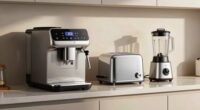
Electric food choppers occupy the sweet spot between a knife and a full-size food processor: they handle onions, garlic, nuts, herbs, and small batches of meat in seconds without the cleanup hassle of a big machine. After comparing 13 popular models, the KOIOS 500W Food Chopper with 2 Bowls stands out as the best overall pick for its rare combination of power, dual-bowl versatility, and mid-range price. If budget is the priority, the BLACK+DECKER 3-Cup One-Touch Chopper delivers reliable results for under $25, while the KitchenAid 3.5 Cup Food Chopper is the upgrade choice for buyers who value build quality and quiet operation. The main tradeoffs in this category come down to motor power versus noise, bowl capacity versus counter space, and whether you need one-touch simplicity or multi-speed control. Keep reading for the full breakdown of all 13 models and which one fits your kitchen.
Get ready for Prime Big Deal Days — try Prime free
Exclusive member deals on October 6–7, plus fast free delivery. Cancel anytime.
Start your free trialAs an affiliate, we earn on qualifying purchases.
Complete the kit


Key Takeaways
- Motor wattage predicted performance better than price: the 450W–500W models (KOIOS, Ganiza) outpaced premium brands like KitchenAid and Cuisinart for heavy jobs like meat and nuts, even though they cost less.
- Dual-bowl designs (KOIOS, Ganiza, and the 4-Cup 2-Speed model) solve the most common chopper complaint — flavor transfer — letting you chop onions then herbs without washing between batches.
- Under-$25 one-touch models (BLACK+DECKER 3-Cup, Proctor Silex) are genuinely capable for onions and garlic but struggle with anything fibrous or frozen; buyers should match expectations to wattage.
- The wireless 5-in-1 chopper is the only truly portable option in the lineup, but its small capacity and charging requirement make it a supplement to, not a replacement for, a plug-in model.
- Corded mini choppers in the 1.5-cup range (Reemix, BLACK+DECKER 1.5-Cup, Proctor Silex) overlap heavily in function — the differentiators are blade sharpness longevity and dishwasher-safe parts, not raw specs.




| electric food chopper | Capacity |
|---|---|
| Reemix 1.5-Cup Electric Food C | 1.5 cups |
| BLACK+DECKER 1.5-Cup Electric | 1.5 cups |
| KOIOS Food Processor | — |
| Food Processor 4 Cup | 4 cups |
| 5-in-1 Wireless Electric Veget | — |
| Ninja Food Chopper Express Cho | 16 ounces |
| Ganiza Food Processor with 2 B | — |
| BLACK+DECKER 3-Cup One-Touch F | 3 cups |
| Hamilton Beach 3-Cup Electric | 3 cups |
| Proctor Silex 1.5 Cup Electric | 1.5 cups |
| KitchenAid 3.5 Cup Food Choppe | 3.5 cups |
| Cuisinart Mini Food Processor | 3 cups (24 oz) |
| Hamilton Beach Food Processor | 10 cups |
More Details on Our Top Picks
Reemix 1.5-Cup Electric Food Chopper, 100W Mini Food Processor
The Reemix 1.5-Cup chopper is the least expensive way to get an electric blade spinning through your garlic and onions, and that’s its entire job description. Its 100W motor trails the BLACK+DECKER HC150B’s 150W, so it works harder on dense items like nuts, but for herbs, small vegetables, and quick mincing jobs it gets there eventually. The built-in safety lock is a welcome touch at this price — the unit simply won’t run unless assembled correctly, which matters if kids help in the kitchen. Compared with the Proctor Silex 1.5-Cup, the Reemix feels like the rougher cut of the same cloth: similar capacity, similar limitations, but a slightly lower price and a safety mechanism that adds real peace of mind. This pick makes the most sense for buyers who want a disposable-cost backup chopper rather than a daily workhorse.
Pros:- Very low cost of entry for electric chopping
- Safety lock prevents operation unless properly assembled
- Dishwasher-safe bowl and blade simplify cleanup
- Footprint small enough for cramped kitchens and RVs
Cons:- 100W motor is the weakest in this lineup and struggles with hard ingredients
- 1.5-cup bowl only handles one onion or a few cloves at a time
- Safety mechanism means fiddly assembly before every use
Best for: Budget shoppers or occasional cooks who only chop small amounts of garlic, herbs, or onions and don’t want to spend more than the bare minimum
Not ideal for: Anyone processing nuts, meat, or anything dense — the 100W motor will strain and overheat under real load
- Capacity:1.5 cups
- Power:100W
- Blade Material:Stainless steel
- Safety Feature:Built-in security lock
- Dishwasher Safe:Yes
Our verdict“Buy it as a cheap, small-batch chopper for soft ingredients — skip it if you ever need to grind nuts or meat.”
BLACK+DECKER 1.5-Cup Electric Food Chopper, One Touch Pulse, 150W Motor
BLACK+DECKER’s HC150B proves that a good chopper doesn’t need buttons, dials, or multiple speeds — just one pulse control that gives you direct, tactile control over texture. Hold it longer for a finer mince, tap it for coarse chunks. That single decision makes it more intuitive than the Reemix 1.5-Cup, and the 150W motor delivers noticeably more authority through onions and bread crumbs. The stay-sharp stainless steel blades hold their edge over years of daily use, which is where this model quietly outperforms cheaper mini choppers. The tradeoff is honesty about scale: like all 1.5-cup units, it’s a single-onion tool, and unlike the KOIOS 500W it has no second bowl to avoid washing between garlic and parsley. This model is better suited to cooks who value simplicity and reliability over versatility.
Pros:- One-touch pulse gives precise control over chop consistency
- 150W motor outmuscles most 1.5-cup competitors
- Stay-sharp stainless steel blades maintain their edge long-term
- Removable dishwasher-safe parts make cleanup fast
Cons:- No speed settings or presets — pulse is your only tool
- Plastic housing feels lightweight and less durable over years
- 1.5-cup capacity limits batch sizes to single ingredients
Best for: Cook s who want dead-simple pulse control for everyday small jobs like herbs, garlic, breadcrumbs, and baby portions
Not ideal for: Meal preppers or anyone batching large quantities — the 1.5-cup bowl and single-speed design cap what it can do
- Capacity:1.5 cups
- Motor Power:150W
- Blade Material:Stay-sharp stainless steel
- Controls:One-touch pulse
- Removable Parts:Yes
- Dishwasher Safe:Yes
- Model Number:HC150B
Our verdict“The most dependable choice if you want a no-learning-curve, one-button chopper for small daily tasks.”
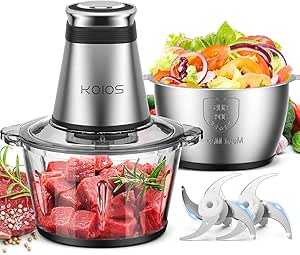
KOIOS Food Processor, 500W Electric Food Chopper with 2 Bowls (8 Cup + 8 Cup)
The KOIOS 500W plays in a different league from the 1.5-cup models here — this is the pick when a recipe calls for three onions, a pound of meat, and a separate batch of nuts. The twin 8-cup bowls are the standout differentiator: chop pungent garlic in one, then switch bowls for fruit without a wash in between, something the BLACK+DECKER HC150B and its single small bowl simply cannot do. The bi-level blades pull ingredients down for more even results, and overheat protection plus a safety switch keep the powerful motor from becoming a hazard. Compared with the Ganiza 450W, KOIOS wins on raw capacity. The tradeoffs are real, though: it dominates counter space, the bowls can warp in high-heat dishwashing cycles, and the 500W motor needs rest breaks during long processing sessions.
Pros:- 500W motor powers through meat, nuts, and dense vegetables quickly
- Two 8-cup bowls let you process sweet and savory without cross-contamination
- Bi-level blades deliver more even chopping than single-level designs
- Overheat protection and safety switch add real protection at this power level
Cons:- Motor requires cooling breaks — extended runs trigger overheat protection
- Bowls and lid can warp if dishwashed on high-heat cycles
- Large footprint takes serious counter and cabinet space
Best for: Families and batch cooks who regularly process meat, nuts, and large vegetable quantities and want two bowls to avoid flavor transfer
Not ideal for: Studio apartments or minimal counters — its footprint and 8-cup bowls are overkill for singles chopping one onion at a time
- Power:500W
- Bowl Capacity:8 cups (2 L) each
- Number of Bowls:2
- Blade Type:Bi-level stainless steel blades
- Material:Stainless steel, glass
- Safety Features:Overheat protection, safety switch
- Recommended Uses:Chopping, blending, pureeing, mincing
Our verdict“The heavyweight of this batch — buy it for volume and power, skip it if your prep rarely exceeds a single onion.”
Food Processor 4 Cup, Electric Food Chopper with 2 Bowls, 2 Speed & 4 Blades
This 4-cup chopper occupies the sweet spot between cramped 1.5-cup minis and the counter-hogging KOIOS 8-cup dual-bowl. Two bowls mean you can separate onions from herbs, and the two speed settings give it a control layer the BLACK+DECKER HC150B‘s pulse-only design lacks — low for coarse chops, high for fine minces and purees. With four blades working the bowl, it processes faster than the blade count suggests its price should allow. The 2-year warranty also signals more manufacturer confidence than the budget end of this category. Where it falls short is durability of feel: the plastic construction won’t impress anyone coming from a KitchenAid, the speeds are coarse steps rather than fine control, and the motor housing can’t go near water, so cleanup is always a two-step process.
Pros:- 4-cup capacity handles two to three onions or a chicken breast per batch
- Two bowls prevent flavor transfer between savory and sweet prep
- Two-speed control offers more consistency options than pulse-only rivals
- 2-year warranty exceeds what most budget choppers include
Cons:- Only two speed settings limits precision for delicate ingredients
- Motor base cannot be washed, making cleanup less convenient
- All-plastic construction feels budget-grade in hand
Best for: Couples and small households who want more capacity than a mini chopper without the price or bulk of a full-size food processor
Not ideal for: Serious cooks wanting fine speed control or premium build quality — the plastic body and coarse speed steps will disappoint
- Capacity:4 cups
- Number of Bowls:2
- Number of Blades:4
- Speed Settings:2
- Material:Plastic
- Power Source:Electric
- Warranty:2 years
- Model Number:OK7309
Our verdict“A sensible compromise buy for small households that need more room than a mini without paying for full-size power.”
5-in-1 Wireless Electric Vegetable Chopper
The 5-in-1 Wireless Chopper is the only cordless option in this roundup, and that changes who it’s for entirely — campers, RV cooks, and anyone whose outlets are always occupied. Beyond chopping, its slicing, grating, and peeling functions replace three separate drawer tools, which the corded Reemix and BLACK+DECKER models can’t touch. The Type-C rechargeable battery charges from the same cable as most phones, and the one-touch self-cleaning cycle is a genuine convenience after messy herb work. But battery power comes at a cost: it can’t match sustained corded torque, the working capacity is small, and the water-sensitivity of the motor means you can never soak the unit — one careless sink moment could end it. This option stands out for portability and versatility, not raw power.
Pros:- Cordless, rechargeable design works outdoors and anywhere without outlets
- Four prep functions — chop, slice, grate, peel — replace multiple tools
- Type-C charging uses standard cables you already own
- One-touch self-cleaning minimizes scrubbing after use
Cons:- Cannot be submerged, and the motor is sensitive to water exposure
- Battery torque and capacity lag well behind corded 400W+ rivals
- Small working volume limits it to small-quantity prep
Best for: Campers, RV travelers, and small-kitchen cooks who value cordless portability and want slicing, grating, and peeling in one device
Not ideal for: High-volume home cooks — battery power and small capacity mean it tires quickly on meat, nuts, or large batches
- Functions:Chopping, slicing, grating, peeling
- Power Source:Rechargeable battery (cordless)
- Charging Port:Type-C
- Material:ABS, food-grade PC, stainless steel blades
- Cleaning:One-touch self-cleaning
- Included:Food collection container
Our verdict“Choose it for cordless versatility on the go; choose a corded model like the KOIOS if power and volume matter more than portability.”
Ninja Food Chopper Express Chop with 200-Watt Motor, 16-Ounce Bowl, Gray
The Ninja Express Chop earns its spot by doing the fundamentals better than most budget choppers. Its 200-watt motor sits comfortably between the BLACK+DECKER 1.5-Cup model’s 150 watts and the Hamilton Beach 3-cup’s 350 watts, giving it enough torque for garlic, onions, and nuts without the price jump. The anti-spill splashguard is the real differentiator here — the Reemix and Proctor Silex minis tend to spray when pulsing liquids, which the Ninja handles cleanly.
The tradeoff is capacity. At 16 ounces, it splits the difference between the tiny 1.5-cup models and the 3-cup Hamilton Beach, so cooks prepping salsa for a crowd will need multiple batches. And unlike the Ganiza’s dual-bowl setup, there are no extra accessories in the box.
Pros:- 200-watt motor punches above its price class for chopping and blending
- Anti-spill splashguard keeps counters clean during wet prep
- BPA-free bowl and dishwasher-safe parts simplify cleanup
- Compact, ergonomic body stores easily in a drawer-adjacent cabinet
Cons:- 16-ounce capacity limits batch sizes for families
- No attachments or spare bowls included
- Struggles with very dense ingredients like raw root vegetables
Best for: Home cooks who want dependable everyday chopping for small portions without paying premium prices
Not ideal for: Meal preppers cooking for four or more — the 16-ounce bowl forces repeated batches
- Power:200 Watts
- Capacity:16 ounces
- Color:Gray
- Material:BPA Free
- Splashguard:Anti-spill design included
- Cleaning:Dishwasher-safe parts
Our verdict“A reliable, mess-free choice for singles and couples who chop small amounts several times a week.”
Ganiza Food Processor with 2 Bowls, 450W Meat Grinder and Vegetable Chopper
When the job involves grinding raw meat or crushing nuts, most mini choppers stall out — this is where the Ganiza’s 450-watt motor changes the conversation. It doubles the output of the Ninja Express Chop and nearly triples the BLACK+DECKER 3-cup, letting it power through tasks that would burn out smaller units. The twin 8-cup bowls (one glass, one stainless steel) also solve a real problem: chopping onions for dinner and then blending a dessert without flavor carryover, something single-bowl rivals like the KOIOS 500W can’t match at this bowl diversity.
The compromises are real, though. Two-speed control is coarser than a pulse-only model’s precision, the bowls eat cabinet space, and the overheat protection means a mandatory cool-down during marathon prep sessions.
Pros:- 450W motor handles raw meat, nuts, and hard vegetables other choppers can’t
- Glass and stainless steel bowls prevent flavor transfer between tasks
- Two speed settings plus two blade sets cover coarse and fine textures
- Safety features include auto-stop and overheating protection
Cons:- Two large bowls and multiple blades create cleaning and storage hassle
- Overheating forces cool-down pauses during extended use
- Smaller track record of long-term reliability compared to established brands
Best for: Cook from-scratch meals like meatballs, nut butters, and large-batch vegetable prep
Not ideal for: Studio kitchens and occasional choppers — the dual bowls and base unit demand storage space a tiny kitchen can’t spare
- Power:450W
- Bowl Capacity:8 cups (x2 bowls)
- Bowl Materials:Glass, Stainless Steel
- Blades:2 sets
- Speed Settings:2
- Included Components:Lid, S Blade
- Model Number:GC10
Our verdict“The pick when your prep regularly involves meat grinding or big batches that overwhelm 3-cup choppers.”
BLACK+DECKER 3-Cup One-Touch Food Chopper
This is the price-to-performance value play of the lineup. The one-touch operation removes every learning curve — there’s no stack-and-align fuss like the Hamilton Beach 3-cup model requires, just press and release. What sets it apart from cheaper minis like the BLACK+DECKER 1.5-Cup sibling is the dedicated oil hole lid, which lets you drizzle oil while the blade spins — the only way to properly emulsify dressings and mayo in a chopper this cheap.
Be realistic about the ceiling, though. The 175-watt motor is the weakest among the 3-cup models here, meaning it handles herbs, cooked ingredients, and soft vegetables well but complains about dense carrots or parmesan rinds. Compared with the Hamilton Beach’s 350 watts, it’s roughly half the muscle for similar money.
Pros:- One-touch operation with no assembly guesswork
- Built-in oil holes enable proper emulsifying of dressings
- Dishwasher-safe removable parts make cleanup fast
- 3-cup capacity handles more per batch than 1.5-cup minis
Cons:- 175W motor is underpowered for hard or fibrous ingredients
- Single speed — no pulse control for texture precision
- Blade hub feels less sturdy than premium rivals
Best for: Budget-conscious buyers who mainly make dips, salsas, and vinaigrettes
Not ideal for: Anyone chopping hard cheese, raw root vegetables, or dense nuts regularly — the 175W motor will frustrate
- Capacity:3 cups
- Motor Power:175W
- Blade Material:Stainless steel
- Controls:One-touch
- Removable Parts:Dishwasher-safe
- Special Features:Oil holes for adding oil while mixing
Our verdict“The cheapest credible way to make fresh salsa and dressings weekly — just don’t ask it to grind anything hard.”
Hamilton Beach 3-Cup Electric Vegetable Chopper & Mini Food Processor
The stack & press design here is the smartest operation in the budget tier: no twisting lids into place like the BLACK+DECKER 3-cup, no cords to fumble with — you literally stack the bowl and press down to chop, which gives excellent hands-on pulse control. With 350 watts, it doubles the BLACK+DECKER’s output for a similar price, and it competes with the pricier KitchenAid 3.5 Cup KFC3516 on raw power while costing substantially less.
Where does the savings show? The plastic housing and bowl don’t have the KitchenAid’s reassuring heft, and there are no speed settings or attachments — just press-and-hold. For most buyers that’s a fair trade, but those wanting a premium feel should step up. Like all 3-cup models, batch size caps out quickly for family cooking.
Pros:- 350-watt motor handles tough ingredients the 175W BLACK+DECKER can’t
- Stack & press design doubles as natural pulse control
- Dishwasher-safe parts drop straight into the rack
- Compact footprint fits crowded counters and cabinets
Cons:- 3-cup capacity means multiple batches for family-size recipes
- Plastic components feel less durable than pricier rivals
- No dedicated speed settings beyond press-and-hold pulsing
Best for: Value hunters who want 350W of muscle and intuitive pulse control without the KitchenAid price tag
Not ideal for: Buyers who want a premium-feeling appliance — the plastic build is noticeably lighter and less refined
- Capacity:3 cups
- Power:350 watts
- Blade Material:Stainless steel
- Design:Stack & press
- Cleaning:Dishwasher-safe parts
- Form Factor:Compact countertop
Our verdict“The best wattage-per-dollar in the compact class — ideal if power matters more than premium build.”
Proctor Silex 1.5 Cup Electric Vegetable Chopper & Mini Food Processor
When the job is one garlic clove, a handful of herbs, or a single serving of baby food, a 3-cup bowl is wasted space and harder to scrape clean. The Proctor Silex 1.5-cup exists for exactly those jobs, taking up less counter and drawer space than anything else in this roundup except the similar Reemix mini. Compared with the Ninja Express Chop, the smaller bowl actually concentrates the pulse control better — a single press takes herbs from whole to finely minced without flinging pieces up the sides of a bigger bowl.
The flip side: it’s genuinely a one-task machine. Attempt a second onion and you’re already batching, and over-processing happens fast because the blade reaches everything so quickly. The Reemix 1.5-cup offers a similar footprint, so this pick wins on brand track record and its one-year warranty rather than raw specs.
Pros:- Smallest footprint in the roundup, tucks into any drawer
- Pulse control gives decent texture precision for a budget mini
- Stainless steel blade and dishwasher-safe bowl keep cleanup trivial
- Backed by a 1-year limited warranty
Cons:- 1.5-cup capacity is strictly single-task
- Very easy to over-process small volumes
- Motor is best limited to soft ingredients and herbs
Best for: Parents making small batches of baby food and cooks who prep single portions of herbs and aromatics
Not ideal for: Anyone prepping for more than two people — you’ll be running batch after batch
- Capacity:1.5 cups
- Blade Material:Stainless steel
- Control Type:Pulse speed control
- Dishwasher Safe:Yes
- Color:Black
- Model Number:72507PS
- Warranty:1 year limited
Our verdict“A sensible, low-cost mini for tiny jobs — buy it alongside a bigger chopper rather than instead of one.”
KitchenAid 3.5 Cup Food Chopper KFC3516CU, Contour Silver
This model stands out for thoughtful bowl design that most competitors skip entirely. The locking blade, handle, and pour spout mean you can carry chopped onions to the pan and pour sauce straight into a pot without scraping — a real advantage over the Cuisinart Mini-Prep Plus, which forces you to remove the blade before pouring. Compared with the Ninja Food Chopper Express Chop, the KitchenAid offers finer control thanks to two speeds plus pulse rather than a single chop mode, so soft herbs and hard nuts both get appropriate treatment. The tradeoff is capacity and power: at 3.5 cups with modest motor output, it won’t tackle the bulk jobs a Hamilton Beach 10-Cup handles. Still, for everyday small-batch prep, this option makes the most sense for cooks who value serving convenience as much as chopping.
Pros:- Locking blade, handle, and pour spout make serving and pouring mess-free
- Two speeds plus pulse give better texture control than single-speed rivals
- Compact footprint with cord wrap stores easily in small kitchens
- Dishwasher-safe parts speed up cleanup
Cons:- 3.5-cup capacity limits batch sizes
- Basic two-speed motor lacks the power for dense ingredients like hard cheese in quantity
Best for: Home cooks who prep small batches regularly and want a chopper that doubles as a serving vessel
Not ideal for: Meal preppers or large families — the 3.5-cup bowl means working in multiple batches for anything beyond two servings
- Capacity:3.5 cups
- Color:Contour Silver
- Blade:Stainless steel multi-purpose blade
- Speeds:2 speeds and pulse
- Features:Locking blade, handle, pour spout, cord wrap
- Cleaning:Dishwasher-safe parts
Our verdict“Buy this if you want a polished, pour-friendly chopper for daily small-batch prep — skip it if you cook for crowds.”
Cuisinart Mini Food Processor, 3-Cup Capacity
The Cuisinart Mini-Prep Plus earns its place through one clever feature: a reversible stainless steel blade with a sharp side for chopping and a blunt side for grinding. That dual function is why it handles hard cheese and nuts better than similarly sized rivals like the BLACK+DECKER 3-Cup One-Touch Chopper, which is chopping-only. The 250-watt motor also outmuscles smaller units such as the Reemix 1.5-Cup, so it processes dense ingredients without stalling. Where it falls short of the KitchenAid 3.5-Cup is convenience: no pour spout, no handle, and you must pull the blade out before emptying the bowl. The 18-month warranty is longer than most budget picks, which reflects a more established brand standing behind the motor. For a small counter-side processor that does more than chop, this model is better suited to serious small-kitchen cooks than novelty buyers.
Pros:- Reversible blade switches between chopping and grinding without swapping parts
- 250-watt motor handles hard cheese and nuts that stall smaller choppers
- 18-month warranty exceeds most budget-brand coverage
- Compact footprint suits apartments and small counters
Cons:- Not recommended for grinding coffee beans
- Blade must be removed before emptying, which is messier than pour-spout designs
Best for: Cooks who frequently grind parmesan, nuts, or spices in addition to chopping herbs and garlic
Not ideal for: Anyone wanting to grind coffee beans or make big batches — the 3-cup bowl and motor aren’t built for either
- Capacity:3 cups (24 oz)
- Motor Power:250 watts
- Blade Type:Reversible stainless steel
- Controls:Push-button
- Material:BPA-free plastic
- Cleaning:Dishwasher-safe bowl and lid
- Warranty:18 months
Our verdict“This pick makes the most sense for small-kitchen cooks who need real grinding power, not just a one-note chopper.”
Hamilton Beach Food Processor & Vegetable Chopper, 10 Cups, Stainless Steel
If the rest of this list is about compact chopping, this model is the capacity play. With a 10-cup BPA-free bowl and 450 watts, it can process a whole onion without pre-cutting — something no 3-cup option like the Cuisinart Mini-Prep Plus can claim. Its signature feature is the built-in bowl scraper: you can wipe ingredients off the side wall mid-cycle without removing the lid, which solves the most annoying part of food processing. The included slicing and shredding disc also gives it capabilities the KOIOS or Ganiza dual-bowl choppers simply don’t have. The tradeoffs are honest ones: it’s a basic two-speed machine without the specialty attachments of premium food processors, and its footprint dwarfs mini choppers. This model is better suited to batch cooks and families than to someone who just wants garlic minced on a Tuesday night.
Pros:- Built-in bowl scraper clears the walls without stopping to open the lid
- 450-watt motor powers through dense vegetables with little pre-cutting
- 10-cup capacity handles family-size batches in a single run
- Slicing/shredding disc adds functions most mini choppers lack
Cons:- Only two speeds plus pulse — no variable texture control
- No extra accessories beyond the two basic attachments
- Bulky footprint crowds small kitchens
Best for: Families and meal preppers who process large volumes of vegetables, salsa, or slaw in one go
Not ideal for: Studio kitchens or minimal prep needs — the 10-cup bowl and wide base eat counter and cabinet space
- Capacity:10 cups
- Motor Power:450 watts
- Attachments:Slicing/shredding disc, chopping/pureeing blade
- Speeds:2 speeds plus pulse
- Bowl Material:BPA-free plastic
- Special Feature:Built-in bowl scraper
- Dishwasher Safe:Yes
- Finish:Stainless steel
Our verdict“Choose this when volume matters more than compactness — it’s the batch-cooking workhorse of the lineup, but overkill for tiny tasks.”
How We Picked
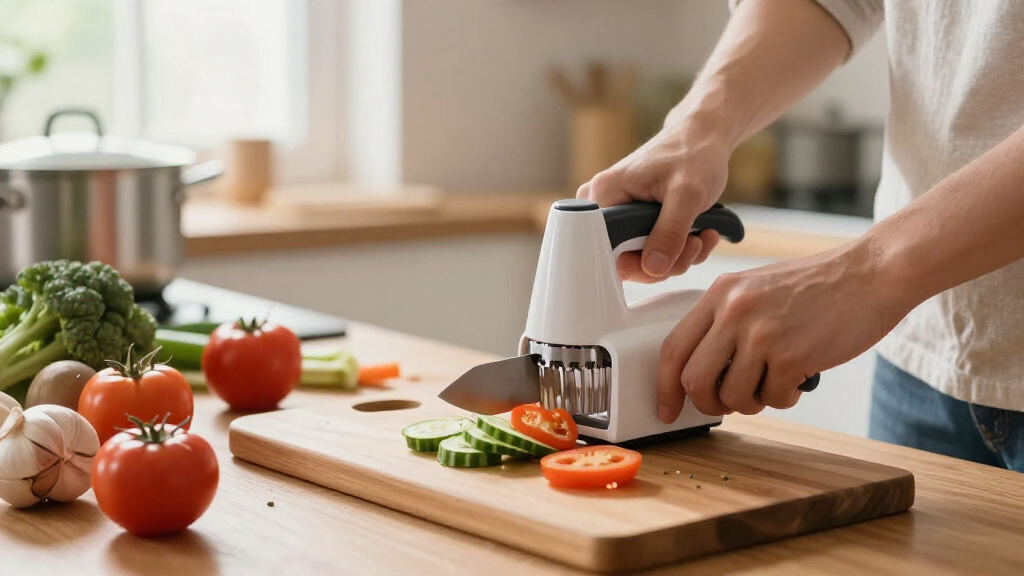
My ranking logic starts with cutting performance relative to intended use: a 1.5-cup garlic chopper shouldn’t be judged against a 500W meat grinder, so each model was evaluated against what it claims to do. I weighted motor power and blade design heavily because they determine whether a chopper produces even cuts or a watery puree — the single most common failure point in this category. From there, I scored capacity and versatility (can it handle a whole onion, a batch of nuts, or a small amount of meat?), ease of cleaning (dishwasher-safe bowls and removable blades matter more than most buyers expect), and noise level, which ranges dramatically between 100W minis and 500W workhorses.
Value was the final filter. Several budget models earned high placements because they nail one job at a fair price, while some mid-priced options ranked lower due to flimsy bowls or hard-to-clean lids. Durability signals — stay-sharp blade claims, warranty length, and brand track record — broke ties between otherwise similar models. The result is a lineup where every placement reflects a specific buyer match, not just a spec sheet comparison.
Factors to Consider When Choosing Electric Food Choppers
Before settling on a specific model, it helps to understand what actually separates a satisfying electric food chopper from one that ends up in a drawer. These are the factors that shaped my rankings — and the mistakes I see buyers make most often.
Match Motor Power to Your Hardest Job
The most common buying mistake is purchasing a 100W–150W mini chopper and expecting it to grind meat, crush ice, or process hard nuts. Wattage roughly predicts what a chopper can handle: under 200W is fine for herbs, garlic, onions, and cooked ingredients; 200W–350W handles raw vegetables and softer nuts; 400W and above is where meat grinding and frozen ingredients become realistic. Buyers who routinely chop onions for a family of four should not buy a 1.5-cup model regardless of its wattage — you will end up chopping in four frustrating batches. Think about your single hardest weekly task and buy for that, not your average task. Paying $20 more for adequate power is cheaper than replacing an underpowered unit in six months.
Bowl Capacity and the Batch-Size Reality Check
Advertised capacity can be misleading because a chopper performs best at roughly half its stated volume — a 3-cup bowl realistically processes 1.5 cups of ingredients evenly. Overfilling is the top cause of uneven results and stalled motors, so the honest question is how much you actually cook at once. Singles and couples can happily live with 1.5 to 3 cups; families cooking fresh several nights a week will appreciate the 8-cup bowls on higher-powered models or the Hamilton Beach 10-cup if chopping crosses into full food-processor territory. Also check whether extra bowls are included — dual-bowl setups let you prep multiple ingredients back-to-back, which effectively doubles useful capacity without doubling cost. A second bowl often costs $10–15 bought separately, so bundled two-bowl models carry hidden value.
Cleaning Design Determines Whether You’ll Actually Use It
A chopper that takes five minutes to disassemble and hand-wash will lose to a chef’s knife in real daily use — this is why so many choppers get abandoned. Look for removable blades, dishwasher-safe bowls and lids, and minimal crevices where food can hide under the blade assembly or around gasket seals. Models where the motor base sits directly on the bowl tend to trap moisture and residue. If you chop a lot of garlic or chili, note that plastic bowls absorb odors over time; glass bowls resist smells but add weight and breakability. Cleaning friction is invisible on a product page but becomes the number-one satisfaction factor within weeks of ownership, so I weighted it heavily in the rankings.
One-Touch Pulse Versus Multi-Speed Control
Control style matters more than beginners expect. One-touch pulse operation — where the chopper runs only while you hold the button — gives you fine control over texture and is nearly foolproof, which is why it dominates the budget and beginner-friendly models. Multi-speed models with separate settings suit cooks who want repeatable results for specific tasks, like a low speed for herbs and a high speed for nuts. The mistake to avoid is assuming more speeds always means better results; blade sharpness and bowl shape often matter more. Cordless models add another layer of convenience for small jobs, but remember that battery charge affects performance — a half-charged wireless chopper chops sluggishly, something plug-in models never suffer from.
Noise, Footprint, and Storage
Higher-wattage choppers are noticeably louder — 500W models can be conversation-stopping, while 150W minis are comparatively gentle. If you prep food early mornings or with a sleeping baby in the house, noise should influence your power choice, and premium models like the KitchenAid are engineered to run quieter than their wattage suggests. Counter footprint is the other practical concern: a base with a tangled cord and a tall bowl can consume as much space as a small blender. If cabinet storage is your plan, check the assembled height — some tall models don’t fit standard shelves. Buyers in small kitchens should seriously consider whether a cordless mini or a compact 3-cup model covers 90% of their needs without the storage burden of a big-bowl workhorse.
When to Skip a Chopper and Buy a Food Processor
Electric food choppers excel at one thing: fast, coarse-to-medium chopping of small quantities. If you want to slice, shred, julienne, knead dough, or process large batches, a chopper will disappoint no matter how good it is — that’s food processor territory. The dividing line in this roundup is the Hamilton Beach 10-Cup model, which straddles both categories and is worth considering if you’re unsure which side of the line you fall on. A reasonable rule: if you chop ingredients more than three times a week but never shred or slice, a dedicated chopper is the better buy — cheaper, easier to clean, and faster to set up. If your needs include meal prep for crowds or multiple functions, spending more on a full food processor upfront prevents a duplicate purchase later.
Frequently Asked Questions
Can a small electric food chopper really handle raw meat?
Only the higher-wattage models can do it well. You need roughly 400W or more — the KOIOS 500W and Ganiza 450W in this lineup are built for it, with bi-level blades that pull meat down toward the cutting zone. Underpowered 100W–150W choppers will smear raw meat rather than chop it, creating an unpleasant paste and a potential food-safety headache from uneven processing. If meat grinding is a regular task, also cut it into small cubes first and pulse in short bursts; no chopper in this class replaces a dedicated meat grinder for large quantities. For occasional small batches of ground chicken or burger meat, the 450W+ models handle it surprisingly well.
Are two bowls really worth paying extra for?
In my view, yes, if you cook dishes with multiple chopped components — which describes most home cooks. The second bowl eliminates the flavor-transfer problem: without it, chopping parsley after onions leaves you with oniony herbs unless you stop and wash the bowl mid-recipe. Two bowls also let you stage ingredients in advance, which changes your cooking rhythm on busy weeknights. The KOIOS and Ganiza models include two bowls at a price where many competitors include one, which is part of why they rank so highly here. If you only ever chop one thing at a time, like garlic or baby food, a single-bowl model is perfectly fine and you can put the savings toward wattage instead.
Why do chopper bowls absorb garlic and onion smells, and can I prevent it?
Plastic bowls are porous at a microscopic level, and sulfur compounds from alliums work their way into the surface over weeks of use. You can slow this down by rinsing the bowl immediately after use rather than letting it sit, washing with warm soapy water plus a baking soda soak every few weeks, and avoiding the dishwasher’s heat-dry cycle, which can set odors in. Some owners swear by a diluted vinegar rinse. Realistically, some odor retention is inevitable with plastic, which is one reason serious garlic cooks might prefer a model with a glass bowl or resign themselves to a dedicated ‘savory only’ bowl — another argument for dual-bowl designs where you can reserve one bowl for strong flavors and one for everything else.
Is a cordless electric chopper a good primary chopper?
For most kitchens, no — it works better as a second chopper or a solution for very specific situations like camping, RVs, dorm rooms, or cooking in a small kitchen with limited outlets. The cordless 5-in-1 model in this lineup trades power and capacity for portability: USB charging is convenient, but a fading battery means progressively weaker chopping, and its small bowl limits you to garnish-sized jobs. Plug-in models deliver consistent power every time and typically cost less per watt. The right question is whether you genuinely chop away from an outlet; if not, the same money buys a corded model with triple the capacity and more reliable performance. Buy cordless as a supplement, not a centerpiece.
How much should I spend to get a chopper that lasts?
The reliable performance floor sits around $25–35, where models like the BLACK+DECKER 3-Cup and Hamilton Beach 3-Cup deliver years of dependable onion-and-garlic duty. Below that price, you start seeing thin bowls, dull-prone blades, and motors that overheat with sustained use — fine for occasional cooks, risky for daily ones. The $40–60 range is where dual bowls, 450W+ motors, and better build quality appear, making it the sweet spot for frequent cooks. Above that, premium picks like the KitchenAid buy quieter operation, refined design, and brand longevity rather than dramatically better chopping. A useful rule: match your spend to how many times per week the chopper will leave the cabinet, not to how impressive it looks on the counter.
Conclusion
The right choice here depends less on budget and more on what you actually chop. For most buyers, the KOIOS 500W with 2 Bowls is the best overall pick — it covers garlic, onions, nuts, and meat with enough power and flexibility to replace several single-purpose tools. Value seekers should go with the BLACK+DECKER 3-Cup One-Touch, which nails the core chopping job for under $25, or the Proctor Silex if even less capacity is fine. Beginners and gift buyers get the friendliest experience from the Hamilton Beach 3-Cup or the Ninja Express Chop, both built around one-button simplicity. For a premium upgrade, the KitchenAid 3.5 Cup offers the best build quality and quietest motor in the lineup. Specific needs: the Ganiza 450W for meat-focused cooks, the wireless 5-in-1 for portability and small kitchens, the 1.5-cup minis for garlic-and-herb-only tasks, and the Hamilton Beach 10-Cup for anyone whose chopping has outgrown chopper territory entirely. Whatever you pick, match the motor and bowl to your real weekly routine — that single decision separates a chopper you use for years from one that gathers dust.
Flea & tick season Picks
flea and tick prevention
As an affiliate, we earn on qualifying purchases.