The best 4K monitor for gaming overall is the ASUS ROG XG32UCWG, which pairs a sharp 32-inch OLED display with a high refresh rate. For speed-focused players, the Amzfast AMZG27F6U stands out with its dual-mode refresh options, while the Dell S2725QS offers a simpler 27-inch IPS setup for mixed gaming and everyday use. The main tradeoffs are refresh rate versus image quality, screen size versus desk space, and gaming features versus general-purpose simplicity. I compared all 11 options by how well their specs serve different play styles and setups. Read on for the full breakdown and a guide to choosing the right balance for your games.

Get kitchen gear delivered free with Prime
- Fast, free delivery on millions of items
- Prime Video, Amazon Music and more included
- Member-only deals all year
Complete the kit


Key Takeaways
OLED is the premium image-quality route: The ASUS ROG XG32UCWG and ROG Swift OLED PG32UCDP are the standout choices for buyers who prioritize contrast and rich color over simpler IPS designs.
Dual mode serves more than one gaming style: The Amzfast AMZG27F6U and Samsung Odyssey G7 G70F offer a way to favor resolution or speed, but buyers should check which mode best matches the games they play.
Refresh rate separates gaming-first screens from general-purpose 4K: The Dell S2725QS adds 120Hz to a straightforward IPS design, while several gaming-oriented picks offer faster refresh options.
Screen size changes the experience as much as resolution: The 37-inch Samsung G75F suits players who want an expansive curved view, while the 27-inch models are easier to fit on smaller desks.
Two listings share the Acer Nitro VG270K name: The repeated entry does not create a distinct feature choice, so buyers should verify the exact model and specification before purchasing.
| ASUS TUF Gaming VG27UQ1A 27-Inch 4K 160Hz Gaming Monitor |  | Best Overall | Screen size: 27 inches | Resolution: 3840 × 2160 (4K UHD) | Panel: Fast IPS | VIEW ON AMAZON | See Our Full Breakdown |
| Samsung Odyssey G7 G75F 37-Inch 4K UHD Curved Gaming Monitor |  | Best for Immersive Big-Screen Gaming | Screen size: 37 inches | Resolution: 3840 × 2160 (4K UHD) | Panel: VA LED | VIEW ON AMAZON | See Our Full Breakdown |
| Amzfast AMZG27F6U 27-inch 4K Gaming Monitor, Dual Mode 160Hz/320Hz, Fast IPS |  | Best Dual-Mode Flexibility | Screen size: 27 inches | Resolution: 3840 × 2160 (4K UHD) | Panel: IPS | VIEW ON AMAZON | See Our Full Breakdown |
| Acer Nitro VG270K 27-inch 4K UHD IPS Gaming Monitor | 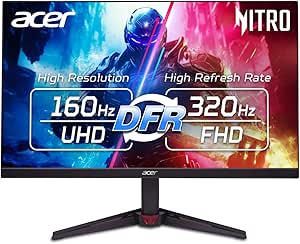 | Best for Multi-Monitor Setups | Screen size: 27 inches | Resolution: 3840 × 2160 (4K UHD) | Panel: IPS | VIEW ON AMAZON | See Our Full Breakdown |
| Dell 27 Plus 4K Monitor S2725QS, 27-Inch IPS, 120Hz |  | Best for Mixed Work and Gaming | Screen size: 27 inches | Resolution: 3840 × 2160 (4K UHD) | Panel: IPS | VIEW ON AMAZON | See Our Full Breakdown |
| ASUS ROG XG32UCWG 32″ 4K 165Hz Glossy OLED G-SYNC Gaming Monitor |  | Best for OLED Contrast and Dual-Mode Play | Screen size: 32 inches | Resolution: 3840 x 2160 (4K UHD) | Refresh rate: 165Hz at 4K; 330Hz at FHD | VIEW ON AMAZON | See Our Full Breakdown |
| LG UltraGear 27G810A-B 27-Inch 4K UHD IPS Gaming Monitor |  | Best 27-Inch Dual-Mode Pick | Screen size: 27 inches | Resolution: 3840 x 2160 (4K UHD) | Refresh rate: Up to 180Hz at 4K; up to 360Hz at Full HD | VIEW ON AMAZON | See Our Full Breakdown |
| Samsung 27″ ViewFinity S7 (S71H) 4K UHD IPS Monitor |  | Best for Casual Gaming and Everyday Use | Screen size: 27 inches | Resolution: 3840 x 2160 (4K UHD) | Panel: IPS | VIEW ON AMAZON | See Our Full Breakdown |
| Acer Nitro VG270K 27-Inch 4K UHD IPS Gaming Monitor |  | Best for 4K-First Budget-Conscious Play | Screen size: 27 inches | Resolution: 3840 x 2160 (4K UHD) | Panel: IPS | VIEW ON AMAZON | See Our Full Breakdown |
| Samsung 27″ Odyssey G7 (G70F) Gaming Monitor – Dual Mode 4K/Full HD |  | Best for High-Refresh 27-Inch Gaming | Screen size: 27 inches | Resolution: 3840 x 2160 (4K UHD) | Refresh rate: 180Hz at 4K; 360Hz at Full HD | VIEW ON AMAZON | See Our Full Breakdown |
| ASUS ROG Swift OLED PG32UCDP 32-Inch 4K Gaming Monitor |  | Best for Dual-Mode Competitive Gaming | Display type: WOLED | Screen size: 32 inches | Resolution: 3840 x 2160 (4K UHD) | VIEW ON AMAZON | See Our Full Breakdown |
| 4k monitors for gaming | Screen size | Resolution | Refresh rate | Panel |
|---|---|---|---|---|
| ASUS TUF Gaming VG27UQ1A 27-In | 27 inches | 3840 × 2160 (4K UHD) | 160Hz | Fast IPS |
| Samsung Odyssey G7 G75F 37-Inc | 37 inches | 3840 × 2160 (4K UHD) | 165Hz | VA LED |
| Amzfast AMZG27F6U 27-inch 4K G | 27 inches | 3840 × 2160 (4K UHD) | Up to 160Hz at 4K; up to 320Hz at 1920 × 1080 | IPS |
| Acer Nitro VG270K 27-inch 4K U | 27 inches | 3840 × 2160 (4K UHD) | 160Hz at 4K; 320Hz at 1080p with DFR | IPS |
| Dell 27 Plus 4K Monitor S2725Q | 27 inches | 3840 × 2160 (4K UHD) | 120Hz | IPS |
| ASUS ROG XG32UCWG 32" 4K 165Hz | 32 inches | 3840 x 2160 (4K UHD) | 165Hz at 4K; 330Hz at FHD | WOLED TrueBlack Glossy |
| LG UltraGear 27G810A-B 27-Inch | 27 inches | 3840 x 2160 (4K UHD) | Up to 180Hz at 4K; up to 360Hz at Full HD | IPS |
| Samsung 27" ViewFinity S7 | 27 inches | 3840 x 2160 (4K UHD) | 60Hz | IPS |
| Acer Nitro VG270K 27-Inch 4K U | 27 inches | 3840 x 2160 (4K UHD) | Up to 72Hz at 4K; 144Hz at 1080p with DFR | IPS |
| Samsung 27" Odyssey G7 | 27 inches | 3840 x 2160 (4K UHD) | 180Hz at 4K; 360Hz at Full HD | Fast IPS |
| ASUS ROG Swift OLED PG32UCDP 3 | 32 inches | 3840 x 2160 (4K UHD) | 240 Hz at 4K; 480 Hz at FHD | — |
More Details on Our Top Picks
ASUS TUF Gaming VG27UQ1A 27-Inch 4K 160Hz Gaming Monitor
I rank the ASUS TUF VG27UQ1A first for buyers who want a fast 27-inch 4K screen without stepping up to a much larger display. Its 160Hz Fast IPS panel pairs sharp detail with responsive motion, while G-SYNC Compatible and FreeSync Premium support smoother play when frame rates fluctuate. Compared with the Dell S2725QS, it offers a higher refresh rate and more gaming-focused sync features; compared with the Amzfast AMZG27F6U, it avoids making 320Hz at 1080p the headline alternative to high-refresh 4K. HDMI 2.1 also makes it a capable console choice, with support for 4K at 120Hz. The tradeoffs are a listed 1000:1 contrast ratio and limited HDR detail, so I would not pick it for deep blacks or HDR-first gaming. No built-in speakers are listed.
Pros:- 4K resolution with a 160Hz refresh rate suits detailed, fast-paced gaming
- G-SYNC Compatible and FreeSync Premium support variable-refresh-rate play
- HDMI 2.1 supports up to 4K at 120Hz for consoles
- Three-year warranty is longer than the one-year coverage listed for several alternatives
Cons:- 1000:1 contrast ratio may make dark scenes look less rich than on the Samsung Odyssey G7 G75F
- HDR performance details are limited in the provided specifications
- No built-in speakers are listed
Best for: PC and console gamers who want 27-inch 4K, high refresh rates, and adaptive sync in one straightforward setup.
Not ideal for: Players prioritizing strong HDR impact, high native contrast, or built-in speakers.
- Screen size:27 inches
- Resolution:3840 × 2160 (4K UHD)
- Panel:Fast IPS
- Refresh rate:160Hz
- Response time:1ms
- Adaptive sync:NVIDIA G-SYNC Compatible; AMD FreeSync Premium
- Color gamut:95% DCI-P3
- Console support:Up to 4K at 120Hz via HDMI 2.1
Our verdict“Choose the ASUS TUF VG27UQ1A for a balanced 27-inch 4K gaming setup with 160Hz performance and broad adaptive-sync support.”
Samsung Odyssey G7 G75F 37-Inch 4K UHD Curved Gaming Monitor
The Samsung Odyssey G7 G75F is the pick for players who want their game to fill more of their view: its 37-inch 1000R curve wraps a 4K image around a larger area than the 27-inch ASUS TUF VG27UQ1A. A 165Hz refresh rate and AMD FreeSync Premium Pro keep the gaming focus intact, while DisplayHDR 600 and a 3000:1 contrast ratio give it a stronger stated contrast profile than the ASUS’s 1000:1. That makes this Samsung the more compelling option for atmospheric games and a spacious desk setup. The size is also its main compromise: it takes substantially more desk room, and the VA panel’s viewing angles may be less consistent than the IPS panels in the ASUS and Dell. I’d skip it if you want a compact, flexible screen for varied seating positions.
Pros:- Large 37-inch 4K screen and 1000R curve create an enveloping gaming view
- 165Hz refresh rate and 1ms GtG response time support fast motion
- DisplayHDR 600 and 3000:1 contrast ratio offer stronger stated contrast than the ASUS TUF VG27UQ1A
- AMD FreeSync Premium Pro helps reduce tearing
Cons:- Large footprint requires more desk space than the 27-inch monitors in this roundup
- VA viewing angles may look less consistent than the IPS panels in the ASUS and Dell
- A 350 cd/m² listed brightness may limit HDR impact in bright rooms
Best for: Single-player and racing-game fans with a deep, spacious desk who want a large curved 4K screen and high refresh rate.
Not ideal for: Gamers with limited desk space, frequent off-center viewing, or a preference for a compact IPS monitor.
- Screen size:37 inches
- Resolution:3840 × 2160 (4K UHD)
- Panel:VA LED
- Curvature:1000R
- Refresh rate:165Hz
- Response time:1ms GtG
- HDR:VESA DisplayHDR 600
- Adaptive sync:AMD FreeSync Premium Pro
Our verdict“Pick the Samsung Odyssey G7 G75F if immersive size and curved 4K gaming matter more to you than desk space and IPS viewing angles.”
Amzfast AMZG27F6U 27-inch 4K Gaming Monitor, Dual Mode 160Hz/320Hz, Fast IPS
The Amzfast AMZG27F6U suits players who split time between detailed 4K games and competitive titles where very high frame rates matter. Its dual mode offers 4K at 160Hz for visual detail or Full HD at 320Hz when speed takes priority. That gives it a different appeal from the Dell S2725QS, which tops out at 120Hz, and a similar mode-switching idea to the Acer Nitro VG270K. Adaptive Sync, a matte IPS panel, and a fully adjustable stand make it practical for mixed gaming setups, while HDMI 2.1 and DisplayPort 1.4 provide useful connection options. The main catch is that 320Hz requires 1080p, so fine detail drops when chasing the fastest mode. Its 1000:1 contrast ratio and HDR400 rating also make it less suited to buyers focused on dark-scene depth or HDR impact.
Pros:- Switches between 4K at 160Hz and Full HD at 320Hz
- Adaptive Sync and 1ms MPRT support smoother-feeling motion
- Height, tilt, swivel, and pivot adjustments offer flexible positioning
- Two HDMI 2.1 and two DisplayPort 1.4 connections
Cons:- 320Hz is available only at Full HD, not 4K
- 1000:1 contrast ratio can limit dark-scene depth
- HDR400 is a modest fit for buyers seeking pronounced HDR effects
Best for: Competitive PC gamers who want one 27-inch monitor for 4K high-refresh play and a separate 320Hz Full HD mode.
Not ideal for: Gamers who expect the 320Hz mode at 4K or put high contrast and impactful HDR ahead of refresh-rate flexibility.
- Screen size:27 inches
- Resolution:3840 × 2160 (4K UHD)
- Panel:IPS
- Refresh rate:Up to 160Hz at 4K; up to 320Hz at 1920 × 1080
- Response time:1ms MPRT
- Brightness:400 nits
- HDR:HDR400
- Connectivity:2 × HDMI 2.1; 2 × DisplayPort 1.4
Our verdict“Choose the Amzfast if you value a switchable 320Hz competitive mode as much as high-refresh 4K gaming.”
Acer Nitro VG270K 27-inch 4K UHD IPS Gaming Monitor
The Acer Nitro VG270K combines high-refresh 4K with a near bezel-less design, making it a natural choice for gamers planning a side-by-side screen setup. Like the Amzfast AMZG27F6U, it can run at 160Hz in 4K or 320Hz in 1080p; the Acer’s listed response time reaches 0.5ms GTG, and AMD FreeSync Premium supports smoother gameplay when frame rates vary. Its thin bezels can help create a less interrupted multi-monitor layout than the more imposing curved Samsung Odyssey G7 G75F. The compromises are a basic tilt-only adjustment range and a 1000:1 contrast ratio. HDR10 is listed, but the supplied specs do not give brightness or a certification level, so I would not choose it on HDR expectations alone. Its 320Hz mode, like the Amzfast’s, requires a resolution drop to Full HD.
Pros:- 4K at 160Hz provides a sharp, fast gaming mode
- 320Hz Full HD mode gives competitive players a higher-refresh option
- Near bezel-less design suits multi-monitor arrangements
- AMD FreeSync Premium and HDMI 2.1 are listed
Cons:- 320Hz requires switching from 4K to 1080p
- Stand adjustment is limited to tilt
- HDR10 is listed without brightness or certification details
Best for: PC gamers building a multi-monitor desk setup who want 4K high refresh rates and a slim-bezel design.
Not ideal for: Buyers who need a height-adjustable stand, detailed HDR performance data, or 320Hz at native 4K.
- Screen size:27 inches
- Resolution:3840 × 2160 (4K UHD)
- Panel:IPS
- Refresh rate:160Hz at 4K; 320Hz at 1080p with DFR
- Response time:Up to 0.5ms GTG
- Adaptive sync:AMD FreeSync Premium
- HDR:HDR10
- Ports:1 × DisplayPort 1.4; 2 × HDMI 2.1
Our verdict“Pick the Acer Nitro VG270K if a slim-bezel multi-monitor setup is a priority and tilt-only adjustment suits your desk.”
Dell 27 Plus 4K Monitor S2725QS, 27-Inch IPS, 120Hz
The Dell S2725QS is the more restrained gaming pick in this group: 4K resolution, a 120Hz refresh rate, and AMD FreeSync Premium cover everyday gaming without chasing the 160Hz speeds offered by the ASUS TUF VG27UQ1A or Samsung Odyssey G7 G75F. That lower ceiling is a meaningful tradeoff for players focused on competitive responsiveness, but it can make sense if the same monitor will serve work, films, and games. Its 99% sRGB coverage, anti-glare finish, built-in speakers, and full stand adjustments support that broader role. The listed 1500:1 contrast ratio is also higher than the 1000:1 figures given for the ASUS and Amzfast. I would pass if high refresh rates are the priority; the Dell’s strongest case is versatility, not leading the lineup in gaming speed.
Pros:- 4K IPS display and 120Hz refresh rate suit mixed-use gaming
- AMD FreeSync Premium supports smoother gameplay
- 99% sRGB coverage and anti-glare finish suit work and everyday viewing
- Built-in speakers and height, swivel, pivot, and tilt adjustments add convenience
Cons:- 120Hz is slower than the 160Hz ASUS, Amzfast, and Acer options
- The provided connectivity details list HDMI and DisplayPort but no HDMI 2.1 specification
- One-year warranty is shorter than the ASUS TUF VG27UQ1A’s three-year warranty
Best for: People who need one 27-inch 4K monitor for desk work, video, and casual-to-moderate gaming with built-in speakers.
Not ideal for: Competitive PC gamers who want 160Hz or faster at 4K, or players seeking advanced gaming-focused connectivity details.
- Screen size:27 inches
- Resolution:3840 × 2160 (4K UHD)
- Panel:IPS
- Refresh rate:120Hz
- Brightness:350 cd/m²
- Contrast ratio:1500:1
- Color gamut:99% sRGB
- Features:AMD FreeSync Premium; ComfortView Plus; built-in speakers
Our verdict“Choose the Dell S2725QS if you want a capable 4K gaming screen that also handles work and everyday entertainment well.”
ASUS ROG XG32UCWG 32″ 4K 165Hz Glossy OLED G-SYNC Gaming Monitor
The 32-inch glossy WOLED panel makes the XG32UCWG the contrast-focused choice here: its deep blacks and 99% DCI-P3 coverage suit atmospheric games, while 4K at 165Hz keeps motion fluid at native resolution. When a game benefits more from speed than detail, its FHD 330Hz mode gives it a different role from the IPS-based Samsung Odyssey G7 G70F, which reaches 180Hz at 4K but uses a smaller 27-inch screen. The ASUS also adds a proximity sensor and a three-year warranty with burn-in coverage, useful safeguards for an OLED used regularly. Its tradeoffs are real: DisplayHDR 400 is modest for an HDR-focused setup, and the 16.1-pound chassis takes up more space than the 27-inch alternatives. I’d choose it for immersive OLED gaming, not for a compact desk or premium HDR brightness.
Pros:- Glossy WOLED panel delivers deep blacks and a 1,500,000:1 contrast ratio.
- Dual mode provides 4K at 165Hz or FHD at 330Hz.
- 0.03ms response time and G-SYNC compatibility support crisp, smooth motion.
- Proximity sensor and three-year burn-in coverage address OLED care concerns.
Cons:- DisplayHDR 400 is limited compared with stronger HDR implementations.
- At 16.1 pounds, it is heavier and less desk-friendly than the 27-inch choices.
Best for: PC and console players who want a large 4K OLED screen, high refresh rates, and an FHD mode for competitive games.
Not ideal for: Buyers with a small desk or those prioritizing brighter HDR performance over OLED contrast.
- Screen size:32 inches
- Resolution:3840 x 2160 (4K UHD)
- Refresh rate:165Hz at 4K; 330Hz at FHD
- Panel:WOLED TrueBlack Glossy
- Response time:0.03ms
- Color:99% DCI-P3; true 10-bit
- Connectivity:HDMI 2.1, DisplayPort 1.4 DSC, USB-C with 15W Power Delivery
- Warranty:3 years with ARR and burn-in coverage
Our verdict“Choose the XG32UCWG if you want large-screen OLED contrast with two refresh-rate modes and can accommodate its size.”
LG UltraGear 27G810A-B 27-Inch 4K UHD IPS Gaming Monitor
The LG UltraGear 27G810A-B is a strong fit for players who want dual-mode flexibility without moving to a 32-inch display. It reaches 180Hz at 4K or 360Hz at Full HD, slightly exceeding the Samsung Odyssey G7 G70F’s listed 180Hz 4K mode only in neither native-rate ceiling nor size, but matching that model’s fast-IPS, dual-mode approach. Against the Acer Nitro VG270K, the LG is the clearer gaming choice for high-refresh 4K: the Acer tops out at 72Hz at 4K and reserves 144Hz for 1080p. The IPS panel, 1ms GtG response, and both FreeSync Premium and G-SYNC compatibility broaden its appeal across gaming PCs. The compromise is that its headline refresh modes depend on the computer and configuration, and DisplayHDR 400 does not make it a high-impact HDR screen. Choose it for adaptable speed and ergonomics, not OLED blacks.
Pros:- Dual mode supports up to 180Hz at 4K and 360Hz at Full HD.
- 1ms GtG response time and support for FreeSync Premium and G-SYNC compatibility.
- Height, tilt, swivel, and pivot adjustments make positioning flexible.
- USB ports, HDMI, DisplayPort, and a four-pole headphone jack offer practical connectivity.
Cons:- Reaching the maximum refresh rates depends on graphics hardware and configuration.
- DisplayHDR 400 offers limited HDR performance compared with OLED contrast.
Best for: Competitive PC players who want a compact 27-inch 4K display and a high-refresh Full HD mode for faster-paced games.
Not ideal for: Buyers seeking OLED contrast or a monitor with strong HDR impact.
- Screen size:27 inches
- Resolution:3840 x 2160 (4K UHD)
- Refresh rate:Up to 180Hz at 4K; up to 360Hz at Full HD
- Panel:IPS
- Response time:1ms GtG
- Color coverage:Up to 95% DCI-P3
- HDR:VESA DisplayHDR 400
- Stand adjustments:Height, tilt, swivel, and pivot
Our verdict“Pick the LG if dual-mode gaming and an adjustable 27-inch IPS setup matter more than OLED image contrast.”
Samsung 27″ ViewFinity S7 (S71H) 4K UHD IPS Monitor
The Samsung ViewFinity S7 is the everyday-use outlier in this gaming-focused group. Its 27-inch IPS panel gives games and desktop work a sharp 4K image, while wide viewing angles help when the screen is shared. But its 60Hz refresh rate and 5ms response time put it well behind gaming-first models such as the LG UltraGear 27G810A-B, which offers up to 180Hz at 4K and a faster stated response time. Game Mode adds a gaming-oriented picture option, but it does not change that motion-performance gap. HDR10 support is present, though the listed 300 cd/m² brightness and 1000:1 contrast ratio frame this more as a general-purpose monitor than an HDR showcase. I’d shortlist it for casual play alongside work; players focused on fast competitive games should choose a higher-refresh alternative.
Pros:- 27-inch 4K IPS panel provides detailed images and wide viewing angles.
- HDR10 and Game Mode offer basic options for gaming picture settings.
- Eye Saver Mode is suited to long desktop sessions.
- Two DisplayPort inputs and an HDMI port support multiple connected devices.
Cons:- 60Hz refresh rate is far below the dual-mode gaming monitors in this roundup.
- 5ms response time is slower than the 1ms-class alternatives.
- Listed 300 cd/m² brightness and 1000:1 contrast limit HDR impact.
Best for: Office and study users who also play slower-paced or casual games and prefer sharp 4K detail over high refresh rates.
Not ideal for: Competitive players who want high-refresh 4K, low motion blur, or gaming-focused adaptive sync.
- Screen size:27 inches
- Resolution:3840 x 2160 (4K UHD)
- Panel:IPS
- Refresh rate:60Hz
- Response time:5ms
- Brightness:300 cd/m²
- Contrast ratio:1000:1
- Ports:1x HDMI, 2x DisplayPort
Our verdict“Choose the ViewFinity S7 for mixed work and casual gaming, but skip it if high-refresh gameplay is a priority.”
Acer Nitro VG270K 27-Inch 4K UHD IPS Gaming Monitor
The Acer Nitro VG270K suits players who care more about 4K sharpness than consistently high refresh rates. Its 27-inch IPS screen can run at up to 72Hz at 4K, a modest step above 60Hz office-oriented options such as the Samsung ViewFinity S7. DFR raises the ceiling to 144Hz, but only at 1080p, so the buyer has to choose between native-resolution detail and smoother motion. That makes it a less flexible gaming monitor than the LG UltraGear 27G810A-B, which supports up to 180Hz at 4K. FreeSync can help reduce tearing, and the near-bezel-less design is useful for a multi-monitor arrangement. Still, the stated 0.5ms response time does not change the 72Hz 4K limit. I’d consider it for casual 4K play, not high-speed competition.
Pros:- 27-inch 4K IPS panel delivers sharp detail for games and general use.
- DFR offers a 144Hz mode at 1080p for games where refresh rate matters more than resolution.
- AMD FreeSync helps reduce tearing.
- Near-bezel-less design works well in multi-monitor layouts.
Cons:- Maximum 4K refresh rate is 72Hz.
- The 144Hz mode requires dropping to 1080p.
- HDR10 support is not paired with listed high brightness or contrast specifications.
Best for: Players building a 4K-focused setup for single-player games who are comfortable with refresh rates near 60Hz at native resolution.
Not ideal for: Competitive gamers who want high refresh rates while keeping the full 4K resolution.
- Screen size:27 inches
- Resolution:3840 x 2160 (4K UHD)
- Panel:IPS
- Refresh rate:Up to 72Hz at 4K; 144Hz at 1080p with DFR
- Response time:Up to 0.5ms GTG
- Color gamut:95% DCI-P3
- Adaptive sync and HDR:AMD FreeSync; HDR10
- Ports:1x DisplayPort 1.4, 2x HDMI 2.0
Our verdict“Choose the Nitro VG270K if native 4K clarity matters more to you than high-refresh gaming at that resolution.”
Samsung 27″ Odyssey G7 (G70F) Gaming Monitor – Dual Mode 4K/Full HD
The Samsung Odyssey G7 G70F pairs a compact 27-inch footprint with a 180Hz 4K mode, making it a strong match for players seeking fast native-resolution gaming without stepping up to a larger screen. Its 360Hz Full HD mode serves competitive titles where frame rate takes precedence over pixel count. Compared with the Acer Nitro VG270K, which reaches 144Hz only at 1080p and 72Hz at 4K, the G70F keeps a substantially higher refresh ceiling at native resolution. The fast IPS panel, 1ms GtG response, G-SYNC compatibility, and FreeSync Premium support round out the gaming focus; its adjustable stand also permits height and pivot changes. The tradeoff is IPS contrast rather than OLED-level blacks, as found on the ASUS ROG XG32UCWG. HDR10 is included, but the listed 350 cd/m² brightness is not a promise of dramatic HDR highlights.
Pros:- Dual mode supports 180Hz at 4K and 360Hz at Full HD.
- Fast IPS panel with a 1ms GtG response time.
- G-SYNC compatibility and FreeSync Premium support.
- Stand adjusts for tilt, height, and pivot.
Cons:- IPS contrast cannot match the deep blacks of the ASUS ROG XG32UCWG’s WOLED panel.
- Listed 350 cd/m² brightness and HDR10 support suggest restrained HDR impact.
- 78W listed power consumption may matter to buyers monitoring energy use.
Best for: PC gamers who want high-refresh 4K in a 27-inch format, plus a very fast Full HD mode for competitive play.
Not ideal for: Buyers who prioritize OLED blacks, a large immersive screen, or especially powerful HDR brightness.
- Screen size:27 inches
- Resolution:3840 x 2160 (4K UHD)
- Refresh rate:180Hz at 4K; 360Hz at Full HD
- Panel:Fast IPS
- Response time:1ms GtG
- Brightness:350 cd/m²
- Adaptive sync:G-SYNC compatible; AMD FreeSync Premium
- Stand adjustments:Tilt, height adjustment, and pivot
Our verdict“Pick the G70F if you want a 27-inch screen with a high 4K refresh rate and a dedicated faster Full HD mode.”
ASUS ROG Swift OLED PG32UCDP 32-Inch 4K Gaming Monitor
The PG32UCDP is the most flexible high-speed option in this lineup: play at 4K and 240 Hz for sharp, fluid detail, or switch to FHD and 480 Hz when competitive speed matters more than resolution. Its 0.03 ms response time and G-SYNC Compatible support suit fast games, while true 10-bit color and 99% DCI-P3 coverage give visually rich single-player games room to shine. Compared with the 32-inch ASUS ROG XG32UCWG, this model offers a higher 4K refresh rate and a 480 Hz mode, making it the stronger fit for players who alternate between genres. The tradeoff is that 480 Hz comes with a drop to FHD, and, like other OLEDs, the panel calls for burn-in management. USB-C with 90 W delivery and a three-year warranty that covers burn-in add practical reassurance.
Pros:- Dual mode offers 4K at 240 Hz or FHD at 480 Hz for different gaming priorities
- 0.03 ms response time supports crisp motion in fast-paced games
- True 10-bit color and 99% DCI-P3 coverage deliver a wide, nuanced color range
- USB-C provides up to 90 W power delivery, and the three-year warranty includes burn-in coverage
Cons:- The 480 Hz mode runs at FHD rather than 4K
- OLED use calls for burn-in management
- A 32-inch screen may take up more desk space than the 27-inch options in this roundup
Best for: PC gamers who switch between detailed 4K single-player games and high-frame-rate competitive titles, and want one 32-inch OLED for both.
Not ideal for: Players who want 4K at every refresh rate, prefer not to manage OLED burn-in risk, or need a more budget-conscious IPS display.
- Display type:WOLED
- Screen size:32 inches
- Resolution:3840 x 2160 (4K UHD)
- Refresh rate:240 Hz at 4K; 480 Hz at FHD
- Response time:0.03 ms GTG
- Color:True 10-bit; 99% DCI-P3
- Adaptive sync:G-SYNC Compatible
- Connectivity and power delivery:HDMI, DisplayPort, USB-C; USB-C up to 90 W
- Warranty:3 years with burn-in coverage
Our verdict“Choose the PG32UCDP if you want a 4K 240 Hz OLED for most games plus a 480 Hz FHD mode for competitive play, and are comfortable managing OLED wear.”

How We Picked
I ranked these monitors around the needs behind 4K gaming: a useful refresh rate, clear motion, and a display format that fits the player’s games and setup. I also weighed panel type, screen size, stated gaming features, and whether a model makes sense for gaming alone or mixed daily use. A headline refresh rate matters less if a monitor’s size or image character does not suit the buyer’s desk and play habits.
Gaming versatility and overall fit drive the leading positions, with premium OLED options and dual-mode displays earning attention for distinct strengths rather than a single shared definition of “best.” More basic IPS choices rank lower for gaming-focused buyers, but can make better sense for casual play or general work. The two Acer Nitro VG270K entries appear to describe the same model, so I treat them as a duplicate rather than separate contenders; buyers should confirm the listing details.
| 4k monitors for gaming | Panel |
|---|---|
| ASUS TUF Gaming VG27UQ1A 27-In | Fast IPS |
| Samsung Odyssey G7 G75F 37-Inc | VA LED |
| Amzfast AMZG27F6U 27-inch 4K G | IPS |
| Acer Nitro VG270K 27-inch 4K U | IPS |
| Dell 27 Plus 4K Monitor S2725Q | IPS |
| ASUS ROG XG32UCWG 32" 4K 165Hz | WOLED TrueBlack Glossy |
| LG UltraGear 27G810A-B 27-Inch | IPS |
| Samsung 27" ViewFinity S7 | IPS |
| Acer Nitro VG270K 27-Inch 4K U | IPS |
| Samsung 27" Odyssey G7 | Fast IPS |
| ASUS ROG Swift OLED PG32UCDP 3 | — |
Factors to Consider When Choosing 4k Monitors For Gaming
Choosing among 4K gaming monitors takes more than comparing resolution and refresh-rate numbers. I would start with the games you play, your graphics hardware, the space available, and whether the screen will also serve work or media. These broader checks can prevent paying for speed you rarely use or buying a display that your setup cannot make the most of.
Match Refresh Rate to Your Games and Hardware
A high refresh rate can make camera movement and quick inputs feel smoother, but the benefit depends on the games you play and the frame rates your PC or console can produce. Competitive shooters reward speed more often than slower strategy or story-driven games. At 4K, pushing very high frame rates can demand powerful graphics hardware, so a monitor’s maximum refresh rate is not a promise that every game will reach it. Dual-mode displays add flexibility, though switching resolution and refresh behavior may involve a compromise in sharpness or screen space. I would choose around the performance you can sustain, not a peak number you expect to see only occasionally.
Choose Panel Type for the Image You Prefer
Panel type shapes the picture in ways a resolution label cannot capture. OLED models can produce deep blacks and strong contrast, which is especially appealing in dark games and movies, while IPS options often suit buyers who want a conventional all-round display. Those strengths come with different practical tradeoffs: OLED buyers should read the manufacturer’s care guidance and consider how much static desktop content they leave onscreen, while IPS buyers may find dark scenes less striking. Glossy finishes can make colors feel vivid, but reflections may be distracting in a bright room. Match the panel and finish to your lighting and daily use, not just a showroom-style image.
Pick a Screen Size That Fits Your Desk
A larger 4K screen can make games feel more expansive, but it also takes up more desk space and asks you to sit farther back for comfortable viewing. Curved screens such as the 37-inch Samsung G75F suit buyers who want a broader, more enveloping view; they can be awkward if the monitor must also serve multiple people or a tight workspace. A 27-inch display is easier to place and may suit close seating, though interface elements and text can feel smaller at native 4K. Before choosing, measure the desk width and viewing distance, and check whether the stand leaves room for a keyboard, speakers, or a console.
Check Connections, Compatibility, and Setup
A monitor only helps if it connects cleanly to the devices you own. Check the manufacturer’s specifications for supported ports, refresh rates over each connection, and compatibility with your graphics card or console; a port’s presence alone does not confirm every mode works through it. Also verify whether the included stand offers the height, tilt, or swivel adjustment you need, since an attractive screen can be uncomfortable at the wrong position. Buyers using a console should confirm which resolution and refresh combinations that console supports. For a mixed PC-and-console setup, make a short list of devices and required connections before comparing screens.
Decide Whether Gaming Extras Are Worth the Tradeoff
Features such as adaptive sync, dual mode, and gaming-focused controls matter most when they solve a problem you actually have. Adaptive sync can help reduce tearing when frame rates vary, while dual mode is useful if you alternate between high-detail single-player games and speed-focused competitive play. These features can add setup choices and may not improve every game or device. A simpler monitor such as the Dell S2725QS can be a more sensible fit for casual gaming and general use, while dedicated gaming models offer more ways to tune play. Pay extra for flexibility only when you expect to use it.
Plan for Long-Term Use and Display Care
Think about what will stay on the screen for hours, not only what a game looks like during a session. OLED owners should follow the care instructions supplied with their specific model and consider whether persistent desktop elements fit their habits; this does not automatically rule OLED out, but it belongs in the decision. For any panel, keep the screen clean with manufacturer-approved methods and avoid harsh cleaners. Check warranty terms and included support information before buying, since policies differ by product and region. A monitor used for work, streaming, and gaming should be chosen for that full routine rather than gaming specs alone.
Frequently Asked Questions
Should I choose an OLED monitor or an IPS monitor for 4K gaming?
Choose OLED if deep blacks, high contrast, and a more cinematic image are priorities, especially for dark or visually rich games. IPS may suit you better if you prefer a more conventional all-purpose screen or expect long sessions with static desktop content. The ASUS ROG OLED models in this roundup are premium gaming-focused choices, while the Dell and several other IPS options offer a simpler route. Check the OLED maker’s care guidance and think about your room’s lighting before deciding. The right choice depends on your daily use, not a universal panel winner.
Is a 4K monitor with a very high refresh rate worth it if my PC cannot reach that frame rate?
It can still make sense if you plan to upgrade your graphics hardware, play less demanding titles, or value smoother motion in the games your system can run quickly. If most of your gaming happens well below the display’s refresh ceiling, a lower-refresh option may be a better use of your budget and desk space. At 4K, high frame rates are demanding, so look at performance in your actual games rather than assuming a spec translates directly to play. Variable refresh support can also help when frame rates fluctuate. Choose the screen around sustainable performance, not an occasional peak.
Are dual-mode 4K monitors a good choice for both competitive and story-driven games?
They can be a good fit if you regularly switch between games that favor detail and games that favor speed. The Amzfast AMZG27F6U and Samsung Odyssey G7 G70F are the roundup’s dual-mode options, giving them a different role from single-mode choices. Before buying, confirm how each mode changes resolution and refresh behavior, and check whether you are comfortable changing settings between games. If you mainly play one genre, a monitor tuned for that use may be simpler. Dual mode is most useful when the flexibility solves a real change in play style.
Will a 27-inch 4K monitor be too small for gaming?
Not necessarily: 27 inches can work well for close desk seating and keeps the display footprint manageable. At native 4K, some interface elements may appear small, so check your operating system’s scaling options if you also use the screen for reading or work. Buyers wanting a wider, more enveloping game view may prefer the 32-inch OLED or 37-inch curved option in this roundup. Larger screens need more desk space and may suit a greater viewing distance. Measure your setup before treating size as a simple upgrade.
How should I choose between the two Acer Nitro VG270K listings?
The roundup includes two entries with the same Acer Nitro VG270K model name, so they do not represent two clearly distinct choices based on the information provided. Check the exact product code, seller listing, and manufacturer specifications to confirm that the screen size, refresh rate, ports, and included accessories match. Do not assume that repeated listings mean there is a meaningful hardware difference. If the details are identical, compare the listing’s support and return terms rather than treating it as a separate monitor. When specifications conflict, rely on the manufacturer’s documentation for the precise variant.
Conclusion
Best overall: I would start with the ASUS ROG XG32UCWG for a premium 32-inch OLED gaming setup with a high refresh rate. Best value-minded choice: The Dell S2725QS is the straightforward pick for buyers who want 4K, 120Hz, and everyday versatility without prioritizing advanced gaming features. Best premium: The ASUS ROG Swift OLED PG32UCDP suits buyers who want a high-end OLED experience and are comfortable paying for a specialist display. Best for beginners: The Acer Nitro VG270K is a simple 27-inch IPS option, though I would confirm the exact listing specifications because it appears twice in this roundup. For competitive flexibility, compare the Amzfast AMZG27F6U and Samsung G70F dual-mode displays; for a bigger curved view, consider the Samsung G75F. Choose based on your games, hardware, and desk rather than chasing the longest spec sheet.