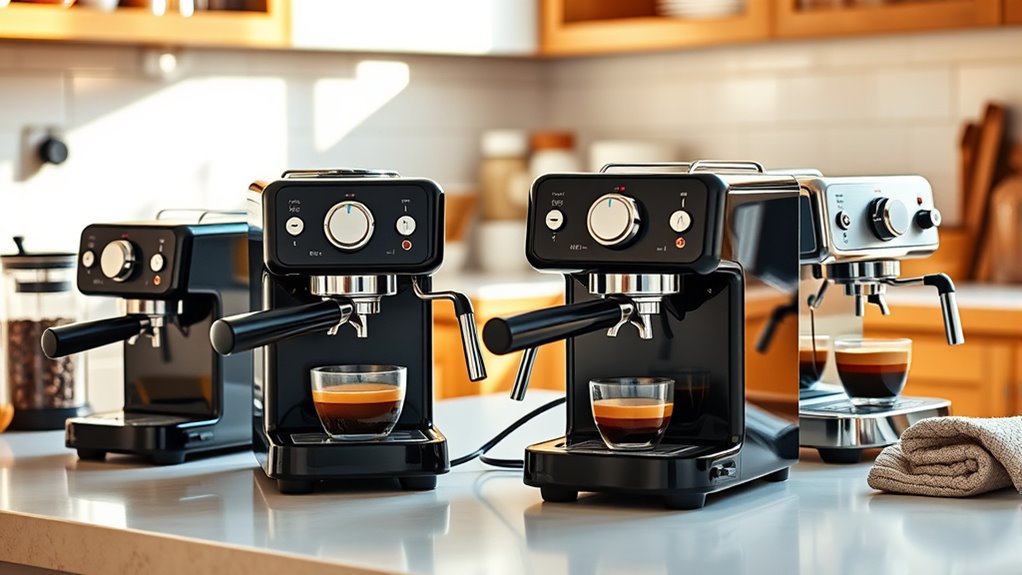
For a budget espresso machine under $300, I’d start with the Breville Bambino for its more espresso-focused design, then compare it with the De’Longhi Stilosa for hands-on value and the Casabrews CM5418 for a compact setup with a steam wand. The main tradeoff is between simpler, lower-cost steam machines and more capable semi-automatic models that demand better technique and accessories. Some options also prioritize a small footprint or multiple-cup brewing over espresso-style control. Read on for all 14 picks, what separates them, and which type of machine fits your coffee routine.

Get kitchen gear delivered free with Prime
- Fast, free delivery on millions of items
- Prime Video, Amazon Music and more included
- Member-only deals all year
Complete the kit


Key Takeaways
- The Breville Bambino is the lineup’s performance-focused pick: it stands apart from the many compact entry-level machines, but its more hands-on workflow may not suit buyers who want a simple one-button routine.
- The De’Longhi Stilosa and Casabrews CM5418 fill different value roles: the Stilosa favors manual control, while the CM5418 pairs a compact body with a steam wand.
- Steam-driven models trade control for simplicity: the IMUSA, Mr. Coffee, and HBN are oriented toward straightforward multi-cup or entry-level brewing rather than fine espresso adjustments.
- A built-in grinder changes the buying equation: the grinder-equipped option can reduce the need for a separate grinder, but adds complexity compared with the simpler machines.
- Compact design is a recurring strength, not a guarantee of easier use: slim machines save counter space, while water-tank access, cleanup, and milk-frothing workflow still affect everyday convenience.




| budget espresso machine under 300 | Dimensions | Wattage | Weight | Operation mode |
|---|---|---|---|---|
| XIXUBX Compact Espresso Machin | 11.4 x 6.7 x 11.8 inches | 1100 watts | 7 pounds | Semi-automatic |
| Casabrews CM5418 Compact Espre | — | 1350 watts | — | Semi-automatic |
| IMUSA 4-Cup Electric Espresso | 7.48 x 9.05 x 11.02 inches | 800 watts | 4.8 pounds | Semi-automatic |
| CASABREWS 3700 Essential Stain | — | 1350 watts | — | Semi-automatic |
| Newbulig Compact Espresso Coff | 11.73 x 6.02 x 11.22 inches | 1350 watts | 6 pounds | — |
| Mr. Coffee 4-Shot Steam Espres | 11.2 x 11.2 x 15 inches | 1200 watts | — | — |
| CHULUX Slim Espresso Machine w | — | 1350 watts in description; 1400 watts in specifications | — | — |
| Breville BES450BSS Bambino Esp | 13.7 x 6.3 x 12 inches | — | 10.9 pounds | — |
| HBN Espresso Machine | 12.91 x 7.28 x 13.58 inches | — | 4.1 pounds | — |
| AERCANA 20-Bar Compact Espress | 12.2 x 5.32 x 11.5 inches | 1450 watts | — | — |
| Chefman CraftBrew Semi-Automat | 10.8 × 8.9 × 11.9 inches (D × W × H) | — | — | Semi-automatic |
| De’Longhi Stilosa Compact Manu | — | — | 8.6 pounds | Manual |
| Espresso Machine with Grinder | 11.6 × 9 × 14 inches (L × W × H) | — | 15 pounds | — |
| XIXUBX Compact Espresso Machin | 11.4 × 6.7 × 11.8 inches | — | 7 pounds | Semi-automatic |
More Details on Our Top Picks
XIXUBX Compact Espresso Machine with Milk Frother, White
Among these compact machines, the XIXUBX stands out for brewing control: PID temperature regulation and pre-infusion are designed to support steadier extraction, giving hands-on coffee makers more to work with than the simpler IMUSA 4-Cup Electric Espresso and Cappuccino Maker. Its steam wand and included stainless steel pitcher also make milk drinks possible without adding a separate frothing tool. At 11.4 inches wide, it suits a small counter, and the removable 34-ounce tank helps with refills. The tradeoff is that this is still a semi-automatic machine for ground coffee: grind size and tamping affect the result, and it does not remove the learning curve. I’d choose it over the CASABREWS 3700 when temperature features matter more than a larger tank.
Pros:- PID temperature control and pre-infusion support more consistent brewing.
- Steam wand and included stainless steel pitcher support making milk drinks.
- Compact 6.7-inch width fits tighter counters.
- Removable 34-ounce water tank simplifies filling.
Cons:- Semi-automatic brewing requires user input, including appropriate grinding and tamping.
- No built-in grinder, so coffee preparation depends on separate equipment or suitable pre-ground coffee.
Best for: Home espresso beginners who want a compact machine with temperature-control features and plan to learn grinding and tamping.
Not ideal for: Buyers who want one-touch coffee or need an integrated grinder, since this machine requires ground coffee and hands-on preparation.
- Operation mode:Semi-automatic
- Pressure:20 bar
- Wattage:1100 watts
- Water capacity:34 fluid ounces
- Dimensions:11.4 x 6.7 x 11.8 inches
- Weight:7 pounds
- Special features:PID temperature control, pre-infusion, milk frother, removable tank, auto shut-off
- Included accessory:Stainless steel milk frothing pitcher
Our verdict“Choose the XIXUBX if you want compact size and added brewing controls, and are willing to handle the espresso preparation yourself.”
Casabrews CM5418 Compact Espresso Machine with Milk Frothing Steam Wand
The CM5418’s built-in pressure gauge gives this compact Casabrews a clear distinction from the CASABREWS 3700, which has a similar 20-bar rating and 1350-watt heating system but no gauge listed. That readout can help a curious home brewer monitor the brewing process, while the steam wand supports milk frothing for cappuccinos and lattes. Its 34-ounce tank and brushed stainless steel body suit a small kitchen or office setup. The compromise is a workflow that asks for patience: the machine may need to cool after steaming before brewing, and its overheating protection can call for a manual reset. Like the XIXUBX, it has no built-in grinder, but it offers a gauge rather than the XIXUBX’s stated PID temperature control and pre-infusion.
Pros:- Built-in pressure gauge offers a way to monitor extraction.
- 1350-watt heating system and steam wand support espresso and milk drinks.
- Compact brushed stainless steel design suits kitchens and offices.
- 34-ounce water tank provides a useful supply for everyday brewing.
Cons:- May need to cool after frothing before it can brew, slowing drink preparation.
- Overheating protection may trigger flashing lights and require a manual reset.
- No built-in grinder; coffee must be supplied separately.
Best for: Hands-on espresso drinkers in small kitchens or offices who want a pressure gauge and are comfortable using separate coffee-grinding equipment.
Not ideal for: People who need quick back-to-back milk drinks or a low-intervention setup, because cooling delays and possible manual resets can interrupt preparation.
- Operation mode:Semi-automatic
- Pressure:20 bar
- Wattage:1350 watts
- Water tank capacity:34 ounces
- Material:Brushed stainless steel
- Built-in feature:Pressure gauge
- Milk frothing:Steam wand
Our verdict“Pick the CM5418 if a pressure gauge matters more to you than uninterrupted milk-drink preparation or built-in grinding.”
IMUSA 4-Cup Electric Espresso and Cappuccino Maker
The IMUSA takes a different approach from the 20-bar machines here: its four-cup capacity and glass carafe make it better suited to pouring several small servings at once than dialing in individual espresso shots. That shared-batch format is a practical distinction from the XIXUBX Compact Espresso Machine, which emphasizes temperature control and pre-infusion for more hands-on brewing. The IMUSA keeps cleanup straightforward with a permanent filter and removable drip tray, and its steam nozzle can froth milk for cappuccinos or lattes. The main tradeoff is its 5-bar pressure rating, well below the 20-bar figures listed for the Casabrews CM5418 and CASABREWS 3700. Its plastic exterior also feels less substantial than those stainless steel alternatives. I’d favor it for simple, shared servings rather than espresso experimentation.
Pros:- Brews up to four servings into a glass carafe.
- Steam nozzle can froth milk for cappuccinos and lattes.
- Permanent filter avoids disposable filters.
- Removable drip tray supports easier cleanup, and the carafe has a cool-touch handle.
Cons:- 5-bar pressure is lower than the 20-bar ratings listed for the Casabrews CM5418 and CASABREWS 3700.
- Plastic exterior is less substantial than the brushed stainless steel alternatives.
- Carafe-style batch brewing offers less of an individual-shot workflow.
Best for: Households or office break areas that want to pour several small coffee servings from one brew and value a simple carafe format.
Not ideal for: Espresso hobbyists seeking the higher-pressure specifications, more extraction controls, or stainless steel construction offered by the Casabrews models.
- Capacity:Up to 4 cups
- Pressure:5 bar
- Wattage:800 watts
- Operation mode:Semi-automatic
- Filter type:Permanent
- Dimensions:7.48 x 9.05 x 11.02 inches
- Weight:4.8 pounds
- Materials:Plastic exterior and glass carafe
Our verdict“Choose the IMUSA for convenient small-batch servings, not for the more adjustable espresso workflow of the 20-bar machines.”
CASABREWS 3700 Essential Stainless Steel Espresso Machine with Steam Wand
Among the semi-automatic options in this batch, the CASABREWS 3700 has the largest stated tank at 43.9 ounces, compared with 34 ounces on the CM5418 and XIXUBX. That extra capacity can mean fewer refills during a day of making drinks. It also pairs a 1350-watt heating system and steam wand with one-cup and two-cup filters, a portafilter, and a tamper with spoon, giving new owners basic brewing accessories in the box. The stainless steel housing keeps the machine compact for a counter or office. Unlike the CM5418, though, it has no pressure gauge to monitor extraction; like that model, it also lacks a grinder. I’d rank it ahead for tank capacity and included accessories, not for added brewing feedback.
Pros:- 43.9-ounce removable tank is larger than the 34-ounce tanks on the XIXUBX and CM5418.
- 1350-watt heating system and steam wand support espresso and milk drinks.
- Includes one-cup and two-cup filters, portafilter, and tamper with spoon.
- Brushed stainless steel housing has a compact footprint.
Cons:- No built-in pressure gauge for monitoring extraction.
- No integrated grinder, so coffee must be prepared separately.
- Semi-automatic operation still requires hands-on preparation.
Best for: Frequent home coffee makers who want a compact stainless steel machine, a larger tank, and basic espresso accessories included.
Not ideal for: Buyers who want a pressure gauge to monitor extraction or an integrated grinder; the CM5418 provides a gauge, while neither machine includes a grinder.
- Operation mode:Semi-automatic
- Pressure:20 bar
- Wattage:1350 watts
- Voltage:120 volts
- Water tank capacity:43.9 ounces
- Filter types:Stainless steel one-cup and two-cup filters; double-shot portafilter
- Material:Brushed stainless steel
- Included accessories:Portafilter, tamper with spoon, instruction manual
Our verdict“The CASABREWS 3700 is the better fit if you value fewer tank refills and included accessories over a pressure gauge.”
Newbulig Compact Espresso Coffee Machine, 20 Bar, Steam Wand
The Newbulig is the speed-focused choice in this group: its stated 30-second heat-up time aims to shorten the wait before brewing, while a built-in pressure gauge and adjustable extraction times offer more user feedback than the CASABREWS 3700. Its 1350-watt system and steam wand also cover the basics for espresso and milk drinks in a narrow 6.02-inch-wide body. Compared with the XIXUBX, it lists a gauge and extraction-time adjustment rather than PID temperature control and pre-infusion, so the appeal is quicker readiness and direct monitoring, not the same set of temperature features. The 34-ounce tank may need regular refills, and the product information notes plastic components, which may feel less substantial than the CASABREWS 3700’s brushed stainless steel housing. It also requires ground coffee.
Pros:- Stated 30-second heat-up time supports quicker preparation.
- Built-in pressure gauge and adjustable extraction times provide brewing feedback.
- 1350-watt system and steam wand support espresso and milk drinks.
- Compact dimensions and 6-pound listed weight suit smaller setups.
Cons:- 34-ounce tank may need frequent refilling when making several drinks.
- Plastic components may feel less substantial than the CASABREWS 3700’s brushed stainless steel housing.
- No built-in grinder; it uses ground coffee.
Best for: Busy home brewers who want a compact machine that heats quickly and offers a pressure gauge and adjustable extraction times.
Not ideal for: Buyers who prioritize a larger tank, an integrated grinder, or a fully metal build over quick warm-up and compact dimensions.
- Model:AH-KFJ52YS-02SR
- Output pressure:20 bar
- Wattage:1350 watts
- Voltage:120 volts
- Water tank capacity:34 ounces
- Dimensions:11.73 x 6.02 x 11.22 inches
- Weight:6 pounds
- Coffee input:Ground coffee
- Stated heat-up time:About 30 seconds
Our verdict“Choose the Newbulig if quick warm-up and a pressure gauge matter more than tank capacity or a fully metal construction.”
Mr. Coffee 4-Shot Steam Espresso Maker with Stainless Steel Frothing Pitcher
The Mr. Coffee stands out among these budget options for its four-shot batch capacity and included stainless steel frothing pitcher. That makes it a practical fit when I want to prepare several small drinks in one go, rather than pull individual servings as with the Breville Bambino. Its marked water pitcher and measuring scoop also give beginners a straightforward way to portion water and coffee without extra accessories.
The tradeoff is its steam-brewing method: it is not a pump-based espresso machine, so buyers seeking the extraction control and consistency associated with pump models such as the CHULUX Slim should look elsewhere. It is best treated as a simple, batch-oriented way to make espresso-style drinks, not as a substitute for a more controllable espresso setup.
Pros:- Brews up to four shots in one batch.
- Includes an integrated frothing wand and stainless steel pitcher.
- Marked water pitcher supports repeatable measuring.
- Measuring scoop is included for ground coffee.
Cons:- Steam brewing differs from pump-based espresso extraction.
- Its 15-inch height may be awkward beneath low cabinets.
- The supplied specs do not state a water-tank capacity.
Best for: Households or hosts who want to prepare up to four shots together and make milk drinks with the included pitcher.
Not ideal for: Espresso hobbyists who want pump-based extraction, finer control, or a closer path to dialing in espresso.
- Type:Semi-automatic steam espresso machine
- Brew capacity:Up to 4 shots
- Wattage:1200 watts
- Voltage:240 volts
- Dimensions:11.2 x 11.2 x 15 inches
- Materials:Metal, plastic, and stainless steel
- Included components:Frothing wand, water pitcher, measuring scoop, and stainless steel frothing pitcher
Our verdict“Choose the Mr. Coffee if batch capacity and included milk-frothing accessories matter more than pump-style espresso extraction.”
CHULUX Slim Espresso Machine with Milk Frother for Home Cappuccino, Creamy
At just 5.5 inches wide, the CHULUX is the clearest space-saving choice in this group, while its pump, pressure gauge, and pre-infusion give it more extraction-focused features than the steam-brewing Mr. Coffee. Its 40-ounce water tank also means fewer interruptions than the HBN’s 240 ml capacity. A steam wand adds flexibility for cappuccinos and lattes, and the machine is described as simple to operate with ground coffee.
Those features do not make it the best fit for everyone. Its stated power differs across the supplied listing—1350 watts in the description and 1400 watts in the specs—and pressure figures alone do not guarantee better espresso. Compared with the Breville Bambino, the CHULUX offers a gauge and pre-infusion, but the provided details do not list an automatic steam wand or the Bambino’s stated PID temperature control. I’d choose it for its narrow footprint and manual features, not assume it matches a more established temperature-control setup.
Pros:- Narrow 5.5-inch width saves counter space.
- Pressure gauge and pre-infusion provide useful extraction feedback and a more even start.
- 40-ounce water tank reduces refill frequency.
- Includes a steam wand and 25-minute inactivity shut-off.
Cons:- Product details list two different wattage figures: 1350 and 1400 watts.
- Manual milk steaming requires more involvement than the Breville Bambino’s automatic wand.
- The supplied product data does not specify dimensions beyond its width.
Best for: Apartment or office users who need a very narrow machine with a pressure gauge, pre-infusion, and a steam wand.
Not ideal for: Buyers who want a clearly specified, automatic milk-steaming workflow or need consistent, unambiguous power specifications before choosing.
- Pump pressure:20 bar
- Wattage:1350 watts in description; 1400 watts in specifications
- Voltage:120 volts
- Water tank:40 ounces
- Width:5.5 inches
- Coffee input:Ground coffee
- Features:Pressure gauge, pre-infusion, steam wand, and 25-minute inactivity auto shut-off
Our verdict“Pick the CHULUX if a narrow footprint and hands-on pump features matter more than the Bambino’s automatic steaming and stated PID control.”
Breville BES450BSS Bambino Espresso Machine, Brushed Stainless Steel
The Bambino earns its place for buyers who want a compact machine with three-second heat-up, PID temperature control, and an automatic steam wand. Those features reduce waiting and make milk texture less dependent on manual technique than on the CHULUX Slim or AERCANA, both of which are described with manual steam wands. Its 54 mm portafilter and included one- and two-cup baskets also give buyers a more conventional espresso workflow than the batch-oriented Mr. Coffee.
The main compromise is what it leaves out: there is no built-in grinder, so fresh-bean use requires another purchase, and its 47-ounce tank may need attention during heavier use. Compared with the AERCANA, the Bambino has less water capacity but offers automatic steaming and stated PID control. I’d favor it when repeatable milk drinks and speed matter more than minimizing the number of separate tools.
Pros:- ThermoJet system reaches extraction temperature in three seconds.
- Automatic steam wand simplifies producing microfoam.
- PID temperature control supports more consistent extraction.
- Compact 6.3-inch width suits smaller counters.
Cons:- No built-in grinder, so whole-bean coffee requires separate equipment.
- The 47-ounce tank can require refilling during frequent use.
- Automatic milk steaming offers less hands-on control for users who prefer manual technique.
Best for: New home espresso makers who want fast warm-up and easier milk texturing, and are willing to use a separate grinder or pre-ground coffee.
Not ideal for: Buyers seeking an all-in-one machine with a built-in grinder or a larger reservoir for frequent back-to-back drinks.
- Power:1560 watts
- Voltage:110–120 volts
- Dimensions:13.7 x 6.3 x 12 inches
- Weight:10.9 pounds
- Water capacity:47 fluid ounces
- Heating system:ThermoJet; stated three-second heat-up
- Portafilter:54 mm
- Included accessories:One- and two-cup filter baskets, milk jug, portafilter, tamper, steam wand tip cleaning tool, and descaling powder
Our verdict“Choose the Bambino if speed and easier milk steaming outweigh the cost and counter space of a separate grinder.”
HBN Espresso Machine, 3.5 Bar Cappuccino & Latte Maker, 2–4 Cup Stainless Steel Coffee Machine with Milk Frother
The HBN is the straightforward pick for someone who values one-knob operation over a more involved espresso workflow. Its 240 ml capacity is listed for two to four cups, and the removable drip tray and water-level gauge carafe keep the basic routine simple. Compared with the Mr. Coffee, which also favors multiple servings but uses steam brewing, the HBN specifies 3.5-bar pressure and a built-in steam wand. That makes it a compact, uncomplicated option for occasional espresso-style drinks and milk beverages.
Its limitations are more pronounced than those of the CHULUX or Bambino: the small capacity restricts back-to-back servings, while the low stated pressure and lack of programmable controls point away from buyers seeking a more adjustable espresso setup. The product description calls its system “high-pressure,” but the listed figure is 3.5 bar; I’d judge it by that stated specification rather than the marketing wording. Choose it for simplicity, not advanced extraction control.
Pros:- One-knob operation keeps the brewing routine simple.
- Compact stainless-steel design suits home or office counters.
- Removable, washable drip tray simplifies cleanup.
- Built-in steam wand supports milk drinks.
Cons:- 240 ml capacity limits the number of servings before refilling.
- Listed output pressure is 3.5 bar, below the 20-bar figures listed for the CHULUX and AERCANA.
- No built-in grinder, programmable timer, or cup-warming plate.
Best for: Occasional coffee drinkers in a small home or office who want simple controls and a few ground-coffee servings at a time.
Not ideal for: Daily multi-drink households or espresso-focused buyers who want a larger reservoir, pump pressure closer to the CHULUX, or programmable functions.
- Power:800 watts
- Voltage:120 volts
- Output pressure:3.5 bar
- Capacity:240 ml; listed as 2–4 cups
- Dimensions:12.91 x 7.28 x 13.58 inches
- Weight:4.1 pounds
- Coffee input:Ground coffee
- Operation and cleanup:Semi-automatic; one-knob control; removable, washable drip tray
Our verdict“Choose the HBN for occasional, simple coffee-making, but pick the CHULUX or AERCANA for more pump pressure and a larger stated water supply.”
AERCANA 20-Bar Compact Espresso Machine with Milk Frother, Stainless Steel, 34 oz Removable Water Tank – Silver
The AERCANA packs several useful details into a body just 5.32 inches wide: a visible pressure gauge, removable 34-ounce tank, cup warmer, hot-water dispenser, and a 1450-watt heater described as ready in about 20 seconds. Against the CHULUX Slim, it offers more listed convenience features, including a cup warmer and hot water; against the HBN, its one-liter tank is far less restrictive than 240 ml. A steam wand adds the option of making milk drinks without relying on an automatic system.
The tradeoff is that buyers still need their own grinder, and the supplied details do not describe temperature control or pre-infusion, features listed for the CHULUX and Bambino. The 20-bar rating is a specification, not a guarantee of better coffee by itself. I’d choose this model for compact dimensions and useful built-ins, while favoring the Bambino for automatic milk texturing or the CHULUX for stated pre-infusion.
Pros:- 5.32-inch width leaves room on crowded counters.
- Removable 34-ounce tank is larger than the HBN’s 240 ml capacity.
- Includes a pressure gauge, cup warmer, and hot-water dispenser.
- 1450-watt system is described as reaching brewing temperature in about 20 seconds.
Cons:- No built-in grinder.
- Manual steam wand requires practice for controlled milk texture.
- Supplied details do not list PID temperature control or pre-infusion.
Best for: Small-kitchen buyers who want a narrow pump machine with a removable tank, pressure gauge, cup warmer, and hot-water function.
Not ideal for: People seeking a built-in grinder, automatic milk texturing, or clearly specified temperature-control features.
- Pressure:20 bar
- Wattage:1450 watts
- Water tank capacity:1 liter (34 ounces), removable
- Dimensions:12.2 x 5.32 x 11.5 inches
- Type:Semi-automatic espresso machine
- Heating time:About 20 seconds, according to the product description
- Additional functions:Auto shut-off, cup warmer, and hot-water dispenser
- Milk frother:Included steam wand
Our verdict“Pick the AERCANA if you want a narrow machine with several built-in conveniences, but choose the Bambino for automatic milk steaming or the CHULUX for pre-infusion.”
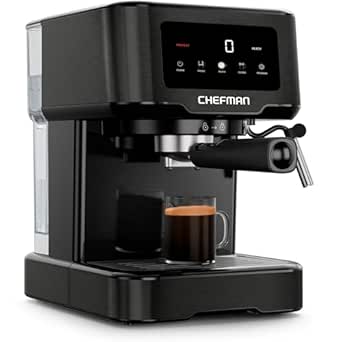
Chefman CraftBrew Semi-Automatic Espresso Machine with Steam Wand
The Chefman CraftBrew suits buyers who want espresso and milk drinks without a large machine or a built-in grinder. Its touch controls and adjustable shot volume make it easier to set a repeatable single or double shot than a fully manual approach like the De’Longhi Stilosa. The removable 1.5-liter tank also offers more capacity than the Stilosa’s 1-liter reservoir, which means fewer refills during a busy morning.
That convenience still comes with hands-on steps: you supply ground coffee, froth milk yourself, and handle descaling when the alert appears. The automatic reminder after 500 brewing cycles helps flag maintenance, but it does not do the cleaning. Compared with the XIXUBX, the Chefman emphasizes a larger tank and touch-based shot adjustment rather than a particularly narrow footprint or listed PID temperature control. Choose it for straightforward controls and milk-drink flexibility; skip it if you want whole-bean grinding built in.
Pros:- Adjustable shot volume supports more control over single and double servings.
- Built-in steam wand lets you make cappuccinos and lattes without a separate frother.
- Removable 1.5-liter tank holds more water than the De’Longhi Stilosa’s 1-liter tank.
- Touch control panel and cycle-based descaling alert make routine operation and maintenance reminders straightforward.
Cons:- Ground coffee only, with no integrated grinder for whole beans.
- Descaling remains a manual task even after the machine prompts you.
- Manual milk frothing takes practice and adds steps to each milk-based drink.
Best for: Home coffee drinkers who use pre-ground coffee, want touch controls and adjustable shots, and make milk drinks often enough to value an included steam wand.
Not ideal for: Buyers who want fresh grinding in one appliance or automatic descaling; this machine takes ground coffee and requires manual cleaning after its descaling alert.
- Operation mode:Semi-automatic
- Pump pressure:15 bar
- Power:1350 watts
- Water tank:1.5 liters, removable
- Coffee input:Ground coffee
- Controls:Touch control panel
- Dimensions:10.8 × 8.9 × 11.9 inches (D × W × H)
- Warranty:1-year assurance
Our verdict“Choose the Chefman for touch-operated shot adjustment and a larger removable tank, but look elsewhere if you want whole-bean grinding or automated maintenance.”
De’Longhi Stilosa Compact Manual Espresso Machine with Milk Frother
The De’Longhi Stilosa is the pick for buyers who want a straightforward manual machine and are willing to learn the routine. It brews single or double shots from ground coffee, and the included filters and measuring scoop provide a useful starting kit. Its two-level cup holder accommodates taller cups, while the manual wand lets you froth milk rather than relying on a separate appliance.
Compared with the Chefman CraftBrew, the Stilosa has a smaller 1-liter tank and fewer listed convenience controls, so it makes more sense for a simpler setup than for frequent back-to-back drinks. In return, the stainless steel boiler and compact, relatively light body offer a less feature-heavy alternative to the Spacekey grinder machine. The tradeoff is time and technique: dosing, brewing, and milk frothing all require hands-on work, and there is no built-in grinder. Buyers seeking press-button convenience should choose the Chefman instead.
Pros:- Includes single- and double-shot filters plus a measuring scoop to get started.
- Manual steam wand can froth milk for cappuccinos and lattes.
- Two-level cup holder accommodates taller cups.
- Compact 8.6-pound design is easier to move than the 15-pound Spacekey.
Cons:- Manual dosing, brewing, and milk frothing require practice and attention.
- The 1-liter tank is smaller than the Chefman CraftBrew’s 1.5-liter reservoir.
- No built-in grinder is listed, so whole-bean users need separate equipment.
Best for: New espresso hobbyists who want to learn manual shot preparation with ground coffee, included filters, and a milk wand in a compact machine.
Not ideal for: People who want quick, repeatable drinks with minimal preparation, a larger water reservoir, or a grinder built into the machine.
- Model:EC260BK
- Operation mode:Manual
- Pump pressure:15 bar
- Power:1100 watts
- Water tank:1000 ml
- Weight:8.6 pounds
- Coffee input:Ground coffee
- Included components:Double-shot filter, single-shot filter, measuring scoop
Our verdict“Pick the Stilosa if learning a hands-on espresso routine matters more than touch controls, a larger tank, or built-in grinding.”
Espresso Machine with Grinder and Frother, 30 Grind Settings, 20 Bar
The Spacekey stands apart from the ground-coffee machines in this group by combining a conical burr grinder with espresso brewing. Its 30 grind settings give buyers room to adjust the grounds without purchasing a separate grinder, while PID temperature control and an LCD display add control and feedback. That makes it the most feature-packed route here for someone who wants to work with whole beans; the De’Longhi Stilosa and XIXUBX both require ground coffee.
The added functions come with a real learning curve. Grind choice, extraction, and milk frothing ask more of a beginner than the simpler Chefman CraftBrew, and the 15-pound body is heavier than the compact, lighter options. Its 1.8-liter removable tank and listed cold brew function broaden its use, but this is not the simplest choice for a quick morning shot. Pick it if a grinder and adjustment range justify extra setup; skip it if simplicity or easy moving matters more.
Pros:- Integrated conical burr grinder with 30 settings removes the need for a separate grinder.
- Accepts whole beans or ground coffee, offering more flexibility than the Stilosa and XIXUBX.
- PID temperature control and an LCD display provide added control and operating feedback.
- Removable 1.8-liter tank and listed cold brew function expand its everyday drink options.
Cons:- Multiple settings and functions create a steeper learning curve than the Chefman CraftBrew.
- At 15 pounds, it is heavier than the Stilosa and the 7-pound XIXUBX.
- The larger feature set may be unnecessary for buyers who use pre-ground coffee and want basic shots.
Best for: Whole-bean espresso drinkers who want an integrated grinder, multiple grind settings, and temperature control without buying a separate grinder.
Not ideal for: Beginners seeking a simple, low-effort machine or buyers who need a particularly light appliance to move around a small counter.
- Grinder:Conical burr
- Grind settings:30
- Pressure:20 bar
- Temperature control:PID
- Water tank:61 oz (1.8 L), removable
- Coffee input:Whole beans or ground coffee
- Display:LCD digital display
- Dimensions:11.6 × 9 × 14 inches (L × W × H)
- Weight:15 pounds
Our verdict“Choose the Spacekey if an integrated burr grinder and broad adjustment range matter more than a simpler routine or lighter machine.”
XIXUBX Compact Espresso Machine with Milk Frother
With a listed width of just 6.7 inches and a weight of 7 pounds, the XIXUBX is the clearest fit for a narrow counter, small office, or coffee station that needs to stay easy to rearrange. It includes PID temperature control and pre-infusion, along with single- and double-shot options, so its compact footprint does not mean giving up those listed brewing features. The stainless steel frothing pitcher is a practical extra for buyers planning to make milk drinks.
Compared with the Spacekey, the XIXUBX takes up less counter width and weighs much less, but it does not include a grinder or the Spacekey’s 30 grind settings. Its 34-ounce tank is also far smaller than the Spacekey’s 61-ounce reservoir, which means more frequent refills. Milk frothing is manual, as it is on the Chefman CraftBrew. Choose this model when space and portability take priority; skip it if you want whole-bean grinding or make many drinks between refills.
Pros:- Narrow 6.7-inch width and 7-pound weight suit tight counters and easier repositioning.
- PID temperature control and pre-infusion are included for a more controlled brewing setup.
- Single- and double-shot options cover common serving sizes.
- Includes a stainless steel milk-frothing pitcher.
Cons:- Ground coffee only, unlike the Spacekey’s whole-bean and ground-coffee options.
- The 34-ounce tank needs more frequent refilling than the Spacekey’s 61-ounce tank.
- Milk must be frothed manually, adding practice and preparation to milk-based drinks.
Best for: Apartment dwellers, office users, and buyers with narrow counters who want espresso and milk frothing in a light, compact machine.
Not ideal for: Households making several drinks in a row or whole-bean coffee fans who want a built-in grinder and larger water capacity.
- Operation mode:Semi-automatic
- Pressure:20 bar
- Power:1100 watts
- Water capacity:34 fluid ounces
- Coffee input:Ground coffee
- Brewing features:PID temperature control and pre-infusion
- Dimensions:11.4 × 6.7 × 11.8 inches
- Weight:7 pounds
- Included accessory:Stainless steel milk-frothing pitcher
Our verdict“Choose the XIXUBX for a narrow, lightweight espresso setup with PID control, but favor the Spacekey for built-in grinding and longer stretches between refills.”
How We Picked
I compared these 14 machines on the factors that matter most when shopping for a budget espresso setup: brewing approach, control, milk-frothing capability, footprint, and day-to-day upkeep. I also looked at whether each model’s design suits a particular routine, such as making several servings, learning manual espresso preparation, or fitting a machine into a small kitchen. A high-pressure figure alone did not determine placement; it matters less to a buyer than a useful workflow and a realistic match for their expectations.
The ranking gives more weight to espresso-oriented capability and practical usability, then accounts for value and fit. That puts the Bambino ahead for buyers seeking a more capable semi-automatic experience, while the Stilosa and CM5418 stand out for different combinations of hands-on control and compact convenience. Steam-driven and very simple machines remain relevant for low-fuss or multi-cup use, but rank lower for buyers seeking control over espresso preparation. Without verified comparative test results or current price data, the picks are framed by product design and intended use rather than claims about measured performance or price.
| budget espresso machine under 300 | Operation mode | Coffee input |
|---|---|---|
| XIXUBX Compact Espresso Machin | Semi-automatic | — |
| Casabrews CM5418 Compact Espre | Semi-automatic | — |
| IMUSA 4-Cup Electric Espresso | Semi-automatic | — |
| CASABREWS 3700 Essential Stain | Semi-automatic | — |
| Newbulig Compact Espresso Coff | — | Ground coffee |
| Mr. Coffee 4-Shot Steam Espres | — | — |
| CHULUX Slim Espresso Machine w | — | Ground coffee |
| Breville BES450BSS Bambino Esp | — | — |
| HBN Espresso Machine | — | Ground coffee |
| AERCANA 20-Bar Compact Espress | — | — |
| Chefman CraftBrew Semi-Automat | Semi-automatic | Ground coffee |
| De’Longhi Stilosa Compact Manu | Manual | Ground coffee |
| Espresso Machine with Grinder | — | Whole beans or ground coffee |
| XIXUBX Compact Espresso Machin | Semi-automatic | Ground coffee |
Factors to Consider When Choosing Budget Espresso Machine Under 300
A low-cost espresso setup is a system, not just a machine. Before choosing, decide what kind of coffee you want to make, how much control you want, and whether you already own a grinder and milk pitcher. These broader tradeoffs can matter more to your daily results than a headline pressure number or a long feature list.
Choose the brewing style before comparing features
Budget machines do not all make coffee in the same way, even when their product pages use the word espresso. Steam-driven designs tend to keep the process simple and may suit buyers who mainly want a strong coffee base for milk drinks. Semi-automatic machines give you more influence over preparation, but that control works best when you are willing to learn dosing, tamping, and timing. A common mistake is buying the most feature-rich model without deciding whether you want a repeatable routine or a hands-on hobby. Pick the brewing style that matches your patience on an ordinary morning, not just your interest in experimenting once.
Plan for the grinder and the coffee you will use
Freshly ground coffee and a suitable grind can shape the cup as much as the machine itself. If you already own a grinder, check whether it can produce a consistent fine grind; a grinder designed mainly for drip coffee may not offer enough adjustment. A machine with an integrated grinder can simplify the setup, but it also adds parts to clean and another point of adjustment. Buyers who prefer pre-ground coffee should confirm the machine’s basket and instructions support that workflow rather than assuming every model does. Compare the total setup you need, not only the appliance in the box.
Treat milk frothing as a separate skill
A steam wand makes milk drinks possible, but it does not make frothing automatic. Wand position, milk quantity, and the size of the pitcher affect the texture, so beginners may need practice before getting consistent foam. If you mainly drink straight espresso or Americanos, a wand may add cleaning without adding much value. If cappuccinos and lattes are the point, check that the wand’s placement leaves enough room for a pitcher and that you can clean it promptly after use. Do not choose a machine solely because its listing promises a milk frother; think about whether you want to learn the routine.
Measure the whole workflow, not just the machine
A compact body can save counter space, but the machine still needs room for a cup, a portafilter, and access to its water tank. Measure under cabinets and account for the space needed to remove and refill the tank. Also consider where grounds will go and whether the drip tray is easy to reach. Small-capacity designs can be convenient for occasional drinks but may call for more frequent refills when serving several people. A quick check of your counter and usual serving size can prevent a space-saving purchase from becoming awkward to use.
Budget for accessories and routine maintenance
The purchase price is only one part of an espresso setup. A tamper, milk pitcher, grinder, and suitable cups may be needed depending on what the machine includes and what you already own. Reusable components can reduce ongoing waste, but they still need regular rinsing and periodic cleaning to keep old coffee and milk from building up. Before choosing, look for clear instructions on cleaning the brew path, steam wand, and removable parts. Paying more for a machine makes sense when its workflow or controls match your habits; it is less persuasive if you would still need to replace most of your setup.
Frequently Asked Questions
Can a budget espresso machine make coffee-shop-style espresso?
It can make satisfying espresso-style drinks, but results depend on the machine, coffee, grind, and technique working together. More hands-on semi-automatic models offer control, while simpler steam-driven machines prioritize ease over fine adjustment. A grinder that can produce a consistent fine grind often matters more than a prominent pressure claim. If your goal is repeatable café-style shots, expect a learning curve and allow room for a suitable grinder. If you mainly want milk drinks, a forgiving workflow may matter more than dialing in every shot.
Should I choose a steam-driven model or a semi-automatic machine?
Choose based on how involved you want to be. Steam-driven machines tend to suit buyers who value a simple routine and do not need much control over extraction. Semi-automatic machines ask more of you but give greater influence over preparation, which can appeal to someone willing to practice. Neither style is automatically better for every household. Think about how often you will make coffee, whether you enjoy adjusting a recipe, and whether other people need to use the machine without instruction.
Is a machine with a built-in grinder a better first purchase?
It can make setup more convenient if you do not already own a capable grinder, since grinding and brewing happen in one appliance. The tradeoff is added complexity: grinder settings, cleaning, and maintenance become part of the routine. A separate grinder gives you more flexibility to upgrade or use it for other brewing methods, but takes extra counter space and adds another purchase. Compare the integrated option with the cost and footprint of a separate grinder, then choose the arrangement you are most likely to maintain.
What should I prioritize if I mostly make lattes and cappuccinos?
Give the steam wand and its everyday usability more weight than features aimed at espresso-only preparation. Check whether you can position a pitcher comfortably, reach the wand for cleaning, and make enough milk for your usual drink. A wand still takes practice; a machine with one does not remove the need to learn how to texture milk. If you make several drinks back to back, tank capacity and the time needed between brewing and steaming can affect convenience. For occasional milk drinks, a simpler machine may be a better fit than paying for controls you will rarely use.
Is it worth choosing the Bambino over a simpler compact model?
The Bambino makes more sense if you want a more espresso-focused machine and are prepared to take an active role in preparation. A simpler compact model may fit better if your priority is a straightforward routine, limited counter space, or occasional milk drinks. The difference is not just the machine’s footprint; it is the amount of attention you want to give each shot. Also account for the grinder and accessories your chosen setup requires. Choose the Bambino for the more involved path, not just because it sits above basic models in a roundup.
Conclusion
For the strongest all-around fit in this group, I’d choose the Breville Bambino if you want a more espresso-focused, hands-on machine. For best value, the De’Longhi Stilosa is a sensible pick for buyers who want manual control without stepping into a more involved setup; the Casabrews CM5418 is a good alternative when compact size and a steam wand matter more. For beginners who favor simplicity, compare the IMUSA or Mr. Coffee steam-driven designs with your needs for serving size and milk drinks. The grinder-equipped machine is the specific-use choice if reducing separate equipment matters more than keeping the setup simple. My short version: choose for the routine you will actually follow, not the longest list of features.