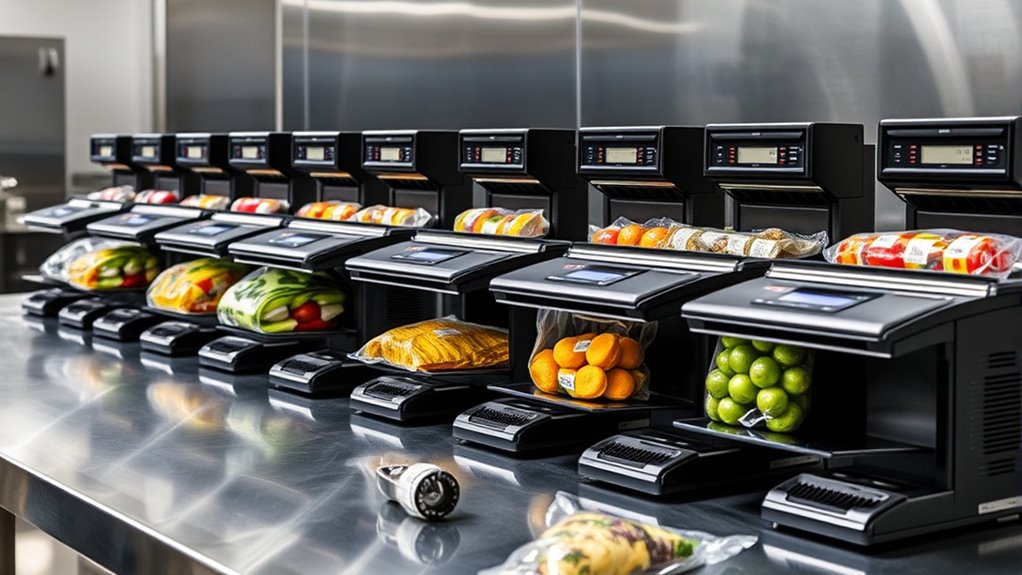

Among these commercial vacuum sealers, my best overall pick is the VacMaster VP230 for buyers seeking a chamber-style machine suited to frequent, varied food prep. The Magic Seal MS450 and MAGIC SEAL MS4005 stand out for their 16-inch sealing capacity, while the DualCore CVS101 is a strong option for liquids and sous vide portions. The main choice is between a chamber sealer, which handles moist foods and liquids more readily, and an external sealer, which can take up less room but may be less suited to wet products. Capacity, counter space, bag compatibility, and daily workload all affect which design makes sense. Continue reading for a ranked breakdown and guidance on matching a sealer to your operation.

Get kitchen gear delivered free with Prime
- Fast, free delivery on millions of items
- Prime Video, Amazon Music and more included
- Member-only deals all year
Complete the kit


Key Takeaways
- Chamber models lead for wet foods: The VacMaster VP230, DualCore CVS101, Avid Armor USV20, and VEVOR chamber options suit buyers who need to seal liquids or moist portions.
- Wide seals favor larger portions: The Magic Seal MS450 and MAGIC SEAL MS4005 offer 16-inch sealing capacity, which may reduce the need to split wide items into smaller bags.
- External sealers trade wet-food flexibility for a different workflow: The Weston Pro-2300 and QKWXV are better matches for buyers whose priorities include straightforward bag sealing rather than chamber-style liquid handling.
- VEVOR’s chamber lineup varies by capacity and power: Its 260W, 320W, and 380W models give buyers different machine specifications to weigh against available space and workload.
- Feature counts and suction figures do not tell the whole story: Bag format, seal width, cleaning needs, and expected batch size are just as relevant to a commercial purchase.
| QKWXV 10-in-1 Vacuum Sealer with Double Heat Seal |  | Best for Repeated Bag Sealing | Model: SV629 | Suction: 95 kPa | Motor power: 230 W | VIEW ON AMAZON | See Our Full Breakdown |
| Magic Seal MS450 16-Inch Commercial Vacuum Sealer |  | Best for High-Volume Wide-Bag Sealing | Construction: 304 stainless steel | Power: 400 W | Suction: 95 kPa | VIEW ON AMAZON | See Our Full Breakdown |
| DualCore CVS101 Chamber Vacuum Sealer for Liquids and Sous Vide |  | Best for Versatile Chamber Sealing | Model: CVS101 | Chamber capacity: Approx. 6 L | Chamber dimensions: 300 × 260 × 80 mm | VIEW ON AMAZON | See Our Full Breakdown |
| Avid Armor USV20 Chamber Vacuum Sealer |  | Best Compact Chamber Sealer | Chamber capacity: 4 L | Chamber dimensions: 12.25 × 8.5 × 3 in | Heating bar length: 11.5 in | VIEW ON AMAZON | See Our Full Breakdown |
| VEVOR Chamber Vacuum Sealer, 320 W, 12.6-Inch Sealing Length |  | Best for Straightforward Wet-Food Packing | Model: DZ-260C | Vacuum power: -100 kPa | Sealing power: 320 W | VIEW ON AMAZON | See Our Full Breakdown |
| Weston Pro-2300 Vacuum Sealer Machine for Food Preservation & Sous Vide |  | Best for Continuous External-Bag Sealing | Power: 1020 watts | Motor: Fan-cooled commercial-grade | Pump type: Double-piston | VIEW ON AMAZON | See Our Full Breakdown |
| VEVOR Chamber Vacuum Sealer – 380W Pump Power, Sealing Bag Packing Machine |  | Best for Wet-Food Batch Prep | Model: YJ-300TV1 | Vacuum pump power: 380 watts | Vacuum rate: 90 L/min | VIEW ON AMAZON | See Our Full Breakdown |
| VEVOR Chamber Vacuum Sealer, 260W, 10.2-Inch Seal Length |  | Best Compact Chamber Pick | Sealing power: 260 watts | Vacuum pump power: 180 watts | Sealing length: 10.2 inches | VIEW ON AMAZON | See Our Full Breakdown |
| Commercial Vacuum Sealer Machine with 95 kPa Suction and Double Heat Seal |  | Best for Flexible Bag Control | Suction power: 95 kPa | Motor power: 130 watts | Sealing time: 8–18 seconds | VIEW ON AMAZON | See Our Full Breakdown |
| MAGIC SEAL MS4005 16-Inch Commercial Vacuum Sealer |  | Best for Wide-Bag Versatility | Power: 250 watts | Seal bar length: 16 inches (40 cm) | Seal width: 8 mm | VIEW ON AMAZON | See Our Full Breakdown |
| VacMaster VP230 Chamber Vacuum Sealer |  | Best for Liquid-Rich Foods | Model: VP230 | Type: Countertop chamber vacuum sealer | Pump: 1/2 HP oil pump | VIEW ON AMAZON | See Our Full Breakdown |
More Details on Our Top Picks
QKWXV 10-in-1 Vacuum Sealer with Double Heat Seal
The QKWXV suits a small food business or serious meal-prep routine that mainly seals bags rather than liquids. Its 95 kPa suction, dual heat strips, and stated 8–18-second sealing time focus on quick, secure cycles; built-in storage and a cutter also reduce interruptions when trimming bags. A removable drip tray and cooling system are useful for repeat batches, though the product data does not specify a continuous-seal capacity. Compared with the Magic Seal MS450, it has a narrower, less explicitly commercial setup: the MS450 lists a 16-inch bar and capacity for up to 450 continuous seals. The QKWXV instead offers a more self-contained package with a bag roll and accessories. Its automatic operation is convenient, but it is not a chamber sealer, so wet foods and loose liquids are a poor fit.
Pros:- 95 kPa suction and a stated 8–18-second sealing cycle
- Dual heat strips are designed to create a secure seal
- Built-in bag storage and cutter simplify bag preparation
- Removable drip tray and cooling system support repeated use
Cons:- Not a chamber sealer, so sealing liquids directly is not its strength
- No continuous-seal capacity is specified for production planning
- The product data does not establish how its freshness claims vary by food or storage conditions
Best for: Small food businesses and frequent meal preppers who seal mostly dry or firm foods and want a built-in cutter and storage.
Not ideal for: Caterers processing liquids or large batches who need chamber sealing or a stated continuous-seal capacity.
- Model:SV629
- Suction:95 kPa
- Motor power:230 W
- Sealing time:8–18 seconds
- Operation mode:Automatic
- Bag roll:5 m long, 11 in wide
- Included bags:5 small bags and 10 large bags
- Included accessories:Suction hose, AC power cord, user manual
Our verdict“Choose the QKWXV for repeated bag sealing and convenient integrated features, but pick a chamber model for liquids or demanding batch work.”
Magic Seal MS450 16-Inch Commercial Vacuum Sealer
For a kitchen sealing many large cuts or broad pouches, the MS450’s 16-inch seal bar is its defining advantage: it accommodates wider bags than the QKWXV 10-in-1 and avoids splitting large portions across smaller packages. Its dual 95 kPa pumps, 400 W power, and cooling fan are paired with a stated capacity of up to 450 continuous seals, making it the clearest fit here for sustained external-bag production. The 304 stainless steel body also suits a work area where corrosion and lingering odors are concerns. This is still an external sealer, not a chamber machine like the DualCore CVS101, so liquids and very wet foods call for extra care. Its commercial footprint and reliance on textured bags also narrow its appeal for compact kitchens or users seeking inexpensive, broadly compatible pouches.
Pros:- 16-inch seal bar accommodates wider bags and larger portions
- Dual pumps deliver 95 kPa suction
- Designed for up to 450 continuous seals with an automatic cooling fan
- 304 stainless steel construction and included spare foam gasket
Cons:- Commercial-size construction takes substantial counter space
- Textured bags may be required, limiting pouch choice
- External vacuum sealing is less suited to liquids than a chamber sealer
Best for: Butchers, caterers, and small food producers who regularly seal wide bags and need long runs of external vacuum sealing.
Not ideal for: Kitchens with limited counter space or operators who need chamber sealing for soups, sauces, and other liquids.
- Construction:304 stainless steel
- Power:400 W
- Suction:95 kPa
- Pumps:Dual
- Seal bar width:16 in (40 cm)
- Seal bar thickness:8 mm
- Continuous seals:Up to 450
- Included accessories:20 textured 8 × 12 in bags, spare foam gasket, printed guide
Our verdict“Pick the MS450 when wide bags and extended sealing runs matter more than a compact footprint or chamber-style liquid handling.”
DualCore CVS101 Chamber Vacuum Sealer for Liquids and Sous Vide
The CVS101 earns its place through two sealing approaches: a roughly 6 L chamber for liquids and powders, plus a separate lower work area for out-of-chamber bags. That flexibility makes it more adaptable than the Avid Armor USV20, whose 4 L chamber is dedicated to chamber work, and its 12-inch dual-seal bar offers a longer sealing span than the Avid Armor’s 11.5-inch bar. Four oil-free pumps and adjustable vacuum and seal times give operators control over delicate items, while liquid-safe marinating adds a useful food-prep function. App-based food logs and expiration reminders may help with stock rotation, but they require scanning food, adding a step that simpler controls avoid. The chamber still limits item size, and out-of-chamber sealing needs compatible rolls; this is a versatile choice, not a substitute for a wide-bar external unit like the Magic Seal MS450.
Pros:- Chamber sealing handles liquids, soups, and powders
- Separate work area supports out-of-chamber sealing
- Adjustable vacuum and seal times with liquid-safe marinating mode
- Four oil-free pumps and a 12-inch dual-seal bar
Cons:- Chamber dimensions limit the size of items sealed inside
- Out-of-chamber sealing requires compatible rolls
- Food tracking features require scanning items through the app
Best for: Small commercial kitchens that package soups, marinades, powders, and sous-vide portions while also wanting an out-of-chamber sealing option.
Not ideal for: Operators packaging oversized products or those who want a simple machine without app-based tracking or multiple bag formats.
- Model:CVS101
- Chamber capacity:Approx. 6 L
- Chamber dimensions:300 × 260 × 80 mm
- Seal bar:12-inch dual-seal bar
- Power:230 W
- Vacuum strength:Up to -100 kPa
- Pump system:Four oil-free dry pumps
- Included bags:10 textured bags, 10 smooth bags, and 1 roll-packed bag
Our verdict“Choose the CVS101 if your workflow mixes liquid-filled chamber bags with occasional out-of-chamber packages and you can work within its chamber size.”
Avid Armor USV20 Chamber Vacuum Sealer
The USV20 is the compact chamber pick for buyers who want to seal liquids and delicate foods without stepping up to the DualCore CVS101 and its larger 6 L chamber. Its 4 L stainless steel chamber fits smooth pouches up to 11 × 10 inches, while adjustable vacuum and seal times let operators adapt cycles to different foods. Smooth-pouch compatibility can make ongoing bag selection simpler than the textured-bag requirement noted for the Magic Seal MS450. The machine’s 14 × 12 × 8.25-inch overall dimensions are relatively manageable for a chamber unit, and a user-replaceable seal bar supports longer-term upkeep. The tradeoff is limited capacity: its 11.5-inch heating bar and chamber exclude larger packages, and at 17.55 lb it is still a substantial appliance to move. It favors controlled small batches over broad production work.
Pros:- Chamber design seals liquids without drawing them into the vacuum system
- Adjustable vacuum and seal times support varied foods
- Uses smooth pouches up to 11 × 10 inches
- Compact chamber format with a user-replaceable seal bar
Cons:- Pouch capacity is limited to 11 × 10 inches
- The 4 L chamber is smaller than the DualCore CVS101’s listed 6 L chamber
- Weighs 17.55 lb, so it is not especially light to relocate
Best for: Small kitchens and food businesses that need chamber sealing for liquids or delicate portions but have limited room for a larger machine.
Not ideal for: High-volume operators or businesses packaging large cuts that need a longer seal bar and more chamber capacity.
- Chamber capacity:4 L
- Chamber dimensions:12.25 × 8.5 × 3 in
- Heating bar length:11.5 in
- Vacuum time:15–60 sec
- Pouch compatibility:Smooth pouches up to 11 × 10 in
- Overall dimensions:14 × 12 × 8.25 in
- Weight:17.55 lb
- Chamber material:Stainless steel
- Seal bar:User-replaceable
Our verdict“Choose the USV20 for compact chamber handling of liquids and small portions, but select a larger chamber model for bigger packages or heavier throughput.”
VEVOR Chamber Vacuum Sealer, 320 W, 12.6-Inch Sealing Length
The VEVOR DZ-260C is a practical chamber option for kitchens that need to package wet foods, marinades, meats, and dry goods with one machine. Its stated -100 kPa vacuum power, stainless steel chamber, and 10 mm seal strip point to a work-focused setup, while the pressure gauge and LED controls give operators visible feedback during operation. Compared with the smaller Avid Armor USV20, it offers a longer 12.6-inch sealing length and wider 10 mm strip, which can suit broader pouches. The DualCore CVS101 adds a separate out-of-chamber work area and app features, so the VEVOR is the more direct choice if those extras are not needed. Its chamber still constrains package size, and warranty details require contacting customer service—an inconvenient gap for a machine intended for commercial use.
Pros:- Designed to package wet foods, meats, marinades, and dry goods
- 12.6-inch sealing length with a 10 mm seal strip
- Pressure gauge and LED controls provide operating feedback
- Stainless steel chamber is suited to repeated kitchen use
Cons:- Chamber dimensions limit the size of items that fit
- Warranty details require contacting customer service
- Does not list the CVS101’s separate out-of-chamber work area
Best for: Small commercial kitchens that want chamber sealing for wet and dry foods with visible pressure and LED controls.
Not ideal for: Buyers who need a clearly documented warranty, an out-of-chamber sealing option, or room for unusually large products.
- Model:DZ-260C
- Vacuum power:-100 kPa
- Sealing power:320 W
- Sealing length:12.6 in
- Seal strip width:10 mm
- Vacuum pump power:180 W
- Voltage:110 V
- Chamber material:Stainless steel
- Included components:Heating wire, manual, Teflon cloth, vacuum pump, vacuum sealer, wrench
Our verdict“Choose this VEVOR for straightforward chamber packing of wet and dry foods, provided its chamber size and warranty-information gap fit your operation.”
Weston Pro-2300 Vacuum Sealer Machine for Food Preservation & Sous Vide
The Weston Pro-2300 suits busy prep stations that need to seal repeatedly without stopping to let the motor cool. Its fan-cooled 1020-watt motor and double-piston pump deliver up to 28 inches of mercury, while the 15-inch seal bar accommodates wider bags than the VEVOR 10.2-inch chamber model. One-touch operation and LED indicators keep routine sealing straightforward, and the transparent lid helps with bag placement.
This is an external-bag sealer, not a chamber machine: for soups, marinades, or other liquid-heavy foods, the VEVOR chamber models are more suitable. The Weston’s large seal bar and repeat-use design also come with a practical omission: there is no built-in cutter or roll storage, so bag prep takes more setup and space. Choose it for throughput and wide bags, not an all-in-one workstation.
Pros:- Fan-cooled commercial-grade motor is designed for continuous sealing without overheating.
- 15-inch seal bar handles wider bags than the VEVOR 10.2-inch chamber model.
- Double-piston pump delivers up to 28 inches of mercury vacuum strength.
- One-touch operation, LED indicators, and a transparent lid simplify alignment and routine use.
Cons:- No built-in bag cutter or roll storage, adding steps and requiring separate accessories.
- External-bag design is less suited to sealing liquid-rich foods than chamber models.
- Large seal bar requires wider bags and more counter or storage space than compact sealers.
Best for: Small food businesses or high-volume home processors sealing wide bags repeatedly, especially for dry goods, meat, and sous-vide portions.
Not ideal for: Kitchens that routinely package liquids or want an integrated bag cutter and roll holder; a chamber sealer or a more self-contained option such as the MAGIC SEAL MS4005 may fit better.
- Power:1020 watts
- Motor:Fan-cooled commercial-grade
- Pump type:Double-piston
- Vacuum strength:Up to 28 inches of mercury
- Seal bar length:Up to 15 inches (38 cm)
- Seal bar width:5 mm
- Operation modes:One-touch automatic and manual
- Lid and indicator:Transparent tinted lid; LED status indicator
Our verdict“Choose the Weston Pro-2300 if repeated sealing and wide external bags matter more than chamber-style liquid handling or integrated bag storage.”
VEVOR Chamber Vacuum Sealer – 380W Pump Power, Sealing Bag Packing Machine
The VEVOR YJ-300TV1 is the stronger fit for kitchens that regularly package marinades, wet ingredients, or mixed food batches. Its chamber design removes air from the chamber rather than pulling directly through the bag opening, which helps avoid the liquid-draw problem associated with external sealers such as the Weston Pro-2300. A 380-watt pump rated at 90 liters per minute and a stated maximum vacuum of -95 kPa support brisk batch work.
The stainless-steel chamber measures 12.87 by 12.20 by 3.15 inches, with an 11.5-inch sealing length. Adjustable vacuum and seal times plus a marinating mode offer more control than a basic external sealer. The tradeoff is workspace demand: the chamber occupies a substantial footprint, and its seal length is shorter than the MAGIC SEAL MS4005’s 16-inch bar. Pick this VEVOR for wet-food versatility, not for oversized bags or a compact counter.
Pros:- Chamber format handles wet, dry, powdery, and solid foods.
- 380-watt pump and 90 L/min vacuum rate are suited to batch preparation.
- Stainless-steel chamber and glass lid allow monitoring during operation.
- Adjustable vacuum and seal times plus a marinating mode add process control.
Cons:- Bulky chamber footprint can take significant counter or workbench space.
- 11.5-inch sealing length limits bag width compared with the MAGIC SEAL MS4005.
- Chamber height is 3.15 inches, so tall or bulky items may not fit.
Best for: Restaurant prep teams and serious home cooks who batch-pack wet foods, marinades, or varied ingredients and have room for a countertop chamber machine.
Not ideal for: Small kitchens, mobile food operations, or buyers sealing bags wider than 11.5 inches; the MAGIC SEAL MS4005 offers a longer bar, while external models take less chamber space.
- Model:YJ-300TV1
- Vacuum pump power:380 watts
- Vacuum rate:90 L/min
- Maximum vacuum:-95 kPa
- Chamber dimensions:12.87 × 12.20 × 3.15 inches
- Sealing length:11.5 inches
- Chamber material:304 stainless steel
- Controls and lid:Adjustable vacuum and seal times; glass lid
Our verdict“Choose this VEVOR if wet-food handling and batch versatility outweigh the space required by its chamber.”
VEVOR Chamber Vacuum Sealer, 260W, 10.2-Inch Seal Length
Among the chamber options here, this VEVOR 10.2-inch model is the more restrained choice for kitchens that want chamber-style handling without moving up to the larger YJ-300TV1. Its stainless-steel chamber can package wet foods and marinades, a useful advantage over the external-bag Weston Pro-2300, while the 8 mm seal strip is designed for a broad, strong seal. A pressure gauge and LED display give operators feedback without relying on a bare-bones control setup.
The compromise is capacity and pace: its 180-watt pump is less powerful than the other VEVOR chamber model’s 380-watt pump, and its 10.2-inch sealing length is the shortest in this group. Large or fragile items also need careful placement inside the chamber. This model makes sense for smaller batches and varied foods, but buyers processing larger volumes should compare it with the YJ-300TV1 before choosing.
Pros:- Chamber design supports wet foods, meats, and marinades.
- Stainless-steel chamber is suited to frequent kitchen use.
- 8 mm seal strip provides a wide sealing area.
- Pressure gauge and LED display provide useful process feedback.
Cons:- 10.2-inch sealing length limits bag width compared with the other VEVOR chamber model.
- 180-watt pump is less powerful than the YJ-300TV1’s 380-watt pump.
- Large or fragile items may need careful positioning, and compatible vacuum bags are required.
Best for: Small commercial kitchens and home food businesses that need chamber sealing for marinades and wet foods but have modest batch sizes.
Not ideal for: High-throughput operations or buyers packing wide, bulky items; the VEVOR YJ-300TV1 has a longer seal length and a more powerful pump.
- Sealing power:260 watts
- Vacuum pump power:180 watts
- Sealing length:10.2 inches
- Seal strip width:8 mm
- Vacuum power:-100 kPa
- Chamber material:Stainless steel
- Display and monitoring:LED display and pressure gauge
- Included components:Machine, heating wires, Teflon cloths, vacuum pump, and vacuum bags
Our verdict“Pick this VEVOR for chamber-style wet-food packing in smaller batches, but move to the YJ-300TV1 for wider bags and heavier throughput.”
Commercial Vacuum Sealer Machine with 95 kPa Suction and Double Heat Seal
This 95 kPa external sealer is aimed at operators who want to adapt the vacuum and sealing process to different foods without switching machines. Ten modes, adjustable vacuum strength, and manual pulse control help users manage delicate items, while dry, moist, and liquid-rich settings broaden its use. Its double heat seal option adds a second sealing line, unlike the Weston Pro-2300’s listed 5 mm seal bar, and the built-in cutter and bag storage make bag preparation more self-contained.
The one-hand lock and removable drip tray with a full indicator are practical for routine work, but this remains an external-bag design; for frequent liquid-heavy batches, the VEVOR chamber sealers are better suited. Its 11.8-inch bag limit is also narrower than the MAGIC SEAL MS4005’s 16-inch bar. Choose it for adjustable handling and integrated conveniences, not chamber capacity or the widest packaging.
Pros:- Adjustable vacuum strength and manual pulse mode help manage delicate foods.
- Dry, moist, and liquid-rich settings provide flexibility across food types.
- Single or double heat sealing offers a choice of seal format.
- Built-in bag storage, cutter, and removable drip tray reduce separate prep steps.
Cons:- External-bag format is less suitable for frequent liquid-heavy packing than a chamber sealer.
- Bags are limited to 11.8 inches wide, narrower than the MAGIC SEAL MS4005’s 16-inch bar.
- Compatible bags are required, so bag selection can constrain workflow.
Best for: Small food businesses and meal-prep operators who seal several food types, want manual control for delicate items, and value built-in bag handling.
Not ideal for: Businesses packing liquid-rich foods in volume or sealing bags wider than 11.8 inches; a VEVOR chamber model or the MAGIC SEAL MS4005 may fit those needs better.
- Suction power:95 kPa
- Motor power:130 watts
- Sealing time:8–18 seconds
- Modes:10
- Bag width limit:Up to 11.8 inches
- Sealing options:Single or double heat seal
- Bag handling:Built-in bag storage and cutter
- Drip tray:Removable, with full indicator
Our verdict“Choose this model for adaptable external sealing and integrated bag prep, but favor a chamber unit for regular liquid-rich batches.”
MAGIC SEAL MS4005 16-Inch Commercial Vacuum Sealer
The MAGIC SEAL MS4005 covers more bag types and formats than the other external models in this batch. Its 16-inch, 8 mm seal bar takes wider packages than the Weston Pro-2300’s 15-inch bar, and its chamber and retractable-nozzle modes support both smooth and textured bags, including Mylar. Adjustable vacuum and sealing controls help tailor the process for delicate foods or liquids, while the air-cooling system is rated for up to 450 consecutive seals.
That breadth comes with a space penalty: a 16-inch bar makes this a substantial countertop machine, and the listing gives no dimensions or weight to help plan placement. Unlike the VEVOR chamber models, it is not a dedicated chamber sealer for routine wet-food batch work. The included cutter, starter bags, spare gasket, and liquid catch container make it more ready to work than the Weston, but buyers should choose it for wide-bag flexibility, not compact storage.
Pros:- 16-inch seal bar accommodates wider bags than the Weston Pro-2300.
- Chamber and retractable-nozzle modes work with smooth and textured bags, including Mylar.
- Air-cooling system is rated for up to 450 consecutive seals.
- Built-in cutter and included bags, roll, spare gasket, and liquid catch container provide useful setup accessories.
Cons:- Large 16-inch bar takes substantial counter and storage space.
- Product dimensions and weight are not provided for workspace planning.
- Dedicated VEVOR chamber models are better suited to routine wet-food batch sealing.
Best for: Small commercial kitchens and serious home processors that need wide bags, Mylar compatibility, and multiple sealing modes in one machine.
Not ideal for: Buyers with limited counter or storage space, or businesses primarily sealing liquid-heavy batches that would benefit more from a dedicated chamber model such as the VEVOR YJ-300TV1.
- Power:250 watts
- Seal bar length:16 inches (40 cm)
- Seal width:8 mm
- Sealing time:1–15 seconds
- Operating modes:Chamber and retractable nozzle
- Consecutive seals:Up to 450
- Warranty:One year
- Included bags and roll:10 smooth bags and 10 textured bags (8 × 12 inches); one 8-inch × 16.4-foot textured roll
Our verdict“Choose the MS4005 when wide bags and compatibility across bag types matter more than a compact footprint or dedicated chamber workflow.”
VacMaster VP230 Chamber Vacuum Sealer
I’d rank the VacMaster VP230 as a strong fit for commercial kitchens that regularly seal soups, marinades, or sous-vide portions. Its chamber design handles liquid-rich foods that can be difficult to seal with an external-suction machine such as the Weston Pro-2300. The 12.25-inch seal bar and double-seal system support bags up to 12 x 15 inches, giving operators room for larger portions and an added sealing barrier. A 1/2 HP oil pump suits repeated use, though it brings maintenance that simpler machines avoid. At 89 pounds, this countertop unit is also far less convenient to move than a lighter-duty option. I’d choose it for a dedicated prep station, not a kitchen that needs a sealer to be stored after each shift.
Pros:- Chamber operation can seal liquid-rich foods without drawing liquid toward an external vacuum channel.
- Double-seal system adds a second barrier against leaks and loss of freshness.
- Accepts bags up to 12 x 15 inches for larger food portions.
- Includes assorted chamber pouches, filler plates, and a maintenance kit.
Cons:- At 89 pounds, it is difficult to move or store between uses.
- The oil pump requires ongoing maintenance.
- Its 15.5 x 19 x 15.75-inch footprint calls for a dedicated workspace.
Best for: Restaurant prep teams and serious home cooks who regularly seal liquids, marinades, or sous-vide portions and can dedicate counter space to a heavy machine.
Not ideal for: Small kitchens or mobile food operators who need a lightweight sealer, and buyers unwilling to maintain an oil pump.
- Model:VP230
- Type:Countertop chamber vacuum sealer
- Pump:1/2 HP oil pump
- Seal bar:12.25 inches
- Maximum bag size:12 x 15 inches
- Chamber size:12.5 x 15 x 5 inches
- Overall dimensions:15.5 x 19 x 15.75 inches
- Weight:89 lbs
- Bag compatibility:3-mil to 7-mil bags
Our verdict“Choose the VP230 if liquid-heavy prep and chamber sealing matter more than portability and low-maintenance operation.”

How We Picked
I ranked these commercial vacuum sealers by how well their design suits real food-prep demands: sealing consistency, handling of moist or liquid foods, usable seal length, and fit for repeated batches. I also weighed workflow factors such as operation style, bag requirements, counter footprint, and the amount of care a machine may need. A specification only mattered when it changed what a buyer could seal or how practical the machine would be in a working kitchen.
The ranking favors versatility and a clear use case over a long feature list. Chamber models rise for buyers handling liquids and varied foods; wide-seal external models stand out for large bags and broad portions. More compact or lower-powered chamber options can make sense for lighter workloads, but they do not automatically outrank a more capable machine. Because the lineup includes different designs, I treat each pick according to its role rather than implying that one sealer suits every commercial setup.
Factors to Consider When Choosing Commercial Vacuum Sealers
Choosing a commercial sealer starts with the foods and batches you handle, not the most impressive-looking specification. These broader factors can help narrow the field before you compare individual models.
Match the sealer design to the food
Chamber and external sealers solve different problems, so choose by product mix rather than by the word “commercial.” Chamber designs are generally the more practical route for liquids, marinades, and wet portions because the bag and product sit inside the chamber during the cycle. External sealers remove air through the bag opening, a workflow that can be less convenient when liquid is present. If your menu is mostly dry, firm foods, an external model may be entirely adequate. A common mistake is buying an external sealer for a workflow dominated by soups or sauces simply because its listed suction sounds strong. Map your wettest routine item before deciding.
Size capacity for your actual batch routine
Seal length sets a practical limit on bag width and the size of portions you can package without repacking. A 16-inch bar can accommodate wider bags than a shorter seal, but it does not automatically improve throughput if your portions are small. Chamber dimensions matter too: the bar length is only one part of the usable space, and bulky foods may not fit even when the bag seals across. Estimate your typical and largest portions, then compare those measurements with both chamber capacity and sealing length. Buyers often focus on the largest item and overlook whether the machine suits most daily batches. A good fit for routine work can matter more than maximum capacity used only occasionally.
Read power and performance claims in context
Wattage and suction figures can help describe a machine, but they do not alone predict how it will perform across different foods and bag types. Chamber and external machines use different sealing processes, so comparing a single number across both designs can mislead. For repeated service, pay attention to the whole cycle: loading, vacuuming, sealing, cooling, and preparing the next bag. If a seller provides cycle guidance or duty limits, compare those details with your expected batch size. Avoid buying extra capacity based only on occasional peak demand if it will consume valuable counter space every day. Give more weight to specifications that directly match your workload.
Check bag compatibility and ongoing supplies
Before buying, confirm which bag types the machine supports and whether those bags are easy for your operation to source. Chamber sealers can often use smooth bags, while many external sealers depend on textured or embossed bags that support air removal. A lower equipment cost can be offset by a bag format that is harder to source or poorly suited to your portion sizes. Check the bag width, thickness guidance, and sealing requirements against the packaging you already use. Also consider whether your team needs multiple bag sizes for prep, storage, and sous vide. Testing your planned packaging format before committing to a large stock reduces avoidable waste.
Plan for cleaning, maintenance, and workspace
A commercial machine needs a home that supports safe loading, cleaning, and repeated use. Chamber models can occupy substantial counter space, and their interior must be accessible for wiping after messy batches. External units may have a different footprint, but still need room for long bags and clear access to the sealing bar. Consider where spills, crumbs, and condensation will collect, and how often the machine will need attention during a shift. A tight workspace can turn an otherwise capable sealer into a bottleneck. Measure the intended location and account for clearance around the lid, controls, and bag-loading area before ordering.
Pay for capacity you will use
More power, a wider bar, or a larger chamber can be useful, but each should solve a recurring problem rather than an imagined one. Buyers with steady batches of large or wet portions may benefit from a more capable chamber unit; a small café sealing occasional dry ingredients may get better utility from a simpler machine. Think about whether multiple staff members will use the sealer and whether the workflow demands repeated cycles during busy periods. For a first commercial machine, easy-to-understand controls and manageable cleaning can matter more than extra modes. Do not assume that a feature count means a faster or simpler shift. Tie every upgrade to a task your team performs regularly.
Frequently Asked Questions
Should I choose a chamber sealer or an external sealer for a small food business?
Start with the products you seal most often. A chamber model is generally the more suitable choice for liquids, marinades, and moist foods, while an external model may fit a dry-goods workflow and take a different approach to bag loading. Also account for available counter space and the bag format each machine requires. If your menu includes both wet and dry items, prioritize the machine that handles the most difficult recurring task. Occasional liquid packaging may not justify a larger chamber unit, but daily wet-food sealing can make the design difference decisive.
Can I use ordinary vacuum bags with every commercial vacuum sealer?
No; bag compatibility depends on the sealer design and model. Many external sealers require textured bags that let air move toward the vacuum channel, while chamber models commonly work with smooth bags. Using an incompatible bag can lead to poor air removal or a failed seal even when the machine itself is functioning correctly. Check the manufacturer’s bag guidance and allowed thickness before buying supplies. If you already use a packaging format, confirm compatibility before choosing a machine so you do not create a separate inventory problem.
How much sealing width do I need for commercial food prep?
Base the choice on the widest bag you use in a normal week, not just the largest item you might package once. A wider seal bar can reduce the need to divide large portions, but it may add to the machine’s footprint and is unnecessary for small, consistent packs. With chamber models, also check chamber dimensions because a wide seal bar cannot compensate for limited interior space. Measure your bags and typical portions before comparing listed seal lengths. For varied menus, a little extra width can add flexibility, but only if the surrounding machine fits your workspace.
Is a higher-wattage chamber sealer always the better commercial choice?
No. Wattage is one specification, not a direct measure of suitability for every kitchen. The right choice also depends on chamber size, sealing length, controls, cleaning access, and how many batches you expect to run. A more powerful unit may be unnecessary for occasional small batches, while a busy operation should look for performance guidance relevant to repeated cycles. Compare machines within the same general design, since chamber and external sealers work differently. Choose the model whose capacity matches your day-to-day volume rather than selecting by wattage alone.
What should I check before using a vacuum sealer for sous vide portions?
Confirm that the sealer supports the bag type and portion size you plan to use, and check that the resulting seals suit your cooking workflow. For wet ingredients or marinades, a chamber model is often a more suitable starting point than an external unit. Review the machine and bag makers’ guidance for sealing and cooking use rather than assuming every vacuum bag is appropriate for heat. Leave enough room in each bag for a dependable seal, especially when packaging irregular cuts. A small trial batch can reveal problems with portion size, liquid handling, or bag choice before you prepare a full service run.
Conclusion
For the broadest mix of commercial food-prep needs, I would start with the VacMaster VP230 as the best overall choice, especially when chamber-style flexibility matters. Buyers seeking a value-focused chamber option can compare the VEVOR 260W, 320W, and 380W models against their batch size and workspace rather than paying for capacity they will not use. For a premium wide-seal workflow, the Magic Seal MS450 and MAGIC SEAL MS4005 are the lineup’s 16-inch options. Beginners with mainly dry foods may prefer the more straightforward external-sealer route represented by the Weston Pro-2300 or QKWXV, while buyers handling liquids and sous vide portions should focus on the DualCore CVS101 or another chamber pick. Choose by your most frequent food, packaging size, and daily workload; those factors matter more than a headline specification.