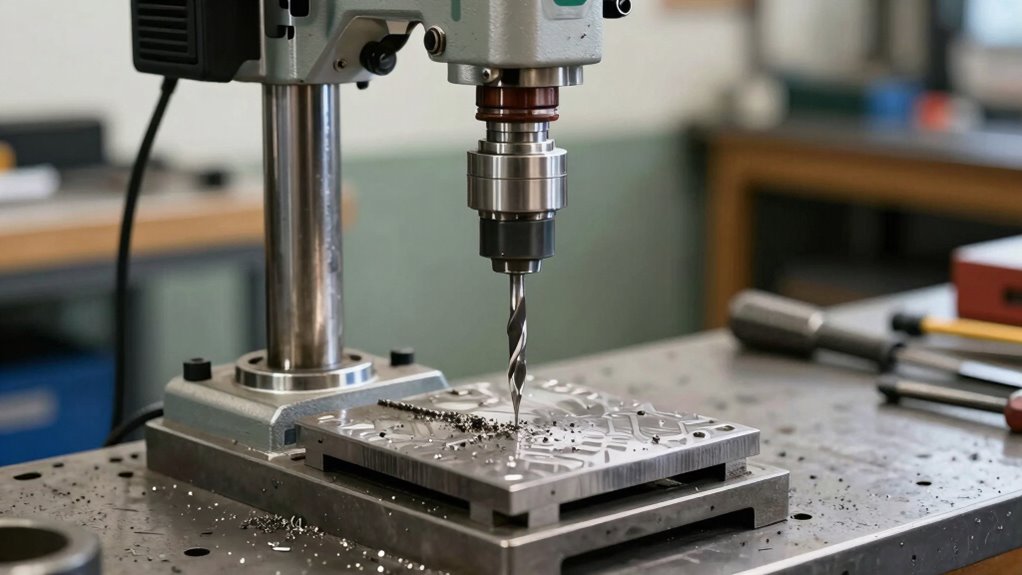

Choosing the right drill press for metalworking requires balancing rigidity, variable speed control, and motor power to prevent bit burnout and ensure clean holes. My top recommendation is the Jet JWDP-12 because its cast-iron construction and smooth variable speed drive handle tough steel drilling with minimal vibration. For those needing portability on the job site, the VEVOR Magnetic Drill Press offers unique stability on ferrous metals without needing a vise. However, many budget-friendly benchtop models lack the stiffness required for hardened steel, leading to chatter and poor finish quality. Read on to see how these fifteen models stack up against each other in real-world metalworking scenarios.

Get kitchen gear delivered free with Prime
- Fast, free delivery on millions of items
- Prime Video, Amazon Music and more included
- Member-only deals all year
Complete the kit


Key Takeaways
- Rigidity separates the winners from the losers: models with cast-iron bases and columns outperform those with thin steel or aluminum components when drilling into steel.
- Variable speed drives (VSD) are superior to stepped pulleys for metalworking, as they allow precise RPM adjustments without stopping to change belts.
- Magnetic drill presses are niche but powerful for large-diameter holes in structural steel, whereas benchtop presses excel at precision and smaller fasteners.
- Motor amperage is a better indicator of sustained torque for metal than horsepower ratings, which are often inflated in budget tools.
- Worktable tilt and travel range are critical for drilling angled holes or deep parts, a feature often sacrificed on entry-level 8-inch models.
| NovelLife B10 Precision Mini Drill Press |  | Best Compact Pick for Small Metal Parts | Motor power: 120 W | Power supply: Adjustable 24V | Motor speed: Up to 7,000 rpm | VIEW ON AMAZON | See Our Full Breakdown |
| VEVOR 1450W Portable Magnetic Drill Press with 6 Annular Cutters |  | Best for Steel Plate and Fabrication | Power: 1450 W | Voltage: 110 V | Maximum coring diameter: 2 in / 50 mm | VIEW ON AMAZON | See Our Full Breakdown |
| VEVOR 10-Inch Benchtop Drill Press with 6.2A Motor and Adjustable Speed |  | Best Value for Routine Bench Drilling | Motor: 6.2A induction motor | Voltage: 110 V | Speed settings: 5 | VIEW ON AMAZON | See Our Full Breakdown |
| WEN DP1263V 12-Inch Variable-Speed Benchtop Drill Press |  | Best Premium Benchtop Pick | Motor: 6.2-amp induction motor | Voltage: 120 V | Speed range: 580–3,100 rpm | VIEW ON AMAZON | See Our Full Breakdown |
| VEVOR 10-Inch Benchtop Drill Press, 3.2 Amp, 5 Speeds |  | Best Entry-Level Metalworking Press | Motor: 3.2A induction motor | Voltage: 120 V | Speed settings: 5 | VIEW ON AMAZON | See Our Full Breakdown |
| QD-KYOHO 10-Inch Variable-Speed Benchtop Drill Press |  | Best for Fine Speed Control | Motor: 6.2 A induction motor; 400 W | Speed range: 50–3,000 RPM, stepless | Swing: 10 inches | VIEW ON AMAZON | See Our Full Breakdown |
| WEN DP1062V 10-Inch Variable-Speed Benchtop Drill Press with Laser |  | Best for Readable Speed Feedback | Motor: 6.2-amp induction motor | Speed range: 530–3,100 RPM | Swing: 10 inches | VIEW ON AMAZON | See Our Full Breakdown |
| RYOBI 10-Inch 5-Speed Drill Press with EXACTLINE Alignment System |  | Best for Straightforward Bench Drilling | Motor: 0.25 hp induction motor; 6.2 A | Speed settings: 5 | Speed range: 620–3,100 RPM | VIEW ON AMAZON | See Our Full Breakdown |
| JET 12-Inch Variable-Speed Benchtop Drill Press, 1/2 HP, 115V (JWDP-12) |  | Best for Demanding Metal Bench Work | Motor: 1/2 HP induction motor | Speed range: 530–3,100 RPM | Swing: 12 inches | VIEW ON AMAZON | See Our Full Breakdown |
| SKIL 6.2-Amp 10-Inch 5-Speed Benchtop Drill Press with Laser Alignment and Work Light |  | Best for Repeatable Hole Depth | Motor: 6.2 A induction motor | Speeds: 5 speeds, 610–2,800 RPM | Maximum chuck: 1/2 inch | VIEW ON AMAZON | See Our Full Breakdown |
| VEVOR 8″ Benchtop Drill Press |  | Best Compact Starter for Light Metal | Motor Power: 2.5 A (276 W) | Speed Range: 750–3200 RPM | Max Chuck Size: 0.5 inches | VIEW ON AMAZON | See Our Full Breakdown |
| BUCKTOOL 12-Inch Benchtop Drill Press |  | Best for Precision Positioning | Motor Power: 0.75 HP | Speed Range: 360–2,000 RPM | Swing: 12 inches | VIEW ON AMAZON | See Our Full Breakdown |
| BUCKTOOL 12-Inch Drill Press (DP12VL) |  | Best Heavy-Duty Benchtop | Motor Power: 6.2 A (744 W) | Max Chuck Size: 5/8 inches | Weight: 86.5 pounds | VIEW ON AMAZON | See Our Full Breakdown |
| VGJ 710W Benchtop Drill Press |  | Best for Small-Scale Precision | Motor Power: 710 W | Max Chuck Size: 13 mm | Speed Range: 800–3000 RPM | VIEW ON AMAZON | See Our Full Breakdown |
| WEN 2.3-Amp 8-Inch Drill Press (4206T) |  | Best Value for Basic Needs | Motor Power: 2.3 A | Swing: 8 inches | Chuck Size: 1/2 inch | VIEW ON AMAZON | See Our Full Breakdown |
| drill press for metalworking | Speed range | Spindle travel | Weight | Motor |
|---|---|---|---|---|
| NovelLife B10 Precision Mini D | — | — | 2.2 kg | — |
| VEVOR 1450W Portable Magnetic | — | — | 26.5 lb | — |
| VEVOR 10-Inch Benchtop Drill P | 610–2,800 rpm | 2 in | — | 6.2A induction motor |
| WEN DP1263V 12-Inch Variable-S | 580–3,100 rpm | 3-1/8 in | 85 lb | 6.2-amp induction motor |
| VEVOR 10-Inch Benchtop Drill P | — | — | 41.9 lb | 3.2A induction motor |
| QD-KYOHO 10-Inch Variable-Spee | 50–3,000 RPM, stepless | 2-3/8 inches | — | 6.2 A induction motor; 400 W |
| WEN DP1062V 10-Inch Variable-S | 530–3,100 RPM | 2 inches | 29.94 kg | 6.2-amp induction motor |
| RYOBI 10-Inch 5-Speed Drill Pr | 620–3,100 RPM | — | — | 0.25 hp induction motor; 6.2 A |
| JET 12-Inch Variable-Speed Ben | 530–3,100 RPM | Over 3-1/8 inches | 85 lb | 1/2 HP induction motor |
| SKIL 6.2-Amp 10-Inch 5-Speed B | — | — | — | 6.2 A induction motor |
| VEVOR 8" Benchtop Drill Press | 750–3200 RPM | 2 inches | 25.4 pounds | — |
| BUCKTOOL 12-Inch Benchtop Dril | 360–2,000 RPM | 3-1/8 inches | — | — |
| BUCKTOOL 12-Inch Drill Press | 580–3200 RPM | — | 86.5 pounds | — |
| VGJ 710W Benchtop Drill Press | 800–3000 RPM | 60 mm | — | — |
| WEN 2.3-Amp 8-Inch Drill Press | — | 2 inches | — | — |
More Details on Our Top Picks
NovelLife B10 Precision Mini Drill Press
The NovelLife B10 is the specialist in this group: its small footprint and 0.6–6 mm bit range suit miniature hardware, model components, and light-duty soft-metal work better than the larger VEVOR DP103L or WEN DP1263V. Its adjustable 24V supply and speed up to 7,000 rpm also suit polishing and grinding tasks, while the included vise and HSS bits make it a ready-to-use desktop setup. That compact format comes with firm limits. A 40 mm stroke and 6 mm maximum bit size rule out larger holes and serious fabrication, and its 120-watt motor is intended for soft materials rather than sustained heavy drilling. I’d choose it for precision at small scale, not as a substitute for a full-size metalworking press.
Pros:- Compact 5.9 × 4.7 × 8.7-inch format fits a crowded bench or desktop.
- Adjustable 24V power supply and speed up to 7,000 rpm suit small drilling and accessory tasks.
- Includes a metal flat vise and HSS drill bits for small-part work.
- Can also handle light polishing and grinding tasks.
Cons:- The 6 mm maximum bit size limits hole diameter and material removal.
- The 40 mm drilling stroke restricts workpiece thickness and depth.
- Its 120-watt motor is intended for soft metals and light duty, not demanding metal fabrication.
Best for: Hobbyists drilling small holes in thin, soft-metal parts, circuit enclosures, model components, or other desktop projects.
Not ideal for: Fabricators or metalworkers who need larger holes, deeper drilling travel, or sustained work in harder metals.
- Motor power:120 W
- Power supply:Adjustable 24V
- Motor speed:Up to 7,000 rpm
- Compatible bit size:0.6–6 mm
- Maximum drilling stroke:40 mm
- Listed metal drilling capacity:6 mm
- Dimensions:5.9 × 4.7 × 8.7 in
- Weight:2.2 kg
Our verdict“Choose the NovelLife B10 for small, controlled holes in soft metal when a full-size press would take up too much space.”
VEVOR 1450W Portable Magnetic Drill Press with 6 Annular Cutters
Unlike the benchtop VEVOR DP103L, this magnetic drill press is built for coring steel in place: its 2-inch maximum diameter and depth, 2,922 lbf magnetic holding force, and included annular cutters are aimed at fabrication work rather than general bench drilling. The coolant system and overload protection support longer, demanding cuts, while 10 speed settings give more adjustment than a fixed-speed approach. Its usefulness depends on the job and material, though. The work surface must be steel at least 10 mm thick for the magnet to hold as specified, and the product information says it is not suitable for stainless steel or cast iron. I’d also verify the speed range before purchase, since the listed maximum of 25,000 rpm appears inconsistent with the rest of the product information.
Pros:- Cores holes up to 2 inches in diameter and depth with included annular cutters.
- Magnetic holding force is listed at 2,922 lbf for securing the drill to qualifying steel.
- Includes a coolant system and six annular cutters for metal drilling.
- Ten speed settings and overload protection add control for fabrication tasks.
Cons:- Requires steel at least 10 mm thick for the specified magnetic hold.
- Product information says it is not suitable for stainless steel or cast iron.
- The listed maximum speed appears inconsistent, making the speed specification unclear.
Best for: Metal fabricators drilling large holes in qualifying steel plate where a portable magnetic base can secure the tool.
Not ideal for: Buyers working on thin plate, stainless steel, cast iron, or small bench projects that call for ordinary twist-bit drilling.
- Power:1450 W
- Voltage:110 V
- Maximum coring diameter:2 in / 50 mm
- Maximum coring depth:2 in / 50 mm
- Magnetic holding force:2,922 lbf / 13,000 N
- Speed settings:10
- Minimum steel plate thickness:0.39 in / 10 mm
- Weight:26.5 lb
Our verdict“Pick this VEVOR when you need portable, large-diameter coring on sufficiently thick steel plate and can work within its material limits.”
VEVOR 10-Inch Benchtop Drill Press with 6.2A Motor and Adjustable Speed
The VEVOR DP103L offers a practical middle ground for a metalworking bench: its 610–2,800 rpm range includes slower settings for metal, while the 2-inch spindle travel gives more drilling depth than the compact NovelLife B10. A tilting table, depth stop, work light, and X-ray positioning system add useful setup aids for repeat holes and angled work. Compared with the larger WEN DP1263V, it has a smaller 10-inch swing and less spindle travel, but its feature set is aimed at everyday small-shop drilling rather than a larger work envelope. The main compromise is adjustment: changing speed means moving the belt, so it is less convenient than mechanical variable-speed designs. Its 0.5-inch maximum drilling diameter also sets a clear limit for metal jobs.
Pros:- Five belt-adjusted speeds include a low 610 rpm setting suited to slower drilling.
- Two-inch spindle travel and adjustable depth stop support controlled, repeatable holes.
- Tilting table supports angled drilling, and the light and positioning system aid setup.
- Metal construction and a 6.2A induction motor suit routine benchtop work.
Cons:- Speed changes require opening the belt area and repositioning the belt.
- Maximum listed drilling diameter is 0.5 inch.
- Its 10-inch swing offers less workpiece clearance than the WEN DP1263V.
Best for: Home-shop metalworkers who mainly drill holes up to 0.5 inch and want a table-mounted press with positioning and depth-control aids.
Not ideal for: Users who frequently change speeds, need holes larger than 0.5 inch, or want the extra swing and travel of the WEN DP1263V.
- Motor:6.2A induction motor
- Voltage:110 V
- Speed settings:5
- Speed range:610–2,800 rpm
- Maximum chuck size:0.5 in
- Maximum drilling diameter:0.5 in
- Spindle travel:2 in
- Worktable tilt:0–45°
Our verdict“Choose the DP103L for regular small-shop drilling when you value setup aids and low-speed options more than fast speed changes or a larger capacity.”
WEN DP1263V 12-Inch Variable-Speed Benchtop Drill Press
For a buyer who wants a more capable fixed bench press, the WEN DP1263V separates itself from the VEVOR DP103L with a 12-inch swing, 3-1/8-inch spindle travel, and mechanical variable speed from 580 to 3,100 rpm. The digital readout lets me match spindle speed to the task without relying on belt-position estimates, a useful advantage when moving between metal and other materials. Its cast-iron base, beveling table, laser, and LED light make it better equipped for repeatable setups than the simpler VEVOR 10-inch, 3.2A model. The tradeoff is a heavier, larger machine: at 85 pounds, it is not a press I’d pick for a temporary or frequently rearranged workstation. Its 5/8-inch capacity is still a limit for larger fabrication holes.
Pros:- Mechanical variable speed from 580 to 3,100 rpm pairs with a digital speed readout.
- 12-inch swing and 3-1/8-inch spindle travel provide more work envelope than the VEVOR DP103L.
- Cast-iron base and beveling table support a stable, adaptable setup.
- Laser, LED work light, depth stop, and table roller extension aid positioning and handling.
Cons:- At 85 pounds and 36.6 inches tall, it needs a stable, dedicated location.
- Maximum listed drilling capacity is 5/8 inch, which may not suit larger fabrication holes.
- Its larger footprint takes more bench and shop space than the 10-inch options.
Best for: Dedicated home-shop users who want variable speed, a larger work envelope, and more spindle travel for repeated metal and mixed-material drilling.
Not ideal for: Small-space users or anyone who needs a lightweight press, portable setup, or capacity beyond 5/8 inch.
- Motor:6.2-amp induction motor
- Voltage:120 V
- Speed range:580–3,100 rpm
- Swing:12 in
- Spindle travel:3-1/8 in
- Maximum chuck size:5/8 in
- Worktable:9-1/2 × 9-1/2 in; bevels 45° left and right
- Weight:85 lb
Our verdict“Choose the WEN DP1263V for a permanent shop setup where variable speed and extra travel matter more than portability.”
VEVOR 10-Inch Benchtop Drill Press, 3.2 Amp, 5 Speeds
The VEVOR DP1006L is a straightforward starting point for a buyer who wants a conventional benchtop press rather than the small-scale NovelLife B10 or the specialized magnetic VEVOR. Its five speeds from 650 to 3,100 rpm and tilting table cover basic drilling and angled setups, with a listed 0.5-inch metal capacity. It is lighter than the 85-pound WEN DP1263V, which makes it easier to position in a modest shop, but the lighter-duty 3.2A motor and basic feature set make it a less compelling choice for sustained or demanding metal work. There is also a specification conflict: the speed range reaches 3,100 rpm, while another listing gives a 2,800 rpm maximum. I’d treat it as a basic small-hole option, not a precision or heavy-fabrication machine.
Pros:- Five speed settings cover a range of basic drilling tasks.
- Tilting worktable adjusts from 0° to 45° for angled work.
- Listed metal drilling capacity reaches 0.5 inch.
- At 41.9 pounds, it is lighter than the WEN DP1263V and easier to place on a compact bench.
Cons:- Product data conflicts on maximum speed, listing both 2,800 and 3,100 rpm.
- The 3.2A motor is a more modest choice than the 6.2A motors in the VEVOR DP103L and WEN DP1263V.
- The 0.5-inch listed capacity limits larger metalworking jobs.
Best for: New home-shop users doing occasional small-hole drilling in metal who want a conventional 10-inch benchtop format and tilting table.
Not ideal for: Metalworkers needing dependable speed documentation, heavy continuous drilling, or larger capacity and longer spindle travel.
- Motor:3.2A induction motor
- Voltage:120 V
- Speed settings:5
- Listed speed range:650–3,100 rpm
- Swing:10 in
- Maximum chuck size:0.5 in
- Worktable tilt:0–45°
- Weight:41.9 lb
Our verdict“Pick the DP1006L for occasional, smaller metal holes if a basic tilting-table press suits your shop better than a heavier, more capable model.”
QD-KYOHO 10-Inch Variable-Speed Benchtop Drill Press
The QD-KYOHO stands out for metalworkers who want to adjust speed gradually rather than choose from preset steps. Its 50–3,000 RPM stepless range starts lower than the WEN DP1062V’s 530 RPM minimum, giving more flexibility when matching speed to a bit and workpiece. A cast-iron table and base help limit vibration, while the laser, light, and safety shield add useful guidance and protection at the bench. The tradeoff is a listed 2-3/8-inch metal drilling capacity, which is a depth figure rather than a clear maximum hole diameter, so I would verify capacity before buying for heavy drilling. Its chuck accepts bits up to 5/8 inch, larger than the WEN’s 1/2-inch chuck, but the QD-KYOHO has less clearly stated metalworking capacity than the JET JWDP-12.
Pros:- Stepless speed adjustment from 50 to 3,000 RPM offers fine control across drilling tasks.
- 5/8-inch chuck accepts larger-shank bits than the 1/2-inch chucks on the WEN and SKIL.
- Cast-iron table and base help reduce vibration during bench work.
- Laser, LED work light, safety shield, and three-year warranty are included.
Cons:- Listed 2-3/8-inch metal drilling capacity is ambiguous and does not clearly state maximum hole diameter.
- 10-inch swing provides less reach around workpieces than the JET’s 12-inch design.
Best for: Bench metalworkers who want low-speed, stepless adjustment and plan to use bits that benefit from a 5/8-inch chuck.
Not ideal for: Buyers drilling large holes in thick metal who need a clearly specified capacity; the listed metal capacity does not clarify maximum hole diameter.
- Motor:6.2 A induction motor; 400 W
- Speed range:50–3,000 RPM, stepless
- Swing:10 inches
- Spindle travel:2-3/8 inches
- Chuck:5/8 inch
- Table:8-11/16 × 8-11/16 inches; rotates 360° and tilts 45°
- Power:120 V corded electric
- Warranty:3 years
Our verdict“Choose the QD-KYOHO for finely adjustable speeds and a larger chuck, but confirm its metal capacity if heavy drilling is your priority.”
WEN DP1062V 10-Inch Variable-Speed Benchtop Drill Press with Laser
The WEN DP1062V is a practical choice for metalworkers who want to see the selected speed without relying on a belt chart or feel. Its digital speed readout makes adjustments easier to track, while the 45-degree table bevels left or right for angled setups. Compared with the QD-KYOHO, it has a narrower 1/2-inch chuck and a higher minimum speed of 530 RPM, so it gives up both larger-bit flexibility and low-speed range. The JET JWDP-12 offers more spindle travel and a 12-inch swing, but is substantially heavier; the WEN suits a more modest bench setup. Its stated 1/2-inch metal capacity sets a clear limit, and its roughly 30 kg weight can make repositioning a two-person task.
Pros:- Digital speed readout makes it easier to set and repeat a target RPM.
- 45-degree table bevels left and right for flexible angled drilling.
- Laser guide and adjustable depth stop support repeatable positioning and depth.
- Clearly listed 1/2-inch metal drilling capacity helps set expectations.
Cons:- 1/2-inch chuck and stated metal capacity limit larger-bit work.
- 530 RPM minimum is less suitable for tasks needing very slow spindle speed than the QD-KYOHO.
- At 29.94 kg, it is cumbersome to reposition on a crowded bench.
Best for: Home metalworkers who value a visible RPM readout and need a compact 10-inch press for small- to medium-sized holes.
Not ideal for: Buyers using larger-shank cutters, requiring very low spindle speeds, or frequently moving their press between work areas.
- Motor:6.2-amp induction motor
- Speed range:530–3,100 RPM
- Swing:10 inches
- Spindle travel:2 inches
- Maximum chuck:1/2 inch
- Metal drilling capacity:1/2 inch
- Worktable:8 × 7.5 inches; bevels 45° left and right
- Weight:29.94 kg
- Warranty:2 years
Our verdict“Pick the WEN DP1062V if a clear digital speed display matters more than low-speed range or larger-hole capacity.”
RYOBI 10-Inch 5-Speed Drill Press with EXACTLINE Alignment System
The RYOBI is the straightforward pick here for metalworkers who prefer a small set of repeatable speed choices over electronic controls. Its five settings from 620 to 3,100 RPM cover common drilling jobs, and the preset depth stop helps keep a series of holes consistent. The table swivels and tilts, while the EXACTLINE alignment system and LED light help with positioning. Compared with the variable-speed QD-KYOHO, the RYOBI cannot be tuned continuously and starts at a higher RPM; in return, its controls are simpler. Its 1/2-inch chuck and tabletop format suit smaller work, not oversized stock or demanding metal removal. The product data does not state a metal drilling capacity, so I would not choose it over the JET JWDP-12 for jobs where that limit needs to be explicit.
Pros:- Five speed settings offer simple, repeatable choices for routine drilling.
- EXACTLINE Alignment System and LED light aid bit placement and visibility.
- Preset depth stop helps keep repeated holes consistent.
- Table swivels 360 degrees and tilts up to 45 degrees.
Cons:- Preset speeds offer less adjustment than the stepless QD-KYOHO or variable-speed JET.
- 1/2-inch chuck limits compatible bit shank size.
- No metal drilling capacity is provided in the product data.
Best for: DIY metalworkers who mainly drill smaller holes and want simple preset speeds, a depth stop, and alignment aids.
Not ideal for: Fabricators working with large or thick metal stock who need a stated metal capacity, more reach, or continuous speed adjustment.
- Motor:0.25 hp induction motor; 6.2 A
- Speed settings:5
- Speed range:620–3,100 RPM
- Maximum chuck:1/2 inch
- Maximum torque:100 in-lb
- Worktable:360-degree swivel; tilts up to 45 degrees
- Features:Preset depth stop, LED light, EXACTLINE Alignment System
- Power:Corded electric, approximately 120 V
Our verdict“Choose the RYOBI for uncomplicated, repeatable bench drilling, but favor the JET or QD-KYOHO when capacity or speed flexibility matters more.”
JET 12-Inch Variable-Speed Benchtop Drill Press, 1/2 HP, 115V (JWDP-12)
The JET JWDP-12 earns its place for buyers who need more reach and spindle travel than the 10-inch presses here. Its 12-inch swing, over 3-1/8 inches of spindle travel, and 1/2 HP induction motor make it better suited to larger setups than the WEN DP1062V, whose travel is 2 inches and swing is 10 inches. The JET also lists a clear 1/2-inch metal drilling capacity, which makes its limits easier to judge than the RYOBI’s unspecified capacity. A cast-iron base, depth stop, work light, roller extension, and XACTA Laser support controlled work. The cost of this greater working envelope is weight: at 85 lb, it is a fixed bench tool, not an easy press to move. Its 13 mm maximum chuck also does not exceed the 1/2-inch class used by several smaller options.
Pros:- 12-inch swing and over 3-1/8 inches of spindle travel accommodate larger setups than 10-inch alternatives.
- 1/2 HP motor and stated 1/2-inch metal capacity suit more demanding bench work.
- Cast-iron base, depth stop, roller extension, LED light, and XACTA Laser aid stability and control.
- Five-year warranty for non-commercial use.
Cons:- 85 lb weight makes relocation difficult and calls for a sturdy bench.
- 13 mm maximum chuck does not offer a larger-bit advantage over 1/2-inch-chuck models.
- 530 RPM minimum is higher than the QD-KYOHO’s 50 RPM minimum.
Best for: Serious home-shop metalworkers who need a 12-inch swing, longer spindle travel, and a clearly stated half-inch metal capacity.
Not ideal for: Users with limited bench space or anyone who needs a drill press that can be moved frequently; the 85 lb frame is cumbersome.
- Motor:1/2 HP induction motor
- Speed range:530–3,100 RPM
- Swing:12 inches
- Spindle travel:Over 3-1/8 inches
- Maximum chuck:13 mm
- Metal drilling capacity:0.5 inch
- Weight:85 lb
- Power:115 V corded electric
- Warranty:5 years; 2 years for commercial or industrial use
Our verdict“Choose the JET when a larger work envelope and longer spindle travel matter more than portability or very low-speed control.”
SKIL 6.2-Amp 10-Inch 5-Speed Benchtop Drill Press with Laser Alignment and Work Light
The SKIL suits metalworkers who care more about consistent hole depth and table adjustment than fine speed tuning. Its adjustable depth stop and height-adjustable, tilting table help repeat a setup, while the laser and LED work light make it easier to align and see the work. The listed 1/2-inch metal capacity gives buyers a clearer boundary than the RYOBI DP103L-A, whose supplied data does not specify metal capacity. Compared with the JET JWDP-12, the SKIL has a smaller 10-inch swing and five preset speeds instead of a variable-speed system, so it is better aimed at routine bench jobs than larger or more demanding work. Its 610–2,800 RPM range also lacks the low-speed reach of the QD-KYOHO. That makes it a focused, practical choice, not the most adaptable press in this group.
Pros:- Listed 1/2-inch metal capacity sets a clear drilling limit.
- Adjustable depth stop helps produce consistent hole depths across repeated work.
- Table adjusts in height and tilts 45 degrees left or right.
- Laser alignment and LED work light aid positioning and visibility.
Cons:- Five preset speeds provide less control than the variable-speed QD-KYOHO and JET.
- 610 RPM minimum is poorly suited to tasks requiring very slow spindle speeds.
- 10-inch swing offers less reach than the JET JWDP-12.
Best for: Home metalworkers drilling repeated holes up to 1/2 inch who want an adjustable table and a depth stop without stepping up to a larger press.
Not ideal for: Buyers who need low RPM, continuously adjustable speeds, larger workpiece reach, or capacity beyond the stated half-inch limit.
- Motor:6.2 A induction motor
- Speeds:5 speeds, 610–2,800 RPM
- Maximum chuck:1/2 inch
- Metal drilling capacity:0.5 inch
- Maximum power:744 W
- Work surface:Tilts 0–45 degrees left and right
- Power:120 V corded electric
- Warranty:3-year limited
Our verdict“Pick the SKIL for repeatable half-inch bench drilling with useful table adjustments, but choose a variable-speed or larger-swing model for broader metalworking jobs.”
VEVOR 8″ Benchtop Drill Press
This unit stands out for its 2.5 A induction motor, which provides consistent torque for light metal tasks without the bulk of larger floor models. Compared to the WEN 4206T, it offers a similar footprint but includes an integrated LED light, a feature often missing at this price point. The 5-speed belt system allows for basic material adaptation, though changing speeds requires manual belt adjustment rather than electronic control. While it handles 0.5-inch holes in steel, the small worktable limits its utility for larger sheet metal projects. It is a pragmatic choice for hobbyists with limited bench space who need more power than a hand drill but less than a heavy-duty press.
Pros:- Integrated LED work light improves visibility in dim garages
- Tilting worktable up to 45° allows for angled drilling
- Induction motor provides smoother operation than universal motors
- Compact footprint fits easily on crowded workbenches
Cons:- Manual belt adjustment for speed changes is tedious
- 0.5-inch chuck limit restricts bit size options
- Small table size hinders support for larger workpieces
Best for: Hobbyists with limited bench space who primarily drill holes under 0.5 inches in thin steel or aluminum.
Not ideal for: Users who need to drill large-diameter holes or work with thick steel plates, as the motor may stall under heavy load.
- Motor Power:2.5 A (276 W)
- Speed Range:750–3200 RPM
- Max Chuck Size:0.5 inches
- Spindle Travel:2 inches
- Weight:25.4 pounds
- Table Tilt:Up to 45°
- Lighting:Integrated LED
Our verdict“This is the right pick for space-constrained workshops needing basic, reliable metal drilling capability.”
BUCKTOOL 12-Inch Benchtop Drill Press
What makes this model distinct is the inclusion of a laser guide and digital speed readout, features rarely seen on benchtop units in this class. Unlike the WEN DP1263V, which may lack these digital aids, this press helps users align holes accurately without complex jig setups. The 360–2,000 RPM range is specifically tuned for slower, controlled metal drilling, reducing the risk of burning bits. However, the 3/4 HP motor may struggle with thicker steel compared to higher-amperage competitors. It excels in scenarios where placement accuracy matters more than raw drilling speed, making it ideal for detailed fabrication work.
Pros:- Laser guide simplifies accurate hole positioning
- Digital readout allows precise RPM monitoring
- Low-speed range is ideal for hard metals
- 2-year warranty offers better support than many budget brands
Cons:- Motor lacks power for aggressive drilling in thick steel
- Belt-driven speed changes remain manual
- Heavier than smaller 8-inch models, reducing portability
Best for: Makers who prioritize hole placement accuracy and benefit from visual aids like lasers and digital RPM displays.
Not ideal for: Users drilling thick steel plates, as the 3/4 HP motor and lower top speed limit heavy-duty capacity.
- Motor Power:0.75 HP
- Speed Range:360–2,000 RPM
- Swing:12 inches
- Spindle Travel:3-1/8 inches
- Warranty:2-Year Limited
- Features:Laser Guide, LED Light
- Table Tilt:±45°
Our verdict“Choose this if you value precision aids and low-speed control for detailed metalwork over raw power.”
BUCKTOOL 12-Inch Drill Press (DP12VL)
Weighing in at 86.5 lbs, this press offers stability that lighter models like the VEVOR 8-inch cannot match. The 6.2 A induction motor delivers significantly more torque, allowing it to handle tougher metals without stalling. With a 580–3200 RPM range and a 5/8-inch chuck, it bridges the gap between light hobby use and semi-pro fabrication. The cast iron base dampens vibration, which is critical for maintaining accuracy in metal. However, its bulk makes it a permanent fixture rather than a portable tool. It is the superior choice for those who need robust construction and higher capacity for frequent metalworking tasks.
Pros:- Heavy cast iron construction minimizes vibration
- 5/8-inch chuck accepts larger drill bits
- Emergency stop and no-voltage release enhance safety
- Table rotates 360° for flexible workpiece alignment
Cons:- Extremely heavy at 86.5 lbs, limiting portability
- Takes up significant bench space
- Higher price point than lighter benchtop alternatives
Best for: Serious hobbyists or small-shop owners needing a stable, high-torque press for regular steel drilling.
Not ideal for: Renters or users with limited space, as its significant weight and size make it difficult to move or store.
- Motor Power:6.2 A (744 W)
- Max Chuck Size:5/8 inches
- Weight:86.5 pounds
- Safety Features:Emergency Stop
- Table Rotation:360°
- Material:Cast Iron
- Speed Range:580–3200 RPM
Our verdict“This is the definitive choice for users who prioritize stability and power over portability in metal drilling.”
VGJ 710W Benchtop Drill Press
This model differentiates itself with a 1–13 mm chuck and a compact 710W motor, making it suitable for delicate tasks rather than heavy fabrication. Compared to the Bucktool DP12VL, it lacks the heavy cast iron mass, which means it may vibrate more under load but is far easier to relocate. The digital display provides real-time RPM feedback, helping users avoid overheating small bits in metal. Its 60 mm spindle travel is shorter than many competitors, limiting deep-hole drilling. It is best viewed as a specialized tool for electronics enclosures, thin brackets, or light aluminum work where finesse outweighs brute force.
Pros:- Digital display offers precise RPM visibility
- Compact size fits in very tight workshop areas
- Lightweight design allows for easy repositioning
- Depth stop ensures consistent hole depths
Cons:- 13 mm max chuck size restricts bit selection
- Short spindle travel limits drilling depth
- Lightweight frame may vibrate during heavy cuts
Best for: Users working on small projects like electronics, jewelry, or thin sheet metal who need fine control.
Not ideal for: Anyone needing to drill holes larger than 13 mm or through thick structural steel, as the motor and chuck are too small.
- Motor Power:710 W
- Max Chuck Size:13 mm
- Speed Range:800–3000 RPM
- Spindle Travel:60 mm
- Display:Digital RPM
- Metal Capacity:0.5 inches
- Mounting:Benchtop
Our verdict“Ideal for detailed, small-scale metalwork where precision and compactness are more important than power.”
WEN 2.3-Amp 8-Inch Drill Press (4206T)
As a long-standing budget option, the WEN 4206T relies on cast iron construction to provide a stable base at a lower cost than feature-rich competitors. While it lacks the LED lighting found on the VEVOR 8-inch, its simplicity means fewer components to fail. The 2.3 A motor is adequate for intermittent light metal work, though it may heat up during prolonged use. The 5-speed belt system is standard for this class, requiring manual adjustment. This press is a solid entry point for those who need a reliable, no-frills machine for occasional repairs and light fabrication without investing in digital features.
Pros:- Cast iron construction offers better stability than plastic-heavy models
- Widely available with a known parts ecosystem
- Simple mechanical design is easy to maintain
- 2-year warranty provides peace of mind for a budget tool
Cons:- No integrated lighting for dark workshops
- Manual belt changes interrupt workflow
- Motor struggles with sustained heavy metal drilling
Best for: Budget-conscious beginners who need a durable, simple machine for occasional light metal and wood tasks.
Not ideal for: Users who require frequent speed changes or work in low-light environments, as it lacks electronic controls and lighting.
- Motor Power:2.3 A
- Swing:8 inches
- Chuck Size:1/2 inch
- Spindle Travel:2 inches
- Construction:Cast Iron
- Warranty:2 Years
- Speeds:5
Our verdict“A dependable, no-nonsense choice for those who want basic metal drilling capability without extra costs.”

How We Picked
I evaluated these fifteen drill presses by prioritizing features that directly impact metalworking outcomes: structural rigidity, speed control precision, and motor durability. Metal drilling generates significant heat and requires consistent, low-vibration force; therefore, I penalized models with loose quills, thin columns, or plastic components that flex under load. I also looked at the usability of speed changes, favoring variable speed controls over manual belt adjustments, which interrupt workflow and discourage using the correct low speeds for hard metals.
The ranking logic places premium industrial-grade machines like the Jet and Bucktool at the top for their ability to handle continuous production work. Mid-range options from WEN and Skil are positioned for hobbyists who need reliability without the industrial price tag, while specialized tools like the VEVOR magnetic press are ranked based on their specific utility for fieldwork rather than general-purpose benchtop performance.
Factors to Consider When Choosing Drill Press For Metalworking
Selecting a drill press for metal is different from buying one for wood. Metal requires lower speeds, higher torque, and a machine that refuses to flex. Here are the critical factors to weigh before you buy.Rigidity and Construction Material
When drilling metal, any flex in the machine translates to chatter marks, oversized holes, and broken bits. Cast iron bases and columns are the gold standard because they dampen vibration and maintain alignment under pressure. Many budget models use thin-gauge steel or even aluminum, which may seem fine for soft aluminum stock but will fail when tackling steel or stainless. I recommend prioritizing weight and material density over brand name; a heavier, well-built machine will always outperform a lighter one with a bigger motor. If the table wobbles by hand, it will wobble when drilling steel.
Speed Control Mechanisms
Metal drilling demands specific RPMs based on the bit diameter and material hardness. Variable Speed Drives (VSD) allow you to dial in the exact speed with a knob or digital display, which is vastly superior to stepped pulley systems that require you to open the belt cover and manually move belts. This friction in workflow often leads users to guess the speed, resulting in burnt bits or rough finishes. While VSD motors are more expensive, they are worth the investment if you switch materials frequently. Stepped pulleys are acceptable for dedicated single-material setups but become a nuisance in mixed-material workshops.
Motor Power and Torque
Do not be misled by horsepower ratings alone, especially on budget tools. A 1/2 HP motor on a premium machine often delivers more usable torque at low speeds than a 1 HP motor on a cheap machine. Look at the amperage rating; higher amps generally indicate a motor capable of sustaining load without stalling. For metalworking, you need low-end torque to start the cut without skidding the bit. A motor that stalls easily under light pressure will frustrate you and ruin your workpieces. Induction motors are generally quieter and more durable than universal motors found in some portable units.
Worktable Adjustability and Capacity
Metal parts are rarely flat or oriented perfectly for drilling. A worktable that tilts 45 degrees and has ample X-Y travel allows you to drill angled holes or position complex parts without excessive clamping gymnastics. Fixed tables limit you to vertical holes only, which restricts your project scope. Additionally, the swing (the distance from the column to the spindle) determines the maximum diameter of the workpiece you can drill. A 12-inch swing is standard for benchtop models, but if you work with large plates, you may need a magnetic drill or a floor model. Check the clearance between the chuck and the table to ensure you can handle the thickness of your stock.
Chuck Quality and Runout
The chuck is the interface between the machine and the bit, and a poor one introduces runout (wobble). For metalworking, I recommend Jacobs-style keyed chucks over keyless ones, as they provide tighter grip and less play over time. Keyless chucks are convenient but often loosen under the high torque of metal drilling. Check user reports for runout issues; even 0.005 inches of wobble can ruin precision holes. A precision-ground spindle and a high-quality chuck are non-negotiable for tight tolerance work. If the chuck feels gritty or loose when rotating, it is a dealbreaker for metal applications.
Frequently Asked Questions
Do I need a variable speed drill press for metal?
While not strictly mandatory, a variable speed drive is highly recommended for metalworking. Different metals and bit sizes require vastly different RPMs to prevent overheating and bit failure. With a stepped pulley system, you must stop the machine, remove the belt cover, and manually adjust belts to change speed, which discourages using the correct speed. Variable speed allows you to adjust on the fly, ensuring you can start with a low RPM for large bits and increase speed for small pilot holes without interrupting your workflow.Can I use a wood drill press for metal?
You can use a drill press designed for wood on soft metals like aluminum or brass, but it is risky for steel. Wood drill presses often lack the rigidity and low-speed torque required for steel, leading to bit skidding and poor hole quality. Furthermore, the dust collection systems are not designed for metal chips, which can damage the machine’s internal components. If you plan to drill steel regularly, invest in a machine with a cast-iron build and a motor rated for continuous duty under load.What is the difference between a magnetic drill press and a benchtop drill press?
A magnetic drill press uses a strong magnetic base to attach directly to ferrous metal surfaces, making it ideal for drilling large holes in structural steel beams or plates where a benchtop press cannot reach. A benchtop drill press is stationary, offering greater precision, stability, and versatility for smaller parts, angled drilling, and using various chucks. Magnetic presses are limited to ferrous materials and generally have less precision for small-diameter holes, while benchtop presses are limited by the physical size of the machine and require the workpiece to be brought to the tool.How important is the swing size for metalworking?
The swing determines the maximum diameter of the workpiece you can drill, measured as twice the distance from the column to the spindle center. For most hobbyist metalworking, a 10-inch to 12-inch swing is sufficient, allowing you to drill holes near the edge of 5-6 inch wide plates. If you work with larger sheet metal or structural components, you may need a floor model with a larger swing or a magnetic drill press. Always check the swing before buying, as it is a fixed physical limitation that cannot be modified.Why do drill bits burn out when drilling metal?
Drill bits burn out primarily due to excessive heat caused by drilling too fast, using a dull bit, or failing to use cutting fluid. Metal conducts heat differently than wood; friction builds up rapidly at the cutting edge. To prevent this, use the correct low RPM for the bit diameter, ensure the bit is sharp and made of cobalt or HSS (High-Speed Steel), and apply cutting oil or lubricant. A drill press with a variable speed control allows you to dial in the correct speed, significantly extending bit life and improving hole quality.Conclusion
Choosing the right drill press for metalworking comes down to matching the machine’s capabilities to your specific material and workflow needs. For most users seeking a balance of precision, power, and build quality, the Jet JWDP-12 stands out as the best overall choice due to its robust cast-iron construction and smooth variable speed drive. If you are working on large structural steel pieces where portability is key, the VEVOR Magnetic Drill Press is the superior specialized tool. For budget-conscious hobbyists who need reliable performance for lighter metals, the WEN DP1263V offers excellent value with its variable speed features. Beginners should start with the SKIL 10-Inch Drill Press for its user-friendly laser alignment and forgiving nature, while professionals requiring heavy-duty industrial performance should look toward the BUCKTOOL 12-Inch models. Evaluate your primary materials and hole sizes to make the final decision.