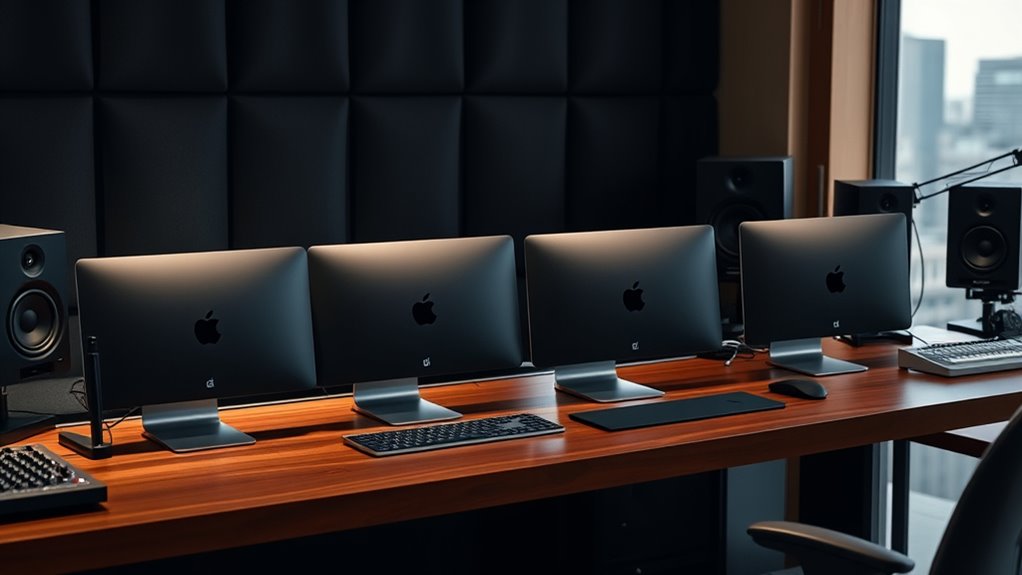

Choosing the right Mac Studio setup for audio production depends heavily on your specific needs, budget, and experience level. For those starting out or working on a tight budget, the Focusrite Scarlett Solo 4th Gen Bundle offers simplicity and quality in a portable package. Meanwhile, the PreSonus AudioBox USB 96 Studio Package provides a comprehensive home studio solution with professional software included. For more advanced users seeking high fidelity and expandability, the PreSonus Studio 24c stands out with its versatile I/O and high sampling rates. Each option balances features and tradeoffs, making it essential to match a product’s strengths to your production goals.

Get kitchen gear delivered free — and shop member deals
- Fast, free delivery on millions of items
- Access to Prime Big Deal Days deals on October 6–7
- Prime Video, Amazon Music and more included
Complete the kit


Key Takeaways
- The PreSonus AudioBox USB 96 Bundle offers an all-in-one solution with professional monitors and mic, ideal for home studios.
- The Focusrite Scarlett Solo 4th Gen is best for beginners and portable recording, despite its limited inputs.
- The PreSonus Studio 24c provides high-quality preamps and multiple sample rates, suited for more serious projects.
- Budget options like the M-Audio M-Track Solo deliver basic recording capabilities at a lower price point.
- Choosing the right setup hinges on your need for expandability, software, and professional-grade hardware.
| PreSonus AudioBox USB 96 Bundle – USB Audio Interface with Studio Monitors, Microphone, and Headphones |  | Best All-in-One Home Studio Package | Audio Interface: PreSonus AudioBox USB 96 | Sample Rate: 96 kHz | Bit Depth: 24 bit | VIEW ON AMAZON | See Our Full Breakdown |
| Focusrite Scarlett Solo 4th Gen USB Audio Interface Bundle for Recording, Songwriting, and Podcasting |  | Best for Beginners and Portability | XLR Mic Preamp: 1 | Hi-Z Instrument Input: 1 | Sample Rate: 192 kHz | VIEW ON AMAZON | See Our Full Breakdown |
| PreSonus AudioBox USB 96 25th Anniversary Studio Recording Package |  | Best Complete Home Recording Solution | Interface: AudioBox USB 96 | Microphone: M7 large-diaphragm condenser | Headphones: HD7 | VIEW ON AMAZON | See Our Full Breakdown |
| PreSonus Studio 24c 2×2 USB Audio Interface with Studio One DAW |  | Best for Serious Home and Small Studio Use | Simultaneous I/O: 2 inputs/2 outputs | Inputs: 2 mic/instrument/line | Outputs: 2 TRS main | VIEW ON AMAZON | See Our Full Breakdown |
| M-Audio M-Track Solo USB Audio Interface |  | Best Budget-Friendly Entry-Level Interface | Inputs: XLR/Line combo with phantom power | Outputs: Stereo RCA, 1/8″ headphone | Resolution: 48kHz | VIEW ON AMAZON | See Our Full Breakdown |
| mac studio for audio production | Software |
|---|---|
| PreSonus AudioBox USB 96 Bundl | — |
| Focusrite Scarlett Solo 4th Ge | — |
| PreSonus AudioBox USB 96 25th | Studio One Artist, Studio Magic |
| PreSonus Studio 24c 2×2 USB Au | Studio One 6 Artist |
| M-Audio M-Track Solo USB Audio | MPC Beats |
More Details on Our Top Picks
PreSonus AudioBox USB 96 Bundle – USB Audio Interface with Studio Monitors, Microphone, and Headphones
This bundle shines for users who want a complete recording setup straight out of the box. The AudioBox USB 96 offers professional 24-bit/96kHz audio quality, paired with high-quality monitors, a condenser microphone, and headphones. Compared to other packages, it delivers more hardware for a similar price, making it ideal for serious hobbyists or semi-professionals. However, its limited inputs (just 2) can become restrictive as your setup grows, and it might overwhelm complete beginners unfamiliar with studio gear.
Pros:- High-fidelity 2×2 audio interface with professional sound quality
- Includes monitors, microphone, and headphones for complete setup
- Compatible with Mac and PC, perfect for home studios
Cons:- Limited to 2 inputs and outputs, restricting expandability
- May be too complex for absolute beginners
Best for: Home studio owners seeking a comprehensive, plug-and-play package
Not ideal for: Users planning larger, multi-instrument setups or live performance use
- Audio Interface:PreSonus AudioBox USB 96
- Sample Rate:96 kHz
- Bit Depth:24 bit
- Included Software:Studio One Pro
- Studio Monitors:PreSonus Eris 3.5
- Microphone:PreSonus M7 MKII
Our verdict“A solid choice for dedicated home studio builders needing a complete, ready-to-record package.”
Focusrite Scarlett Solo 4th Gen USB Audio Interface Bundle for Recording, Songwriting, and Podcasting
This setup is perfect for newcomers or anyone wanting a simple, portable solution. The Scarlett Solo 4th Gen provides high-resolution 24-bit/192kHz audio, with one XLR mic input and one instrument input. Its compact design makes it easy to carry between locations, and the included software enables quick start for recording vocals or guitar. Compared with bulkier interfaces, it’s less intimidating but also more limited in inputs, which might restrict more complex recording projects. Some users find the bundled software a bit overwhelming at first.
Pros:- High-quality 24-bit/192kHz resolution
- Compact and portable design
- Includes professional recording software
Cons:- Limited to one XLR mic input
- May need additional gear for complex setups
Best for: Beginners, streamers, and mobile musicians
Not ideal for: Producers needing multiple inputs or large-scale studio setups
- XLR Mic Preamp:1
- Hi-Z Instrument Input:1
- Sample Rate:192 kHz
- Dynamic Range:120dB
- Included Microphone:CM25 MkIII
- Included Headphones:SH-450
Our verdict“An excellent starter interface that prioritizes portability and ease of use for solo artists.”
PreSonus AudioBox USB 96 25th Anniversary Studio Recording Package
This package offers a straightforward, all-in-one route to get started. The rugged AudioBox USB 96 interface pairs with a large-diaphragm condenser microphone, headphones, and professional software like Studio One Artist. It’s designed primarily for home use, giving users everything needed to record and mix music. Compared with individual components, this package offers better value for newcomers who want a comprehensive setup. Its main limitation is that it’s built with USB 2.0, which may affect future expandability and higher sampling rates.
Pros:- Complete package with hardware, software, and accessories
- High-quality components suitable for serious home recording
- Includes professional-grade software valued over $1000
Cons:- Primarily for home studio use
- Limited connectivity (USB 2.0 only)
Best for: Home recording enthusiasts seeking an all-inclusive starter kit
Not ideal for: Pro users or those needing multi-mic, multi-instrument setups
- Interface:AudioBox USB 96
- Microphone:M7 large-diaphragm condenser
- Headphones:HD7
- Software:Studio One Artist, Studio Magic
- Included accessories:Cables, mic stand
Our verdict“A compelling choice for beginners wanting an easy, all-in-one setup to start recording right away.”
PreSonus Studio 24c 2×2 USB Audio Interface with Studio One DAW
The Studio 24c offers professional-grade features in a compact form. It boasts XMAX-L preamps, multiple sample rate options up to 192 kHz, and MIDI I/O, making it suitable for more demanding projects. Compared to smaller interfaces, its higher-quality preamps and versatile connectivity support more complex workflows. However, it remains limited to 2 inputs and outputs, which could restrict larger setups or session expansion. Its inclusion of Studio One 6 Artist Edition simplifies the software side, but the need for USB-C or USB-A ports can be a constraint for some users.
Pros:- High-quality XMAX-L preamps for clear, detailed recordings
- Supports multiple sample rates up to 192 kHz
- Includes popular Studio One DAW software
Cons:- Limited to 2 inputs and 2 outputs
- Requires USB-C or USB-A connection, which may need adapters
Best for: Prosumers and semi-professionals needing high-quality audio and expandability
Not ideal for: Beginners or users requiring many inputs for multi-instrument recording
- Simultaneous I/O:2 inputs/2 outputs
- Inputs:2 mic/instrument/line
- Outputs:2 TRS main
- Sample Rates:44.1 to 192 kHz
- Connectivity:USB-C and USB-A
- Software:Studio One 6 Artist
Our verdict“Ideal for users who need high fidelity and reliable connectivity for small-scale professional projects.”
M-Audio M-Track Solo USB Audio Interface
The M-Track Solo stands out for its affordability and versatility. It features combo inputs suitable for microphones and instruments, with phantom power for condenser mics. Its 48kHz resolution covers basic recording needs, and it includes MPC Beats software for music production. Compared to higher-end models, it’s less feature-rich and offers fewer I/O options, but it remains a solid choice for those just starting or streaming. Its simplicity means less setup time but also fewer options for future expansion.
Pros:- Versatile combo inputs for mics and instruments
- Affordable price point
- Includes music production software
Cons:- Limited to 48kHz resolution
- No advanced effects or onboard processing
Best for: Beginners, hobbyists, and budget-conscious podcasters
Not ideal for: Pro studios or multi-instrument recording scenarios
- Inputs:XLR/Line combo with phantom power
- Outputs:Stereo RCA, 1/8″ headphone
- Resolution:48kHz
- Software:MPC Beats
Our verdict“A practical, low-cost interface suitable for basic recording, streaming, and podcasting needs.”

How We Picked
Our selection process focused on compatibility with Mac Studio, quality of preamps and converters, expandability, included software, and user versatility. We prioritized products that balance professional features with practical usability for audio production, ensuring options cover beginner to advanced levels. We also considered customer reviews, brand reputation, and overall value to identify setups that deliver reliable performance in a Mac-centric workflow.
| mac studio for audio production | Software |
|---|---|
| PreSonus AudioBox USB 96 Bundl | — |
| Focusrite Scarlett Solo 4th Ge | — |
| PreSonus AudioBox USB 96 25th | Studio One Artist, Studio Magic |
| PreSonus Studio 24c 2×2 USB Au | Studio One 6 Artist |
| M-Audio M-Track Solo USB Audio | MPC Beats |
Factors to Consider When Choosing Mac Studio For Audio Production
When selecting a Mac Studio setup for audio production, consider your experience level, project scope, and future needs. A beginner might prioritize affordability and simplicity, while a professional will look for expandability, high-quality preamps, and software support. Your choice should align with whether you’re building a home studio, mobile setup, or upgrading an existing system. Key factors include I/O options, sample rates, included software, and hardware durability. Understanding these elements helps ensure your investment supports your creative workflow effectively.Assessing Your Needs
Start by defining whether you’re a hobbyist, semi-professional, or pro. Beginners benefit from bundled packages with software and hardware, such as the PreSonus AudioBox bundles, which simplify setup. More advanced users will prioritize high-quality preamps, expandability, and higher sample rates, as seen in the Studio 24c. Consider the number of inputs and outputs you need, especially if you plan to record multiple sources simultaneously.
Hardware Quality and Expandability
Look for interfaces with professional-grade preamps and high sampling rates (at least 96 kHz, ideally 192 kHz). Expandability options like MIDI I/O or additional inputs can be vital as your projects grow. If portability is key, compact designs with basic features may suffice, but larger setups often require more robust hardware with multiple I/O and software compatibility.
Software and Compatibility
Included DAWs like Studio One or Ableton Live can influence your workflow. Ensure the software is compatible with Mac Studio, and check if it suits your style—whether recording, mixing, or producing. Also, confirm hardware connectivity options like USB-C, USB-A, or Thunderbolt, to match your Mac Studio’s ports and future-proof your investment.
Frequently Asked Questions
What is the best audio interface for Mac Studio for beginners?
The Focusrite Scarlett Solo 4th Gen is widely regarded as an excellent entry point for newcomers thanks to its straightforward setup, reliable audio quality, and compact design. It provides enough features for basic recording tasks and includes essential software, making it a practical choice for those just starting out in audio production on Mac.
Can I upgrade my audio interface later after buying a Mac Studio?
Yes, most audio interfaces connect via USB or Thunderbolt, and upgrading is straightforward if your Mac Studio has compatible ports. Choosing an interface with multiple I/O options and support for higher sample rates ensures you won’t need to replace it as your setup expands. Consider models like the Studio 24c for future-proofing, as they support more complex projects and higher fidelity.
Does an audio interface affect the quality of my Mac Studio recordings?
Absolutely. The quality of your audio interface’s preamps, converters, and overall build directly impacts your sound clarity and fidelity. Higher-end interfaces like the PreSonus Studio 24c deliver cleaner, more detailed recordings, especially at higher sample rates, making them suitable for professional or semi-professional work.
What should I consider when choosing software bundled with my interface?
Look for DAWs and plugins that match your workflow. For Mac users, Studio One and Ableton Live are popular options. Ensure the software is compatible with your Mac operating system and offers features aligned with your project goals, whether recording vocals, mixing, or producing beats. Bundled software can add value but should also meet your creative needs.
Is a more expensive audio interface worth it for Mac Studio users?
Higher-priced interfaces generally offer better preamps, higher sample rates, more I/O options, and greater expandability. If your projects demand professional sound quality, multi-channel recording, or future growth, investing in a more capable interface can be worthwhile. For casual or beginner use, however, more affordable options often suffice and provide excellent value.
Conclusion
Choosing the right Mac Studio setup depends heavily on your level of experience and production ambitions. Beginners and casual users should consider affordable, all-in-one options like the Focusrite Scarlett Solo or PreSonus AudioBox bundles, which simplify setup and include essential software. Enthusiasts and semi-professionals will benefit from the versatility and higher fidelity of the Studio 24c, especially if they need more inputs or higher sampling rates. For professionals or those planning large, complex sessions, investing in a high-end interface with expandability will pay off in the long run. Make sure your choice aligns with your current needs and future growth plans, ensuring your Mac Studio can support your creative journey effectively.
Fall Picks
fall essentials
As an affiliate, we earn on qualifying purchases.