A sediment filter for well water in a kitchen can catch grit before it reaches a dedicated drinking-water system, faucet, or appliance—but the cartridge must fit the housing and match the sediment load. My two picks are the Aquaboon 5-Micron 6-Pack for a straightforward replacement supply and the Membrane Solutions 5-Micron 6-Pack for buyers who want a stated capacity range and a material certification claim. Both use standard 10 x 2.5-inch dimensions and target common particles such as sand, rust, and dirt. The main tradeoff is how much documented information you want: Aquaboon emphasizes multilayer melt-blown construction, while Membrane Solutions provides a capacity estimate that depends on the incoming water. Neither cartridge removes dissolved contaminants, and neither is a substitute for water testing or a complete well-water treatment plan.

Get kitchen gear delivered free with Prime
- Fast, free delivery on millions of items
- Prime Video, Amazon Music and more included
- Member-only deals all year
Complete the kit

Key Takeaways
- Aquaboon is my pick for a simple six-cartridge supply, with multilayer melt-blown polypropylene construction and no stated gallon-capacity claim.
- Membrane Solutions suits buyers who value a stated 15,000–20,000-gallon capacity range, though actual service life varies with sediment conditions.
- Both cartridges are 5-micron, 10 x 2.5-inch replacements; verify your housing’s dimensions and cartridge requirements before ordering.
- A 5-micron sediment cartridge targets suspended particles such as sand and rust, not dissolved minerals, bacteria, or chemicals.
- For a kitchen drinking-water setup, test well water and check whether the sediment cartridge belongs before the kitchen filter or at another point in the plumbing.
| Aquaboon 5-Micron Sediment Water Filter Replacement, 10 x 2.5 in, 6-Pack | 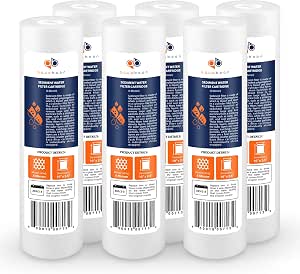 | Best Overall for a straightforward standard-housing replacement | Dimensions: 10 x 2.5 inches | Pack quantity: 6 filters | Material: Food-grade polypropylene | VIEW ON AMAZON | See Our Full Breakdown |
| Membrane Solutions 5-Micron String-Wound Whole-House Water Filter Cartridges, 10 x 2.5 Inches, 6-Pack |  | Best for Buyers Who Want a Stated Capacity Range | Model: WPP-F10-5 | Dimensions: 10 x 2.5 inches | Pack quantity: 6 cartridges | VIEW ON AMAZON | See Our Full Breakdown |
| sediment filter for well water kitchen | Dimensions | Pack quantity | Material | Construction |
|---|---|---|---|---|
| Aquaboon 5-Micron Sediment Wat | 10 x 2.5 inches | 6 filters | Food-grade polypropylene | Multilayer melt-blown |
| Membrane Solutions 5-Micron St | 10 x 2.5 inches | 6 cartridges | — | — |
More Details on Our Top Picks
Aquaboon 5-Micron Sediment Water Filter Replacement, 10 x 2.5 in, 6-Pack
The Aquaboon 5-micron cartridge is the cleaner fit for a buyer who wants a familiar sediment-filter replacement without relying on a gallon estimate to plan maintenance. Its multilayer, melt-blown polypropylene design is described as capturing rust, sand, dirt, and sludge, the kinds of visible particles that can collect in a well-water line and burden downstream equipment. The six-pack also gives a household replacements on hand, which can be useful when a cartridge clogs sooner than expected after a change in water conditions.
Against the Membrane Solutions cartridge, Aquaboon’s strongest distinction is its specified multilayer melt-blown construction, rather than a published capacity range. That construction description gives buyers a clearer picture of the filter format, but it does not provide independent removal data or a reliable replacement interval. Membrane Solutions is easier to plan around on paper because it states a capacity range; Aquaboon is the more straightforward pick if a standard fit and a simple particle-capture role matter more than that estimate.
The cartridge measures 10 x 2.5 inches and is described as fitting most standard housings. “Most” does not mean every housing: check the existing cartridge dimensions, end style, and manufacturer guidance before buying. Its food-grade polypropylene material is a useful material detail, but it does not make this cartridge a drinking-water purifier by itself. I would use it as a sediment stage and rely on appropriate testing and any separate treatment needed for dissolved or microbiological contaminants.
Aquaboon’s main weakness is limited service-life information. The supplied description offers no stated gallon capacity or independent performance figures, so a buyer cannot confidently predict how often the cartridge will need replacement from the listing alone. For a well with heavy sand or rapidly changing turbidity, inspection and pressure or flow changes should guide maintenance. Compared with Membrane Solutions, this pick gives less planning detail but keeps the decision simple: choose it when its construction and six-cartridge format fit your housing and replacement routine.
Pros:- Multilayer melt-blown polypropylene construction is specified.
- Designed to capture common particles including rust, sand, dirt, and sludge.
- Food-grade polypropylene material is identified.
- Six cartridges provide replacements for a compatible standard housing.
Cons:- Compatibility depends on the specific housing and cartridge design.
- No independent performance results or stated service-life capacity are provided.
- A sediment cartridge does not address dissolved or microbiological contaminants.
Best for: Kitchen or household owners replacing a standard 10 x 2.5-inch sediment cartridge who want a six-pack and a clearly described melt-blown design.
Not ideal for: Buyers who need a documented gallon-capacity estimate, independent performance data, or a complete solution for dissolved contaminants and microbes.
- Dimensions:10 x 2.5 inches
- Pack quantity:6 filters
- Material:Food-grade polypropylene
- Construction:Multilayer melt-blown
- Compatibility:Most standard filter housings; verify the specific housing
- Target particles:Rust, sand, dirt, and sludge
Our verdict“I’d choose Aquaboon for a simple, standard-housing sediment replacement when construction details matter more than a stated capacity estimate.”
Membrane Solutions 5-Micron String-Wound Whole-House Water Filter Cartridges, 10 x 2.5 Inches, 6-Pack
Membrane Solutions earns its place as the more specification-led alternative. Like Aquaboon, it is a 5-micron polypropylene cartridge in a 10 x 2.5-inch format, intended to capture sediment, rust, sand, and other undissolved particles. Its distinguishing detail is a stated capacity of up to 15,000–20,000 gallons, with the manufacturer noting that water quality affects the result. That range can help a buyer frame maintenance expectations, but it should not be treated as a guaranteed interval for a well with an unknown sediment load.
Compared with Aquaboon’s multilayer melt-blown design, this cartridge is identified as string-wound. The supplied information also names NSF/ANSI 42 certification for material requirements only. That scope matters: it is a material-related certification claim, not evidence that the cartridge removes every contaminant or that the whole filter assembly has a particular treatment performance. I would count those details as useful documentation, not as proof of a broader purification function.
The six-cartridge pack fits most 10-inch housings and lists compatibility with selected GE and Whirlpool models. That makes it a plausible replacement for buyers who have checked their existing cartridge, but the phrase “most housings” still calls for a fit check. In a kitchen system, the same caution applies to installation location: confirm that your housing is rated for the intended use and that the cartridge’s flow and particle rating suit the rest of the setup.
The capacity statement is the key advantage over Aquaboon, and also a potential source of false confidence. A sandy or rusty well can load a cartridge well before the upper estimate, while cleaner water may allow a longer run. The supplied guidance says to replace at least every six months, but actual timing should also follow changes in flow, pressure, or visible sediment and the housing maker’s instructions. I rank it behind Aquaboon because the capacity range is conditional and does not establish better filtration; it is the better match when planning guidance and a stated material certification claim are priorities.
Pros:- Stated capacity range of up to 15,000–20,000 gallons, depending on water quality.
- Designed to capture sediment, rust, sand, and other undissolved particles.
- Fits most 10-inch housings, with selected GE and Whirlpool models listed.
- Six cartridges included; NSF/ANSI 42 material requirements claim is specified.
Cons:- Actual capacity and replacement timing depend on inlet-water conditions.
- Manufacturer recommends replacement at least every six months.
- The certification detail applies to material requirements only, not broad contaminant removal.
Best for: Buyers who want a string-wound 5-micron replacement with a stated, water-quality-dependent capacity range and material certification details.
Not ideal for: Anyone expecting the gallon estimate to guarantee cartridge life, or seeking treatment for dissolved chemicals, minerals, or microorganisms.
- Model:WPP-F10-5
- Dimensions:10 x 2.5 inches
- Pack quantity:6 cartridges
- Material and construction:Polypropylene; string-wound
- Stated capacity:Up to 15,000–20,000 gallons, depending on water quality
- Certification:NSF/ANSI 42, material requirements only
- Replacement guidance:At least every six months; water conditions may require earlier replacement
- Listed compatible models:GE GNSV70R and Whirlpool WHKF-GD05
Our verdict“I’d pick Membrane Solutions over Aquaboon when a stated capacity range and material documentation help with planning, while treating both as sediment-only cartridges.”

How We Picked
I compared these cartridges against the needs implied by well water used in a kitchen: capturing common suspended particles, fitting a standard housing, and giving the buyer enough information to plan replacements. Both products have the same nominal micron rating and cartridge dimensions, so I gave more weight to their differences in construction details, capacity guidance, and the clarity of their limitations. I also looked at whether the supplied information distinguishes sediment filtration from broader water treatment; a particulate cartridge should not be mistaken for a solution to every well-water concern.
My ranking is based on how useful each option is for a typical buyer replacing a 10-inch cartridge. Aquaboon ranks first for its clear multilayer melt-blown description and uncomplicated role as a standard sediment replacement, while Membrane Solutions ranks second as the more specification-led choice for buyers who want a stated capacity range. That order is not a claim that one will perform better in every well. Well-water sediment varies considerably, and cartridge life depends on the amount and type of material entering the filter. Product details supplied here do not establish comparative, independent performance results, so I avoid treating either manufacturer’s claims as a direct head-to-head test.
Factors to Consider When Choosing Sediment Filter For Well Water Kitchen
For kitchen well water, I treat a sediment cartridge as one stage in a system, not a one-cartridge answer to water quality. These two options share a 5-micron rating and common dimensions, so the choice comes down to fit, construction information, and how you plan replacements.
Start With the Housing, Not the Brand
Before choosing either cartridge, check the old filter’s length, diameter, end shape, and required cartridge type. Both picks are listed at 10 x 2.5 inches, but that measurement alone does not prove compatibility with every housing. Some housings use different cartridge lengths, seals, or proprietary formats. If the filter is part of a kitchen system, check the system manual as well as the cartridge listing; a cartridge that physically fits may still be unsuitable for the housing’s intended flow or use.
What a 5-Micron Sediment Cartridge Can—and Cannot—Do
A 5-micron sediment filter is intended to capture suspended particles such as grit, sand, and rust. That can reduce the amount of visible debris reaching downstream plumbing or a separate kitchen filter. It does not establish removal of dissolved minerals, metals, chemicals, or microorganisms. For a private well, I would use a water test to identify treatment needs rather than assume that clearer-looking water is safe or fully treated. The two products here are sediment cartridges, not all-purpose purifiers.
Choose Between Melt-Blown and String-Wound Details
Aquaboon describes its cartridge as multilayer melt-blown polypropylene, while Membrane Solutions identifies a string-wound polypropylene design. Those construction descriptions help distinguish the products, but the supplied information does not provide independent head-to-head test results. I would not infer a guaranteed difference in removal or lifespan from construction labels alone. If you value a clear construction description, Aquaboon is the more direct choice; if a capacity estimate and material certification detail matter more, Membrane Solutions offers more planning information.
Plan Replacement Around Your Water
Membrane Solutions states capacity of up to 15,000–20,000 gallons, but makes that estimate dependent on water quality and recommends replacement at least every six months. Aquaboon supplies no gallon-capacity figure. In either case, well-water sediment load can change cartridge life. Check for reduced flow, pressure changes, visible loading, or other signs identified by your housing instructions. A household with a sudden increase in sand or rust may need more frequent changes than a household with relatively clear inlet water.
Think About Filter Placement in a Kitchen Setup
A sediment stage may be installed ahead of a kitchen drinking-water filter to protect it from larger particles, but the right arrangement depends on the system design and the cartridge’s rated use. Follow the housing and treatment-system instructions rather than improvising a connection. If sediment is affecting the whole house, a point-of-entry setup may be more appropriate than relying only on an under-sink cartridge. Match the filter location to the problem, and test well water to decide whether additional treatment is needed.
Frequently Asked Questions
Will either cartridge make well water safe to drink?
No. Both products are described as sediment filters for particles such as sand, rust, and dirt. That function does not demonstrate removal of bacteria, viruses, dissolved metals, nitrates, pesticides, or other contaminants. I would test private well water through an appropriate laboratory and select any additional treatment based on the results. Clear water is not, by itself, proof of safe drinking water.
Are these two 10 x 2.5-inch cartridges interchangeable?
They share the listed 10 x 2.5-inch dimensions and are described as compatible with most standard housings, but I would not assume a universal fit. Check the existing cartridge, housing manual, seal arrangement, and any manufacturer-specific requirements before ordering. Membrane Solutions lists selected GE and Whirlpool models, while Aquaboon advises that compatibility can vary by housing.
Which option is better for a well with frequent sediment?
Neither listing establishes a comparative performance winner for heavy sediment conditions. Aquaboon describes multilayer melt-blown construction, while Membrane Solutions provides a conditional capacity range; those details do not guarantee how long either cartridge will last in a particular well. For frequent grit or rapid clogging, monitor flow and pressure, inspect cartridges as directed, and consider whether a larger-capacity prefilter or a different treatment arrangement is appropriate.
How often should I replace a sediment cartridge?
Replacement timing depends on water quality, usage, housing instructions, and changes in flow or pressure. Membrane Solutions recommends replacement at least every six months, while its stated gallon capacity is conditional on inlet-water quality. Aquaboon does not provide a gallon-capacity estimate. Use the product and housing guidance, and check the cartridge more often if your well carries visible sediment or flow drops noticeably.
Does NSF/ANSI 42 mean the Membrane Solutions cartridge removes all contaminants?
No. The supplied product details specify NSF/ANSI 42 for material requirements only. That statement should not be read as proof of broad contaminant removal or as certification of a complete kitchen treatment system. Check the exact certification scope and test results for any contaminant you need to address, and base well-water treatment on a current water test.
Conclusion
For a buyer who wants a straightforward standard-housing replacement with a clearly described melt-blown design, I would choose Aquaboon. If you prefer a stated capacity range and material certification detail and understand that capacity depends on your water, Membrane Solutions is the stronger fit. For either option, confirm the housing dimensions before purchase and plan maintenance around actual well conditions rather than assuming a fixed lifespan. If your goal is safe drinking water rather than particle control alone, test the well and pair sediment filtration with treatment matched to the results.