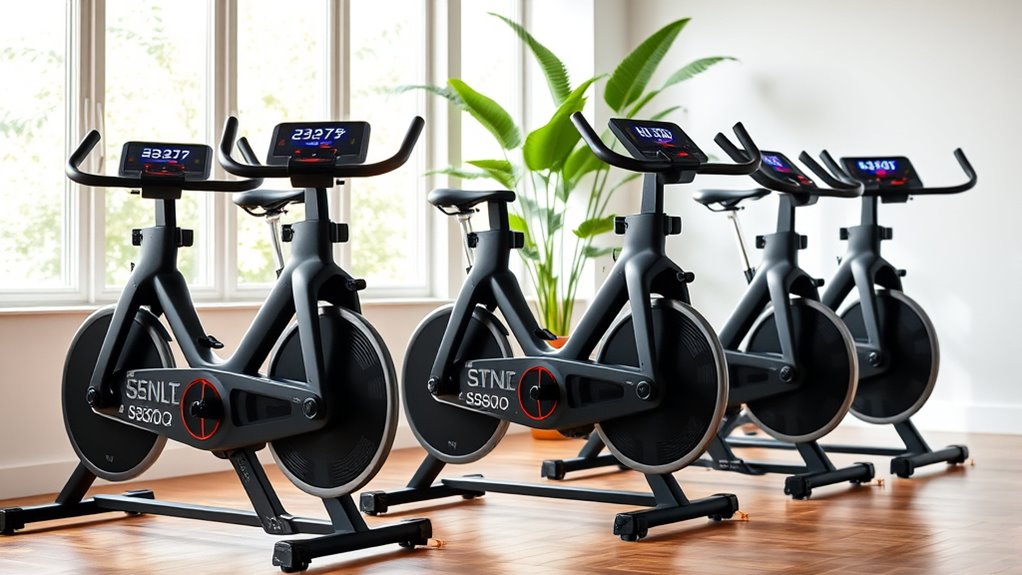
For a spin bike for home training, I’d start with the YOSUDA Pro Magnetic Exercise Bike as the strongest all-around option, while the YOSUDA Magnetic Exercise Bike 002C stands out for app connectivity and the GOFLYSHINE Indoor Exercise Bike for riders who prefer a simple LCD display. The main tradeoffs are adjustability and ride feel versus footprint, connected features, and setup demands. A magnetic-resistance model may suit riders seeking quieter adjustments, while a basic monitor can be enough for workouts without an app. Continue reading for the full breakdown of all 13 bikes and guidance on choosing for your space, routine, and experience level.

Get kitchen gear delivered free with Prime
- Fast, free delivery on millions of items
- Prime Video, Amazon Music and more included
- Member-only deals all year
Complete the kit


Key Takeaways
- The lineup splits between connected and straightforward training: several YOSUDA, MERACH, OLIXIS, pooboo, and CURSOR models emphasize app support, while the GOFLYSHINE model is specifically listed with an LCD monitor.
- Magnetic resistance appears across many of the options, including the YOSUDA Pro, MERACH S26, pooboo, and YPOO; compare the actual adjustment method and controls rather than assuming every magnetic bike offers the same ride.
- Fit deserves priority over feature count: adjustable seat and handlebars are explicit on the CURSOR Fitness bike, making rider position a key point to verify across models.
- App connectivity is not a complete training system by itself: check what the app controls or tracks, whether a subscription is needed, and whether the bike remains useful without a phone.
- The product names alone do not establish a clear premium-versus-value hierarchy, so compare each listing’s dimensions, weight limits, resistance details, warranty, and included accessories before deciding which model earns the higher spend.
| CURSOR Fitness Indoor Exercise Bike with Adjustable Seat and Handlebars |  | Best for Simple, Quick Setup | Resistance mechanism: Friction | Resistance levels: 100 | Drive system: Belt | VIEW ON AMAZON | See Our Full Breakdown |
| YOSUDA Pro Magnetic Exercise Bike |  | Best for Connected Workout Tracking | Resistance: Magnetic, 0–100 levels | Drive: Belt drive | Weight capacity: Listing is inconsistent: 300 pounds in one specification and 350 pounds elsewhere | VIEW ON AMAZON | See Our Full Breakdown |
| MERACH S26 Magnetic Resistance Indoor Exercise Bike |  | Best for App Variety and Rider Fit | Resistance: Adjustable magnetic resistance, 0–100% | Weight capacity: 300 pounds | Noise level: Under 25 dB | VIEW ON AMAZON | See Our Full Breakdown |
| Exercise Bike Stationary Indoor Spin Bike for Home Cardio Fitness Workout |  | Best for Enclosed-Wheel Safety | Resistance: Magnetic, 9 levels | Weight capacity: 300 pounds | Frame material: High-carbon steel | VIEW ON AMAZON | See Our Full Breakdown |
| YOSUDA Magnetic Exercise Bike 002C with App Connectivity |  | Best for Broad Rider-Height Fit | Resistance mechanism: Magnetic, stepless | Resistance levels: 100 | Drive system: Belt | VIEW ON AMAZON | See Our Full Breakdown |
| RELIFE REBUILD YOUR LIFE Indoor Exercise Bike |  | Best for Shorter Riders | Model: EB801 (model number CA-EB801) | Drive system: Belt-driven | Operating noise: Below 25 dB | VIEW ON AMAZON | See Our Full Breakdown |
| OLIXIS Indoor Exercise Bike with App Control |  | Best for App Variety | Model: BIUCWE | Frame: Metal | Weight capacity: 300 lbs | VIEW ON AMAZON | See Our Full Breakdown |
| pooboo Stationary Exercise Bike with Magnetic Resistance and App Connectivity |  | Best for High-Capacity, Tracked Training | Model: D525KM16 | Resistance: 100-level magnetic resistance | Drive and noise: Belt drive; below 25 dB | VIEW ON AMAZON | See Our Full Breakdown |
| Merach Exercise Bike – Magnetic Friction Stationary Bike with App |  | Best for a Broad Rider Height Range | Model: MR-S26B1 | Weight capacity: 300 lbs | Rider height range: 4’8″–6’2″ | VIEW ON AMAZON | See Our Full Breakdown |
| GOFLYSHINE Stationary Indoor Exercise Bike with LCD Monitor |  | Best for Simple, Self-Contained Workouts | Model: 290 | Frame: Alloy steel | Maximum user weight: 200 lbs | VIEW ON AMAZON | See Our Full Breakdown |
| YOSUDA 002 Indoor Exercise Bike with App Support |  | Best for a Broad Rider-Height Range | Flywheel: 25 lbs | Drive system: Belt-driven | Frame: Heavy-duty steel | VIEW ON AMAZON | See Our Full Breakdown |
| YPOO Adjustable Magnetic Resistance Exercise Bike |  | Best for App-Compatible Quiet Training | Resistance: Adjustable magnetic resistance, 0–100% | Drive system: Maintenance-free belt drive | Maximum user weight: 300 lbs | VIEW ON AMAZON | See Our Full Breakdown |
| CURSOR Magnetic Exercise Bike with App Training |  | Best for Compact, Metric-Focused Workouts | Model: CBE50 | Resistance: Magnetic; 100 levels | Drive system: Belt | VIEW ON AMAZON | See Our Full Breakdown |
| spin bike for home training | Resistance | Drive system | Weight capacity |
|---|---|---|---|
| CURSOR Fitness Indoor Exercise | — | Belt | — |
| YOSUDA Pro Magnetic Exercise B | Magnetic, 0–100 levels | — | Listing is inconsistent: 300 pounds in one specification and 350 pounds elsewhere |
| MERACH S26 Magnetic Resistance | Adjustable magnetic resistance, 0–100% | — | 300 pounds |
| Exercise Bike Stationary Indoo | Magnetic, 9 levels | — | 300 pounds |
| YOSUDA Magnetic Exercise Bike | — | Belt | — |
| RELIFE REBUILD YOUR LIFE Indoo | Adjustable from 0% to 100% | Belt-driven | 280 lbs |
| OLIXIS Indoor Exercise Bike wi | — | — | 300 lbs |
| pooboo Stationary Exercise Bik | 100-level magnetic resistance | — | 350 lbs |
| Merach Exercise Bike | Magnetic friction | — | 300 lbs |
| GOFLYSHINE Stationary Indoor E | Adjustable, infinite resistance | Belt drive | — |
| YOSUDA 002 Indoor Exercise Bik | — | Belt-driven | — |
| YPOO Adjustable Magnetic Resis | Adjustable magnetic resistance, 0–100% | Maintenance-free belt drive | — |
| CURSOR Magnetic Exercise Bike | Magnetic; 100 levels | Belt | — |
More Details on Our Top Picks
CURSOR Fitness Indoor Exercise Bike with Adjustable Seat and Handlebars
The CURSOR Fitness makes the most sense for home riders who want a straightforward spin bike and would rather avoid a long setup. Its tool-free assembly is listed as taking under 30 minutes, and the belt drive is designed to keep noise below 25 dB—useful when workouts share space with other household routines. Seat and handlebar adjustments give it more fit flexibility than a bare-bones bike, while the 300-pound capacity matches several options here.
The key tradeoff is its friction resistance: unlike the magnetic systems on the YOSUDA Pro and MERACH S26, friction can mean more contact wear over time. Its 100 resistance levels offer fine adjustment, but the listing’s battery-powered specification lacks battery details. Choose this CURSOR for easy assembly and simple training; skip it if you want app-connected tracking or a magnetic system.
Pros:- Tool-free assembly is listed as taking under 30 minutes
- Belt drive is designed for quiet riding below 25 dB
- Seat and handlebars both adjust to help fit different riders
- Listed maximum user weight is 300 pounds
Cons:- Friction resistance differs from the quieter-contact magnetic systems on several alternatives
- Battery-powered specification is listed without details about the battery or its function
Best for: Riders who want a basic home spin bike with quick assembly, adjustable touchpoints, and a listed 300-pound capacity.
Not ideal for: Buyers prioritizing magnetic resistance, app-connected workouts, or clear information about the bike’s battery-powered feature.
- Resistance mechanism:Friction
- Resistance levels:100
- Drive system:Belt
- Maximum user weight:300 pounds
- Item weight:39.7 pounds
- Seat adjustment:2-way, 8 vertical settings
- Handlebar adjustment:4 vertical settings
- Noise level:Below 25 dB
- Assembly time:Under 30 minutes
Our verdict“Choose the CURSOR if fast setup and basic quiet home rides matter more than magnetic resistance or connected training features.”
YOSUDA Pro Magnetic Exercise Bike
The YOSUDA Pro stands out for riders who want their home bike to support more than a basic ride. Its Bluetooth app support, LCD metrics, and tablet and water bottle holders make it easier to follow a session and keep essentials close. The magnetic resistance and belt drive are listed at 20 dB or less, giving it a quieter setup than the CURSOR Fitness, which uses friction resistance and is specified below 25 dB.
Its six-way seat adjustment offers more positioning options than the MERACH S26’s general seat-adjustment description, although the MERACH provides a stated rider-height range and named app compatibility. One practical concern is the conflicting capacity information: the listing says both 300 and 350 pounds. I would want that clarified before buying, and the bike still needs assembly despite arriving 80% pre-assembled.
Pros:- Magnetic resistance and belt drive are specified at 20 dB or less
- LCD tracks time, speed, distance, calories, and heart rate
- Bluetooth app support adds connected workout tracking
- Six-way seat adjustment and two-way handlebar adjustment support fit changes
Cons:- The listing gives conflicting weight capacities of 300 and 350 pounds
- Assembly is still required, even though the bike arrives 80% pre-assembled
Best for: Home cyclists who want an LCD display, Bluetooth workout tracking, and convenient places for a tablet and water bottle.
Not ideal for: Buyers who need a clearly stated weight limit or want a bike that arrives fully assembled.
- Resistance:Magnetic, 0–100 levels
- Drive:Belt drive
- Weight capacity:Listing is inconsistent: 300 pounds in one specification and 350 pounds elsewhere
- Display metrics:Time, speed, distance, calories, and heart rate
- Connectivity:Bluetooth app support
- Seat adjustment:6-way
- Handlebar adjustment:2-way
- Noise level:20 dB or less
- Assembly:80% pre-assembled
Our verdict“Pick the YOSUDA Pro for built-in tracking and connected rides, but confirm its weight capacity before purchase.”
MERACH S26 Magnetic Resistance Indoor Exercise Bike
The MERACH S26 is a strong fit for households where riders want connected training and a clearly stated range of bike fit. Its 4’8″–6’2″ rider-height range makes suitability easier to judge than on the YOSUDA Pro, whose listing describes adjustment options but no height range. The bike pairs magnetic resistance with compatibility for MERACH, KINOMAP, Zwift, Google Fit, and Apple Health, so buyers can choose among several tracking platforms instead of relying on a single named app.
It also includes a tablet holder, dumbbell rack, and water bottle holders, giving home workouts more setup flexibility than the simpler CURSOR Fitness. The tradeoff is that app features require a compatible device, and assembly remains necessary despite the bike arriving 80% pre-assembled. Its one-year warranty is useful product data, but buyers should not mistake broad app compatibility for an included screen or device.
Pros:- Stated rider-height range makes fit easier to assess
- Works with MERACH, KINOMAP, Zwift, Google Fit, and Apple Health
- Magnetic resistance and noise level under 25 dB suit indoor training
- Includes a tablet holder, dumbbell rack, and water bottle holders
Cons:- Assembly is required after delivery
- App features depend on having a compatible device
Best for: Households with riders from 4’8″ to 6’2″ who want magnetic resistance and a choice of fitness and health apps.
Not ideal for: Buyers who do not have a compatible phone or tablet, or who want a bike ready to ride without assembly.
- Resistance:Adjustable magnetic resistance, 0–100%
- Weight capacity:300 pounds
- Noise level:Under 25 dB
- Rider height range:4’8″–6’2″
- Frame material:Alloy steel
- App compatibility:MERACH, KINOMAP, Zwift, Google Fit, and Apple Health
- Warranty:1 year
- Assembly:80% pre-assembled
Our verdict“Choose the MERACH S26 if a defined rider-height range and broad app compatibility matter more than a simpler setup.”
Exercise Bike Stationary Indoor Spin Bike for Home Cardio Fitness Workout
The Wdemngg is the most safety-focused choice in this group: its fully enclosed flywheel helps shield moving parts from children and pets, a feature not specified for the MERACH S26 or YOSUDA bikes. Its magnetic system has nine resistance levels, and the bike connects with Kinomap, Zwift, and Fitshow. Built-in handlebar heart-rate sensors add a basic tracking option without requiring a separate chest strap.
That simpler resistance range is also its main limit. Riders building structured sessions may prefer the YOSUDA Pro or MERACH S26, both of which list 0–100 resistance adjustment for finer changes. Wdemngg also lacks an integrated display, so detailed metrics depend on an external device. Its adjustable seat and 300-pound capacity make it a practical home option, but the listing does not provide a noise measurement or specific rider-height range.
Pros:- Fully enclosed flywheel shields moving parts from children and pets
- Magnetic resistance supports quiet home workouts
- Connects with Kinomap, Zwift, and Fitshow
- Built-in handlebar sensors measure heart rate
Cons:- Nine resistance levels offer less adjustment detail than the 0–100 systems on the YOSUDA Pro and MERACH S26
- No integrated display; detailed workout metrics rely on an external device
- No rider-height range or numeric noise level is provided
Best for: Families who want a magnetic home spin bike with an enclosed flywheel and basic handlebar heart-rate sensing.
Not ideal for: Cyclists who need fine-grained resistance changes, an onboard display, or a stated rider-height range.
- Resistance:Magnetic, 9 levels
- Weight capacity:300 pounds
- Frame material:High-carbon steel
- Seat adjustment:Up/down and front/back
- Connectivity:Kinomap, Zwift, and Fitshow
- Heart-rate monitor:Built-in handlebar sensors
- Warranty:1 year
- Display:No integrated display screen
Our verdict“Choose the Wdemngg if enclosed moving parts matter more to your household than fine resistance control or an onboard screen.”
YOSUDA Magnetic Exercise Bike 002C with App Connectivity
The YOSUDA 002C is a sensible pick for riders who want a broad stated fit range and quiet, app-connected home training. Its 4’8″–6’2″ range is clearer than the fit information provided for the CURSOR Fitness, while its four-way seat adjustment lets riders adjust both height and fore-aft position. The stepless magnetic resistance gives continuous control rather than the Wdemngg’s nine fixed levels, which can help when making small effort changes during a ride.
A 25-pound flywheel and belt drive round out a familiar indoor-cycling setup, and Bluetooth adds access to workout metrics and trainer-led sessions. The tradeoff is warranty coverage: the frame is listed for three months, while parts are listed for 12 months. Compared with the YOSUDA Pro, this model has a stated rider-height range and flywheel weight, but the Pro lists an LCD and additional handlebar adjustment.
Pros:- Stated rider-height range spans 4’8″ to 6’2″
- Stepless magnetic resistance allows continuous adjustment
- Bluetooth app connectivity supports workout metrics and trainer-led sessions
- Belt drive and magnetic resistance are designed for quiet riding
Cons:- Frame warranty is listed as three months, shorter than the 12-month parts warranty
- No integrated display is specified, unlike the YOSUDA Pro
Best for: Riders between 4’8″ and 6’2″ who want continuous magnetic resistance and Bluetooth-linked training sessions.
Not ideal for: Buyers who want a longer frame warranty, an integrated LCD display, or more handlebar adjustment options.
- Resistance mechanism:Magnetic, stepless
- Resistance levels:100
- Drive system:Belt
- Flywheel weight:25 pounds
- Maximum user weight:300 pounds
- Rider height range:4’8″–6’2″
- Seat adjustment:4-way
- Item weight:27 kg
- Warranty:3 months for overall framework; 12 months for parts
Our verdict“Choose the YOSUDA 002C for its stated height range and continuous magnetic resistance, but look elsewhere if frame warranty length is a priority.”
RELIFE REBUILD YOUR LIFE Indoor Exercise Bike
The RELIFE is the most clearly size-targeted option in this group: its stated rider range of 4’8″–5’8″ and six-way seat adjustment make fit the main reason to choose it. The quiet belt drive, rated below 25 dB, is also suited to shared homes, while the tablet mount and LED display cover basic at-home tracking and entertainment. Compared with the pooboo D525KM16, which accommodates riders up to 6’3″ and supports a higher load, the RELIFE has a much narrower fit window and fewer listed connected-workout features. In return, its compact design and transport wheels may suit a smaller room. The 280 lb capacity is a useful boundary, and some assembly remains despite the bike arriving 80% pre-assembled. Taller riders should skip it rather than assume the adjustments will compensate.
Pros:- Stated fit range and six-way seat adjustment are tailored to shorter riders.
- Belt drive operates below 25 dB, a practical advantage in shared homes.
- Compact frame and transport wheels make repositioning easier.
- Tablet mount and LED display support basic guided workouts and ride tracking.
Cons:- The 4’8″–5’8″ rider range excludes many taller users.
- 280 lb weight capacity is lower than the pooboo and OLIXIS options.
- Some assembly is required.
Best for: Shorter riders between 4’8″ and 5’8″ who want a quiet, compact bike for regular home sessions.
Not ideal for: Riders taller than 5’8″ or households needing a higher weight capacity and app-connected training options.
- Model:EB801 (model number CA-EB801)
- Drive system:Belt-driven
- Operating noise:Below 25 dB
- Resistance:Adjustable from 0% to 100%
- Weight capacity:280 lbs
- Rider height range:4’8″–5’8″
- Adjustments:Six-way adjustable seat; six-level handlebar height adjustment
- Display and assembly:LED display; 80% pre-assembled
Our verdict“Choose the RELIFE if you are a shorter rider seeking quiet, compact training, but skip it if you need a broader fit range or app connectivity.”
OLIXIS Indoor Exercise Bike with App Control
The OLIXIS suits riders who want several app choices without giving up straightforward resistance adjustment. Its infinite resistance lets you make gradual changes instead of choosing from a fixed set of levels, while compatibility with FITSHOW, KINOMAP, and Zwift opens up different styles of guided or virtual riding. The 300 lb capacity and cushioned seat with spring suspension add practical support for frequent home workouts. Compared with the pooboo D525KM16, OLIXIS lists three compatible platforms but does not specify Bluetooth syncing with Apple Health or Google Fit, and pooboo supports a higher weight limit. The LCD tracks basic ride metrics, including pulse, but the connected experience depends on having a compatible app and device. Its listed dimensions also call for a dedicated footprint rather than an assumed corner fit.
Pros:- Infinite resistance supports fine adjustments as workout intensity changes.
- Compatible with FITSHOW, KINOMAP, and Zwift.
- 300 lb capacity and adjustable seat and handlebars support a range of home riders.
- Foam-and-spring seat suspension adds cushioning for longer sessions.
Cons:- Connected workouts depend on a compatible app and device.
- Its 300 lb capacity is below the pooboo D525KM16’s 350 lb limit.
- The 43.1 x 20.5 x 47.6 in dimensions may be awkward in very tight workout areas.
Best for: Home riders who want to choose among FITSHOW, KINOMAP, and Zwift and prefer finely adjustable resistance.
Not ideal for: Buyers who want workout data to sync directly with Apple Health or Google Fit, or who need capacity above 300 lbs.
- Model:BIUCWE
- Frame:Metal
- Weight capacity:300 lbs
- Drive and resistance:Belt drive; infinite resistance
- App compatibility:FITSHOW, KINOMAP, and Zwift
- LCD metrics:Scan, time, speed, distance, calories, and pulse
- Adjustments:Five-level handlebar adjustment; seven-level seat adjustment
- Dimensions:43.1 x 20.5 x 47.6 in
- Seat:PU with foam and spring suspension
Our verdict“Pick the OLIXIS if app choice and gradual resistance control matter most, but choose pooboo if you need more capacity or listed health-data syncing.”
pooboo Stationary Exercise Bike with Magnetic Resistance and App Connectivity
The pooboo stands out for combining a 350 lb capacity with 100-level magnetic resistance and broad workout tracking. That range gives riders more control over small intensity changes than a basic adjustable-resistance setup, while the quiet belt drive is rated below 25 dB for home use. Its stated rider range of 4.9–6.3 ft is also much broader than the RELIFE’s 4’8″–5’8″ window. App support includes MERACH, Kinomap, and Zwift, with workout data syncing to Apple Health and Google Fit. Compared with the OLIXIS BIUCWE, pooboo offers greater capacity and named health-platform syncing; OLIXIS, however, lists pulse among its LCD metrics. Connected features require a compatible device, and riders outside the stated height range should check fit before choosing it.
Pros:- 350 lb weight capacity is the highest among these five bikes.
- 100-level magnetic resistance allows small changes in workout intensity.
- Compatible with MERACH, Kinomap, and Zwift, with Apple Health and Google Fit syncing.
- Quiet belt drive is rated below 25 dB.
Cons:- Connected training and data syncing require a compatible app or device.
- The stated rider range may not fit people shorter than 4.9 ft or taller than 6.3 ft.
- The 12-month warranty is a defined support period buyers should compare with their needs.
Best for: Riders who need a higher-capacity bike, detailed resistance adjustment, and app-linked workout tracking at home.
Not ideal for: Buyers who prefer a fully self-contained workout without a compatible app or device, or riders outside the 4.9–6.3 ft fit range.
- Model:D525KM16
- Resistance:100-level magnetic resistance
- Drive and noise:Belt drive; below 25 dB
- Weight capacity:350 lbs
- Rider height range:4.9–6.3 ft
- Connectivity:Bluetooth; MERACH app, Kinomap, and Zwift compatibility
- Workout data sync:Apple Health and Google Fit
- Display:LCD monitor
- Warranty:12 months
Our verdict“Choose pooboo for its higher capacity, fine resistance steps, and health-app syncing; skip it if you want app-free training or fall outside its listed fit range.”
Merach Exercise Bike – Magnetic Friction Stationary Bike with App
The Merach MR-S26B1 is a fit-focused choice for households where riders vary in height: its stated range spans 4’8″ to 6’2″, wider than the RELIFE and close to the pooboo’s listed coverage. The triangular alloy-steel frame supports up to 300 lb, while noise below 25 dB suits indoor training around other people. Its app links to Kinomap and Zwift, with Google Fit and Apple Health compatibility for riders who track activity across platforms. Compared with the pooboo D525KM16, Merach lists explicit seat and handlebar height ranges but has a lower weight capacity and does not specify 100 resistance levels. The provided information calls the resistance magnetic friction, so buyers should not assume a specific fine-grained adjustment count. Setup may take effort, and the footprint can challenge very small rooms.
Pros:- Stated rider range from 4’8″ to 6’2″ suits many mixed-height households.
- Triangular alloy-steel frame supports up to 300 lbs.
- Noise level below 25 dB is suited to indoor use.
- App compatibility includes Kinomap, Zwift, Google Fit, and Apple Health.
Cons:- 300 lb capacity is lower than the pooboo D525KM16’s 350 lb limit.
- The product data does not state a resistance-level count.
- Setup may be complex, and the footprint may not suit very small spaces.
Best for: Households with riders from 4’8″ to 6’2″ who want a quiet bike with app and health-platform compatibility.
Not ideal for: Riders who need more than 300 lbs of capacity, a compact footprint, or a specified high-count resistance scale.
- Model:MR-S26B1
- Weight capacity:300 lbs
- Rider height range:4’8″–6’2″
- Seat adjustment range:32.4–40.6 in
- Handlebar adjustment range:36.1–39.9 in
- Resistance:Magnetic friction
- Frame:Extra-thick alloy steel, triangular frame
- Noise level:Below 25 dB
- Warranty:1 year
Our verdict“Choose the Merach if a broad height range and app syncing matter more than maximum capacity or a clearly specified resistance scale.”
GOFLYSHINE Stationary Indoor Exercise Bike with LCD Monitor
The GOFLYSHINE keeps its pitch simple: infinite resistance, an LCD for core ride metrics, and a device holder for riders who want to follow their own videos or plans. A belt drive and emergency brake add practical controls for regular indoor sessions, while transport wheels help move the bike after a workout. Compared with the app-oriented OLIXIS BIUCWE, it puts less emphasis on connected platforms and more on basic onboard tracking and straightforward use. Its main compromise is capacity: at 200 lbs, it sits well below OLIXIS, Merach, and pooboo. The listed seat and handlebar height ranges also give less fit information than several alternatives, so buyers should confirm dimensions against their body before ordering. Assembly is required, and the monitor reports distance in miles rather than kilometers.
Pros:- Infinite resistance supports gradual changes in effort.
- LCD tracks time, speed, distance, and calories burned.
- Device holder supports following videos or independent workout plans.
- Transport wheels make the bike easier to move after training.
Cons:- 200 lb maximum user weight is substantially lower than the other bikes in this group.
- No app compatibility is listed for connected training.
- Assembly is required, and the monitor displays distance in miles rather than kilometers.
Best for: Riders under 200 lbs who want a straightforward bike with basic metrics, adjustable resistance, and easy repositioning.
Not ideal for: Riders above 200 lbs, buyers seeking app-connected training, or anyone who needs distance displayed in kilometers.
- Model:290
- Frame:Alloy steel
- Maximum user weight:200 lbs
- Drive system:Belt drive
- Resistance:Adjustable, infinite resistance
- Seat height adjustment:32.7–37.4 in
- Handlebar height adjustment:39–43.3 in
- Monitor metrics:Time, speed, distance, and calories burned
Our verdict“Pick the GOFLYSHINE for basic, app-free home cycling if its 200 lb capacity and mile-only distance display suit your needs.”
YOSUDA 002 Indoor Exercise Bike with App Support
The YOSUDA 002 pairs a 25 lb flywheel and belt drive with a steel frame, making it a sensible fit for home riders who want steady workouts without chain noise. Its standout advantage over the CURSOR CBE50 is the stated fit range: the YOSUDA accommodates riders from 4 ft 8 in to 6 ft, while the CURSOR listing gives no height range. Four-way seat adjustment also allows more positioning flexibility than a simple up-and-down seat. Bluetooth app support, an LCD, and a tablet holder give riders options for following workouts or tracking basic ride data. The tradeoff is its 6 ft height limit, which rules it out for taller households; the YPOO extends to 6 ft 1 in. Its app support is described broadly, without naming compatible platforms.
Pros:- Belt-driven system is suited to quieter home workouts.
- Four-way seat and two-way handlebar adjustment offer flexible positioning.
- Bluetooth support, LCD display, and tablet holder provide workout tracking and screen options.
- Cage pedals and a resistance-bar flywheel stop add basic riding and stopping security.
Cons:- Recommended rider height tops out at 6 ft.
- The product information does not identify which apps are supported.
- A 25 lb flywheel may be less appealing to riders seeking a heavier flywheel.
Best for: Households with riders between 4 ft 8 in and 6 ft who want a belt-driven bike with adjustable fit and app support.
Not ideal for: Riders taller than 6 ft or buyers who need named app compatibility before choosing a training platform.
- Flywheel:25 lbs
- Drive system:Belt-driven
- Frame:Heavy-duty steel
- Maximum weight capacity:300 lbs
- Recommended rider height:4 ft 8 in to 6 ft
- Seat adjustment:Four-way
- Handlebar adjustment:Two-way
- Display and connectivity:LCD; Bluetooth app support
- Safety features:Adjustable cage pedals and resistance-bar flywheel stop
Our verdict“Choose the YOSUDA 002 if its height range fits your household and you want adjustable positioning with a quieter belt drive.”
YPOO Adjustable Magnetic Resistance Exercise Bike
For riders who want to pair indoor sessions with a named training platform, the YPOO makes its case through compatibility with YPOOFIT, KINOMAP, and Zwift. That is more specific than the YOSUDA 002’s general Bluetooth app support, so buyers can check their preferred app before committing. Its magnetic resistance and maintenance-free belt drive are suited to quieter home use, while the listed noise level is under 25 dB. The height range reaches 6 ft 1 in, edging past the YOSUDA’s 6 ft limit and making the YPOO a better fit for slightly taller riders. The tradeoffs are a 300 lb maximum capacity and some setup after delivery despite arriving 80% pre-assembled. Its extra holders are useful, but the product details do not specify the LCD’s tracked metrics.
Pros:- Compatible with YPOOFIT, KINOMAP, and Zwift.
- Magnetic resistance and a maintenance-free belt drive support quiet, low-maintenance workouts.
- Height range extends to 6 ft 1 in, slightly beyond the YOSUDA 002’s stated limit.
- Device holder, two bottle holders, and transport wheels add practical home-use features.
Cons:- Maximum user weight is 300 lbs, despite the product title stating 330 lbs.
- Setup is still required after delivery, even though the bike arrives 80% pre-assembled.
- The listed details do not specify which workout metrics the LCD displays.
Best for: Home cyclists who want quiet magnetic resistance, a choice of named fitness apps, and a fit range that includes riders up to 6 ft 1 in.
Not ideal for: Riders over 300 lbs or buyers who want a bike ready to ride without completing setup.
- Resistance:Adjustable magnetic resistance, 0–100%
- Drive system:Maintenance-free belt drive
- Maximum user weight:300 lbs
- Rider height range:4 ft 8 in to 6 ft 1 in
- Connectivity:YPOOFIT, KINOMAP, and Zwift
- Noise level:Under 25 dB
- Display:LCD workout monitor
- Assembly:80% pre-assembled
- Included holders:Device holder and two bottle holders
Our verdict“Pick the YPOO if named app compatibility and quiet magnetic resistance matter more than avoiding setup or exceeding a 300 lb capacity.”
CURSOR Magnetic Exercise Bike with App Training
The CURSOR CBE50 suits riders who want a compact footprint and a broad set of ride metrics in a straightforward home bike. Its LCD tracks pulse, speed, distance, time, and calories, giving it a more clearly specified display than the YPOO, whose listed details do not name the metrics. The CURSOR also offers 100 magnetic resistance levels and Bluetooth compatibility with KINOMAP and SPAX, which can help riders tailor workout intensity and connect to supported apps. At 38.58 × 18.5 × 46.46 inches, with transport wheels, it is easier to plan around than a bike whose dimensions are not provided. Compared with the YOSUDA 002, however, its listed data does not give a rider-height range or seat-adjustment directions. It also requires batteries for power, an added upkeep detail for a home setup.
Pros:- Compact listed dimensions and transport wheels support easier placement and repositioning.
- 100 magnetic resistance levels offer fine-grained workout adjustment.
- LCD lists pulse, speed, distance, time, and calorie tracking.
- Bluetooth compatibility with KINOMAP and SPAX adds app-based training options.
Cons:- The monitor requires batteries for power.
- The supplied details do not state a rider-height range or specific seat and handlebar adjustment directions.
- Maximum weight capacity is 300 lbs.
Best for: Home riders with limited floor space who want a clearly specified workout monitor, app connections, and adjustable magnetic resistance.
Not ideal for: Buyers who need a stated rider-height range, a mains-powered monitor, or a larger weight capacity than 300 lbs.
- Model:CBE50
- Resistance:Magnetic; 100 levels
- Drive system:Belt
- Maximum weight capacity:300 lbs
- Dimensions:38.58 × 18.5 × 46.46 in
- Item weight:47.4 lbs
- Frame material:Alloy steel
- Connectivity:Bluetooth; compatible with KINOMAP and SPAX
- Monitor metrics:Pulse, speed, distance, time, and calories
Our verdict“Choose the CURSOR CBE50 if space-conscious storage and clearly listed ride metrics are priorities, and battery-powered monitoring is acceptable.”

How We Picked
I compared the 13 listed bikes through the needs of home training: resistance type and adjustment, likely usefulness for steady and interval sessions, rider fit, display or app support, and how easily a buyer can judge the bike’s space and setup needs. I gave weight to clearly stated features, such as magnetic resistance, app connectivity, adjustable contact points, and an LCD monitor, while treating unspecified details as questions for the product listing rather than filling gaps with assumptions.
The ranking logic favors models whose stated features support a wider range of home workouts without making connected features the only reason to choose them. Options with a clear training distinction—such as the YOSUDA Pro’s magnetic resistance or the YOSUDA 002C’s app connectivity—stand out for different buyers, while simpler or less fully specified listings rank lower until fit, stability, and service details are confirmed. I also considered practical ownership factors, including footprint, assembly, maintenance, and warranty information; buyers should verify these directly because the supplied product names do not provide those specifications.
| spin bike for home training | Drive system |
|---|---|
| CURSOR Fitness Indoor Exercise | Belt |
| YOSUDA Pro Magnetic Exercise B | — |
| MERACH S26 Magnetic Resistance | — |
| Exercise Bike Stationary Indoo | — |
| YOSUDA Magnetic Exercise Bike | Belt |
| RELIFE REBUILD YOUR LIFE Indoo | Belt-driven |
| OLIXIS Indoor Exercise Bike wi | — |
| pooboo Stationary Exercise Bik | — |
| Merach Exercise Bike | — |
| GOFLYSHINE Stationary Indoor E | Belt drive |
| YOSUDA 002 Indoor Exercise Bik | Belt-driven |
| YPOO Adjustable Magnetic Resis | Maintenance-free belt drive |
| CURSOR Magnetic Exercise Bike | Belt |
Factors to Consider When Choosing Spin Bike For Home Training
A useful home bike is one you can fit, adjust, and keep using—not simply the one with the longest feature list. I’d check the details below before choosing between similar models, especially when product names mention apps or resistance without spelling out how those features work.
Match the Resistance System to Your Workout
Magnetic resistance is common across this lineup, but the label alone does not tell you how finely you can adjust effort or how the bike responds during quick intervals. Look for a clearly described resistance control and a usable range, then ask whether changes are manual or app-controlled. Friction-based systems can have different maintenance needs, so check whether the pads are replaceable and how the maker describes wear. A mistake is choosing by resistance type while ignoring adjustment access during a ride. For steady cardio, smooth and repeatable changes may matter more than a large number of resistance levels. For interval work, the ease and speed of changing effort deserve closer attention.
Check Fit Before Comparing Workout Features
Seat and handlebar adjustment affect whether you can ride comfortably and maintain a repeatable position. Confirm which directions each contact point adjusts, then compare the listed rider-height range with your own measurements; a product name that says “adjustable” does not establish that the range will suit every rider. If more than one person will use the bike, quick and secure adjustments can make sharing less frustrating. Also check pedal compatibility and whether the saddle can be replaced if it does not suit you. Buyers often focus on screens and apps before checking these basic fit details. I would treat unclear adjustment ranges as a reason to verify the listing or contact the seller before buying.
Treat App Support as a Feature to Verify
“App connectivity” can mean very different things: workout tracking, instructor-led sessions, resistance control, or only a connection to a companion app. Check device compatibility, the information the app records, and whether useful functions require a subscription. If several people plan to ride, confirm whether profiles can be separated or whether the app tracks activity by device. Consider what happens if the app changes, your phone is unavailable, or you prefer not to train while looking at a screen. A bike with a basic display may be a better fit if you only need simple session feedback. Do not pay extra for connectivity until you know which functions you will actually use.
Measure the Riding Area and the Storage Route
Measure the bike’s operating footprint, not just the space it occupies when parked. Allow room to mount, dismount, move the handlebars or seat, and pedal without hitting nearby furniture. Check the assembled dimensions and the route through doorways and stairs, since moving a boxed or assembled bike can be harder than expected. If you need to store it after each session, verify whether it has transport wheels and whether its weight is manageable for the person moving it. A compact-looking frame can still need generous clearance around the rider. Buyers should also check floor protection needs, especially on hard surfaces or in shared rooms.
Judge Stability and Build From Verifiable Details
Frame material, bike weight, maximum user weight, stabilizer design, and warranty terms offer more useful clues than a general claim of sturdy construction. Compare those details with your training intensity: a bike used for regular standing efforts may need more stability than one used for easy seated rides. Look for a clear assembly manual and accessible replacement-part information, since these affect ownership after delivery. A common mistake is treating a high weight limit as proof that a bike will feel solid; it is only one specification among several. Check whether the maker provides support for wear parts and how warranty coverage differs by component. If core build details are missing, treat that uncertainty as part of the buying decision.
Decide Which Accessories and Metrics You Need
Some riders need only a cadence or time display, while others want broader workout data or a place to follow guided sessions. Before paying for extras, list the metrics you will use to adjust your training and check whether the bike measures them directly or relies on a connected device. Confirm whether a tablet or phone holder, water-bottle holder, and pedals are included rather than assuming they come with the bike. Accessories can affect convenience but cannot compensate for poor fit or a bike that moves under effort. If you already own a preferred saddle, pedals, or training app, check compatibility before choosing a bundled setup. This can prevent paying for features that duplicate equipment you already have.
Frequently Asked Questions
Should I choose a magnetic-resistance bike or the Merach friction model?
Choose based on the resistance mechanism you prefer and the maintenance details the seller provides, not on the word “magnetic” alone. Several bikes here are described as magnetic, while the Merach Exercise Bike is explicitly labeled magnetic friction, so verify how resistance is applied and adjusted on that model. Ask about wear parts, replacement instructions, and whether resistance changes are easy to make during a workout. If you want simpler upkeep, compare the makers’ maintenance guidance before deciding. The listing details should take precedence over assumptions based on the product name.
Is an app-connected bike worth choosing if I already use a workout app?
It can be, but only if the bike’s connection adds something your current setup does not. Check whether it sends workout data to your preferred app, controls resistance, or provides training content, and confirm any subscription requirements. The YOSUDA 002C, OLIXIS, pooboo, and other listed models mention app support or connectivity, but those phrases do not specify the same functions. If your existing app already handles plans and tracking, a connected bike may offer little extra value. Prioritize fit and ride controls first, then pay for app features that match a routine you will actually follow.
How can I tell whether a spin bike will fit multiple riders at home?
Compare the listed seat and handlebar adjustment ranges with each rider’s height and preferred position. The CURSOR Fitness model explicitly names adjustable seat and handlebars, but buyers should confirm the exact adjustment directions and range rather than rely on the label. Check how quickly the settings can be changed and whether the adjustment points lock securely. If riders differ greatly in height, a bike with limited adjustment can become inconvenient even if it fits one person well. Also verify the manufacturer’s maximum user weight and pedal setup for every intended rider.
What details should I confirm before buying a bike for an apartment?
Check the assembled footprint, operating clearance, bike weight, transport wheels, and the maker’s guidance on noise. Product names and resistance labels do not establish how quiet a bike will be in your particular room or how much floor vibration it may create. If possible, review the setup instructions and confirm whether a mat is recommended for floor protection. Make sure you can move the bike through your home and leave enough space to mount and dismount safely. For shared walls or late sessions, look for specific noise information rather than assuming a magnetic system will be silent.
When is it worth choosing a bike with a basic LCD monitor instead of app support?
A basic monitor may suit you if you want straightforward session feedback and do not need guided classes, phone syncing, or app-based tracking. The GOFLYSHINE listing specifically mentions an LCD monitor, while several alternatives advertise app support; compare what each display actually reports before choosing. Simple controls can reduce setup and screen dependence, especially for riders who already follow their own workout plan. On the other hand, if tracking sessions across time is part of your motivation, confirm that the app records useful data and works with your devices. Choose the simpler setup when it covers the training information you need.
Conclusion
For a broad home-training routine, I’d begin with the YOSUDA Pro Magnetic Exercise Bike as my best overall pick, subject to confirming its fit, stability, and warranty details. The best value is harder to name from product titles alone: compare the YPOO, MERACH S26, and other magnetic models against their actual adjustment range, included accessories, and support terms before deciding. For app-focused training, shortlist the YOSUDA 002C, OLIXIS, pooboo, and CURSOR Magnetic models, then verify which app functions are included. Beginners may prefer a bike with clear controls and uncomplicated workout feedback, making the GOFLYSHINE LCD option worth checking. For riders who need explicit seat and handlebar adjustability, the CURSOR Fitness model is a specific candidate; for a premium choice, I would not assign a winner until the listing confirms stronger build, fit, warranty, or training features. Match those verified details to your room and routine, and the right choice should become clearer.