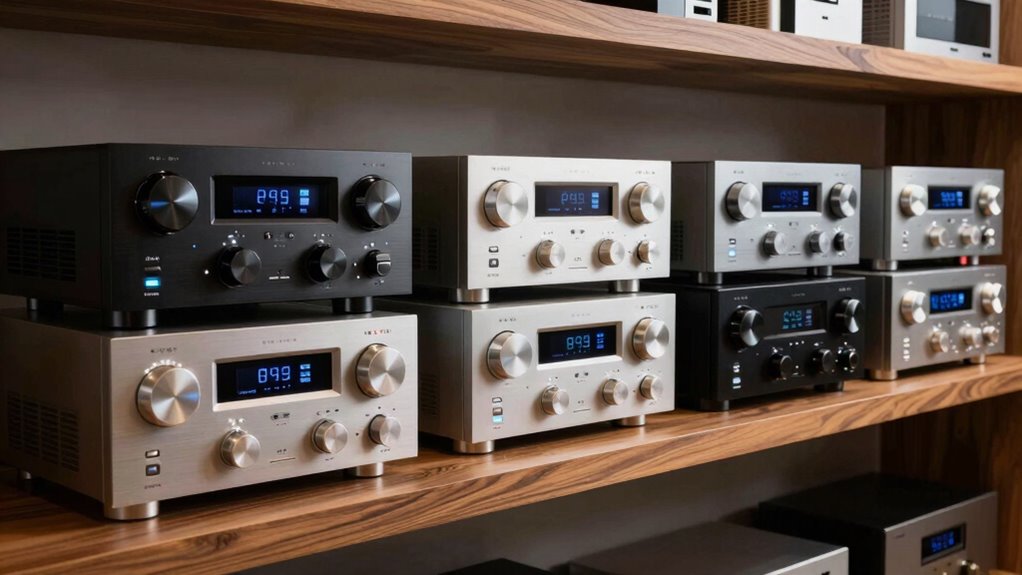

The best stereo receiver for most buyers is the Sony STR-DH190, a straightforward two-channel choice with Bluetooth and a phono input for a turntable. For a compact music setup, the Yamaha R-S202BL offers a traditional stereo approach, while the Denon AVR-S770H suits buyers who want modern home-theater connections and room to expand. The main tradeoff is between simple two-channel listening and multichannel receivers built for TVs, gaming, or surround sound; power claims and connection types also vary widely. Some products here are compact amplifiers rather than conventional stereo receivers, so matching the unit to your sources and speakers matters. Read on for the full comparison and advice on choosing the right fit.

Get kitchen gear delivered free with Prime
- Fast, free delivery on millions of items
- Prime Video, Amazon Music and more included
- Member-only deals all year
Complete the kit


Key Takeaways
- The Sony STR-DH190 is the clearest music-first pick: its two-channel design, Bluetooth, and phono input suit a traditional stereo system better than the multichannel AV receivers.
- AV receivers dominate the feature-rich end of this lineup: Denon, Onkyo, Sony, and Yamaha models bring HDMI and surround-sound support, but can be more receiver than a two-speaker music setup needs.
- Channel count changes the use case: the Donner MAMP2 and WOOPKER AK45 Pro suit basic two-channel setups, while the Donner MAMP6 and four-channel Pyle models serve multi-speaker or announcement needs.
- Bluetooth is common, but it is not a substitute for checking source connections: turntables, TVs, game consoles, and USB playback call for different inputs, and features vary across these models.
- Published power figures are not directly comparable: some compact amplifiers advertise large maximum-watt numbers, while buyers should prioritize speaker compatibility, intended listening level, and usable connections.
| Sony STR-DH590 5.2-Channel 4K HDR Home Theater AV Receiver with Bluetooth |  | Best for Entry-Level Home Theater | Channels: 5.2 | HDMI: 4 inputs, 1 output | Supported video: 4K HDR pass-through, HDCP 2.2 | VIEW ON AMAZON | See Our Full Breakdown |
| WOOPKER AK45 Pro 2-Channel Stereo Audio Amplifier with Bluetooth 5.0 |  | Best Compact Karaoke Pick | Channels: 2.0 | Peak power: 400 W + 400 W | Bluetooth: Version 5.0 | VIEW ON AMAZON | See Our Full Breakdown |
| Yamaha R-S202BL Stereo Receiver |  | Best Traditional Stereo Receiver | Channels: 2 | Output power: 85 watts | Output wattage: 100 watts | VIEW ON AMAZON | See Our Full Breakdown |
| Donner MAMP6 6-Channel Stereo Receiver with Bluetooth 5.3 |  | Best for Multi-Speaker Rooms and Events | Channels: 6 | Peak power: 1000W | Bluetooth: Version 5.3 | VIEW ON AMAZON | See Our Full Breakdown |
| Donner 4-Channel Stereo Receiver with Bluetooth 5.3 |  | Best Four-Channel Value | Channels: 4 | Peak power: 1000W | Bluetooth: Version 5.3 | VIEW ON AMAZON | See Our Full Breakdown |
| Denon AVR-S770H 7.2-Channel 8K Home Theater Receiver |  | Best for Gaming and Immersive Surround | Channels: 7.2 | Output power: 75 watts × 7 | Video passthrough: 8K/60Hz, 4K/120Hz | VIEW ON AMAZON | See Our Full Breakdown |
| Pyle 4-Channel Audio Amplifier with Bluetooth – Home Stereo Receiver, 500W Max Power, Dual Mic Input with Echo and Talk-Over, AUX In, Sub Out, USB-A MP3 Player, AM/FM |  | Best for Karaoke and Casual PA Use | Channels: 4 | Advertised output power: 500 watts maximum | Speaker load: 4–8 ohms | VIEW ON AMAZON | See Our Full Breakdown |
| Yamaha RX300A 5.2-Channel Home Theater AV Receiver – Dolby Atmos, 4K120/8K HDMI, Bluetooth Multipoint, Black |  | Best Compact Home-Theater Choice | Channels: 5.2 | Power output: 70 watts per channel | HDMI ports: 5 total: 4 inputs and 1 output | VIEW ON AMAZON | See Our Full Breakdown |
| Donner MAMP2 2-Channel Stereo Audio Amplifier with Bluetooth 5.3 |  | Best for Flexible Multi-Source Stereo | Channels: 2 | RMS power: 60W × 2 | Peak power: 600W | VIEW ON AMAZON | See Our Full Breakdown |
| Sony STR-DH190 2-Channel Home Stereo Receiver with Phono Inputs and Bluetooth |  | Best for a Simple Turntable Setup | Channels: 2 | Output power: 100 watts per channel at 8 ohms, 1 kHz | Supported speaker impedance: 6–16 ohms | VIEW ON AMAZON | See Our Full Breakdown |
| Denon AVR-S570BT 5.2-Channel 8K AV Receiver |  | Best for a Straightforward 8K Home Theater | Channels: 5.2 | Output power: 70 watts per channel | HDMI ports: 5 total: 4 inputs and 1 output | VIEW ON AMAZON | See Our Full Breakdown |
| Onkyo TX-NR6100 7.2-Channel THX Certified Network AV Receiver |  | Best for Immersive Surround and Gaming | Channels: 7.2 | Power: 100 watts per channel | Audio formats: Dolby Atmos; DTS:X | VIEW ON AMAZON | See Our Full Breakdown |
| Denon AVR-S670H 5.2-Channel 8K Home Theater Receiver |  | Best for Built-In Music Streaming | Channels: 5.2 | Output power: 75 watts per channel | HDMI ports: 8; input/output split not specified | VIEW ON AMAZON | See Our Full Breakdown |
| Pyle PDA77BU 4-Channel Bluetooth Stereo Receiver |  | Best for Karaoke and Local Playback | Channels: 4; audio output mode listed as stereo | Power specifications: 500 watts; 800 watts peak output | Bluetooth: Version 5.0; range up to 30+ feet | VIEW ON AMAZON | See Our Full Breakdown |
More Details on Our Top Picks
Sony STR-DH590 5.2-Channel 4K HDR Home Theater AV Receiver with Bluetooth
I’d choose the Sony STR-DH590 when a stereo-receiver shortlist also needs to serve a TV and a surround-sound setup. Its four HDMI inputs and 4K HDR pass-through let connected video sources run through the receiver, a clear advantage over the Yamaha R-S202BL, which is a two-channel music receiver without HDMI listed. Bluetooth and FM radio cover casual listening, while S-Force PRO offers virtual surround for a two-speaker arrangement. The tradeoff is that this is an AV receiver, not a straightforward two-channel stereo pick: buyers focused on conventional music listening may prefer the Yamaha’s simpler stereo design. It also lacks listed Wi-Fi, and its virtual surround feature is not a substitute for a full surround-speaker system.
Pros:- Four HDMI inputs support connecting several video sources through the receiver.
- 4K HDR pass-through with HDCP 2.2 fits compatible TV and source setups.
- Bluetooth streaming and FM radio add convenient listening options.
- S-Force PRO provides a virtual surround mode for two-speaker setups.
Cons:- Its home-theater focus may be unnecessary for buyers seeking a basic stereo receiver.
- No Wi-Fi connectivity is listed.
- Virtual surround is designed for a two-speaker setup and does not replace discrete surround speakers.
Best for: Listeners building a modest TV-and-music system who need HDMI switching, Bluetooth, and the option to expand to 5.2-channel surround.
Not ideal for: Buyers who only need a simple two-channel music receiver, or who want Wi-Fi streaming and a dedicated stereo-first design.
- Channels:5.2
- HDMI:4 inputs, 1 output
- Supported video:4K HDR pass-through, HDCP 2.2
- Connectivity:Bluetooth, HDMI
- Output power:145 watts
- Audio features:S-Force PRO virtual surround, high-resolution audio compatibility
- Other inputs:4 stereo RCA, 1 optical, 1 coaxial
- Dimensions:11.75 × 17 × 5.25 inches
Our verdict“Choose the STR-DH590 if HDMI-connected home theater matters as much as stereo listening; choose the Yamaha R-S202BL for a simpler two-channel music setup.”
WOOPKER AK45 Pro 2-Channel Stereo Audio Amplifier with Bluetooth 5.0
The WOOPKER AK45 Pro is the lineup’s compact, feature-rich choice for a desk, small room, or casual karaoke setup. Alongside Bluetooth 5.0, it accepts RCA, USB, SD cards, and microphones, giving it more direct playback and singing options than the Yamaha R-S202BL, which instead adds an FM/AM tuner and connections for two speaker systems. Bass and treble controls let buyers adjust the sound without adding another component, and the included remote makes basic changes easier from across the room. Its stated 50 watts per channel suits modest home speakers, but it is not the pick for powering a large listening space. The compact feature set also skips the more traditional radio focus of Yamaha, and the remote needs separately purchased AAA batteries.
Pros:- Bluetooth, RCA, USB, and SD card inputs support several playback sources.
- Two microphone inputs make casual karaoke possible without a separate mixer.
- Bass, treble, master volume, and microphone volume controls allow direct adjustments.
- Compact format suits desks and bookshelves.
Cons:- The stated 50 watts per channel is better suited to smaller listening spaces than demanding or large-room setups.
- AAA batteries for the included remote are not supplied.
- No FM/AM tuner is listed, unlike the Yamaha R-S202BL.
Best for: Small-room listeners who want a compact amplifier for home speakers, Bluetooth playback, USB or SD music, and occasional two-microphone karaoke.
Not ideal for: Buyers who need a traditional FM/AM tuner, higher output for a large room, or a receiver built around multi-room speaker connections.
- Channels:2.0
- Peak power:400 W + 400 W
- Bluetooth:Version 5.0
- Inputs:RCA, USB, SD card, microphone
- Audio controls:Master volume, microphone volume, bass, treble
- Remote:Included; requires AAA batteries
Our verdict“Pick the AK45 Pro for compact Bluetooth and karaoke flexibility, but choose the Yamaha R-S202BL if radio presets and traditional stereo-receiver features matter more.”
Yamaha R-S202BL Stereo Receiver
For a conventional two-channel setup, I’d put the Yamaha R-S202BL ahead of the more specialized WOOPKER AK45 Pro. The Yamaha combines FM/AM radio with 40 presets, Bluetooth streaming, a headphone terminal, and connections for two speaker systems—useful if a listener wants familiar receiver controls rather than karaoke inputs and SD-card playback. Its brushed aluminum finish also gives it a more traditional component-system look. The tradeoff is focus: this is a two-channel receiver, not a home-theater hub, and HDMI or Wi-Fi connectivity is not listed. Compared with the Sony STR-DH590, it is the more direct fit for music and radio, but it cannot handle that model’s HDMI-based TV-source switching or 5.2-channel setup.
Pros:- FM/AM tuner stores up to 40 station presets.
- Bluetooth supports streaming from compatible devices.
- Connections support two speaker systems.
- Includes a headphone terminal, remote, and FM and AM antennas.
Cons:- Two-channel design does not serve buyers building a surround-sound system.
- No HDMI or Wi-Fi connectivity is listed.
- Lacks the microphone and USB/SD playback options found on the WOOPKER AK45 Pro.
Best for: Music-and-radio listeners assembling a straightforward two-channel system with Bluetooth, physical speaker connections, and easy access to FM/AM presets.
Not ideal for: Buyers who need HDMI switching for a TV, surround channels, Wi-Fi streaming, or karaoke microphone inputs.
- Channels:2
- Output power:85 watts
- Output wattage:100 watts
- Bluetooth:Version 4.1 + EDR
- Tuner:FM/AM with 40 station presets
- Frequency response:10 Hz–100 kHz
- CD input sensitivity:500 mV / 47 kΩ
- Included accessories:FM antenna, AM antenna, remote control, owner’s manual
Our verdict“Choose the R-S202BL for a traditional two-channel music-and-radio system; choose the Sony STR-DH590 if your receiver must also route TV video sources.”
Donner MAMP6 6-Channel Stereo Receiver with Bluetooth 5.3
The Donner MAMP6 is the strongest fit here when a buyer needs to spread audio across several speaker groups or add microphones for gatherings. Its six channels and support for up to six speaker groups give it broader distribution flexibility than the four-channel Donner MAMP5, while Bluetooth 5.3, optical, coaxial, RCA, AUX, USB, and FM cover a wide mix of sources. Dual microphone inputs with echo and talk-over controls make announcements and karaoke more practical than on the music-focused Yamaha R-S202BL. The compromise is that this is not an HDMI-equipped home-theater receiver, and its stated output is 25W RMS per channel, so buyers should not read the 1000W peak figure as sustained power. It suits multi-zone use better than high-output listening.
Pros:- Six channels and support for up to six speaker groups allow broader speaker distribution than the four-channel MAMP5.
- Bluetooth 5.3 plus optical, coaxial, RCA, AUX, USB, and FM provide flexible source choices.
- Dual microphone inputs include echo and talk-over controls for karaoke and announcements.
- Independent treble, midrange, and bass controls support sound adjustments.
Cons:- No HDMI input is listed for connecting and switching TV video sources.
- Rated output is 25W RMS per channel, despite the higher peak-power figure.
- The remote-control battery is not included.
Best for: Hosts, community spaces, or multi-room households that need several speaker groups, varied source inputs, and microphone controls for events.
Not ideal for: TV-centered home-theater buyers who need HDMI, or listeners seeking high sustained power for demanding speakers or a large room.
- Channels:6
- Peak power:1000W
- Bluetooth:Version 5.3
- Inputs:Bluetooth, USB up to 64 GB, 2 pairs RCA, AUX, FM, optical, coaxial
- Microphone inputs:2 × 1/4-inch
- Speaker compatibility:4–16 ohms; supports up to 6 groups of 12 speakers
- Audio controls:Treble, midrange, bass, echo, talk-over
Our verdict“Choose the MAMP6 when six-channel speaker distribution and event microphone features matter more than HDMI or high per-channel output.”
Donner 4-Channel Stereo Receiver with Bluetooth 5.3
The Donner MAMP5 offers a middle ground for buyers who want more speaker coverage than a conventional stereo receiver without stepping up to the six-channel MAMP6. Its four independently controlled channels support up to four speaker groups, and the input selection—Bluetooth 5.3, USB, RCA, AUX, FM, optical, and coaxial—covers common music sources. Dual microphone inputs, echo, and Talk Over also make it more event-ready than the Yamaha R-S202BL, which is better suited to radio and ordinary two-channel listening. The key limitation is output: the MAMP5 is rated at 25W RMS per channel, so the 1000W peak figure should not be treated as continuous power. There is no HDMI input, making it a poor match for a TV-based receiver setup.
Pros:- Four independently controlled channels support up to four speaker groups.
- Bluetooth 5.3, USB, RCA, AUX, FM, optical, and coaxial inputs cover varied sources.
- Dual microphone inputs with echo and Talk Over suit karaoke and speaking events.
- Treble, midrange, and bass settings can be adjusted from the receiver or remote.
Cons:- Rated output is 25W RMS per channel, not 1000W continuous power.
- No HDMI input is listed for TV and video-source switching.
- Remote batteries are not included.
Best for: Buyers needing independently controlled audio across up to four speaker groups, with karaoke or speaking-event features and a broad choice of audio inputs.
Not ideal for: Home-theater shoppers who need HDMI, or listeners who need stronger sustained output for large rooms or demanding speakers.
- Channels:4
- Peak power:1000W
- Bluetooth:Version 5.3
- Connectivity:USB, RCA, AUX, FM, optical, coaxial, Bluetooth
- Speaker compatibility:4–16 ohms; supports up to 4 groups of 8 speakers
- Microphone inputs:2 × 1/4-inch
- Audio controls:Treble, midrange, bass, echo, Talk Over
Our verdict“Pick the MAMP5 for four-group audio and microphone features; choose the MAMP6 if you need two additional channels and support for more speaker groups.”
Denon AVR-S770H 7.2-Channel 8K Home Theater Receiver
I’d choose the Denon AVR-S770H when a system needs both modern gaming video and object-based surround sound. Its 4K/120Hz and 8K/60Hz passthrough, plus VRR and ALLM, suit current consoles, while Dolby Atmos and DTS:X support more elaborate speaker layouts than the two-channel Sony STR-DH190. Wi-Fi, HEOS, AirPlay 2, and Bluetooth also make it better equipped for network streaming than the Yamaha RX300A, which lacks built-in Wi-Fi. The tradeoff is that this receiver powers seven channels, so buyers planning a larger setup should look at a model with more amplified channels. Its three 8K-capable HDMI inputs may also feel limiting if several high-bandwidth sources need to stay connected at once.
Pros:- 4K/120Hz and 8K/60Hz passthrough with VRR and ALLM supports current gaming sources.
- Dolby Atmos and DTS:X enable immersive surround configurations.
- Wi-Fi, HEOS, AirPlay 2, and Bluetooth offer several streaming routes.
- Audyssey room calibration helps tailor sound to the listening space.
Cons:- Seven amplified channels limit expansion compared with receivers designed for larger speaker systems.
- Only three HDMI inputs support 8K passthrough, which can constrain multi-source setups.
Best for: Console and movie fans building a seven-channel Atmos system who also want 4K/120Hz gaming and built-in network streaming.
Not ideal for: Listeners planning more than seven amplified speaker channels or those who need more than three 8K-capable HDMI inputs.
- Channels:7.2
- Output power:75 watts × 7
- Video passthrough:8K/60Hz, 4K/120Hz
- HDMI inputs:3 with 8K upscaling
- HDMI outputs:2
- Audio formats:Dolby Atmos, Dolby TrueHD, DTS:X, DTS Neural:X
- Connectivity:HDMI, Wi-Fi, Bluetooth, AirPlay 2, HEOS
- Room calibration:Audyssey
Our verdict“Choose the AVR-S770H for a gaming-ready, Atmos-capable system with network streaming, but skip it if you need more than seven amplified channels.”
Pyle 4-Channel Audio Amplifier with Bluetooth – Home Stereo Receiver, 500W Max Power, Dual Mic Input with Echo and Talk-Over, AUX In, Sub Out, USB-A MP3 Player, AM/FM
The Pyle’s defining advantage is not home-cinema decoding but its karaoke-ready controls: two microphone inputs, echo, and talk-over make it a more natural fit for announcements or sing-alongs than the Sony STR-DH190. Bluetooth, USB, microSD, AUX, and FM add practical ways to play music without a separate source component. I’d treat the advertised 500W as peak power, not a direct measure of sustained output; the provided data doesn’t specify RMS power, so it’s harder to match confidently with demanding speakers. Compared with the Donner MAMP2, the Pyle is oriented toward four-channel use and mic-led gatherings, while the Donner lists more source types, including optical, coaxial, and phono. There’s no Wi-Fi, and Bluetooth is the main wireless streaming option.
Pros:- Dual microphone inputs with echo and talk-over suit karaoke and announcements.
- Bluetooth supports wireless playback from phones, tablets, and computers.
- USB-A, AUX, microSD, and FM provide varied playback sources.
- Four-channel configuration and subwoofer output offer flexible basic system connections.
Cons:- The 500W figure is peak power; RMS output is not specified in the supplied data.
- No Wi-Fi or network-streaming platform is listed.
- No HDMI input is listed for direct connection to modern video sources.
Best for: Hosts setting up a casual karaoke room, small gathering space, or announcement system with wired speakers and microphones.
Not ideal for: Buyers seeking clearly specified continuous power, network streaming, or a receiver for a modern HDMI-based home theater.
- Channels:4
- Advertised output power:500 watts maximum
- Speaker load:4–8 ohms
- Wireless connectivity:Bluetooth
- Inputs:USB-A, AUX, microSD, FM, Bluetooth
- Microphone inputs:2 with echo and talk-over
- Other output:Subwoofer output
- Control:Remote control and EQ knobs
Our verdict“Pick the Pyle for microphone-led gatherings and straightforward playback, not for a clearly rated, network-connected home theater system.”
Yamaha RX300A 5.2-Channel Home Theater AV Receiver – Dolby Atmos, 4K120/8K HDMI, Bluetooth Multipoint, Black
The Yamaha RX300A suits buyers who want current video support and virtualized immersive sound without moving up to a seven-channel receiver. Its 5.2-channel layout supports a 3.1.2 arrangement, while Dolby Atmos and DTS Virtual:X add height effects; that makes it more home-theater-focused than the two-channel Sony STR-DH190. The 4K/120Hz and 8K/60Hz support, alongside Dolby Vision, HDR10+, VRR, and ALLM, also gives newer sources room to grow. Bluetooth Multipoint is handy when two devices share playback duties, but it is not a substitute for the Denon AVR-S770H’s Wi-Fi, AirPlay 2, and HEOS streaming. This Yamaha also has fewer amplified channels than the Denon, and its 70-watt-per-channel output may be a less comfortable match for large rooms or demanding speakers.
Pros:- 5.2-channel setup supports flexible layouts including 3.1.2.
- Dolby Atmos and DTS Virtual:X add immersive audio options.
- 4K/120Hz, 8K/60Hz, Dolby Vision, and HDR10+ cover modern video formats.
- Bluetooth Multipoint pairs two devices at once.
Cons:- No built-in Wi-Fi is listed for network streaming.
- Five amplified channels offer less system expansion than the Denon AVR-S770H.
- Listed output of 70 watts per channel may be limiting in large rooms or with demanding speakers.
Best for: Movie and console users who want a five-channel system, modern HDR and high-refresh video support, and simple Bluetooth listening.
Not ideal for: Buyers who need built-in Wi-Fi streaming, a seven-channel speaker layout, or extra power headroom for a large room.
- Channels:5.2
- Power output:70 watts per channel
- HDMI ports:5 total: 4 inputs and 1 output
- Video support:4K/120Hz, 8K/60Hz, HDR10+, Dolby Vision, ALLM, VRR
- Audio formats:Dolby Atmos, DTS Virtual:X
- Bluetooth:Multipoint for two paired devices
- Room correction:Automatic calibration with microphone
- Remote:Included
Our verdict“Choose the RX300A for a modern, five-channel theater with useful video support; choose the Denon AVR-S770H if you need more channels and network streaming.”
Donner MAMP2 2-Channel Stereo Audio Amplifier with Bluetooth 5.3
The Donner MAMP2 is the most versatile two-channel option here for buyers connecting a mix of old and new audio sources. Phono, optical, coaxial, RCA, AUX, USB, FM, and Bluetooth 5.3 cover a broader range of inputs than the Sony STR-DH190, whose listed connections are more conventional. It also supports two groups of four speakers and a subwoofer, giving a stereo setup more routing flexibility than its channel count suggests. Two microphone inputs and adjustable treble, midrange, bass, and echo add a social-use angle absent from the Sony. The compromise is clear: there is no HDMI input, so it is not the right hub for a TV-centered surround system. Its 60W RMS per channel is also a more useful reference than its 600W peak figure when comparing sustained stereo output.
Pros:- Phono, optical, coaxial, RCA, AUX, USB, FM, and Bluetooth accommodate varied sources.
- Supports two groups of up to four speakers and one subwoofer.
- Bluetooth 5.3 provides a current wireless connection option.
- Dual microphone inputs and adjustable EQ suit karaoke or small presentations.
Cons:- No HDMI input for direct TV or home-theater connections.
- Two-channel amplification does not provide discrete surround sound.
- Remote control batteries are not included.
Best for: Stereo listeners combining a turntable, digital sources, radio, and Bluetooth who want multi-speaker switching and microphone inputs.
Not ideal for: TV-focused home-theater buyers who need HDMI or surround decoding, or listeners seeking a receiver with specified output above 60W RMS per channel.
- Channels:2
- RMS power:60W × 2
- Peak power:600W
- Speaker impedance:4–16 ohms
- Speaker support:Up to two groups of four speakers
- Subwoofer support:1
- Inputs:Bluetooth 5.3, USB, RCA, AUX, FM, optical, coaxial, phono
- Microphone inputs:2 × 1/4-inch
Our verdict“Choose the MAMP2 for flexible stereo sources and speaker routing, but look elsewhere for HDMI-based surround sound.”
Sony STR-DH190 2-Channel Home Stereo Receiver with Phono Inputs and Bluetooth
The Sony STR-DH190 keeps the stereo-receiver brief focused: connect a turntable to its phono input, add other analog sources, and stream over Bluetooth. Its 100 watts per channel into 8-ohm speakers and A/B speaker switching make it a straightforward fit for conventional two-channel listening or two speaker pairs. Compared with the Donner MAMP2, the Sony has fewer input types and no listed microphone features, but its source connections and controls make more sense for a listener who simply wants music playback and FM radio. It is not a substitute for the Yamaha RX300A or Denon AVR-S770H in a surround system: this model is two-channel only and has no HDMI video connections. The Bluetooth version is also unspecified, so buyers prioritizing newer wireless standards may prefer another option.
Pros:- Dedicated phono input simplifies turntable connection.
- 100 watts per channel is specified for 8-ohm speakers.
- A/B switching supports up to four speakers across two pairs.
- Bluetooth and FM radio with 30 presets provide convenient listening options.
Cons:- Two-channel output does not support discrete surround speaker systems.
- No HDMI, optical, or coaxial inputs are listed.
- Bluetooth version is not specified.
Best for: Vinyl listeners who want a conventional stereo receiver with a phono input, Bluetooth, FM presets, and A/B speaker switching.
Not ideal for: Home-theater builders needing surround decoding or HDMI, and buyers who require a stated Bluetooth version or broad digital inputs.
- Channels:2
- Output power:100 watts per channel at 8 ohms, 1 kHz
- Supported speaker impedance:6–16 ohms
- Inputs:Phono, 4 stereo RCA, 3.5 mm
- Wireless connectivity:Bluetooth
- Speaker switching:A/B; supports up to four speakers
- Radio:FM with 30 presets
- Power requirement:AC 120 V, 60 Hz
Our verdict“Pick the STR-DH190 for straightforward vinyl-and-Bluetooth stereo, but choose a multichannel AV receiver for TV-based surround sound.”
Denon AVR-S570BT 5.2-Channel 8K AV Receiver
The Denon AVR-S570BT is a sensible pick for a compact home-theater setup that needs modern video support without moving up to seven amplified channels. Its 5.2-channel layout supports a conventional surround system with two subwoofer connections, while 8K and a broad selection of HDR formats keep compatible video sources in the picture. Compared with the Onkyo TX-NR6100, it gives up Dolby Atmos, DTS:X, Wi-Fi, and higher stated power, so it is less suited to an expanding immersive-audio system. In return, the on-screen setup assistant and Bluetooth make basic installation and music playback approachable. Its main limitation is its leaner connectivity: four HDMI inputs may feel restrictive when several consoles and video sources share the receiver.
Pros:- Supports 8K video and several HDR formats, including Dolby Vision and HDR10+
- On-screen setup assistant can make initial configuration easier
- Bluetooth and listed music services provide options for wireless listening
- VRR, QFT, and ALLM support suit compatible gaming sources
Cons:- Five amplified channels do not support an expanding Dolby Atmos or DTS:X speaker layout
- Four HDMI inputs offer less source capacity than the Onkyo TX-NR6100
- No Wi-Fi connectivity is listed
Best for: Buyers building a five-channel surround system who want 8K/HDR compatibility, Bluetooth, and guided setup without needing network audio or height-channel expansion.
Not ideal for: Home-theater owners planning Dolby Atmos or DTS:X, or households with more than four HDMI source devices.
- Channels:5.2
- Output power:70 watts per channel
- HDMI ports:5 total: 4 inputs and 1 output
- Video support:8K; HDR, HLG, Dolby Vision, HDR10+, Dynamic HDR
- Audio formats:Dolby TrueHD; DTS-HD Master Audio
- Gaming features:VRR, QFT, ALLM
- Connectivity:Bluetooth
- Streaming services:Spotify, TIDAL, Pandora, TuneIn, Deezer
Our verdict“Choose the AVR-S570BT for a guided, five-channel 8K setup; choose the Onkyo TX-NR6100 if you want immersive formats and more HDMI capacity.”
Onkyo TX-NR6100 7.2-Channel THX Certified Network AV Receiver
Among these AV-oriented stereo-receiver roundup options, the Onkyo TX-NR6100 is the strongest fit for a buyer who wants to build beyond basic surround. Its 7.2 channels, Dolby Atmos and DTS:X support, and THX Select certification give it a more ambitious home-cinema role than the five-channel Denon AVR-S570BT or AVR-S670H. Three HDMI 2.1 inputs support demanding gaming setups, including 4K/120Hz and 8K/60Hz video with VRR, ALLM, and QFT. Wi-Fi and Bluetooth add network and wireless listening options, while the stated 100 watts per channel exceeds the Denon AVR-S570BT’s 70 watts. That broader capability comes with a larger, more involved receiver than a simple two-channel stereo model. The product information also leaves future software-update support unclear.
Pros:- Seven-channel amplification supports a more expandable surround setup than the five-channel Denon models
- Dolby Atmos, DTS:X, and THX Select certification target immersive home cinema
- Three HDMI 2.1 inputs support 4K/120Hz and 8K/60Hz video
- Wi-Fi and Bluetooth provide both network and wireless connectivity
Cons:- Software update support date is unspecified
- Its home-theater feature set is excessive for a buyer seeking only basic stereo playback
- The listed 21-inch depth calls for checking available equipment-rack space
Best for: Home-theater and gaming households planning a seven-channel Atmos or DTS:X system with multiple HDMI 2.1 sources.
Not ideal for: Listeners who only need a compact two-channel music receiver, or buyers who want confirmed details about future software support.
- Channels:7.2
- Power:100 watts per channel
- Audio formats:Dolby Atmos; DTS:X
- Video support:8K/60Hz; 4K/120Hz HDR
- HDMI ports:8 total; 3 HDMI 2.1 inputs
- Gaming features:VRR, ALLM, QFT
- Connectivity:Bluetooth, Wi-Fi
- Dimensions:21 × 18.64 × 10.64 in (D × W × H)
- Warranty:2 years parts and labor
Our verdict“Pick the TX-NR6100 if immersive surround and HDMI 2.1 gaming are priorities, but skip it for a simple two-channel listening system.”
Denon AVR-S670H 5.2-Channel 8K Home Theater Receiver
The Denon AVR-S670H makes the most sense for buyers who want a five-channel home-theater receiver that also fits into a wireless music setup. Its HEOS, Wi-Fi, and Bluetooth give it more network-listening flexibility than the Bluetooth-only AVR-S570BT, and Alexa voice control adds another way to manage playback. For movies and games, it combines 8K pass-through and 4K upscaling with ARC/eARC and VRR, ALLM, and QFT. The tradeoff is that it remains a 5.2-channel receiver: unlike the seven-channel Onkyo TX-NR6100, it is not the choice for a Dolby Atmos or DTS:X speaker expansion. The product data lists eight HDMI ports but does not specify their input/output split, and warranty details are absent, so buyers should check those points against their setup needs.
Pros:- HEOS, Wi-Fi, and Bluetooth offer several routes for music streaming
- 8K pass-through and 4K upscaling support newer video sources and displays
- ARC/eARC simplifies connection to compatible televisions
- VRR, ALLM, and QFT support gaming features
Cons:- Five amplified channels limit expansion compared with the seven-channel Onkyo TX-NR6100
- Warranty details are not specified in the supplied product information
- The HDMI port count is given without an input/output breakdown
Best for: Listeners who want a five-channel home-theater receiver with HEOS, Wi-Fi, Bluetooth, and Alexa voice control for music around the home.
Not ideal for: Buyers planning a seven-channel immersive-audio system or anyone who needs clearly specified HDMI input counts and warranty terms before choosing.
- Channels:5.2
- Output power:75 watts per channel
- HDMI ports:8; input/output split not specified
- Video support:8K pass-through; 4K upscaling
- Audio formats:Dolby TrueHD, Dolby Digital, Dolby Digital Plus, DTS-HD Master Audio
- Connectivity:Bluetooth, Wi-Fi, HEOS
- HDMI features:ARC/eARC, VRR, ALLM, QFT
- Voice control:Amazon Alexa
Our verdict“Choose the AVR-S670H for networked music and a five-channel theater, but select the Onkyo TX-NR6100 for seven-channel expansion.”
Pyle PDA77BU 4-Channel Bluetooth Stereo Receiver
The Pyle PDA77BU serves a different purpose from the Denon and Onkyo home-theater receivers: it is a straightforward stereo-mode, four-channel system with karaoke-friendly microphone inputs rather than a surround-sound hub. Dual 1/4-inch microphone connections with independent controls make it the more relevant pick for parties, announcements, or casual singing, while USB, SD, FM, AUX, RCA, and 3.5 mm inputs cover a broad range of local sources. Bluetooth 5.0 adds wireless playback, though the listed range is more limited than a networked receiver’s whole-home approach. Unlike the Denon AVR-S670H, the PDA77BU’s supplied specifications do not list 8K video, HDMI, or streaming-service integration. Its power information also gives both 500 watts and 800 watts peak, so buyers should not treat those figures as directly comparable to per-channel ratings from the AV receivers.
Pros:- Two 1/4-inch microphone inputs have independent controls for karaoke and announcements
- USB, SD, FM, AUX, RCA, and 3.5 mm inputs support varied playback sources
- Bluetooth 5.0 offers wireless playback from compatible devices
- Front-panel display and remote control support convenient operation
Cons:- Power is listed as both 500 watts and 800 watts peak, making output harder to compare
- No HDMI or video-support specifications are provided, unlike the Denon AVR-S670H
- Complete dimensions are not supplied
Best for: Karaoke hosts and casual home listeners who need two independently controlled microphone inputs, radio, and several local playback connections.
Not ideal for: Buyers seeking an HDMI-connected home-theater receiver, clearly comparable per-channel power specifications, or documented dimensions for a tight installation.
- Channels:4; audio output mode listed as stereo
- Power specifications:500 watts; 800 watts peak output
- Bluetooth:Version 5.0; range up to 30+ feet
- Inputs:USB, SD card, FM radio, AUX, RCA, 3.5 mm
- Microphone inputs:2 × 1/4-inch
- Controls and display:Front-panel display; remote control
- Color:Black
Our verdict“Choose the PDA77BU for karaoke, microphone use, and local audio sources, not for a modern HDMI home-theater system.”

How We Picked
I ranked these stereo receivers by how well they match real listening setups, not by headline power claims or feature count alone. I weighed channel configuration, connection options, ease of use, and whether each model makes sense for music, a TV-based system, multiple speaker zones, or occasional microphone use. I also treated traditional two-channel receivers, compact amplifiers, and multichannel AV receivers as distinct categories: they may all appear in searches for stereo receivers, but they do not serve the same job.
The top positions favor clear-purpose models with useful, relevant features and fewer compromises for their intended buyer. AV receivers rank higher when their HDMI and surround capabilities justify the extra complexity; simpler amplifiers rank lower for general-purpose use when their connection details or channel roles are narrower. Because the products span very different designs, buyers should compare the inputs, supported speaker setup, and intended function before treating any wattage or channel number as a direct measure of sound quality.
Factors to Consider When Choosing Stereo Receivers
Choosing a receiver starts with the system you want to build, not the longest feature list. I would first decide whether the system is for two-channel music, TV and gaming, several pairs of speakers, or a mix of those jobs. Then I would check the connections and speaker requirements that can limit compatibility after purchase.
Match the Receiver Type to the Job
A stereo receiver or compact two-channel amplifier is the natural fit for a pair of passive speakers and music sources. An AV receiver makes more sense when HDMI switching, a TV connection, or surround sound is part of the plan. Multi-channel compact amplifiers can distribute sound to several speakers, but channel count alone does not mean they provide home-theater decoding or HDMI features. A common mistake is buying an AV receiver for a simple music setup and paying for controls and connections that will go unused. The reverse mistake is choosing a basic stereo unit for a TV-centered system that needs HDMI inputs or surround channels. Write down the intended speaker layout and main sources before comparing models.
Check Every Source Connection Before You Buy
Make a short list of the devices you will connect: turntable, television, console, phone, CD player, or USB drive. A phono input is intended for a turntable with a moving-magnet cartridge; without one, a separate phono preamp may be needed. Bluetooth is convenient for casual playback, but it does not replace wired inputs when you need stable TV audio or several permanent sources. HDMI features matter for home theater, while analog inputs and radio features can matter more in a traditional stereo room. Do not assume that two receivers with Bluetooth support offer the same range of inputs or playback options. Match each device to an actual input on the receiver before settling on a model.
Treat Channel Count as a Speaker-Planning Tool
Two channels generally cover a conventional left-and-right music setup, while four-channel amplifiers can address additional speakers or separate listening areas depending on their design. AV receiver channel counts refer to supported home-theater speaker configurations, which are not interchangeable with multiroom speaker outputs. Decide whether extra speakers will play the same program, serve another zone, or form part of a surround layout. Those uses can call for different controls, wiring, and receiver features. Buying more channels than the room or plan requires adds complexity without automatically improving stereo playback. If expansion is likely, check what the receiver can support rather than relying on the number in its name.
Verify Speaker Compatibility and Power Claims
Amplifier power figures can be presented under different measurement conditions, so maximum-watt claims do not provide a reliable apples-to-apples ranking. Check the speaker’s impedance and the receiver’s supported load, then think about the room size and the volume you actually need. A modest system in a small room may not benefit from chasing a large advertised number. Poor matching can lead to distortion, protection shutdowns, or unnecessarily limited volume. Also check whether the maker’s specification refers to continuous output, a particular number of channels, or a brief maximum. Treat power as a compatibility check rather than the sole measure of sound quality.
Decide Which Home-Theater Features Will Stay Useful
For a TV and gaming system, HDMI format support can affect compatibility with newer video sources, while supported audio formats shape surround playback. A receiver with newer HDMI capabilities can be a better long-term match for a modern display, but it may be excessive if the system will only play music. Check the exact number of HDMI inputs and the formats supported rather than relying on a broad label such as 8K or Dolby Atmos. Also confirm how you will connect the TV and whether your sources need features such as high-refresh-rate video. Buyers who only need two speakers can usually put more weight on straightforward operation and the right audio inputs. The best feature set is the one that fits the devices already in the room.
Choose Convenience Features You Will Actually Use
Bluetooth, radio tuners, USB playback, microphone inputs, and network functions each solve different problems. Bluetooth works well for quick phone playback, while a built-in tuner is useful when radio is part of everyday listening. Microphone inputs and talk-over controls are tailored to announcements, karaoke, or gatherings rather than focused music listening. USB playback can be useful, but check which file formats and media types a unit supports before depending on it. Extra controls can make a receiver more versatile, yet they may also add setup steps or clutter a simple system. Prioritize the two or three features that would change how you use the system each week.
Frequently Asked Questions
Can I use an AV receiver for ordinary two-speaker music listening?
Yes. AV receivers can drive a left and right speaker for stereo playback, so they can suit a mixed TV-and-music setup. Their advantage is broader home-theater connectivity, not necessarily a better fit for every music system. If you will not use HDMI switching, surround channels, or related features, a simpler two-channel receiver may be easier to operate. Check that the AV receiver supports the sources and speaker load you have planned.
Do I need a phono input to connect my turntable?
You need either a receiver with a phono input or a separate phono preamp between the turntable and a standard line-level input. A turntable with a built-in phono preamp may connect directly to an ordinary analog input, depending on its settings. Check the turntable’s manual before buying, since plugging an unamplified phono signal into a standard input can produce very quiet, thin sound. If vinyl is central to your setup, a dedicated phono input can simplify wiring and reduce the number of extra boxes.
Are a compact Bluetooth amplifier and a stereo receiver interchangeable?
Not always. Compact amplifiers can power passive speakers and stream audio over Bluetooth, but some lack features associated with traditional receivers, such as a radio tuner, multiple source inputs, or a phono stage. The products in this roundup also vary in channel count and intended use, so a four-channel unit is not automatically a replacement for a two-channel music receiver. Compare the inputs, speaker outputs, and controls against your actual system plan. Choose based on the connections you need, not just the product’s category label.
Should I choose a receiver with more channels for future expansion?
Only if you have a realistic plan for the extra speakers. A higher channel count can support a surround layout or additional speakers, but it does not guarantee multiroom control, independent volume, or the specific playback functions you may want. Extra channels can also add wiring and setup complexity. Before paying for them, decide where the speakers will go and whether they should play the same content or different content. Then verify that the receiver supports that exact arrangement.
How should I compare power ratings across these receivers and amplifiers?
Start by checking the measurement conditions and whether the figure describes continuous output or a maximum figure. Ratings may also be reported with different numbers of channels driven, which makes direct comparisons misleading. Match the receiver to the speaker’s impedance and the volume needed for the room instead of selecting by the largest number on the product listing. If the specifications do not clearly state how power was measured, treat the figure cautiously. Speaker compatibility and useful connections are better starting points for a practical shortlist.
Conclusion
For the best overall music-first fit, I would start with the Sony STR-DH190, especially if you want two-channel listening, Bluetooth, and a phono input. The Yamaha R-S202BL is a sensible value choice for buyers seeking a conventional stereo receiver, while the Sony STR-DH190 is also the easiest recommendation for beginners who want a focused setup rather than an AV receiver’s broader controls. For a more feature-rich home theater, I would compare the Denon AVR-S770H and Onkyo TX-NR6100; the Onkyo is the premium-leaning option here for buyers who want a capable multichannel platform. If you need a compact amplifier for several speakers or microphone features, look instead at the Donner or Pyle models and verify that their connections match your use. The best pick depends on whether your system is built around music, a TV, or a specific multi-speaker task.