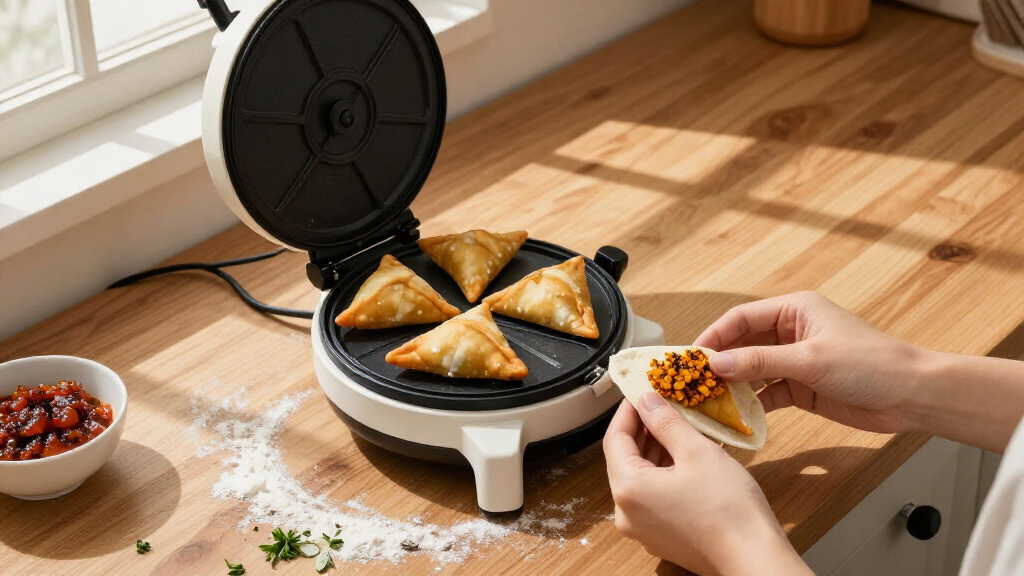

Finding an electric samosa maker means sorting through equipment often sold as dumpling or wrapper machines. The key distinction is whether you need a machine that forms filled pastries, one that makes wrappers, or a commercial line built for repeated high-volume production. My leading pick for samosa-focused production is the Wtecom Commercial Automatic Dumpling Wrapper Maker, which includes a samosa mold and adds automatic powder spreading. For a broader, customizable filled-food machine, the TXMACHINE Semi-Automatic Electric Dumpling Maker offers more operating flexibility, while the HNZXIB Commercial Automatic Dumpling and Gyoza Maker is aimed at businesses prioritizing throughput.

Get kitchen gear delivered free with Prime
- Fast, free delivery on millions of items
- Prime Video, Amazon Music and more included
- Member-only deals all year
These are not small countertop appliances: several options weigh around 220 pounds or more, and the stated capacities reach thousands of pieces per hour. That makes space, installation, and realistic production needs as important as the headline capacity. I rank the machines by how directly they serve samosa production, how much adjustability or mold flexibility they offer, and how clearly their listed specifications support a buyer’s decision. I also call out the tradeoffs: some include just one mold, optional shapes may cost extra, and product details contain inconsistencies worth confirming before purchase.
Complete the kit


Key Takeaways
- Wtecom is the most directly samosa-oriented commercial pick here because it lists one samosa mold and automatic powder spreading, though it is heavy and additional shapes cost extra.
- TXMACHINE is the most flexible choice for varied filled foods and different operating modes, but it is semi-automatic and includes only one mold set.
- HNZXIB lists a capacity of up to 5,000 dumplings per hour and a large filling hopper, but its 300-pound weight makes it a fixed-site commercial machine rather than a casual kitchen appliance.
- Koalalko’s two listed models share the same model number, capacity, dimensions, and weight; buyers should compare the listing details carefully rather than assume they are meaningfully different machines.
- A stated production rate of 5,000 pieces per hour does not by itself establish samosa output, finished-product quality, or suitability for a particular filling and dough recipe.
| Wtecom Commercial Automatic Dumpling Wrapper Maker |  | Best Overall for Samosa-Focused Production | Brand / model: Wtecom Y-WTDM-001A | Operation: Automatic | Stated capacity: Up to 5,000 pieces per hour | VIEW LATEST PRICE | See Our Full Breakdown |
| TXMACHINE Semi-Automatic Electric Dumpling Maker with 10 Molds |  | Best for Flexible Small-Business Production | Brand: TXMACHINE | Operation: Semi-automatic; manual and electric operation also supported | Power: 400 W | VIEW LATEST PRICE | See Our Full Breakdown |
| Commercial Automatic Dumpling and Gyoza Maker |  | Best for High-Throughput Food-Service Operations | Brand / model: HNZXIB XAUHD-2 | Operation: Automatic | Stated capacity: Up to 5,000 dumplings per hour | VIEW LATEST PRICE | See Our Full Breakdown |
| Koalalko Commercial Automatic Dumpling Making Machine |  | Best for Adjustable Commercial Pastry Forming | Brand / model: Koalalko KOA-JZJ-01 | Operation: Automatic | Stated capacity: Up to 5,000 pieces per hour | VIEW LATEST PRICE | See Our Full Breakdown |
| Koalalko Commercial Automatic Dumpling Maker with One Mold |  | Best for Buyers Comparing a Clearly Stated Single-Mold Setup | Brand / model: Koalalko KOA-JZJ-01 | Operation: Automatic | Stated capacity: Up to 5,000 pieces per hour | VIEW LATEST PRICE | See Our Full Breakdown |
| electric samosa maker | Operation | Material | Brand / model | Stated capacity |
|---|---|---|---|---|
| Wtecom Commercial Automatic Du | Automatic | Food-grade stainless steel | Wtecom Y-WTDM-001A | Up to 5,000 pieces per hour |
| TXMACHINE Semi-Automatic Elect | Semi-automatic; manual and electric operation also supported | Aluminum alloy | — | — |
| Commercial Automatic Dumpling | Automatic | Stainless steel | HNZXIB XAUHD-2 | Up to 5,000 dumplings per hour |
| Koalalko Commercial Automatic | Automatic | Stainless steel | Koalalko KOA-JZJ-01 | Up to 5,000 pieces per hour |
| Koalalko Commercial Automatic | Automatic | Stainless steel | Koalalko KOA-JZJ-01 | Up to 5,000 pieces per hour |
More Details on Our Top Picks
Wtecom Commercial Automatic Dumpling Wrapper Maker
The Wtecom earns my top spot because it is the clearest match for buyers who specifically want to make samosas: the listing includes one samosa mold, rather than asking the buyer to begin with a generic shape. Its automatic powder spreading and adjustable dough thickness also address parts of wrapper production that can otherwise require extra handling. The stated capacity is up to 5,000 pieces per hour, placing it alongside the other commercial machines here for advertised throughput, but the more useful distinction is its named samosa mold and wrapper-making emphasis.
Compared with the Koalalko machines, Wtecom describes automatic powder spreading and specifies the included mold size, giving buyers more information about the starting setup. Compared with TXMACHINE, it is geared toward automatic commercial production rather than offering manual, electric, and semi-automatic modes. That focus may suit a business that already knows its production process, but it gives less apparent flexibility for a small operation still experimenting with hands-on methods. The listing says 48 additional mold shapes are available, yet they require an extra fee, so the included mold is the practical baseline rather than a complete assortment.
The main caution is the machine’s size and inconsistent weight information. The specifications give 110 kg (242 lb), while item details list 220 pounds; either figure signals heavy equipment, and the discrepancy should be resolved with the seller. Its stainless-steel construction and US plug are useful stated details, but I would confirm installation requirements, mold availability, and the dough-and-filling formats supported before committing. For samosa makers prioritizing a specified samosa mold, it has a more direct case than the general dumpling units; for a compact home kitchen, it is plainly too much machine.
Pros:- Includes one specifically identified samosa mold.
- Automatic powder spreading and adjustable dough thickness support a more directed wrapper workflow.
- Lists capacity up to 5,000 pieces per hour and 48 optional mold shapes.
- Food-grade stainless-steel construction and a US plug are specified.
Cons:- Additional mold shapes require an extra fee.
- The listed weight conflicts: 110 kg (242 lb) in specifications versus 220 pounds in item details.
- Its heavy commercial form is not suited to most home kitchens.
Best for: Commercial kitchens or food businesses that want an automatic wrapper machine with a samosa mold included and adjustable dough thickness.
Not ideal for: Home cooks, occasional batch makers, or buyers who need a light machine, multiple included molds, or fully consistent weight and setup information before ordering.
- Brand / model:Wtecom Y-WTDM-001A
- Operation:Automatic
- Stated capacity:Up to 5,000 pieces per hour
- Power:220 W
- Voltage / plug:110 V / US plug
- Material:Food-grade stainless steel
- Included mold:One samosa mold, 8 × 8 × 9 cm
- Dimensions:25.98 × 17.13 × 30.31 in
- Weight:Listed as 110 kg (242 lb); item details also say 220 lb
Our verdict“I would choose Wtecom when a specified samosa mold and automatic wrapper production matter more than portability or a broad set of included molds.”
TXMACHINE Semi-Automatic Electric Dumpling Maker with 10 Molds
TXMACHINE stands apart because it supports manual, electric, and semi-automatic operation, rather than committing the buyer to an automatic production line. That range can matter to a small food business testing different recipes, batches, or labor setups. The machine is described for dumplings and filled foods including samosas, empanadas, spring rolls, pierogi, ravioli, and momo, making it the lineup’s broadest stated fit for varied pastry work. Its aluminum-alloy molds have a nonstick coating, a useful detail for a process involving dough and filling.
Compared with Wtecom, TXMACHINE does not identify a samosa mold as the included mold; it supplies one set of dumpling molds, with 6-, 8-, or 10-mold options and custom shapes available. A buyer should confirm which mold configuration comes with the chosen listing and whether a samosa-specific shape is available in the needed size. In contrast with the high-capacity automatic machines from HNZXIB and Koalalko, TXMACHINE’s semi-automatic positioning puts flexibility ahead of a stated 5,000-piece-per-hour output claim. It is a better match for a varied menu or a lower-throughput workflow than for a business trying to maximize continuous production.
The tradeoff is that the machine is still sizable: listed dimensions are 80 × 68 × 15 cm, and the product details reportedly differ on its weight. Only one mold set is included, so custom shapes or additional sets may add cost and ordering steps. I would verify the actual machine weight, the selected mold count, and the operating mode available for the exact configuration before buying. Its unusual mix of adaptable operation and custom molds gives it a different role from the more automated options, but it is not a simple plug-in countertop samosa press.
Pros:- Supports manual, electric, and semi-automatic operation.
- Described for samosas and a broad range of other filled foods.
- Nonstick-coated aluminum-alloy molds are specified.
- Mold options include 6, 8, or 10 molds, with custom shapes available.
Cons:- Only one mold set is included.
- The listed machine weight differs across product details.
- The included dumpling mold set is not explicitly identified as a samosa mold.
Best for: Small commercial kitchens and food entrepreneurs making several types of filled pastries who value operating flexibility and the option to request custom molds.
Not ideal for: Buyers who want a clearly specified samosa mold included, a fully automatic high-volume line, or a compact appliance for occasional home use.
- Brand:TXMACHINE
- Operation:Semi-automatic; manual and electric operation also supported
- Power:400 W
- Voltage:110 V / 60 Hz or 220 V / 50 Hz
- Dimensions:80 × 68 × 15 cm
- Material:Aluminum alloy
- Mold coating:Nonstick
- Mold options:6, 8, or 10 molds; custom shapes available
- Included components:One set of dumpling molds
Our verdict“I would pick TXMACHINE for a flexible filled-food workflow, provided the seller confirms the mold configuration and machine weight.”
Commercial Automatic Dumpling and Gyoza Maker
HNZXIB is the most clearly throughput-led option in this roundup. It lists up to 5,000 dumplings per hour, a large filling hopper for continuous feeding, and adjustable dough sheet thickness from 1.5 to 3 mm. Those details point toward a commercial workflow where repeated production and filling supply matter more than switching between manual and automatic operation. Stainless-steel construction is specified for both the machine and blade, and the listing describes several filling types, including meat, meat and vegetable, and fish.
Compared with Wtecom, HNZXIB emphasizes continuous filling and dumpling output rather than including a named samosa mold and automatic powder spreading. It may be suitable for a food-service business adapting production to samosa-style products, but buyers should confirm that the mold shape and finished product meet their samosa requirements. Koalalko also lists up to 5,000 pieces per hour and adjustable production settings, while HNZXIB’s stated large hopper and sheet-thickness range provide more specific clues about its production workflow. The listing does not provide a samosa mold as an included component.
At 300 pounds, this is fixed-site commercial equipment, not a machine to move in and out of storage. The stated capacity is substantial, but it describes dumplings rather than a guaranteed number of samosas per hour; product shape, filling, dough, and operator setup can change real output. I would also ask the seller to confirm mold options, installation needs, and whether the desired samosa size is supported. For buyers who need a named samosa mold out of the box, Wtecom makes a clearer case. HNZXIB suits operators who value hopper-fed production and can verify the mold fit before purchase.
Pros:- Lists production capacity up to 5,000 dumplings per hour.
- Large filling hopper is intended to support continuous operation.
- Adjustable dough sheet thickness is specified from 1.5 to 3 mm.
- Stainless-steel machine and blade are listed.
Cons:- The machine weighs 300 lb and requires a suitable installation space.
- The stated output is for dumplings, not a confirmed samosa production rate.
- The included components do not specify a samosa mold.
Best for: Established food-service operators who need a large-hopper automatic dumpling line and can confirm that a suitable samosa mold is available.
Not ideal for: Home cooks, small kitchens without equipment space, or samosa-focused buyers who require a specifically listed samosa mold included with the machine.
- Brand / model:HNZXIB XAUHD-2
- Operation:Automatic
- Stated capacity:Up to 5,000 dumplings per hour
- Dough sheet thickness:1.5–3 mm
- Material:Stainless steel
- Blade material:Stainless steel
- Weight:300 lb
- Included components:One automatic handmade dumpling machine
- Filling types described:Meat, meat and vegetable, fish, and other fillings
Our verdict“I would shortlist HNZXIB for high-volume food service only after confirming its mold options and fit for the required samosa format.”
Koalalko Commercial Automatic Dumpling Making Machine
Koalalko’s KOA-JZJ-01 is a straightforward automatic commercial machine for buyers who want controls over both wrapper thickness and filling quantity. Its description names samosas alongside dumplings, empanadas, ravioli, and other filled pastries, and the machine includes one mold with interchangeable shapes available. The stated maximum output is up to 5,000 pieces per hour, giving it a production scale similar to HNZXIB, though the product details do not give the latter’s large-hopper description or sheet-thickness range.
Against Wtecom, Koalalko offers adjustment of filling quantity as well as wrapper thickness, but Wtecom is more explicit about including a samosa mold and automatic powder spreading. That distinction matters: Koalalko is described as suitable for samosas, yet the included mold is not identified by shape in the supplied specifications. The 48 available mold shapes provide room to adapt the machine to other products, but only one mold is included. Buyers should establish whether the required samosa mold is the included one or must be obtained separately.
The biggest practical constraint is its 220-pound weight and substantial footprint of roughly 25.19 × 17.32 × 31.49 inches. The stainless-steel construction and US voltage and plug details help define the basic setup, but the mass means placement should be planned before delivery. Koalalko’s listing is a more direct choice than HNZXIB for someone who values filling-quantity adjustment across pastry types; it is less convincing than Wtecom for a buyer who wants a samosa-specific mold stated as included. There is also a second Koalalko listing in this roundup with the same model number and nearly identical core specifications, so I would compare the actual listing and mold terms rather than assume this is a distinct design.
Pros:- Automatic operation with adjustable wrapper thickness and filling quantity.
- Described for samosas and several other filled pastries.
- Lists capacity up to 5,000 pieces per hour.
- Stainless-steel construction and 48 available mold shapes are specified.
Cons:- Only one mold is included.
- The included mold is not identified specifically as a samosa mold.
- At 220 lb, it needs planned placement and installation.
Best for: Commercial operators who want automatic formation with adjustable wrapper thickness and filling quantity for several filled-pastry formats.
Not ideal for: Buyers who need multiple molds included, a clearly identified samosa mold, or equipment light enough to move or store easily.
- Brand / model:Koalalko KOA-JZJ-01
- Operation:Automatic
- Stated capacity:Up to 5,000 pieces per hour
- Power:220 W
- Voltage / plug:110 V / 60 Hz, US plug
- Material:Stainless steel
- Dimensions:25.19 × 17.32 × 31.49 in
- Weight:220 lb
- Molds:One included; 48 shapes available
Our verdict“I would choose this Koalalko when adjustable filling quantity matters, after confirming which mold comes with the machine.”
Koalalko Commercial Automatic Dumpling Maker with One Mold
This Koalalko listing describes the same basic commercial proposition as the other KOA-JZJ-01: automatic formation for dumplings and filled pastries, including samosas, with adjustable wrapper thickness and filling quantity. It lists up to 5,000 pieces per hour and includes one mold, while other shapes are available separately. Its role here is not a different performance class; it is the version whose title explicitly calls out the one-mold package, making the included starting setup particularly easy to spot.
Compared with the Koalalko listing above, the core details are almost identical: same model number, 220-pound weight, dimensions, motor power, stated capacity, and stainless-steel construction. I would not treat the two as meaningfully different machines based on the supplied information. The practical choice is to compare the mold terms, seller details, and exact included components. Compared with Wtecom, this machine offers adjustable filling quantity, but the listing does not specify that the included mold is for samosas; Wtecom’s included samosa mold is a stronger fit when that exact shape is the priority.
As with its sibling listing, one mold only is a real limitation if a kitchen plans to produce several shapes. The additional molds are sold separately, and the 220-pound body is a commitment to a fixed commercial location. The listing gives US voltage and plug information, but the advertised maximum output still should not be read as a promised samosa rate. Before ordering, I would confirm the included mold shape, available replacement or optional molds, and whether the machine handles the intended dough and filling. This is a reasonable specification-led option for an operator already prepared for a heavy automatic machine, not a compact or multi-mold starter appliance.
Pros:- Automatic operation and adjustable wrapper thickness and filling quantity.
- Described for samosas, gyoza, ravioli, empanadas, and other pastries.
- Lists capacity up to 5,000 pieces per hour.
- US plug and stainless-steel construction are specified.
Cons:- Only one mold is included; additional shapes are sold separately.
- The included mold is not identified as a samosa mold.
- Its 220-pound weight makes moving and storage difficult.
Best for: Commercial buyers who want an automatic filled-pastry machine and prefer a listing that clearly states its one-mold package and adjustable filling controls.
Not ideal for: Buyers who want several molds included, need an explicitly samosa-shaped mold without further confirmation, or are comparing for a lighter machine.
- Brand / model:Koalalko KOA-JZJ-01
- Operation:Automatic
- Stated capacity:Up to 5,000 pieces per hour
- Voltage / plug:110 V / 60 Hz, US plug
- Motor power:220 W
- Material:Stainless steel
- Dimensions:25.19 × 17.32 × 31.49 in
- Weight:220 lb
- Included / optional molds:One mold included; additional shapes available separately
Our verdict“I would consider this listing for a fixed commercial setup, but compare it directly with the other KOA-JZJ-01 and verify the included mold before choosing.”
How We Picked
I ranked these options for readers searching specifically for electric samosa makers, not simply for the broadest range of dumpling equipment. Product descriptions use overlapping terms such as dumpling maker, wrapper maker, and filled-pastry machine, so I focused on the stated connection to samosas: included samosa molds, compatibility with samosa production, and the ability to change mold shapes. A machine that names a samosa mold gets a clearer advantage for a buyer who wants to start with that format rather than adapt a general-purpose unit.
Next, I compared how each machine handles production. Automatic operation and stated capacity may suit food businesses with repeat batches, while semi-automatic operation may make more sense when flexibility matters more than maximum throughput. I also looked at useful controls, including adjustable dough thickness, filling quantity, large-hopper feeding, and automatic powder spreading. Those features can affect the practical workflow, but they do not prove that every dough or filling will work equally well; recipe compatibility and setup still need confirmation with the seller.
Finally, I weighed mold availability, installation burden, and specification clarity. These machines are substantial pieces of equipment, so listed weight and dimensions influence whether they can fit a kitchen and be installed safely. I noted where only one mold is included, where additional shapes are separately available, and where the supplied details conflict—especially the Wtecom weight entries and TXMACHINE weight information. I did not treat an advertised pieces-per-hour figure as a guarantee of samosa output. The ranking favors the strongest stated fit for samosa production and useful production controls, while giving less weight to broad capacity claims that lack details about finished samosas.
| electric samosa maker | Brand / model | Operation | Stated capacity | Material |
|---|---|---|---|---|
| Wtecom Commercial Automatic Du | Wtecom Y-WTDM-001A | Automatic | Up to 5,000 pieces per hour | Food-grade stainless steel |
| TXMACHINE Semi-Automatic Elect | — | Semi-automatic; manual and electric operation also supported | — | Aluminum alloy |
| Commercial Automatic Dumpling | HNZXIB XAUHD-2 | Automatic | Up to 5,000 dumplings per hour | Stainless steel |
| Koalalko Commercial Automatic | Koalalko KOA-JZJ-01 | Automatic | Up to 5,000 pieces per hour | Stainless steel |
| Koalalko Commercial Automatic | Koalalko KOA-JZJ-01 | Automatic | Up to 5,000 pieces per hour | Stainless steel |
Factors to Consider When Choosing Electric Samosa Makers
I would start by defining the job: making samosas occasionally, preparing wrappers for a regular small business, or running a high-volume commercial line. The machines here span those needs unevenly, and none should be assumed to be a compact household samosa press.Check whether it forms wrappers or complete filled pastries
The product names can blur an important distinction. Wtecom is presented as a wrapper maker and includes a samosa mold, while the other machines are described as forming dumplings or filled pastries. That difference can affect how dough and filling are handled, so I would ask the seller to explain the machine’s actual production sequence: does it feed dough, add filling, seal a finished piece, or produce wrappers for later filling? A broad claim that a unit supports samosas does not answer every workflow question.
For a buyer whose priority is forming samosas directly, I would place more weight on a specifically named samosa mold than on a general list of compatible foods. Wtecom is strongest on that point. TXMACHINE supports samosas among many filled foods but lists a dumpling mold set, so the desired mold shape should be confirmed. The Koalalko descriptions name samosas but do not identify the included mold shape. HNZXIB is the most general dumpling-and-gyoza option in its description, so its samosa fit needs especially careful verification.
Treat production capacity as a ceiling, not a promise
Several machines advertise output of up to 5,000 pieces per hour. That figure can help distinguish a commercial machine from a small-batch appliance, but it does not establish the rate for a particular samosa. Shape, size, dough recipe, filling consistency, setup, and operator workflow can all affect the finished output. HNZXIB states its capacity in dumplings per hour; Wtecom and the Koalalko machines use pieces per hour. I would ask the manufacturer which product configuration the quoted figure refers to and whether it is measured with the buyer’s intended dough and filling.
For a small operation, a more flexible machine may be more useful than the largest headline output. TXMACHINE’s manual, electric, and semi-automatic modes may suit a business still refining its workflow, although the supplied information does not give a comparable hourly capacity. For a mature production kitchen, the automatic options may make more sense if their mold and recipe fit are confirmed. I would plan around the volume the business can actually sell and staff, not just a maximum listed by the manufacturer.
Confirm mold shape, size, and included quantity
A machine’s mold determines what shape it forms, so mold details are central to a samosa purchase. A reference to 48 available shapes does not mean 48 molds are included. Wtecom lists one samosa mold and 48 optional shapes; Koalalko lists one included mold and 48 available shapes; TXMACHINE includes one set, with 6-, 8-, or 10-mold options and custom shapes described. HNZXIB supports customizable shapes and sizes, but the supplied details do not identify an included samosa mold.
Before ordering, I would request the exact included mold shape, finished samosa dimensions, and a written list of any extra molds needed. Ask whether molds can be changed without specialist service and whether the machine can make the size and seam style your product requires. The word “customizable” is promising, but it is not a substitute for confirming availability, cost, lead time, and compatibility with the machine configuration being sold.
Match adjustments to the recipe and workflow
Adjustable dough thickness can help operators tune the wrapper for a particular recipe, while adjustable filling quantity can help set portion size. Wtecom lists adjustable dough thickness and automatic powder spreading. HNZXIB specifies a 1.5–3 mm sheet thickness and a large filling hopper. Both Koalalko listings describe adjustable wrapper thickness and filling quantity. TXMACHINE offers multiple operating modes and coated aluminum-alloy molds, but the supplied details do not list comparable thickness or filling controls.
These controls do not guarantee that every dough handles cleanly or that a chosen filling feeds reliably. I would ask about recommended dough hydration or consistency, acceptable filling texture, cleaning steps, and adjustment procedures. For a samosa filled with a particular potato mixture or other recipe, the seller should confirm whether the filling can pass through the feed system as prepared. That conversation is more useful than relying on a general claim that a machine handles “other fillings.”
Plan for the footprint, weight, and power connection
These are mostly commercial machines with substantial weight. HNZXIB lists 300 pounds; both Koalalko listings list 220 pounds; Wtecom lists 110 kg but also gives a conflicting 220-pound figure. TXMACHINE gives dimensions and a weight that differs across product details. Those figures affect delivery, floor placement, installation, and future service access. Measure the usable area, including space for loading dough and filling and for cleaning around the equipment, rather than comparing only the machine’s stated dimensions.
Check electrical compatibility as well. The supplied listings include 110 V machines, while TXMACHINE also gives a 220 V option, and Wtecom lists a US plug. I would confirm the voltage, frequency, plug, power draw, and any circuit requirements for the exact unit being shipped. For heavy equipment, ask who handles delivery to the final location and whether the floor, bench, or work surface is suitable. Weight and plug details are not minor footnotes; they help establish whether the machine can be used safely in the space you have.
Resolve listing inconsistencies before placing an order
Some supplied product details conflict. The Wtecom weight appears as both 110 kg (242 pounds) and 220 pounds, while TXMACHINE’s listed weight varies across product details. The two Koalalko entries share the KOA-JZJ-01 model number and closely matching specifications, so their titles alone do not show a meaningful design difference. I would ask the seller to confirm the shipped model, weight, dimensions, included molds, and what is covered by the order.
For a machine with optional molds, request a complete written quote or order breakdown identifying which shape is included and which options are separate. Keep the response alongside the listing details so the equipment configuration is clear. This matters especially when the listing uses broad food-compatibility claims but does not identify the specific samosa mold. Clear answers about setup and parts can help separate a suitable production machine from one that merely sounds suitable in a product description.
Frequently Asked Questions
Are these machines dedicated samosa makers?
Not all of them are dedicated samosa machines. They are described mainly as dumpling, wrapper, or filled-pastry equipment, with samosas included among the compatible foods for several models. Wtecom gives the clearest samosa-specific starting point because one samosa mold is listed as included. For TXMACHINE and both Koalalko listings, I would confirm the exact included mold shape before ordering; HNZXIB’s supplied details do not identify a samosa mold.
Which option is the best fit for a buyer focused on samosas?
Wtecom is my most direct recommendation for a samosa-focused commercial buyer because it lists an included samosa mold and automatic powder spreading. Its heavy build and separately sold optional molds make it a poor fit for a small home kitchen. If you need other filled-food formats or multiple operating modes, TXMACHINE may offer more flexibility, but I would first confirm that its included or custom mold produces the samosa shape you want.
Does a stated capacity of 5,000 pieces per hour mean 5,000 samosas per hour?
No. The supplied listings state high maximum rates for dumplings or pieces, but they do not confirm that those figures apply to samosas of a particular size, recipe, or filling. Dough behavior, mold shape, feed consistency, and production setup can affect the actual rate. I would ask the seller for a samosa-specific output estimate and the conditions used to calculate it before planning staffing or production around the advertised maximum.
Can I use one machine for different filled pastries?
The listings describe support for several foods, and interchangeable or custom molds are available on some models. TXMACHINE names a broad range of filled foods and supports custom mold shapes; Wtecom lists 48 optional shapes, while Koalalko also describes 48 available mold shapes. However, food compatibility depends on the mold and feeding setup, and extra shapes may cost more. I would confirm the exact molds and filling requirements for each product rather than assume every shape is included.
Are any of these suitable for an ordinary home kitchen?
Most are aimed at commercial use and weigh far more than typical countertop appliances: the listed machines include models at 220 or 300 pounds, and Wtecom is also described as a heavy unit with conflicting weight entries. TXMACHINE is the most flexible in operation, but its listed dimensions and inconsistent weight details still call for careful checking. For occasional home cooking, I would be cautious about buying any of these before confirming the footprint, electrical setup, delivery requirements, and where the machine will be stored.
Conclusion
For a commercial buyer who wants the most direct stated fit for samosas, I recommend Wtecom: it includes a samosa mold and adds automatic powder spreading, with the important caveats that optional molds cost extra and its listed weight conflicts. For a small business making several kinds of filled pastry, TXMACHINE is the better match when manual, electric, and semi-automatic operation is useful; confirm the mold configuration and actual weight first. If your operation needs a hopper-fed automatic dumpling line, HNZXIB deserves a look, but only after the seller confirms a suitable samosa mold and the installation plan.
For buyers focused on adjustable dough and filling controls across different pastry products, either Koalalko listing may fit a fixed commercial kitchen, but the two supplied entries share the same model number and nearly identical specifications. I would compare their included-mold terms directly rather than treat them as distinct machines. I would skip all five if the requirement is a lightweight, occasional-use countertop appliance. Across this lineup, the best choice depends less on the headline capacity than on the exact mold, the production method, and whether the machine fits your kitchen and recipe.