If you’re considering the best 130mm triplet APO refractors for astrophotography, I recommend options like the Explore Scientific FCD100 series and the SVBONY SV550 for their superb optical clarity and portability. Celestron and other models also offer excellent features for capturing stunning celestial shots. These telescopes combine high-quality ED glass, stable mounts, and precise focusers. Keep going for detailed insights into their features and what makes each one stand out.
Key Takeaways
- High-quality FCD1 ED glass and multi-layer coatings ensure sharp, high-contrast images with minimal chromatic aberration for stunning astrophotography.
- Portable lightweight design (around 6.4 to 10.9 lbs) with durable aluminum construction allows easy outdoor setup and transport.
- Focal lengths between 650mm and 900mm with f/6–f/7 ratios provide versatile imaging for planets, deep-sky objects, and wide-field astrophotography.
- Dual-speed 2.5-inch focusers enable precise focusing necessary for high-resolution astrophotography and detailed celestial shots.
- Compatibility with various mounts, accessories, and field flatteners supports high-fidelity imaging with full-frame or half-frame cameras.
Explore Scientific FCD100 Series ED102 Refractor Telescope (OTA Only)
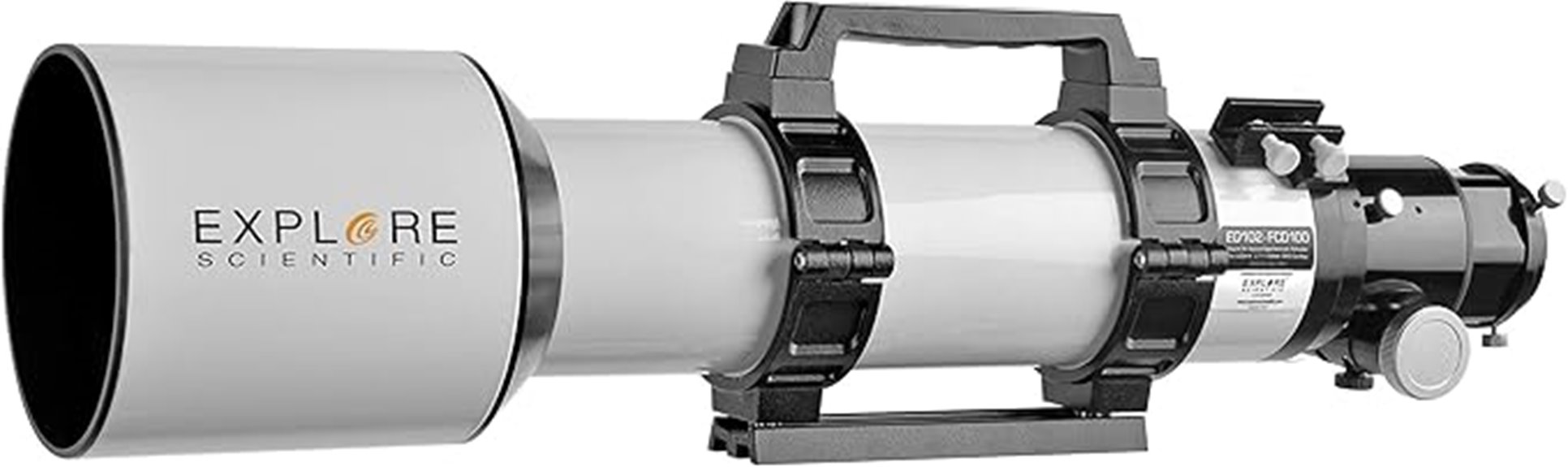
If you’re an experienced amateur astronomer seeking top-tier astrophotography performance, the Explore Scientific FCD100 Series ED102 Refractor Telescope (OTA Only) is an excellent choice. Its 102mm aperture and f/7 focal ratio deliver sharp, color-accurate images with minimal chromatic aberration, thanks to genuine HOYA FCD100 ED glass and proprietary multi-layer coatings. Weighing just 10.9 pounds, it’s lightweight yet durable, making it ideal for portability and stable mounting. Designed for both astrophotography and visual observation, this high-quality refractor provides exceptional resolution of 1.14 arcseconds, ensuring stunning celestial shots with rich detail.
Best For: experienced amateur astronomers and astrophotographers seeking high-precision, portable refractor optics for detailed celestial imaging and observation.
Pros:
- Exceptional image quality with sharp, color-accurate visuals and minimal chromatic aberration due to genuine HOYA FCD100 ED glass
- Lightweight and durable aluminum construction weighing only 10.9 lbs, ideal for portability and stable mounting
- High resolution of 1.14 arcseconds, enabling detailed astrophotography and visual observation of fine celestial features
Cons:
- OTA is sold separately, requiring additional purchase to complete the telescope setup
- Limited aperture size compared to larger telescopes, which may restrict deep-sky object viewing for some users
- Requires compatible mounts and accessories, which may increase overall cost and setup complexity
Explore Scientific ED102 Refractor Telescope for Astrophotography
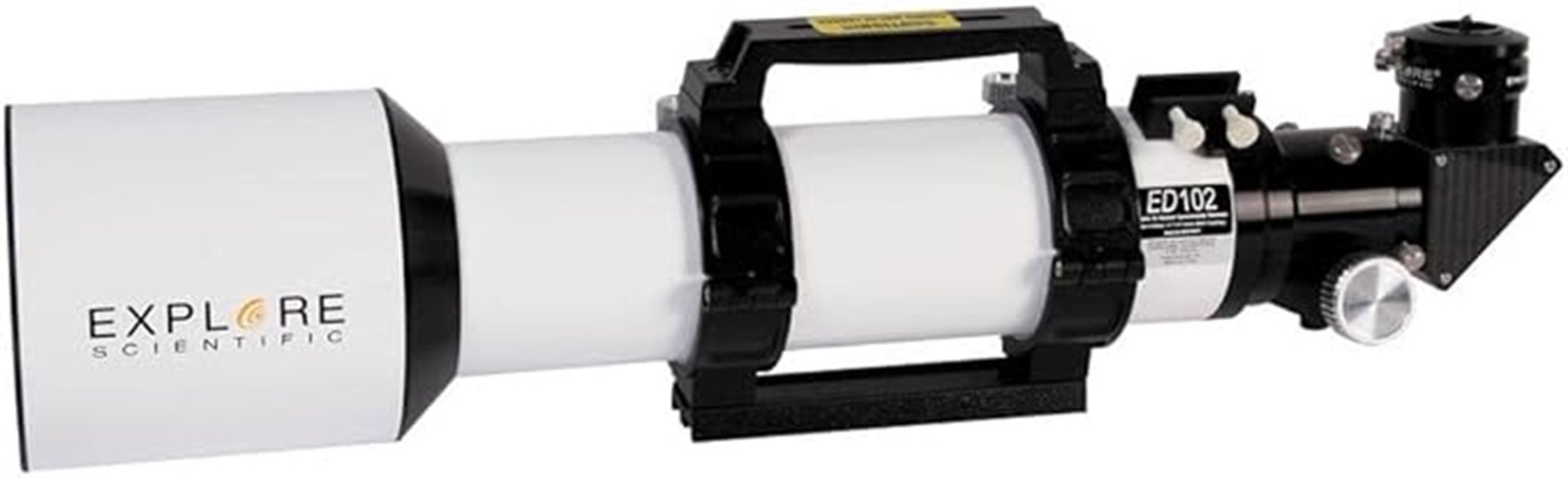
The Explore Scientific ED102 Refractor Telescope stands out for astrophotographers seeking exceptional optical quality in a portable package. It combines genuine FCD1 HOYA extra-low dispersion glass with multi-layer coatings on all surfaces, delivering high-contrast, detailed images of the Moon, planets, nebulae, and star clusters. Its air-spaced triplet design virtually eliminates chromatic aberration, ensuring sharp, color-accurate results. With a 102mm aperture, 714mm focal length, and f/7 focal ratio, it offers versatile imaging capabilities. Its retractable dew shield and handle-equipped cradle make setup and transport easy, perfect for on-the-go astrophotography sessions.
Best For: astrophotographers seeking high-contrast, sharp images in a portable, easy-to-setup refractor telescope.
Pros:
- Combines genuine FCD1 HOYA ED glass with multi-layer coatings for exceptional image clarity.
- Virtually eliminates chromatic aberration due to its air-spaced triplet design.
- Compact, lightweight, with features like a retractable dew shield and built-in handle for easy transport.
Cons:
- May require additional accessories (e.g., mount, camera adapters) for full astrophotography setup.
- Premium optical components can come at a higher price point.
- Slightly limited aperture compared to larger telescopes, which might affect extremely faint object imaging.
Celestron Omni XLT 120 Refractor Telescope
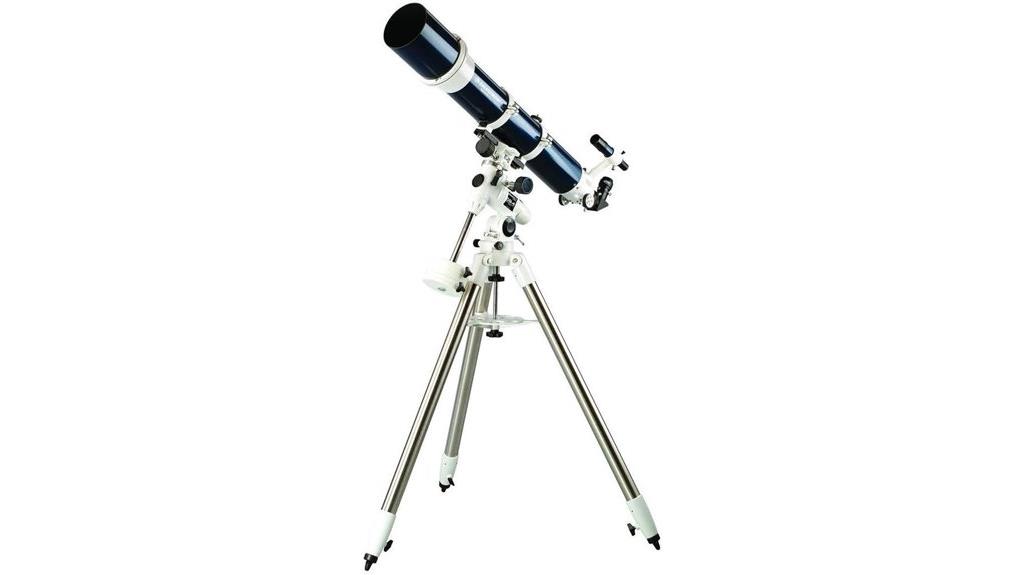
Designed for amateur astronomers who prioritize high-quality optics and precise tracking, the Celestron Omni XLT 120 Refractor Telescope offers exceptional image clarity thanks to hand-selected optical glass and fully multi-coated StarBright XLT coatings. Its optical tube is carefully figured for sharp images, while the German equatorial CG-4 mount guarantees smooth, accurate tracking with worm gear slow-motion controls. The package includes a 6×30 finderscope, a steel tripod, and a 25mm eyepiece, making setup straightforward. Plus, the free Starry Night software adds educational value, making this telescope a versatile choice for those seeking professional-grade optics and reliable performance.
Best For: amateur astronomers seeking high-quality optics, precise tracking, and educational resources for both beginner and intermediate stargazing.
Pros:
- Hand-selected optical glass and fully multi-coated StarBright XLT coatings ensure bright, clear images.
- German equatorial CG-4 mount provides smooth, accurate tracking with easy slow-motion controls.
- Includes essential accessories like finderscope, steel tripod, and educational software, offering a complete setup out of the box.
Cons:
- Relatively heavy and bulky, which may make transportation and setup less convenient.
- The high-quality optics and mount come at a higher price point compared to entry-level telescopes.
- Requires some initial alignment and calibration, which could be challenging for complete beginners.
SVBONY SV550 Triplet APO Telescope
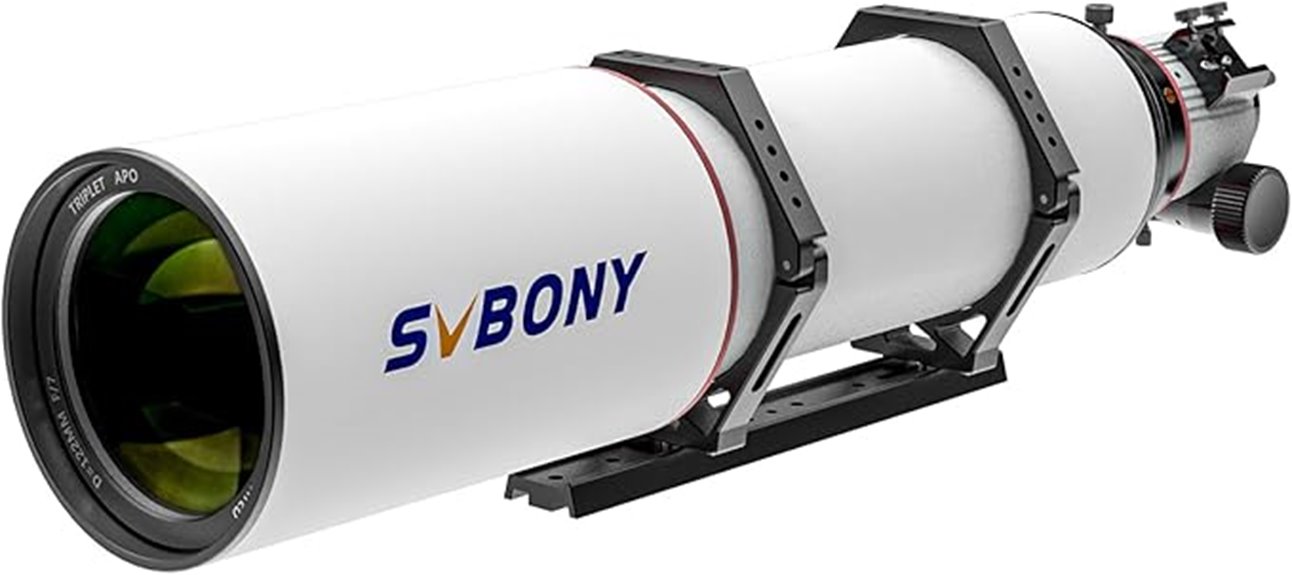
For astrophotographers seeking a portable yet powerful refractor, the SVBONY SV550 Triplet APO Telescope stands out with its 122mm aperture and high-quality FPL-51 triplet lens. Its F7 focal ratio and 854mm focal length make it versatile for both deep-sky imaging and visual observation. Weighing just 6.44kg, it’s easy to transport, and the 300mm dovetail guarantees stable mounting. The dual-speed 2.5-inch focuser allows precise focusing, vital for astrophotography. With minimal chromatic aberration and enhanced light-gathering, this telescope captures detailed, sharp images of faint objects, making it an excellent choice for both amateurs and serious astrophotographers.
Best For: amateur and serious astrophotographers seeking a portable, high-quality refractor for deep-sky imaging and visual observation.
Pros:
- High-quality FPL-51 triplet apochromatic lens minimizes chromatic aberration for sharp images
- Compact, lightweight design with a 122mm aperture suitable for travel and portability
- Precise dual-speed 2.5-inch focuser allows accurate focusing for astrophotography
Cons:
- Relatively higher cost compared to entry-level telescopes
- Limited to visual observation and astrophotography; not suitable for planetary imaging requiring higher magnification
- Requires compatible mounts and accessories for optimal use and stability
Explore Scientific ED80 Refractor Telescope for Astrophotography
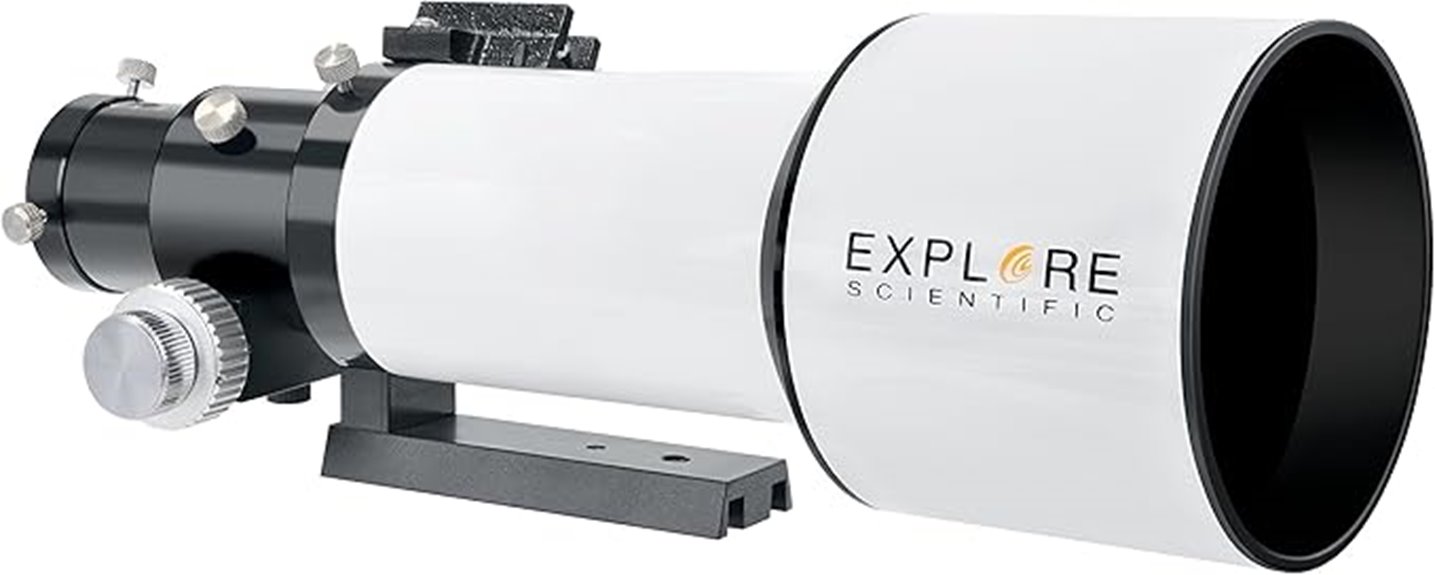
If you’re seeking a compact yet powerful telescope for astrophotography, the Explore Scientific ED80 Refractor stands out thanks to its high-quality optics and portability. Its 80mm aperture and f/6 focal ratio, combined with genuine FCD1 HOYA ED glass and multi-layer coatings, deliver brilliant, high-contrast images while virtually eliminating chromatic aberrations. The air-spaced triplet design ensures sharp, detailed views of the Moon, planets, and deep-sky objects. Its lightweight, retractable dew shield and precise collimation system make setup easy and transport effortless. Perfect for both beginners and seasoned astrophotographers, this telescope offers excellent imaging capabilities in a compact, versatile package.
Best For: amateur and experienced astrophotographers seeking a portable, high-quality refractor telescope for capturing detailed images of celestial objects.
Pros:
- Virtually eliminates chromatic aberrations thanks to air-spaced triplet design and FCD1 HOYA ED glass
- Compact and lightweight with a retractable dew shield for easy transport and setup
- Excellent optical performance for astrophotography of the Moon, planets, nebulae, and star clusters
Cons:
- Moderate aperture size may limit deep-sky object brightness compared to larger telescopes
- Slightly higher price point for high-quality apochromatic optics
- Requires additional accessories like mounts and cameras for complete astrophotography setup
SVBONY SV105 Telescope Camera, 1.25″ CMOS Astrophotography Camera
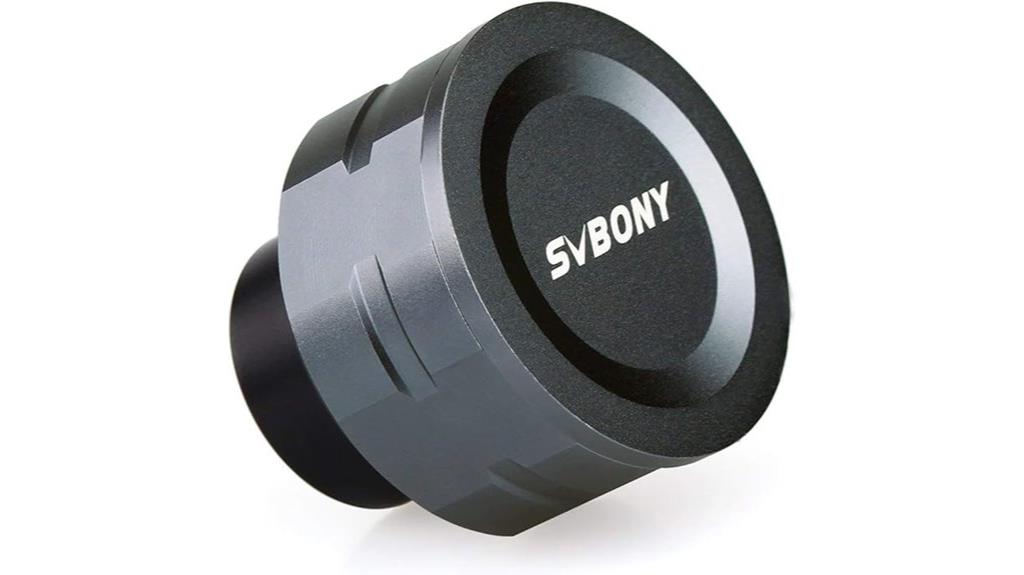
The SVBONY SV105 Telescope Camera stands out as an excellent choice for amateur astronomers who want to capture detailed lunar and planetary images without complex setup. Its 1/2.8″ IMX307 CMOS sensor delivers 1920×1080 resolution at up to 30 fps, supporting high-speed 2K video recording. Designed for ease of use, it connects via USB with plug-and-play compatibility across Windows, Linux, and Android devices. The camera’s dark light compensation technology enhances image clarity in low-light conditions, making it ideal for real-time lunar and planetary observation. Its straightforward electronic eyepiece design makes capturing and sharing bright celestial objects accessible for beginners and casual astronomers alike.
Best For: amateur astronomers and astrophotography enthusiasts seeking an easy-to-use, high-resolution camera for lunar and planetary imaging with minimal setup.
Pros:
- Supports high-speed 2K video recording at 30 fps for detailed lunar and planetary captures
- Plug-and-play USB connectivity compatible with Windows, Linux, and Android devices for convenient use
- Dark light compensation technology enhances image clarity in low-light conditions, ideal for astrophotography
Cons:
- Limited to 1920×1080 resolution, which may not satisfy those seeking ultra-high-definition imaging
- Compatibility with MacOS laptops is available, but iOS devices like phones and tablets are not supported
- Primarily designed for bright celestial objects, so less suitable for deep-sky or faint object imaging
Explore Scientific FCD100 Series 80mm Air-Spaced Apochromatic Triplet Refractor Telescope

The Explore Scientific FCD100 Series 80mm Air-Spaced Apochromatic Triplet Refractor Telescope stands out as an excellent choice for amateur astronomers and astrophotographers seeking high-quality, portable optics. Its combination of genuine Hoya FCD100 ED glass and multi-layer coatings delivers sharp, high-contrast images with minimal chromatic aberration. The 80mm aperture and f/6 focal ratio make it versatile for capturing the Moon, planets, nebulae, and galaxies, gathering more light than smaller scopes. Its compact design, 480mm focal length, and features like a dew shield and precise focuser make it perfect for spontaneous viewing and astrophotography on the go.
Best For: amateur astronomers and astrophotographers seeking a high-quality, portable apochromatic refractor for detailed celestial observation and imaging.
Pros:
- Combines genuine Hoya FCD100 ED glass with multi-layer coatings for sharp, high-contrast images.
- Air-spaced triplet design virtually eliminates chromatic aberration, ensuring color-accurate views.
- Compact, lightweight design with a 480mm focal length makes it ideal for spontaneous outings and travel.
Cons:
- Higher price point compared to entry-level telescopes, which may be a consideration for budget-conscious users.
- Limited aperture size (80mm), which may restrict deep-sky object viewing under light-polluted skies.
- Requires careful handling and maintenance of the precise focuser and dew shield for optimal performance.
Celestron StarSense Explorer DX 130AZ Telescope with Smartphone Dock

For beginners seeking an easy and guided way to explore the night sky, the Celestron StarSense Explorer DX 130AZ Telescope with Smartphone Dock offers a user-friendly solution. Its 130mm Newtonian reflector provides sharp views of the Moon, planets, and deep-sky objects like nebulae and galaxies. The star recognition technology uses your phone to analyze star patterns and help locate objects effortlessly. Simply attach your smartphone, follow the on-screen arrows, and let the app guide you. With smooth manual controls and clear visual aids, this telescope makes celestial observing straightforward and enjoyable, making it an excellent choice for newcomers wanting quick, stunning sky views.
Best For: beginners and amateur astronomers looking for an easy-to-use, guided telescope for exploring the night sky with smartphone integration.
Pros:
- User-friendly setup with intuitive app-guided navigation
- High-quality 130mm reflector for clear, detailed views of lunar, planetary, and deep-sky objects
- Smartphone compatibility with augmented reality features simplifies target locating and enhances the viewing experience
Cons:
- Manual mount requires some adjustment for precise tracking during extended observations
- Limited to basic tracking; not motorized or computerized for automatic object tracking
- Requires a smartphone with compatible app, which may be a barrier for some users
SVBONY SV550 Telescope with Accessories
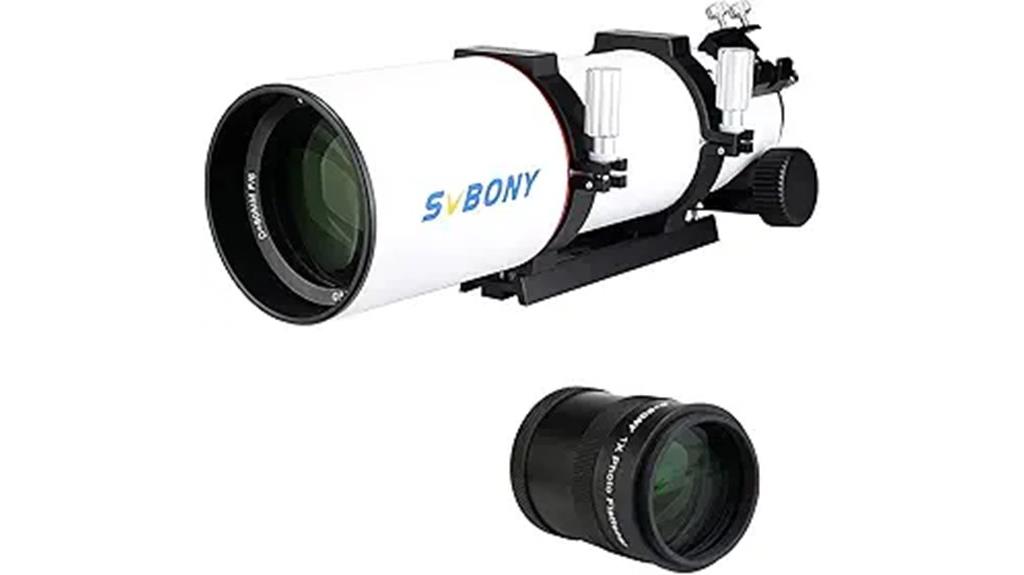
If you’re serious about deep sky astrophotography, the SVBONY SV550 Telescope with Accessories stands out as an excellent choice thanks to its 80mm F6 APO triplet optics and all-inclusive bundle. Its high-quality optics deliver sharp, color-corrected images, while the magnesium alloy focusing seat reduces weight and enhances stability. The hollow dovetail plate allows quick setup, and the included SV209 field flattener ensures a wide, flat field suitable for large targets. Compatible with both half-frame and full-frame cameras thanks to the M63 extension tube and M48 adapter ring, this package offers excellent versatility and performance for capturing stunning celestial images.
Best For: astrophotographers seeking high-precision, portable, and versatile deep sky imaging equipment with excellent optical quality.
Pros:
- High-quality 80mm F6 APO triplet optics deliver sharp, color-corrected images suitable for detailed astrophotography.
- Magnesium alloy focusing seat reduces weight by over 20%, enhancing portability and stability during setup.
- Included SV209 field flattener and accessories support large target imaging with a wide, flat field across full-frame and half-frame cameras.
Cons:
- The total weight of 8.8 pounds may still require sturdy mounting and setup considerations.
- The specialized optical system and accessories might have a higher initial cost compared to entry-level telescopes.
- Requires some familiarity with astrophotography setups and accessories for optimal use and assembly.
Factors to Consider When Choosing 130MM Triplet APO Refractors for Astrophotography
When choosing a 130mm triplet APO refractor for astrophotography, I consider factors like optical quality, focal length, and mechanical build to guarantee sharp images and durability. Portability and weight also matter, especially if I plan to travel with my setup. Additionally, I look at specific astrophotography features that can make capturing stunning images easier and more effective.
Optical Quality and Glass
Optical quality and the type of glass used are critical factors in selecting a 130mm triplet APO refractor for astrophotography. High-quality refractors often use ED (extra-low dispersion) glass like FPL-51 or FCD1, which markedly reduce chromatic aberration and deliver sharper images. The air-spaced triplet design aligns three lenses with precise spacing, enhancing color correction and minimizing optical distortions across the field of view. Superior optical glass and multiple anti-reflective coatings boost light transmission and contrast, resulting in brighter, more detailed celestial images. Choosing glass that meets professional standards ensures high contrast and accurate color reproduction. Ultimately, the quality of the glass and optical elements directly influences your ability to capture stunning, high-contrast astrophotos with clarity and fidelity.
Focal Length and Ratio
Focal length and ratio are key considerations because they directly influence how you’ll capture celestial images. A 130mm triplet APO typically has a focal length between 650mm and 900mm, affecting the field of view and magnification. Longer focal lengths offer higher magnification, ideal for planetary and lunar shots, but result in a narrower view. Shorter focal ratios, like f/5 or f/6, provide wider fields, perfect for deep-sky objects such as nebulae and star clusters. Choosing the right combination depends on your targets and preferred imaging style. If you want detailed planetary images, a longer focal length with a higher ratio works best. For broader, deep-sky captures, a shorter focal ratio provides the wider perspective necessary for stunning astrophotos.
Mechanical Build and Focuser
A solid mechanical build is vital for achieving sharp, stable astrophotos with a 130mm triplet APO refractor. A high-quality tube made from durable materials like aluminum or magnesium alloy provides stability and long-term reliability. The focuser should be at least a 2.5-inch dual-speed model, offering smooth, precise movement with minimal backlash to guarantee accurate focusing during long exposures. Secure mounting points, such as Vixen-style dovetails or 3-point systems, are important for stable attachment to mounts, reducing vibrations. The collimation system must allow easy, fine adjustments for ideal optical alignment. Finally, a sturdy, lightweight, well-balanced structure minimizes vibrations, helping to maintain sharp, stable images during extended astrophotography sessions. This combination is key to capturing professional-quality celestial shots.
Portability and Weight
When selecting a 130mm triplet APO refractor, considering its portability and weight can make a big difference in how smoothly your astrophotography sessions go. Lighter models, typically weighing between 6 to 10 pounds, are easier to transport and set up in the field, making them ideal for outdoor adventures. Manufacturers often use lightweight materials like magnesium alloys to reduce weight without sacrificing optical quality. Compact focal lengths, ranging from 480mm to 854mm, further enhance portability and simplify setup. Heavier models, however, may require larger mounts and tripods, which can be cumbersome to carry and handle. Striking a balance between optical performance and weight is essential for comfortable, efficient astrophotography, especially when you’re traveling or shooting in remote locations.
Astrophotography Features
Choosing the right 130mm triplet APO refractor for astrophotography hinges on several key features that directly impact image quality. High-contrast, sharp images with minimal chromatic aberration are essential, and triplet designs excel here. The apochromatic setup ensures red, green, and blue wavelengths focus precisely at the same point, providing true color reproduction and reducing false color artifacts. The 130mm aperture offers impressive light-gathering power, ideal for capturing faint deep-sky objects and detailed planetary features. A fast focal ratio (around f/6 to f/7) strikes a balance between wide-field imaging and resolving fine planetary details. Additionally, high-quality optical coatings, precise collimation adjustments, and a stable focuser are crucial for achieving peak image clarity and consistency during astrophotography sessions.
Mount Compatibility Options
Selecting a compatible mount is vital to getting the most out of your 130mm triplet APO refractor for astrophotography. First, verify the refractor has a Vixen-style dovetail or a compatible mounting foot, so it fits standard mounts easily. Check if the telescope includes a 2-inch or 1.25-inch focuser that matches your existing accessories for flexibility. It’s also important to verify the telescope’s weight to guarantee your mount can handle it without sacrificing stability or tracking accuracy. Additionally, look for mounts that offer precise adjustments, like dual-speed or fine-focus controls, which are essential for sharp images. Finally, consider whether an equatorial or altazimuth mount suits your imaging style best, as each offers different advantages for astrophotography.
Price and Warranty Support
Price and warranty support play a crucial role in ensuring you get the best value and peace of mind when investing in a 130mm triplet APO refractor for astrophotography. Prices can vary widely based on brand, optical quality, and included accessories, so it’s essential to compare options both online and in-store. Many reputable models offer price matching or encourage reporting lower prices to help you secure a competitive deal. Warranty support typically covers optical defects and mechanical issues, giving you confidence in your investment. Longer warranties, often exceeding two years, reflect the manufacturer’s confidence in their product’s durability. Reliable customer service and warranty support are key for resolving issues quickly, ensuring your astrophotography sessions stay on track with minimal downtime.
Brand Reputation and Support
A reputable brand guarantees you receive better customer support, which is crucial when dealing with sophisticated astrophotography equipment like a 130mm triplet APO refractor. When technical issues or warranty claims arise, knowing you can rely on prompt assistance makes a significant difference. Established manufacturers often have extensive service networks, simplifying repairs and parts replacement. Consistent quality control from trusted brands reduces the risk of defective units, saving you time and frustration. Positive reviews and industry recognition further confirm a brand’s reliability and performance. Choosing a well-known, reputable brand provides peace of mind, knowing that long-term support is available if needed. For delicate and costly astrophotography gear, this support ensures you can focus on capturing stunning celestial images without unnecessary worries.
Frequently Asked Questions
What Are the Main Differences Between ED and Apochromatic Triplet Refractors?
The main difference between ED and apochromatic triplet refractors is in color correction. I find ED refractors use extra-low dispersion glass to reduce chromatic aberration, providing sharp, color-accurate images at a lower cost. Apochromatic triplets, on the other hand, offer even better color correction and contrast because they use multiple low-dispersion glasses, making them ideal for high-quality astrophotography, though they tend to be more expensive.
How Does Aperture Size Impact Astrophotography Image Quality?
Aperture size is like the lens of a camera—it determines how much light you can gather, directly impacting your astrophotography image quality. The bigger the aperture, the more photons it collects, revealing fainter details and sharper images. With a larger aperture, I notice improved contrast and clarity, especially when capturing distant celestial objects. So, choosing the right size is essential for stunning, detailed shots of the night sky.
Are 130MM Triplet APOS Suitable for Astrophotography Beginners?
Yes, a 130mm triplet APO refractor is suitable for astrophotography beginners. I found that its size strikes a great balance—it’s manageable to handle yet powerful enough to capture stunning celestial details. The triplet design helps reduce chromatic aberration, making your images clearer. Plus, many models are user-friendly, so you can learn the basics without feeling overwhelmed. It’s an excellent choice to start your astrophotography journey.
What Accessories Enhance Imaging With 130MM Triplet APO Refractors?
To enhance imaging with my 130mm triplet APO refractor, I recommend adding a high-quality equatorial mount for stability, a good coma corrector for sharp star images, and a reliable motorized focuser for precise adjustments. I also use a light pollution filter to improve clarity, a good star atlas for target planning, and a sturdy tripod. These accessories help me capture stunning, detailed celestial shots with ease and confidence.
How Do I Maintain Optical Quality Over Time With These Telescopes?
To maintain optical quality over time, I always keep my 130mm triplet APO refractor clean and protected. I use a gentle brush and lens cleaning solution for the optics, and I store it in a dust-free, climate-controlled environment. Regularly checking for dew with a dew shield and ensuring the focuser and mount are properly aligned also help preserve image quality. Consistent care keeps my telescope performing at its best.
Conclusion
So, are you ready to capture breathtaking celestial images with one of these top 130mm triplet APO refractors? Each offers unique features to suit different needs and budgets. Whether you’re just starting out or upgrading your gear, these telescopes can help you achieve stunning astrophotography results. Which one will you choose to turn your night sky dreams into reality? The stars are waiting—are you ready to explore them?