A handheld gimbal stabilizer can smooth walking shots, but the right choice depends on whether you’re stabilizing a phone, a mirrorless camera, or an action camera. My best overall pick is the DJI Osmo Mobile 8 for a phone-first setup, while the DJI RS 4 Mini stands out for interchangeable-lens camera users and the hohem iSteady X3 SE is a simpler, foldable option. The biggest tradeoffs are payload and camera compatibility versus portability, setup effort, and phone-focused features. A one-axis selfie-stick gimbal also serves a different purpose from a three-axis stabilizer, so the product label alone does not tell the whole story. Read on for the full breakdown, buying advice, and picks by type of creator.

Get kitchen gear delivered free with Prime
- Fast, free delivery on millions of items
- Prime Video, Amazon Music and more included
- Member-only deals all year
Complete the kit


Key Takeaways
- Phone, camera, and action-camera gimbals are not interchangeable: the DJI RS models target camera rigs, the Osmo Mobile and most Hohem and AOCHUAN models target phones, and the Hohem iSteady Pro 4 is designed for action cameras.
- The DJI RS 4 Mini family is the camera-focused tier: choose between the RS 4 Mini and its Combo based on the included accessories you need, rather than treating either as a phone gimbal.
- DJI’s Osmo Mobile models offer several distinct phone options: the 7, 7P, 8, and Standard Combo are separate listings, so check the exact package and feature set instead of assuming the names mean the same bundle.
- Three-axis phone gimbals suit controlled movement better than a one-axis design: the Coovoamae combines stabilization with selfie-stick utility, but it is not a like-for-like substitute for the three-axis picks.
- Portability and add-ons create the main phone-gimbal tradeoff: foldable designs such as the hohem iSteady X3 SE and AOCHUAN Smart XE emphasize carry convenience, while remote, tracking, and combo features can make setup more involved.
| hohem iSteady X3 SE Foldable Phone Gimbal with Detachable Remote, Gray |  | Best Overall for Travel | Stabilization: 3-axis, iSteady 8.0 | Weight: 0.79 lbs | Payload capacity: 0.66 lbs | VIEW ON AMAZON | See Our Full Breakdown |
| Coovoamae 1-Axis Smartphone Gimbal Stabilizer with Extendable Selfie Stick, Tripod, and Bluetooth Remote | 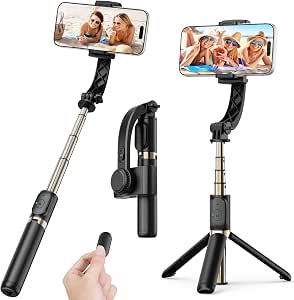 | Best Value for Casual Selfie Videos | Stabilization: 1-axis with built-in gyroscope | Compatible smartphones: Most phones with 4.0–6.2-inch screens | Extension length: 31.5 inches | VIEW ON AMAZON | See Our Full Breakdown |
| AOCHUAN Smart XE 3-Axis Foldable Smartphone Gimbal Stabilizer |  | Best for App-Assisted Tracking | Stabilization: 3-axis | Compatibility: iPhone and most Android smartphones | Weight: 0.78 lb | VIEW ON AMAZON | See Our Full Breakdown |
| DJI RS 3 Mini Camera Gimbal Stabilizer |  | Best for Lightweight Mirrorless Cameras | Weight: 795 g (1.75 lbs) in portrait mode; 850 g (1.8 lbs) with horizontal arm | Payload capacity: 0.4–2 kg (0.8–4.4 lbs) | Screen: 1.4-inch full-color touchscreen | VIEW ON AMAZON | See Our Full Breakdown |
| DJI RS 4 Mini, Gimbal Stabilizer for Camera, Canon/Sony/Nikon/Fujifilm |  | Best for Fast Camera Setup | Model: RS 4 Mini | Model number: P24M | Payload capacity: 2 kg / 4.4 lbs | VIEW ON AMAZON | See Our Full Breakdown |
| Hohem iSteady Pro 4 3-Axis Action Camera Gimbal Stabilizer |  | Best for Action Cameras | Stabilization: 3-axis | Compatible cameras: GoPro HERO 3–13, DJI Osmo Action, Insta360 ONE R, Sony RX0, and similarly sized action cameras | Maximum weight recommendation: 150 g | VIEW ON AMAZON | See Our Full Breakdown |
| DJI Osmo Mobile 7P 3-Axis Smartphone Gimbal Stabilizer |  | Best for Built-In Creator Tools | Stabilization: 3-axis | Compatibility: iPhone and Android smartphones | Operating time: Up to 10 hours | VIEW ON AMAZON | See Our Full Breakdown |
| DJI Osmo Mobile 8 3-Axis Phone Gimbal Stabilizer |  | Best for Full-Rotation Tracking | Model: Osmo Mobile 8 | Stabilization: 3-axis | Pan rotation: 360° horizontal | VIEW ON AMAZON | See Our Full Breakdown |
| Hohem iSteady X3 SE 3-Axis Gimbal Stabilizer for iPhone and Android |  | Best for Remote-Controlled Portability | Model: iSteady X3 SE | Stabilization: 3-axis | Weight: 0.79 lb | VIEW ON AMAZON | See Our Full Breakdown |
| COMITOK L7C Pro Gimbal Stabilizer for iPhone and Android, Foldable 3-Axis Phone Gimbal with Face/Object Tracking |  | Best for a Small Folded Footprint | Model: L7C Pro | Stabilization: 3-axis | Weight: 0.8 lb | VIEW ON AMAZON | See Our Full Breakdown |
| DJI RS 4 Mini Combo Gimbal Stabilizer |  | Best for Mirrorless Camera Creators | Brand: DJI | Model: RS 4 Mini | Maximum payload: 2 kg / 4.4 lbs | VIEW ON AMAZON | See Our Full Breakdown |
| Hohem iSteady X3 3-Axis Gimbal Stabilizer for iPhone and Android |  | Best for Remote Solo Filming | Brand: Hohem | Model: iSteady X3 (HPG-X3P) | Compatible devices: iPhone and Android | VIEW ON AMAZON | See Our Full Breakdown |
| DJI Osmo Mobile 8 Standard Combo Phone Gimbal Stabilizer |  | Best for Extended Phone Shoots | Brand: DJI | Model: Osmo Mobile 8 | Stabilization: 3-axis | VIEW ON AMAZON | See Our Full Breakdown |
| DJI Osmo Mobile 7 3-Axis Gimbal Stabilizer for iPhone and Android |  | Best Lightweight Phone Gimbal | Brand: DJI | Model: DS307 | Stabilization: 3-axis | VIEW ON AMAZON | See Our Full Breakdown |
| handheld gimbal stabilizer | Stabilization | Weight | Model | Battery life |
|---|---|---|---|---|
| hohem iSteady X3 SE Foldable P | 3-axis, iSteady 8.0 | 0.79 lbs | — | Up to 11 hours |
| Coovoamae 1-Axis Smartphone Gi | 1-axis with built-in gyroscope | 0.49 lb (7.84 oz) | — | Up to 2 hours |
| AOCHUAN Smart XE 3-Axis Foldab | 3-axis | 0.78 lb | — | Up to 10 hours |
| DJI RS 3 Mini Camera Gimbal St | Third-generation RS stabilization | 795 g (1.75 lbs) in portrait mode; 850 g (1.8 lbs) with horizontal arm | — | — |
| DJI RS 4 Mini | — | — | RS 4 Mini | — |
| Hohem iSteady Pro 4 3-Axis Act | 3-axis | — | — | Up to 14 hours |
| DJI Osmo Mobile 7P 3-Axis Smar | 3-axis | — | — | — |
| DJI Osmo Mobile 8 3-Axis Phone | 3-axis | — | Osmo Mobile 8 | Up to 10 hours |
| Hohem iSteady X3 SE 3-Axis Gim | 3-axis | 0.79 lb | iSteady X3 SE | Up to 11 hours |
| COMITOK L7C Pro Gimbal Stabili | 3-axis | 0.8 lb | L7C Pro | — |
| DJI RS 4 Mini Combo Gimbal Sta | — | — | RS 4 Mini | — |
| Hohem iSteady X3 3-Axis Gimbal | 3-axis, iSteady 8.0 | 0.93 lb | iSteady X3 (HPG-X3P) | — |
| DJI Osmo Mobile 8 Standard Com | 3-axis | — | Osmo Mobile 8 | Up to 10 hours |
| DJI Osmo Mobile 7 3-Axis Gimba | 3-axis | 300 g | DS307 | — |
More Details on Our Top Picks
hohem iSteady X3 SE Foldable Phone Gimbal with Detachable Remote, Gray
The iSteady X3 SE is my strongest fit for phone users who want real three-axis stabilization without carrying a larger camera rig. Its 0.79-pound foldable body is easier to pack than the DJI RS 3 Mini, which is built for mirrorless cameras, while the detachable remote lets you start or control shots from up to 32.81 feet away. That distance is useful for solo clips and group framing, and the 11-hour battery life suits a long day of filming better than the Coovoamae’s two-hour limit. It also switches between portrait and landscape orientation. The tradeoff is a 0.66-pound phone limit, so heavier phones or bulky accessories may be a poor fit, and some tracking and gesture features depend on the Hohem Joy app.
Pros:- Three-axis stabilization helps smooth movement across more directions than a one-axis stick.
- Foldable 0.79-pound design is convenient for travel.
- Detachable remote works from up to 32.81 feet away.
- Up to 11 hours of battery life supports extended filming.
Cons:- Payload limit of 0.66 pounds rules out some heavier phone setups.
- AI tracking and gesture features rely on the Hohem Joy app.
Best for: Travelers and solo phone creators who want three-axis stabilization, remote framing, and a long battery life in a foldable setup.
Not ideal for: People using heavier phones or demanding a gimbal that works without companion-app features.
- Stabilization:3-axis, iSteady 8.0
- Weight:0.79 lbs
- Payload capacity:0.66 lbs
- Remote range:Up to 32.81 feet
- Battery life:Up to 11 hours
- Charging time:2 hours
- App:Hohem Joy
- Included accessories:Remote controller, tripod, storage pouch, Type-C charging cable, quick start guide, warranty card
Our verdict“Choose the iSteady X3 SE for a travel-friendly phone gimbal with stronger stabilization and longer runtime than the Coovoamae.”
Coovoamae 1-Axis Smartphone Gimbal Stabilizer with Extendable Selfie Stick, Tripod, and Bluetooth Remote
The Coovoamae is a selfie stick with one-axis shake reduction, not a substitute for the three-axis phone gimbals in this roundup. That simpler design keeps it light at 0.49 pounds and lets it extend to 31.5 inches, making it handy for travel clips, group photos, and hands-free tripod shots. Its detachable Bluetooth remote works up to 32 feet away, and horizontal or vertical framing does not require an app. Compared with the Hohem iSteady X3 SE, it gives up multi-axis stabilization and substantial battery endurance, but its 7.5-inch folded size and selfie-stick reach suit casual use better than a dedicated gimbal. The central compromise is clear: up to two hours of battery life and one-axis correction are limiting for long shoots or footage with lots of walking.
Pros:- Lightweight 0.49-pound build folds to 7.5 inches.
- Extends to 31.5 inches for wider group shots and higher camera angles.
- Converts into a tripod for hands-free use.
- Detachable remote works up to 32 feet away, with no app needed for orientation changes.
Cons:- One-axis stabilization offers less correction than the three-axis Hohem iSteady X3 SE and AOCHUAN Smart XE.
- Battery life is limited to up to two hours.
- Phone compatibility is specified for most phones with 4.0–6.2-inch screens, which may exclude some devices.
Best for: Casual travelers and families who want an extendable selfie stick, remote shutter, and tripod function for short phone videos and photos.
Not ideal for: Creators who need smooth walking footage, multi-axis stabilization, or a full day of shooting between charges.
- Stabilization:1-axis with built-in gyroscope
- Compatible smartphones:Most phones with 4.0–6.2-inch screens
- Extension length:31.5 inches
- Folded size:7.5 inches
- Weight:0.49 lb (7.84 oz)
- Remote range:Up to 32 ft
- Battery life:Up to 2 hours
- Phone holder rotation:360°
Our verdict“Pick the Coovoamae for compact selfie-stick versatility, not for the smoother movement control offered by three-axis gimbals.”
AOCHUAN Smart XE 3-Axis Foldable Smartphone Gimbal Stabilizer
The AOCHUAN Smart XE makes the most sense for phone creators who want three-axis stabilization plus hands-on framing controls. Face tracking and gesture control can help a solo creator stay in frame, while the focus wheel offers more direct control than the Hohem iSteady X3 SE’s listed app-based features. Its foldable 0.78-pound design and up to 10-hour battery life keep it practical for mobile filming, and it supports both portrait and landscape shooting. Compared with the Coovoamae, it is the more capable choice for moving footage, though it lacks the Coovoamae’s stated long selfie-stick extension. The limits are its 250-gram payload and compatibility that may vary among Android phones. Buyers also need to supply their own phone; it is not included.
Pros:- Three-axis stabilization is suited to smoother moving shots than the Coovoamae’s one-axis design.
- Face tracking and gesture control support solo filming.
- Focus wheel provides a physical control for focus adjustments.
- Up to 10 hours of battery life and portrait or landscape shooting support varied filming sessions.
Cons:- Maximum payload is 250 g, limiting heavier phones and accessories.
- Android compatibility may vary by phone.
- Phone is not included.
Best for: Solo creators with a compatible iPhone or Android phone who want tracking, gesture controls, and a physical focus wheel.
Not ideal for: People with heavier phone setups, uncertain Android compatibility, or a need for an included smartphone.
- Stabilization:3-axis
- Compatibility:iPhone and most Android smartphones
- Weight:0.78 lb
- Maximum payload:250 g
- Battery capacity:2600 mAh
- Battery life:Up to 10 hours
- Features:Face tracking, gesture control, focus wheel
- Included items:Gimbal, tripod, USB-C charging cable, user manual
Our verdict“Choose the Smart XE over the Coovoamae when tracking and three-axis movement control matter more than selfie-stick reach.”
DJI RS 3 Mini Camera Gimbal Stabilizer
The DJI RS 3 Mini is a camera gimbal, not a handheld phone stabilizer in the same sense as the Hohem iSteady X3 SE or AOCHUAN Smart XE. Its 2 kg payload capacity is designed for compatible mirrorless camera-and-lens combinations, making it the right step up when a phone’s image quality or lens options are no longer enough. Native vertical shooting, Bluetooth shutter control, and a 1.4-inch touchscreen add useful controls without moving to a larger rig. At 795 g in portrait mode, it remains relatively portable for a camera gimbal, though it is substantially heavier than the phone-focused options here. The key tradeoff is system fit: camera-and-lens compatibility matters, and the DJI Ronin app must be downloaded from DJI’s website because it is unavailable on Google Play.
Pros:- Supports compatible camera and lens setups weighing up to 2 kg.
- Native vertical shooting suits portrait-oriented video without relying on a phone gimbal.
- 1.4-inch color touchscreen provides onboard control.
- Bluetooth shutter control and third-generation RS stabilization are built in.
Cons:- Much heavier than phone gimbals such as the Hohem iSteady X3 SE.
- Compatibility depends on the specific camera-and-lens combination.
- DJI Ronin app must be downloaded from DJI’s website rather than Google Play.
Best for: Travel and social-video creators using a compatible mirrorless camera who want a compact camera gimbal with native vertical shooting.
Not ideal for: Phone-only users or buyers who want a lightweight phone gimbal with straightforward app access.
- Weight:795 g (1.75 lbs) in portrait mode; 850 g (1.8 lbs) with horizontal arm
- Payload capacity:0.4–2 kg (0.8–4.4 lbs)
- Screen:1.4-inch full-color touchscreen
- Connectivity:Bluetooth shutter control
- Shooting orientation:Native vertical shooting
- Stabilization:Third-generation RS stabilization
- Included accessories:Quick-release plate, tripod, multi-camera control cable, USB-C charging cable
Our verdict“Choose the RS 3 Mini if you need stabilization for a compatible mirrorless camera; phone-only creators should favor a dedicated smartphone gimbal.”
DJI RS 4 Mini, Gimbal Stabilizer for Camera, Canon/Sony/Nikon/Fujifilm
The DJI RS 4 Mini is the pick here for creators who want quick setup and tracking with a camera-capable gimbal. Its automated axis locks reduce the steps involved in getting ready to shoot, while intelligent tracking helps keep a subject framed; those features make it more workflow-focused than the RS 3 Mini, whose listed strengths center on a touchscreen and native vertical shooting. It supports cameras and smartphones up to 2 kg, giving it wider stated payload flexibility than phone-only options such as the AOCHUAN Smart XE. That flexibility does not make it the simplest choice for casual phone clips: camera compatibility and balancing still matter, and the supplied details do not specify its weight, battery life, or included accessories. The DJI Ronin app also requires a manual download from DJI’s website.
Pros:- Automated axis locks speed up setup.
- Intelligent tracking helps keep subjects framed.
- Supports compatible cameras and smartphones up to 2 kg.
- Fast vertical switching suits creators producing portrait and landscape content.
Cons:- DJI Ronin app is unavailable on Google Play and must be downloaded from DJI’s website.
- Specific camera and lens compatibility needs checking before purchase.
- Provided product details do not state weight or battery life, making portability and runtime harder to compare.
Best for: Content creators who regularly switch between compatible camera or phone setups and value quick balancing and subject tracking.
Not ideal for: Phone-only beginners seeking a clearly specified, lightweight smartphone gimbal or buyers who prefer app downloads through Google Play.
- Model:RS 4 Mini
- Model number:P24M
- Payload capacity:2 kg / 4.4 lbs
- Maximum weight recommendation:2 kg
- Setup feature:Automated axis locks
- Tracking feature:Intelligent tracking
- Balancing feature:Teflon-enhanced balancing
- Warranty:2 years
Our verdict“Pick the RS 4 Mini for a camera-capable gimbal where quick setup and tracking outweigh the simpler handling of phone-specific models.”
Hohem iSteady Pro 4 3-Axis Action Camera Gimbal Stabilizer
The iSteady Pro 4 is the action-camera specialist in this group: unlike the DJI Osmo Mobile 7P and other phone gimbals here, it is built for compatible compact cameras, with a recommended maximum weight of 150 g. Its 3-axis stabilization and quick-release mount help smooth moving footage, while wireless shutter control makes starting a clip less fiddly. The headline advantage for longer outings is up to 14 hours of battery life, and the gimbal can charge the camera while filming. Its IPX4 rating offers splash resistance, not protection for underwater use, and camera size and weight determine whether a particular setup fits. Choose it for action-camera footage; smartphone users should pick a phone-specific model instead.
Pros:- 3-axis stabilization with iSteady 5.0 anti-shaking
- Up to 14 hours of battery life
- Can charge a compatible camera while filming
- Quick-release mount and support for a range of action cameras
Cons:- IPX4 protection does not allow immersion
- Compatibility depends on the camera’s size and weight
Best for: Action-camera owners with a compatible GoPro, Osmo Action, Insta360 ONE R, Sony RX0, or similarly sized camera who want stabilized footage on longer outings.
Not ideal for: Smartphone filmmakers or anyone planning to submerge the gimbal; it is designed for compact action cameras and only resists splashes.
- Stabilization:3-axis
- Compatible cameras:GoPro HERO 3–13, DJI Osmo Action, Insta360 ONE R, Sony RX0, and similarly sized action cameras
- Maximum weight recommendation:150 g
- Wireless control:Bluetooth shutter control
- Battery life:Up to 14 hours
- Water resistance:IPX4 splash-resistant
- Included accessories:Mini tripod, carry case, camera charging cables, gimbal charging cable, user manual, quick start guide
- Warranty:1 year
Our verdict“Choose the iSteady Pro 4 for compatible action-camera footage and long runtime, but pick a DJI Osmo Mobile model if you shoot on a phone.”
DJI Osmo Mobile 7P 3-Axis Smartphone Gimbal Stabilizer
The Osmo Mobile 7P suits phone creators who want more than stabilization in one setup. Its multifunctional module adds tracking, lighting, and audio reception, while the built-in extension rod and tripod support solo framing and hands-free shots. Compared with the Hohem iSteady X3 SE, the 7P puts more emphasis on integrated shooting tools; the Hohem’s detachable remote is a simpler choice for starting shots from farther away. The DJI offers up to 10 hours of operation, but its Mimo app requires extra setup for Android users because it must be downloaded from DJI’s website rather than Google Play. That app friction is a real tradeoff for a gimbal whose tracking and guided shooting features rely on DJI’s software.
Pros:- 3-axis stabilization for smoother smartphone footage
- Multifunctional module supports tracking, lighting, and audio reception
- Built-in extension rod and tripod expand framing options
- Up to 10 hours of operating time
Cons:- DJI Mimo must be downloaded from DJI’s website on Android
- The added module and integrated features may be unnecessary for buyers who only need stabilization
Best for: Phone vloggers and solo creators who want tracking, lighting, audio reception, and an extension rod in one gimbal setup.
Not ideal for: Android users who want to install companion apps only through Google Play, or buyers seeking a straightforward remote-controlled gimbal without extra creator tools.
- Stabilization:3-axis
- Compatibility:iPhone and Android smartphones
- Operating time:Up to 10 hours
- Multifunctional module:Tracking, lighting, and audio reception
- Built-in features:Extension rod and tripod
- Phone mount:Magnetic phone clamp
- Included items:Osmo Mobile 7P, Multifunctional Module, magnetic phone clamp, USB-C cables, storage pouch
- App:DJI Mimo; Android users may need to download it from DJI’s website
Our verdict“Pick the Osmo Mobile 7P if you want an all-in-one phone-creator setup and can accommodate DJI Mimo’s Android installation process.”
DJI Osmo Mobile 8 3-Axis Phone Gimbal Stabilizer
The Osmo Mobile 8 is the standout pick here for phone shooters who want 360° horizontal rotation alongside native subject tracking. That rotation gives moving subjects room to travel around the frame without the same pan limit, while its built-in extension rod and tripod make solo filming more flexible. Like the Osmo Mobile 7P, it pairs stabilization with a multifunctional module for audio and lighting; the 7P’s listed module also supports tracking, so the 8’s clearest distinction is its full horizontal rotation and phone-charging support. Runtime is up to 10 hours, with charging support for the phone, but Android users still face the DJI Mimo download process outside Google Play. This is a feature-rich phone gimbal, not the simplest choice for casual steady clips.
Pros:- 3-axis stabilization for smoother footage
- 360° horizontal rotation paired with native subject tracking
- Built-in extension rod and tripod
- Multifunctional module supports audio and lighting, with phone charging support
Cons:- DJI Mimo is unavailable on Google Play and must be downloaded from DJI’s website
- Its extra tracking and creator features may add needless complexity for simple handheld clips
Best for: Phone videographers who track moving subjects, want full horizontal rotation, and value built-in filming accessories and phone charging support.
Not ideal for: Casual users seeking a basic stabilizer or Android buyers unwilling to download DJI Mimo from DJI’s website.
- Model:Osmo Mobile 8
- Stabilization:3-axis
- Pan rotation:360° horizontal
- Battery life:Up to 10 hours
- Built-in features:Extension rod and tripod
- Tracking:Native subject tracking
- Multifunctional module:Audio and lighting
- Included accessories:Multifunctional module, magnetic phone clamp, USB-C phone charging/audio cable, storage pouch, USB-C power cable
Our verdict“Choose the Osmo Mobile 8 if full horizontal rotation and tracking matter more than a simple setup, and you are comfortable using DJI Mimo.”
Hohem iSteady X3 SE 3-Axis Gimbal Stabilizer for iPhone and Android
The foldable iSteady X3 SE earns its place for phone owners who want a compact stabilizer with a useful separation between camera and operator: its detachable magnetic remote works up to 32.81 feet away. That makes solo framing easier than relying on the built-in tripod alone, while the Hohem Joy app adds AI tracking and gesture control. Its up to 11 hours of battery life also exceeds the DJI Osmo Mobile 7P’s listed 10 hours, though the DJI offers a multifunctional module for lighting and audio reception that this Hohem does not list. The X3 SE folds for carrying and switches between portrait and landscape, but its payload limit of 0.66 lb rules out heavier phone setups. For lightweight smartphone rigs, it balances portability and remote operation well.
Pros:- 3-axis stabilization for smooth smartphone footage
- Detachable magnetic remote works up to 32.81 feet away
- Foldable design weighs 0.79 lb
- Up to 11 hours of battery life
Cons:- Payload capacity is limited to 0.66 lb
- Does not list the integrated lighting and audio reception module offered with the DJI Osmo Mobile 7P
Best for: Solo smartphone creators who want a foldable 3-axis gimbal, a remote they can use from across a room, and long operating time.
Not ideal for: People using phones or phone accessories that push the total setup above 0.66 lb, or creators who want integrated lighting and audio tools.
- Model:iSteady X3 SE
- Stabilization:3-axis
- Weight:0.79 lb
- Payload capacity:0.66 lb
- Remote range:Up to 32.81 feet
- Battery life:Up to 11 hours
- Charging time:2 hours
- App:Hohem Joy
- Included accessories:Tripod, storage pouch, Type-C charging cable, remote controller, quick start guide, warranty card
Our verdict“Choose the iSteady X3 SE for portable phone shooting with a stand-off remote, provided your phone setup stays within its payload limit.”
COMITOK L7C Pro Gimbal Stabilizer for iPhone and Android, Foldable 3-Axis Phone Gimbal with Face/Object Tracking
The COMITOK L7C Pro is the compact-carry pick: folded, it measures 6 x 4.3 x 1.8 inches and weighs 0.8 lb, making it an appealing fit for creators who want a phone gimbal ready to pack away between clips. Its 3-axis stabilization is joined by AI face and object tracking and gesture controls, so it offers more automated framing than the remote-focused Hohem iSteady X3 SE. COMITOK also lists a 2600mAh battery and an 80-minute charging time, although the supplied data does not specify runtime in hours, so buyers should not assume a precise all-day duration. The main constraint is its 9.92-ounce maximum phone weight; larger phones or heavier add-ons may exceed the limit. It prioritizes a small folded shape over a generous payload.
Pros:- Compact folded dimensions of 6 x 4.3 x 1.8 inches
- Lightweight design at 0.8 lb
- AI face and object tracking with gesture controls
- 2600mAh battery with an 80-minute charging time
Cons:- Maximum recommended phone weight is 9.92 ounces
- No built-in leveling indicator is listed
- Battery runtime in hours is not specified in the product data
Best for: Traveling phone creators who prioritize a small folded gimbal and use a smartphone under 9.92 ounces.
Not ideal for: Owners of heavier phones or creators who need a stated runtime in hours or a built-in leveling indicator.
- Model:L7C Pro
- Stabilization:3-axis
- Weight:0.8 lb
- Maximum weight recommendation:9.92 ounces
- Battery capacity:2600mAh
- Charging time:80 minutes
- Folded dimensions:6 x 4.3 x 1.8 inches
- Unfolded dimensions:10.2 x 5.1 x 3.5 inches
Our verdict“Choose the L7C Pro if a compact folded size and automated tracking matter most, but check your phone’s weight before buying.”
DJI RS 4 Mini Combo Gimbal Stabilizer
The RS 4 Mini Combo is the camera-focused pick here: its 2 kg payload supports compatible mirrorless setups, while the Osmo Mobile models are designed for phones. Automated axis locks cut setup to a stated one second, and the included tracking module can keep a subject framed without constant joystick adjustments. Fast vertical switching also suits creators who publish in both portrait and landscape formats. Compared with the more portable Osmo Mobile 8, this gimbal offers camera compatibility and a briefcase handle, but it is a larger, more involved choice than a phone-only stabilizer. Its main usability tradeoff is Android setup: the DJI Ronin app is unavailable on Google Play, so users must download it from DJI’s website.
Pros:- Supports compatible camera and smartphone setups up to a 2 kg payload.
- Automated axis locks make setup fast.
- Included Intelligent Tracking Module helps maintain subject framing.
- Switches between horizontal and vertical shooting quickly.
Cons:- Android users must download the Ronin app from DJI’s website.
- A camera-oriented gimbal is more than many phone-only users need.
- Balancing still matters when changing camera setups, despite the Teflon-enhanced design.
Best for: Creators using compatible mirrorless cameras who want fast setup, subject tracking, and frequent portrait-to-landscape shooting.
Not ideal for: Phone-only creators seeking the simplest compact setup, or Android users who prefer installing apps through Google Play.
- Brand:DJI
- Model:RS 4 Mini
- Maximum payload:2 kg / 4.4 lbs
- Stated setup time:1 second
- Vertical switching time:10 seconds
- Compatibility:Canon, Sony, Nikon, Fujifilm cameras and smartphones
- Included accessories:Tripod, Intelligent Tracking Module, Briefcase Handle, L-Shaped Multi-Camera Control Cable, quick-release plate, USB-C charging cable, and screw kit
Our verdict“Choose the RS 4 Mini Combo if you need a compact camera gimbal with tracking and fast vertical switching, rather than a phone-only model like the Osmo Mobile 8.”
Hohem iSteady X3 3-Axis Gimbal Stabilizer for iPhone and Android
The Hohem iSteady X3 is the most flexible choice in this group for filming yourself from a distance. Its detachable remote works up to 32.8 feet away, and the included tripod, extension rod, and magnetic fill light let solo creators set up a shot without adding as many separate accessories. Three-axis stabilization supports smoother moving footage than a basic selfie-stick setup. Compared with the DJI Osmo Mobile 7, Hohem leans harder into remote control and bundled filming aids, while DJI specifies ActiveTrack 7.0 and up to 10 hours of operation. The X3 weighs 0.93 lb and depends on the Hohem Joy app for AI tracking and gesture control, so buyers who avoid companion apps may prefer simpler controls.
Pros:- Detachable remote supports shooting from up to 32.8 feet away.
- Three-axis iSteady 8.0 stabilization helps steady moving phone footage.
- Includes a tripod, extension rod, and magnetic fill light.
- AI tracking and gesture control support hands-free solo filming.
Cons:- AI tracking and gesture control require the Hohem Joy app.
- At 0.93 lb, it may be less appealing to buyers focused on carrying the lightest kit.
- The listed details do not specify battery runtime.
Best for: Solo phone creators who need to start or control shots from across a room and want a tripod, extension rod, and fill light included.
Not ideal for: Travelers prioritizing the lightest possible kit, or users who want AI tracking and gesture control without a companion app.
- Brand:Hohem
- Model:iSteady X3 (HPG-X3P)
- Compatible devices:iPhone and Android
- Stabilization:3-axis, iSteady 8.0
- Weight:0.93 lb
- Remote shooting range:Up to 32.8 ft
- Features:Foldable design, detachable remote, tripod, extension rod, magnetic fill light, AI tracking, and gesture control
- Warranty:1 year
Our verdict“Pick the iSteady X3 for remote solo shooting and its included filming accessories; choose the Osmo Mobile 7 instead if DJI’s specified tracking features and runtime matter more.”
DJI Osmo Mobile 8 Standard Combo Phone Gimbal Stabilizer
The Osmo Mobile 8 Standard Combo stands out for phone creators who want a long stated runtime and room to move the camera around a subject. Its 360° pan rotation supports continuous turning shots, while the built-in extension rod and tripod make solo framing and static recording easier without separate supports. DJI lists up to 10 hours of battery life and phone charging, a useful pairing for longer filming sessions. Compared with the Osmo Mobile 7, it offers the same broad phone-gimbal focus but adds the specified 360° pan rotation; both have a built-in tripod and extension rod. The standard combo does not include the Multifunctional Module, and the DJI Mimo app is unavailable on Google Play, adding friction for some Android users.
Pros:- Three-axis stabilization helps smooth phone footage.
- 360° pan rotation supports continuous turning shots.
- Built-in extension rod and tripod add framing options without separate gear.
- Up to 10 hours of battery life and phone charging suit longer sessions.
Cons:- The Multifunctional Module is sold separately.
- DJI Mimo is unavailable on Google Play.
- The standard combo is designed for phones rather than interchangeable-lens cameras.
Best for: Phone videographers who film for extended stretches, want 360° panning, and value a built-in extension rod and tripod.
Not ideal for: Android users who want app installation through Google Play, or buyers who expect the Multifunctional Module in the standard combo.
- Brand:DJI
- Model:Osmo Mobile 8
- Stabilization:3-axis
- Pan rotation:360°
- Battery life:Up to 10 hours
- Built-in features:Extension rod and tripod
- Included items:Gimbal, magnetic phone clamp, USB-C charging/audio cable, USB-C power cable, and storage pouch
- Multifunctional Module:Sold separately; not included in the standard combo
Our verdict“Choose the Osmo Mobile 8 Standard Combo for long phone shoots and 360° panning, provided you are comfortable sourcing the app outside Google Play and buying the module separately if needed.”
DJI Osmo Mobile 7 3-Axis Gimbal Stabilizer for iPhone and Android
At a stated 300 g, the foldable Osmo Mobile 7 is the clearest fit for phone users who want stabilization without carrying a camera-sized rig. It pairs three-axis stabilization with ActiveTrack 7.0, a built-in tripod, and up to 10 hours of operation, covering everyday clips, guided shots, and unattended framing. Compared with the Hohem iSteady X3, the Osmo Mobile 7 is lighter by its listed weight and specifies DJI’s tracking system, while Hohem bundles a detachable remote, extension rod, and magnetic fill light. DJI’s tradeoff is app access: Mimo must be downloaded from DJI’s website rather than Google Play. The Tracking Kit accessories are also sold separately, so buyers should not assume they come with this package.
Pros:- Stated weight of 300 g supports a lighter carry than the Hohem iSteady X3.
- Three-axis stabilization and ActiveTrack 7.0 support smooth, tracked phone video.
- Foldable design and built-in tripod suit travel and quick setups.
- Up to 10 hours of operation and USB-C phone charging support longer use.
Cons:- DJI Mimo must be downloaded from DJI’s website rather than Google Play.
- Tracking Kit accessories are sold separately.
- Designed for smartphones, not mirrorless camera payloads like the DJI RS 4 Mini Combo.
Best for: Phone-first travelers and casual creators who want a lightweight foldable gimbal, built-in tripod, and subject tracking.
Not ideal for: Android users who only install apps through Google Play, or solo creators who specifically want a detachable remote and fill light included.
- Brand:DJI
- Model:DS307
- Stabilization:3-axis
- Tracking:ActiveTrack 7.0
- Weight:300 g
- Maximum operating time:10 hours
- Features:Foldable design, built-in tripod, and USB-C phone charging
- Included items:Osmo Mobile 7, Magnetic Phone Clamp 4, 50 cm USB-C to USB-C cable, and storage pouch
Our verdict“The Osmo Mobile 7 suits phone creators who value low carry weight and built-in tracking, while remote-filming setups may be better served by the Hohem iSteady X3.”

How We Picked
I organized the 14 handheld gimbal stabilizers by the device they are built to support first: smartphones, interchangeable-lens cameras, or action cameras. Within each group, I weighed stabilization design, compatibility, setup and control features, portability, and the usefulness of included accessories. Those factors matter more than a long feature list if a gimbal cannot balance the buyer’s device or is too cumbersome for the intended shoot.
The ranking favors options with a clear role and a practical balance of capability and ease of use. Phone-first models lead the general-purpose recommendations because they fit the broadest audience in this roundup; camera and action-camera picks remain strong choices for buyers whose gear calls for them. I distinguish closely named products and combo packages by their stated configuration, and I avoid treating a bundle as a better stabilizer simply because it includes more accessories. Models with narrower stabilization designs or unclear fit for a buyer’s device rank lower for general use, even when their selfie or portability features may suit a specific need.
| handheld gimbal stabilizer | Battery life | Model |
|---|---|---|
| hohem iSteady X3 SE Foldable P | Up to 11 hours | — |
| Coovoamae 1-Axis Smartphone Gi | Up to 2 hours | — |
| AOCHUAN Smart XE 3-Axis Foldab | Up to 10 hours | — |
| DJI RS 3 Mini Camera Gimbal St | — | — |
| DJI RS 4 Mini | — | RS 4 Mini |
| Hohem iSteady Pro 4 3-Axis Act | Up to 14 hours | — |
| DJI Osmo Mobile 7P 3-Axis Smar | — | — |
| DJI Osmo Mobile 8 3-Axis Phone | Up to 10 hours | Osmo Mobile 8 |
| Hohem iSteady X3 SE 3-Axis Gim | Up to 11 hours | iSteady X3 SE |
| COMITOK L7C Pro Gimbal Stabili | — | L7C Pro |
| DJI RS 4 Mini Combo Gimbal Sta | — | RS 4 Mini |
| Hohem iSteady X3 3-Axis Gimbal | — | iSteady X3 (HPG-X3P) |
| DJI Osmo Mobile 8 Standard Com | Up to 10 hours | Osmo Mobile 8 |
| DJI Osmo Mobile 7 3-Axis Gimba | — | DS307 |
Factors to Consider When Choosing Handheld Gimbal Stabilizer
Before choosing a handheld gimbal stabilizer, match it to your camera and shooting habits—not just to a preferred brand or a promise of smooth footage. These checks can prevent compatibility surprises and help you decide which features will actually improve your filming routine.
Match the Gimbal to Your Camera and Payload
Start with the device you plan to mount, including its case, lens, microphone, and other accessories. A gimbal made for a phone cannot take the place of a camera stabilizer, and a camera gimbal may be unnecessary weight for quick phone clips. For interchangeable-lens setups, check supported payload and balance requirements against the complete rig, not just the camera body. Small changes such as a heavier lens can affect whether a setup can be balanced and operated smoothly. Buyers who use several devices should check which one they film with most often and whether changing configurations will be practical. A gimbal that fits today’s setup may not suit a future camera upgrade.
Choose Stabilization for the Movement You Film
Three-axis stabilization is a common choice for walking footage and camera movement where motion can come from several directions. A one-axis model may make sense when the main aim is to steady a phone while extending selfie reach, but its role is narrower. Neither design can replace careful movement, framing, or a stable starting position. Think through your typical shot: talking-to-camera clips, walking tours, follow shots, and action footage place different demands on a stabilizer. A feature list that names multiple modes is less useful if those modes do not match your filming habits. Buyers filming fast movement should also check whether their camera and gimbal combination supports the control features they expect.
Check Phone Fit, Camera Controls, and Tracking
Phone gimbals depend on a secure clamp and a compatible phone size and weight, while camera gimbals may need specific control connections for features such as recording or focus adjustments. Confirm fit with your phone case attached if you prefer not to remove it between shots. Face or object tracking can help a solo creator stay framed, but tracking behavior and available controls may vary by phone and app. Remote controls add flexibility when the gimbal is mounted on a tripod or held at a distance, though they also create another part to keep charged and paired. Do not assume every named feature works identically across iOS and Android. Check the maker’s compatibility details for your specific device before buying.
Weigh Portability Against Setup and Accessories
Foldable gimbals are easier to pack, but compact storage does not automatically mean the quickest setup. Consider whether you are willing to unfold the arms, mount the device, balance it, and connect an app each time you film. A remote, tripod, extension pole, or combo accessory can broaden how you shoot, yet a bundle is useful only if you will carry and use those parts. Extra attachments may add bulk and make a simple filming session feel more involved. If you mostly record short clips on the go, a straightforward design can be more valuable than a larger accessory kit. For planned shoots, extra control and mounting options may justify the additional setup.
Plan for Battery, App, and Ongoing Use
Battery life should be judged against the length and pattern of your shoots, including time spent waiting between takes with the gimbal powered on. Check whether charging and power-bank use fit your routine, and remember that phone recording can drain the phone battery separately. App-based features may need permissions, a connection, or firmware updates, so confirm that the required software works with your device. A gimbal that depends on an app for tracking can still stabilize without that feature, but the experience may differ. Also think about storage, transport protection, and replacement parts such as mounting accessories. A simpler model can be the better long-term fit if you want fewer connections and less setup to manage.
Frequently Asked Questions
Can I use a phone gimbal with a camera or action camera?
Usually, no: handheld gimbal stabilizers are designed around a particular device size, weight, and mounting system. The phone models in this roundup are built for smartphones, while the DJI RS 3 Mini and RS 4 Mini models are aimed at camera setups and the Hohem iSteady Pro 4 is intended for action cameras. Even if a device can be physically attached with an adapter, balance, payload, and control compatibility may still be wrong. Check the manufacturer’s supported devices and weight limits for the exact setup you plan to mount. If you expect to switch between device types, choose based on the heaviest complete rig and verify each configuration separately.
Is a one-axis phone gimbal enough for walking videos?
A one-axis design can help steady certain kinds of phone movement, but it does not offer the same range of correction as a three-axis gimbal. That difference matters more when you walk, change direction, or move the phone around your subject. If your main use is a selfie stick with occasional stabilization, the Coovoamae may fit that narrower purpose. For frequent moving shots, a three-axis phone option is the more relevant starting point. Whatever you choose, smooth footage still depends on walking gently and keeping the gimbal within its supported phone setup.
Should I choose the DJI Osmo Mobile 7, 7P, or 8?
Choose by the features and package you need rather than assuming the model number alone identifies the best fit. The Osmo Mobile 7, 7P, and 8 are distinct listings in this roundup, and the Standard Combo is another package to compare. Check the exact included accessories, tracking and control functions, phone compatibility, and how the unit folds or mounts. A bundle is not automatically a better match if you will not use its extras. Before deciding, compare the manufacturer’s specifications for your phone and the shooting features you expect to use most.
Do I need a combo bundle, or is the standard gimbal enough?
A standard gimbal is often enough if you mainly hold it by hand and record straightforward clips. A combo can make sense when its added accessories solve a real need, such as mounting options or a way to control the gimbal from a distance. Compare the contents of the specific package rather than relying on the word “Combo,” since included items can vary by listing. Extra pieces also mean more to carry, charge, and keep track of. If you are undecided, make a short list of shots you cannot currently capture and choose a bundle only when its contents address those shots.
Can a handheld gimbal replace a tripod or in-camera stabilization?
No single stabilizing method covers every situation. A gimbal is useful for controlled movement and handheld shots, while a tripod is better for a fixed frame or a long, stationary take. In-camera stabilization can help with general handheld footage, but it does not provide the same physical movement control or tracking options as a gimbal. Some products in this roundup include tripod-related accessories, though that does not turn every gimbal into a substitute for a dedicated tripod. Many creators benefit from using different tools for moving shots, locked-off scenes, and casual clips rather than expecting one device to handle all three.
Conclusion
For most phone-first creators, my best overall recommendation is the DJI Osmo Mobile 8, with the Osmo Mobile 7, 7P, and Standard Combo worth comparing by exact configuration. For a more portable phone setup, the hohem iSteady X3 SE is a strong candidate, while the Coovoamae is the best value-style pick for selfie-stick use if its one-axis design matches your needs. Beginners should prioritize easy mounting and a clear fit for their phone over a long list of modes. Camera owners should look to the DJI RS 4 Mini, choosing the Combo only when its included extras suit their workflow; the RS 3 Mini is another camera-focused option. For action-camera footage, the Hohem iSteady Pro 4 is the specialist pick. Match the device type first, then decide whether portability, tracking, accessories, or camera control deserves priority.