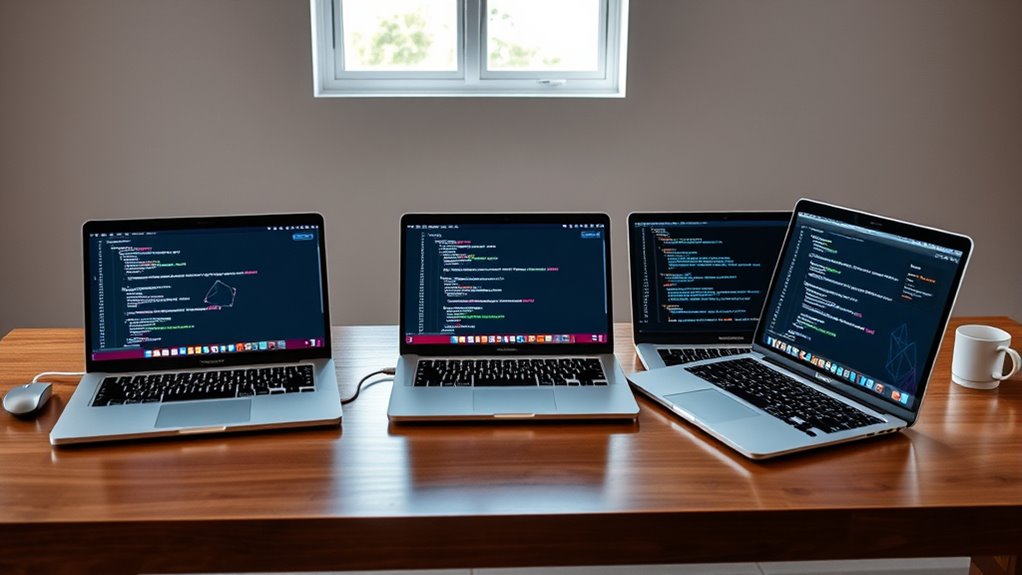

If you’re choosing the best MacBook Pro for software development in 2025, I recommend models equipped with the latest M4 Max or M4 Pro chips, offering powerful CPUs and GPUs that handle demanding workflows with ease. Look for options with 36GB to 48GB of unified memory, high-resolution Liquid Retina XDR displays, and extensive ports for peripherals. These features guarantee top performance and portability. Keep exploring, and you’ll find more details to help make your decision.
Key Takeaways
- The top models feature the powerful M4 Max and M4 Pro chips, offering exceptional processing for demanding development tasks.
- All models include high-resolution Liquid Retina XDR displays with HDR support, ideal for visual accuracy and detailed coding.
- Extensive port options like Thunderbolt 5 and HDMI enable seamless connection to peripherals and external displays.
- Variants provide up to 48GB of unified memory and large SSDs, ensuring smooth multitasking and ample storage for complex workflows.
- Designed for portability and long battery life, these MacBook Pros support on-the-go productivity for software development in 2025.
Apple MacBook Pro 14-inch Laptop with M4 Max (2024)
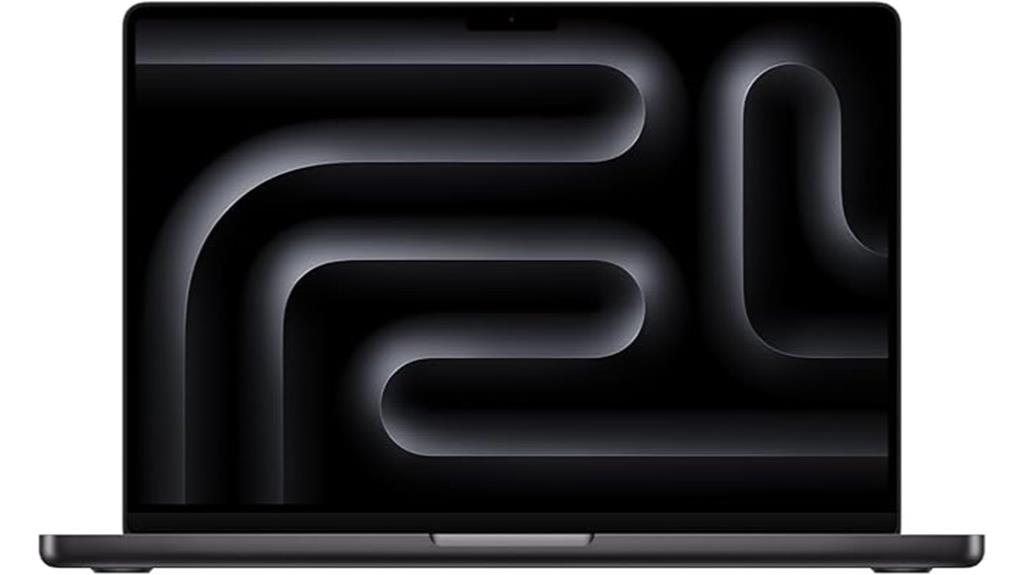
Are you looking for a powerful laptop that can handle demanding software development tasks with ease? The Apple MacBook Pro 14-inch with M4 Max (2024) is exactly that. It packs incredible power thanks to its M4 Max chip, perfect for intensive workflows like 3D rendering or compiling large codebases. The stunning 14.2-inch Liquid Retina XDR display offers vivid visuals, while the all-day battery guarantees you stay productive. With 36GB of unified memory and 1TB SSD storage, it supports professional workflows seamlessly. Plus, its sleek Space Black design and robust connectivity options make it ideal for developers who need performance and portability.
Best For: professionals and developers who require high performance for demanding workflows like 3D rendering, large code compilation, and creative projects.
Pros:
- Powerful M4 Max chip delivers exceptional performance for intensive tasks
- Stunning 14.2-inch Liquid Retina XDR display with vivid visuals
- Seamless integration within the Apple ecosystem and robust connectivity options
Cons:
- High price point may be a barrier for some users
- Limited to Apple-specific software and hardware compatibility
- The sleek design might compromise upgradeability or repairability
Apple 2024 MacBook Pro Laptop with M4 Pro

If you’re looking for a powerful laptop that can handle demanding software development tasks, the Apple 2024 MacBook Pro with M4 Pro stands out. It’s equipped with the M4 Pro chip, delivering exceptional performance for compiling large codebases and managing complex workflows. The 16.2-inch Liquid Retina XDR display offers stunning visuals with high brightness and contrast, perfect for creative work. With up to 48GB of unified memory and fast SSD storage, multitasking is seamless. Its robust connectivity options, including Thunderbolt 5 ports and HDMI, make external device integration easy. Plus, the all-day battery life ensures you stay productive whether plugged in or on the go.
Best For: professionals and developers who need a powerful, portable MacBook Pro for demanding creative, coding, and workflow-intensive tasks.
Pros:
- Exceptional performance with M4 Pro chip for compiling large codebases and managing complex workflows
- Stunning 16.2-inch Liquid Retina XDR display with high brightness and contrast for professional visuals
- Extensive connectivity options including Thunderbolt 5, HDMI, and SDXC slot for easy external device integration
Cons:
- Premium pricing may be a barrier for budget-conscious users
- Heavier and larger compared to ultraportable laptops, which could impact portability
- Limited to up to 48GB of unified memory, which may be insufficient for extremely intensive multi-application workflows
Apple 2024 MacBook Pro Laptop with M4 Max
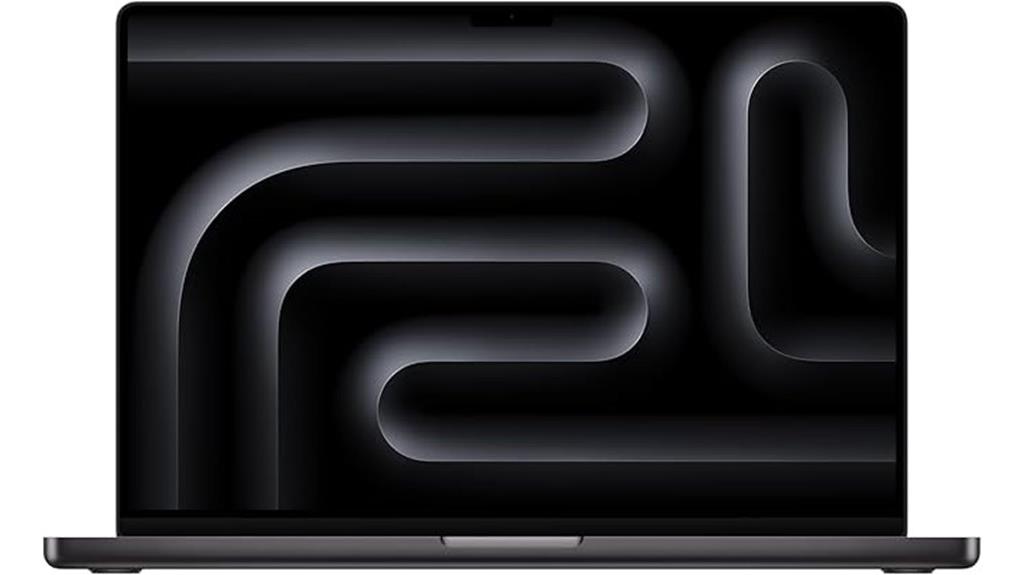
The Apple 2024 MacBook Pro with M4 Max stands out as an ideal choice for software developers who demand top-tier performance. Its M4 Max chip, with a 16-core CPU and 40-core GPU, handles demanding tasks like 3D rendering and large code compilations effortlessly. The stunning 16.2-inch Liquid Retina XDR display provides vibrant visuals, while the all-day battery life keeps you productive longer. Built for the Apple ecosystem, it offers seamless device integration and advanced privacy. With 48GB of unified memory and 1TB SSD storage, this laptop delivers power and speed in a sleek, portable design, perfect for intensive development workflows.
Best For: software developers and creative professionals requiring high-performance, portable computing with seamless Apple ecosystem integration.
Pros:
- Exceptional processing power with M4 Max chip, ideal for demanding tasks like 3D rendering and large code compilations
- Stunning 16.2-inch Liquid Retina XDR display with high peak brightness and contrast for vibrant visuals
- All-day battery life ensures productivity without frequent recharging
Cons:
- Premium price point may be prohibitive for budget-conscious users
- Limited to Apple ecosystem, reducing flexibility with non-Apple devices and software
- Heavier and larger than some ultraportable laptops, which could impact portability for some users
Apple 2024 MacBook Pro Laptop with M4 Pro
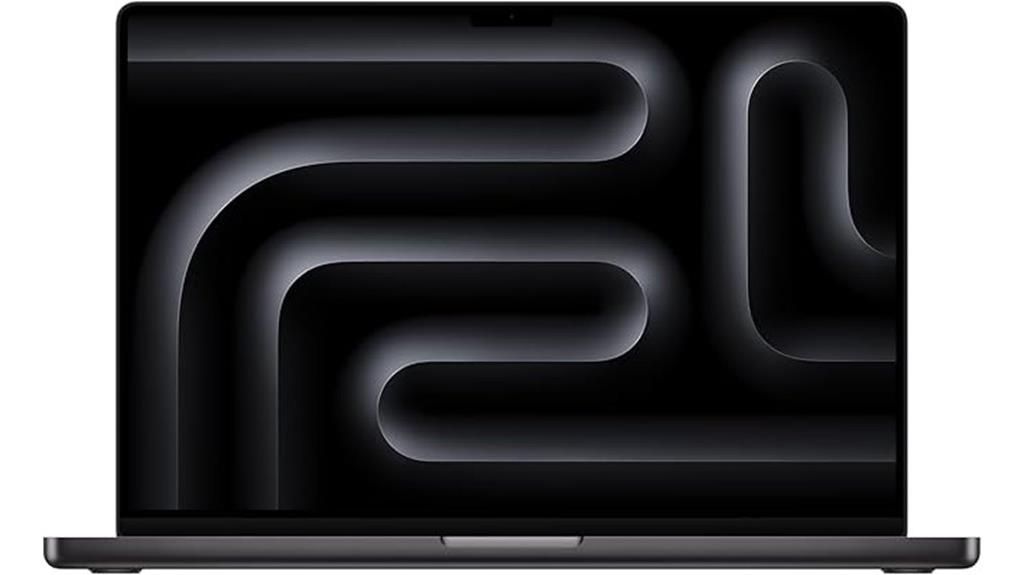
With its powerful M4 Pro chip featuring a 14-core CPU and 20-core GPU, the 2024 MacBook Pro is an excellent choice for software developers who need top-tier performance for demanding tasks like code compilation, 3D rendering, and media processing. Its hardware-accelerated ray tracing, 16-core Neural Engine, and high memory bandwidth guarantee smooth multitasking and fast processing. The 16.2-inch Liquid Retina XDR display offers stunning visuals with HDR support and ProMotion technology. With up to 24 hours of battery life, fast charging, and extensive ports including Thunderbolt 5, HDMI, and SDXC, this MacBook Pro balances power, portability, and connectivity perfectly for professional workflows.
Best For: Software developers and creative professionals needing high-performance, portable MacBook with advanced display and extensive connectivity options.
Pros:
- Powerful M4 Pro chip with high-core CPU and GPU for demanding tasks
- Stunning 16.2-inch Liquid Retina XDR display with HDR and ProMotion technology
- Extensive ports including Thunderbolt 5, HDMI, and SDXC for versatile connectivity
Cons:
- Relatively heavy at 4.71 pounds for portable use
- Premium price point may be a barrier for some users
- Limited to macOS ecosystem, which may not suit all workflows
Apple 2024 MacBook Pro Laptop with M4 Max

For software developers demanding top-tier performance, the Apple 2024 MacBook Pro with M4 Max stands out thanks to its powerful 14-core CPU and 32-core GPU. It excels at handling demanding tasks like complex workflows, 3D rendering, and large code compilations. The 14.2-inch Liquid Retina XDR display offers stunning visuals with high brightness and contrast, perfect for detailed work. With up to 36GB of unified memory and fast SSD storage, it guarantees seamless multitasking. Its all-day battery life and extensive connectivity options make it ideal for professional workflows, whether on the go or at a desk. It’s a powerhouse built for serious development work.
Best For: software developers and creative professionals needing top-tier performance, stunning visuals, and extensive connectivity for demanding workflows.
Pros:
- Exceptional processing power with M4 Max chip, 14-core CPU, and 32-core GPU for complex tasks
- Stunning 14.2-inch Liquid Retina XDR display with high brightness and contrast for detailed visuals
- Long battery life and versatile connectivity options, including multiple ports and external display support
Cons:
- Premium pricing may be a barrier for some users
- Heavier and bulkier than some ultraportable laptops
- Limited to 36GB of unified memory, which might be restrictive for extremely large workflows
Factors to Consider When Choosing a MacBook Pro for Software Development

When choosing a MacBook Pro for software development, I consider factors like processor performance, display quality, and size to match my workload. I also look at memory and storage options to guarantee smooth multitasking and ample space for projects. Finally, I check battery life and tool compatibility to keep my workflow reliable and efficient.
Processor Performance Needs
Choosing the right processor is vital for software development on a MacBook Pro, especially when handling demanding tasks like compiling large codebases or running virtual machines. I recommend models with the M4 Pro or M4 Max chips for peak performance. Higher-core configurations, such as a 14-core CPU with 32 or 40 GPU cores, provide the speed and multitasking power needed for complex workflows. It’s also wise to select a device with at least 24GB of unified memory to manage multiple development tools and large projects seamlessly. For graphics-intensive work, a model with a 40-core GPU can accelerate rendering and GPU-accelerated applications. Prioritizing the latest chips ensures hardware acceleration and high memory bandwidth, which are vital for resource-intensive software development tasks.
Display Clarity and Size
A high-performance processor is vital, but the display quality and size also considerably impact your development experience. A larger display, like 14.2 or 16.2 inches, offers more space for multitasking and detailed coding, reducing the need to switch tabs constantly. High-resolution Liquid Retina XDR screens with 3456×2234 resolution provide sharp visuals, essential for debugging and design work. Brightness levels up to 1600 nits ensure clear visibility in bright environments and accurate color reproduction. Features like True Tone and ProMotion’s 120Hz refresh rate make long coding sessions more comfortable by delivering smooth visuals and reducing eye strain. Additionally, a high contrast ratio of 1,000,000:1 enhances the clarity of complex interfaces, making fine details easier to see and work with efficiently.
Memory and Storage Options
Have you ever experienced slow performance or lag when running multiple virtual machines or large projects? Upgrading your memory and storage can make a big difference. I recommend at least 36GB of RAM for smooth multitasking and handling large codebases. Ample SSD storage, 512GB or more, guarantees quick access to files, tools, and compilers, reducing delays. The unified memory architecture boosts data transfer speeds between the CPU and GPU, improving performance during intensive tasks. Some models offer up to 128GB of configurable memory, allowing customization based on project complexity. Having sufficient storage and memory prevents bottlenecks when running resource-heavy applications or containers. Prioritizing these options ensures your MacBook Pro remains responsive and efficient, even during demanding software development workflows.
Battery Life Durability
Long work sessions demand a MacBook Pro with reliable battery life, so I always look for models that can keep up without frequent recharges. Devices with larger batteries, like those with 100Wh or more, offer extended usage, which is essential for on-the-go development. High-performance chips, such as the M4 Max or M4 Pro, help balance power and efficiency, ensuring longer battery life during intensive tasks. Fast charging capabilities are a plus, allowing me to quickly top up when needed and minimize downtime. Additionally, choosing a MacBook Pro with good battery management and longevity features helps maintain ideal health over time, ensuring consistent performance. Durable battery life means I can focus on coding without worrying about running out of power unexpectedly.
Compatibility With Tools
Choosing the right MacBook Pro for software development means guaranteeing it seamlessly supports your tools and workflow. First, verify that its macOS version supports all the development software you rely on. Check that the hardware specifications meet the minimum requirements for your applications, especially processor and memory capacity, to handle your workload efficiently. It’s also vital to confirm that external peripherals like displays, debugging devices, and other accessories are compatible with the MacBook’s ports and connectivity options. Additionally, guarantee your chosen model can run necessary software updates and support hardware features over time. Long-term compatibility depends on these factors, so taking the time to verify software and hardware support will keep your development environment smooth and productive.
Port Selection and Connectivity
Selecting the right ports and connectivity options on a MacBook Pro can considerably impact your workflow as a software developer. I look for multiple Thunderbolt 5 ports to support high-speed data transfer and connect external devices seamlessly. An SDXC card slot is essential for easy media transfer from cameras or peripherals. HDMI and headphone ports offer versatile display options and audio output, reducing setup hassle. I also verify support for multiple external displays—up to two with M4 Pro chips or four with M4 Max—so I can expand my workspace efficiently. Ultimately, MagSafe 3 charging provides quick, secure power connections, minimizing downtime. These connectivity features ensure I stay productive, with flexible options to suit various development tasks and peripherals.
Frequently Asked Questions
How Does Battery Life Compare During Intensive Coding Sessions?
During intensive coding sessions, I find the battery life on the newer MacBook Pros quite impressive. They typically last around 6 to 8 hours, depending on workload and screen brightness. I make sure to optimize settings and close unnecessary apps, which helps extend battery life. Overall, I’m pleasantly surprised by how well these Macs handle long coding sessions without needing frequent recharges, keeping me productive throughout the day.
Are There Significant Software Compatibility Issues With the M4 Chips?
Think of software compatibility issues with the M4 chips as gentle ripples on a still pond. While most mainstream applications run smoothly, some niche or older programs might need updates or alternative solutions. I’ve found that developers are quick to adapt, and Apple’s ecosystem is continuously evolving. So, while minor hurdles could appear, they’re usually easily navigated, making the shift quite seamless overall.
What Are the Best Accessories to Enhance Development Productivity?
I recommend a high-quality external monitor to boost your screen real estate, making multitasking easier. A mechanical keyboard can improve typing comfort and speed, while a precision mouse or trackpad enhances navigation. An external SSD ensures fast storage for large projects, and a good pair of noise-canceling headphones helps me focus. These accessories together greatly boost my productivity, making development smoother and more enjoyable.
How Do Display Quality and Resolution Impact Coding Accuracy?
Think of your display as your digital canvas—its quality and resolution directly impact your coding accuracy. A crisp, high-resolution screen reduces eye strain and makes reading tiny code snippets easier, much like a clear window offers better views. When your display is sharp and vibrant, you catch bugs faster and develop more efficiently, turning complex tasks into manageable work, like an artist with perfect tools.
Is Upgradeability a Concern for Future-Proofing These Macbook Pros?
Upgradeability is definitely a concern for future-proofing MacBook Pros. I’d rather have options to enhance RAM or storage later, but Apple’s recent models tend to lock these in at purchase. This means I need to choose wisely now, considering my future needs. If I want my machine to stay relevant longer, I prefer models that offer some upgradeability or at least ensure I select configurations with ample specs upfront.
Conclusion
If you’re serious about software development in 2025, choosing the right MacBook Pro can make all the difference. Did you know that developers report a 30% boost in productivity when using powerful, portable laptops like these? With options ranging from the M4 Pro to M4 Max, there’s a perfect fit for your needs. Investing in the right machine means smoother workflows and faster results—so, why wait to upgrade?