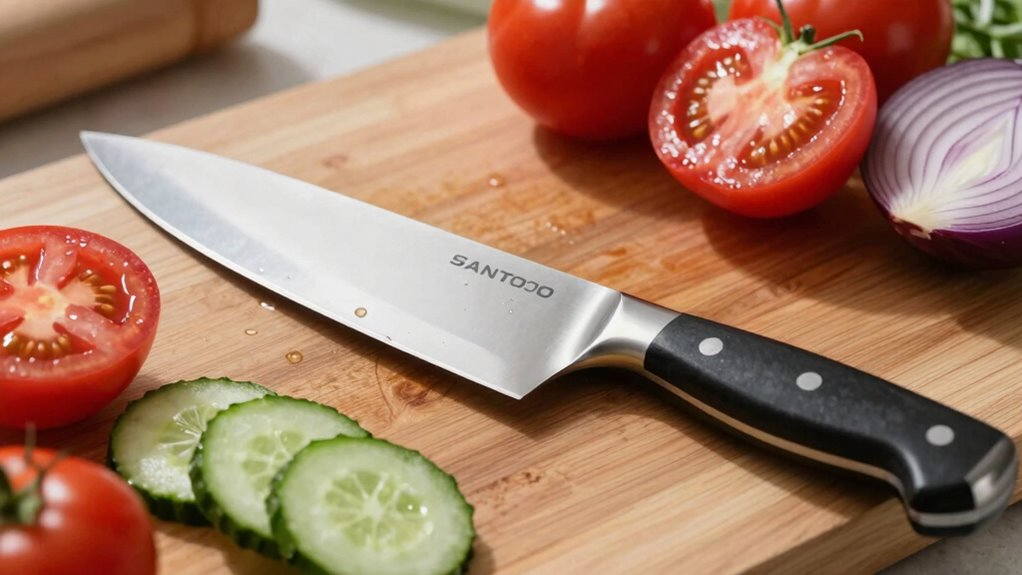
The Wüsthof Classic 7-Inch Santoku Knife stands out as the best overall choice for most home cooks, offering a perfect balance of forged German steel durability and ergonomic comfort. For those prioritizing budget without sacrificing performance, the Victorinox Swiss Classic 7-Inch Santoku delivers exceptional sharpness and reliability at a fraction of the cost, while the imarku 7-Inch Santoku appeals to cooks seeking a traditional Japanese aesthetic with high-carbon steel benefits. The primary tradeoffs in this category involve balancing the convenience of self-sharpening or low-maintenance designs against the superior edge retention of premium forged blades. Buyers must also decide between the lightweight agility of smaller 5-inch models and the broader cutting surface of standard 7-inch versions. Continue reading to see how these models compare in handling, maintenance requirements, and long-term value.

Get kitchen gear delivered free with Prime
- Fast, free delivery on millions of items
- Prime Video, Amazon Music and more included
- Member-only deals all year
Complete the kit


Key Takeaways
- Forged German steel models like Wüsthof and Henckels offer superior durability and edge retention compared to stamped blades, but require more careful maintenance to prevent chipping.
- Budget options like Victorinox and Home Hero utilize stamped steel which is lighter and easier to sharpen but may lose its edge faster under heavy daily use.
- Self-sharpening sheaths, found in models like Farberware EdgeKeeper, are convenient for beginners but can degrade the blade geometry over time compared to manual sharpening.
- Blade length is a critical differentiator; 5-inch santokus provide better control for detailed work, while 7-inch versions offer more versatility for larger ingredients.
- Handle ergonomics vary significantly, with Western-style handles on brands like Mercer favoring power grips, while Japanese-style handles on imarku suit pinch grips better.
| imarku 5-Inch Santoku Knife with Pakkawood Handle |  | Best Compact Santoku | Blade length: 5 inches | Blade material: High-carbon stainless steel | Blade thickness: 2.3 mm | VIEW ON AMAZON | See Our Full Breakdown |
| Home Hero 7-Inch Santoku Knife with Sheath |  | Best for Protected Storage | Blade length: 7 inches | Blade material: 3Cr13 high-carbon stainless steel | Blade edge: Plain | VIEW ON AMAZON | See Our Full Breakdown |
| Henckels Solution 2-Piece Santoku Knife Set |  | Best Santoku Set for Everyday Cleanup | Set includes: 5.5-inch and 7-inch santoku knives | Blade material: Stainless steel | Construction: Precision-stamped | VIEW ON AMAZON | See Our Full Breakdown |
| QEGNOBOK 7-Inch Santoku Kitchen Knife |  | Best Warranty Coverage | Blade length: 7 inches | Blade material: High-carbon stainless steel (3CR13MOV) | Blade thickness: 0.08 inch | VIEW ON AMAZON | See Our Full Breakdown |
| Victorinox Swiss Classic 7-Inch Santoku Knife with Granton Blade |  | Best Lightweight, Low-Fuss Pick | Blade length: 6.69 inches | Blade material: Stainless steel | Blade edge: Fluted | VIEW ON AMAZON | See Our Full Breakdown |
| Mercer Culinary Genesis 7-Inch Santoku Knife – Black |  | Best for a Secure Grip | Brand: Mercer Culinary | Model: M20707 | Blade length: 7 inches | VIEW ON AMAZON | See Our Full Breakdown |
| Wüsthof Gourmet 5-Inch Hollow Edge Santoku Knife |  | Best Compact Santoku | Brand: Wüsthof | Blade length: 5 inches | Blade material: High-carbon stainless steel | VIEW ON AMAZON | See Our Full Breakdown |
| imarku 7-Inch Santoku Knife |  | Best for a Gift-Ready Full-Size Knife | Blade length: 7 inches | Blade material: High-carbon stainless steel | Handle material: Pakkawood | VIEW ON AMAZON | See Our Full Breakdown |
| Farberware EdgeKeeper 5-Inch Santoku Knife with Self-Sharpening Sheath |  | Best for Built-In Edge Upkeep | Brand: Farberware | Blade length: 5 inches | Blade material: High-carbon stainless steel | VIEW ON AMAZON | See Our Full Breakdown |
| Wüsthof Classic 7-Inch Santoku Knife |  | Best Forged Build | Brand: Wüsthof | Model number: 1040131317 | Blade length: 7 inches | VIEW ON AMAZON | See Our Full Breakdown |
| Cuisinart Graphix Collection Santoku Knife, 7-inch Stainless Steel |  | Best for a Simple, Forged Stainless Pick | Brand: Cuisinart | Model: C77SS-7SAN | Blade length: 7 inches | VIEW ON AMAZON | See Our Full Breakdown |
| HENCKELS Forged Accent 2-Piece Santoku Knife Set |  | Best Two-Size Santoku Set | Brand: HENCKELS | Set includes: 5-inch santoku knife and 7-inch santoku knife | Number of pieces: 2 | VIEW ON AMAZON | See Our Full Breakdown |
| imarku 7-Inch Santoku Knife, High-Carbon Stainless Steel |  | Best for Easier Food Release | Brand: imarku | Blade length: 7 inches | Overall length: 12 inches | VIEW ON AMAZON | See Our Full Breakdown |
| HOSHANHO 7-Inch Japanese Santoku Chef Knife |  | Best for a Thin, Precise Edge | Brand: HOSHANHO | Blade length: 7 inches | Blade material: 10Cr15CoMoV high-carbon stainless steel | VIEW ON AMAZON | See Our Full Breakdown |
| santoku knife | Blade material | Handle material | Blade length | Construction |
|---|---|---|---|---|
| imarku 5-Inch Santoku Knife wi | High-carbon stainless steel | FSC-certified Pakkawood | 5 inches | Forged |
| Home Hero 7-Inch Santoku Knife | 3Cr13 high-carbon stainless steel | Plastic | 7 inches | Forged |
| Henckels Solution 2-Piece Sant | Stainless steel | Acrylonitrile butadiene styrene | — | Precision-stamped |
| QEGNOBOK 7-Inch Santoku Kitche | High-carbon stainless steel (3CR13MOV) | ABS plastic | 7 inches | Forged |
| Victorinox Swiss Classic 7-Inc | Stainless steel | Polypropylene | 6.69 inches | Stamped |
| Mercer Culinary Genesis 7-Inch | High-carbon German steel | Black Santoprene | 7 inches | — |
| Wüsthof Gourmet 5-Inch Hollow | High-carbon stainless steel | Polyoxymethylene (POM) | 5 inches | Stamped |
| imarku 7-Inch Santoku Knife | High-carbon stainless steel | Pakkawood | 7 inches | — |
| Farberware EdgeKeeper 5-Inch S | High-carbon stainless steel | — | 5 inches | — |
| Wüsthof Classic 7-Inch Santoku | High-carbon stainless steel | Polyoxymethylene (POM) | 7 inches | Forged |
| Cuisinart Graphix Collection S | High-carbon stainless steel | Stainless steel | 7 inches | Forged |
| HENCKELS Forged Accent 2-Piece | German stainless steel | Stainless steel | — | Forged |
| imarku 7-Inch Santoku Knife | High-carbon stainless steel | Stainless steel | 7 inches | Forged |
| HOSHANHO 7-Inch Japanese Santo | 10Cr15CoMoV high-carbon stainless steel | African pakkawood | 7 inches | — |
More Details on Our Top Picks
imarku 5-Inch Santoku Knife with Pakkawood Handle
The 5-inch blade gives this imarku a more nimble role than the full-size Home Hero 7-Inch Santoku: it is better suited to close control when mincing herbs, trimming small vegetables, or working on a compact board. Its 15–18° hand-polished edge and 2.3 mm high-carbon stainless steel blade are aimed at precise everyday cuts, while the anti-stick surface may help ingredients release as you work. The Pakkawood handle also gives it a more refined grip material than the plastic handle on the Home Hero. The tradeoff is reach: larger produce and wide chopping tasks can feel cramped on this shorter blade. The listing also gives no care instructions, so buyers seeking clearly specified cleanup guidance may prefer the dishwasher-safe Henckels Solution set.
Pros:- Compact blade supports controlled, detailed cuts
- Hand-polished 15–18° edge is designed for precise slicing
- Anti-stick surface may help food release
- FSC-certified Pakkawood handle offers an alternative to plastic
Cons:- Five-inch blade has limited reach for large ingredients
- No dishwasher or care instructions are provided
Best for: Cooks with smaller hands or compact prep spaces who frequently mince herbs and cut modest-sized vegetables.
Not ideal for: Anyone who regularly slices large produce or wants explicit dishwasher and maintenance guidance.
- Blade length:5 inches
- Blade material:High-carbon stainless steel
- Blade thickness:2.3 mm
- Edge angle:15–18°
- Handle material:FSC-certified Pakkawood
- Construction:Forged
- Weight:3.2 ounces
- Included:1 santoku knife
Our verdict“Choose this imarku for controlled small-scale prep; pick the Home Hero 7-Inch instead when a longer blade matters more.”
Home Hero 7-Inch Santoku Knife with Sheath
The Home Hero pairs a familiar 7-inch santoku blade with a protective sheath, making it a practical choice for cooks who store knives in a drawer or take one to another kitchen. Its nonstick coating is intended to reduce food cling, and the forged 3Cr13 high-carbon stainless steel blade covers routine work with meat, fish, vegetables, and sushi. Against the compact imarku 5-Inch, this model offers more blade length for larger ingredients, though it will feel less nimble for tight, detailed cuts. The plastic handle keeps the design straightforward, but it lacks the more distinctive Pakkawood feel of the imarku. Hand washing is recommended, so the included sheath helps with storage but does not make this a low-maintenance, dishwasher-friendly pick.
Pros:- Seven-inch blade handles a broad range of everyday ingredients
- Protective sheath is included for storage
- Nonstick coating is designed to limit food cling
- Ergonomic handle is shaped for a comfortable grip
Cons:- Hand washing is recommended rather than dishwasher cleanup
- Plastic handle offers a simpler feel than the Pakkawood imarku
- Full-size blade is less compact for close, detailed cutting
Best for: Home cooks who want a full-size santoku with a sheath for drawer storage, shared kitchens, or occasional transport.
Not ideal for: Buyers who want a dishwasher-safe knife or a more compact blade for detailed prep.
- Blade length:7 inches
- Blade material:3Cr13 high-carbon stainless steel
- Blade edge:Plain
- Handle material:Plastic
- Construction:Forged
- Item length:11 inches
- Weight:0.26 kg
- Included:Santoku knife and sheath
Our verdict“Pick the Home Hero if a sheath and full-size blade matter more than dishwasher convenience or compact handling.”
Henckels Solution 2-Piece Santoku Knife Set
Rather than asking one knife to cover every task, the Henckels Solution set supplies both 5.5-inch and 7-inch santokus. The smaller blade can handle compact prep, while the longer one offers more reach for larger ingredients—a more flexible arrangement than buying a single blade such as the Victorinox Swiss Classic 7-Inch. Its dishwasher-safe construction is a clear convenience advantage over the hand-wash-recommended Home Hero, and the lightweight stamped blades should feel manageable during routine chopping. The tradeoff is storage: no sheath or protective holder is listed, so the two knives need a safe place of their own. Buyers who want a more premium forged feel may also prefer a different build; this set prioritizes practical sizing and easier cleanup over that kind of construction.
Pros:- Includes 5.5-inch and 7-inch santoku knives
- Dishwasher-safe design simplifies cleanup
- Lightweight construction supports easy handling
- Hollow edges are designed to help reduce food sticking
Cons:- No sheath or protective storage is specified
- Precision-stamped construction may not suit buyers seeking a forged knife
Best for: Busy home cooks who want two santoku sizes for different ingredients and prefer dishwasher-safe cleanup.
Not ideal for: Minimalist kitchens with limited knife storage or buyers specifically seeking forged construction.
- Set includes:5.5-inch and 7-inch santoku knives
- Blade material:Stainless steel
- Construction:Precision-stamped
- Blade edge:Hollow
- Handle material:Acrylonitrile butadiene styrene
- Handle style:Triple-rivet
- Dishwasher safe:Yes
- Set size:2 pieces
Our verdict“Choose this set for two useful blade sizes and easy cleanup, provided you have safe storage for both knives.”
QEGNOBOK 7-Inch Santoku Kitchen Knife
The QEGNOBOK stands out among these single-knife picks for pairing a 7-inch blade with a stated lifetime warranty. Its 3CR13MOV high-carbon stainless steel blade has hollow scallops intended to reduce sticking, a useful feature for repetitive vegetable prep. The 15–18-degree-per-side edge and forged construction give it a more feature-focused specification than the simpler stamped Victorinox Swiss Classic, while its ABS handle keeps the design practical rather than upscale. Compared with the two-knife Henckels Solution set, though, QEGNOBOK offers no second blade size or dishwasher-safe claim; only one knife is included, and care details are not provided. The lifetime warranty may appeal to buyers focused on coverage, but it does not change the basic tradeoff: this is a single-purpose everyday santoku with a plastic handle.
Pros:- Seven-inch blade suits general-purpose santoku tasks
- Hollow scallops are designed to reduce food sticking
- Forged high-carbon stainless steel construction
- Lifetime warranty is specified
Cons:- Only one knife is included
- ABS handle is less distinctive than the Pakkawood imarku handle
- No dishwasher guidance is provided
Best for: Cooks seeking one full-size santoku with a stated lifetime warranty and a scalloped blade for vegetable prep.
Not ideal for: Buyers who want multiple blade sizes, a non-plastic handle, or confirmed dishwasher-safe care.
- Blade length:7 inches
- Blade material:High-carbon stainless steel (3CR13MOV)
- Blade thickness:0.08 inch
- Edge angle:15–18 degrees per side
- Handle material:ABS plastic
- Construction:Forged
- Warranty:Lifetime
- Included:1 kitchen knife
Our verdict“Choose the QEGNOBOK for a full-size scalloped santoku with stated lifetime coverage, not for a multi-knife or dishwasher-ready setup.”
Victorinox Swiss Classic 7-Inch Santoku Knife with Granton Blade
The Victorinox Swiss Classic suits cooks who want a lightweight, dishwasher-safe santoku without stepping up to a two-knife set. Its fluted stainless steel blade is designed to reduce sticking and friction as you slice, dice, and mince, while the 3.84-ounce weight makes it notably easy to maneuver compared with the heavier Home Hero 7-Inch. The polypropylene handle keeps the knife practical for regular kitchen use, though it will not offer the wood-like feel of the compact imarku’s Pakkawood grip. The main compromise is stamped construction, which may disappoint shoppers who specifically want a forged blade such as the QEGNOBOK. Its listed blade length is 6.69 inches, slightly shorter than a full 7 inches, but still gives more reach than a compact 5-inch santoku.
Pros:- Lightweight 3.84-ounce design is easy to maneuver
- Fluted blade is intended to reduce sticking and friction
- Dishwasher safe for convenient cleanup
- Swiss-made with an ergonomic polypropylene handle
Cons:- Stamped construction may not appeal to buyers seeking a forged knife
- Polypropylene handle is functional rather than a premium material
Best for: Home cooks who value low weight, dishwasher-safe cleanup, and a fluted blade for everyday slicing and dicing.
Not ideal for: Buyers seeking forged construction, a premium handle material, or a knife set with multiple blade sizes.
- Blade length:6.69 inches
- Blade material:Stainless steel
- Blade edge:Fluted
- Handle material:Polypropylene
- Construction:Stamped
- Weight:3.84 ounces
- Dishwasher safe:Yes
- Country of manufacture:Switzerland
Our verdict“Pick the Victorinox for a light, dishwasher-safe everyday santoku; choose the QEGNOBOK if forged construction matters more.”
Mercer Culinary Genesis 7-Inch Santoku Knife – Black
The Mercer Culinary Genesis is a strong fit for cooks who want a full-size santoku with a handle designed to stay secure when wet. Its Santoprene grip distinguishes it from the Pakkawood-handled imarku 7-Inch Santoku, while the 7-inch blade gives it more reach than the compact 5-inch Wüsthof Gourmet. A Granton edge helps food release during slicing, and the high-carbon German steel blade is precision-forged for a durable working edge. The tradeoff is weight: this model is heavier than lighter options such as the 4-ounce Wüsthof Gourmet, which may matter during extended prep or for cooks who prefer nimble knives. It also requires hand washing, so it is not a low-maintenance choice for dishwasher-dependent kitchens.
Pros:- Non-slip Santoprene handle is designed to stay secure when wet.
- Precision-forged high-carbon German steel blade.
- Granton edge helps reduce food sticking while slicing.
- Seven-inch blade handles chopping, mincing, and dicing across a range of ingredients.
Cons:- Heavier than some comparable kitchen knives, including the 4-ounce Wüsthof Gourmet.
- Hand washing is required; it is not dishwasher safe.
Best for: Home cooks who regularly prep wet ingredients and want a full-size santoku with a secure, non-slip handle.
Not ideal for: Cooks who prioritize a lightweight knife or need dishwasher-safe cleanup.
- Brand:Mercer Culinary
- Model:M20707
- Blade length:7 inches
- Blade material:High-carbon German steel
- Handle material:Black Santoprene
- Edge feature:Granton edge
- Care:Hand wash only
- Warranty:Lifetime limited manufacturer’s warranty
- Country of manufacture:Taiwan
Our verdict“Choose the Mercer Genesis if a secure wet grip and full-size blade matter more to you than low weight or dishwasher convenience.”
Wüsthof Gourmet 5-Inch Hollow Edge Santoku Knife
The Wüsthof Gourmet 5-Inch suits cooks who want santoku-style control in a smaller, lighter package. At 4 ounces, it is easier to maneuver for close work than the full-size Mercer Culinary Genesis or the 7-inch Wüsthof Classic, though its short blade gives up cutting capacity on large vegetables and broad slicing jobs. The hollow indentations are intended to help food release from the blade, a useful feature when preparing moist or thinly sliced ingredients. Its stamped construction also sets it apart from the forged Wüsthof Classic: buyers get a lighter format, but not the same forged build. Hand washing is recommended, so the compact size does not make cleanup more convenient. This is the most appealing Wüsthof here for cooks who value control over reach.
Pros:- Compact 5-inch blade offers close control for smaller prep tasks.
- Lightweight at 4 ounces.
- Hollow edge is designed to help food release.
- Limited lifetime warranty.
Cons:- Short blade is less suited to large vegetables and broad slicing strokes.
- Stamped construction differs from the forged build of the Wüsthof Classic.
- Hand washing is recommended.
Best for: Cooks with smaller hands, limited prep space, or a preference for a lightweight knife for everyday small-to-medium ingredients.
Not ideal for: Anyone who often slices large produce or wants the longer reach and forged construction of the Wüsthof Classic 7-Inch.
- Brand:Wüsthof
- Blade length:5 inches
- Blade material:High-carbon stainless steel
- Blade edge:Hollow
- Construction:Stamped
- Handle material:Polyoxymethylene (POM)
- Weight:4 ounces
- Care:Hand wash only
- Warranty:Limited lifetime warranty
Our verdict“Pick the Wüsthof Gourmet if maneuverability matters more than the reach and forged construction of a full-size santoku.”
imarku 7-Inch Santoku Knife
The imarku 7-Inch Santoku combines a full-length blade with a hand-polished 15–18-degree edge and a Pakkawood handle, making it a practical pick for cooks who also want a presentation-ready gift box. Its hollow design aims to reduce food sticking, much like the hollow edges on the Wüsthof Gourmet and Wüsthof Classic, while the 7-inch blade offers more reach than either 5-inch option. The listed 6.88-ounce weight makes it a more substantial choice than the compact Gourmet, though buyers who prefer a lighter knife may find it less nimble. The product data describes one knife, not a set, and notes that packaging may vary with brand upgrades. Choose it for an all-purpose full-size santoku and gift presentation, not for extras or a guaranteed packaging style.
Pros:- Seven-inch blade provides useful reach for general chopping and slicing.
- Hand-polished edge is specified at 15–18 degrees per side.
- Hollow design is intended to reduce food sticking.
- Pakkawood handle and included gift box suit presentation as a gift.
Cons:- Only one knife is included.
- At 6.88 ounces, it is heavier than the 4-ounce Wüsthof Gourmet.
- Packaging may vary with brand upgrades.
Best for: Gift buyers and home cooks seeking a full-size santoku with a Pakkawood handle and a stated fine edge angle.
Not ideal for: Shoppers who want a knife set, a particularly lightweight feel, or consistent gift-box packaging.
- Blade length:7 inches
- Blade material:High-carbon stainless steel
- Handle material:Pakkawood
- Blade thickness:2.5 mm
- Edge angle:15–18 degrees per side
- Weight:6.88 ounces
- Item length:12 inches
- Included components:One santoku knife
Our verdict“Choose the imarku if you want a gift-ready, full-size santoku with a Pakkawood handle and do not need a set or lightweight build.”
Farberware EdgeKeeper 5-Inch Santoku Knife with Self-Sharpening Sheath
The Farberware EdgeKeeper stands apart from the other knives here with a sheath that sharpens the blade as it is inserted or removed. That built-in sharpening feature may appeal to cooks who do not want a separate sharpener, while the protective sheath also gives the 5-inch knife a defined storage solution. Its blade has oval indentations intended to reduce food sticking, similar in purpose to the hollow edges on the Wüsthof Gourmet and imarku 7-Inch. The shorter blade favors compact prep over the reach of the Mercer Genesis or the Wüsthof Classic. There is a maintenance tradeoff: the knife must be hand washed, rinsed, and dried immediately, and the sheath does not replace careful cleaning. Choose this model for convenient storage and routine edge upkeep, not for large-batch slicing.
Pros:- EdgeKeeper sheath sharpens the blade during insertion and removal.
- Protective sheath supports safer storage.
- Oval blade indentations are designed to reduce food sticking.
- Contoured handle is designed for a comfortable grip.
Cons:- Five-inch blade has less reach than the Mercer Genesis and Wüsthof Classic.
- Requires hand washing, rinsing, and immediate drying.
- The built-in sharpener is tied to the included sheath rather than being a separate sharpening tool.
Best for: Home cooks who want a compact santoku with protective storage and an integrated sharpening feature.
Not ideal for: Cooks who regularly prepare large ingredients, prefer a 7-inch blade, or want to avoid immediate hand drying.
- Brand:Farberware
- Blade length:5 inches
- Blade material:High-carbon stainless steel
- Blade feature:Oval indentations
- Included components:Santoku knife with EdgeKeeper sheath
- Sharpening:Built-in sharpener in sheath
- Care:Hand wash, rinse, and dry immediately
- Manufacturer:Lifetime Brands Inc.
Our verdict“Choose the Farberware EdgeKeeper if compact storage and built-in edge upkeep matter more than a longer blade or fuss-free cleanup.”
Wüsthof Classic 7-Inch Santoku Knife
The Wüsthof Classic 7-Inch is the lineup’s forged full-size option for buyers who prioritize a stable, substantial build. Its full tang, full bolster, and triple-riveted handle distinguish it from the stamped 5-inch Wüsthof Gourmet, while the 7-inch high-carbon stainless steel blade offers more reach for slicing and chopping than that compact alternative. At 6.24 ounces, it is lighter than the Mercer Culinary Genesis listing of a heavier-than-some design, though the available data does not give Mercer’s exact weight. The hollow edge is intended to help with food release, adding a practical feature to its forged construction. Its tradeoffs are the hand-wash-only care and a fuller, heavier feel than a small prep knife. This is a considered pick for cooks who value construction and versatility over minimal weight.
Pros:- Forged construction with full tang and full bolster.
- Triple-riveted POM handle supports a stable build.
- Seven-inch blade is suited to varied slicing, chopping, and dicing tasks.
- Hollow edge is designed to help food release.
Cons:- Hand washing is required.
- At 6.24 ounces, it is less compact and light than the 4-ounce Wüsthof Gourmet.
- The full bolster creates a more substantial feel than a small, nimble prep knife.
Best for: Home cooks who want a forged, full-size santoku with a reinforced handle build for regular slicing, chopping, and dicing.
Not ideal for: Buyers who want a compact, lightweight knife or dishwasher-safe maintenance.
- Brand:Wüsthof
- Model number:1040131317
- Blade length:7 inches
- Blade material:High-carbon stainless steel
- Construction:Forged
- Blade edge:Hollow
- Handle material:Polyoxymethylene (POM)
- Weight:6.24 ounces
- Care:Hand wash only
Our verdict“Choose the Wüsthof Classic if you want a forged 7-inch santoku with a reinforced build and accept hand washing and a substantial feel.”
Cuisinart Graphix Collection Santoku Knife, 7-inch Stainless Steel
The Cuisinart Graphix is a straightforward choice for cooks who want one full-size santoku rather than a multi-knife set. Its forged high-carbon stainless steel blade tapers to a sharp plain edge for controlled chopping and slicing, while the textured handle is intended to give a more secure hold than a smooth steel grip. Compared with the imarku 7-Inch Santoku, which adds a hollow edge for food release, the Cuisinart keeps its design simpler and does not claim that feature. The tradeoff is that it arrives as a single knife, with no smaller companion or protective storage piece listed. Its all-steel handle may also be less appealing to cooks who prefer the warmer feel of wood or a grippier nonmetal surface. I’d shortlist it for a modern kitchen that values a clean, conventional build and a lifetime warranty.
Pros:- Forged high-carbon stainless steel blade with a plain, tapered edge
- Textured stainless handle is designed for a comfortable grip
- 7-inch blade suits everyday chopping and slicing
- Lifetime warranty is included
Cons:- Sold as one knife, with no smaller santoku or other pieces
- The stainless handle may not suit cooks who prefer wood or a softer-grip material
Best for: Home cooks who want a single forged 7-inch santoku with a stainless handle and a lifetime warranty.
Not ideal for: Buyers seeking two santoku sizes, a hollow-edge design for food release, or a nonmetal handle.
- Brand:Cuisinart
- Model:C77SS-7SAN
- Blade length:7 inches
- Blade material:High-carbon stainless steel
- Construction:Forged
- Handle material:Stainless steel
- Edge type:Plain
- Weight:9.92 ounces
- Warranty:Lifetime
Our verdict“Choose the Cuisinart Graphix if you want one forged, full-size santoku with a stainless handle and warranty coverage rather than a set or a specialized hollow-edge blade.”
HENCKELS Forged Accent 2-Piece Santoku Knife Set
The HENCKELS Forged Accent set earns its place by pairing a 5-inch and a 7-inch santoku, giving cooks a compact option for smaller prep and a full-size blade for larger ingredients. That makes it more flexible than the Cuisinart Graphix, which is sold as a single 7-inch knife, though buyers who already own a dependable small knife may not need the duplicate role. Both blades use German stainless steel and forged construction, with triple-rivet handles for a traditional, balanced format. The set is also listed as dishwasher-safe, a convenience not specified for the Cuisinart. There are practical limits: the product details do not describe a storage cover, and dishwasher suitability does not remove the need to dry and store knives with care. I’d favor this set for households that will use both sizes regularly, not for minimalists seeking one carefully chosen santoku.
Pros:- Includes two useful santoku blade lengths, 5 and 7 inches
- Forged German stainless steel construction
- Triple-rivet handles are designed for balance and comfort
- Listed as dishwasher-safe
Cons:- Two knives may be redundant for cooks who already own a compact prep knife
- No protective storage cover is described in the product details
- The set takes more storage space than a single-knife option such as the Cuisinart Graphix
Best for: Households that want both a compact 5-inch santoku for detail work and a 7-inch knife for routine prep.
Not ideal for: Cooks who only need one santoku or want a listed protective cover for drawer or countertop storage.
- Brand:HENCKELS
- Set includes:5-inch santoku knife and 7-inch santoku knife
- Number of pieces:2
- Blade material:German stainless steel
- Construction:Forged
- Blade edge:Plain
- Handle material:Stainless steel
- Color:Black
Our verdict“Pick the HENCKELS set if you will use both blade sizes; choose a single-knife option instead if you want less storage demand and fewer overlapping tools.”
imarku 7-Inch Santoku Knife, High-Carbon Stainless Steel
The standout distinction here is the double-bevel hollow edge, designed to help sliced food release from the blade during prep. That gives the imarku a more specific advantage over the Cuisinart Graphix, whose listed plain edge does not include hollow-ground grooves. Its 7-inch forged high-carbon stainless blade covers familiar santoku tasks, while the seamless steel handle avoids rivet gaps where residue can collect. The all-steel construction is listed as dishwasher-safe and resistant to rust and stains with normal care, but that convenience comes with a grip tradeoff: the handle may feel slippery when wet or oily. Dishwasher-safe also does not mean maintenance-free, so cooks should still care for the edge and dry the knife appropriately. I’d choose it for food release and easy-clean construction, but not for anyone prioritizing a textured or wood handle.
Pros:- Double-bevel hollow edge is designed to reduce food sticking
- Forged 7-inch high-carbon stainless steel blade
- Seamless stainless handle has no rivets or gaps
- Listed as dishwasher-safe and resistant to rust and stains with normal care
Cons:- All-steel handle may feel slippery when wet or oily
- Dishwasher-safe construction still calls for ordinary blade care
- Unlike the HOSHANHO, it has no listed pakkawood handle or 15-degree edge
Best for: Cooks who often slice moist or starchy ingredients and want a hollow-edge santoku with a seamless steel handle.
Not ideal for: Anyone who needs a reliably grippy handle when hands are wet or oily, or who prefers a wood-handled knife.
- Brand:imarku
- Blade length:7 inches
- Overall length:12 inches
- Blade material:High-carbon stainless steel
- Blade edge:Hollow edge, double bevel
- Blade thickness:0.1 inches
- Construction:Forged
- Handle material:Stainless steel
- Included component:1 santoku knife
Our verdict“Choose this imarku if hollow-edge food release and seamless steel construction matter more to you than a textured or wood handle.”
HOSHANHO 7-Inch Japanese Santoku Chef Knife
The HOSHANHO is the precision-leaning choice in this group: its listed 15-degree edge and 62 HRC hardness point toward a sharper, firmer cutting feel than the more conventional Cuisinart Graphix. A double-sided groove design is intended to reduce resistance and food sticking, while the triple-layer forged blade pairs 10Cr15CoMoV high-carbon stainless steel with an African pakkawood handle. That handle sets it apart from the all-steel imarku, offering a different feel for cooks who do not want metal under the palm. The tradeoff is that the supplied details do not give care or maintenance instructions, and the specified hardness makes attentive edge care a sensible part of ownership. At 350 g, it is also a substantial knife rather than a lightweight pick. I’d choose it for controlled, precise prep over easy-care convenience.
Pros:- 15-degree edge is suited to precise slicing and chopping
- Triple-layer forged 10Cr15CoMoV high-carbon stainless steel blade
- Double-sided grooves are designed to reduce cutting resistance and sticking
- African pakkawood handle offers an alternative to the imarku’s all-steel grip
Cons:- Supplied product details do not specify care or maintenance instructions
- Listed weight of 350 g may feel substantial compared with lighter santoku options
- Hardness of 62 HRC makes attentive edge care a sensible ownership consideration
Best for: Cooks who prioritize a thin, precise cutting edge and prefer a pakkawood handle over an all-steel grip.
Not ideal for: Buyers who want clear care instructions, a lightweight knife, or a lower-maintenance choice for casual kitchen use.
- Brand:HOSHANHO
- Blade length:7 inches
- Blade material:10Cr15CoMoV high-carbon stainless steel
- Blade construction:Triple-layer laminated steel, forged
- Blade hardness:62 HRC
- Blade angle:15 degrees
- Handle material:African pakkawood
- Weight:350 g
- Included component:7-inch santoku knife
Our verdict“Choose the HOSHANHO if a precise 15-degree edge and pakkawood handle matter more than lighter weight or clearly specified care guidance.”

How We Picked
I evaluated these santoku knives based on three core criteria: blade performance, ergonomic design, and maintenance requirements. Blade performance focused on the steel type (high-carbon vs. stainless), hardness rating, and the effectiveness of the hollow edge or Granton scallops in reducing suction during slicing. I prioritized models that maintain a consistent edge through repeated use, rather than those that start sharp but degrade quickly. Ergonomic design was assessed by analyzing handle materials, weight distribution, and grip comfort, ensuring that each pick minimizes hand fatigue during extended prep sessions. Maintenance requirements were weighed heavily, distinguishing between knives that are dishwasher-safe (often at the cost of longevity) and those requiring hand-washing for optimal performance.
The ranking logic favors versatility and long-term value. Premium picks are ranked higher if they offer a balance of heft and agility that suits a wide range of cooking tasks. Budget options are included if they provide a significant percentage of premium performance at a lower cost, making them accessible for beginners. I excluded models with poor handle durability or those that lack a protective sheath, as safety and storage are integral to a knife’s practical utility in a busy kitchen.
| santoku knife | Construction | Blade edge |
|---|---|---|
| imarku 5-Inch Santoku Knife wi | Forged | — |
| Home Hero 7-Inch Santoku Knife | Forged | Plain |
| Henckels Solution 2-Piece Sant | Precision-stamped | Hollow |
| QEGNOBOK 7-Inch Santoku Kitche | Forged | — |
| Victorinox Swiss Classic 7-Inc | Stamped | Fluted |
| Mercer Culinary Genesis 7-Inch | — | — |
| Wüsthof Gourmet 5-Inch Hollow | Stamped | Hollow |
| imarku 7-Inch Santoku Knife | — | — |
| Farberware EdgeKeeper 5-Inch S | — | — |
| Wüsthof Classic 7-Inch Santoku | Forged | Hollow |
| Cuisinart Graphix Collection S | Forged | — |
| HENCKELS Forged Accent 2-Piece | Forged | Plain |
| imarku 7-Inch Santoku Knife | Forged | Hollow edge, double bevel |
| HOSHANHO 7-Inch Japanese Santo | — | — |
Factors to Consider When Choosing Santoku Knife
Selecting the right santoku knife requires looking beyond brand names to understand how construction and design impact your daily cooking routine. These factors will help you narrow down the 14 options to the one that fits your specific kitchen habits.Blade Steel and Hardness
The steel composition determines how long the knife stays sharp and how easily it can be repaired. High-carbon stainless steel is the industry standard for high-end santokus, offering a hard edge that resists corrosion. However, harder steel is more brittle and prone to chipping if used on bones or frozen foods. Softer stainless steels, often found in budget models, are more forgiving and easier to sharpen at home but dull faster. If you cook daily and have a honing steel, the harder steel is worth the investment for its precision. If you prefer low maintenance and occasional use, a softer steel might save you the hassle of frequent professional sharpening.
Forged vs. Stamped Construction
Forged knives are made from a single bar of steel heated and pounded into shape, resulting in a heavier, denser blade with better balance. This method creates a distinct bolster that transitions smoothly from the blade to the handle, offering superior stability for rocking cuts. Stamped knives are cut from sheet metal, making them lighter and less expensive but often less balanced. Forged models are better suited for heavy-duty tasks like chopping dense squash, while stamped knives excel at delicate slicing of herbs or fish. The choice depends on whether you prioritize weight and stability or lightweight agility and cost savings.
The Role of the Hollow Edge
Many santoku knives feature a hollow edge or Granton scallops along the blade side. These indentations create air pockets that reduce friction and prevent sticky foods like potatoes, cheese, or sushi from adhering to the blade. While this feature improves slicing efficiency and visibility, it can complicate sharpening. The hollows create uneven surfaces that require specific sharpening techniques or professional services to maintain a flat edge. If you frequently slice wet or starchy ingredients, this feature is a major advantage. However, if you prefer simple home maintenance, a flat-edge santoku might be a more practical choice despite the potential for food sticking.
Handle Ergonomics and Grip
Handle design dictates how comfortable the knife feels during long prep sessions. Western-style handles are typically full-tang, meaning the metal extends through the handle, providing balance and durability. They are often made of synthetic materials that resist moisture and are easy to grip. Japanese-style handles are often lighter and octagonal, encouraging a pinch grip for greater control. Home cooks transitioning from chef’s knives may find Western handles more familiar, while those seeking precision for fine chopping may prefer the tactile feedback of Japanese-style handles. Consider your existing grip style; if you currently use a pinch grip on other knives, a Japanese-style santoku will likely feel more natural.
Maintenance and Sharpening Needs
Understanding the maintenance burden is vital for long-term satisfaction. Self-sharpening sheaths offer convenience but can grind down the blade unevenly over time, potentially shortening the knife’s lifespan. Traditional manual sharpening with whetstones or pull-through sharpeners preserves the blade geometry but requires skill and time. Some budget knives are marketed as dishwasher-safe, but the high heat and detergents can damage handles and dull blades rapidly. If you value convenience above all, a self-sharpening model is a reasonable compromise. If you value the life and performance of the tool, choose a model that requires hand-washing and regular honing.
Frequently Asked Questions
What is the main difference between a santoku and a chef’s knife?
The primary difference lies in the blade shape and cutting motion. A chef’s knife has a curved edge designed for a rocking motion, while a santoku has a flatter profile optimized for up-and-down chopping and push-cutting. Santokus are also typically lighter and shorter, offering more control for precise tasks. If you prefer a rocking chop, stick with a chef’s knife. If you want to improve your precision and speed in slicing vegetables, the santoku’s flat edge provides a distinct advantage.Can I use a santoku knife to cut meat and bones?
Most santoku knives are designed for boneless meats, poultry, and fish. The thin, hard steel used in many santokus is not suitable for cutting through bones, as it can chip or break under the pressure. For cutting through chicken bones or rib roasts, use a heavier cleaver or a boning knife. Some robust forged santokus can handle dense vegetables and tough skins, but they are not all-purpose tools for heavy-duty butchery. Always treat your santoku as a precision slicing tool rather than a heavy-duty cleaver.Is a 5-inch or 7-inch santoku better for home cooking?
The 7-inch santoku is the versatile standard for most home cooks, offering enough length for large vegetables and efficient slicing. A 5-inch santoku is better suited for smaller hands, tight kitchen spaces, or detailed work like mincing herbs and peeling. If you already own a large chef’s knife, a 5-inch santoku can serve as a complementary utility knife for finer tasks. For a primary kitchen knife, the 7-inch version provides the best balance of reach and control for general prep work.Do self-sharpening santoku knives really work?
Self-sharpening sheaths use ceramic or carbide strips to realign the edge when the knife is inserted. While they can help maintain a usable edge between professional sharpenings, they do not remove metal to create a new edge like a whetstone. Over time, this process can wear down the blade unevenly and alter the original geometry. These knives are a good convenience option for beginners who struggle with manual sharpening, but they may limit the long-term lifespan of a high-quality blade compared to traditional maintenance methods.Why do some santoku knives have a hollow edge and others don’t?
Hollow edges, or Granton scallops, are added to reduce suction and prevent food from sticking to the blade. This is particularly useful when slicing starchy or wet ingredients like potatoes, cucumbers, and cheese. Knives without hollow edges have a smooth, continuous edge that is easier to sharpen and maintain at home. If you frequently slice sticky foods, the hollow edge is a practical feature. If you prefer easier home sharpening and don’t mind wiping the blade occasionally, a flat-edge santoku is a simpler choice.Conclusion
Choosing the right santoku knife depends on your cooking style and maintenance preferences. For the best overall balance of performance and durability, the Wüsthof Classic 7-Inch Santoku Knife remains the top contender for serious home cooks. If you are on a budget but want reliable sharpness, the Victorinox Swiss Classic 7-Inch Santoku is the best value option that doesn’t compromise on basic function. Beginners who prioritize convenience might prefer the Farberware EdgeKeeper for its self-sharpening feature, while those seeking a premium Japanese aesthetic and high-carbon performance should look at the imarku 7-Inch Santoku. Ultimately, the best knife is one that feels comfortable in your hand and encourages you to cook more often.